Field Note: Rapid Goal Setting For Cross Functional Teams
Context:
I wrote the original version of this right after coming back from Hurricane Florence, working inside a very mixed group of agencies, contractors, and mission partners.
On the org chart, everyone lived in neat vertical silos.
In the room, we were a temporary coalition that had to act like a single team under time pressure.
That tension between functional hierarchy and cross functional reality is what this field note is about.
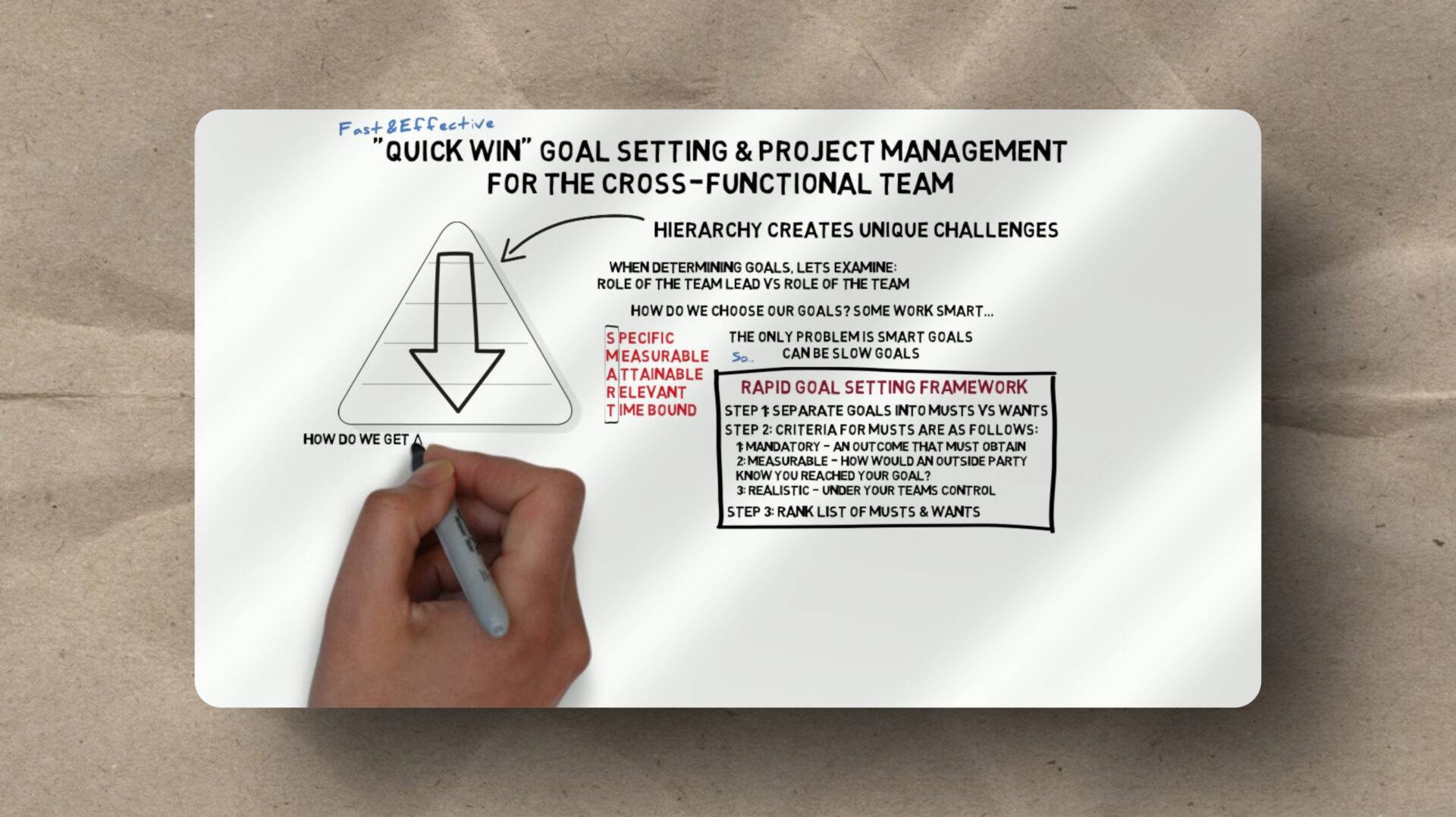
Here is the Video explainer from way back when. The video is old, but the advice is timeless.
archival link of video above. https://www.youtube.com/watch?v=g2lxHb4UqTQ
This is a practical pattern for days when you:
- Have people from different silos in the same room
- Have a short suspense window
- Need real progress, not a beautifully worded plan
The tools:
- A rapid goal setting framework based on musts and wants
- A simple social protocol for federated work: the three Cs
- Clear separation between the role of the team lead and the team members
It will feel familiar if you have read the Doctrine pieces on:
- Conflict over objectives vs alternatives
- Must / Want / Risk decision funnels
- Federation vs Integration
- Diagnostic vs Prescriptive posture
Cross Functional Teams As Tiny Federations
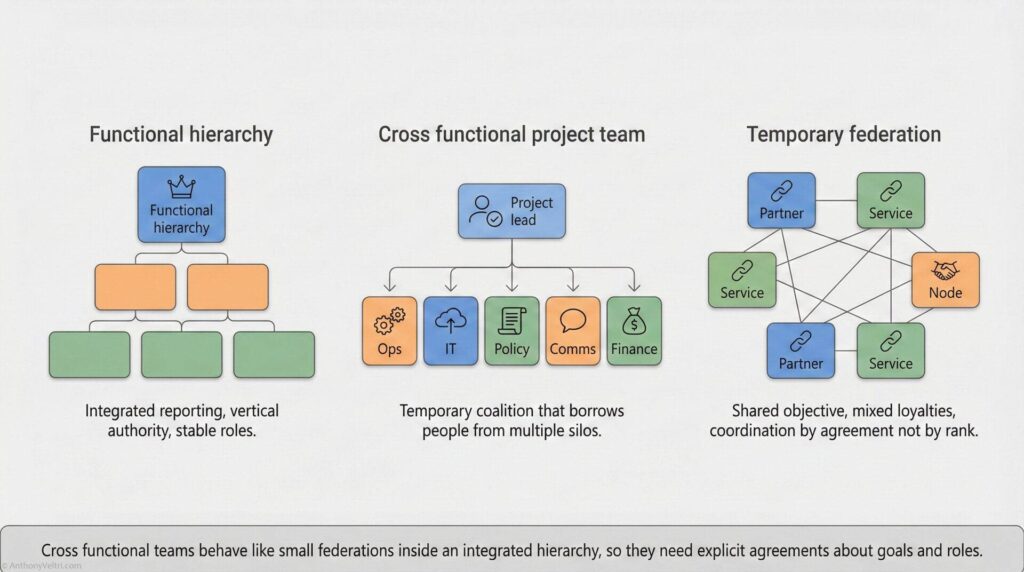
On paper, the organization is usually integrated:
- Vertical chains of command
- Clear reporting lines
- Local goals that map to a budget or a function
Then a real event hits.
Someone forms a cross functional project team:
- Ops, IT, Policy, Communications, Finance, maybe an external partner
- Each person still reports back to their home unit
- The team has to act as one, without rewriting the org chart
In doctrine terms, that team is a temporary federation:
- Multiple sovereigns, one mission
- Shared objective for this work, independent home loyalties
- Success depends less on the boxes and more on the agreements between the boxes
That is where rapid goal setting and the three Cs live.
You are not trying to fix the entire organization.
You are trying to give this small federation enough structure to move.
Rapid Goal Setting Under Stress
SMART goals are fine if you have months and a patient sponsor.
In a cross functional emergency, they are usually too slow and too abstract.
What you need is a way to quickly get to:
- A short list of things that truly must happen
- A second list of wants that are nice to have if capacity allows
- A shared understanding that both lists are real constraints, not wishful thinking
The pattern:
- Separate musts from wants
- Define musts tightly
- Rank the combined list together
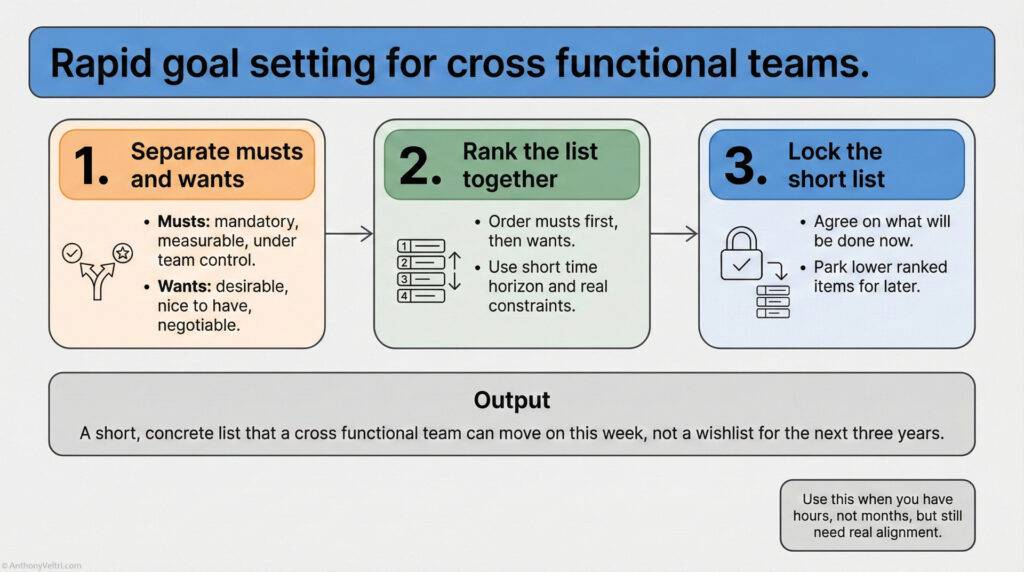
1. Separate musts from wants
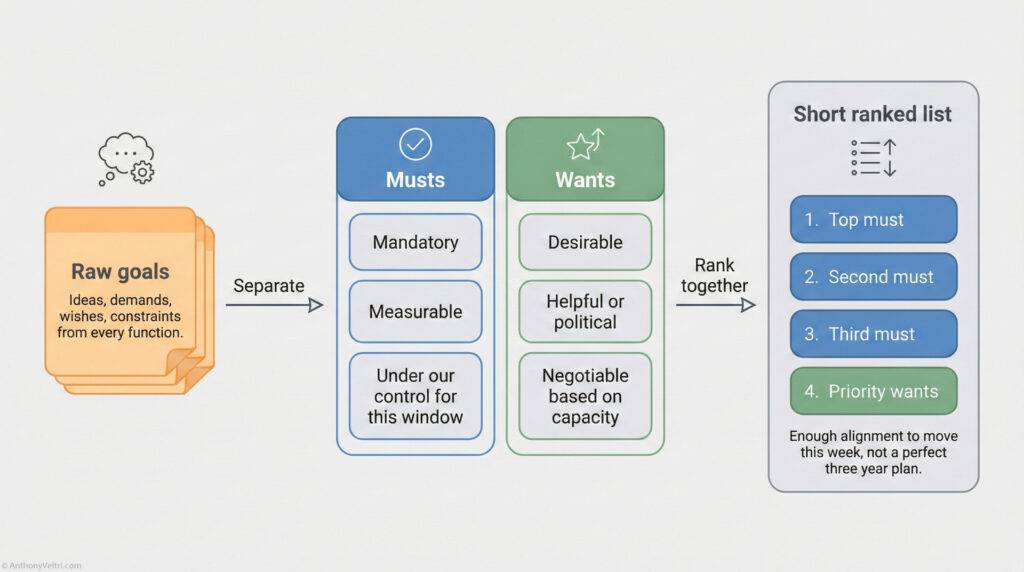
Start with a sticky note storm or a quick round robin.
Ask everyone to propose goals from their perspective, then classify:
- Musts
- Mandatory for mission success
- Measurable by an outside observer
- Under the control of this team in the current time frame
- Wants
- Desirable, helpful, or politically important
- May not be fully measurable or fully under team control
- Negotiable based on time and capacity
This is not just semantics.
A must is something you are willing to defend when pressure mounts.
If you will abandon it as soon as someone important frowns, it is a want dressed up in armor.
2. Tighten the criteria for musts
Insist that musts meet all three conditions:
- Mandatory
If this does not happen, the effort has failed in a meaningful way. - Measurable
An outside party could tell whether it happened. - Under team control for this window
In a 2 to 8 week horizon, this group can actually move the needle.
Everything else moves to the wants column, without shame.
This is where the cross functional nature matters.
Someone from Finance may say “we must comply with X” and someone from Ops may say “we must not delay Y.”
Your job is to test each proposed must against reality, not against volume or rank.
3. Rank the list together
Once you have two columns, do a fast ranking exercise:
- Rank musts first, from most critical to least
- Then rank wants, from highest value to lowest
You can do this with dot voting, pairwise comparison, or a simple facilitated discussion.
The output is not a perfect prioritization.
The output is permission to move.
At the end you should have:
- The top few musts that become your non negotiable spine
- A short list of wants that become the stretch layer if time and capacity allow
This gives the team something concrete to carry into planning or execution, instead of a vague cloud of intentions.
The Three Cs: A Lightweight Treaty For Federated Teams
When you are running a cross functional effort, positional authority alone is not enough.
You can be the most senior person in the room and still fail if:
- Nobody is clear on the mission
- Roles are fuzzy
- No one feels allowed to call out drift
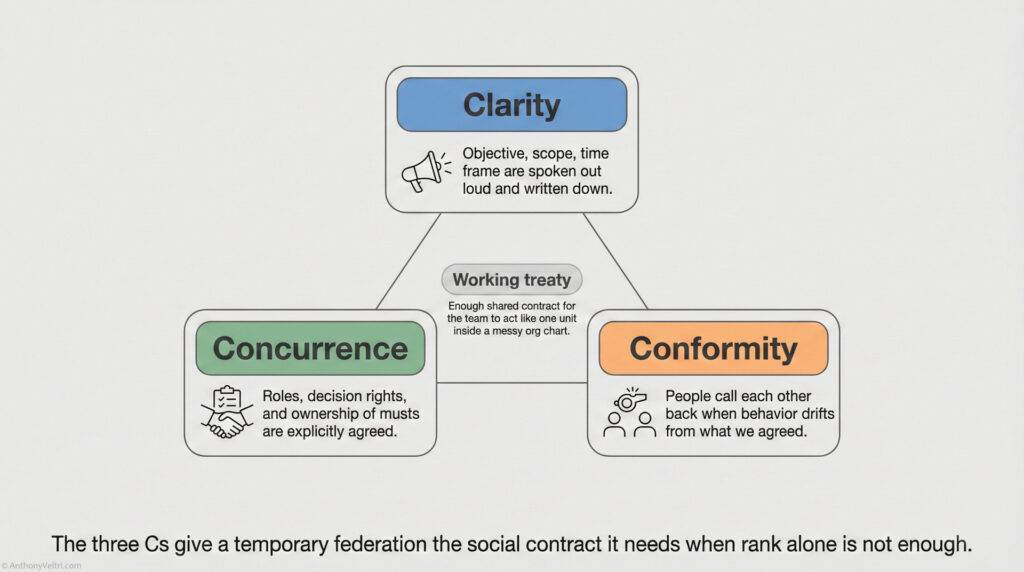
The three Cs are a simple social protocol:
- Clarity
- Concurrence
- Conformity
Clarity
Clarity is the answer to:
- What are we actually trying to accomplish here
- What is in scope and out of scope
- What time frame and constraints we are operating under
In federated language, clarity defines the shared objective for this coalition, even if each node has additional local objectives.
You do not need a forty page charter.
You do need a one page description that real people can repeat without squinting.
Concurrence
Concurrence is explicit agreement on:
- Roles and responsibilities
- Decision rights
- Who owns which part of the musts and wants
This is where you deconflict:
- “I thought they were doing that.”
- “We assumed that was policy’s job.”
- “We did not know we had authority to act.”
In federated language, concurrence is the agreement at the boundary between nodes:
- Who delivers what
- Who can decide what
- How conflicts of objectives will be resolved
Conformity
Conformity is the uncomfortable one.
It means:
- We call each other back when we drift away from what we agreed
- The agreements are real enough that behavior is expected to line up with them
- Even senior people can be reminded, respectfully, that they are leaving the lane
Without conformity, clarity and concurrence dissolve within days.
You end up back in “whoever is loudest wins” mode.
In federated terms, conformity is the social enforcement layer:
- No central police
- Many peers who care enough to protect the agreement
Roles: Team Lead And Team Members
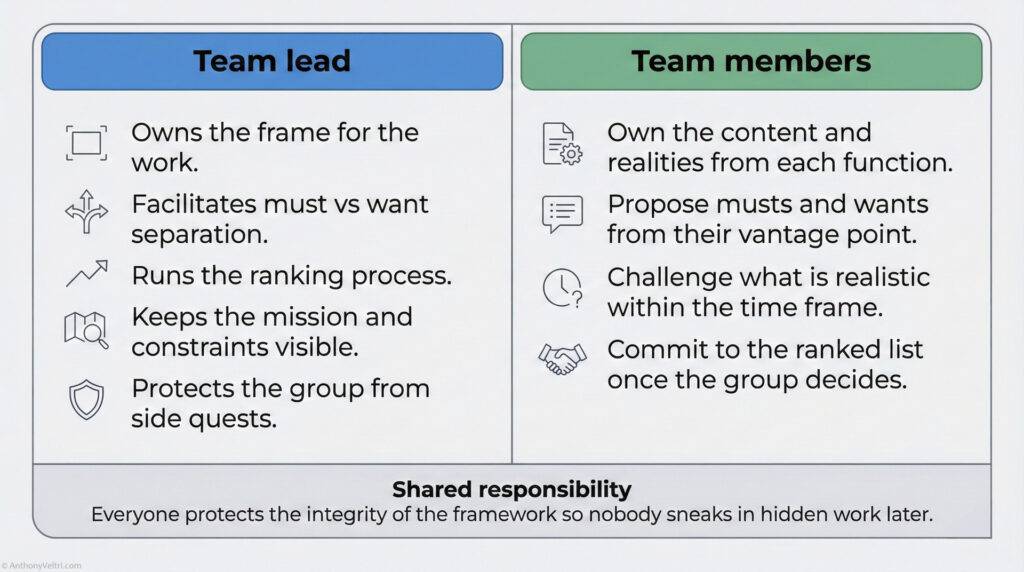
Cross functional teams tend to fail in two predictable ways:
- The team lead tries to own the subject matter and the goals
- The team members wait to be told what the goals are
You want a split that looks more like this.
The team lead
The team lead’s job is to own the frame:
- Facilitate the must vs want separation
- Run the ranking process
- Keep the objective and constraints visible
- Protect the group from side quests and pet projects
The lead does not decide what is valuable for every domain.
They hold the process that lets the group surface and sort that value.
The team members
The team members’ job is to own the content:
- Bring subject matter reality from their function or agency
- Propose musts and wants from their vantage point
- Challenge assumptions about what is realistic
- Commit to the list once ranked, even if their favorite want ends up low
Once the group has clarity, concurrence, and conformity around the musts and wants, the team lead can use positional authority to break ties and move the work forward.
The result is not pure consensus.
It is earned alignment: people have been heard, tradeoffs are visible, and someone is clearly in charge of moving.
How This Connects To The Rest Of The Doctrine
This pattern sits at the intersection of several themes in your doctrine.
- Federation vs Integration
- Functional hierarchy is integrated.
- Cross functional teams are miniature federations inside that hierarchy.
- The three Cs are a lightweight treaty that lets the federation behave coherently.
- Decision Funnel (Must / Want / Risk)
- This field note focuses on musts and wants for short term goals.
- Risk can be layered in when you are ranking or when you compare alternatives.
- Conflict Over Objectives vs Alternatives
- Rapid goal setting surfaces whether people disagree on where you are going or just how to get there.
- Many cross functional fights are really unspoken objective conflicts.
- Diagnostic vs Prescriptive Posture
- Early in a response, you sit mostly in diagnostic mode with the team.
- Once musts and wants are clear and rank ordered, you shift into prescriptive mode and start moving.
In other words, this is a team altitude implementation of several higher altitude ideas.
How To Use This In Practice
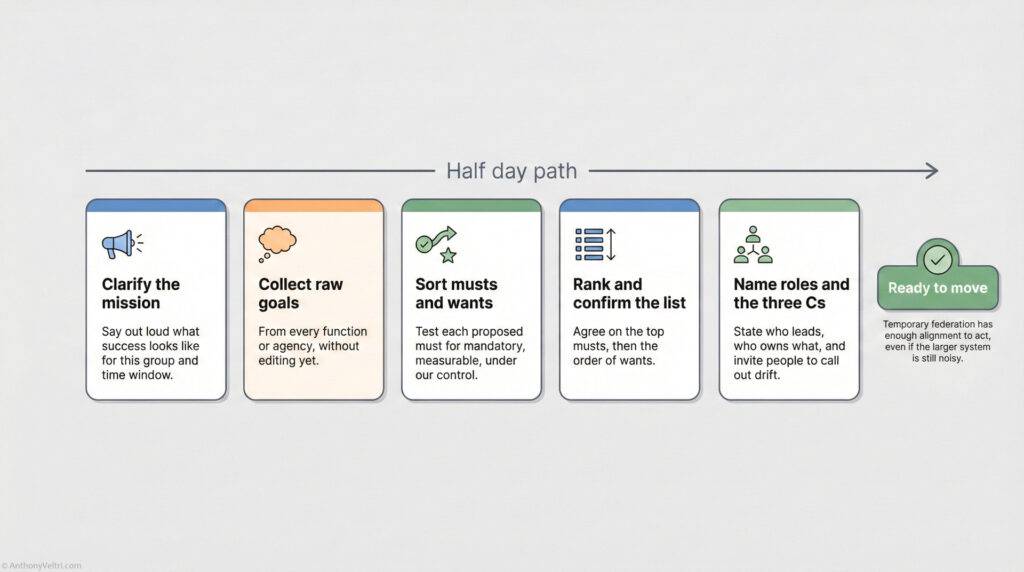
When you walk into a mixed room after a disruptive event, you can do this in under half a day.
- Clarify the mission out loud
- “For this group, over the next two weeks, success looks like…”
- Collect and separate musts and wants
- Sticky notes, chat board, or simple round robin
- Force the mandatory / measurable / under our control test
- Rank the combined list together
- Start with musts, then wants
- Capture the reasoning once, visibly
- Confirm the three Cs
- Clarity: Read the objective and top goals back to the group
- Concurrence: Ask directly, “Can each of you live with this list and explain it to your home unit”
- Conformity: Explicitly invite people to call out drift later
- Name the roles
- State who is acting as team lead
- Name any deputies or alternates
- Capture who owns which musts
From that point forward, you are no longer improvising.
You are operating a small federation on a shared contract, inside a larger system that may or may not be as coherent.
That is usually enough to make you the calmest person in the room.
Last Updated on March 15, 2026