Coordination & Decision Architecture for when
You’re Responsible for the Outcome. You Don’t Control the System.
How do you deliver when the mission depends on organizations, budgets, data, and decisions you cannot command?
Practical patterns for leaders who must align organizations, budgets, data and decisions they cannot command. Built from twenty years of field-tested work across DHS critical infrastructure, disaster response, federal systems governance and international civil-military coordination.
Building decision infrastructure that lets autonomous public, private, and sovereign partners create a trustworthy shared picture without forced standardization.
The recurring problem is simple: the mission requires coordination, but no one actor controls the systems, budgets, data, operating tempo, or decision rights required to force it.
This archive documents the patterns that make such systems work anyway: federation architecture, interface stewardship, honest handling of partial truth, resilient operations, and practical governance that people can actually sustain.
Here you will find: Frameworks for building federation infrastructure when integration isn’t viable. Demonstrated patterns for coordinating autonomous entities with different technical maturity, competing priorities, and independent governance.
operating pattern: See the gap → Ground truth it → Build the system → Plug it into operations → Document it so others don’t start from zero
Or listen while you work → Audio Library: 40+ episodes, 20+ hours
Prefer a structured listen → Fix Systems: The Audiobook
SCALE & IMPACT across enterprise programs: 296,000+ eligible users across 22 components. 200+ contributor partners. 200+ legacy systems brought into governance,. 20,000+ personnel supported.
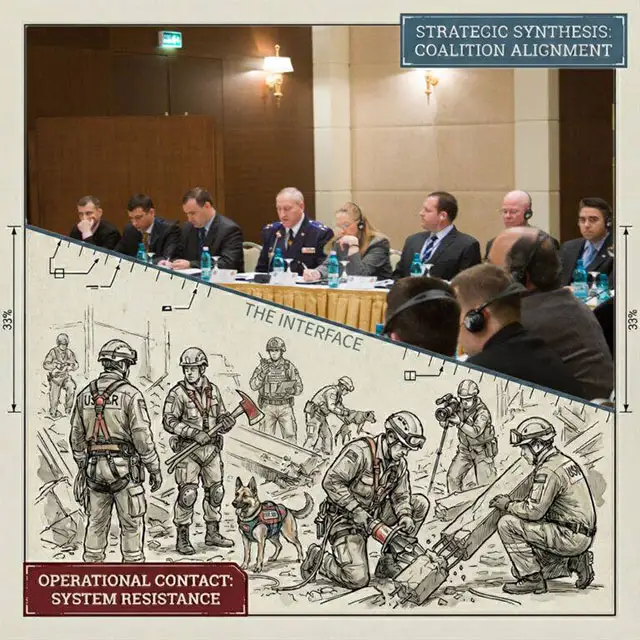
Documented patterns to identify consequential institutional problems, diagnose the hidden governance and stewardship failures beneath them, and develop targeted interventions that help move organizations from evidence to action.
This archive exists because embodied expertise is often invisible until it is missing. It was built to document, connect, and preserve operational patterns that are too broad, too cross-boundary, or too tacit to fit cleanly into a CV, abstract, or short conversation. The goal is not just to tell stories about past work, but to make the judgment behind that work visible, searchable, and usable for the next person who has to inherit, evaluate, or repair a complex system.
Bulletin of the American Meteorological Society | September 2026: Federation Cannot Replace Stewardship: Governing the Calibration Chain in Continental-Scale Observation Networks | Plain-language companion: Why These Examples Matter
Issues in Science and Technology | September 2026: Forum response in Building a Knowledge Commons. Identifies the missing translational function in knowledge infrastructure: someone accountable for carrying its value into the decisions that determine its survival.
Perspectives of Earth and Space Scientists | July 2026: Governance of Long-Term Scientific Infrastructure: Public Value Does Not Protect Itself
New in Eos (AGU) | 27 May 2026 The Governance Gap Threatening Long-Term Ecological Archives
Technology Changes Quickly Months. The underlying coordination dynamics persist.
Best practices assume the world is standing still. Doctrine is what you use when the world moves. We study the friction, load, and stress that mission-critical systems must survive, from the forest floor to the operations center. The frameworks are free. The patterns are field-tested. Enjoy.
What you will find here
This site is organized around three things I do repeatedly (and have done for twenty years).
Routes (Diagnostic Triage)
red band
Quick protocols when decisions are stalling or systems are breaking. Think emergency checklists, not pilot operating handbooks: diagnostic flowcharts that identify the failure mode and route you to solutions.
Doctrine (Patterns & Frameworks)
gold band
Deep patterns from 20 years of federal work & enterprise interoperability. Federation vs integration. Coordination without authority. Capacity planning. Read these when you have time for mental models.
Field Notes (Ops Stories)
green band
Real examples from disaster response, coalition coordination, critical-infrastructure federation. Hurricane Katrina, DHS critical infrastructure protection, multinational coordination.
–>Figures (Visual Library)
200+ indexed diagrams. Decision altitude maps, organizational structures, integration patterns. Visual pattern recognition and reference material.
The archive is cross-referenced so that core doctrine principles lead back to field evidence, and diagnostic tools lead into the frameworks that support them.
Systems Where These Patterns Were Applied
These patterns did not come from a whiteboard. They were learned, tested, and applied in systems that had to keep working across multiple domains.
International multi-sovereign coordination:
International Civil-Military Coordination (2010): Through the U.S. Army Corps of Engineers, I worked with civil and military partners across Eastern Europe, including former Soviet republics and former Warsaw Pact countries, on emergency preparedness exercises where no participant controlled the others. The operating choices from that work were later captured in the federation framework documented here. When the 2010 Icelandic ash cloud disrupted travel, relationships and credibility already built through the exercises helped preserve mission continuity across multinational and diplomatic boundaries.
Link: Read the field note
Institutional governance:
USFS Business Analysis Center of Excellence (Established 2016): was established to identify and bring 200+ unbudgeted “shadow” systems into enterprise compliance to mitigate critical succession and institutional risks. Following this initial compliance and intake phase, the Center transitioned into a stable Operations and Maintenance (O&M) phase. It now provides ongoing governance and resources for research systems that manage mission-critical and Congressional reporting data for 20,000+ eligible agency personnel.
Link: Read the field note
Federal enterprise coordination:
The iCAV architecture established a federated mission system for a shared critical-infrastructure operating picture, later evolving into the Geospatial Information Infrastructure (GII) and DHS OneView. Two-lane architecture met rigid uptime requirements while supporting growth from 50 initial partners to 200+ federated contributors across federal, state, local, tribal, and private-sector environments. It later served as the standard common operating picture for 296,000+ eligible users across 22 DHS components.
Link: Read the field note
Stewardship Workshop
A half-day stress-test lab for the ‘Federation Without Owners’ failure mode (tested and developed in coalition + federal contexts). All underlying frameworks are published on this site. The lab is the applied format
Run of show, artifacts, and target audience
In a contested environment, bandwidth is a luxury, not a guarantee
We need the cloud, but we cannot rely on it exclusively. This is not about abandoning the cloud; it is about layering our defense. While we leverage massive cloud pipelines for steady-state operations, we must simultaneously build Disconnected Oracles: local inference nodes that ensure intelligence capabilities survive when the network degrades (DDIL).
Featured stories from the field
A few starting points if you want to see how this work looks in practice.
When You Cannot Force Compliance: iCAV, Hurricane Katrina, And Lessons In Federation
Building a shared critical-infrastructure picture across 50+ autonomous partners required federation, not forced integration. iCAV’s architecture evolved into DHS GII and OneView, later supporting 296,000+ eligible users across 22 components and a large partner ecosystem.
Link: Read the field note
Stranded in Vienna, Responsible in Kyiv
When volcanic ash grounded flights across Europe, I went from technical lead to sole US representative coordinating civil-military emergency preparedness with former Warsaw Pact nations. Delivering training to 100 participants, managing diplomatic protocols, and operating without my team demonstrated that federated environments require adaptability over authority.
Link: Read the field note
Bay St. Louis: Trust Before Logos After Hurricane Katrina
Multi-agency disaster coordination fails when outsiders mistake formal authority for earned trust. After Katrina, watching a large relief organization try to centralize a local pastor’s distribution network taught me that federation respects sovereignty while integration destroys participation. The lesson applies anywhere autonomous entities must coordinate without centralized control.
Link: Read the field note
To a sovereign partner, ‘Integration’ often looks like ‘Assimilation.’
When command authority evaporates, governance must shift. A candid briefing on why federated environments require a move from Identity Trust (“Who are you?”) to Artifact Verification (“Is this data safe?”).
Where this pattern came from:
I was trained as a remote sensing and GIS scientist and spent my early career where natural hazards, emergency response, communications, and information systems met.
That work included wildland fire academies, a self-built mobile mapping unit deployed after Hurricane Katrina, geospatial and C4ISR work in the Department of Homeland Security, wireless and RF path-loss modeling for emergency communications, and internal guidance for federal programs.
The domains looked different, but the operating pattern remained consistent:
See the gap. Ground truth it. Build a practical system. Plug it into existing operations. Then document it so the work can be understood, defended, transferred, and improved.
This archive preserves that pattern and the field evidence behind it.
Frequently Asked Questions
What is coordination architecture?
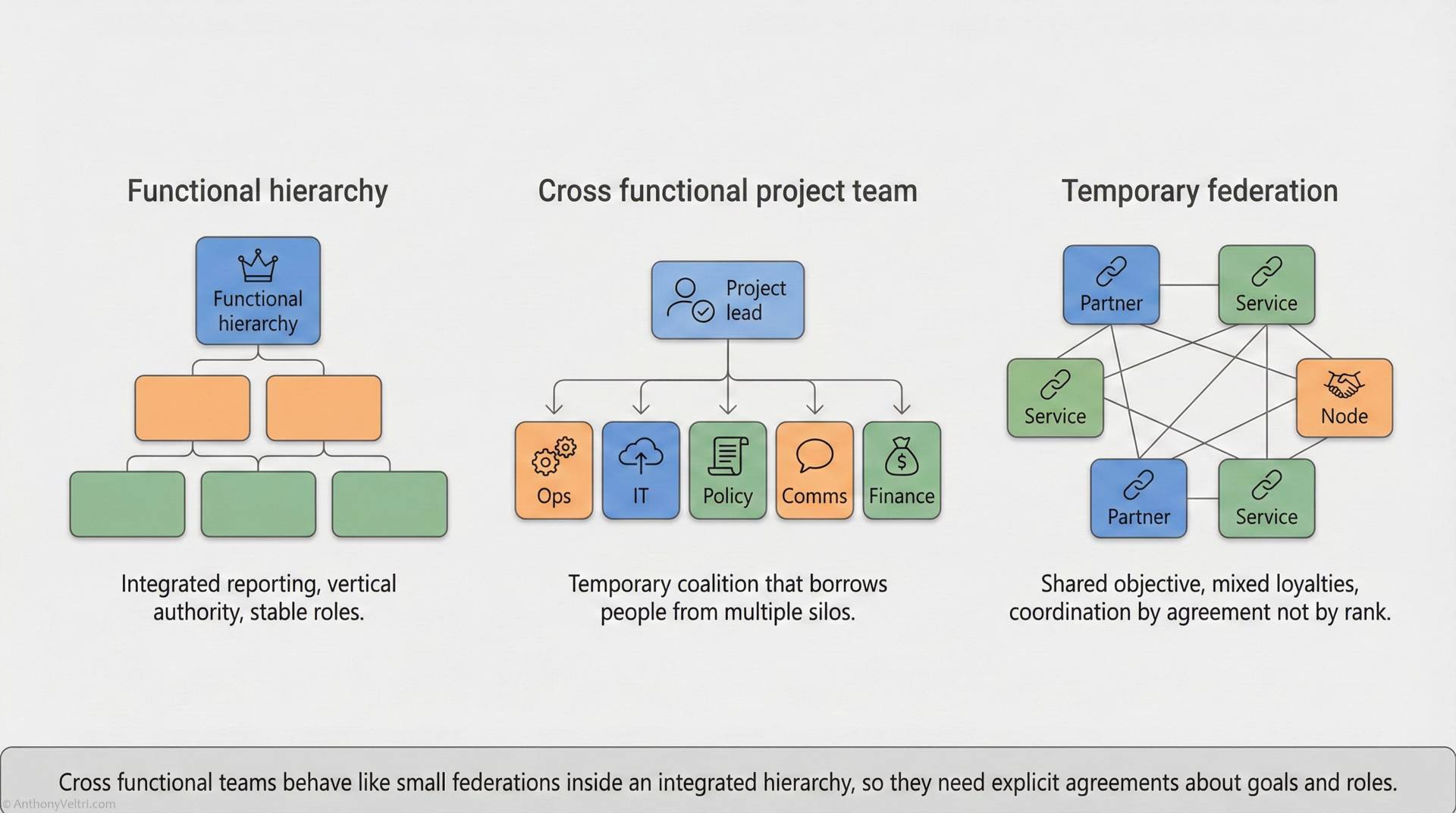
Coordination architecture is the design of decision paths, ownership boundaries, interfaces, and operating agreements that allow people and organizations to work together when no single actor fully controls the system.
What is federation architecture?
Federation architecture is an approach for coordinating across teams, agencies, systems, or partners without forcing everything into one centralized model. It preserves local autonomy while defining the shared interfaces needed for reliable coordination.
Who are Doctrine Patterns for?
Doctrine Patterns are for leaders, operators, analysts, architects, and stewards who are responsible for outcomes in complex public systems, especially where authority is fragmented and coordination failures are expensive.
How to read this site
If this is your first time here, a quick decoder.
- Gold bars = Doctrine
These are core principles and patterns. They answer “What do I believe about how good systems behave under stress?” and “What are the reusable ideas?” - Green bars = Field Notes
These are stories. They show doctrine colliding with reality, deployments, projects, and case studies where things went right, wrong, or sideways. - Blue bars = Services and contact
These are the few ways I work directly with organizations that want help making sense of their own systems and stories. - Red bars = Routes – guided paths when you are under pressure and need traction
If you are just browsing, start with a few doctrine guides and one or two field notes (the Mobile Mapping Unit and Katrina Book are good entry points).
Need help with your own systems?
- Being introduced? Start with the Interpreter Kit
- Ready to talk? Use the chat bubble or contact form with a bit of context
Just browsing? Pick a field note, see if the patterns match problems you recognize.
Ready to connect? Reach out to Anthony Veltri here.