Skip to content

Introduced by a trusted connector?

Start Here

Anthony Veltri

  • Doctrine
    • Doctrine Library
    • Global Library
  • Field Notes
  • Routes
    • Route 01: When the Interface Is Breaking (and you are becoming the patch)
    • ROUTE 02: If decisions stall and meetings go nowhere, start here
    • ROUTE 03: If you have lots of projects but no portfolio clarity, start here
    • ROUTE 04: If you’re confused about federation vs integration, start here
    • ROUTE 05: If heroics are propping up your system, start here
    • ROUTE 06: If you cannot force compliance across partners, start here
    • ROUTE 07: If compliance exists but commitment does not, start here
    • ROUTE 08: If disconnected workflows create audit anxiety, start here
  • Figure Library
  • FAQ
  • About
    • Capability Statement
    • Interpreter Kit
  • Contact
Anthony Veltri

Architecture & Interfaces

15
  • Doctrine 01: Federation vs Integration in Mission Networks
  • Doctrine 03: Interfaces Are Where Systems Break, So They Require Stewards, Contracts, and Ownership
  • Doctrine 04: Useful Interoperability Is the Goal, Not Perfect Interoperability
  • Doctrine 05: Innovation Must Live at the Edge, Not in the Center
  • Doctrine 06: A Two-Lane System Protects Stability and Enables Evolution
  • Doctrine 14: Technical Debt Is a Leadership Signal, Not a Coding Failure
  • Doctrine 15: Architecture Must Accelerate Teams, Not Bottleneck Them
  • Doctrine 17: Architects Translate Strategy Into Engineering and Engineering Into Strategy
  • Doctrine 20: Golden Datasets: Putting Truth In One Place Without Pretending Everything Is Perfect
  • Doctrine 21: Zero Trust Is A Trust Model, Not A Card “Type”
  • Doctrine 23: Loop Closure as Load-Bearing System Infrastructure
  • ANNEX B. Data Contracts
  • ANNEX C. Interface Ownership Model
  • ANNEX H. Architecture Doctrine
  • Annex L: The Rosetta Stone for Data Teams: Bridging the Gap Between Technicians and Executives

Decision Tempo & Governance

10
  • Doctrine 02: Distributed Decisions Increase Alignment, Speed, and Resilience
  • Doctrine 07: Clear Intent Matters More Than Perfect Data
  • Doctrine 08: Clear Intent Compresses Ambiguity, Reduces Conflict, and Accelerates Action
  • Doctrine 09: Decision Drag Is the Enemy of Mission Tempo. Architecture Is the Remedy
  • Doctrine 10: Degraded Operations Are the Normal Mode, Not the Exception
  • Doctrine 11: Preventive Action and Contingent Action Must Both Be Designed Intentionally
  • Doctrine 22: When “It Depends” Is the Right Answer: How to Think in Probabilities Under Uncertainty
  • ANNEX D. Decision Altitudes Model
  • ANNEX E. Prevention–Contingency Matrix
  • ANNEX I. High Visibility Workflows

Portfolio & Alignment

4
  • Doctrine 16: Portfolio Thinking Ensures Effort Aligns With What Actually Matters
  • ANNEX F. Pattern Library
  • ANNEX J. System Evolution and Drift Management
  • ANNEX K. System and Workflow Profiles (Case Studies)

Leadership & Human Systems

6
  • Doctrine 24: Stewardship Places the Burden on the Steward, Not the Parties
  • Doctrine 18: Commitment Outperforms Compliance in High Trust, High Tempo Environments
  • Doctrine 19: Supervision, Management, and Leadership Are Three Different Jobs. Confusing Them Breaks Systems
  • Doctrine 23: Loop Closure as Load-Bearing System Infrastructure
  • ANNEX A. Human Contracts
  • ANNEX G. Leadership Doctrine

Resilience & Operations

3
  • Doctrine 24: Stewardship Places the Burden on the Steward, Not the Parties
  • Doctrine 12: Resilience Is an Emergent Property, Not a Feature
  • Doctrine 13: Problem Solving Requires Finding the Real Deviation and the Relevant Change

Doctrine Companions

7
  • Doctrine 03 Companion: The RS-CAT Framework: Converting Raw Recall into Teachable Principle
  • Doctrine 03 Companion: The Interface Void
  • Doctrine 11 Companion: Agency vs. Outcome
  • Doctrine 09 Companion: Artifacts Over Adjectives
  • Doctrine 03 Companion: Constraints: bidirectional translation: Compression vs Construction
  • Doctrine 10 Companion: Span of Control and Cross Training Are Load-Bearing Constraints
  • Doctrine 21 Companion: Claims, Roles, and Entitlements in Microsoft 365

Field Reports

1
  • Field Report: College Financing and the 5-Year Home Runway
View Categories
  • Home
  • Doctrine & Supporting Guides
  • Doctrine Companions
  • Doctrine 09 Companion: Artifacts Over Adjectives

Doctrine 09 Companion: Artifacts Over Adjectives

Anthony Veltri
Updated on December 29, 2025

5 min read

Doctrine Companion to Decision Altitude

There is a quiet lie that shows up in a lot of org charts and LinkedIn profiles.

We act like skills live in adjectives.

  • Strategic
  • Visionary
  • Collaborative
  • Influential

These words float near job titles and performance reviews. They are rarely tied to anything you can point at.

If your skill only exists as an adjective, it is not real. It is branding.
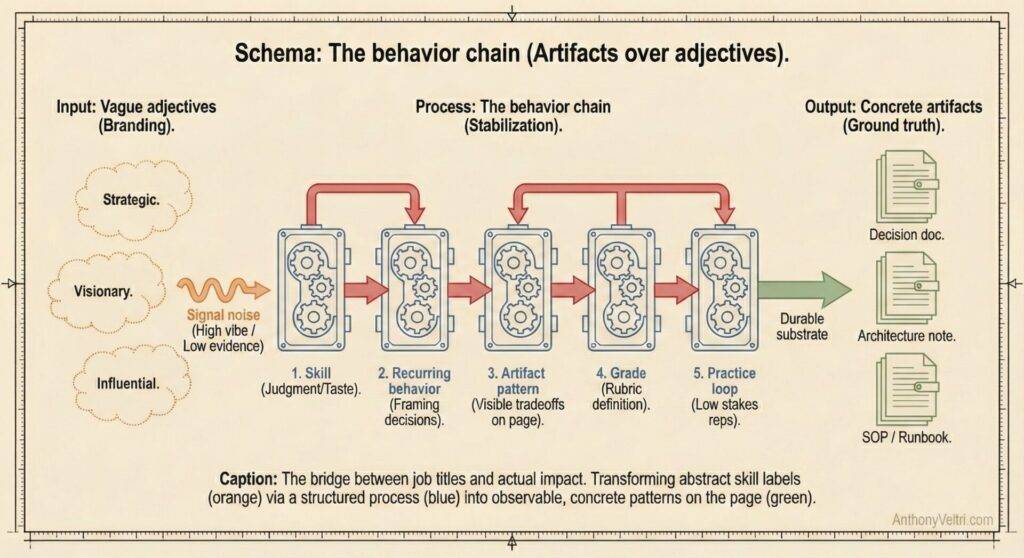
This diagram illustrates how building skills through defined steps leads from vague descriptors to clear, observable outcomes and artifacts.

Real skills live in artifacts.

  • Decision docs
  • Specs and architecture notes
  • Portfolio dashboards
  • Runbooks, SOPs, playbooks (and why you want all three)
  • Stakeholder maps and meeting notes

Once you accept that, “skill” stops being a label and starts being a pattern you can see on the page.


From adjectives to artifacts #

Pick any high level adjective you care about.

Strategic.

Where would that show up on paper, at each decision altitude?

  • High altitude:
    • A portfolio view that connects projects to real objectives and constraints.
    • A decision doc that surfaces tradeoffs, not just preferences.
  • Mid altitude:
    • A program roadmap that shows clear sequencing and dependencies instead of a wish list.
    • Risk and opportunity sections that actually affect what gets funded.
  • Ground level:
    • A sprint plan or workboard that matches the stated priorities, not politics or noise.
    • Handoffs that make the next team faster, not slower.

If you cannot show me where “strategic” lives in the artifacts, then we are arguing about a vibe. That is how you end up with panel interviews where the most fluent storyteller wins and the best operator never even gets a callback.


The behavior chain #

This is the core pattern I want to make explicit.

Skill → Recurring behavior → Artifact pattern → Grade → Practice loop

  • Skill
    • Example: judgment, orchestration, coordination, taste, updating.
  • Recurring behavior
    • How you frame decisions, structure options, name risks, update plans.
  • Artifact pattern
    • The way that behavior shows up on the page: clear decision sentence, explicit options, visible tradeoffs, links to metrics and constraints.
  • Grade
    • A small rubric that answers “what does good look like for this artifact in this environment.”
  • Practice loop
    • Regular low stakes reps, reviewed against that rubric, with coaching.
    • AI can act as a consistent wall to hit against, but humans still own what “good” is.

This is the bridge between your job title and your actual impact. It is also the bridge between “I am strategic, trust me” and “Here is what my thinking looks like in the wild.”


A minimal practice loop for one artifact #

Start extremely small.

  1. Pick one artifact that matters.
    • Decision doc, strategy memo, executive update, incident review, whatever is most leveraged in your role.
  2. Define what good looks like with someone whose judgment you trust.
    • Five to seven bullet points.
    • Example for a decision doc:
      • Is the decision stated in one clear sentence near the top.
      • Are there at least two real options.
      • Are stakes and metrics explicit.
      • Is there a specific recommendation.
      • Are key risks and tradeoffs surfaced.
  3. Collect three real examples, mark them up.
    • Circle what is strong.
    • Underline what is muddy.
    • Write one sentence about why.
  4. Turn that into a simple rubric.
    • For each bullet, define what a “1” and a “5” look like.
    • You can keep this very rough. The goal is direction, not precision.
  5. Wire in AI as a consistent reviewer.
    • Give the model the rubric and the annotated examples.
    • Ask it to score new docs, quote the sections it is reacting to, and suggest edits that would move a chosen dimension up by one point.
  6. Run one low stakes rep each week.
    • Take a messy situation or vague request.
    • Write a one page artifact that fits your pattern.
    • Run it through the rubric.
    • Compare your version to a stronger version from the model and notice what you missed.

That is it. That is the smallest useful practice loop.

You are no longer “doing your reps” only in live games with fuzzy, delayed feedback. You have a practice lane that is cheap, repeatable, and specific to your real work.


Rubrics without surveillance #

Rubrics and AI scoring are powerful and dangerous.

If you are not careful, this can drift from “practice tool” to “metric that gets weaponized.”

Guardrails:

  • Rubric scores are coaching signals, not performance ratings.
  • No secret scoring. If the AI is grading docs, people should know and see the output.
  • Keep the rubric small and human readable. If you cannot explain it to a new hire in five minutes, it is too ornate.
  • Rotate who maintains the rubric so it does not harden into one person’s taste.

This is the same pattern as metrics. Once a number can travel up a slide deck, it will try to become the story. You have to guard the intent.


Why this Doctrine Companion belongs under Decision Altitude #

Decision Altitude asks “what level of the sky are we flying at” when we make a call.

Artifacts Over Adjectives adds a sharper question:

At this altitude, what should a good artifact look like, and how can we practice producing it on purpose.

A senior leader should not just be strategic. They should leave behind visible artifacts of strategic judgment that someone else can read a year later and say “this is why we chose that path, and here is where we would update it now.”

If you can name the skill, see it in the artifact, grade it with a clear rubric, and practice it in a safe lane, then you have something most organizations never get.

You are no longer arguing about adjectives. You are coaching on film.

Last Updated on December 29, 2025

Related Posts #

This slide illustrates the relationships among claims, roles, and entitlements in Microsoft 365, as presented in Doctrine 21.

Doctrine 21 Companion: Claims, Roles, and Entitlements in Microsoft 365 #

Empty chair on a stage

The Audition Trap: Why Panel Interviews Create False Negatives in Hiring #

This slide illustrates the distinction between Construction and Compression, as presented in Doctrine Companion, using a geometric theme.

Doctrine 03 Companion: Constraints: bidirectional translation: Compression vs Construction #

This slide illustrates the distinction between agency and outcome, framed within Doctrine 11 and presented in a circuit motif.

Doctrine 11 Companion: Agency vs. Outcome #

This slide illustrates

Doctrine 10 Companion: Span of Control and Cross Training Are Load-Bearing Constraints #

This slide illustrates the

Doctrine 03 Companion: The RS-CAT Framework: Converting Raw Recall into Teachable Principle #

Leave a Reply Cancel reply

You must be logged in to post a comment.

Table of Contents
  • From adjectives to artifacts
  • The behavior chain
  • A minimal practice loop for one artifact
  • Rubrics without surveillance
  • Why this Doctrine Companion belongs under Decision Altitude

Share This Article :

  • Facebook
  • X
  • LinkedIn
  • Pinterest

Was it helpful ?

  • Happy
  • Normal
  • Sad
  • Privacy Policy
  • Introductions
  • Contact

© 2026 Anthony Veltri

  • Doctrine
    • Doctrine Library
    • Global Library
  • Field Notes
  • Routes
    • Route 01: When the Interface Is Breaking (and you are becoming the patch)
    • ROUTE 02: If decisions stall and meetings go nowhere, start here
    • ROUTE 03: If you have lots of projects but no portfolio clarity, start here
    • ROUTE 04: If you’re confused about federation vs integration, start here
    • ROUTE 05: If heroics are propping up your system, start here
    • ROUTE 06: If you cannot force compliance across partners, start here
    • ROUTE 07: If compliance exists but commitment does not, start here
    • ROUTE 08: If disconnected workflows create audit anxiety, start here
  • Figure Library
  • FAQ
  • About
    • Capability Statement
    • Interpreter Kit
  • Contact