Skip to content

Introduced by a trusted connector?

Start Here

Anthony Veltri

  • Doctrine
    • Doctrine Library
    • Global Library
  • Field Notes
  • Routes
    • Route 01: When the Interface Is Breaking (and you are becoming the patch)
    • ROUTE 02: If decisions stall and meetings go nowhere, start here
    • ROUTE 03: If you have lots of projects but no portfolio clarity, start here
    • ROUTE 04: If you’re confused about federation vs integration, start here
    • ROUTE 05: If heroics are propping up your system, start here
    • ROUTE 06: If you cannot force compliance across partners, start here
    • ROUTE 07: If compliance exists but commitment does not, start here
    • ROUTE 08: If disconnected workflows create audit anxiety, start here
  • Figure Library
  • FAQ
  • About
    • Capability Statement
    • Interpreter Kit
  • Contact
Anthony Veltri

Architecture & Interfaces

15
  • Doctrine 01: Federation vs Integration in Mission Networks
  • Doctrine 03: Interfaces Are Where Systems Break, So They Require Stewards, Contracts, and Ownership
  • Doctrine 04: Useful Interoperability Is the Goal, Not Perfect Interoperability
  • Doctrine 05: Innovation Must Live at the Edge, Not in the Center
  • Doctrine 06: A Two-Lane System Protects Stability and Enables Evolution
  • Doctrine 14: Technical Debt Is a Leadership Signal, Not a Coding Failure
  • Doctrine 15: Architecture Must Accelerate Teams, Not Bottleneck Them
  • Doctrine 17: Architects Translate Strategy Into Engineering and Engineering Into Strategy
  • Doctrine 20: Golden Datasets: Putting Truth In One Place Without Pretending Everything Is Perfect
  • Doctrine 21: Zero Trust Is A Trust Model, Not A Card “Type”
  • Doctrine 23: Loop Closure as Load-Bearing System Infrastructure
  • ANNEX B. Data Contracts
  • ANNEX C. Interface Ownership Model
  • ANNEX H. Architecture Doctrine
  • Annex L: The Rosetta Stone for Data Teams: Bridging the Gap Between Technicians and Executives

Decision Tempo & Governance

10
  • Doctrine 02: Distributed Decisions Increase Alignment, Speed, and Resilience
  • Doctrine 07: Clear Intent Matters More Than Perfect Data
  • Doctrine 08: Clear Intent Compresses Ambiguity, Reduces Conflict, and Accelerates Action
  • Doctrine 09: Decision Drag Is the Enemy of Mission Tempo. Architecture Is the Remedy
  • Doctrine 10: Degraded Operations Are the Normal Mode, Not the Exception
  • Doctrine 11: Preventive Action and Contingent Action Must Both Be Designed Intentionally
  • Doctrine 22: When “It Depends” Is the Right Answer: How to Think in Probabilities Under Uncertainty
  • ANNEX D. Decision Altitudes Model
  • ANNEX E. Prevention–Contingency Matrix
  • ANNEX I. High Visibility Workflows

Portfolio & Alignment

4
  • Doctrine 16: Portfolio Thinking Ensures Effort Aligns With What Actually Matters
  • ANNEX F. Pattern Library
  • ANNEX J. System Evolution and Drift Management
  • ANNEX K. System and Workflow Profiles (Case Studies)

Leadership & Human Systems

6
  • Doctrine 24: Stewardship Places the Burden on the Steward, Not the Parties
  • Doctrine 18: Commitment Outperforms Compliance in High Trust, High Tempo Environments
  • Doctrine 19: Supervision, Management, and Leadership Are Three Different Jobs. Confusing Them Breaks Systems
  • Doctrine 23: Loop Closure as Load-Bearing System Infrastructure
  • ANNEX A. Human Contracts
  • ANNEX G. Leadership Doctrine

Resilience & Operations

3
  • Doctrine 24: Stewardship Places the Burden on the Steward, Not the Parties
  • Doctrine 12: Resilience Is an Emergent Property, Not a Feature
  • Doctrine 13: Problem Solving Requires Finding the Real Deviation and the Relevant Change

Doctrine Companions

7
  • Doctrine 03 Companion: The RS-CAT Framework: Converting Raw Recall into Teachable Principle
  • Doctrine 03 Companion: The Interface Void
  • Doctrine 11 Companion: Agency vs. Outcome
  • Doctrine 09 Companion: Artifacts Over Adjectives
  • Doctrine 03 Companion: Constraints: bidirectional translation: Compression vs Construction
  • Doctrine 10 Companion: Span of Control and Cross Training Are Load-Bearing Constraints
  • Doctrine 21 Companion: Claims, Roles, and Entitlements in Microsoft 365

Field Reports

1
  • Field Report: College Financing and the 5-Year Home Runway
View Categories
  • Home
  • Doctrine & Supporting Guides
  • Doctrine Companions
  • Doctrine 03 Companion: The Interface Void

Doctrine 03 Companion: The Interface Void

Anthony Veltri
Updated on December 25, 2025

5 min read

Doctrine Claim: High-resolution mental models are a dangerous luxury when they have never been tested against a low-resolution reality. The Interface Void is the technical debt of unearned knowledge: it is the gap between a stored sentence (recognition) and a working capability (execution). Bridging this void is not an informational task; it is an operational requirement.
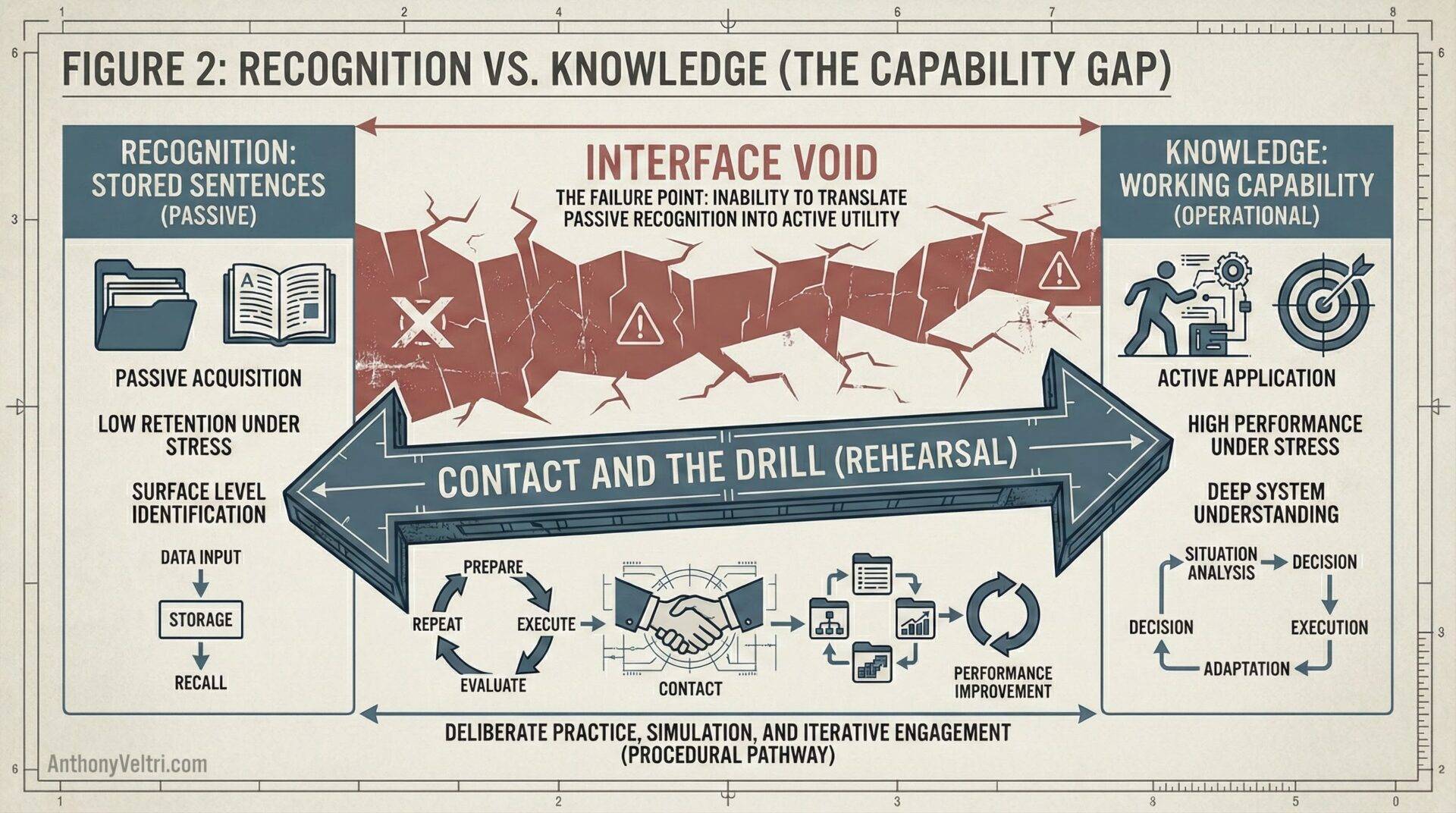

This diagram illustrates the capability gap between passive recognition and active knowledge, highlighting rehearsal and simulation as bridging steps.

1. The Problem: Recognition vs. Knowledge #

We often conflate “knowing about” a thing with “being able to do” the thing. This confusion creates the Interface Void, a failure point where a theoretical model loses contact with operational reality.

  • Recognition: You can identify the concept, recite the acronyms, and follow the rituals of a process. You possess the “Construction” (the map) but lack the “Compression logic” (the terrain-earned signal) required to navigate it.
  • Knowledge: You can produce the promised result under pressure, in the dark, while exhausted. You have closed the loop between the brain and the mission.

We distinguish the Interface Void from the more common “capability gap” because they are not the same: a capability gap implies a lack of information, whereas the void identifies the missing bridge between existing knowledge and successful execution.


2. The Architecture of the Void #

The Interface Void thrives in environments with high consequence lag. In low-consequence domains, the person who “Constructs” the model (the strategist) is often miles away and months removed from the person who must “Operate” it (the technician). Because the bill for a bad model is deferred, the void stays open, rewarding superficial Recognition while rarely auditing actual Knowledge.

In high-consequence domains (like Wildland Fire or Aviation) the void is closed by The Drill. There, reality provides a definitive, immediate audit of capability. If you possess only “stored sentences” about your equipment, the system resets the moment friction hits.


3. The “Next Guy” Problem (Legacy Schema Debt) #

The Interface Void is the primary driver of Legacy Schema Debt. This occurs when a predecessor leaves behind a “Compressed” result (the SOP, the spreadsheet, the model) without leaving the “Construction” logic (the why and the how).

As the “Next Guy,” you inherit a map of a city that was never actually built. You are stuck trying to force reality into an outdated box. We do not document processes to satisfy academic requirements; we document them so the mission survives the handoff.
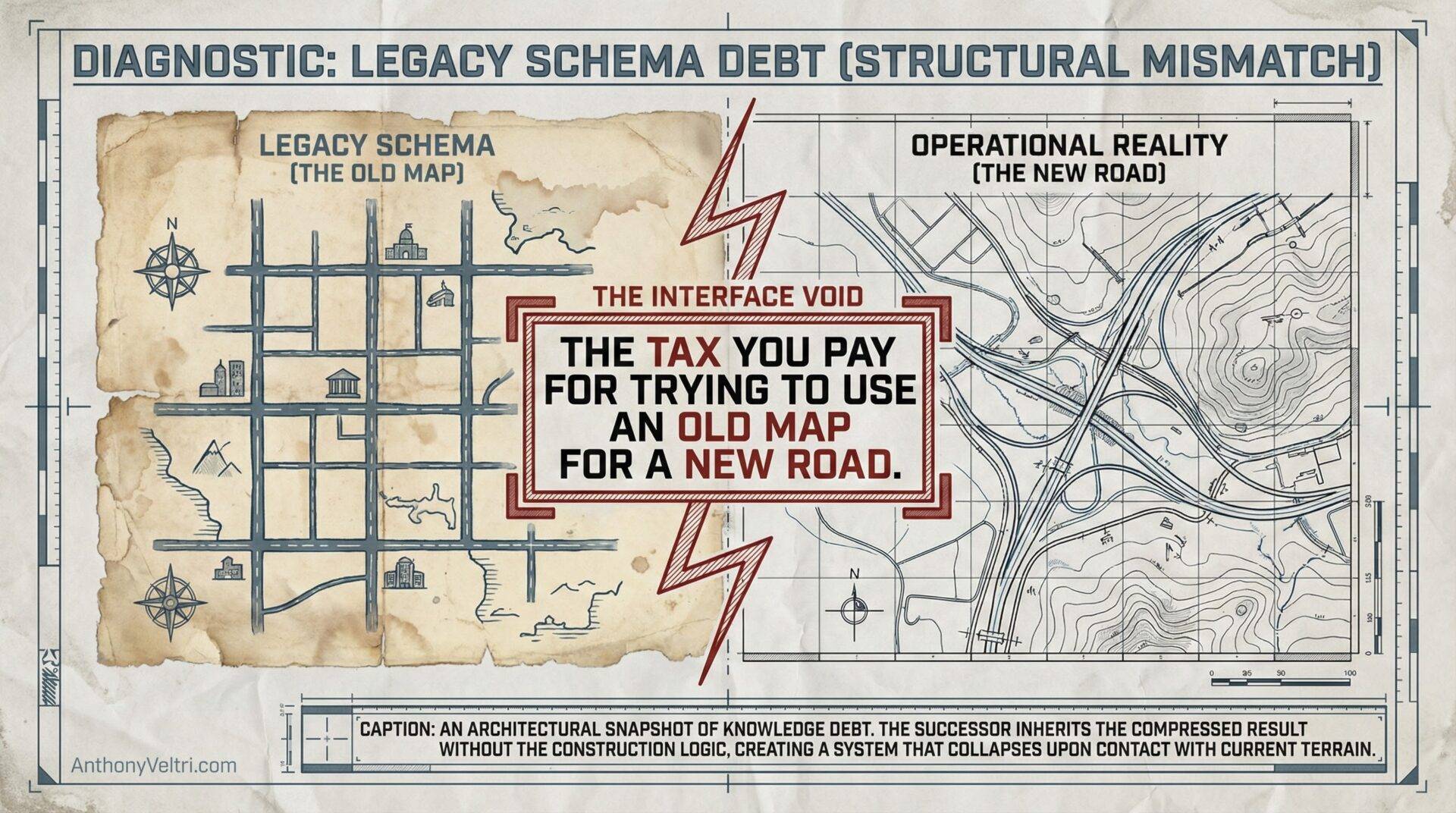
This diagram contrasts legacy schemas with operational realities, suggesting potential costs of outdated frameworks in new contexts.
An architectural snapshot of knowledge debt: The successor inherits the compressed result without the construction logic, creating a system that collapses upon contact with current terrain.

4. Bridging the Void: Extraction over Delivery #

The void cannot be bridged by “Information Delivery” (more classes or reading). It can only be closed through Extraction.

  1. Stewardship of the Interface: We stop spelling out acronyms for our own status and start building the pedagogical scaffolding for the “next guy”.
  2. The Drill (Operational Rehearsal): We move from being “informed” to being “operational” by testing the model against high-friction simulations.
  3. RS-CAT Pipeline: We surgically extract the “Transferable Principle” from raw recall, re-indexing it for the learner rather than the expert.

5. Doctrine Diagnostic: Evaluating the Void #

FeatureCapability GapInterface Void
Primary FocusMissing Information/Credential Missing Bridge to Execution
SolutionMore Classes/Reading The Drill/RS-CAT Extraction
Audit MethodWritten Test/Certification High-Friction Simulation/The X
ConsequenceDeferred Inefficiency Immediate Mission Failure

The Interface Void exists where Consequence Lag is high. In domains like corporate strategy, software architecture, or long-term policy, the person who “Constructs” the model is often miles away (and years removed) from the person who has to “Operate” it.

The Distinction of the X

  • High-Consequence (The X): Consequences accrue in seconds/minutes to the operator. The Feedback Loop is tight. The Void is closed by The Drill.
  • Low-Consequence (The Ivory Tower): Consequences accrue in weeks/months/years to “the organization.” The person who accrued the debt is rarely the one who pays it. The Void stays open because Recognition is rewarded while Knowledge is rarely audited.

Interface Void is the technical term for the Capability Gap. It is the jagged space between Recognition (where you have a stored sentence or a model) and Knowledge (where you have a working capability to produce results).
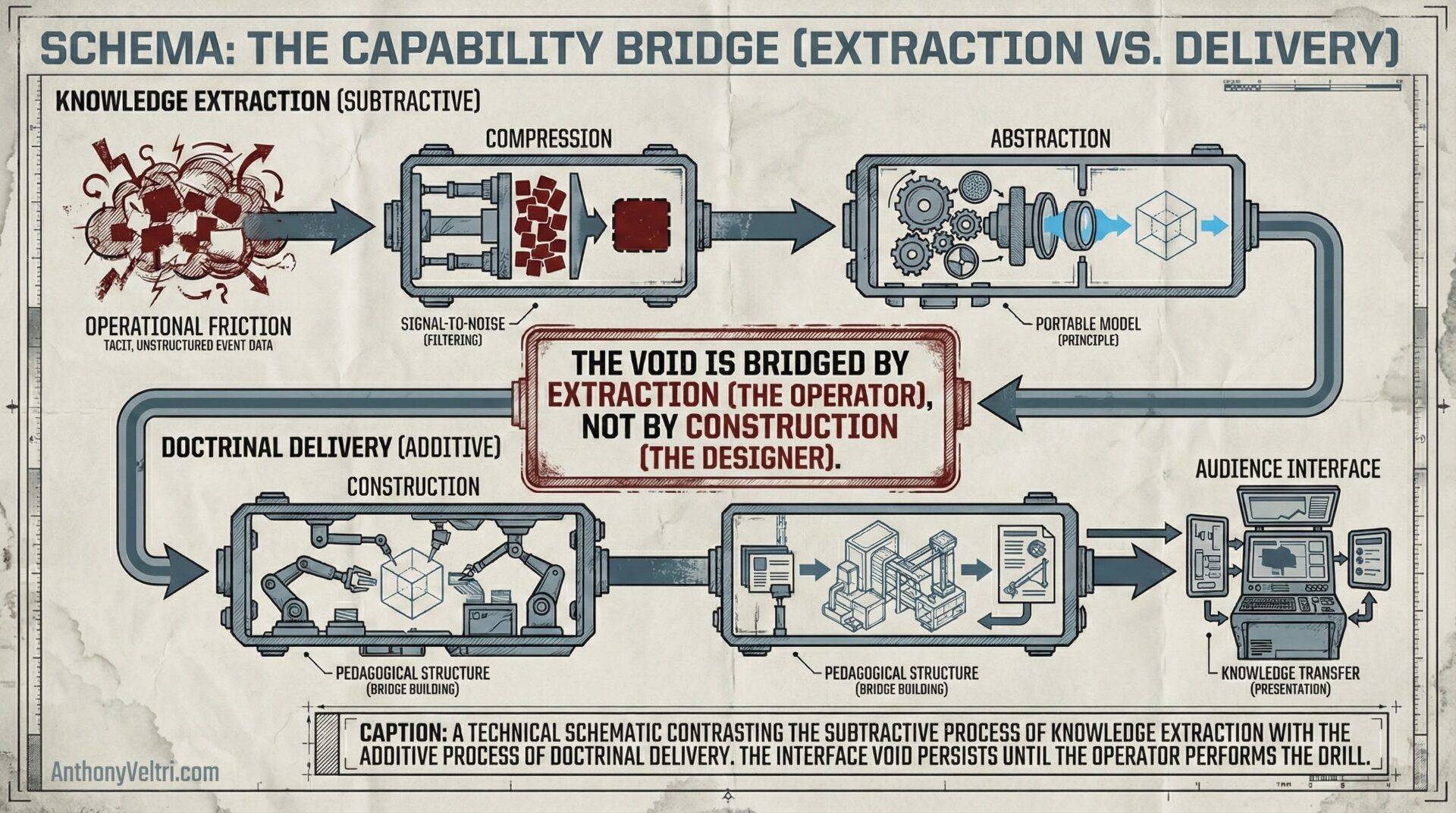
This diagram illustrates how knowledge extraction (compression and abstraction) differs from doctrinal delivery, emphasizing extraction.
This diagram illustrates how knowledge extraction (compression and abstraction) differs from doctrinal delivery, emphasizing extraction. Simply handing someone a manual (Construction) never solves the problem of operational capability (Extraction).

We distinguish the Interface Void from the more common ‘capability gap’ because they are not the same: a capability gap implies a lack of information, whereas the void identifies the missing bridge between stored knowledge and operational execution. An operator who has read about their SCBA but never drilled under pressure technically possesses the knowledge, but they lack the working capability. On paper, the firefighter and the Excel student both have a ‘capability gap,’ but the nature of their void is different: one is a matter of deferred inefficiency, the other is a matter of immediate life and death.

The Interface Void is the failure point where a model loses contact with reality. It often occurs in two ways:

  1. The Operator Gap: You recognize the pattern, you know the acronym, and you can recite the principle. But when the friction hits, you cannot execute the move. You are standing on the edge of the void, looking at the terrain, but you have no bridge to the other side.
  2. The System Gap: This is the “Next Guy Problem.” The person before you left you a compressed model (the construction), but because they didn’t leave you the “Why” or the “How” (the compression logic), the model fails the moment reality changes. The model is floating in the void without a durable substrate to anchor it.

An Example: #

Scene
You are in a high-stakes meeting where the room is speaking in fluent “Acronym-ese.” Everyone is nodding. A senior leader points to a slide showing a “Optimized Workflow Model.” It looks perfect. It’s clean, symmetrical, and completely logical.

Then you ask a question: “When the power goes out at the regional center and the backup generator fails to kick in, who exactly makes the call to divert the traffic, and what manual do they open to do it?”

The room goes silent. The “Optimized Workflow” just hit a wall.

Break
That silence is the sound of the Interface Void.

It’s the gap between the Construction (the pretty model on the slide) and the Operational Reality (the mess on the ground). We had the stored sentence (we knew the workflow was “optimized”) but we didn’t have the working capability to handle the friction. We had inherited a model from the “Next Guy” that was all compression and no texture.

Schema
The Interface Void is the technical debt of knowledge. It occurs when we prioritize Recognition over Knowledge.

  • Recognition: You can recite the acronym, identify the model, and follow the ritual. You have the “Construction,” but you lack the “Compression Logic” that built it.
  • Knowledge: You can produce the promised result under pressure. You have bridged the void through The Drill (rehearsal) and RS-CAT (extraction).

The Void is where missions fail. It’s where the “Next Guy” gets lost because he has a map of a city that was never actually built. To bridge it, we must stop spelling out the acronyms only for ourselves and start building the “Pedagogical Scaffolding” for everyone else.

Field notes and examples #

  • Regime Recognition and the Cost of Asymmetric Errors: When Post-Hoc Learning Beats Theory-First
  • Reclaiming the Right to Orchestrate: Decision Altitudes and Why Your Chisel Doesn’t Give You the Right to Judge My Output
  • Field Note: Guided Sensemaking Interview
  • Model vs. Terrain: Bridging the Interface Void on the Merritt Parkway
  • Seeing the Dragon: The Magic Eye of Modern Governance

Last Updated on December 25, 2025

Related Posts #

This slide illustrates the relationships among claims, roles, and entitlements in Microsoft 365, as presented in Doctrine 21.

Doctrine 21 Companion: Claims, Roles, and Entitlements in Microsoft 365 #

A graphic with the text

ANNEX C. Interface Ownership Model #

A slide with the text

Doctrine 03: Interfaces Are Where Systems Break, So They Require Stewards, Contracts, and Ownership #

A diagram shows a translucent seated person labeled

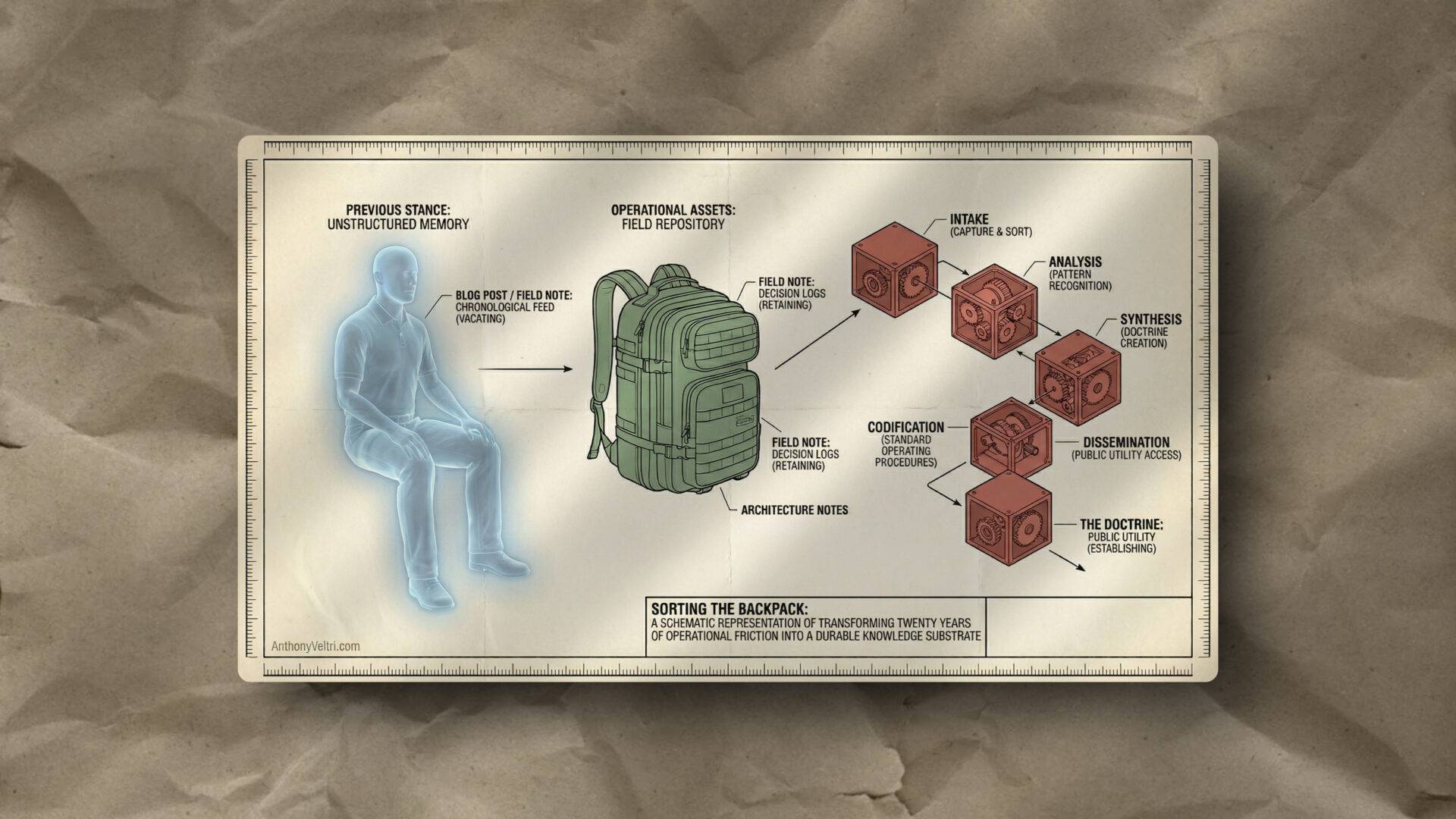
Field Note: Sorting the 20-Year Backpack #

This slide illustrates the

Doctrine 09 Companion: Artifacts Over Adjectives #

This slide illustrates the distinction between agency and outcome, framed within Doctrine 11 and presented in a circuit motif.

Doctrine 11 Companion: Agency vs. Outcome #

Related Docs

  • Doctrine 03: Interfaces Are Where Systems Break, So They Require Stewards, Contracts, and Ownership
  • Doctrine 03 Companion: Constraints: bidirectional translation: Compression vs Construction
  • Doctrine 03 Companion: The Interface Void
  • Doctrine 03 Companion: The RS-CAT Framework: Converting Raw Recall into Teachable Principle

Leave a Reply Cancel reply

You must be logged in to post a comment.

Table of Contents
  • 1. The Problem: Recognition vs. Knowledge
  • 2. The Architecture of the Void
  • 3. The "Next Guy" Problem (Legacy Schema Debt)
  • 4. Bridging the Void: Extraction over Delivery
  • 5. Doctrine Diagnostic: Evaluating the Void
  • An Example:

Share This Article :

  • Facebook
  • X
  • LinkedIn
  • Pinterest

Was it helpful ?

  • Happy
  • Normal
  • Sad
  • Privacy Policy
  • Introductions
  • Contact

© 2026 Anthony Veltri

  • Doctrine
    • Doctrine Library
    • Global Library
  • Field Notes
  • Routes
    • Route 01: When the Interface Is Breaking (and you are becoming the patch)
    • ROUTE 02: If decisions stall and meetings go nowhere, start here
    • ROUTE 03: If you have lots of projects but no portfolio clarity, start here
    • ROUTE 04: If you’re confused about federation vs integration, start here
    • ROUTE 05: If heroics are propping up your system, start here
    • ROUTE 06: If you cannot force compliance across partners, start here
    • ROUTE 07: If compliance exists but commitment does not, start here
    • ROUTE 08: If disconnected workflows create audit anxiety, start here
  • Figure Library
  • FAQ
  • About
    • Capability Statement
    • Interpreter Kit
  • Contact