Skip to content

Introduced by a trusted connector?

Start Here

Anthony Veltri

  • Doctrine
    • Doctrine Library
    • Global Library
  • Field Notes
  • Routes
    • Route 01: When the Interface Is Breaking (and you are becoming the patch)
    • ROUTE 02: If decisions stall and meetings go nowhere, start here
    • ROUTE 03: If you have lots of projects but no portfolio clarity, start here
    • ROUTE 04: If you’re confused about federation vs integration, start here
    • ROUTE 05: If heroics are propping up your system, start here
    • ROUTE 06: If you cannot force compliance across partners, start here
    • ROUTE 07: If compliance exists but commitment does not, start here
    • ROUTE 08: If disconnected workflows create audit anxiety, start here
  • Figure Library
  • FAQ
  • About
    • Capability Statement
    • Interpreter Kit
  • Contact
Anthony Veltri

Architecture & Interfaces

15
  • Doctrine 01: Federation vs Integration in Mission Networks
  • Doctrine 03: Interfaces Are Where Systems Break, So They Require Stewards, Contracts, and Ownership
  • Doctrine 04: Useful Interoperability Is the Goal, Not Perfect Interoperability
  • Doctrine 05: Innovation Must Live at the Edge, Not in the Center
  • Doctrine 06: A Two-Lane System Protects Stability and Enables Evolution
  • Doctrine 14: Technical Debt Is a Leadership Signal, Not a Coding Failure
  • Doctrine 15: Architecture Must Accelerate Teams, Not Bottleneck Them
  • Doctrine 17: Architects Translate Strategy Into Engineering and Engineering Into Strategy
  • Doctrine 20: Golden Datasets: Putting Truth In One Place Without Pretending Everything Is Perfect
  • Doctrine 21: Zero Trust Is A Trust Model, Not A Card “Type”
  • Doctrine 23: Loop Closure as Load-Bearing System Infrastructure
  • ANNEX B. Data Contracts
  • ANNEX C. Interface Ownership Model
  • ANNEX H. Architecture Doctrine
  • Annex L: The Rosetta Stone for Data Teams: Bridging the Gap Between Technicians and Executives

Decision Tempo & Governance

10
  • Doctrine 02: Distributed Decisions Increase Alignment, Speed, and Resilience
  • Doctrine 07: Clear Intent Matters More Than Perfect Data
  • Doctrine 08: Clear Intent Compresses Ambiguity, Reduces Conflict, and Accelerates Action
  • Doctrine 09: Decision Drag Is the Enemy of Mission Tempo. Architecture Is the Remedy
  • Doctrine 10: Degraded Operations Are the Normal Mode, Not the Exception
  • Doctrine 11: Preventive Action and Contingent Action Must Both Be Designed Intentionally
  • Doctrine 22: When “It Depends” Is the Right Answer: How to Think in Probabilities Under Uncertainty
  • ANNEX D. Decision Altitudes Model
  • ANNEX E. Prevention–Contingency Matrix
  • ANNEX I. High Visibility Workflows

Portfolio & Alignment

4
  • Doctrine 16: Portfolio Thinking Ensures Effort Aligns With What Actually Matters
  • ANNEX F. Pattern Library
  • ANNEX J. System Evolution and Drift Management
  • ANNEX K. System and Workflow Profiles (Case Studies)

Leadership & Human Systems

6
  • Doctrine 24: Stewardship Places the Burden on the Steward, Not the Parties
  • Doctrine 18: Commitment Outperforms Compliance in High Trust, High Tempo Environments
  • Doctrine 19: Supervision, Management, and Leadership Are Three Different Jobs. Confusing Them Breaks Systems
  • Doctrine 23: Loop Closure as Load-Bearing System Infrastructure
  • ANNEX A. Human Contracts
  • ANNEX G. Leadership Doctrine

Resilience & Operations

3
  • Doctrine 24: Stewardship Places the Burden on the Steward, Not the Parties
  • Doctrine 12: Resilience Is an Emergent Property, Not a Feature
  • Doctrine 13: Problem Solving Requires Finding the Real Deviation and the Relevant Change

Doctrine Companions

7
  • Doctrine 03 Companion: The RS-CAT Framework: Converting Raw Recall into Teachable Principle
  • Doctrine 03 Companion: The Interface Void
  • Doctrine 11 Companion: Agency vs. Outcome
  • Doctrine 09 Companion: Artifacts Over Adjectives
  • Doctrine 03 Companion: Constraints: bidirectional translation: Compression vs Construction
  • Doctrine 10 Companion: Span of Control and Cross Training Are Load-Bearing Constraints
  • Doctrine 21 Companion: Claims, Roles, and Entitlements in Microsoft 365

Field Reports

1
  • Field Report: College Financing and the 5-Year Home Runway
View Categories
  • Home
  • Doctrine & Supporting Guides
  • Architecture & Interfaces
  • Doctrine 05: Innovation Must Live at the Edge, Not in the Center

Doctrine 05: Innovation Must Live at the Edge, Not in the Center

Anthony Veltri
Updated on December 9, 2025

6 min read

Why experiments succeed closer to real problems and fail inside central offices #

This page is a Doctrine Guide. It shows how to apply one principle from the Doctrine in real systems and real constraints. Use it as a reference when you are making decisions, designing workflows, or repairing things that broke under pressure.


Real innovation comes from friction, not conference rooms. Innovation happens where reality is felt. #

Innovation does not originate in headquarters. It grows at the edge where operators face real conditions, see drift first, feel friction, and test solutions in live environments. Central nodes play a vital role in defining what must stay correct, what can vary, and where the boundaries lie. But the actual discovery of better methods, useful shortcuts, smarter processes, and new patterns happens in the places where information arrives first and where consequences are immediate. When architecture clearly defines which elements are invariant and which can be adapted, the edge becomes a safe and productive space for experimentation. Innovation becomes a system property rather than a personality trait or an accident. The result is a mission that improves itself in real time rather than waiting for top top-down transformation.

Organizations often believe that innovation happens in:

  • the headquarters
  • the program office
  • the lab
  • the strategic boardroom

But the most meaningful innovations rarely originate there.

They come from the edge.
They come from the field.
They come from people living with the problem every day.

Innovation is created where pain is felt.

The center discovers ideas.
The edge invents them.


Lived Example: The field analyst who invented a workflow the central team never imagined #

During a mission cycle involving cross agency data, one analyst in the field created a lightweight workflow to stitch together:

  • fire perimeters
  • evacuation zones
  • shelter status
  • road closures
  • partner data feeds

It was simple.
It was ugly.
It was brilliant.

It solved a real problem with real constraints.

Meanwhile, a central team elsewhere had been designing an elegant enterprise feature to solve the same issue.

The field workflow worked immediately.
The central feature was still six months away.

That analyst’s rough prototype became the seed for a later enterprise capability because:

  • it solved something real
  • it demonstrated true user need
  • it operated under live constraints
  • it did not wait for permissions
  • it emerged from the edge

The innovation lived at the edge first.
The center adopted it later.


Business Terms: Why edge innovation wins #

Innovation succeeds at the edge because:

  • people closest to problems see them first
  • solutions emerge from actual constraints
  • iterations are fast
  • failure is cheap
  • feedback loops are immediate
  • motivation is high
  • bureaucracy is low
  • teams own what they create
  • the usefulness is obvious, not theoretical

Center driven innovation often:

  • solves hypothetical problems
  • requires committees
  • depends on full funding
  • moves slowly
  • produces beautiful designs without operational value

The edge produces what works.
The center produces what is approved.


System Terms: The mechanics of edge innovation #
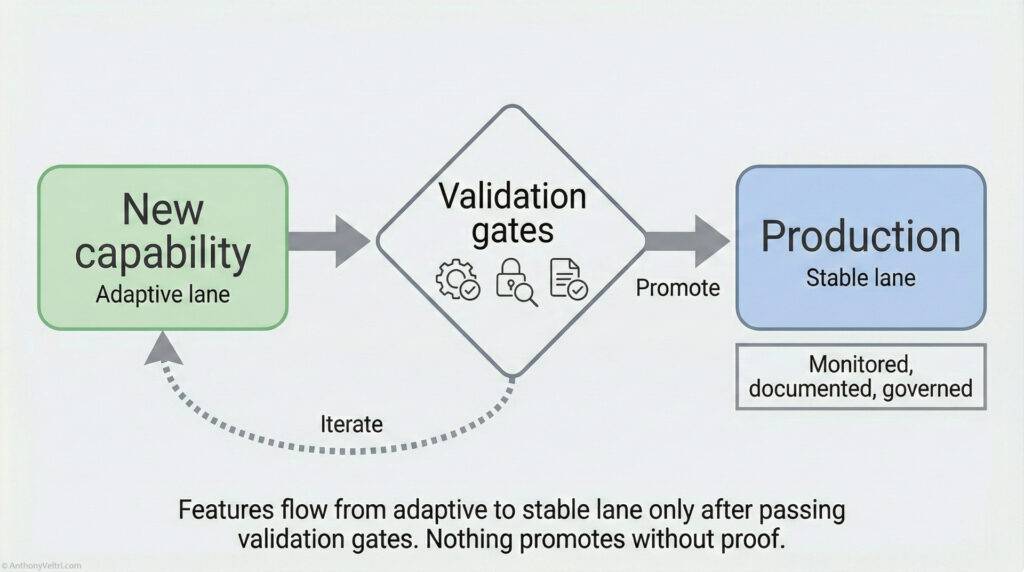
A flowchart showing “New capability” in a green box, passing “Validation gates,” then “Production” in a blue box. Features only move to production if validated; iteration returns features to new capability if needed.
The Innovation Loop. The edge (Green) is where new capabilities are born. The center’s job isn’t to invent them, but to validate them through a gate before promoting them to production (Blue).

In system language, edge innovation thrives because:

  • latency to problem context is minimal
  • user feedback forms a tight loop
  • coupling is local, not global
  • risk exposure is limited
  • prototyping is unconstrained
  • system variation encourages exploration
  • boundary conditions are visible
  • workflows are real, not imagined

Central innovation is disadvantaged because:

  • context is missing
  • the problem landscape is filtered
  • failure is more expensive
  • coupling is higher
  • experiments are slower
  • scale requirements dominate design
  • assumptions fill the gaps

Edge innovation is exploration.
Central innovation is refinement.


Why Central Innovation Fails (and keeps failing) #
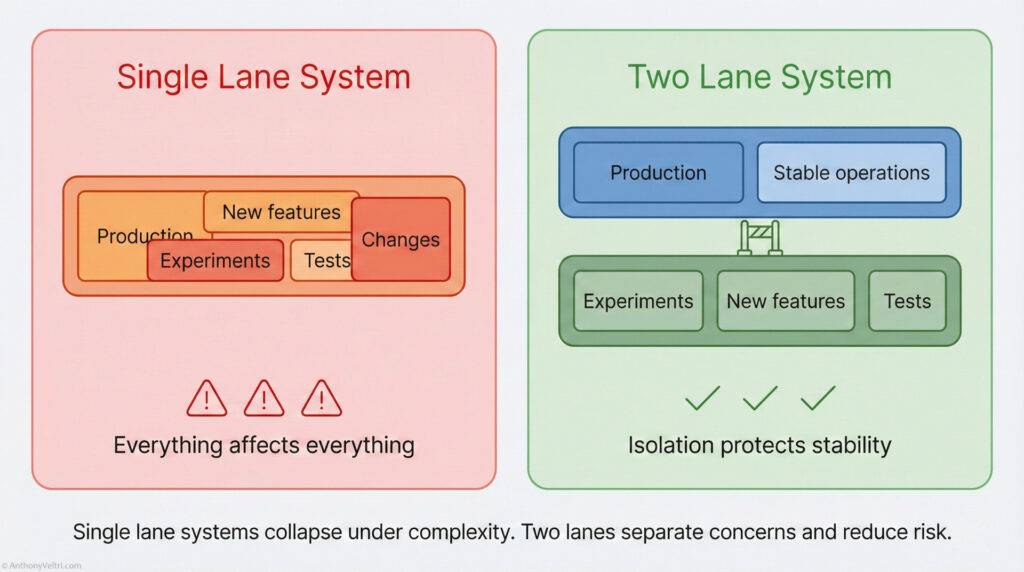
A diagram compares a Single Lane System, where changes, tests, experiments, and features overlap and cause risks, with a Two Lane System, where production and experiments are separated, protecting stability.
Why the Center Cannot Experiment. A single-lane system (Red) collapses if you try to experiment in production. To innovate safely, you must split the architecture into a Stable Lane and an Adaptive Lane (Green).

Business perspective #

Central innovation fails because:

  • it is disconnected from lived reality
  • solutions are designed for abstract users
  • committees slow iteration
  • budgets control creativity
  • leadership overestimates uniformity
  • approvals kill momentum
  • political incentives skew priorities

The result is technically beautiful, strategically irrelevant work.

System perspective #

Central innovation fails because:

  • the systems are too coupled to experiment safely
  • versioning requirements prevent fast changes
  • testing environments do not match real ones
  • edge cases are invisible
  • signals are filtered
  • complexity hides true constraints

The center builds theoretical elegance.
The edge builds usable truth.


Why Edge Innovation Succeeds #

Business perspective #

Edge innovation works because:

  • users build what they need
  • ideas emerge organically from friction
  • failures are small
  • successes are obvious
  • ownership drives adoption
  • no one needs a steering committee for a script
  • small wins scale upward

The center almost never has the problem first.
The edge always does.

System perspective #
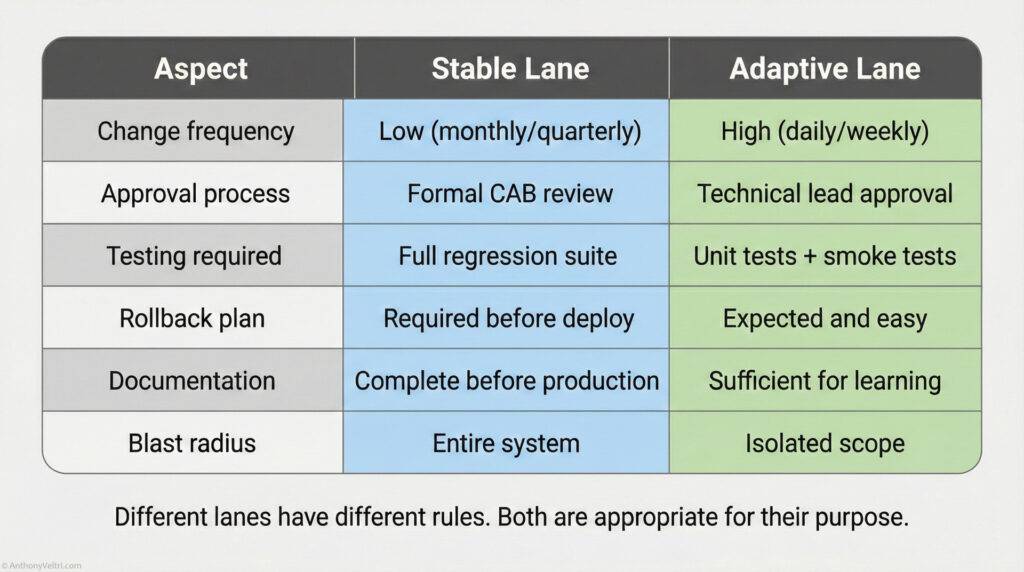
A table compares Stable Lane and Adaptive Lane across six aspects: change frequency, approval process, testing, rollback plan, documentation, and blast radius, highlighting stricter controls in Stable Lane and flexibility in Adaptive Lane.
Different Rules for Different Lanes. The edge (Adaptive Lane) needs speed, peer review, and isolated scope. The center (Stable Lane) needs regression testing and zero downtime. You cannot run both with one rulebook.

Edge innovation works because:

  • local systems are loosely coupled
  • experimentation is cheap
  • integration requirements are simpler
  • live constraints shape design
  • patterns emerge naturally
  • workflow context is immediate

The edge is a laboratory.
The center is a courtroom.


Business Example: The partner created the tool leadership wished they had funded #

A partner agency built a rough but highly effective mapping tool to visualize road closures and reroute logistics convoys faster than the main system could update.

Leadership was impressed.
But this tool never would have been approved through the central development pipeline because:

  • it bypassed standard processes
  • it solved a problem the center did not understand
  • it used tools not on the enterprise roadmap
  • it was built in two days instead of two quarters

The center eventually adopted its logic into the main platform.
The idea lived at the edge first.


System Example: iCAV’s best features started as edge hacks #
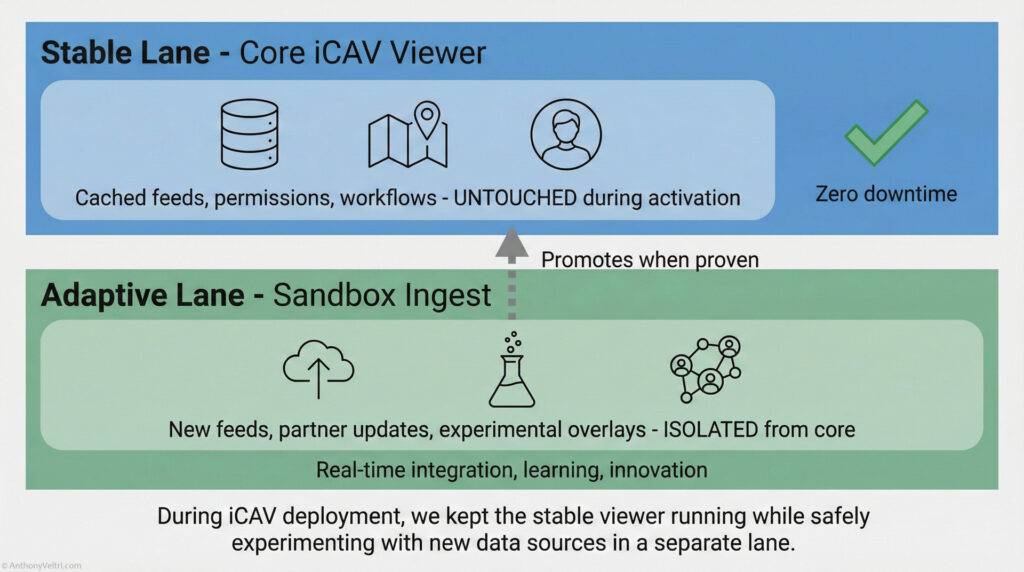
Diagram showing two lanes: "Stable Lane – Core iCAV Viewer" (blue, represents zero downtime and untouched activation) above "Adaptive Lane – Sandbox Ingest" (green, for new feeds and real-time innovation), with a promotion arrow between them.
We kept the core viewer stable (Blue) while letting the field experiment with new data in the sandbox (Green). Successful experiments were promoted; failures were discarded without breaking the mission.

Many of the best iCAV features were born not in planning meetings but in:

  • field analyst workflows
  • operator scripts
  • partner built preprocessors
  • hacky data normalization routines
  • pilot deployments with a handful of users

The central team rarely invented the solution.
The field did.

The central team then:

  • refined
  • secured
  • standardized
  • scaled
  • hardened

Innovation came from the edge.
Enterprise strength came from the center.

This is the correct sequence.


Architect-Level Principle #

As an architect, I design environments where innovation starts at the edge.
The center refines, secures, and scales.
The edge discovers truth.
The center codifies it.


Twenty Second Takeaway #

“Innovation does not start in program offices. It starts at the edge where people feel the problem directly. My job as an architect is to create the guardrails and pathways that let edge innovations emerge safely, then bring the best of them into the center to refine and scale.”


Cross Links to Other Principles #

Edge innovation directly supports:

  • Two-lane systems
  • Distributed decisions
  • Useful interoperability
  • Federation
  • Degraded operations
  • Portfolio thinking
  • Architecture accelerates

These principles reinforce each other.


Doctrine Diagnostic – For Reflection: #

Ask yourself:

Are the people closest to the problem allowed to experiment, or is every idea routed through headquarters first?

If the second is true, you are killing your own innovation.

Fix the pathways.

Field notes and examples #

  • Seeing the Dragon: The Magic Eye of Modern Governance
  • Field Note: Integration Debt vs Temporal Arbitrage
  • Systems Built On Heroics Are Brittle
  • Field Notes: What The Mobile Mapping Unit Taught Me About Forward-Deployed Systems
  • Field Notes: What I Learned Writing The Government Video Guide

Last Updated on December 9, 2025

Related Posts #

A black pen drawing of two rustic barn-like buildings sits on lined paper, with a pen resting at the edge and a brown, crumpled background visible behind the sheet.

Field Note: The 1790 Farmhouse and What It Taught Me About Stewardship #

This diagram illustrates increasing salary capacities, with larger houses on higher blocks representing $6k, $24k (median), and $80k per year.

Field Report: College Financing and the 5-Year Home Runway #

A geometric abstract background with circles, lines, and shapes in neutral tones, overlaid with a dark rectangle containing the text

Doctrine 06: A Two-Lane System Protects Stability and Enables Evolution #

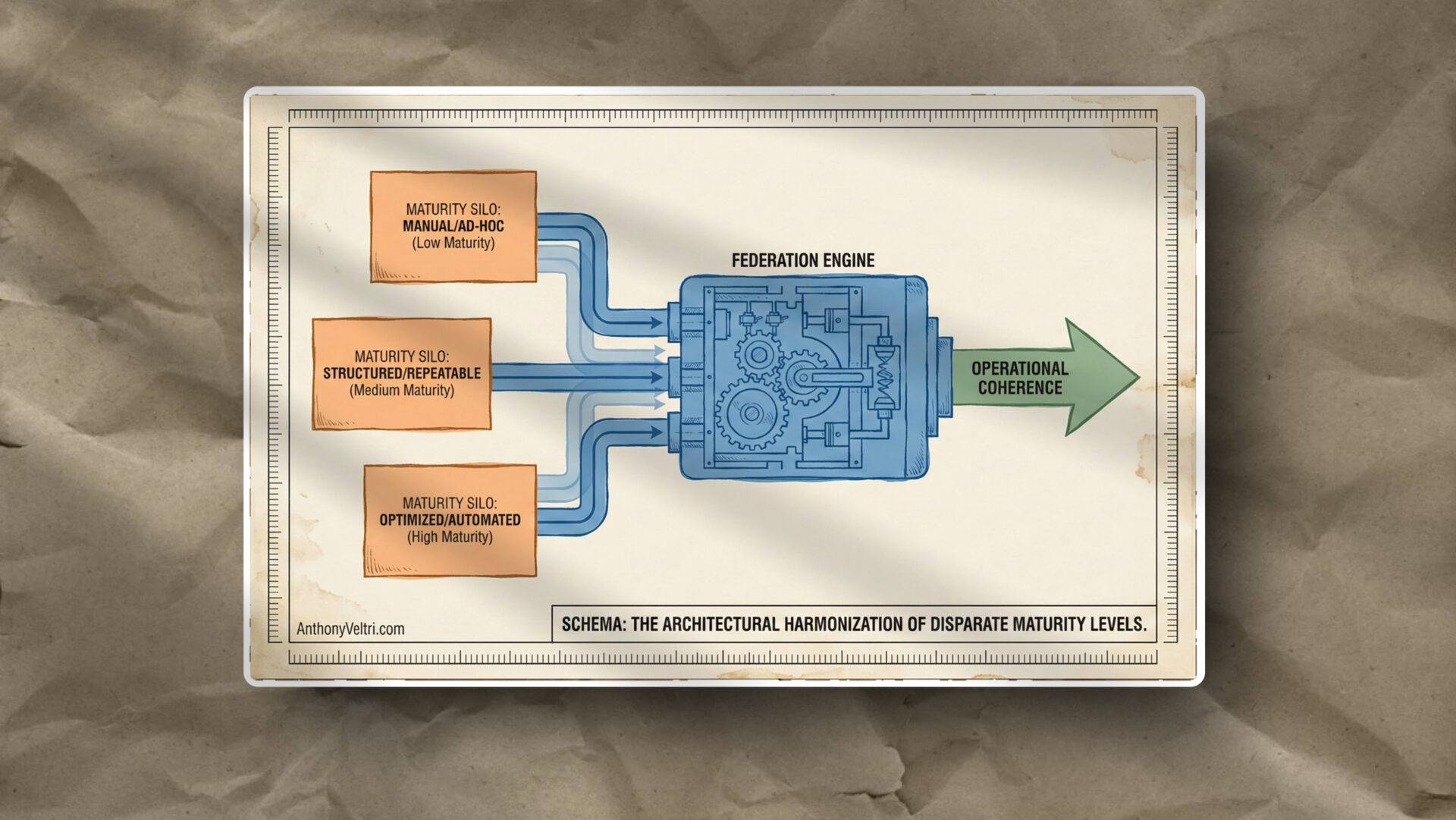
A diagram depicts three orange boxes labeled “Maturity Silo” (low, medium, high) feeding blue lines into a central “Federation Engine,” which outputs an arrow labeled “Operational Coherence.” The background looks like wrinkled brown paper.

Field Note: Compass-X Recognition Patterns and Strategic Framing #

This sepia-toned image highlights early logging practices, as seen by seven men on felled logs amid equipment and pine trees.

Field Note: Integration Debt vs Temporal Arbitrage #

This diagram illustrates the

Doctrine 03 Companion: The Interface Void #

architecture, governance, interfaces
Table of Contents
  • Why experiments succeed closer to real problems and fail inside central offices
  • Real innovation comes from friction, not conference rooms. Innovation happens where reality is felt.
  • Lived Example: The field analyst who invented a workflow the central team never imagined
  • Business Terms: Why edge innovation wins
  • System Terms: The mechanics of edge innovation
  • Why Central Innovation Fails (and keeps failing)
    • Business perspective
    • System perspective
  • Why Edge Innovation Succeeds
    • Business perspective
    • System perspective
  • Business Example: The partner created the tool leadership wished they had funded
  • System Example: iCAV’s best features started as edge hacks
  • Architect-Level Principle
  • Twenty Second Takeaway
  • Cross Links to Other Principles
  • Doctrine Diagnostic - For Reflection:

Share This Article :

  • Facebook
  • X
  • LinkedIn
  • Pinterest

Was it helpful ?

  • Happy
  • Normal
  • Sad
  • Privacy Policy
  • Introductions
  • Contact

© 2026 Anthony Veltri

  • Doctrine
    • Doctrine Library
    • Global Library
  • Field Notes
  • Routes
    • Route 01: When the Interface Is Breaking (and you are becoming the patch)
    • ROUTE 02: If decisions stall and meetings go nowhere, start here
    • ROUTE 03: If you have lots of projects but no portfolio clarity, start here
    • ROUTE 04: If you’re confused about federation vs integration, start here
    • ROUTE 05: If heroics are propping up your system, start here
    • ROUTE 06: If you cannot force compliance across partners, start here
    • ROUTE 07: If compliance exists but commitment does not, start here
    • ROUTE 08: If disconnected workflows create audit anxiety, start here
  • Figure Library
  • FAQ
  • About
    • Capability Statement
    • Interpreter Kit
  • Contact