Skip to content

Introduced by a trusted connector?

Start Here

Anthony Veltri

  • Doctrine
    • Doctrine Library
    • Global Library
  • Field Notes
  • Routes
    • Route 01: When the Interface Is Breaking (and you are becoming the patch)
    • ROUTE 02: If decisions stall and meetings go nowhere, start here
    • ROUTE 03: If you have lots of projects but no portfolio clarity, start here
    • ROUTE 04: If you’re confused about federation vs integration, start here
    • ROUTE 05: If heroics are propping up your system, start here
    • ROUTE 06: If you cannot force compliance across partners, start here
    • ROUTE 07: If compliance exists but commitment does not, start here
    • ROUTE 08: If disconnected workflows create audit anxiety, start here
  • Figure Library
  • FAQ
  • About
    • Capability Statement
    • Interpreter Kit
  • Contact
Anthony Veltri

Architecture & Interfaces

15
  • Doctrine 01: Federation vs Integration in Mission Networks
  • Doctrine 03: Interfaces Are Where Systems Break, So They Require Stewards, Contracts, and Ownership
  • Doctrine 04: Useful Interoperability Is the Goal, Not Perfect Interoperability
  • Doctrine 05: Innovation Must Live at the Edge, Not in the Center
  • Doctrine 06: A Two-Lane System Protects Stability and Enables Evolution
  • Doctrine 14: Technical Debt Is a Leadership Signal, Not a Coding Failure
  • Doctrine 15: Architecture Must Accelerate Teams, Not Bottleneck Them
  • Doctrine 17: Architects Translate Strategy Into Engineering and Engineering Into Strategy
  • Doctrine 20: Golden Datasets: Putting Truth In One Place Without Pretending Everything Is Perfect
  • Doctrine 21: Zero Trust Is A Trust Model, Not A Card “Type”
  • Doctrine 23: Loop Closure as Load-Bearing System Infrastructure
  • ANNEX B. Data Contracts
  • ANNEX C. Interface Ownership Model
  • ANNEX H. Architecture Doctrine
  • Annex L: The Rosetta Stone for Data Teams: Bridging the Gap Between Technicians and Executives

Decision Tempo & Governance

10
  • Doctrine 02: Distributed Decisions Increase Alignment, Speed, and Resilience
  • Doctrine 07: Clear Intent Matters More Than Perfect Data
  • Doctrine 08: Clear Intent Compresses Ambiguity, Reduces Conflict, and Accelerates Action
  • Doctrine 09: Decision Drag Is the Enemy of Mission Tempo. Architecture Is the Remedy
  • Doctrine 10: Degraded Operations Are the Normal Mode, Not the Exception
  • Doctrine 11: Preventive Action and Contingent Action Must Both Be Designed Intentionally
  • Doctrine 22: When “It Depends” Is the Right Answer: How to Think in Probabilities Under Uncertainty
  • ANNEX D. Decision Altitudes Model
  • ANNEX E. Prevention–Contingency Matrix
  • ANNEX I. High Visibility Workflows

Portfolio & Alignment

4
  • Doctrine 16: Portfolio Thinking Ensures Effort Aligns With What Actually Matters
  • ANNEX F. Pattern Library
  • ANNEX J. System Evolution and Drift Management
  • ANNEX K. System and Workflow Profiles (Case Studies)

Leadership & Human Systems

6
  • Doctrine 24: Stewardship Places the Burden on the Steward, Not the Parties
  • Doctrine 18: Commitment Outperforms Compliance in High Trust, High Tempo Environments
  • Doctrine 19: Supervision, Management, and Leadership Are Three Different Jobs. Confusing Them Breaks Systems
  • Doctrine 23: Loop Closure as Load-Bearing System Infrastructure
  • ANNEX A. Human Contracts
  • ANNEX G. Leadership Doctrine

Resilience & Operations

3
  • Doctrine 24: Stewardship Places the Burden on the Steward, Not the Parties
  • Doctrine 12: Resilience Is an Emergent Property, Not a Feature
  • Doctrine 13: Problem Solving Requires Finding the Real Deviation and the Relevant Change

Doctrine Companions

7
  • Doctrine 03 Companion: The RS-CAT Framework: Converting Raw Recall into Teachable Principle
  • Doctrine 03 Companion: The Interface Void
  • Doctrine 11 Companion: Agency vs. Outcome
  • Doctrine 09 Companion: Artifacts Over Adjectives
  • Doctrine 03 Companion: Constraints: bidirectional translation: Compression vs Construction
  • Doctrine 10 Companion: Span of Control and Cross Training Are Load-Bearing Constraints
  • Doctrine 21 Companion: Claims, Roles, and Entitlements in Microsoft 365

Field Reports

1
  • Field Report: College Financing and the 5-Year Home Runway
View Categories
  • Home
  • Doctrine & Supporting Guides
  • Architecture & Interfaces
  • Doctrine 03: Interfaces Are Where Systems Break, So They Require Stewards, Contracts, and Ownership

Doctrine 03: Interfaces Are Where Systems Break, So They Require Stewards, Contracts, and Ownership

Anthony Veltri
Updated on December 9, 2025

4 min read

Why boundaries fail first and why every interface needs a clear owner on each side #

This page is a Doctrine Guide. It shows how to apply one principle from the Doctrine in real systems and real constraints. Use it as a reference when you are making decisions, designing workflows, or repairing things that broke under pressure.


Systems rarely fail in the middle. They fail at the edges. #

In every complex system, the most fragile point is not the core.

It is the boundary:

  • between teams
  • between systems
  • between data sources
  • between authorities
  • between timelines
  • between contracts
  • between assumptions

Interfaces are fault lines.
They break first, break quietly, and break asymmetrically.

If you do not define them—and assign ownership—your system becomes a chain held together by hope.


Lived Example: The partner feed that “worked” but never lined up #
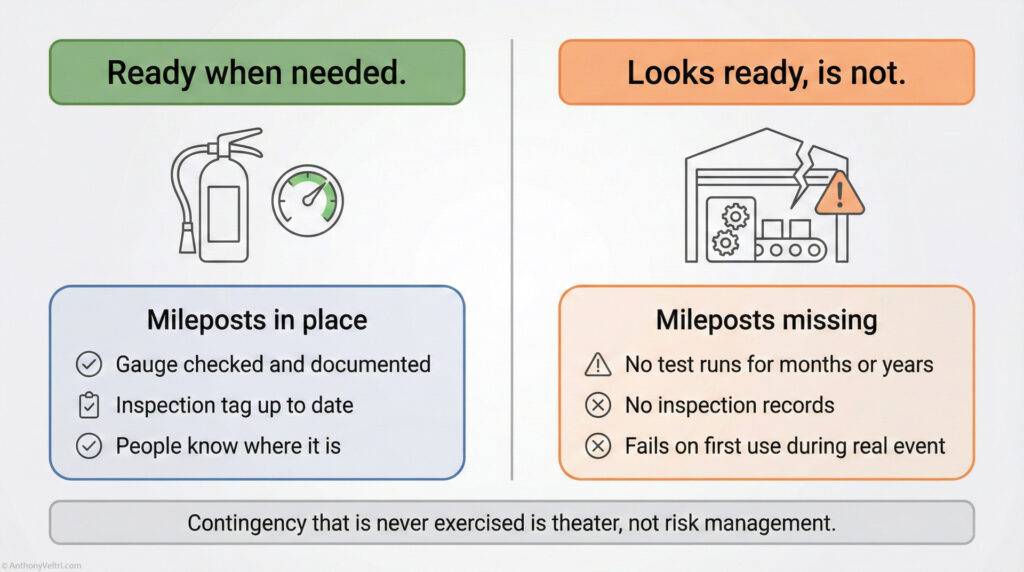
A comparison chart shows “Ready when needed” with checked fire extinguisher versus “Looks ready, is not” with a broken extinguisher box. It highlights the importance of regular checks and documentation for emergency readiness.
A comparison chart shows “Ready when needed” with checked fire extinguisher versus “Looks ready, is not” with a broken extinguisher box. It highlights the importance of regular checks and documentation for emergency readiness. Contingency vs Theater

During an activation, a partner agency insisted their feed was publishing correctly.

Technically, they were right.
Their service endpoint was available.
It returned valid data.
There was no error on their side.

But it failed at the interface:

  • their geometry was misaligned
  • their schema did not match our expectations
  • their timestamps drifted
  • their refresh rate was lower than advertised
  • their service intermittently returned partial sets

Everything inside their system worked.
Everything inside our system worked.

The failure was at the boundary.
There was no shared contract.
There was no shared owner.
There was no shared understanding of what “working” meant.

Once we defined the interface contract, the failure disappeared.

Interfaces break first.

Architects fix the boundaries.


Business Terms: Why interfaces matter #

Interfaces matter because:

  • this is where misunderstandings hide
  • this is where assumptions collide
  • this is where scope slips
  • this is where partners blame each other
  • this is where timelines misalign
  • this is where escalation begins
  • this is where trust erodes

Inside teams, communication is usually strong.
Across teams, communication becomes filtered, delayed, and political.

Interfaces are where leadership must pay attention.


System Terms: What an interface actually is #

An interface is:

  • a boundary
  • a contract
  • a promise
  • a data structure
  • a behavioral expectation
  • a refresh rate
  • an authentication model
  • an error handling agreement
  • a versioning plan

Interfaces are agreements, not pipes.

When architects fail to define them:

  • coupling increases
  • ambiguity grows
  • error cascades multiply
  • drift accumulates
  • failure detection becomes slow and expensive
  • ownership becomes contested

Every poorly defined interface becomes a long term problem.


Why Interfaces Fail #

Business perspective #

Interfaces fail because:

  • expectations differ
  • success is defined differently
  • teams assume “the other side” will adjust
  • responsibilities are unclear
  • authorities overlap
  • timelines mismatch
  • communication breaks down
  • nobody wants to own problems that originate “outside”

A system without explicit interface ownership collapses into finger pointing.

System perspective #

Interfaces fail because:

  • schemas drift
  • formats evolve
  • time stamps misalign
  • refresh rates change
  • update cadences differ
  • error states are undocumented
  • retries are poorly understood
  • authentication rotates without warning
  • hidden assumptions compound over time

Interfaces fail because systems evolve.
Contracts prevent that evolution from becoming chaos.


Why Contracts Fix Interfaces #

An interface contract clarifies:

  • what each side promises
  • what “working” looks like
  • what tolerances exist
  • what versioning means
  • what happens when something breaks
  • who responds first
  • what “stable” means during activation
  • what minimum viable publication looks like
  • what “we will fix it after the storm” actually means

Without contracts, both sides act on wishful thinking.

With contracts, both sides act on shared expectations.


Two Types of Interface Contracts #
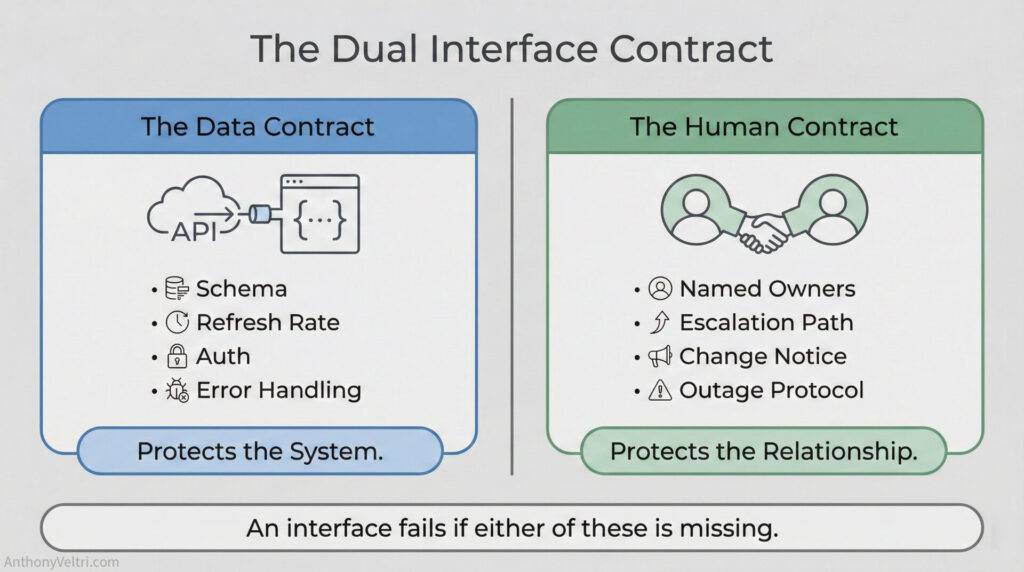
A diagram titled "The Dual Interface Contract" shows two sections: The Data Contract, with technology icons and bullet points for schema, refresh rate, auth, error handling, and "Protects the System"; and The Human Contract, with handshake icons and bullet points for named owners, escalation path, change notice, outage protocol, and "Protects the Relationship." A note below states an interface fails if either contract is missing.
You should distinguish between the Data Contract (Schema, API) and the Human Contract (Escalation, Roles).

You will use both in your doctrine.

1. Data Contract #

Defines the technical and behavioral boundary.

Must include:

  • schema
  • attributes
  • geometry expectations
  • refresh rate
  • time stamping rules
  • authentication method
  • fallback behavior
  • error handling
  • versioning
  • minimum viable publication

This contract protects the system.

2. Human Contract #

Defines the responsibilities and roles between people.

Must include:

  • who owns the feed on their side
  • who owns the ingestion on our side
  • how we escalate
  • how we communicate during outages
  • how we announce changes
  • how we interpret urgent needs
  • what autonomy each side has
  • what cannot be changed during an activation

This contract protects the relationship.

Both are required for resilient systems.


Business Example: Two owners solved what six months of calls could not #

A multi agency integration stalled for months because:

  • engineers talked only to engineers
  • managers talked only to managers
  • leadership talked only to leadership

Nobody owned the interface together.

We established a two owner model:

  • one owner on their side
  • one owner on our side
  • weekly sync
  • shared definition of success
  • shared versioning agreement
  • shared change log

The integration completed in three weeks.

Interfaces do not need committees.
They need owners.


System Example: The iCAV harmonization layer saved dozens of broken interfaces #
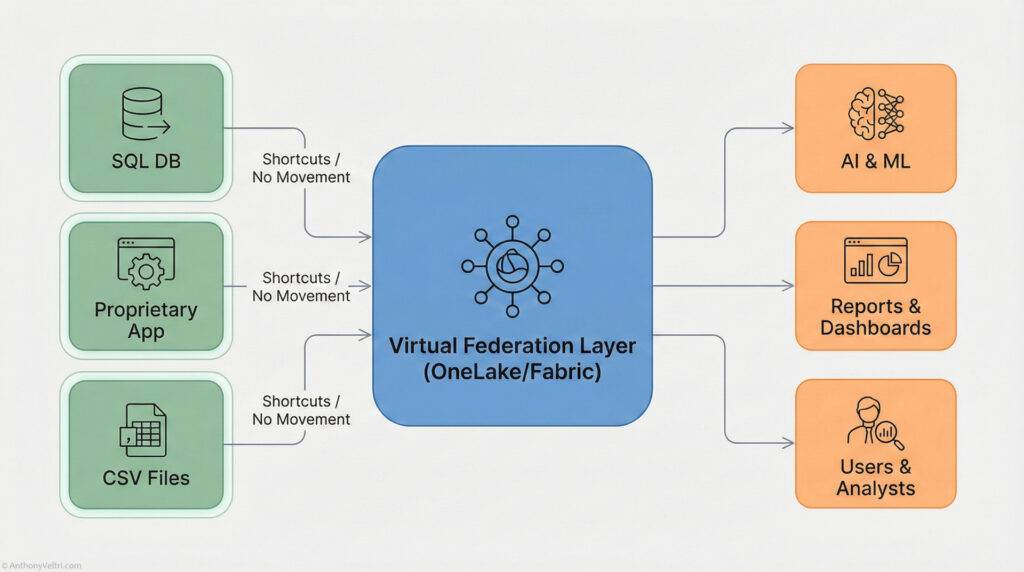
Diagram showing SQL DB, Proprietary App, and CSV Files connecting via a Virtual Federation Layer (OneLake/Fabric) to AI & ML, Reports & Dashboards, and Users & Analysts. Shortcuts/No Movement noted for each input source.
The concept of federation shows up everywhere. This chart visualizes the exact architecture we are describing: taking disparate inputs (CSV, SQL) and harmonizing them via shortcuts/connectors.

In iCAV:

  • some feeds were too slow
  • some were malformed
  • some were insecure
  • some used legacy projections
  • some included garbage geometry
  • some missed critical fields

Rather than forcing integration, we created:

  • harmonization patterns
  • tolerant parsing
  • schema mapping
  • confidence scoring
  • caching
  • fallback modes
  • partner specific connectors

Each connector acted as a controlled interface boundary with:

  • explicit expectations
  • explicit behavior
  • explicit ownership

This prevented the entire system from collapsing under diversity.


Architect-Level Principle #
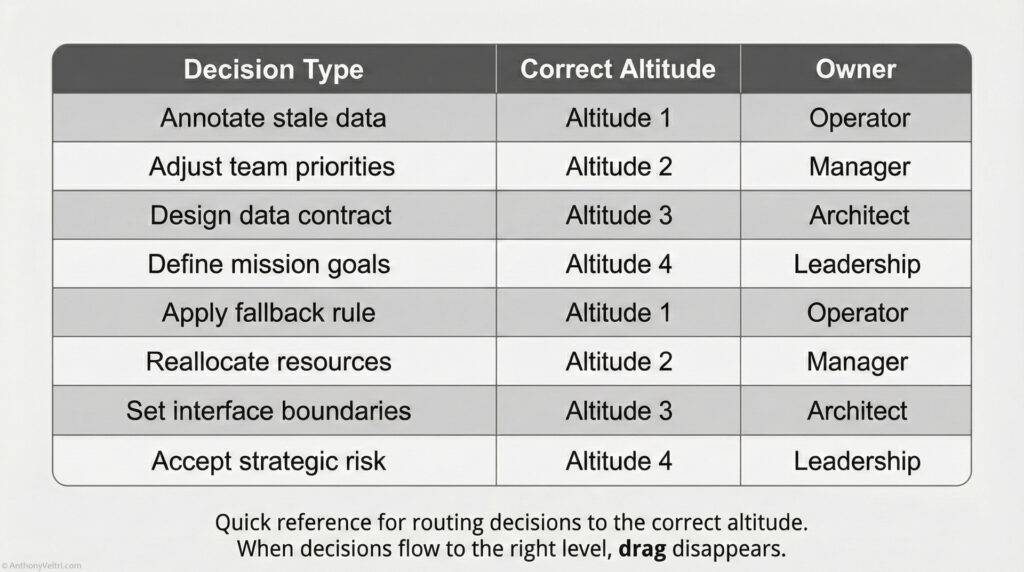
A table showing decision types, their correct altitudes, and owners: Annotate stale data—Operator; Adjust team priorities—Manager; Design data contract—Architect; Define mission goals—Leadership, with related altitudes.
Types of decisions, who owns them, and their “decision altitude.”

As an architect, I treat interfaces as the most fragile part of the system.
I define contracts.
I assign owners.
I design boundaries so failures stay local and do not cascade.


Twenty Second Takeaway: #

“Systems do not fail in the center. They fail at the boundaries between teams and systems. I define clear interface contracts and assign owners on each side so that ambiguity does not become failure. That is how I prevent small issues from turning into systemic outages.”


Cross Links to Other Principles #

Interfaces connect tightly with:

  • Useful interoperability
  • Federation
  • Two lane systems
  • Emergent resilience
  • Degraded operations
  • Decision drag
  • Technical debt as leadership signal
  • Distributed decisions

Interfaces are the friction points that every other principle supports.


Doctrine Diagnostic – For Reflection: #

Ask yourself:
Where are your system’s true boundaries?
Do they have owners?
Do they have contracts?

If not, that is where failure will begin.

Define the boundaries before they define the failure.

Field notes and examples #

  • Field Note: Sorting the 20-Year Backpack
  • The Loudest Listener: When Interviews Become Something Else
  • Field Note: Defining “Operator”
  • Why I Kept Quiet: A Field Note on the Stewardship of Operational Knowledge
  • Field Note: The 1790 Farmhouse and What It Taught Me About Stewardship
  • Hoover Dam Lessons: “Proudly Maintained By Mike E.”
  • Culture As Invisible Spec: Training A Media Specialist For Wildland Fire
  • Interfaces Break First: Designing For Partial Truth
  • Living With Incomplete Pictures: Notes From High Tempo Systems
  • Proudly Maintained: Why Systems Need A Nameplate

Last Updated on December 9, 2025

Related Posts #

Abstract graphic with geometric shapes, lines, and dots in neutral and orange tones. A large dark rectangle overlays the left side with the white text:

DOCTRINE 24: Stewardship Places the Burden on the Steward, Not the Parties #

This slide illustrates the principle that loop closure is structural, as highlighted by the modern, technical design elements.

Doctrine 23: Loop Closure as Load-Bearing System Infrastructure #

This diagram illustrates increasing salary capacities, with larger houses on higher blocks representing $6k, $24k (median), and $80k per year.

Field Report: College Financing and the 5-Year Home Runway #

A graphic with the text

ANNEX C. Interface Ownership Model #

A black pen drawing of two rustic barn-like buildings sits on lined paper, with a pen resting at the edge and a brown, crumpled background visible behind the sheet.

Field Note: The 1790 Farmhouse and What It Taught Me About Stewardship #

A graphic with the title

ANNEX B. Data Contracts #

architecture, federation, interfaces, resilience
Table of Contents
  • Why boundaries fail first and why every interface needs a clear owner on each side
  • Systems rarely fail in the middle. They fail at the edges.
  • Lived Example: The partner feed that “worked” but never lined up
  • Business Terms: Why interfaces matter
  • System Terms: What an interface actually is
  • Why Interfaces Fail
    • Business perspective
    • System perspective
  • Why Contracts Fix Interfaces
  • Two Types of Interface Contracts
    • 1. Data Contract
    • 2. Human Contract
  • Business Example: Two owners solved what six months of calls could not
  • System Example: The iCAV harmonization layer saved dozens of broken interfaces
  • Architect-Level Principle
  • Twenty Second Takeaway:
  • Cross Links to Other Principles
  • Doctrine Diagnostic - For Reflection:

Share This Article :

  • Facebook
  • X
  • LinkedIn
  • Pinterest

Was it helpful ?

  • Happy
  • Normal
  • Sad
  • Privacy Policy
  • Introductions
  • Contact

© 2026 Anthony Veltri

  • Doctrine
    • Doctrine Library
    • Global Library
  • Field Notes
  • Routes
    • Route 01: When the Interface Is Breaking (and you are becoming the patch)
    • ROUTE 02: If decisions stall and meetings go nowhere, start here
    • ROUTE 03: If you have lots of projects but no portfolio clarity, start here
    • ROUTE 04: If you’re confused about federation vs integration, start here
    • ROUTE 05: If heroics are propping up your system, start here
    • ROUTE 06: If you cannot force compliance across partners, start here
    • ROUTE 07: If compliance exists but commitment does not, start here
    • ROUTE 08: If disconnected workflows create audit anxiety, start here
  • Figure Library
  • FAQ
  • About
    • Capability Statement
    • Interpreter Kit
  • Contact