Skip to content

Introduced by a trusted connector?

Start Here

Anthony Veltri

  • Doctrine
    • Doctrine Library
    • Global Library
  • Field Notes
  • Routes
    • Route 01: When the Interface Is Breaking (and you are becoming the patch)
    • ROUTE 02: If decisions stall and meetings go nowhere, start here
    • ROUTE 03: If you have lots of projects but no portfolio clarity, start here
    • ROUTE 04: If you’re confused about federation vs integration, start here
    • ROUTE 05: If heroics are propping up your system, start here
    • ROUTE 06: If you cannot force compliance across partners, start here
    • ROUTE 07: If compliance exists but commitment does not, start here
    • ROUTE 08: If disconnected workflows create audit anxiety, start here
  • Figure Library
  • FAQ
  • About
    • Capability Statement
    • Interpreter Kit
  • Contact
Anthony Veltri

Architecture & Interfaces

15
  • Doctrine 01: Federation vs Integration in Mission Networks
  • Doctrine 03: Interfaces Are Where Systems Break, So They Require Stewards, Contracts, and Ownership
  • Doctrine 04: Useful Interoperability Is the Goal, Not Perfect Interoperability
  • Doctrine 05: Innovation Must Live at the Edge, Not in the Center
  • Doctrine 06: A Two-Lane System Protects Stability and Enables Evolution
  • Doctrine 14: Technical Debt Is a Leadership Signal, Not a Coding Failure
  • Doctrine 15: Architecture Must Accelerate Teams, Not Bottleneck Them
  • Doctrine 17: Architects Translate Strategy Into Engineering and Engineering Into Strategy
  • Doctrine 20: Golden Datasets: Putting Truth In One Place Without Pretending Everything Is Perfect
  • Doctrine 21: Zero Trust Is A Trust Model, Not A Card “Type”
  • Doctrine 23: Loop Closure as Load-Bearing System Infrastructure
  • ANNEX B. Data Contracts
  • ANNEX C. Interface Ownership Model
  • ANNEX H. Architecture Doctrine
  • Annex L: The Rosetta Stone for Data Teams: Bridging the Gap Between Technicians and Executives

Decision Tempo & Governance

10
  • Doctrine 02: Distributed Decisions Increase Alignment, Speed, and Resilience
  • Doctrine 07: Clear Intent Matters More Than Perfect Data
  • Doctrine 08: Clear Intent Compresses Ambiguity, Reduces Conflict, and Accelerates Action
  • Doctrine 09: Decision Drag Is the Enemy of Mission Tempo. Architecture Is the Remedy
  • Doctrine 10: Degraded Operations Are the Normal Mode, Not the Exception
  • Doctrine 11: Preventive Action and Contingent Action Must Both Be Designed Intentionally
  • Doctrine 22: When “It Depends” Is the Right Answer: How to Think in Probabilities Under Uncertainty
  • ANNEX D. Decision Altitudes Model
  • ANNEX E. Prevention–Contingency Matrix
  • ANNEX I. High Visibility Workflows

Portfolio & Alignment

4
  • Doctrine 16: Portfolio Thinking Ensures Effort Aligns With What Actually Matters
  • ANNEX F. Pattern Library
  • ANNEX J. System Evolution and Drift Management
  • ANNEX K. System and Workflow Profiles (Case Studies)

Leadership & Human Systems

6
  • Doctrine 24: Stewardship Places the Burden on the Steward, Not the Parties
  • Doctrine 18: Commitment Outperforms Compliance in High Trust, High Tempo Environments
  • Doctrine 19: Supervision, Management, and Leadership Are Three Different Jobs. Confusing Them Breaks Systems
  • Doctrine 23: Loop Closure as Load-Bearing System Infrastructure
  • ANNEX A. Human Contracts
  • ANNEX G. Leadership Doctrine

Resilience & Operations

3
  • Doctrine 24: Stewardship Places the Burden on the Steward, Not the Parties
  • Doctrine 12: Resilience Is an Emergent Property, Not a Feature
  • Doctrine 13: Problem Solving Requires Finding the Real Deviation and the Relevant Change

Doctrine Companions

7
  • Doctrine 03 Companion: The RS-CAT Framework: Converting Raw Recall into Teachable Principle
  • Doctrine 03 Companion: The Interface Void
  • Doctrine 11 Companion: Agency vs. Outcome
  • Doctrine 09 Companion: Artifacts Over Adjectives
  • Doctrine 03 Companion: Constraints: bidirectional translation: Compression vs Construction
  • Doctrine 10 Companion: Span of Control and Cross Training Are Load-Bearing Constraints
  • Doctrine 21 Companion: Claims, Roles, and Entitlements in Microsoft 365

Field Reports

1
  • Field Report: College Financing and the 5-Year Home Runway
View Categories
  • Home
  • Doctrine & Supporting Guides
  • Architecture & Interfaces
  • Doctrine 14: Technical Debt Is a Leadership Signal, Not a Coding Failure

Doctrine 14: Technical Debt Is a Leadership Signal, Not a Coding Failure

Anthony Veltri
Updated on December 5, 2025

4 min read

Why accumulated debt reveals decision environments, not developer shortcomings #

This Doctrine guide redefines Technical Debt as Institutional Pressure, not (just) bad code.

This page is a Doctrine Guide. It shows how to apply one principle from the Doctrine in real systems and real constraints. Use it as a reference when you are making decisions, designing workflows, or repairing things that broke under pressure.


Technical debt is not a mistake. It is a message. #
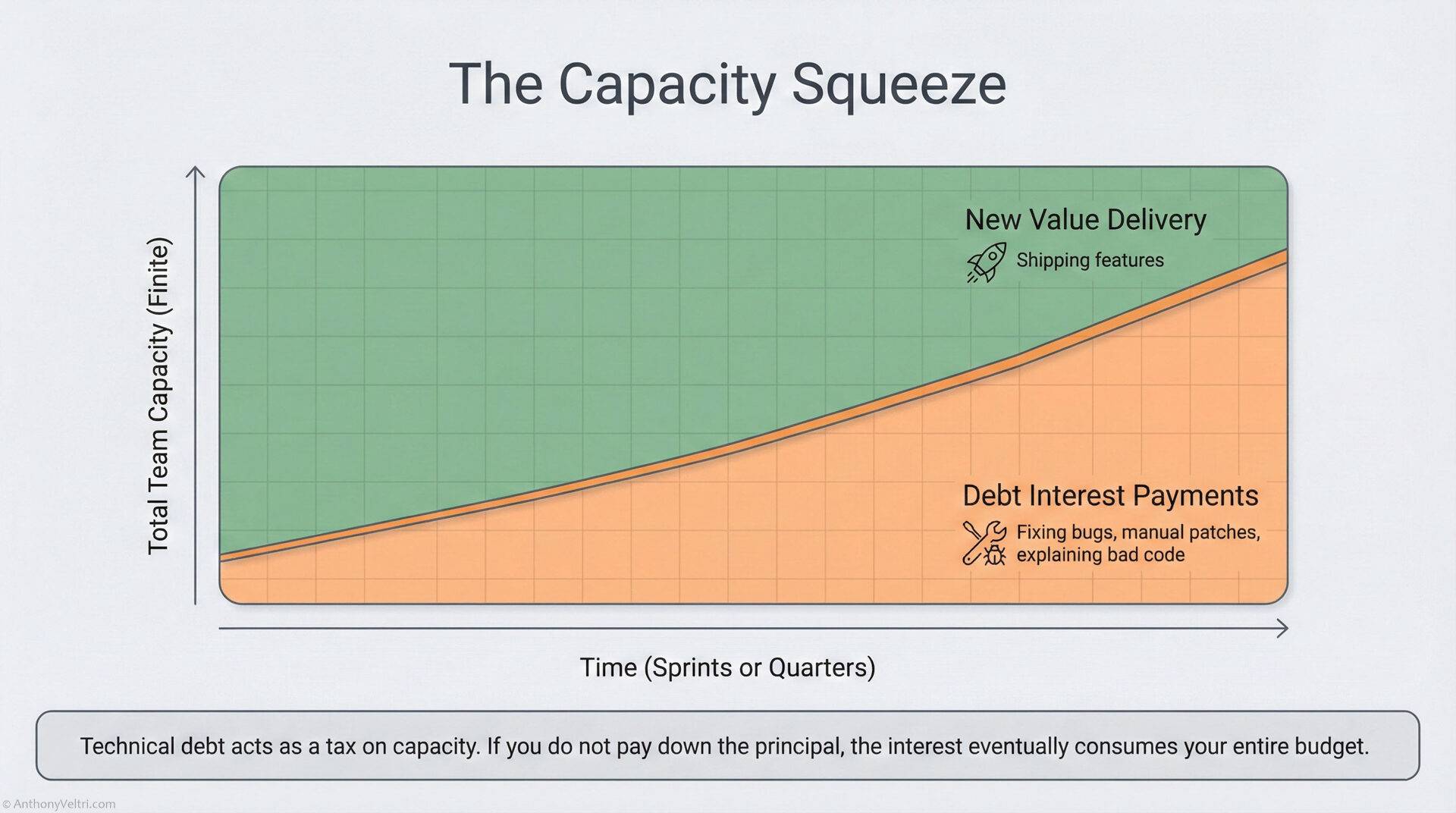
A graph titled "The Capacity Squeeze" shows team capacity over time split into two areas: green (new value delivery) increases slowly, while orange (debt interest payments) grows, reducing capacity for new features.
The Capacity Squeeze. Technical debt acts as interest on your capacity. As debt (Orange) grows, it consumes the bandwidth available for new value (Green), eventually bringing the team to a standstill.

When leaders see technical debt, they often look for the engineer who “did it wrong.”

This is the wrong instinct.

Technical debt is rarely created by:

  • incompetence
  • laziness
  • poor engineering

Technical debt is usually created by:

  • unclear intent
  • shifting priorities
  • rapid timelines
  • political pressure
  • under staffing
  • under scoping
  • leadership indecision
  • architecture not protecting the team
  • forced compliance over commitment

Debt is not a coding artifact.
Debt is a leadership artifact.


Lived Example: The rushed connector that became permanent #

During one activation, we created a temporary connector to support a partner whose feed was unreliable.

The connector was:

  • brittle
  • barely documented
  • built in a hurry
  • intended to last forty-eight hours

But leadership:

  • saw it working
  • adopted it as permanent
  • never funded a replacement
  • never approved downtime
  • never created a migration window

Months later, this “temporary” solution became a major source of outages.

The engineering team did not fail.
Leadership failed to create the conditions for replacement.

Debt became embedded because the system rewarded short-term wins over long-term stability.

Technical debt signals leadership behavior.


Business Terms: What technical debt actually reveals #

Technical debt reveals:

  • the real priorities of the organization
  • the gap between stated timelines and real timelines
  • the pressure leaders put on teams
  • where ambiguity exists
  • where incentives conflict
  • where documentation is sacrificed
  • where short term gains are needed
  • where the stable lane is under protected
  • where innovation is happening without guardrails

Debt is not technical.
Debt is informational.

It tells you what leadership had to trade off.


System Terms: Technical debt as structural imbalance #
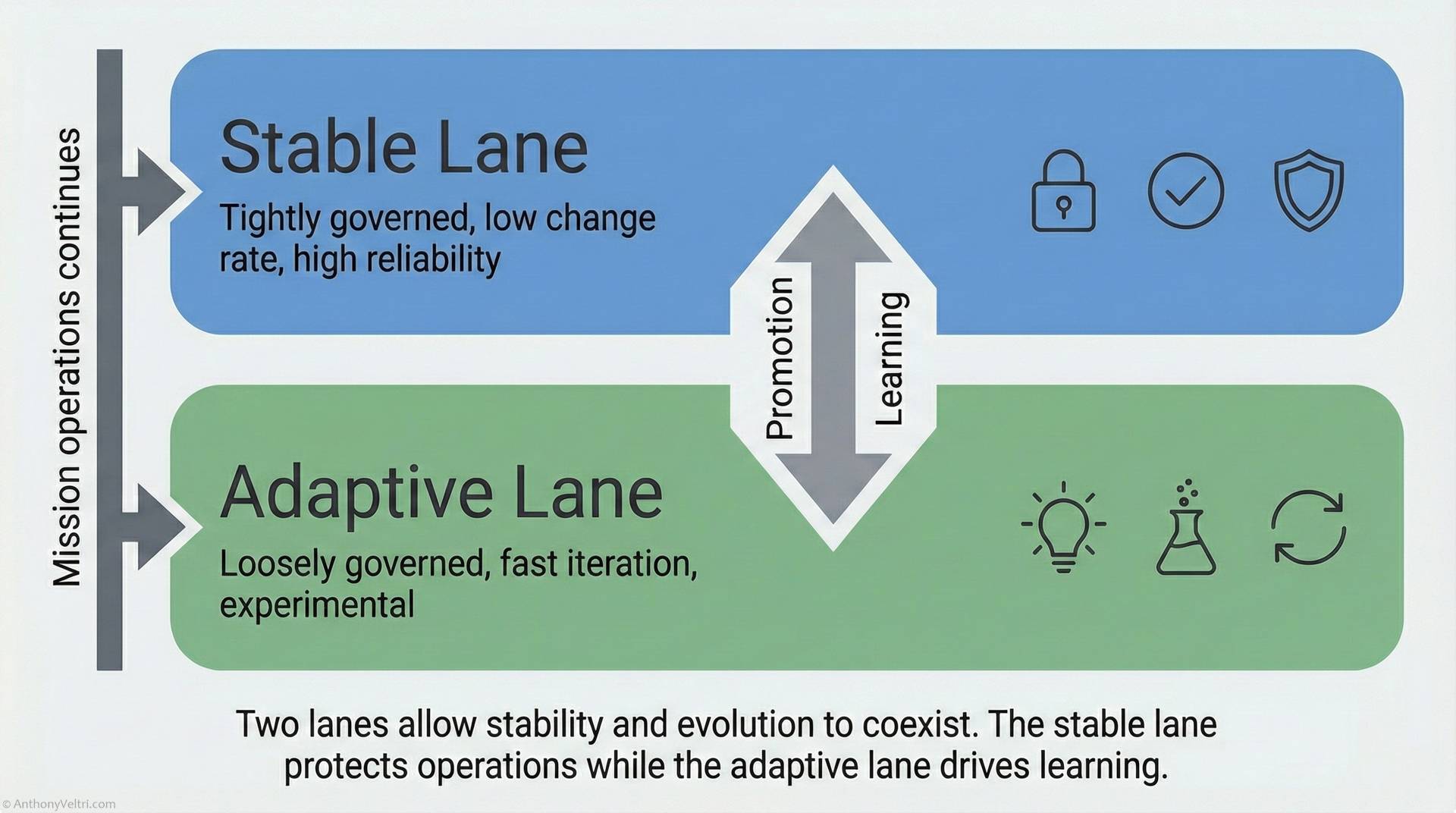
A diagram shows two lanes: Stable Lane (blue, reliable, low change rate) and Adaptive Lane (green, experimental, fast iteration). An arrow between them indicates promotion and learning. Text explains the lanes' complementary roles.
The Two-Lane Model. The stable lane (Blue) protects operations. The adaptive lane (Green) drives learning. The arrows show the relationship: Promotion (Up) and Learning (Down). Paying Down Debt: The only way to manage debt sustainably is to separate the Stable Lane (Protection) from the Adaptive Lane (Innovation). Without this separation, every experiment becomes permanent debt.

In system language, technical debt is:

  • structural pressure
  • accumulated coupling
  • hidden complexity
  • postponed alignment
  • acquired brittleness
  • a signal that the system’s rate of change exceeded its rate of consolidation

Technical debt is not a bug.
It is a snapshot of the system’s evolution under constraints.


Why Technical Debt Is Misunderstood #

Business perspective #

Leaders often misunderstand technical debt as:

  • sloppy engineering
  • incomplete documentation
  • poor workmanship
  • “fix it when you have time” problems

This leads to:

  • blame
  • distrust
  • morale issues
  • friction
  • micromanagement
  • tension between leadership and engineering

When technical debt becomes personal, the culture collapses.

System perspective #

Technical debt is misunderstood because:

  • systems evolve faster than governance
  • interfaces drift
  • roadmaps are aspirational
  • crises force shortcuts
  • funding is episodic
  • incentives reward delivery over consolidation

Debt is not misbehavior.
Debt is the price of speed and survival.


Why Technical Debt Is a Leadership Signal #
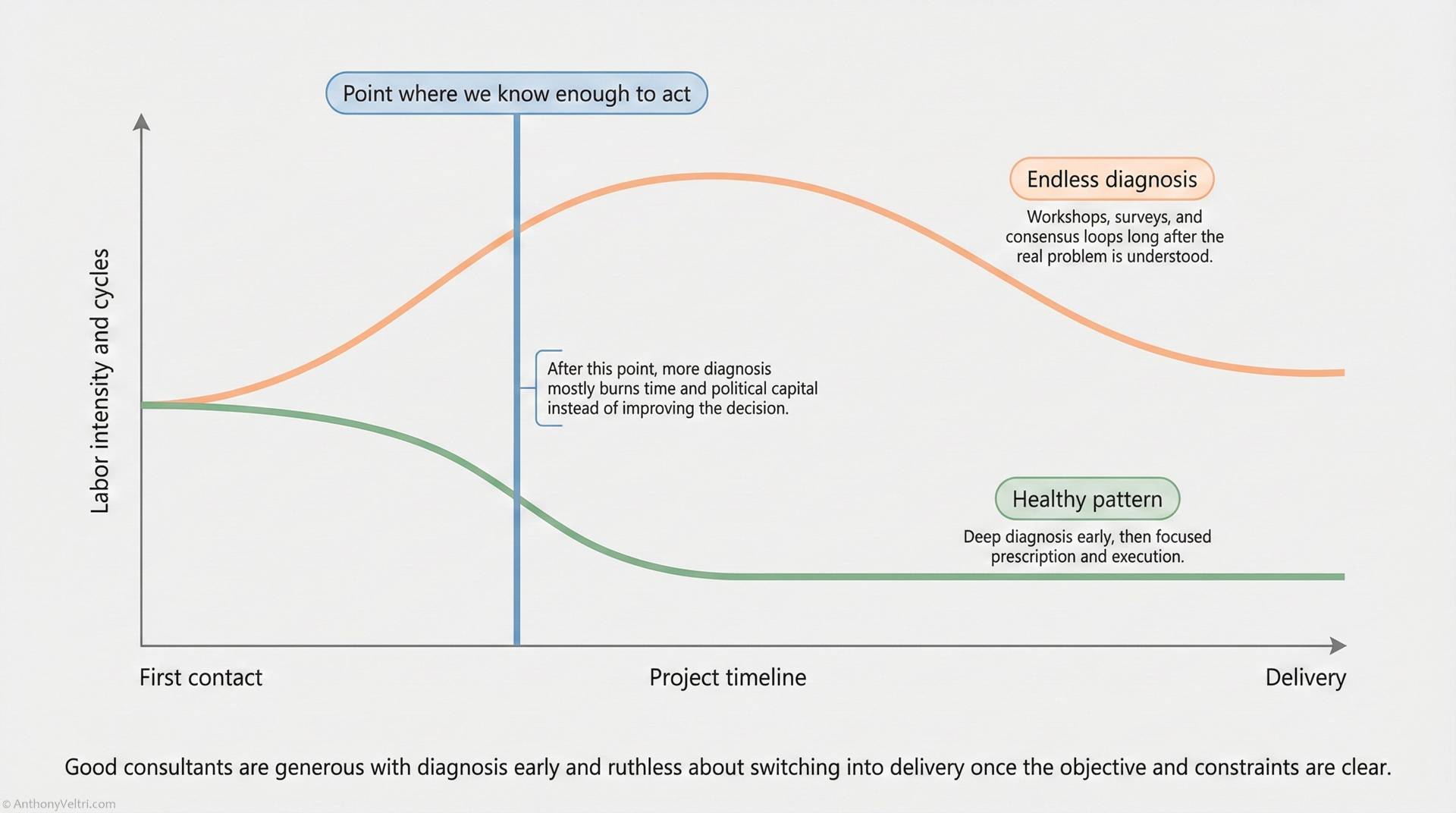
A graph shows labor intensity and cycles over a project timeline. It contrasts "Endless diagnosis" (prolonged analysis, orange line) with a "Healthy pattern" (focused action after initial diagnosis, green line), from first contact to delivery.
The Cost of Rushing. When leadership forces delivery before diagnosis is complete (Orange Line), the project enters “Endless Diagnosis” mode… a (permanent) state of technical debt and rework.

Technical debt tells you:

  • where leadership made trade-offs
  • where intent was unclear
  • where priorities shifted without time to align
  • where engineering was forced to deliver prematurely
  • where teams operate under chronic overload
  • where approvals bottlenecked
  • where decision drag forced last minute action
  • where architects were not empowered
  • where the stable lane was compromised
  • where governance is underdeveloped

Debt is a symptom of leadership environment, not individual capacity.


Business Example: The team that accumulated debt because leadership changed direction five times #
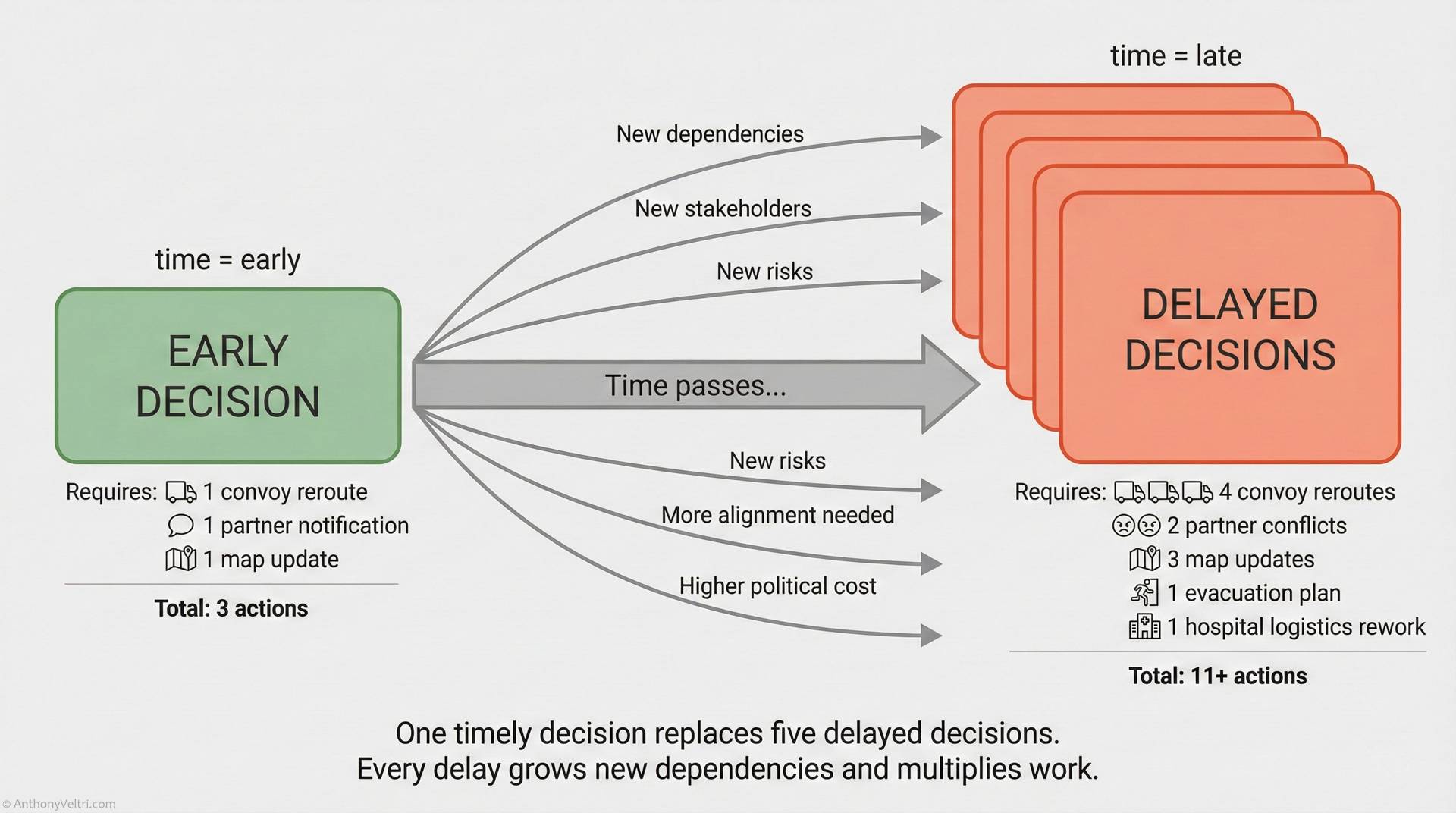
A flowchart compares early and delayed decisions. Early decision (left) leads to 3 actions; delayed decisions (right) lead to 11+ actions, more risks, costs, and dependencies. Text below states delays multiply work.
The Cost of Waiting and the Multiplication of Effort (compounding interest). Waiting for perfect data is not free. It exponentially increases the dependencies and effort required to achieve the same result later. In this example, a decision made early requires 3 actions. The same decision made late requires 11+ actions because dependencies have grown in the meantime.

During one modernization cycle, leadership changed priorities repeatedly:

  • new direction
  • new partner
  • new interface
  • new timeline
  • new prototype

Each shift was reasonable in isolation.
Cumulatively, they created:

  • rushed work
  • partial implementations
  • deferred decisions
  • incomplete documentation
  • hurried integration

By the end, the debt was not a record of engineering failure.
It was a record of leadership uncertainty.


System Example: The cascading debt inside the ingest pipeline #

In one ingest subsystem, we found:

  • three unused transformation routines
  • two deprecated schemas
  • one fallback method no one understood
  • four partial implementations
  • two undocumented exceptions
  • mismatched versioning patterns

This was not because engineers were careless.
This was because:

  • partner schemas changed
  • political pressure accelerated timelines
  • requirements were unclear
  • leadership shifted priorities mid sprint
  • testing windows were constrained
  • ingest was forced into the stable lane during activations

The debt recorded the organization’s history.

Debt is a narrative of decisions.


Architect Level Principle #

As an architect, I treat technical debt as a leadership signal.
It reveals where priorities, constraints, and pressures shaped the system.
My job is to understand the story and redesign the environment so debt accumulates in predictable, manageable ways.


Twenty Second Takeaway: #

“Technical debt is not caused by bad coding. It is caused by leadership pressure, unclear intent, shifting priorities, and real-world constraints. I use debt as a diagnostic tool to understand what the system had to survive. Then I design guardrails so future debt accumulates in healthier ways.”


Cross Links to Other Principles #

Technical debt links naturally to:

  • Two-lane systems
  • Interfaces and ownership
  • Useful interoperability
  • Federation
  • Decision drag
  • Portfolio thinking
  • Emergent resilience
  • Clear intent
  • Architect as translator

Debt always reveals upstream failures or pressures from these principles.


Doctrine Diagnostic – For Reflection: #

Ask yourself:

When you see technical debt, what do you assume?

Do you assume failure?
Or do you assume a signal?

If you assume a signal, you will discover the truth faster.

Use debt as a diagnostic.
Not as a weapon.

Last Updated on December 5, 2025

Related Posts #

This diagram illustrates increasing salary capacities, with larger houses on higher blocks representing $6k, $24k (median), and $80k per year.

Field Report: College Financing and the 5-Year Home Runway #

This diagram illustrates differences between a propagation model and field data, emphasizing real-world effects near structures.

Model vs. Terrain: Bridging the Interface Void on the Merritt Parkway #

This diagram illustrates the

Doctrine 03 Companion: The Interface Void #

This sepia-toned image highlights early logging practices, as seen by seven men on felled logs amid equipment and pine trees.

Field Note: Integration Debt vs Temporal Arbitrage #

This slide illustrates the principle that loop closure is structural, as highlighted by the modern, technical design elements.

Doctrine 23: Loop Closure as Load-Bearing System Infrastructure #

This slide illustrates the

Doctrine 03 Companion: The RS-CAT Framework: Converting Raw Recall into Teachable Principle #

architecture, governance, leadership, technical-debt
Table of Contents
  • Why accumulated debt reveals decision environments, not developer shortcomings
  • Technical debt is not a mistake. It is a message.
  • Lived Example: The rushed connector that became permanent
  • Business Terms: What technical debt actually reveals
  • System Terms: Technical debt as structural imbalance
  • Why Technical Debt Is Misunderstood
    • Business perspective
    • System perspective
  • Why Technical Debt Is a Leadership Signal
  • Business Example: The team that accumulated debt because leadership changed direction five times
  • System Example: The cascading debt inside the ingest pipeline
  • Architect Level Principle
  • Twenty Second Takeaway:
  • Cross Links to Other Principles
  • Doctrine Diagnostic - For Reflection:

Share This Article :

  • Facebook
  • X
  • LinkedIn
  • Pinterest

Was it helpful ?

  • Happy
  • Normal
  • Sad
  • Privacy Policy
  • Introductions
  • Contact

© 2026 Anthony Veltri

  • Doctrine
    • Doctrine Library
    • Global Library
  • Field Notes
  • Routes
    • Route 01: When the Interface Is Breaking (and you are becoming the patch)
    • ROUTE 02: If decisions stall and meetings go nowhere, start here
    • ROUTE 03: If you have lots of projects but no portfolio clarity, start here
    • ROUTE 04: If you’re confused about federation vs integration, start here
    • ROUTE 05: If heroics are propping up your system, start here
    • ROUTE 06: If you cannot force compliance across partners, start here
    • ROUTE 07: If compliance exists but commitment does not, start here
    • ROUTE 08: If disconnected workflows create audit anxiety, start here
  • Figure Library
  • FAQ
  • About
    • Capability Statement
    • Interpreter Kit
  • Contact