Skip to content

Introduced by a trusted connector?

Start Here

Anthony Veltri

  • Doctrine
    • Doctrine Library
    • Global Library
  • Field Notes
  • Routes
    • Route 01: When the Interface Is Breaking (and you are becoming the patch)
    • ROUTE 02: If decisions stall and meetings go nowhere, start here
    • ROUTE 03: If you have lots of projects but no portfolio clarity, start here
    • ROUTE 04: If you’re confused about federation vs integration, start here
    • ROUTE 05: If heroics are propping up your system, start here
    • ROUTE 06: If you cannot force compliance across partners, start here
    • ROUTE 07: If compliance exists but commitment does not, start here
    • ROUTE 08: If disconnected workflows create audit anxiety, start here
  • Figure Library
  • FAQ
  • About
    • Capability Statement
    • Interpreter Kit
  • Contact
Anthony Veltri

Architecture & Interfaces

15
  • Doctrine 01: Federation vs Integration in Mission Networks
  • Doctrine 03: Interfaces Are Where Systems Break, So They Require Stewards, Contracts, and Ownership
  • Doctrine 04: Useful Interoperability Is the Goal, Not Perfect Interoperability
  • Doctrine 05: Innovation Must Live at the Edge, Not in the Center
  • Doctrine 06: A Two-Lane System Protects Stability and Enables Evolution
  • Doctrine 14: Technical Debt Is a Leadership Signal, Not a Coding Failure
  • Doctrine 15: Architecture Must Accelerate Teams, Not Bottleneck Them
  • Doctrine 17: Architects Translate Strategy Into Engineering and Engineering Into Strategy
  • Doctrine 20: Golden Datasets: Putting Truth In One Place Without Pretending Everything Is Perfect
  • Doctrine 21: Zero Trust Is A Trust Model, Not A Card “Type”
  • Doctrine 23: Loop Closure as Load-Bearing System Infrastructure
  • ANNEX B. Data Contracts
  • ANNEX C. Interface Ownership Model
  • ANNEX H. Architecture Doctrine
  • Annex L: The Rosetta Stone for Data Teams: Bridging the Gap Between Technicians and Executives

Decision Tempo & Governance

10
  • Doctrine 02: Distributed Decisions Increase Alignment, Speed, and Resilience
  • Doctrine 07: Clear Intent Matters More Than Perfect Data
  • Doctrine 08: Clear Intent Compresses Ambiguity, Reduces Conflict, and Accelerates Action
  • Doctrine 09: Decision Drag Is the Enemy of Mission Tempo. Architecture Is the Remedy
  • Doctrine 10: Degraded Operations Are the Normal Mode, Not the Exception
  • Doctrine 11: Preventive Action and Contingent Action Must Both Be Designed Intentionally
  • Doctrine 22: When “It Depends” Is the Right Answer: How to Think in Probabilities Under Uncertainty
  • ANNEX D. Decision Altitudes Model
  • ANNEX E. Prevention–Contingency Matrix
  • ANNEX I. High Visibility Workflows

Portfolio & Alignment

4
  • Doctrine 16: Portfolio Thinking Ensures Effort Aligns With What Actually Matters
  • ANNEX F. Pattern Library
  • ANNEX J. System Evolution and Drift Management
  • ANNEX K. System and Workflow Profiles (Case Studies)

Leadership & Human Systems

6
  • Doctrine 24: Stewardship Places the Burden on the Steward, Not the Parties
  • Doctrine 18: Commitment Outperforms Compliance in High Trust, High Tempo Environments
  • Doctrine 19: Supervision, Management, and Leadership Are Three Different Jobs. Confusing Them Breaks Systems
  • Doctrine 23: Loop Closure as Load-Bearing System Infrastructure
  • ANNEX A. Human Contracts
  • ANNEX G. Leadership Doctrine

Resilience & Operations

3
  • Doctrine 24: Stewardship Places the Burden on the Steward, Not the Parties
  • Doctrine 12: Resilience Is an Emergent Property, Not a Feature
  • Doctrine 13: Problem Solving Requires Finding the Real Deviation and the Relevant Change

Doctrine Companions

7
  • Doctrine 03 Companion: The RS-CAT Framework: Converting Raw Recall into Teachable Principle
  • Doctrine 03 Companion: The Interface Void
  • Doctrine 11 Companion: Agency vs. Outcome
  • Doctrine 09 Companion: Artifacts Over Adjectives
  • Doctrine 03 Companion: Constraints: bidirectional translation: Compression vs Construction
  • Doctrine 10 Companion: Span of Control and Cross Training Are Load-Bearing Constraints
  • Doctrine 21 Companion: Claims, Roles, and Entitlements in Microsoft 365

Field Reports

1
  • Field Report: College Financing and the 5-Year Home Runway
View Categories
  • Home
  • Doctrine & Supporting Guides
  • Decision Tempo & Governance
  • Doctrine 11: Preventive Action and Contingent Action Must Both Be Designed Intentionally

Doctrine 11: Preventive Action and Contingent Action Must Both Be Designed Intentionally

Anthony Veltri
Updated on December 9, 2025

5 min read

Why planning for the expected and structuring for the unexpected creates systems that survive real conditions #

This Doctrine guide is the manifesto for Defense in Depth. It argues that you cannot stop all failures (Prevention), so you must also plan for survival (Contingency).

This page is a Doctrine Guide. It shows how to apply one principle from the Doctrine in real systems and real constraints. Use it as a reference when you are making decisions, designing workflows, or repairing things that broke under pressure.


A system built only for prevention will fail under surprise. A system built only for contingency will drown in chaos. #
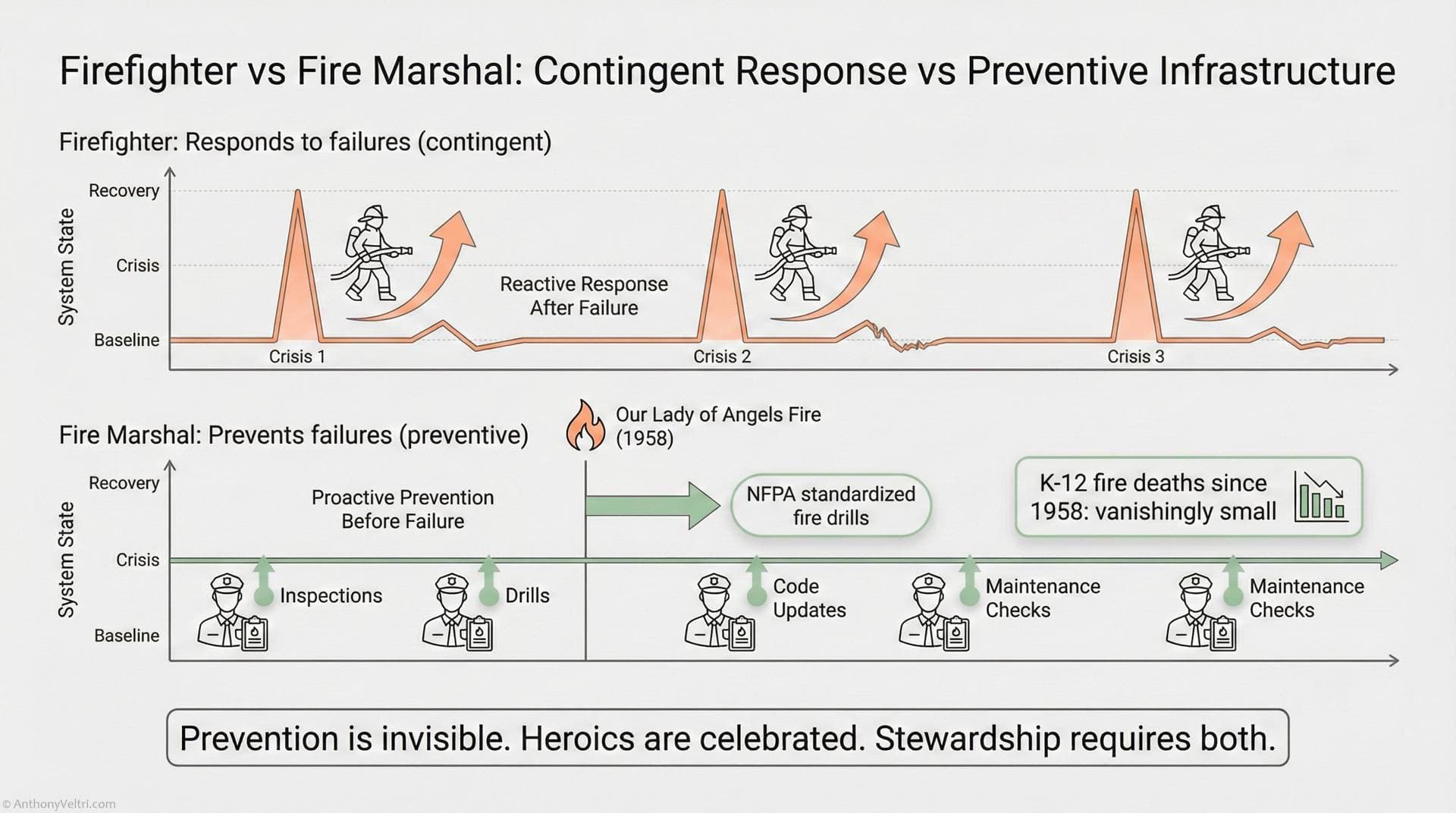
Infographic compares firefighters’ reactive crisis response to fire marshals’ preventive measures like inspections, drills, and maintenance. Graphs show frequent crises with firefighting versus sustained system stability with fire prevention.
Two Types of Defense. The Fire Marshal represents Prevention (Inspections, Codes). The Firefighter represents Contingency (Response). You cannot choose one; you need both.

Most organizations fall into one of two traps:

Trap one: They optimize everything for prevention.
This creates brittle systems that collapse under stress.

Trap two: They rely entirely on contingency.
This creates reactive chaos and waste.

Resilient systems blend both:

  • preventive scaffolding that blocks avoidable failures
  • contingent scaffolding that handles unavoidable ones

You cannot choose one.
You must design for both.


Lived Example: The ingest pipeline that survived the partner outage #

During an activation:

  • a major partner feed died
  • another partner feed drifted by four hours
  • timestamps became inconsistent
  • geometry changed without notice

Prevention alone would have failed because:

  • no prevention can stop partners from failing

Contingency alone would have failed because:

  • without preventive scaffolding, fallback behavior would have been chaotic

Because we had both:

  • preventive alignment kept errors isolated
  • contingent fallback filled gaps
  • cached layers preserved situational awareness
  • annotations explained uncertainty
  • analysts continued making correct decisions

Prevention reduced avoidable chaos.
Contingency absorbed unavoidable chaos.

The system survived because both layers were intentional.


Business Terms: Prevention and contingency serve different purposes #
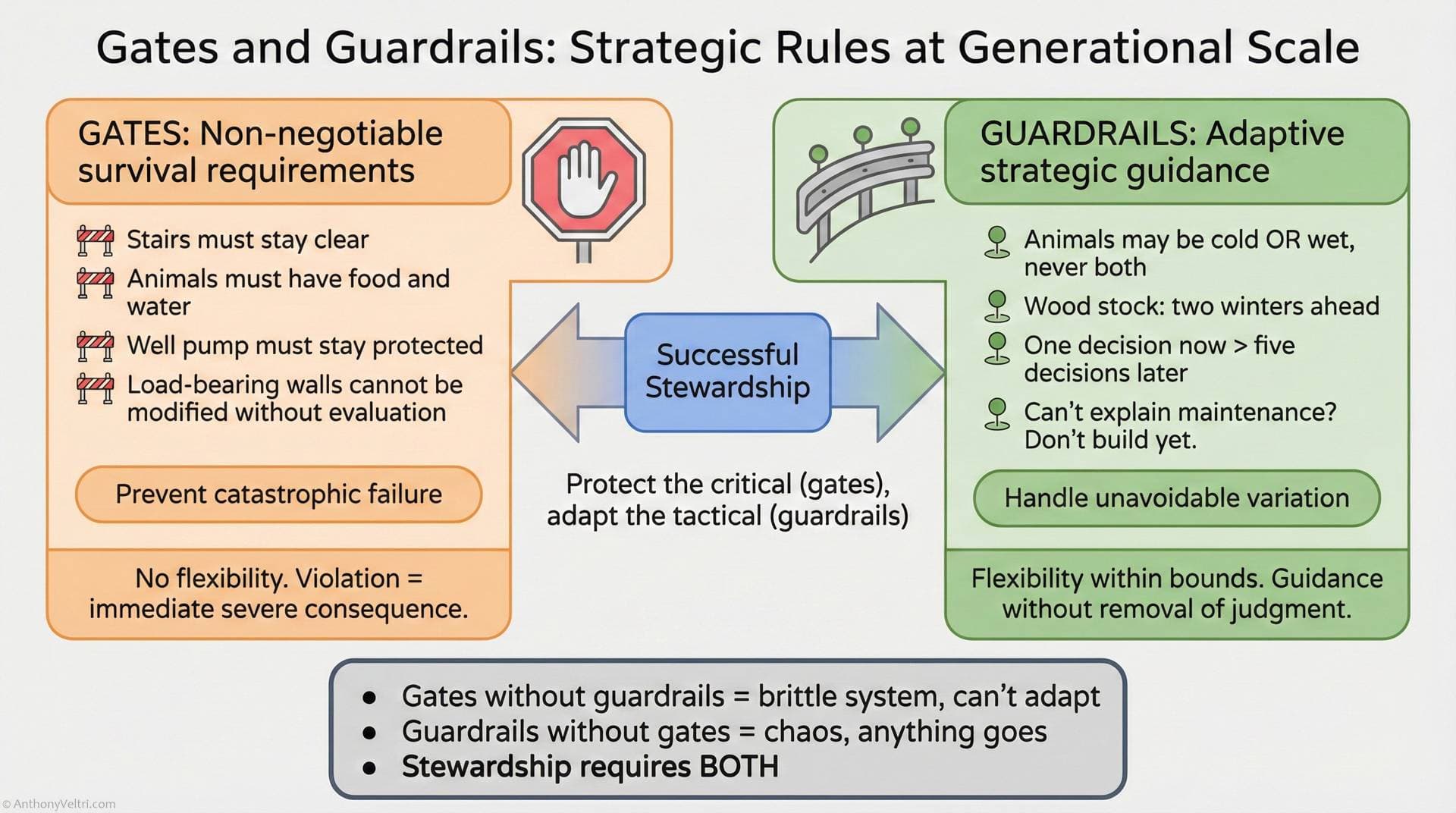
A diagram contrasts "Gates" (non-negotiable survival requirements, like food and water) with "Guardrails" (adaptive strategic guidance, like seasonal animal needs), both leading to successful stewardship of critical systems.
Gates vs. Guardrails. Prevention acts as a Gate (Binary, Stop/Go). Contingency acts as a Guardrail (Keeps you on the road when you drift). A resilient system uses Gates for critical safety and Guardrails for variance.

Preventive actions reduce error probability by:

  • clarifying intent
  • defining contracts
  • setting boundaries
  • stabilizing interfaces
  • reducing ambiguity
  • improving alignment
  • removing confusion
  • designing constraints

Contingent actions reduce error impact by:

  • defining fallback behavior
  • preserving partial truth
  • isolating failures
  • enabling local correction
  • tolerating drift
  • absorbing outliers
  • providing escape hatches

Prevention avoids unnecessary problems.
Contingency handles unavoidable problems.

Without prevention:
Teams drown in noise.

Without contingency:
Teams fail under surprise.


System Terms: Prevention and contingency as architectural patterns #
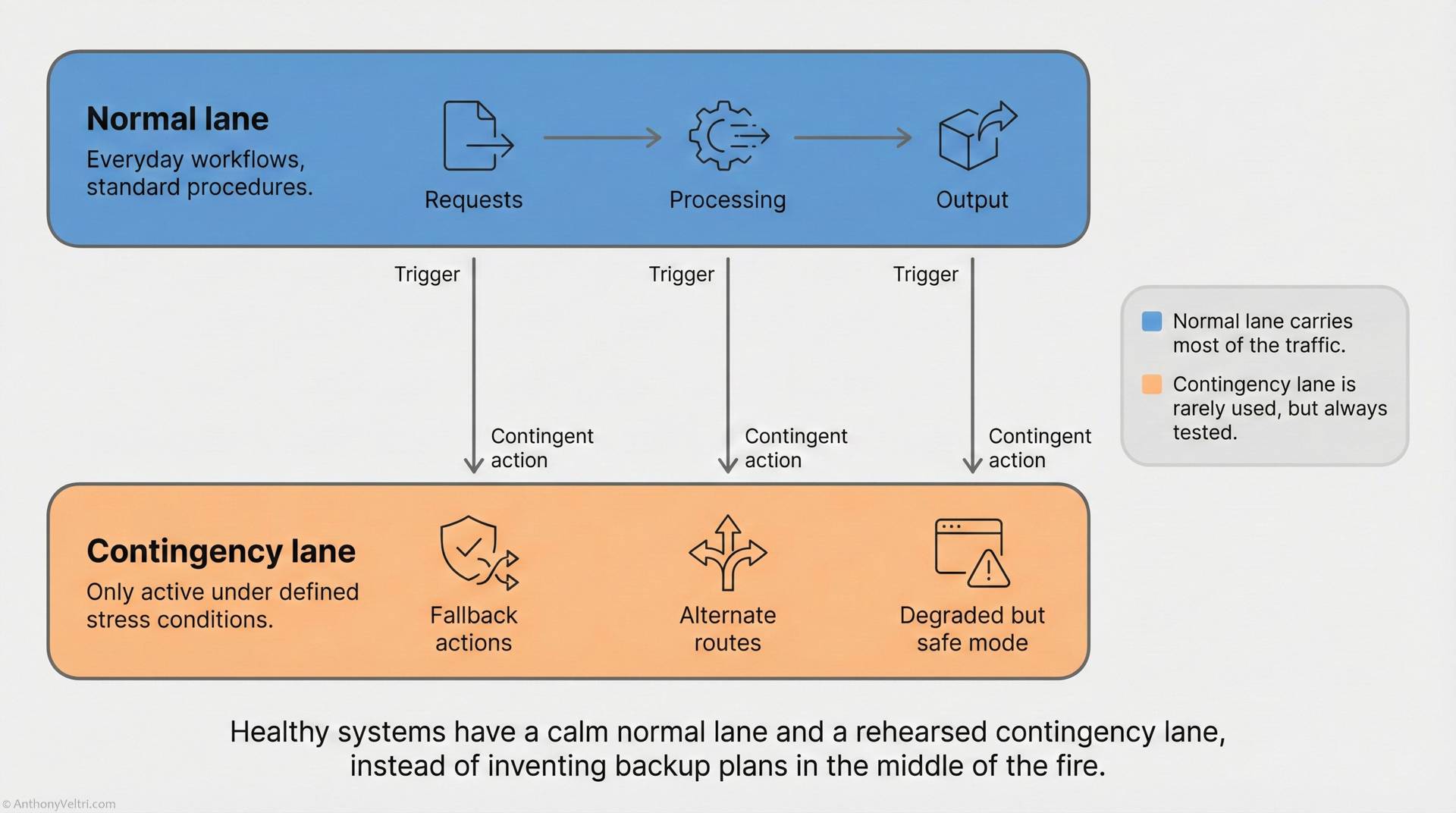
A diagram showing a "Normal lane" for routine workflows with requests, processing, and output, and a "Contingency lane" for stress conditions with fallback actions, alternate routes, and degraded mode.
Degraded Mode is a Lane, Not a Crash. A healthy architecture has a specific “Contingency Lane” (Orange) designed for when the “Normal Lane” (Blue) is blocked. Triggers move you between them safely. Do not mix your crisis response with your normal operations. Build a specific “Contingency Lane” (Orange) that activates when the “Normal Lane” (Blue) is blocked.

Preventive architecture includes:

  • invariants
  • low coupling
  • clear interfaces
  • stable lanes
  • known constraints
  • schema contracts
  • versioning plans
  • explicit decision altitudes
  • intent articulation

Contingent architecture includes:

  • fallback modes
  • tolerant ingest
  • degraded operations
  • caching
  • last known good state
  • asynchronous updates
  • partial rendering
  • local autonomy

A balanced architecture uses both.


Why Prevention Alone Fails #

Business perspective #

Prevention alone:

  • assumes compliance
  • assumes stability
  • assumes predictability
  • assumes partner maturity
  • assumes all conditions can be controlled

But real missions:

  • involve diversity
  • involve drift
  • involve failure
  • involve political constraints
  • involve degraded conditions

A prevention only approach collapses under real variation.

System perspective #

Prevention alone:

  • over couples the system
  • creates global brittleness
  • requires synchronized correctness
  • magnifies partner failures
  • removes local flexibility
  • makes every deviation catastrophic

Preventive systems without contingent scaffolding are doomed.


Why Contingency Alone Fails #
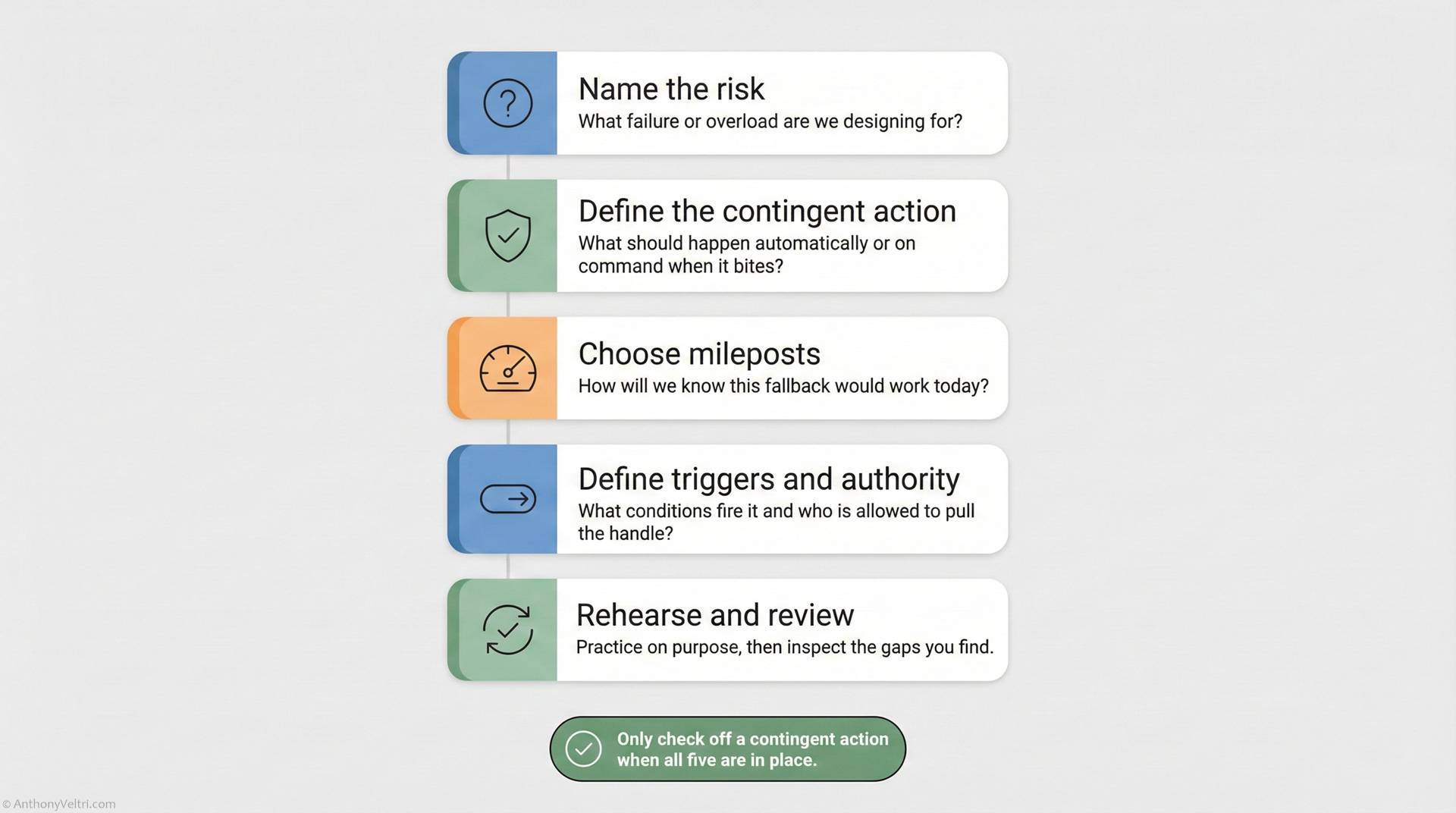
A flowchart with five steps: Name the risk, Define the contingent action, Choose mileposts, Define triggers and authority, and Rehearse and review. A green note at the bottom says to check off a contingent action only when all steps are complete.
Contingency is Design, Not Improv. A valid contingency plan has 5 parts: Risk Name, Action, Mileposts, Triggers, and Rehearsal. If you skip steps, it’s not a plan- it’s a wish. This checklist prevents the practitioner from thinking “Contingency = Winging It.”

Business perspective #

Contingency without prevention:

  • turns every day into firefighting
  • normalizes reactivity
  • overloads teams
  • causes misalignment
  • increases political heat
  • increases fatigue
  • hides structural flaws

Contingency without prevention becomes chaos.

System perspective #

Contingency alone:

  • increases entropy
  • encourages inconsistent behavior
  • breaks alignment
  • makes drift unmanageable
  • causes unpredictable outcomes
  • undermines trust
  • increases cognitive load

Contingent systems without preventive structure deteriorate rapidly.


The Prevention–Contingency Matrix (You Must Include This) #

This becomes a powerful visual and conceptual tool for your doctrine.

1. Strong prevention, strong contingency #

Best case.
Systems are resilient and stable.

2. Strong prevention, weak contingency #

Rigid.
Fails under surprise.

3. Weak prevention, strong contingency #

Chaotic.
Survives but at high cost.

4. Weak prevention, weak contingency #

Catastrophic.
System collapses under minor stress.

You design for box one.


Business Example: The team that prevented dozens of failures through clarity #

A cross agency team once struggled with constant emergencies.
Every week felt like a crisis.

When we introduced preventive clarity:

  • defined invariants
  • clarified intent
  • defined boundaries
  • set expectations
  • created simple contracts

Emergencies dropped dramatically.

Then we introduced contingent scaffolding:

  • fallback behavior
  • degraded mode behavior
  • tolerant ingest
  • cached layers

Crises no longer derailed operations.

Prevention reduced the number of crises.
Contingency reduced the impact of the remaining ones.


System Example: iCAV succeeded because it used both layers #
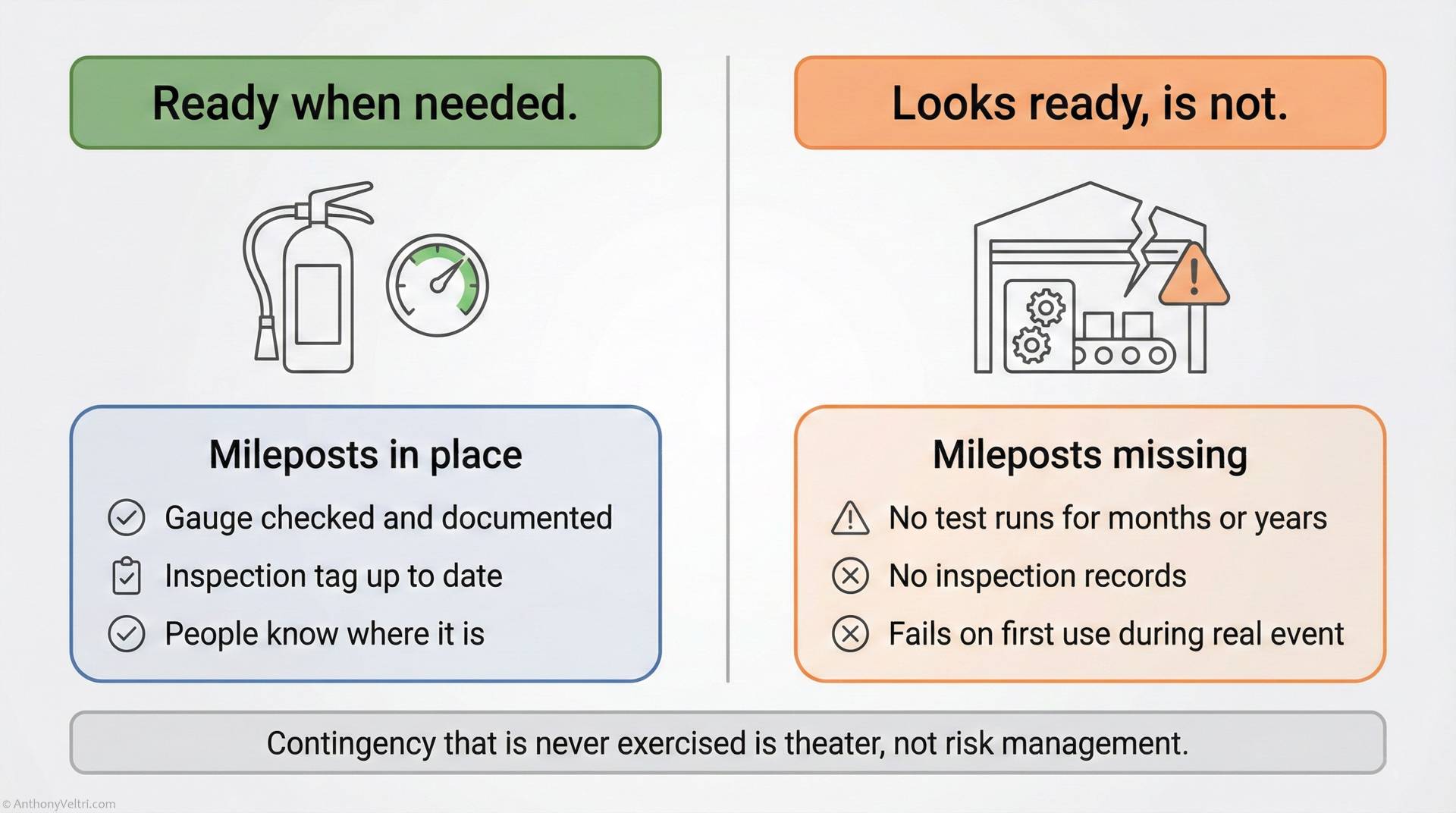
A comparison chart shows “Ready when needed” with checked fire extinguisher versus “Looks ready, is not” with a broken extinguisher box. It highlights the importance of regular checks and documentation for emergency readiness.
Real vs. Fake Contingency. If you have a plan but no triggers or rehearsals, you have Theater (The Binder). Real contingency looks like a maintained fire extinguisher.

iCAV’s preventive design:

  • stable ingest patterns
  • clear schemas
  • known connectors
  • predictable behavior
  • interface boundaries

iCAV’s contingent design:

  • caching
  • degraded mode
  • tolerant parsing
  • fallback logic
  • asynchronous ingest
  • partial rendering

This combination made iCAV reliable under chaos, not despite chaos.


Architect-Level Principle #

As an architect, I design both preventive and contingent scaffolding.
Prevention avoids the avoidable.
Contingency absorbs the unavoidable.
Resilience requires both.


Twenty-Second Takeaway: #

“Mission systems need preventive clarity and contingent fallback. Prevention avoids avoidable problems. Contingency absorbs unavoidable ones. I design both so the system works during normal conditions and during surprise.”


Cross Links to Other Principles #

This principle integrates deeply with:

  • Degraded operations
  • Emergent resilience
  • Federation
  • Useful interoperability
  • Distributed decisions
  • Clear intent
  • Architecture accelerates
  • Decision drag
  • Portfolio thinking

Prevention and contingency are the backbone of resilient architecture.


Doctrine Diagnostic – For Reflection: #

Ask yourself:

Does your system prevent avoidable problems?
Does it survive unavoidable ones?

If the answer to either is no, your system is incomplete.

Design both layers now.

Field notes and examples #

  • Field Notes – The Pre-Shoot Ritual: How To Lower Friction For High-Stakes Video

Last Updated on December 9, 2025

Related Posts #

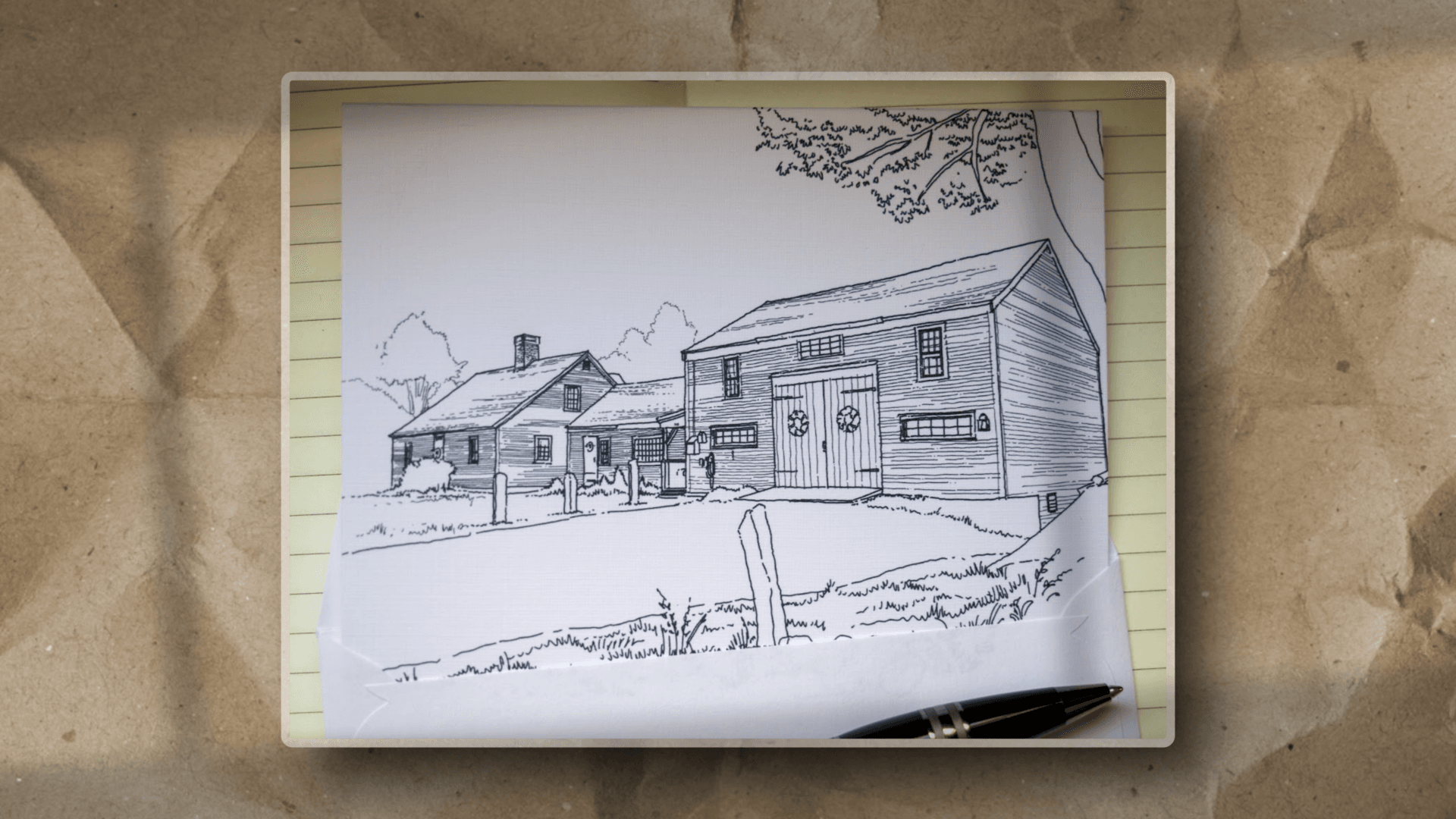
A black pen drawing of two rustic barn-like buildings sits on lined paper, with a pen resting at the edge and a brown, crumpled background visible behind the sheet.

Field Note: The 1790 Farmhouse and What It Taught Me About Stewardship #

This diagram illustrates how guided sensemaking transforms handwritten ideas into organized digital files through structured processes.

Field Note: Guided Sensemaking Interview #

This sepia-toned image highlights early logging practices, as seen by seven men on felled logs amid equipment and pine trees.

Field Note: Integration Debt vs Temporal Arbitrage #

This slide illustrates the

Doctrine 03 Companion: The RS-CAT Framework: Converting Raw Recall into Teachable Principle #

ANNEX F Pattern Library" text over a background of interconnected geometric lines, circles, and digital patterns resembling a circuit or network schematic.

ANNEX F. Pattern Library #

A geometric abstract design with circles, lines, and dots in muted colors, featuring a dark rectangle with the white text

Doctrine 12: Resilience Is an Emergent Property, Not a Feature #

contracts, governance, interfaces, interoperability, visibility
Table of Contents
  • Why planning for the expected and structuring for the unexpected creates systems that survive real conditions
  • A system built only for prevention will fail under surprise. A system built only for contingency will drown in chaos.
  • Lived Example: The ingest pipeline that survived the partner outage
  • Business Terms: Prevention and contingency serve different purposes
  • System Terms: Prevention and contingency as architectural patterns
  • Why Prevention Alone Fails
    • Business perspective
    • System perspective
  • Why Contingency Alone Fails
    • Business perspective
    • System perspective
  • The Prevention–Contingency Matrix (You Must Include This)
    • 1. Strong prevention, strong contingency
    • 2. Strong prevention, weak contingency
    • 3. Weak prevention, strong contingency
    • 4. Weak prevention, weak contingency
  • Business Example: The team that prevented dozens of failures through clarity
  • System Example: iCAV succeeded because it used both layers
  • Architect-Level Principle
  • Twenty-Second Takeaway:
  • Cross Links to Other Principles
  • Doctrine Diagnostic - For Reflection:

Share This Article :

  • Facebook
  • X
  • LinkedIn
  • Pinterest

Was it helpful ?

  • Happy
  • Normal
  • Sad
  • Privacy Policy
  • Introductions
  • Contact

© 2026 Anthony Veltri

  • Doctrine
    • Doctrine Library
    • Global Library
  • Field Notes
  • Routes
    • Route 01: When the Interface Is Breaking (and you are becoming the patch)
    • ROUTE 02: If decisions stall and meetings go nowhere, start here
    • ROUTE 03: If you have lots of projects but no portfolio clarity, start here
    • ROUTE 04: If you’re confused about federation vs integration, start here
    • ROUTE 05: If heroics are propping up your system, start here
    • ROUTE 06: If you cannot force compliance across partners, start here
    • ROUTE 07: If compliance exists but commitment does not, start here
    • ROUTE 08: If disconnected workflows create audit anxiety, start here
  • Figure Library
  • FAQ
  • About
    • Capability Statement
    • Interpreter Kit
  • Contact