Why teams built on commitment move faster, adapt better, and deliver more value than teams built on rule following #
This guide moves beyond the “rules vs. freedom” debate and shows why Compliance and Commitment are not binary opposites, but distinct structural layers. You use Compliance to establish a safety floor, and Commitment to unlock the performance ceiling. High-tempo systems require both.
This page is a Doctrine Guide. It shows how to apply one principle from the Doctrine in real systems and real constraints. Use it as a reference when you are making decisions, designing workflows, or repairing things that broke under pressure.
Compliance prevents the wrong thing. Commitment drives the right thing. #
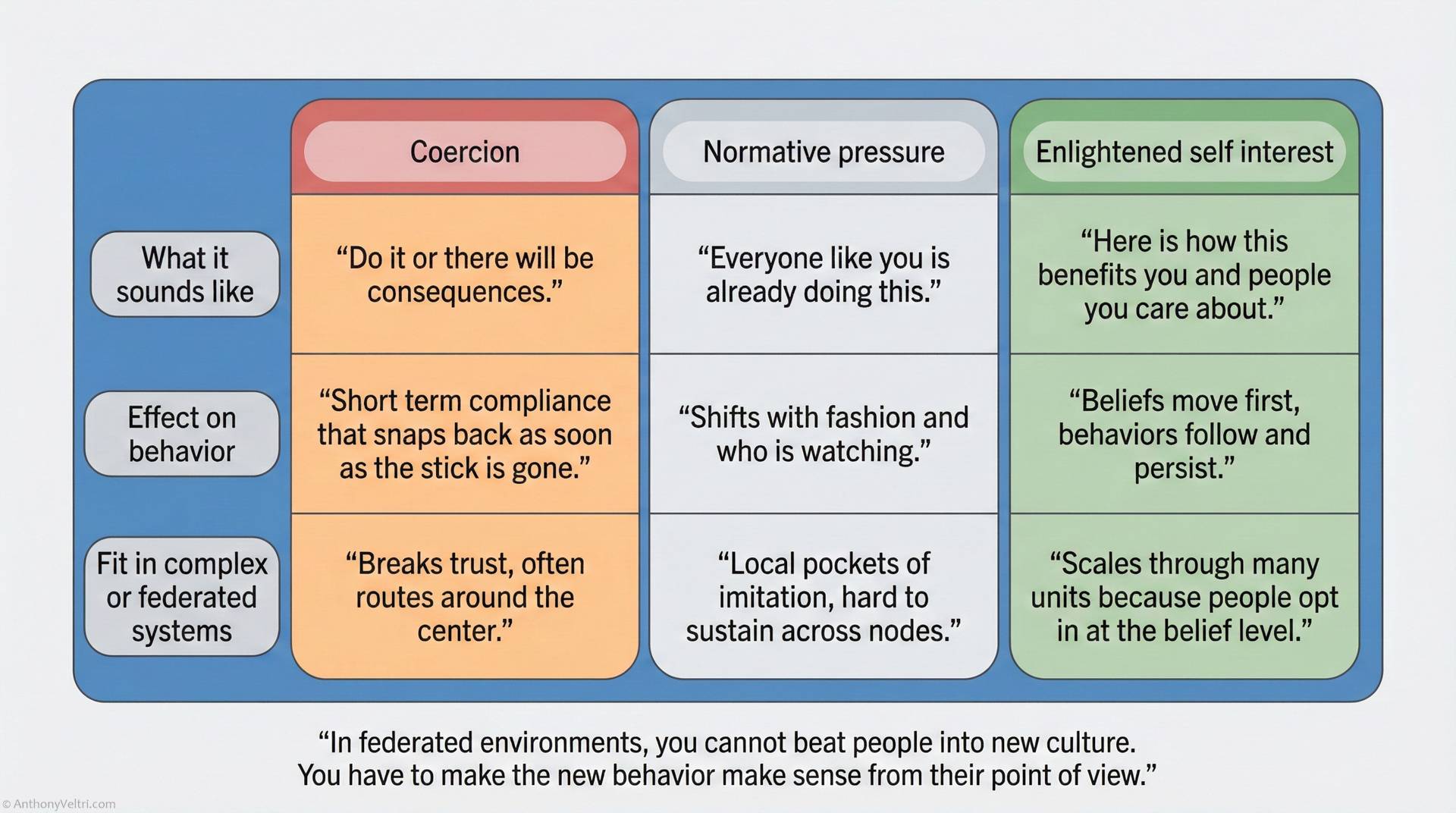
Compliance is:
- safe
- predictable
- slow
- defensive
Commitment is:
- proactive
- adaptive
- fast
- mission focused
Compliance ensures people avoid mistakes.
Commitment ensures people advance the mission.
Compliance is the floor.
Commitment is the engine.
Lived Example: The analyst who moved the mission forward while others debated #
During a major activation, two teams argued over:
- whether a partner feed was stale
- who owned the update
- whether to escalate
- whether a meeting was needed
While they debated, an analyst who understood the intent:
- pulled the cached layer
- annotated the time drift
- adjusted the affected routing
- notified partners
- kept the mission picture accurate
Compliance would have told her to wait.
Commitment told her to act.
She advanced the mission while others followed the rulebook.
Business Terms: Compliance is about permission. Commitment is about purpose. #
Compliance answers:
- What am I allowed to do?
- What am I required to do?
- What do I avoid?
Commitment answers:
- What advances the mission?
- What protects tempo?
- What supports the system?
Compliance is fear-based.
Commitment is purpose-based.
In high-tempo, high-consequence environments, fear slows everything down.
Purpose accelerates everything that matters.
System Terms: Compliance constrains, commitment harmonizes #
In system language:
Compliance systems:
- restrict behavior
- add friction
- add latency
- reduce autonomy
- require synchronization
- centralize decisions
Commitment systems:
- distribute decisions
- stabilize intent
- reduce ambiguity
- reduce escalation
- tolerate variation
- accelerate flow
Compliance protects boundaries.
Commitment advances outcomes.
Both matter, but only one moves the mission.
Why Compliance Is Necessary but Not Sufficient #
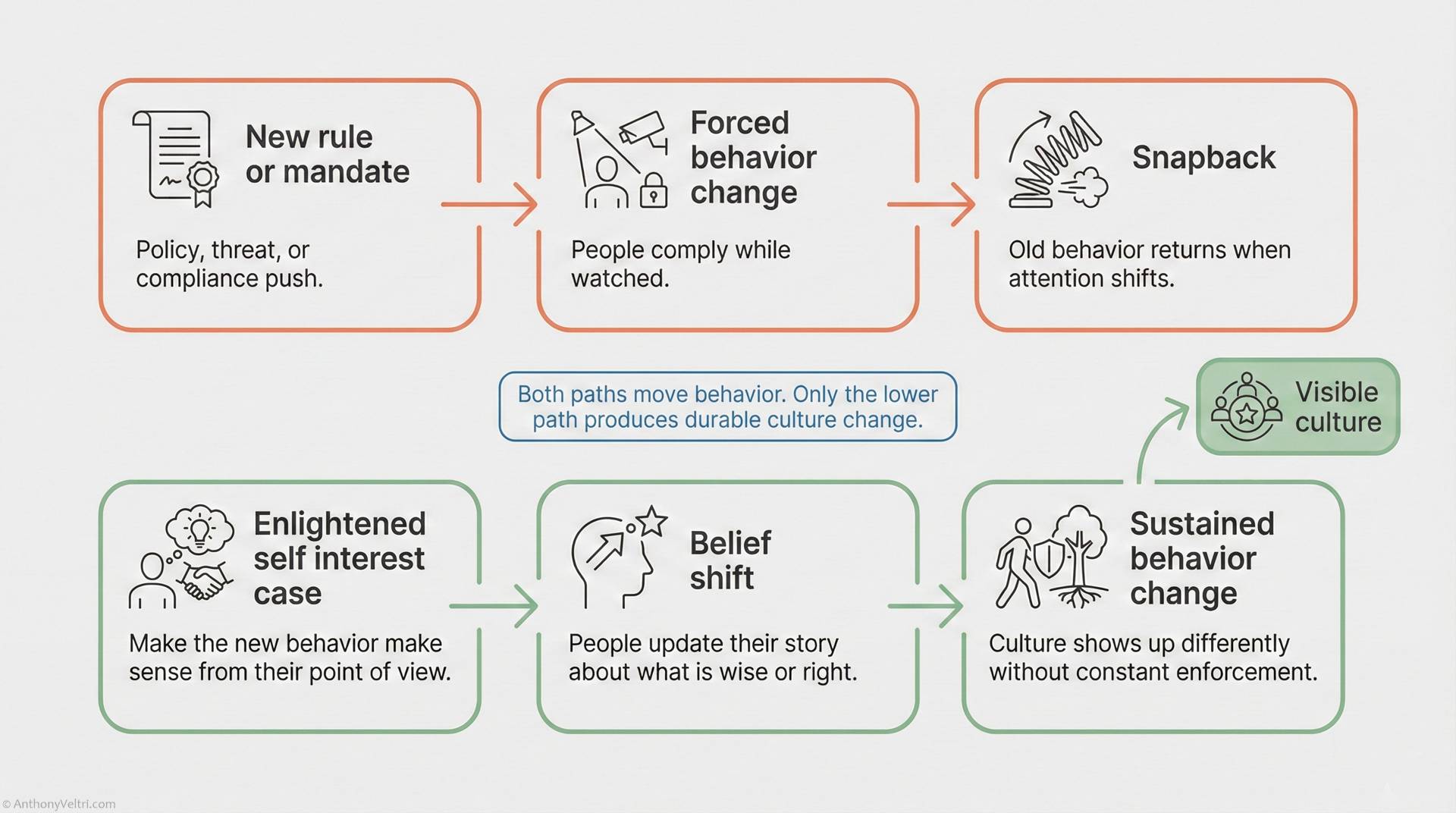
Business perspective #
Compliance is the minimum viable behavior in:
- legal environments
- security contexts
- safety protocols
- regulated systems
Compliance prevents:
- violations
- risks
- errors
- political fallout
But compliance alone creates:
- hesitation
- waiting
- escalation
- defensive behavior
- low initiative
- slow tempo
Compliance is the guardrail, not the engine.
System perspective #
Compliance systems:
- reduce harmful outliers
- enforce predictable patterns
- create structural safety
- provide boundaries
But they also:
- increase coupling
- reduce autonomy
- force decisions upward
- slow adaptation
Systems built only on compliance collapse under variation.
Why Commitment Outperforms Compliance in Mission Systems #
Business perspective #
Commitment increases:
- ownership
- initiative
- speed
- correctness
- morale
- alignment
- trust
Teams act because they believe in the mission, not because a rule told them to.
Commitment replaces:
- hesitation with action
- friction with flow
- fear with clarity
Commitment is the fuel for mission tempo.
System perspective #
Commitment increases:
- graceful degradation
- distributed decision flow
- local correction
- resilience under stress
- tolerance for partner diversity
- adaptive behavior
- emergent order
Systems perform better when people act in harmony with the intent, not in obedience to procedure.
Why Commitment Is Safer Than Compliance in High-Consequence Work #
This is counterintuitive but true.
Compliance avoids doing the wrong thing.
Commitment ensures you do the right thing.
Compliance protects rules.
Commitment protects outcomes.
In crisis environments, waiting is more dangerous than acting.
Commitment reduces:
- decision drag
- rework
- misunderstandings
- escalations
- brittle synchronization
- operational blind spots
Commitment is safer because it protects the mission, not the rulebook.
The Commitment Contract (This Model Applies Across All Doctrine) #
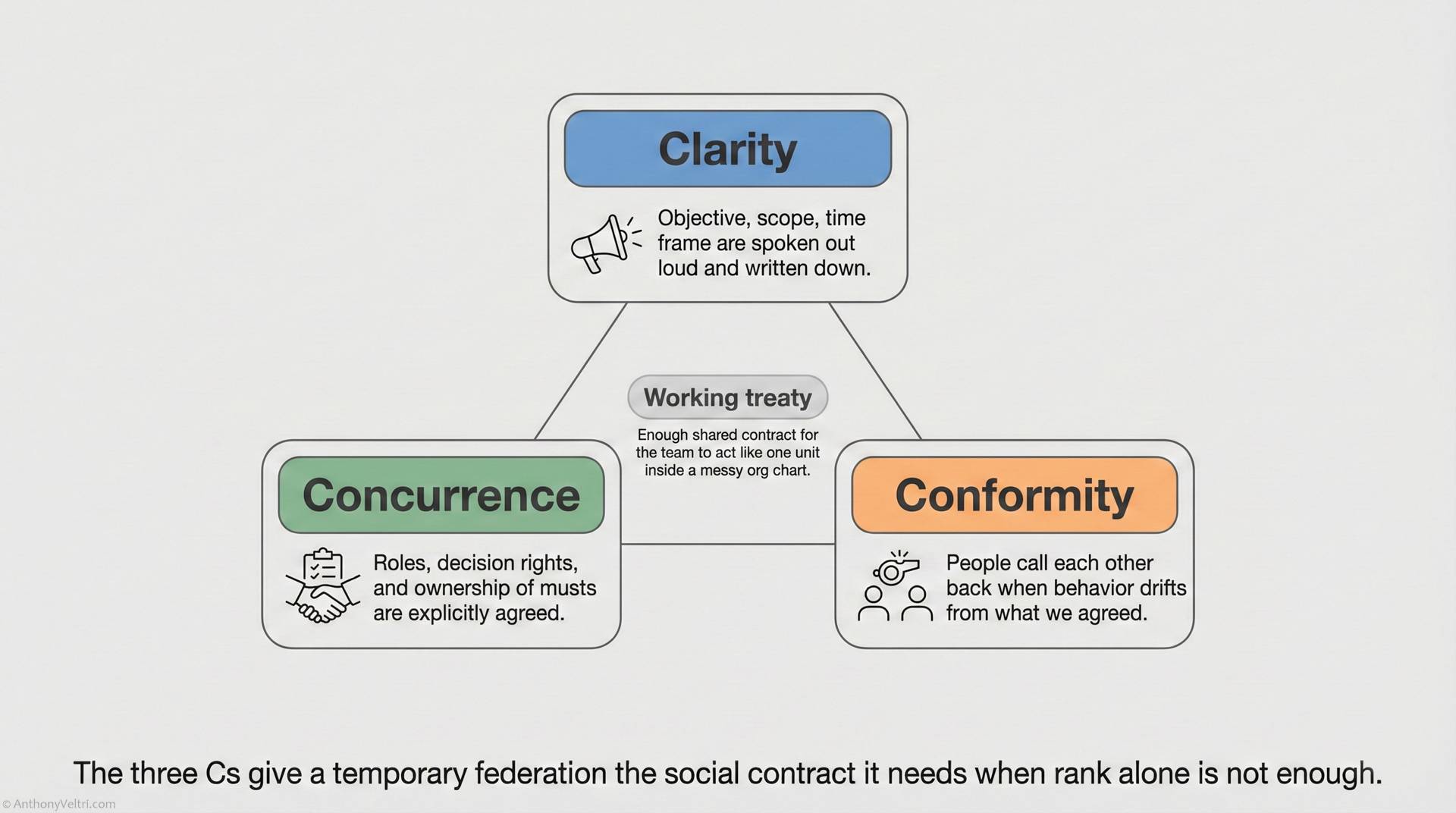
Commitment systems require a psychological contract built on three pillars:
1. Shared intent #
People know what good looks like.
2. Clear boundaries #
People know what they must not violate.
3. Trust in autonomy #
People are empowered to act without waiting.
When these three exist, commitment outperforms compliance every time.
Business Example: The team that transformed once intent was clarified #
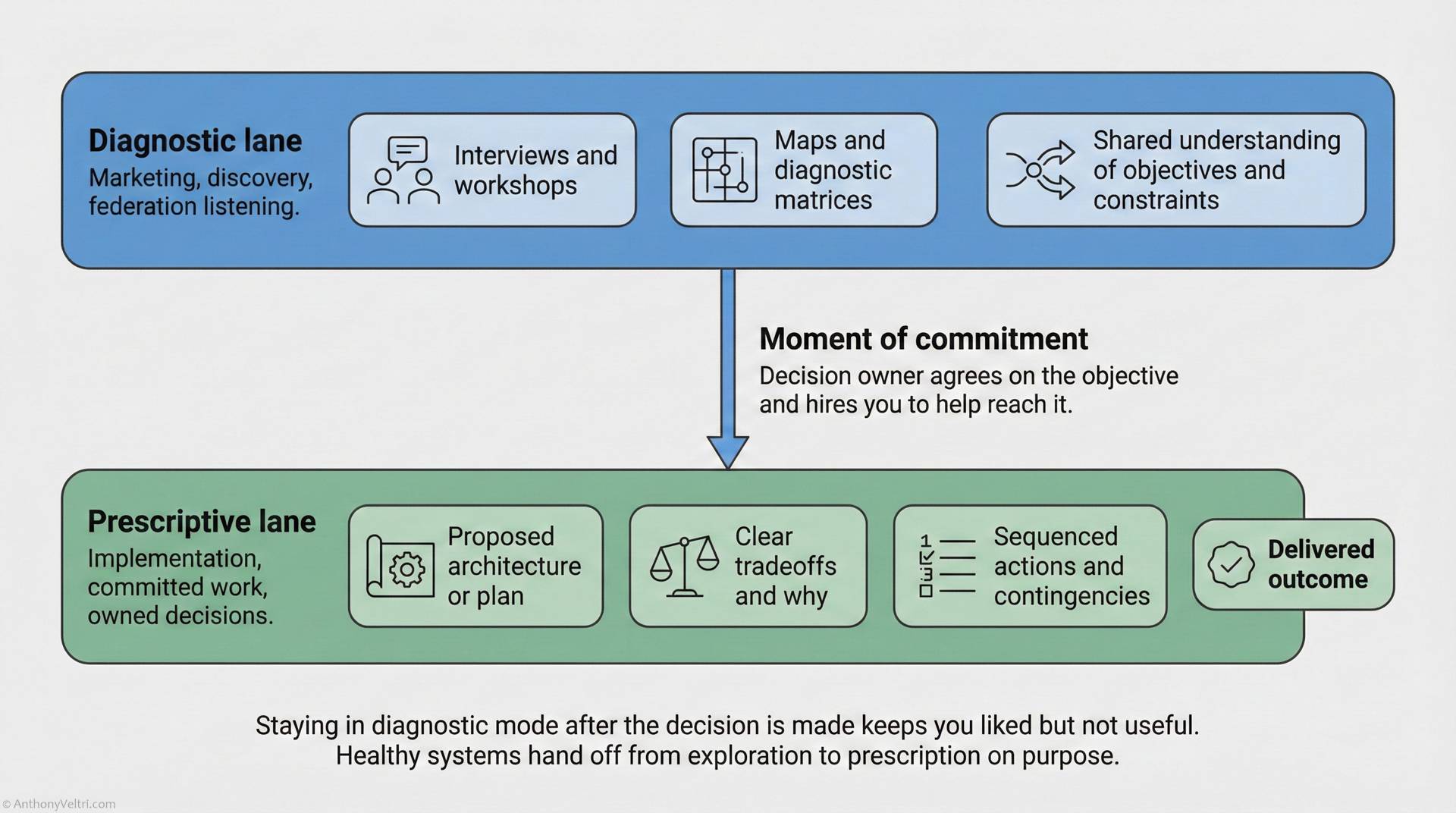
A team once struggled with:
- slow approvals
- constant friction
- fear of being wrong
- chronic escalation
We reset three things:
- intent
- boundaries
- authority limits
Within days:
- decisions accelerated
- meetings reduced
- people stopped waiting
- trust increased
- rework dropped
Nothing else changed.
The team went from compliance to commitment.
The difference was night and day.
System Example: iCAV’s best operators were commitment-driven #
iCAV worked because operators were:
- committed to truth
- committed to tempo
- committed to clarity
- committed to mission outcomes
They were not simply compliant with:
- ingestion checklists
- update ceremonies
- release cycles
Their commitment compensated for upstream degradation and partner drift.
This human commitment, paired with architectural design, is what made the system effective.
Architecture supports commitment.
Compliance alone cannot.
Architect Level Principle #
As an architect I design environments where commitment is safe and rewarded.
Compliance prevents the wrong thing.
Commitment advances the right thing.
High trust and high tempo require commitment.
Twenty-Second Takeaway: #
“Compliance keeps people from doing the wrong thing. Commitment drives people to do the right thing. In high tempo environments, commitment is what preserves mission tempo. I design systems that make commitment safe and clear so teams can act without hesitation.”
Cross Links to Other Principles #
Commitment reinforces:
- Clear intent
- Distributed decisions
- Decision drag
- Architecture accelerates
- Degraded operations
- Federation
- Useful interoperability
- Emergent resilience
- Preventive and contingent design
Commitment is the cultural layer that makes the architecture come alive.
Doctrine Diagnostic – For Reflection: #
Ask yourself:
Are your teams acting because they are afraid to be wrong, or because they are committed to being useful?
Only one of those produces real outcomes.
Build commitment.
Use compliance only as a boundary.
Field notes and examples #
- Field Note: The Room She Chose
- Unjust Is Not the Same as Inefficient
- What Hiring Systems Discard When They Compress a Career
- When the Governance Instrument Exists: ICOS, NEON, and the Two Paths to Named Stewardship
- Doctrine Is Not Best Practices: A Field Note From the Kitchen
- Field Note – The Initial Spark Fallacy: Why Fast Learners Aren’t Always Your Best Talent
- Interface Stewardship in Federated Alliance Governance: Coordination Without Control in NATO’s Agency Architecture
- Switching Costs Can Delay Departure, But They Cannot Manufacture Consent.
- A Letter to Forest Service Colleagues: On the Clock That May Have Changed
- Don’t Build an Army of Conscripts When You Need a Coalition of Allies
Last Updated on February 22, 2026