Skip to content

Introduced by a trusted connector?

Start Here

Anthony Veltri

  • Doctrine
    • Doctrine Library
    • Global Library
  • Field Notes
  • Routes
    • Route 01: When the Interface Is Breaking (and you are becoming the patch)
    • ROUTE 02: If decisions stall and meetings go nowhere, start here
    • ROUTE 03: If you have lots of projects but no portfolio clarity, start here
    • ROUTE 04: If you’re confused about federation vs integration, start here
    • ROUTE 05: If heroics are propping up your system, start here
    • ROUTE 06: If you cannot force compliance across partners, start here
    • ROUTE 07: If compliance exists but commitment does not, start here
    • ROUTE 08: If disconnected workflows create audit anxiety, start here
  • Figure Library
  • FAQ
  • About
    • Capability Statement
    • Interpreter Kit
  • Contact
Anthony Veltri

Architecture & Interfaces

15
  • Doctrine 01: Federation vs Integration in Mission Networks
  • Doctrine 03: Interfaces Are Where Systems Break, So They Require Stewards, Contracts, and Ownership
  • Doctrine 04: Useful Interoperability Is the Goal, Not Perfect Interoperability
  • Doctrine 05: Innovation Must Live at the Edge, Not in the Center
  • Doctrine 06: A Two-Lane System Protects Stability and Enables Evolution
  • Doctrine 14: Technical Debt Is a Leadership Signal, Not a Coding Failure
  • Doctrine 15: Architecture Must Accelerate Teams, Not Bottleneck Them
  • Doctrine 17: Architects Translate Strategy Into Engineering and Engineering Into Strategy
  • Doctrine 20: Golden Datasets: Putting Truth In One Place Without Pretending Everything Is Perfect
  • Doctrine 21: Zero Trust Is A Trust Model, Not A Card “Type”
  • Doctrine 23: Loop Closure as Load-Bearing System Infrastructure
  • ANNEX B. Data Contracts
  • ANNEX C. Interface Ownership Model
  • ANNEX H. Architecture Doctrine
  • Annex L: The Rosetta Stone for Data Teams: Bridging the Gap Between Technicians and Executives

Decision Tempo & Governance

10
  • Doctrine 02: Distributed Decisions Increase Alignment, Speed, and Resilience
  • Doctrine 07: Clear Intent Matters More Than Perfect Data
  • Doctrine 08: Clear Intent Compresses Ambiguity, Reduces Conflict, and Accelerates Action
  • Doctrine 09: Decision Drag Is the Enemy of Mission Tempo. Architecture Is the Remedy
  • Doctrine 10: Degraded Operations Are the Normal Mode, Not the Exception
  • Doctrine 11: Preventive Action and Contingent Action Must Both Be Designed Intentionally
  • Doctrine 22: When “It Depends” Is the Right Answer: How to Think in Probabilities Under Uncertainty
  • ANNEX D. Decision Altitudes Model
  • ANNEX E. Prevention–Contingency Matrix
  • ANNEX I. High Visibility Workflows

Portfolio & Alignment

4
  • Doctrine 16: Portfolio Thinking Ensures Effort Aligns With What Actually Matters
  • ANNEX F. Pattern Library
  • ANNEX J. System Evolution and Drift Management
  • ANNEX K. System and Workflow Profiles (Case Studies)

Leadership & Human Systems

6
  • Doctrine 24: Stewardship Places the Burden on the Steward, Not the Parties
  • Doctrine 18: Commitment Outperforms Compliance in High Trust, High Tempo Environments
  • Doctrine 19: Supervision, Management, and Leadership Are Three Different Jobs. Confusing Them Breaks Systems
  • Doctrine 23: Loop Closure as Load-Bearing System Infrastructure
  • ANNEX A. Human Contracts
  • ANNEX G. Leadership Doctrine

Resilience & Operations

3
  • Doctrine 24: Stewardship Places the Burden on the Steward, Not the Parties
  • Doctrine 12: Resilience Is an Emergent Property, Not a Feature
  • Doctrine 13: Problem Solving Requires Finding the Real Deviation and the Relevant Change

Doctrine Companions

7
  • Doctrine 03 Companion: The RS-CAT Framework: Converting Raw Recall into Teachable Principle
  • Doctrine 03 Companion: The Interface Void
  • Doctrine 11 Companion: Agency vs. Outcome
  • Doctrine 09 Companion: Artifacts Over Adjectives
  • Doctrine 03 Companion: Constraints: bidirectional translation: Compression vs Construction
  • Doctrine 10 Companion: Span of Control and Cross Training Are Load-Bearing Constraints
  • Doctrine 21 Companion: Claims, Roles, and Entitlements in Microsoft 365

Field Reports

1
  • Field Report: College Financing and the 5-Year Home Runway
View Categories
  • Home
  • Doctrine & Supporting Guides
  • Architecture & Interfaces
  • ANNEX B. Data Contracts

ANNEX B. Data Contracts

Anthony Veltri
Updated on December 5, 2025

5 min read

The technical agreements that stabilize interfaces, reduce ambiguity, and enable useful interoperability #

Doctrine Claim: Without a Data Contract, every system update is a potential outage for your partners. Contracts stop the “silent drift” of schemas and timestamps that breaks mission tempo. This is the technical agreement that turns a data feed from a “leak” into a “product.”


1. Purpose of Data Contracts #

Data contracts define the expectations for information flowing across boundaries.
They create predictability where partner diversity, schema drift, and leadership-driven change would otherwise create chaos.
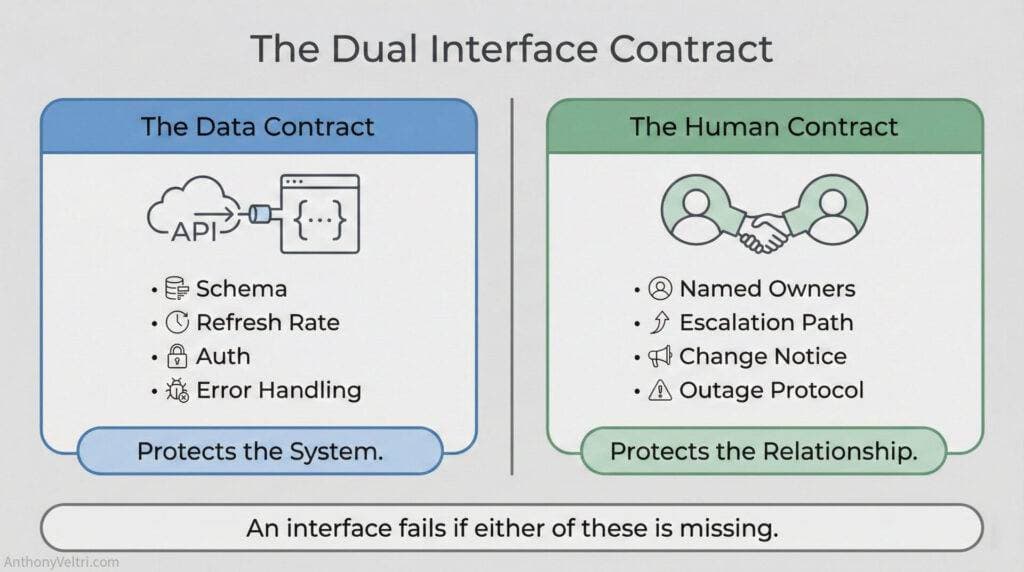
A diagram titled "The Dual Interface Contract" shows two sections: The Data Contract, with technology icons and bullet points for schema, refresh rate, auth, error handling, and "Protects the System"; and The Human Contract, with handshake icons and bullet points for named owners, escalation path, change notice, outage protocol, and "Protects the Relationship." A note below states an interface fails if either contract is missing.
The Handshake: Every interface needs two owners. One owns the Data Contract (Technical), and one owns the Human Contract (Relational). You need both to prevent failure. You should distinguish between the Data Contract (Schema, API) and the Human Contract (Escalation, Roles). The Full Interface. A stable interface requires two contracts: a Data Contract (Technical Schema) and a Human Contract (Roles & Escalation). This Annex covers the left side.

Data contracts exist because:

  • systems evolve independently
  • partners update on different cadences
  • schemas drift silently
  • timestamps degrade
  • formats vary
  • upstream decisions ripple downstream

Without data contracts:

  • small deviations cause large failures
  • ingest pipelines break
  • partners misunderstand requirements
  • errors cascade
  • analysts lose trust
  • mission tempo degrades

Data contracts stabilize the technical boundary so humans can work with clarity and autonomy.


2. Why Data Contracts Matter #

Data contracts are essential for:

  • federation
  • useful interoperability
  • degraded operations
  • distributed decisions
  • interface ownership
  • preventing rework
  • preventing schema drift
  • protecting high tempo work
  • predictable partner integration

Data contracts reduce:

  • ambiguity
  • unplanned outages
  • mismatched assumptions
  • brittle behavior
  • reprocessing
  • ad hoc fixes
  • politics around correctness

They are the technical version of human contracts and must be paired with them.


3. The Ten Required Elements of a Data Contract #
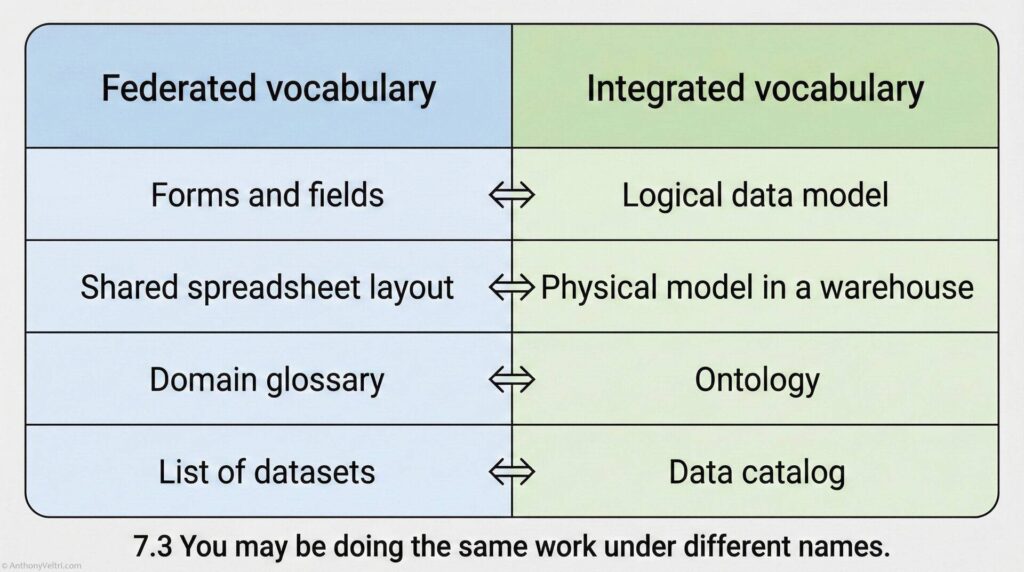
A two column table or side by side boxes. Left side labeled “Federated vocabulary.” Right side labeled “Integrated vocabulary.” Example rows: “Forms and fields” ↔ “Logical data model” “Shared spreadsheet layout” ↔ “Physical model in a warehouse” “Domain glossary” ↔ “Ontology” “List of datasets” ↔ “Data catalog”
The Translation: A Data Contract acts as the Rosetta Stone between partners. It explicitly maps “Your Field Name” to “My Logical Model,” preventing drift. You may be doing the same work under different names.

A complete data contract defines ten expected behaviors.

1. Schema definition #

Fields, types, optional vs required, maximum tolerances.

2. Geometry rules (if applicable) #

Projection, resolution, topology expectations, tolerance for errors.

3. Time rules #

Timestamp fields, timezone assumptions, publish window, acceptable drift.

4. Refresh cadence #

Expected update frequency; acceptable minimum and maximum.

5. Versioning model #

Major, minor, or patch level changes; deprecation rules.

6. Authentication and authorization #

Methods, token refresh expectations, fallback conditions.

7. Error signaling #

How unexpected conditions are communicated; expected error codes.

8. Fallback behavior #

What happens if updates stop, timestamps drift, or schema partially degrades.

9. Publishing expectations #

Minimum viable publication; required attributes during crises or high-profile cycles.

10. Change management #

How contract changes are communicated, approved, and rolled out.

If even one of these ten is missing, the boundary becomes fragile.


4. Data Contract Altitudes #
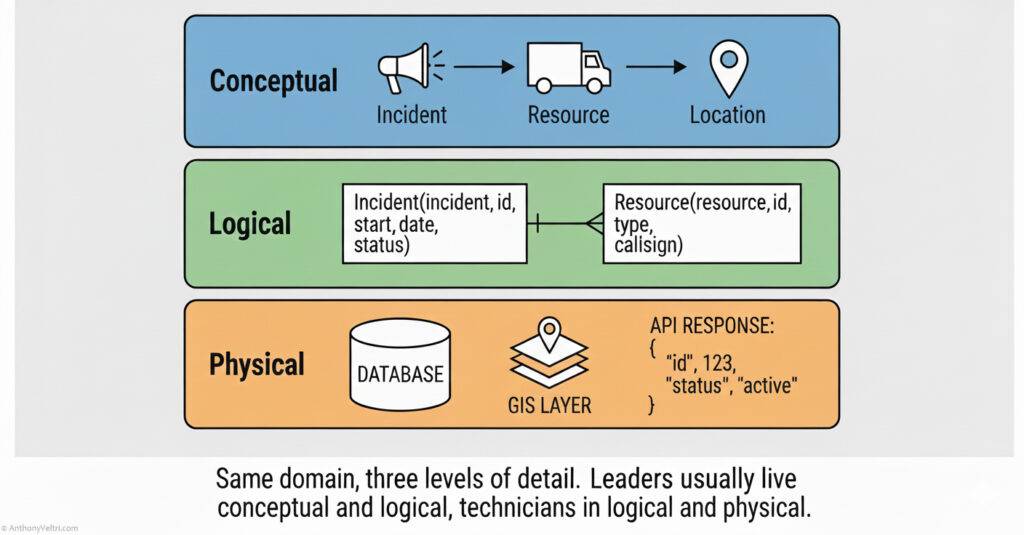
A vertical stack of three rectangles labeled “Conceptual,” “Logical,” and “Physical.” In the Conceptual box, show icons or labels like “Incident,” “Resource,” “Location,” with simple arrows between them. In the Logical box, show a simplified entity relationship style view, for example “Incident(incident_id, start_date, status)” linked to “Resource(resource_id, type, callsign).” In the Physical box, show logos or generic icons for a database, a GIS layer, and an API response snippet.
Contract Layers: A Data Contract lives at the Logical Layer (Schema/Rules), but it must support the Conceptual Layer (Mission Intent) and govern the Physical Layer (Database/API). The Translation Ladder: Leaders live in the Conceptual layer (Icons/Outcomes). Engineers live in the Physical layer (Database/JSON). The Architect lives in the Logical layer, translating between the two – same domain, three levels of detail. For a Golden Dataset isn’t just a database (Physical). It is a clearly defined concept (Conceptual) with a strict schema (Logical) that everyone agrees on.

Data contracts operate across three levels.

Altitude 1: Technical correctness #

Operators and engineers ensure the data meets field level expectations.

Altitude 2: Process correctness #

Managers ensure the contract is followed, updated, and communicated.

Altitude 3: Intent correctness #

Leadership ensures the contract supports mission and strategic outcomes.

Failures occur when:

  • leadership adds requirements without understanding downstream impact
  • managers fail to protect technical boundaries
  • operators do not understand the intent
  • schema changes are pushed outside of agreed processes

This describes both mission systems and the FRN environment.


5. Data Contracts and Doctrine #

Data contracts directly support:

  • federation vs integration
  • useful interoperability
  • degraded operations
  • preventive and contingent design
  • interfaces and ownership
  • decision drag reduction
  • commitment over compliance

A data contract is not a bureaucratic artifact.
It is a stabilizing force that keeps the system coherent under stress.


6. Business Example: Federal Register Notices (FRNs) and the cost of no data contract #
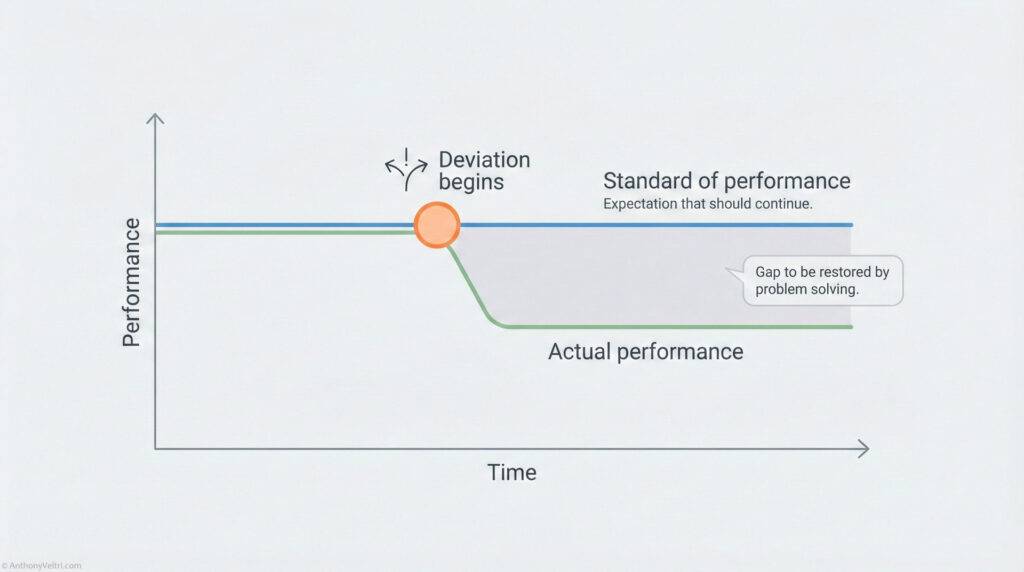
A line graph shows performance over time. At one point, actual performance drops below the standard of performance, creating a gap labeled "Gap to be restored by problem solving.
The Reality Gap & The Deviation Gap: A problem is not just “something bad.” It is a measurable divergence (Green Line) from an expected standard (Blue Line). If you cannot draw this gap, you do not have a problem statement. For this Annex, it is about Detecting Drift. A Data Contract provides the “Standard of Performance” (Blue Line). Without it, you cannot measure when a partner’s feed drifts into failure (Green Line).

FRNs are a perfect high visibility case of failed data contracts.

Common problems we saw:

  • leadership added fields on a whim, without verifying business need
  • new mandatory fields appeared during review cycles
  • teams used inconsistent definitions for the same fields
  • some attributes were non negotiable legally, others were preference based
  • timelines shifted without communicating impacts
  • operators and editors were forced to reverse engineer meaning
  • revisions cascaded across teams because there was no baseline

These are classic failures that occur when a data contract is missing.

To fix this, our team created a practical data contract even if we did not name it that:

  • locked required fields
  • defined optional fields
  • stopped leadership driven schema drift
  • clarified meaning of attributes
  • prevented unnecessary rework
  • stabilized expectations across editors, analysts, and leadership
  • ensured the FRN met legal standards without endless thrash
  • restored predictability

What we created was a data contract for legal publication.

It prevented chaos even though the content was not technical in the traditional sense.
It was data.
It required rules.

FRNs succeed only when the schema is stable.


7. System Example: iCAV and the federated ingest layer #

In iCAV, data contracts took the form of:

  • partner specific ingest profiles
  • expected schema shapes
  • fallback acceptance rules
  • geometry tolerance
  • time drift tolerance
  • metadata expectations
  • caching rules
  • versioning logic

These contracts allowed:

  • partners to publish imperfect data
  • ingest to tolerate upstream variation
  • the viewer to display partial truth
  • analysts to trust the picture
  • engineers to isolate failures

Without data contracts, federation collapses.
With contracts, it scales.


8. Data Contract Template (Paste Ready) #

Here is your reusable template for WordPress:


Data Contract Template

Purpose:
Describe what this data supports and why it matters.

Schema:
Required fields:
Optional fields:
Data types:
Range and tolerance:

Geometry (if applicable):
Projection:
Resolution:
Topology expectations:
Error tolerance:

Time Rules:
Timestamp field(s):
Timezone convention:
Acceptable drift:

Refresh Cadence:
Expected update rate:
Minimum cadence:
Maximum cadence:

Versioning:
Major changes:
Minor changes:
Patch changes:
Deprecation path:

Authentication:
Method:
Token rotation:
Fallback behavior:

Error Signaling:
Codes:
Messages:
Retry rules:

Fallback:
What happens when updates stop or degrade?

Minimum Viable Publication:
What must still be sent even when the system is stressed?

Change Management:
Notice window:
Channels:
Approval process:


9. Cross Links #

Data contracts are directly supported by:

  • Annex A: Human Contracts
  • Annex C: Interface Ownership
  • Principle 7: Interfaces break first
  • Principle 10: Degraded operations
  • Principle 12: Emergent resilience
  • Principle 14: Decision drag
  • Principle 19: Commitment over compliance

Data contracts prevent technical drift.
Human contracts prevent interpersonal drift.

They must work together.


10. Doctrine Diagnostic – For Reflection: #

Ask yourself:

Where in your system do people argue about data meaning?
Where do fields change informally?
Where do updates break downstream code?
Where do external stakeholders introduce changes without impact review?

These are signs of missing data contracts.

Write the contract.
Stabilize the boundary.
Reduce the drag.

Last Updated on December 5, 2025

Related Posts #

A graphic with the text

ANNEX A. Human Contracts #

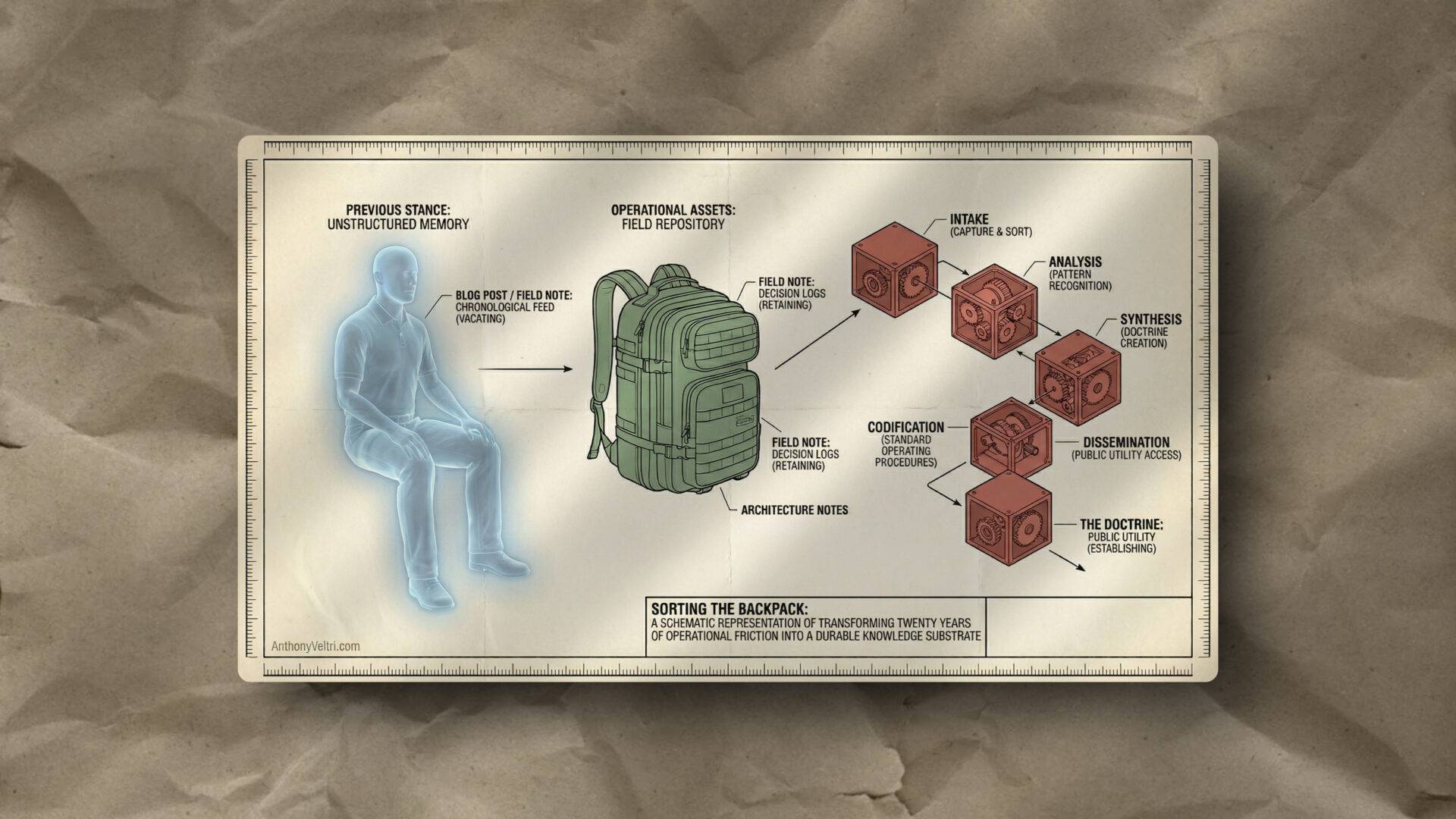
A diagram shows a translucent seated person labeled

Field Note: Sorting the 20-Year Backpack #

ANNEX F Pattern Library" text over a background of interconnected geometric lines, circles, and digital patterns resembling a circuit or network schematic.

ANNEX F. Pattern Library #

A digital graphic with the title "ANNEX I High-Visibility Workflows" in bold text, overlaid on a background of abstract, interconnected lines and circles resembling a technical or technological schematic.

ANNEX I. High Visibility Workflows #

A graphic with the title

ANNEX K. System and Workflow Profiles (Case Studies) #

A graphic with abstract blue and black data and circuit patterns, overlaid with a dark rectangle containing the text

Annex L: The Rosetta Stone for Data Teams: Bridging the Gap Between Technicians and Executives #

contracts, governance, interfaces, technical-debt
Table of Contents
  • The technical agreements that stabilize interfaces, reduce ambiguity, and enable useful interoperability
  • 1. Purpose of Data Contracts
  • 2. Why Data Contracts Matter
  • 3. The Ten Required Elements of a Data Contract
    • 1. Schema definition
    • 2. Geometry rules (if applicable)
    • 3. Time rules
    • 4. Refresh cadence
    • 5. Versioning model
    • 6. Authentication and authorization
    • 7. Error signaling
    • 8. Fallback behavior
    • 9. Publishing expectations
    • 10. Change management
  • 4. Data Contract Altitudes
    • Altitude 1: Technical correctness
    • Altitude 2: Process correctness
    • Altitude 3: Intent correctness
  • 5. Data Contracts and Doctrine
  • 6. Business Example: Federal Register Notices (FRNs) and the cost of no data contract
  • 7. System Example: iCAV and the federated ingest layer
  • 8. Data Contract Template (Paste Ready)
  • 9. Cross Links
  • 10. Doctrine Diagnostic - For Reflection:

Share This Article :

  • Facebook
  • X
  • LinkedIn
  • Pinterest

Was it helpful ?

  • Happy
  • Normal
  • Sad
  • Privacy Policy
  • Introductions
  • Contact

© 2026 Anthony Veltri

  • Doctrine
    • Doctrine Library
    • Global Library
  • Field Notes
  • Routes
    • Route 01: When the Interface Is Breaking (and you are becoming the patch)
    • ROUTE 02: If decisions stall and meetings go nowhere, start here
    • ROUTE 03: If you have lots of projects but no portfolio clarity, start here
    • ROUTE 04: If you’re confused about federation vs integration, start here
    • ROUTE 05: If heroics are propping up your system, start here
    • ROUTE 06: If you cannot force compliance across partners, start here
    • ROUTE 07: If compliance exists but commitment does not, start here
    • ROUTE 08: If disconnected workflows create audit anxiety, start here
  • Figure Library
  • FAQ
  • About
    • Capability Statement
    • Interpreter Kit
  • Contact