Skip to content

Introduced by a trusted connector?

Start Here

Anthony Veltri

  • Doctrine
    • Doctrine Library
    • Global Library
  • Field Notes
  • Routes
    • Route 01: When the Interface Is Breaking (and you are becoming the patch)
    • ROUTE 02: If decisions stall and meetings go nowhere, start here
    • ROUTE 03: If you have lots of projects but no portfolio clarity, start here
    • ROUTE 04: If you’re confused about federation vs integration, start here
    • ROUTE 05: If heroics are propping up your system, start here
    • ROUTE 06: If you cannot force compliance across partners, start here
    • ROUTE 07: If compliance exists but commitment does not, start here
    • ROUTE 08: If disconnected workflows create audit anxiety, start here
  • Figure Library
  • FAQ
  • About
    • Capability Statement
    • Interpreter Kit
  • Contact
Anthony Veltri

Architecture & Interfaces

15
  • Doctrine 01: Federation vs Integration in Mission Networks
  • Doctrine 03: Interfaces Are Where Systems Break, So They Require Stewards, Contracts, and Ownership
  • Doctrine 04: Useful Interoperability Is the Goal, Not Perfect Interoperability
  • Doctrine 05: Innovation Must Live at the Edge, Not in the Center
  • Doctrine 06: A Two-Lane System Protects Stability and Enables Evolution
  • Doctrine 14: Technical Debt Is a Leadership Signal, Not a Coding Failure
  • Doctrine 15: Architecture Must Accelerate Teams, Not Bottleneck Them
  • Doctrine 17: Architects Translate Strategy Into Engineering and Engineering Into Strategy
  • Doctrine 20: Golden Datasets: Putting Truth In One Place Without Pretending Everything Is Perfect
  • Doctrine 21: Zero Trust Is A Trust Model, Not A Card “Type”
  • Doctrine 23: Loop Closure as Load-Bearing System Infrastructure
  • ANNEX B. Data Contracts
  • ANNEX C. Interface Ownership Model
  • ANNEX H. Architecture Doctrine
  • Annex L: The Rosetta Stone for Data Teams: Bridging the Gap Between Technicians and Executives

Decision Tempo & Governance

10
  • Doctrine 02: Distributed Decisions Increase Alignment, Speed, and Resilience
  • Doctrine 07: Clear Intent Matters More Than Perfect Data
  • Doctrine 08: Clear Intent Compresses Ambiguity, Reduces Conflict, and Accelerates Action
  • Doctrine 09: Decision Drag Is the Enemy of Mission Tempo. Architecture Is the Remedy
  • Doctrine 10: Degraded Operations Are the Normal Mode, Not the Exception
  • Doctrine 11: Preventive Action and Contingent Action Must Both Be Designed Intentionally
  • Doctrine 22: When “It Depends” Is the Right Answer: How to Think in Probabilities Under Uncertainty
  • ANNEX D. Decision Altitudes Model
  • ANNEX E. Prevention–Contingency Matrix
  • ANNEX I. High Visibility Workflows

Portfolio & Alignment

4
  • Doctrine 16: Portfolio Thinking Ensures Effort Aligns With What Actually Matters
  • ANNEX F. Pattern Library
  • ANNEX J. System Evolution and Drift Management
  • ANNEX K. System and Workflow Profiles (Case Studies)

Leadership & Human Systems

6
  • Doctrine 24: Stewardship Places the Burden on the Steward, Not the Parties
  • Doctrine 18: Commitment Outperforms Compliance in High Trust, High Tempo Environments
  • Doctrine 19: Supervision, Management, and Leadership Are Three Different Jobs. Confusing Them Breaks Systems
  • Doctrine 23: Loop Closure as Load-Bearing System Infrastructure
  • ANNEX A. Human Contracts
  • ANNEX G. Leadership Doctrine

Resilience & Operations

3
  • Doctrine 24: Stewardship Places the Burden on the Steward, Not the Parties
  • Doctrine 12: Resilience Is an Emergent Property, Not a Feature
  • Doctrine 13: Problem Solving Requires Finding the Real Deviation and the Relevant Change

Doctrine Companions

7
  • Doctrine 03 Companion: The RS-CAT Framework: Converting Raw Recall into Teachable Principle
  • Doctrine 03 Companion: The Interface Void
  • Doctrine 11 Companion: Agency vs. Outcome
  • Doctrine 09 Companion: Artifacts Over Adjectives
  • Doctrine 03 Companion: Constraints: bidirectional translation: Compression vs Construction
  • Doctrine 10 Companion: Span of Control and Cross Training Are Load-Bearing Constraints
  • Doctrine 21 Companion: Claims, Roles, and Entitlements in Microsoft 365

Field Reports

1
  • Field Report: College Financing and the 5-Year Home Runway
View Categories
  • Home
  • Doctrine & Supporting Guides
  • Architecture & Interfaces
  • ANNEX C. Interface Ownership Model

ANNEX C. Interface Ownership Model

Anthony Veltri
Updated on December 5, 2025

6 min read

Why every interface needs two owners, one on each side, and why systems fail when ownership is ambiguous #

Doctrine Claim: Most organizations assign owners to the boxes (systems) but leave the lines (interfaces) ownerless. This is a fatal error. Systems rarely fail in the center; they fail at the seams where ownership is ambiguous. This annex defines the “Two-Owner Rule” required to secure those seams.


1. Purpose of Interface Ownership #

Interfaces are the points where systems, people, and authorities meet.
They are the fault lines.
They are the first points to fail.

An interface is:

  • the boundary
  • the seam
  • the handshake
  • the expectation set
  • the contract between systems or teams

The interface ownership model ensures:

  • predictability
  • clarity
  • timely correction
  • reduced conflict
  • faster decisions
  • stable federation

If you do not assign explicit owners on both sides of the boundary, you are relying on luck, personalities, and good intentions.

That collapses under stress.


2. Why Interfaces Fail Without Owners #
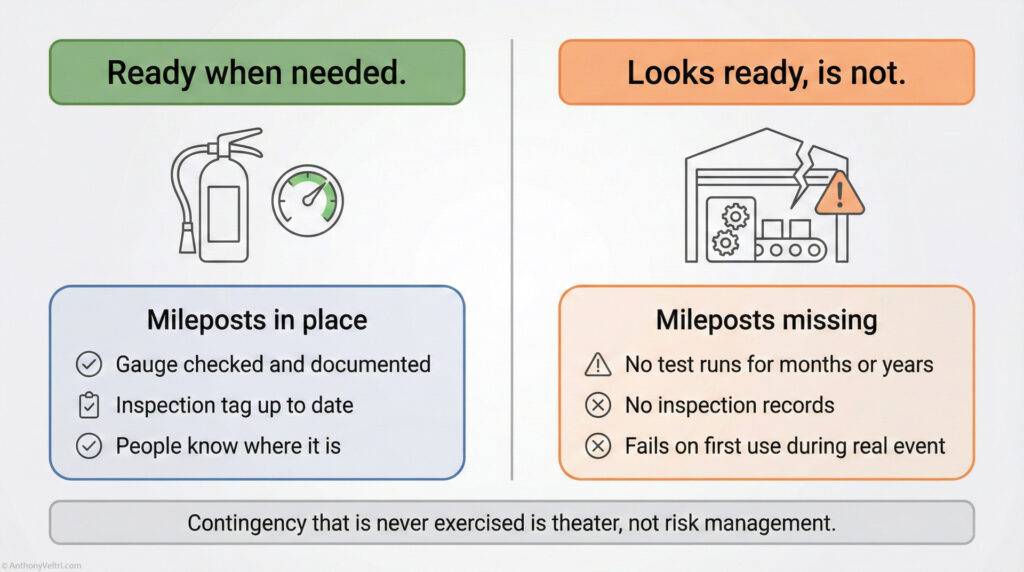
A comparison chart shows “Ready when needed” with checked fire extinguisher versus “Looks ready, is not” with a broken extinguisher box. It highlights the importance of regular checks and documentation for emergency readiness.
Real vs. Fake Contingency. If you have a plan but no triggers or rehearsals, you have Theater (The Binder). Real contingency looks like a maintained fire extinguisher. “Bolting on” a plan without integration is Theater. True resilience requires the mechanics (inspections, gauges) to be built into the daily operation. Also – Ownership Theater: If an interface has an “Owner” on paper (The Binder) but no active monitoring (The Extinguisher), it is Theater. Real ownership is active.

Interfaces fail first because they contain:

  • differing incentives
  • differing vocabularies
  • differing constraints
  • differing update cycles
  • differing leadership pressures
  • differing interpretations of intent

And because:

  • nobody wants to claim blame
  • nobody knows who should decide
  • nobody knows who should respond first
  • nobody controls the full pathway
  • nobody owns the friction

Ownership is the difference between drift and clarity.


3. The Two Owner Model #
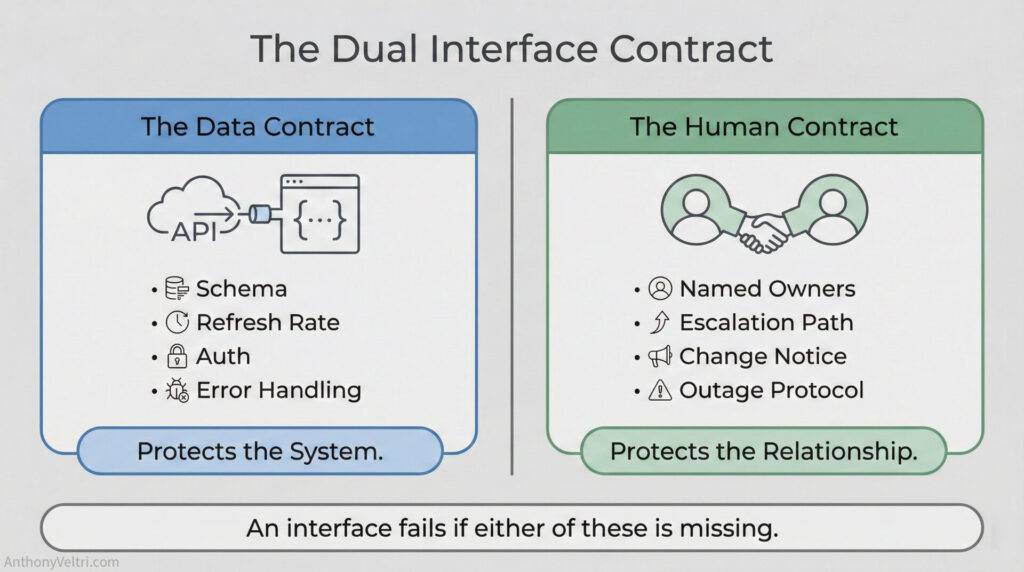
A diagram titled "The Dual Interface Contract" shows two sections: The Data Contract, with technology icons and bullet points for schema, refresh rate, auth, error handling, and "Protects the System"; and The Human Contract, with handshake icons and bullet points for named owners, escalation path, change notice, outage protocol, and "Protects the Relationship." A note below states an interface fails if either contract is missing.
The Handshake: Every interface needs two owners. One owns the Data Contract (Technical), and one owns the Human Contract (Relational). You need both to prevent failure. You should distinguish between the Data Contract (Schema, API) and the Human Contract (Escalation, Roles).

Every interface needs two named owners, not one.

Owner A: Upstream owner #

Owns the data, service, or behavior being published.

Owner B: Downstream owner #

Owns the ingestion, use, and impact of what is published.

Both owners must:

  • agree on intent
  • maintain the human contract
  • maintain the data contract
  • monitor deviations
  • coordinate changes
  • escalate intelligently
  • update leadership when needed

One owner cannot manage both sides.
That creates blind spots, bias, and blame.

Two owners create clarity.


4. Ownership Altitudes #
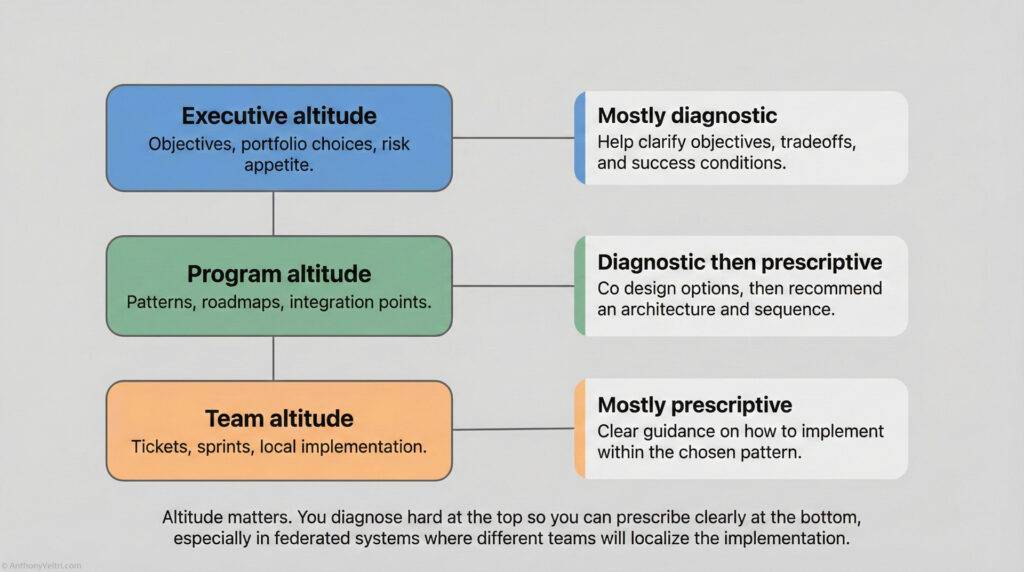
A diagram with three altitudes: Executive (diagnostic), Program (diagnostic then prescriptive), and Team (prescriptive), showing how responsibilities and clarity increase from objectives to implementation.
Ownership by Altitude: Ownership isn’t just one person; it’s a stack. The Operator owns the Signal. The Manager owns the SLA. The Executive owns the Risk. Altitude Translation / The Leadership Stack: The Executive Altitude sees “Objectives.” The Team Altitude sees “Tickets.” The Architect connects them at the Program Altitude. Supervision happens at the Team Altitude (Orange). Management happens at the Program Altitude (Green). Leadership happens at the Executive Altitude (Blue). When people operate in the wrong box, the system breaks.

Interface ownership exists at three levels.

Altitude 1: Operational ownership #

Operators understand how to detect drift, respond to errors, and communicate anomalies.

Altitude 2: Managerial ownership #

Managers align timelines, resources, and update cycles.

Altitude 3: Strategic ownership #

Leaders ensure the interface aligns with mission goals, legal obligations, or policy pressures.

If any altitude is missing, the interface becomes unstable.

This is exactly what happened with FRNs until your team stabilized the altitudes.


5. Interface Ownership and Doctrine #

The interface ownership model supports:

  • federation
  • useful interoperability
  • degraded operations
  • preventive vs contingent action
  • decision drag reduction
  • commitment over compliance
  • portfolio alignment
  • emergent resilience
  • clear intent

Interfaces are where doctrine becomes reality.
Without owners, nothing else holds.


6. Business Example: Federal Register Notices (FRNs) and interface ownership failures #

FRNs exposed one of the most classic interface failures:

Leadership created requirements without owning the downstream impact.
Operators received those requirements without owning the upstream rationale.
Managers were stuck in the middle.

The interface between:

  • leadership expectations
  • editorial workflow
  • legal standards
  • template formatting
  • content owners
  • technical systems

was entirely ownerless.

Symptoms included:

  • fields added without explanation
  • schema drift
  • inconsistent expectations
  • revision loops
  • delayed publication
  • inconsistent interpretations of “correct”
  • misaligned roles
  • unnecessary escalations

To stabilize this, our team introduced ownership even if informally:

  • leadership owned intent
  • managers owned workflow
  • analysts and editors owned correctness
  • legal reviewers owned compliance
  • the publishing team owned formatting and final release

This two sided interface ownership model:

  • stabilized revisions
  • clarified expectations
  • stopped leadership thrash
  • reduced decision drag
  • reduced rework
  • restored predictable cadence

It was a textbook recovery driven by the interface ownership principle.


7. System Example: iCAV’s ingestion model as a two owner system #

In iCAV:

  • each partner source had an upstream owner
  • each ingest connector had a downstream owner

Together they:

  • coordinated schema adjustments
  • resolved geometry issues
  • caught timestamp drift
  • managed degraded mode
  • handled outages
  • communicated changes
  • preserved mission tempo

Where ownership was clear, interfaces were stable.
Where ownership was informal or missing, failures multiplied until ownership was assigned.

This pattern repeated across multiple years and multiple activations.

Ownership fixed what technology alone could not.


8. The Interface Ownership Loop #
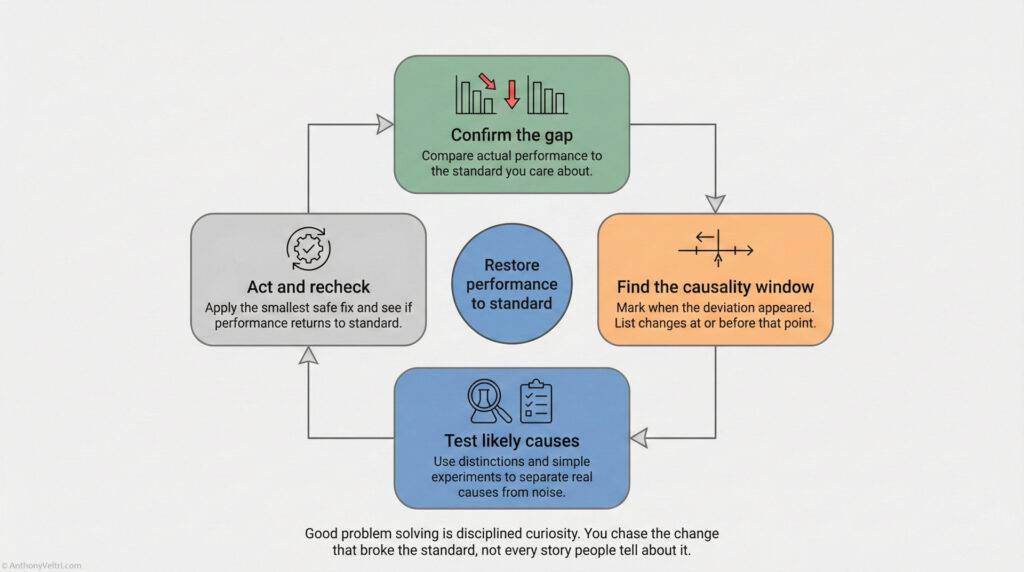
A flowchart showing a problem-solving cycle: Confirm the gap, Find the causality window, Test likely causes, Act and recheck, all revolving around restoring performance to standard. Text at bottom emphasizes disciplined curiosity.
The Resolution Loop. Disciplined problem solving moves in a cycle: Confirm the Gap –> Find the Causality Window –> Test Likely Causes –> Act and Recheck. As with an OODA loop, interruptions of the cycle can be disorienting and costly. You cannot manage drift linearly. You must cycle through Confirming the Gap, Finding the Cause, Testing the Fix, and Updating the Standard. The Maintenance Loop: Ownership isn’t a static state – it’s a cycle of Confirming Health, Finding Drift, Testing Fixes, and Updating the Contract.

A functioning interface ownership loop includes:

1. Visibility #

Both owners see the same behavior, drift, and deviations.

2. Responsibility #

Each owner knows what they own and what they do not.

3. Coordination #

Owners talk directly at the right cadence.

4. Escalation #

Owners escalate together, not against each other.

5. Iteration #

Owners revise the contract when conditions change.

This loop is how you keep the boundary healthy.


9. Interface Ownership Checklist (Paste Ready) #

Paste this into your WordPress Page.


Interface Ownership Checklist

Boundary Name:
Describe the interface.

Upstream Owner:
Name, role, responsibilities.

Downstream Owner:
Name, role, responsibilities.

Technical Contract:
Link to the data contract.

Human Contract:
Link to the human contract.

Scope:
What is inside the interface.
What is outside the interface.

Cadence:
Normal communication.
High tempo communication.

Drift Detection:
How both sides detect and confirm deviations.

Change Management:
Notice requirements.
Approval flow.
Impact review.

Escalation Path:
Step 1:
Step 2:
Step 3:

Intent:
What the interface must achieve.
What must never be violated.


10. Cross Links #

Interface ownership connects directly to:

  • Annex A: Human Contracts
  • Annex B: Data Contracts
  • Principle 7: Interfaces break first
  • Principle 10: Degraded operations
  • Principle 14: Decision drag
  • Principle 16: Distributed decisions
  • Principle 19: Commitment vs compliance
  • Principle 20: Leadership vs management vs supervision

Interfaces are the structural friction points.
Ownership is the antidote.


11. For Reflection: #

Ask yourself:

Which of your interfaces have clear owners?
Which have two owners?
Which have none?

Where ownership is missing, failure is waiting.

Assign ownership now.
Stabilize the boundary.
Protect the system.

Last Updated on December 5, 2025

Related Posts #

A graphic with abstract blue and black data and circuit patterns, overlaid with a dark rectangle containing the text

Annex L: The Rosetta Stone for Data Teams: Bridging the Gap Between Technicians and Executives #

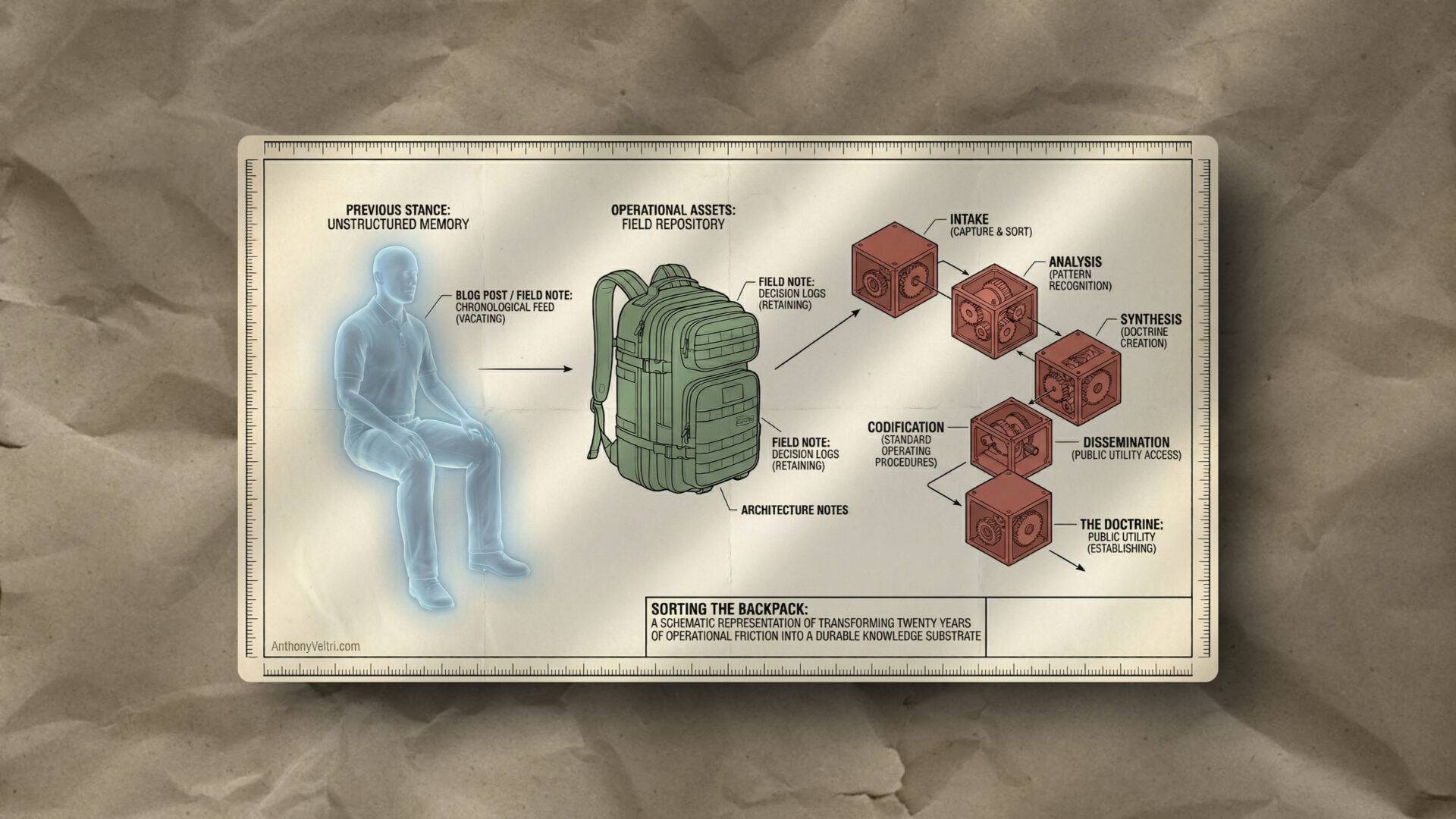
A diagram shows a translucent seated person labeled

Field Note: Sorting the 20-Year Backpack #

ANNEX F Pattern Library" text over a background of interconnected geometric lines, circles, and digital patterns resembling a circuit or network schematic.

ANNEX F. Pattern Library #

This diagram illustrates increasing salary capacities, with larger houses on higher blocks representing $6k, $24k (median), and $80k per year.

Field Report: College Financing and the 5-Year Home Runway #

A slide with the text

Doctrine 03: Interfaces Are Where Systems Break, So They Require Stewards, Contracts, and Ownership #

A graphic with the title

ANNEX K. System and Workflow Profiles (Case Studies) #

architecture, interfaces, leadership
Table of Contents
  • Why every interface needs two owners, one on each side, and why systems fail when ownership is ambiguous
  • 1. Purpose of Interface Ownership
  • 2. Why Interfaces Fail Without Owners
  • 3. The Two Owner Model
    • Owner A: Upstream owner
    • Owner B: Downstream owner
  • 4. Ownership Altitudes
    • Altitude 1: Operational ownership
    • Altitude 2: Managerial ownership
    • Altitude 3: Strategic ownership
  • 5. Interface Ownership and Doctrine
  • 6. Business Example: Federal Register Notices (FRNs) and interface ownership failures
  • 7. System Example: iCAV’s ingestion model as a two owner system
  • 8. The Interface Ownership Loop
    • 1. Visibility
    • 2. Responsibility
    • 3. Coordination
    • 4. Escalation
    • 5. Iteration
  • 9. Interface Ownership Checklist (Paste Ready)
  • 10. Cross Links
  • 11. For Reflection:

Share This Article :

  • Facebook
  • X
  • LinkedIn
  • Pinterest

Was it helpful ?

  • Happy
  • Normal
  • Sad
  • Privacy Policy
  • Introductions
  • Contact

© 2026 Anthony Veltri

  • Doctrine
    • Doctrine Library
    • Global Library
  • Field Notes
  • Routes
    • Route 01: When the Interface Is Breaking (and you are becoming the patch)
    • ROUTE 02: If decisions stall and meetings go nowhere, start here
    • ROUTE 03: If you have lots of projects but no portfolio clarity, start here
    • ROUTE 04: If you’re confused about federation vs integration, start here
    • ROUTE 05: If heroics are propping up your system, start here
    • ROUTE 06: If you cannot force compliance across partners, start here
    • ROUTE 07: If compliance exists but commitment does not, start here
    • ROUTE 08: If disconnected workflows create audit anxiety, start here
  • Figure Library
  • FAQ
  • About
    • Capability Statement
    • Interpreter Kit
  • Contact