Skip to content

Introduced by a trusted connector?

Start Here

Anthony Veltri

  • Doctrine
    • Doctrine Library
    • Global Library
  • Field Notes
  • Routes
    • Route 01: When the Interface Is Breaking (and you are becoming the patch)
    • ROUTE 02: If decisions stall and meetings go nowhere, start here
    • ROUTE 03: If you have lots of projects but no portfolio clarity, start here
    • ROUTE 04: If you’re confused about federation vs integration, start here
    • ROUTE 05: If heroics are propping up your system, start here
    • ROUTE 06: If you cannot force compliance across partners, start here
    • ROUTE 07: If compliance exists but commitment does not, start here
    • ROUTE 08: If disconnected workflows create audit anxiety, start here
  • Figure Library
  • FAQ
  • About
    • Capability Statement
    • Interpreter Kit
  • Contact
Anthony Veltri

Architecture & Interfaces

15
  • Doctrine 01: Federation vs Integration in Mission Networks
  • Doctrine 03: Interfaces Are Where Systems Break, So They Require Stewards, Contracts, and Ownership
  • Doctrine 04: Useful Interoperability Is the Goal, Not Perfect Interoperability
  • Doctrine 05: Innovation Must Live at the Edge, Not in the Center
  • Doctrine 06: A Two-Lane System Protects Stability and Enables Evolution
  • Doctrine 14: Technical Debt Is a Leadership Signal, Not a Coding Failure
  • Doctrine 15: Architecture Must Accelerate Teams, Not Bottleneck Them
  • Doctrine 17: Architects Translate Strategy Into Engineering and Engineering Into Strategy
  • Doctrine 20: Golden Datasets: Putting Truth In One Place Without Pretending Everything Is Perfect
  • Doctrine 21: Zero Trust Is A Trust Model, Not A Card “Type”
  • Doctrine 23: Loop Closure as Load-Bearing System Infrastructure
  • ANNEX B. Data Contracts
  • ANNEX C. Interface Ownership Model
  • ANNEX H. Architecture Doctrine
  • Annex L: The Rosetta Stone for Data Teams: Bridging the Gap Between Technicians and Executives

Decision Tempo & Governance

10
  • Doctrine 02: Distributed Decisions Increase Alignment, Speed, and Resilience
  • Doctrine 07: Clear Intent Matters More Than Perfect Data
  • Doctrine 08: Clear Intent Compresses Ambiguity, Reduces Conflict, and Accelerates Action
  • Doctrine 09: Decision Drag Is the Enemy of Mission Tempo. Architecture Is the Remedy
  • Doctrine 10: Degraded Operations Are the Normal Mode, Not the Exception
  • Doctrine 11: Preventive Action and Contingent Action Must Both Be Designed Intentionally
  • Doctrine 22: When “It Depends” Is the Right Answer: How to Think in Probabilities Under Uncertainty
  • ANNEX D. Decision Altitudes Model
  • ANNEX E. Prevention–Contingency Matrix
  • ANNEX I. High Visibility Workflows

Portfolio & Alignment

4
  • Doctrine 16: Portfolio Thinking Ensures Effort Aligns With What Actually Matters
  • ANNEX F. Pattern Library
  • ANNEX J. System Evolution and Drift Management
  • ANNEX K. System and Workflow Profiles (Case Studies)

Leadership & Human Systems

6
  • Doctrine 24: Stewardship Places the Burden on the Steward, Not the Parties
  • Doctrine 18: Commitment Outperforms Compliance in High Trust, High Tempo Environments
  • Doctrine 19: Supervision, Management, and Leadership Are Three Different Jobs. Confusing Them Breaks Systems
  • Doctrine 23: Loop Closure as Load-Bearing System Infrastructure
  • ANNEX A. Human Contracts
  • ANNEX G. Leadership Doctrine

Resilience & Operations

3
  • Doctrine 24: Stewardship Places the Burden on the Steward, Not the Parties
  • Doctrine 12: Resilience Is an Emergent Property, Not a Feature
  • Doctrine 13: Problem Solving Requires Finding the Real Deviation and the Relevant Change

Doctrine Companions

7
  • Doctrine 03 Companion: The RS-CAT Framework: Converting Raw Recall into Teachable Principle
  • Doctrine 03 Companion: The Interface Void
  • Doctrine 11 Companion: Agency vs. Outcome
  • Doctrine 09 Companion: Artifacts Over Adjectives
  • Doctrine 03 Companion: Constraints: bidirectional translation: Compression vs Construction
  • Doctrine 10 Companion: Span of Control and Cross Training Are Load-Bearing Constraints
  • Doctrine 21 Companion: Claims, Roles, and Entitlements in Microsoft 365

Field Reports

1
  • Field Report: College Financing and the 5-Year Home Runway
View Categories
  • Home
  • Doctrine & Supporting Guides
  • Decision Tempo & Governance
  • ANNEX D. Decision Altitudes Model

ANNEX D. Decision Altitudes Model

Anthony Veltri
Updated on December 5, 2025

6 min read

Why decisions must be made at the right altitude to move fast, stay aligned, and avoid unnecessary friction #

Doctrine Claim: Decisions have mass. Strategic choices are heavy and belong at the top. Tactical choices are light and belong at the edge. When you confuse the two: when leaders micromanage formatting or operators wait for permission to fix a typo, the system freezes. This guide defines the four altitudes of authority required to maintain high tempo without losing alignment.


1. Purpose of the Decision Altitudes Model #

Decision making in complex organizations breaks down when:

  • people act at the wrong level
  • authority is unclear
  • escalation is inconsistent
  • leadership and operators step into each other’s lanes
  • decisions stall while waiting for the wrong person

The Decision Altitudes Model provides a clean structure for:

  • who decides
  • where they decide
  • what they decide
  • when they decide

This model makes distributed decisions possible, reduces decision drag, and protects mission tempo.


2. The Four Decision Altitudes #

The system has four decision altitudes.
Each must operate cleanly for the system to function.
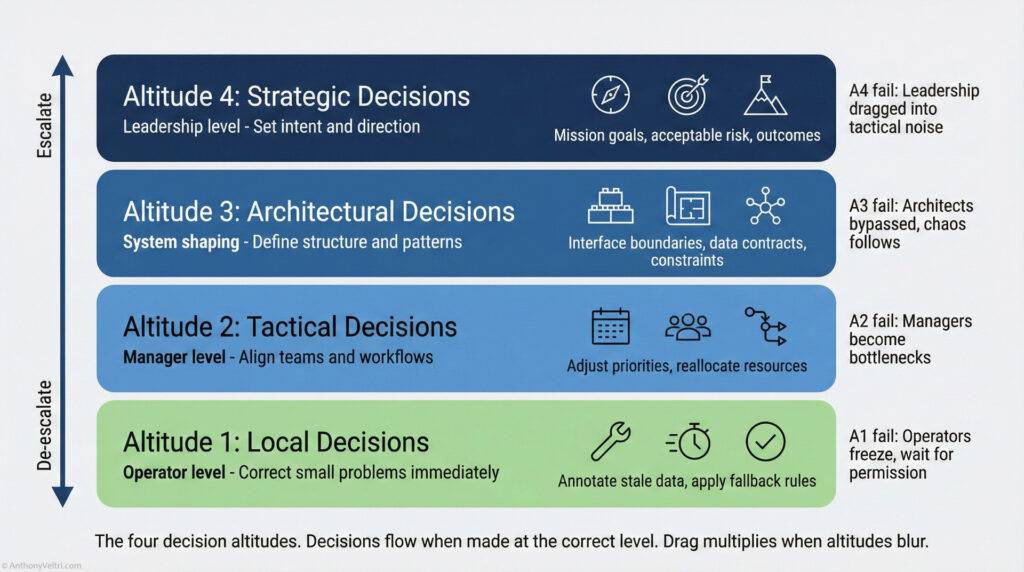
A flowchart with four colored layers: Strategic, Architectural, Tactical, and Local Decisions, each with descriptions of their roles, responsibilities, and consequences if made at the wrong level.
Intent must exist at every altitude. Strategic Intent (Level 4) guides Architectural Intent (Level 3), which constrains Local Intent (Level 1). If a layer is missing, the signal breaks.

The Decision Altitude Escalation Ladder #
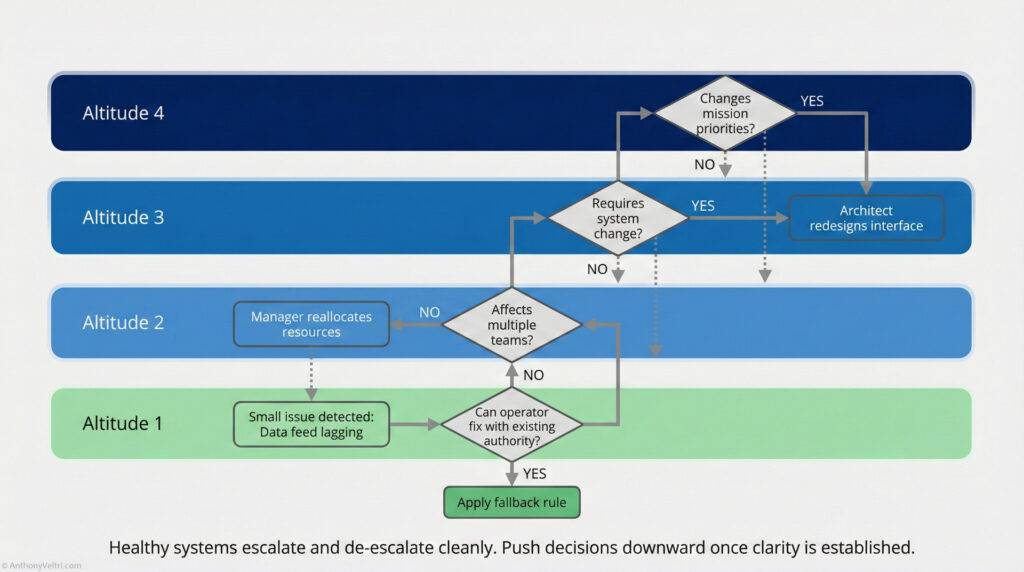
A flowchart illustrating a decision-making process across four altitudes, from operator action at Altitude 1 up to mission priority changes at Altitude 4, with steps for escalation, resource allocation, and system changes.
Escalation Pathways. Decisions should be solved at the lowest possible altitude (Level 1 or 2). They only escalate to Architecture (Level 3) or Strategy (Level 4) if they break a boundary.

Altitude 1: Local Decisions (Operator Level) #

Purpose: Correct small problems immediately at the point of action.

These decisions include:

  • annotating stale data
  • making minor corrections
  • adjusting workflows
  • clarifying a technical detail
  • applying predefined fallback behavior
  • preventing a small issue from escalating

Operators decide because:

  • they see the problem first
  • they understand the immediate context
  • the cost of waiting is too high

Failure mode:
Operators wait for permission, causing delays, drag, and avoidable escalation.


Altitude 2: Tactical Decisions (Manager Level) #

Purpose: Align teams, workflows, and timelines.

These decisions include:

  • adjusting priorities
  • reallocating resources
  • harmonizing partner expectations
  • reviewing process changes
  • triaging work across teams

Managers decide because:

  • they understand system flow
  • they control allocation
  • they see cross team friction
  • they own workflow health

Failure mode:
Managers micromanage operators or act like strategists, causing drift and confusion.


Altitude 3: Architectural Decisions (System Shaping Level) #

Purpose: Shape the structure, patterns, and constraints of the system.

These decisions include:

  • interface boundaries
  • data contract design
  • schema consistency
  • risk thresholds
  • fallback principles
  • federation shapes
  • evolution path
  • change management rules

Architects decide because:

  • they see the whole system
  • they understand coupling
  • they know which constraints matter
  • they design for both prevention and contingency
  • they protect tempo and reduce drag

Failure mode:
Architects are bypassed and technical decisions become political decisions, creating instability.


Altitude 4: Strategic Decisions (Leadership Level) #

Purpose: Set intent, define direction, and select the outcomes that matter.

These decisions include:

  • mission goals
  • definition of success
  • acceptable risk
  • portfolio prioritization
  • organizational boundaries
  • long term commitments

Leadership decides because:

  • they carry strategic accountability
  • they must align resources
  • they shape the environment teams operate within

Failure mode:
Leadership dictates operator level decisions or changes requirements without understanding impact.


3. Why Decisions Must Stay in Their Lane #
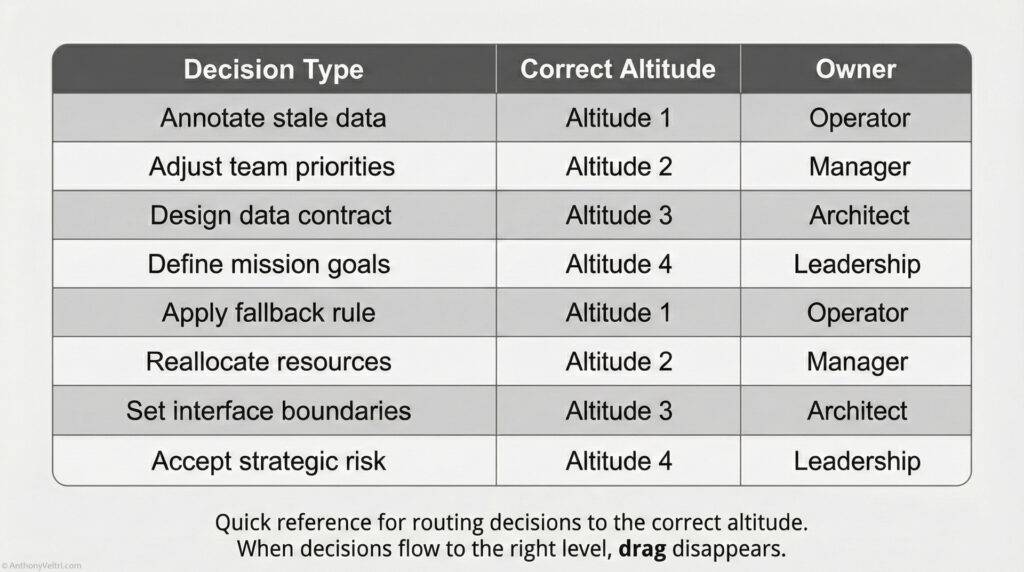
A table showing decision types, their correct altitudes, and owners: Annotate stale data—Operator; Adjust team priorities—Manager; Design data contract—Architect; Define mission goals—Leadership, with related altitudes.
Ownership by Type: Don’t guess who decides. Map the type of decision (e.g., “Annotate stale data”) to the owner (Operator). Clarity removes drag. Owning the Truth: Golden Datasets (among others) require explicit ownership at the right altitude. Architects own the Schema (Altitude 3). Managers own the Data Quality (Altitude 2). Operators own the Updates (Altitude 1).

Every altitude exists for a reason.

When altitudes blur:

  • operators escalate unnecessarily
  • managers become bottlenecks
  • architects get overridden
  • leadership gets dragged into tactical noise
  • strategic decisions collapse into daily firefighting
  • conflict increases
  • morale drops
  • decision drag multiplies

When altitudes are clear:

  • people act quickly
  • alignment is stronger
  • escalation is clean
  • authority is respected
  • tempo is protected

A healthy system routes decisions to the correct altitude instinctively.


4. Decision Altitude Failures in Real Environments #
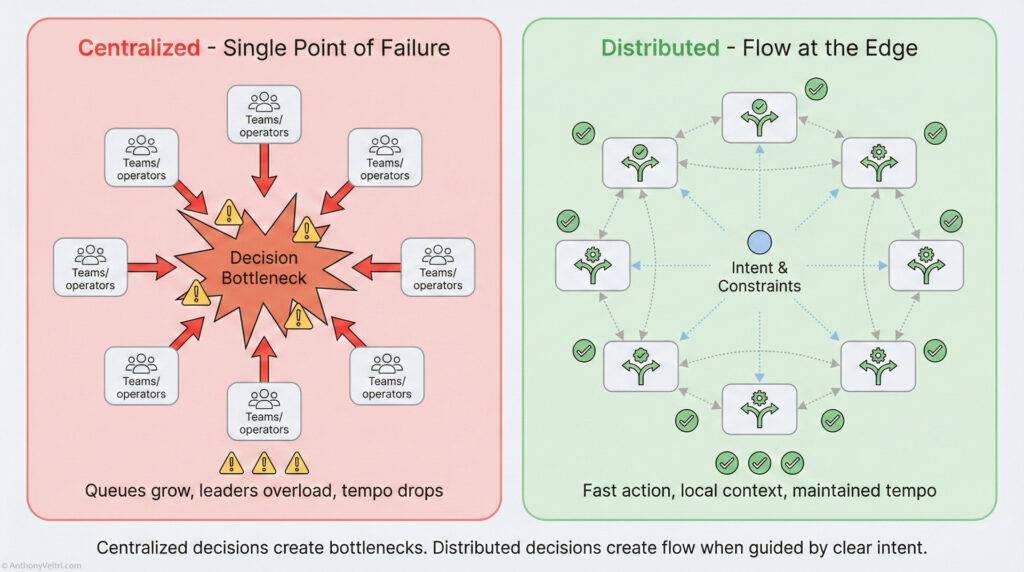
Infographic comparing centralized (single point of failure) with distributed (flow at the edge) decision-making. Centralized shows bottlenecks and overload; distributed shows quick, local decisions guided by intent and constraints.
Intent Enables Flow: Without intent (Red), every decision must route to the center for data validation. With intent (Green), the center sets constraints, and the nodes can act immediately on local data. Structure creates or reduces drag: Centralized systems (Red) create drag by forcing every decision through a single overloaded node (bottleneck). Distributed systems (Green) remove drag by pushing authority to the edge. Another example: The Cost of Wrong Altitude: When leaders (Center) try to make local decisions, they create a bottleneck (Red). When they set intent and let operators decide, they create flow (Green).

FRN Example: Leadership acting at Altitude 1 #

FRN failures often came from leadership operating at the wrong altitude:

Leadership at altitude 4 added fields:

  • based on personal preference
  • during revision cycles
  • without evaluating downstream impact

But these were local-level decisions altering:

  • schema
  • formatting
  • operator workload
  • workflow timing

Wrong altitude → chaos.

Once your team reset altitudes:

  • leadership defined intent
  • managers owned workflow
  • editors owned correctness
  • legal reviewers owned compliance

The system stabilized instantly.


iCAV Example: Operators forced into Altitude 3 decisions #

In early iCAV cycles, analysts were forced into architectural decisions:

  • changing ingest logic
  • altering fallback patterns
  • adjusting harmonization rules

This was the result of unclear altitude boundaries.

When architecture reclaimed those decisions:

  • analysts focused on real time correctness
  • architects focused on stability and evolution
  • managers focused on throughput
  • leadership focused on mission outcomes

Tempo increased, friction fell.


5. The Decision Altitude Test #

Whenever a decision appears, ask:

Which altitude does this belong to?
If the wrong person is deciding, move it.

Example questions:

  • Does this require immediate correction? → Altitude 1
  • Does this affect workflow or resource allocation? → Altitude 2
  • Does this change system shape, boundaries, or patterns? → Altitude 3
  • Does this affect our mission, risk, or strategic direction? → Altitude 4

This test prevents 80 percent of decision drag.


6. The Altitude Escalation Ladder #

Healthy systems escalate and de escalate decisions cleanly.

Start at Altitude 1 #

Operators solve small problems immediately.

Escalate to Altitude 2 #

Only if the issue affects timelines, resources, or cross team flow.

Escalate to Altitude 3 #

Only if the issue affects boundaries, interfaces, or architecture.

Escalate to Altitude 4 #

Only if the issue affects mission intent or strategic direction.

De escalate when possible #

Push decisions downward once clarity is established.

This pattern prevents accidental drift upward.


7. Decision Altitude Template (Paste Ready) #


Decision Altitude Template

Decision:
Describe the decision.

Correct Altitude:
1 / 2 / 3 / 4

Why This Altitude:
Explain the reasoning.

Owner:
Operator / Manager / Architect / Leader

Escalation Path:
Step 1:
Step 2:
Step 3:

Intent:
What this decision must achieve.
What must not be violated.

Impact:
Local, cross team, architectural, strategic.


8. Cross Links #

Decision altitudes connect directly to:

  • Principle 16: Distributed decisions
  • Principle 17: Clear intent
  • Principle 19: Commitment over compliance
  • Principle 20: Leadership vs management vs supervision
  • Annex A: Human contracts
  • Annex C: Interface ownership
  • Annex E: Prevention–contingency matrix

Decision altitudes are the backbone of your command philosophy.


9. For Reflection: #

Ask yourself:

Who is making decisions at the wrong altitude?
Where is leadership dragged down?
Where are operators frozen?
Where are managers bottlenecking?
Where are architects bypassed?

Fix the altitude.
Restore the flow.

Last Updated on December 5, 2025

Related Posts #

A graphic with abstract blue and black data and circuit patterns, overlaid with a dark rectangle containing the text

Annex L: The Rosetta Stone for Data Teams: Bridging the Gap Between Technicians and Executives #

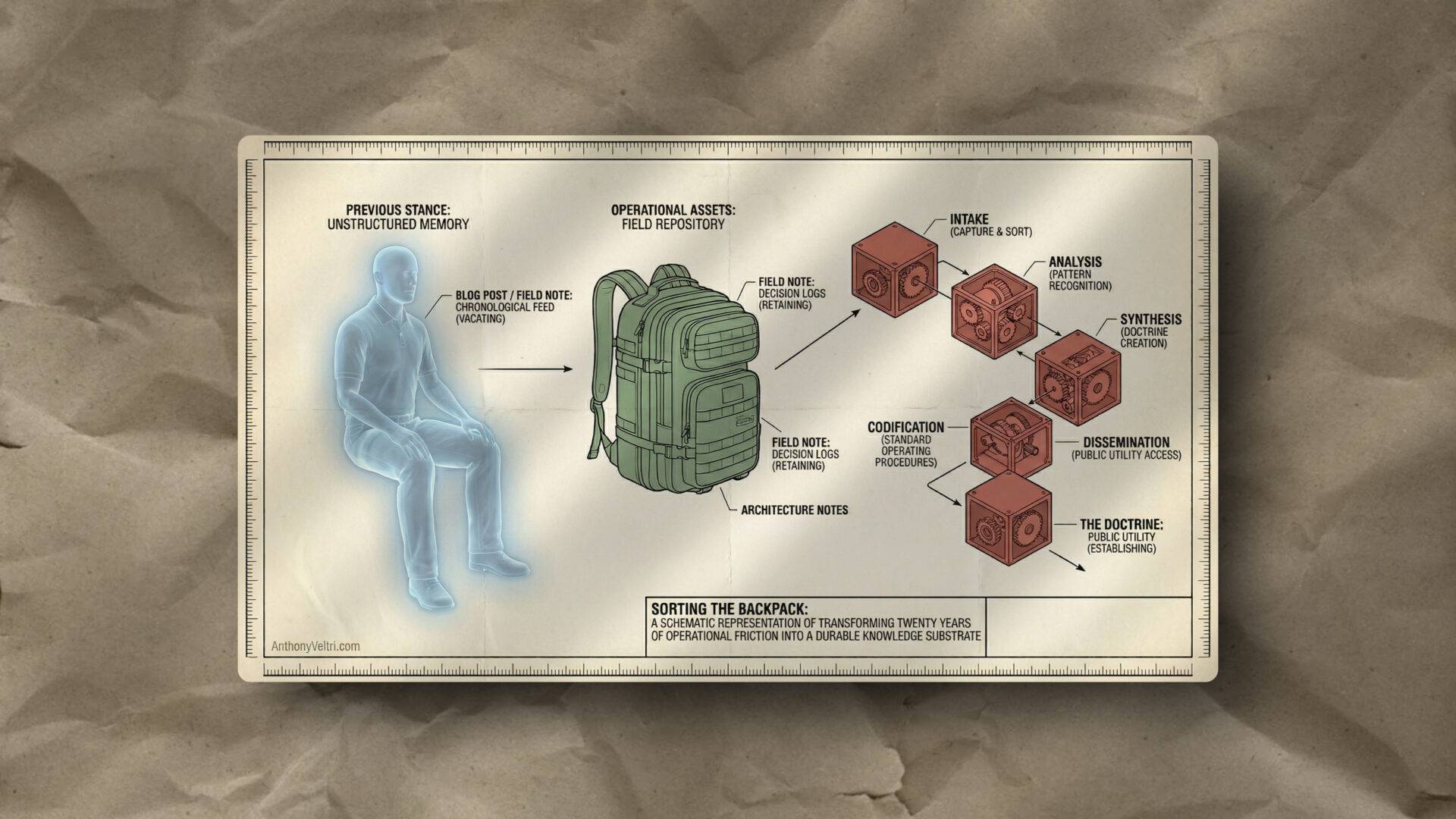
A diagram shows a translucent seated person labeled

Field Note: Sorting the 20-Year Backpack #

ANNEX F Pattern Library" text over a background of interconnected geometric lines, circles, and digital patterns resembling a circuit or network schematic.

ANNEX F. Pattern Library #

A digital graphic with the title "ANNEX I High-Visibility Workflows" in bold text, overlaid on a background of abstract, interconnected lines and circles resembling a technical or technological schematic.

ANNEX I. High Visibility Workflows #

A graphic with the title

ANNEX K. System and Workflow Profiles (Case Studies) #

A graphic with the text

ANNEX C. Interface Ownership Model #

decision-tempo, governance
Table of Contents
  • Why decisions must be made at the right altitude to move fast, stay aligned, and avoid unnecessary friction
  • 1. Purpose of the Decision Altitudes Model
  • 2. The Four Decision Altitudes
    • The Decision Altitude Escalation Ladder
    • Altitude 1: Local Decisions (Operator Level)
    • Altitude 2: Tactical Decisions (Manager Level)
    • Altitude 3: Architectural Decisions (System Shaping Level)
    • Altitude 4: Strategic Decisions (Leadership Level)
  • 3. Why Decisions Must Stay in Their Lane
  • 4. Decision Altitude Failures in Real Environments
    • FRN Example: Leadership acting at Altitude 1
    • iCAV Example: Operators forced into Altitude 3 decisions
  • 5. The Decision Altitude Test
  • 6. The Altitude Escalation Ladder
    • Start at Altitude 1
    • Escalate to Altitude 2
    • Escalate to Altitude 3
    • Escalate to Altitude 4
    • De escalate when possible
  • 7. Decision Altitude Template (Paste Ready)
  • 8. Cross Links
  • 9. For Reflection:

Share This Article :

  • Facebook
  • X
  • LinkedIn
  • Pinterest

Was it helpful ?

  • Happy
  • Normal
  • Sad
  • Privacy Policy
  • Introductions
  • Contact

© 2026 Anthony Veltri

  • Doctrine
    • Doctrine Library
    • Global Library
  • Field Notes
  • Routes
    • Route 01: When the Interface Is Breaking (and you are becoming the patch)
    • ROUTE 02: If decisions stall and meetings go nowhere, start here
    • ROUTE 03: If you have lots of projects but no portfolio clarity, start here
    • ROUTE 04: If you’re confused about federation vs integration, start here
    • ROUTE 05: If heroics are propping up your system, start here
    • ROUTE 06: If you cannot force compliance across partners, start here
    • ROUTE 07: If compliance exists but commitment does not, start here
    • ROUTE 08: If disconnected workflows create audit anxiety, start here
  • Figure Library
  • FAQ
  • About
    • Capability Statement
    • Interpreter Kit
  • Contact