Skip to content

Introduced by a trusted connector?

Start Here

Anthony Veltri

  • Doctrine
    • Doctrine Library
    • Global Library
  • Field Notes
  • Routes
    • Route 01: When the Interface Is Breaking (and you are becoming the patch)
    • ROUTE 02: If decisions stall and meetings go nowhere, start here
    • ROUTE 03: If you have lots of projects but no portfolio clarity, start here
    • ROUTE 04: If you’re confused about federation vs integration, start here
    • ROUTE 05: If heroics are propping up your system, start here
    • ROUTE 06: If you cannot force compliance across partners, start here
    • ROUTE 07: If compliance exists but commitment does not, start here
    • ROUTE 08: If disconnected workflows create audit anxiety, start here
  • Figure Library
  • FAQ
  • About
    • Capability Statement
    • Interpreter Kit
  • Contact
Anthony Veltri

Architecture & Interfaces

15
  • Doctrine 01: Federation vs Integration in Mission Networks
  • Doctrine 03: Interfaces Are Where Systems Break, So They Require Stewards, Contracts, and Ownership
  • Doctrine 04: Useful Interoperability Is the Goal, Not Perfect Interoperability
  • Doctrine 05: Innovation Must Live at the Edge, Not in the Center
  • Doctrine 06: A Two-Lane System Protects Stability and Enables Evolution
  • Doctrine 14: Technical Debt Is a Leadership Signal, Not a Coding Failure
  • Doctrine 15: Architecture Must Accelerate Teams, Not Bottleneck Them
  • Doctrine 17: Architects Translate Strategy Into Engineering and Engineering Into Strategy
  • Doctrine 20: Golden Datasets: Putting Truth In One Place Without Pretending Everything Is Perfect
  • Doctrine 21: Zero Trust Is A Trust Model, Not A Card “Type”
  • Doctrine 23: Loop Closure as Load-Bearing System Infrastructure
  • ANNEX B. Data Contracts
  • ANNEX C. Interface Ownership Model
  • ANNEX H. Architecture Doctrine
  • Annex L: The Rosetta Stone for Data Teams: Bridging the Gap Between Technicians and Executives

Decision Tempo & Governance

10
  • Doctrine 02: Distributed Decisions Increase Alignment, Speed, and Resilience
  • Doctrine 07: Clear Intent Matters More Than Perfect Data
  • Doctrine 08: Clear Intent Compresses Ambiguity, Reduces Conflict, and Accelerates Action
  • Doctrine 09: Decision Drag Is the Enemy of Mission Tempo. Architecture Is the Remedy
  • Doctrine 10: Degraded Operations Are the Normal Mode, Not the Exception
  • Doctrine 11: Preventive Action and Contingent Action Must Both Be Designed Intentionally
  • Doctrine 22: When “It Depends” Is the Right Answer: How to Think in Probabilities Under Uncertainty
  • ANNEX D. Decision Altitudes Model
  • ANNEX E. Prevention–Contingency Matrix
  • ANNEX I. High Visibility Workflows

Portfolio & Alignment

4
  • Doctrine 16: Portfolio Thinking Ensures Effort Aligns With What Actually Matters
  • ANNEX F. Pattern Library
  • ANNEX J. System Evolution and Drift Management
  • ANNEX K. System and Workflow Profiles (Case Studies)

Leadership & Human Systems

6
  • Doctrine 24: Stewardship Places the Burden on the Steward, Not the Parties
  • Doctrine 18: Commitment Outperforms Compliance in High Trust, High Tempo Environments
  • Doctrine 19: Supervision, Management, and Leadership Are Three Different Jobs. Confusing Them Breaks Systems
  • Doctrine 23: Loop Closure as Load-Bearing System Infrastructure
  • ANNEX A. Human Contracts
  • ANNEX G. Leadership Doctrine

Resilience & Operations

3
  • Doctrine 24: Stewardship Places the Burden on the Steward, Not the Parties
  • Doctrine 12: Resilience Is an Emergent Property, Not a Feature
  • Doctrine 13: Problem Solving Requires Finding the Real Deviation and the Relevant Change

Doctrine Companions

7
  • Doctrine 03 Companion: The RS-CAT Framework: Converting Raw Recall into Teachable Principle
  • Doctrine 03 Companion: The Interface Void
  • Doctrine 11 Companion: Agency vs. Outcome
  • Doctrine 09 Companion: Artifacts Over Adjectives
  • Doctrine 03 Companion: Constraints: bidirectional translation: Compression vs Construction
  • Doctrine 10 Companion: Span of Control and Cross Training Are Load-Bearing Constraints
  • Doctrine 21 Companion: Claims, Roles, and Entitlements in Microsoft 365

Field Reports

1
  • Field Report: College Financing and the 5-Year Home Runway
View Categories
  • Home
  • Doctrine & Supporting Guides
  • Decision Tempo & Governance
  • ANNEX E. Prevention–Contingency Matrix

ANNEX E. Prevention–Contingency Matrix

Anthony Veltri
Updated on December 5, 2025

4 min read

Why resilient systems require both prevention and contingency, and how the balance determines performance under stress #

Doctrine Claim: You cannot prevent every failure, and you cannot firefight your way to stability. Resilient systems require two distinct layers of defense: Prevention (to reduce the probability of error) and Contingency (to reduce the impact of error). This matrix forces you to design for survival, not just perfection.


1. Purpose of the Prevention–Contingency Matrix #
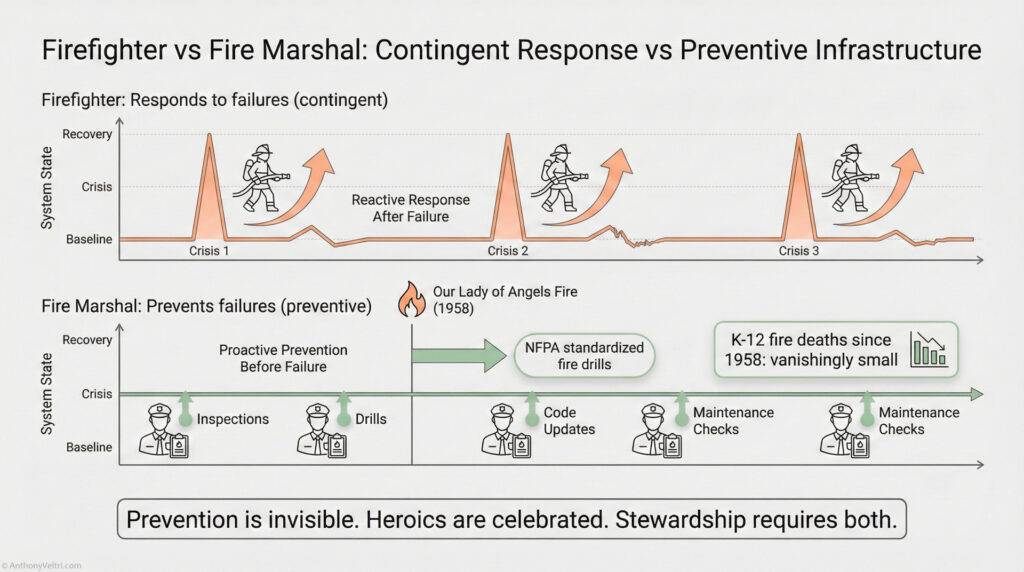
Infographic compares firefighters’ reactive crisis response to fire marshals’ preventive measures like inspections, drills, and maintenance. Graphs show frequent crises with firefighting versus sustained system stability with fire prevention.
Two Types of Defense. The Fire Marshal represents Prevention (Inspections, Codes). The Firefighter represents Contingency (Response). You cannot choose one; you need both.

Organizations often make a fatal mistake:

They build systems only for prevention
or
they build systems only for contingency.

Either extreme fails.

Prevention supports stability.
Contingency supports resilience.

The Prevention–Contingency Matrix shows why you must intentionally design both.


2. The Four Quadrants of System Resilience #

The matrix has four conditions.
Everything you build will fall into one of them.
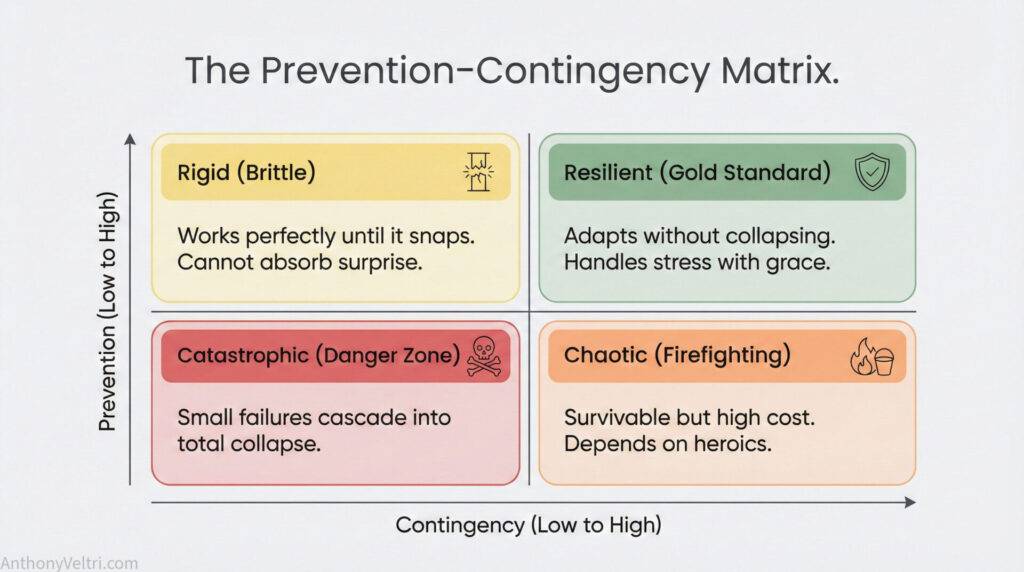
This diagram illustrates how varying prevention and contingency levels define organizational risk: rigid, resilient, catastrophic, or chaotic.
The Resilience Target: You cannot choose between preventing failure and surviving failure – you must do both. Rigid systems (Yellow) work perfectly until they snap. Chaotic systems (Orange) survive but burn out teams. The goal is the Gold Standard (Green): strong gates to stop errors, and strong guardrails to survive the ones that get through.

Quadrant 1: Strong Prevention, Strong Contingency #

Best case. The gold standard.
This is what you design for.

The system:

  • handles expected conditions with ease
  • handles unexpected conditions with grace
  • adapts without collapsing
  • maintains tempo under stress

Rare in the wild.
Always deliberate.


Quadrant 2: Strong Prevention, Weak Contingency #

Rigid. Looks strong until stress hits. Then it breaks.

The system:

  • works perfectly under ideal conditions
  • collapses when anything deviates
  • requires synchronized correctness
  • cannot absorb partner drift
  • fails under surprise

This is common in heavily centralized or overly integrated systems.


Quadrant 3: Weak Prevention, Strong Contingency #

Chaotic but survivable.
High stress. High cost.

The system:

  • constantly reacts
  • constantly patches
  • operates like firefighting
  • depends on heroics
  • compensates for unclear rules
  • does not scale

This is where many FRN workflows lived before stabilization.


Quadrant 4: Weak Prevention, Weak Contingency #

Catastrophic.
Small failures cascade into large failures.

The system:

  • cannot prevent errors
  • cannot respond to them
  • fails during normal operations
  • completely collapses during stress

This quadrant is the danger zone.


3. Prevention: What It Is and What It Does #
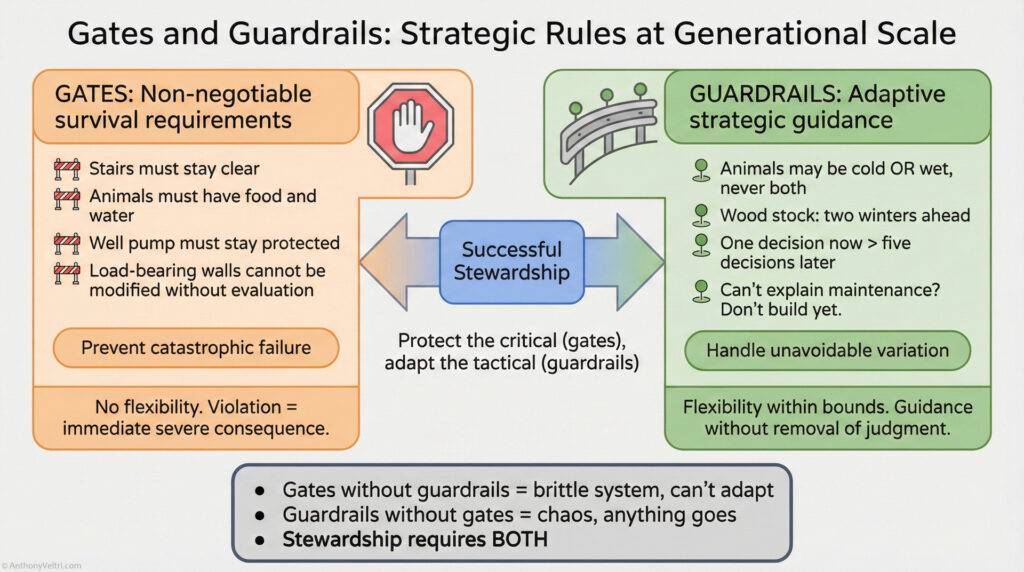
A diagram contrasts "Gates" (non-negotiable survival requirements, like food and water) with "Guardrails" (adaptive strategic guidance, like seasonal animal needs), both leading to successful stewardship of critical systems.
Gates vs. Guardrails. Bad architecture relies on Gates that stop traffic to check for defects. Good architecture uses Guardrails to shape the work product upstream, ensuring that what arrives at the boundary is already compliant, rather than jamming the gate with bad requests. Prevention acts as a Gate (Binary, Stop/Go). Contingency acts as a Guardrail (Keeps you on the road when you drift). A resilient system uses Gates for critical safety and Guardrails for variance. Design for Autonomy: Leadership provides the Guardrails (Adaptive Guidance) so teams can move fast. It only uses Gates (Hard Stops) for survival-critical issues.

Prevention is the set of constraints, agreements, and structures that reduce the number of avoidable failures.

Prevention includes:

  • clear intent
  • data contracts
  • human contracts
  • interface ownership
  • stable workflows
  • predictable schemas
  • versioning discipline
  • consistent communication
  • defined time rules
  • known boundaries

Prevention reduces:

  • confusion
  • avoidable errors
  • unnecessary escalations
  • misinterpretation
  • thrash
  • leadership driven drift
  • political heat

Prevention is structure.
Prevention is clarity.
Prevention is sanity.


4. Contingency: What It Is and What It Does #
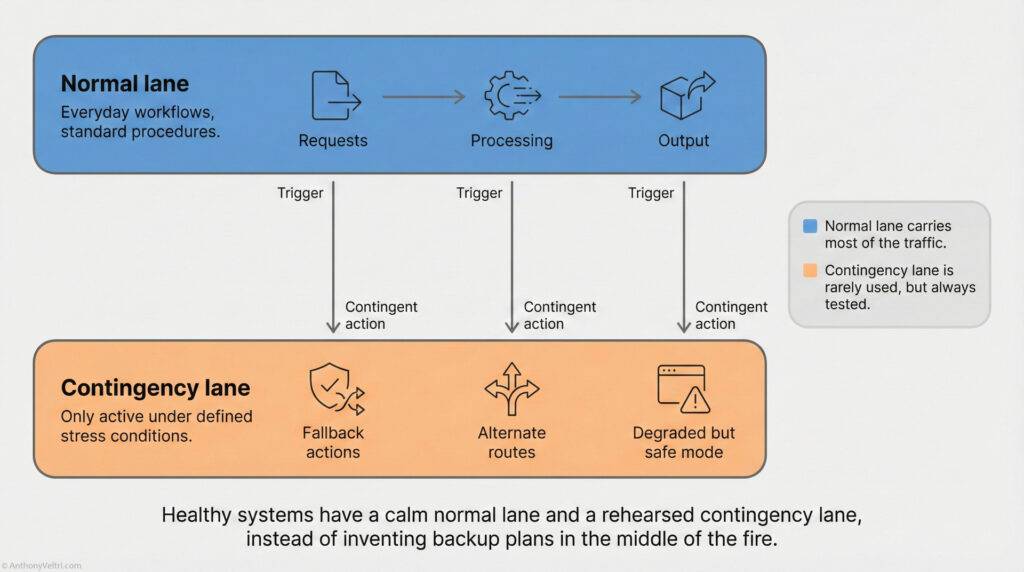
A diagram showing a "Normal lane" for routine workflows with requests, processing, and output, and a "Contingency lane" for stress conditions with fallback actions, alternate routes, and degraded mode.
Degraded Mode is a Lane, Not a Crash. A healthy architecture has a specific “Contingency Lane” (Orange) designed for when the “Normal Lane” (Blue) is blocked. Triggers move you between them safely. Do not mix your crisis response with your normal operations. Build a specific “Contingency Lane” (Orange) that activates when the “Normal Lane” (Blue) is blocked.

Contingency is the ability to absorb the failures that prevention cannot stop.

Contingency includes:

  • fallback behavior
  • tolerant ingest
  • cached layers
  • degraded mode
  • last known good values
  • partial updates
  • manual overrides
  • asynchronous operation
  • autonomy at the edge

Contingency reduces:

  • mission impact of failures
  • fragility
  • decision drag
  • downtime
  • brittleness
  • panic
  • escalation

Contingency is resilience.
Contingency is optionality.
Contingency is life support.


5. Why You Must Engineer Both Layers #
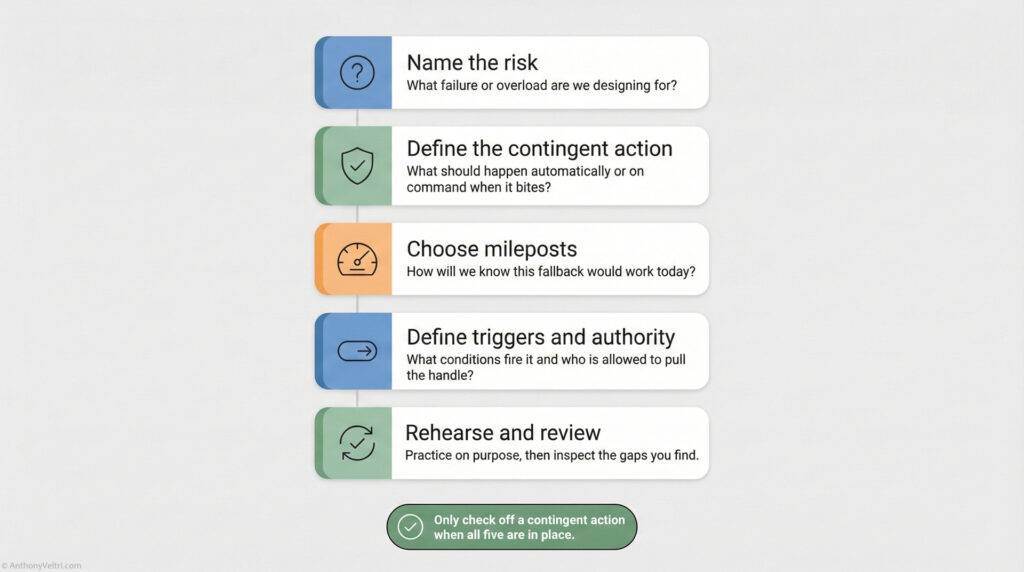
A flowchart with five steps: Name the risk, Define the contingent action, Choose mileposts, Define triggers and authority, and Rehearse and review. A green note at the bottom says to check off a contingent action only when all steps are complete.
Contingency is Design, Not Improv. A valid contingency plan has 5 parts: Risk Name, Action, Mileposts, Triggers, and Rehearsal. If you skip steps, it’s not a plan- it’s a wish. This checklist prevents the practitioner from thinking “Contingency = Winging It.”

Prevention without contingency is brittle.
Contingency without prevention is chaos.

Both are required because:

  • conditions vary
  • partners drift
  • leadership changes
  • data degrades
  • outages occur
  • political visibility grows
  • constraints shift

A balanced system is hard to break even when reality breaks the rules.


6. Business Example: FRN workflows as a weak prevention, weak contingency system #

Before stabilization, the FRN environment lived in Quadrant 4:

Weak prevention:

  • no stable schema
  • shifting requirements
  • leadership driven edits
  • unclear responsibilities
  • inconsistent review expectations
  • vague definitions of correctness

Weak contingency:

  • no fallback for late edits
  • no tolerance for last minute changes
  • no method to isolate drift
  • errors cascaded through all stages
  • timelines collapsed under pressure

The workflow was brittle and chaotic.

Once your team introduced both prevention and contingency:

Prevention:

  • fixed schema
  • stable templates
  • clear ownership
  • rules for legal vs preference
  • predictable revision cycles

Contingency:

  • partial acceptance of changes
  • triage rules
  • allowable late edits
  • communication routines
  • quick harmonization paths

FRNs moved into Quadrant 1:
High prevention, high contingency.

This is why quality and predictability immediately improved.


7. System Example: iCAV as a Quadrant 1 system #

iCAV is a textbook example of Quadrant 1.

Strong prevention:

  • stable schemas
  • known schemas
  • format and geometry rules
  • agreed boundaries
  • partner expectations
  • interface owners
  • predictable ingest shapes

Strong contingency:

  • tolerant ingest
  • cached values
  • last known good state
  • asynchronous flows
  • degraded mode
  • partial truth rendering

This is why iCAV survived:

  • partner outages
  • stale data
  • inconsistent timestamps
  • drift
  • political pressure
  • schema variation

Quadrant 1 is not luck.
It is architecture.


8. Prevention–Contingency Evaluation Tool (Paste Ready) #

Here is a reusable evaluation block:


Prevention–Contingency Evaluation

Boundary or System:

Prevention Rating (1 to 5):
Rules:
Contracts:
Predictability:
Stability:
Clarity:

Contingency Rating (1 to 5):
Fallback:
Tolerance:
Recovery:
Isolation:
Degraded mode:

Quadrant:
1, 2, 3, or 4

Risks Identified:
List them.

Actions:
Increase prevention by:
Increase contingency by:


9. Cross Links #

The matrix ties directly to:

  • Principle 17: Clear intent
  • Principle 18: Preventive vs contingent design
  • Principle 19: Commitment vs compliance
  • Annex A: Human contracts
  • Annex B: Data contracts
  • Annex C: Interface ownership
  • Annex D: Decision altitudes
  • Annex F: Pattern library

The matrix is the health check for all doctrine.


10. For Reflection: #

Ask yourself:

Is your system built only for stability?
Or only for crisis?
Or neither?

Only Quadrant 1 systems survive real conditions.

Move your system there now.

Last Updated on December 5, 2025

Related Posts #

Abstract geometric design with various circles, lines, and shapes in muted tones. A dark rectangle overlay contains the white text:

Doctrine 11: Preventive Action and Contingent Action Must Both Be Designed Intentionally #

ANNEX F Pattern Library" text over a background of interconnected geometric lines, circles, and digital patterns resembling a circuit or network schematic.

ANNEX F. Pattern Library #

A graphic with abstract circuit-like patterns and geometric shapes. Large text reads

ANNEX H. Architecture Doctrine #

A graphic with the title

ANNEX K. System and Workflow Profiles (Case Studies) #

A digital graphic with the title "ANNEX I High-Visibility Workflows" in bold text, overlaid on a background of abstract, interconnected lines and circles resembling a technical or technological schematic.

ANNEX I. High Visibility Workflows #

A diagram shows a translucent seated person labeled

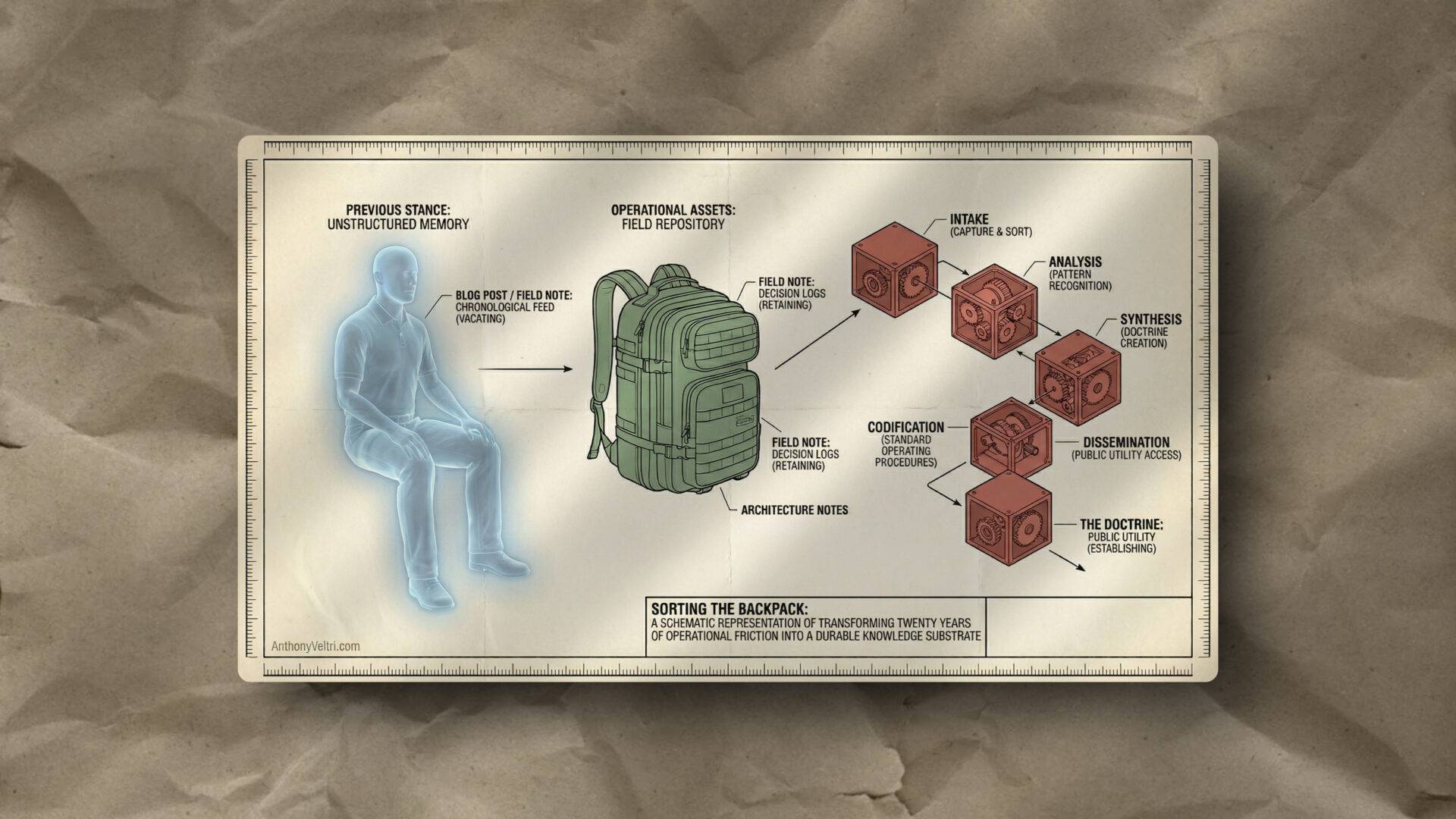
Field Note: Sorting the 20-Year Backpack #

decision-tempo, governance
Table of Contents
  • Why resilient systems require both prevention and contingency, and how the balance determines performance under stress
  • 1. Purpose of the Prevention–Contingency Matrix
  • 2. The Four Quadrants of System Resilience
    • Quadrant 1: Strong Prevention, Strong Contingency
    • Quadrant 2: Strong Prevention, Weak Contingency
    • Quadrant 3: Weak Prevention, Strong Contingency
    • Quadrant 4: Weak Prevention, Weak Contingency
  • 3. Prevention: What It Is and What It Does
  • 4. Contingency: What It Is and What It Does
  • 5. Why You Must Engineer Both Layers
  • 6. Business Example: FRN workflows as a weak prevention, weak contingency system
  • 7. System Example: iCAV as a Quadrant 1 system
  • 8. Prevention–Contingency Evaluation Tool (Paste Ready)
  • 9. Cross Links
  • 10. For Reflection:

Share This Article :

  • Facebook
  • X
  • LinkedIn
  • Pinterest

Was it helpful ?

  • Happy
  • Normal
  • Sad
  • Privacy Policy
  • Introductions
  • Contact

© 2026 Anthony Veltri

  • Doctrine
    • Doctrine Library
    • Global Library
  • Field Notes
  • Routes
    • Route 01: When the Interface Is Breaking (and you are becoming the patch)
    • ROUTE 02: If decisions stall and meetings go nowhere, start here
    • ROUTE 03: If you have lots of projects but no portfolio clarity, start here
    • ROUTE 04: If you’re confused about federation vs integration, start here
    • ROUTE 05: If heroics are propping up your system, start here
    • ROUTE 06: If you cannot force compliance across partners, start here
    • ROUTE 07: If compliance exists but commitment does not, start here
    • ROUTE 08: If disconnected workflows create audit anxiety, start here
  • Figure Library
  • FAQ
  • About
    • Capability Statement
    • Interpreter Kit
  • Contact