Skip to content

Introduced by a trusted connector?

Start Here

Anthony Veltri

  • Doctrine
    • Doctrine Library
    • Global Library
  • Field Notes
  • Routes
    • Route 01: When the Interface Is Breaking (and you are becoming the patch)
    • ROUTE 02: If decisions stall and meetings go nowhere, start here
    • ROUTE 03: If you have lots of projects but no portfolio clarity, start here
    • ROUTE 04: If you’re confused about federation vs integration, start here
    • ROUTE 05: If heroics are propping up your system, start here
    • ROUTE 06: If you cannot force compliance across partners, start here
    • ROUTE 07: If compliance exists but commitment does not, start here
    • ROUTE 08: If disconnected workflows create audit anxiety, start here
  • Figure Library
  • FAQ
  • About
    • Capability Statement
    • Interpreter Kit
  • Contact
Anthony Veltri

Architecture & Interfaces

15
  • Doctrine 01: Federation vs Integration in Mission Networks
  • Doctrine 03: Interfaces Are Where Systems Break, So They Require Stewards, Contracts, and Ownership
  • Doctrine 04: Useful Interoperability Is the Goal, Not Perfect Interoperability
  • Doctrine 05: Innovation Must Live at the Edge, Not in the Center
  • Doctrine 06: A Two-Lane System Protects Stability and Enables Evolution
  • Doctrine 14: Technical Debt Is a Leadership Signal, Not a Coding Failure
  • Doctrine 15: Architecture Must Accelerate Teams, Not Bottleneck Them
  • Doctrine 17: Architects Translate Strategy Into Engineering and Engineering Into Strategy
  • Doctrine 20: Golden Datasets: Putting Truth In One Place Without Pretending Everything Is Perfect
  • Doctrine 21: Zero Trust Is A Trust Model, Not A Card “Type”
  • Doctrine 23: Loop Closure as Load-Bearing System Infrastructure
  • ANNEX B. Data Contracts
  • ANNEX C. Interface Ownership Model
  • ANNEX H. Architecture Doctrine
  • Annex L: The Rosetta Stone for Data Teams: Bridging the Gap Between Technicians and Executives

Decision Tempo & Governance

10
  • Doctrine 02: Distributed Decisions Increase Alignment, Speed, and Resilience
  • Doctrine 07: Clear Intent Matters More Than Perfect Data
  • Doctrine 08: Clear Intent Compresses Ambiguity, Reduces Conflict, and Accelerates Action
  • Doctrine 09: Decision Drag Is the Enemy of Mission Tempo. Architecture Is the Remedy
  • Doctrine 10: Degraded Operations Are the Normal Mode, Not the Exception
  • Doctrine 11: Preventive Action and Contingent Action Must Both Be Designed Intentionally
  • Doctrine 22: When “It Depends” Is the Right Answer: How to Think in Probabilities Under Uncertainty
  • ANNEX D. Decision Altitudes Model
  • ANNEX E. Prevention–Contingency Matrix
  • ANNEX I. High Visibility Workflows

Portfolio & Alignment

4
  • Doctrine 16: Portfolio Thinking Ensures Effort Aligns With What Actually Matters
  • ANNEX F. Pattern Library
  • ANNEX J. System Evolution and Drift Management
  • ANNEX K. System and Workflow Profiles (Case Studies)

Leadership & Human Systems

6
  • Doctrine 24: Stewardship Places the Burden on the Steward, Not the Parties
  • Doctrine 18: Commitment Outperforms Compliance in High Trust, High Tempo Environments
  • Doctrine 19: Supervision, Management, and Leadership Are Three Different Jobs. Confusing Them Breaks Systems
  • Doctrine 23: Loop Closure as Load-Bearing System Infrastructure
  • ANNEX A. Human Contracts
  • ANNEX G. Leadership Doctrine

Resilience & Operations

3
  • Doctrine 24: Stewardship Places the Burden on the Steward, Not the Parties
  • Doctrine 12: Resilience Is an Emergent Property, Not a Feature
  • Doctrine 13: Problem Solving Requires Finding the Real Deviation and the Relevant Change

Doctrine Companions

7
  • Doctrine 03 Companion: The RS-CAT Framework: Converting Raw Recall into Teachable Principle
  • Doctrine 03 Companion: The Interface Void
  • Doctrine 11 Companion: Agency vs. Outcome
  • Doctrine 09 Companion: Artifacts Over Adjectives
  • Doctrine 03 Companion: Constraints: bidirectional translation: Compression vs Construction
  • Doctrine 10 Companion: Span of Control and Cross Training Are Load-Bearing Constraints
  • Doctrine 21 Companion: Claims, Roles, and Entitlements in Microsoft 365

Field Reports

1
  • Field Report: College Financing and the 5-Year Home Runway
View Categories
  • Home
  • Doctrine & Supporting Guides
  • Leadership & Human Systems
  • ANNEX G. Leadership Doctrine

ANNEX G. Leadership Doctrine

Anthony Veltri
Updated on December 5, 2025

7 min read

The leadership patterns that create high trust, high tempo, low drag environments #

Doctrine Claim: Leadership is not a personality trait; it is the architecture of human behavior. This doctrine defines the patterns: altitude discipline, clear interfaces, and distributed decision rights. These considerations allow high-tempo teams to operate with autonomy without losing coherence.


1. Purpose of the Leadership Doctrine #
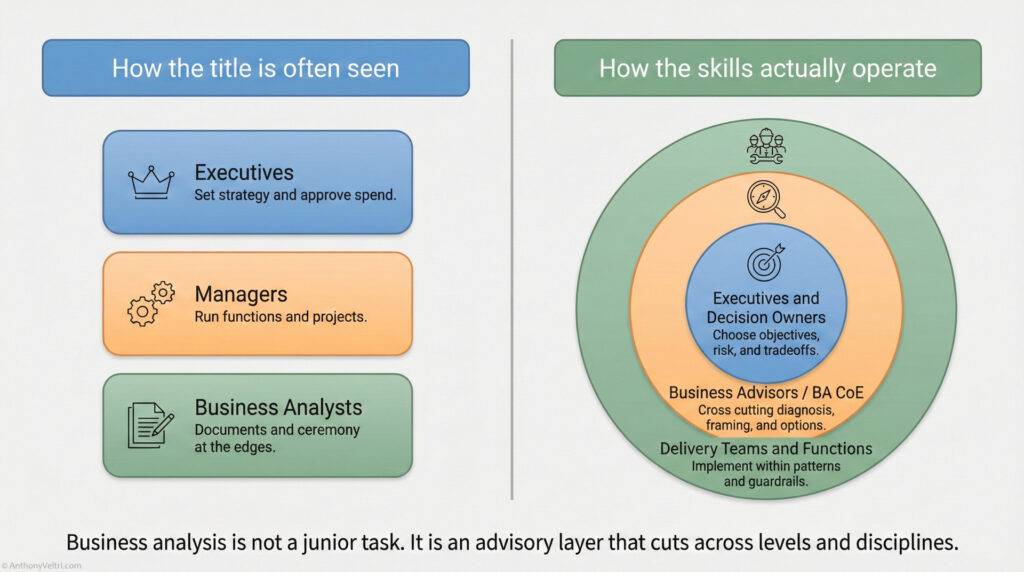
A diagram contrasts traditional job titles with actual skill operation. Left: vertical boxes for Executives, Managers, Business Analysts. Right: nested circles showing skill overlap among Executives, Owners, Advisors, and Delivery Teams.
Role Clarity. The Org Chart (Left) confuses titles with functions. A true system view (Right) places Leadership at the center (Strategy), with Advisors and Managers radiating outward to execution. Leadership isn’t just sitting at the top of a pyramid (Left). It is the central force (Right) that holds the concentric rings of Management, Advice, and Delivery together. We use org charts because they are tidy, but remember: we model a spherical cow, but there is no such thing as a spherical cow.

Leadership in complex systems is not about authority or personality.
It is about:

  • clarity
  • altitude
  • trust
  • constraints
  • alignment

The purpose of this doctrine is to codify the patterns that allow leaders to:

  • distribute decisions without losing control
  • maintain tempo without creating chaos
  • stabilize interfaces without micromanaging
  • reduce drag without centralizing authority
  • create autonomy without losing coherence

Leadership is the architecture of human behavior.

This annex defines the patterns that make that architecture work.


2. The Ten Patterns of High Tempo Leadership #

These patterns appear repeatedly across mission systems, bureaucratic environments, FRNs, and iCAV. They are universal.


Pattern 1: Intent Over Instruction #

Principle:
Leaders define what must be achieved, not how to do it.

Effect:
Teams move faster because they understand the purpose, not just the steps.

Example:
In FRNs, once leadership clarified the intent of the publication rather than dictating field level details, the workflow stabilized.


Pattern 2: Commitment Over Compliance #

Principle:
Commitment advances the mission. Compliance only avoids mistakes.

Effect:
Teams act with initiative instead of waiting.

Example:
iCAV analysts corrected stale data because they were committed to maintaining truth, not just following a checklist.


Pattern 3: Autonomy Within Boundaries #
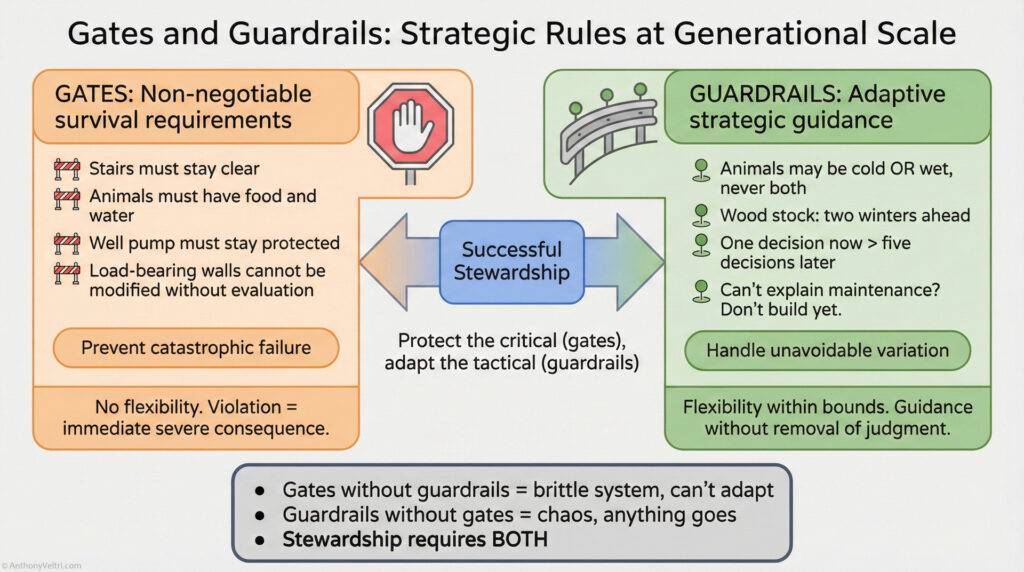
A diagram contrasts "Gates" (non-negotiable survival requirements, like food and water) with "Guardrails" (adaptive strategic guidance, like seasonal animal needs), both leading to successful stewardship of critical systems.
Gates vs. Guardrails: Bad architecture relies on Gates that stop traffic to check for defects. Good architecture uses Guardrails to shape the work product upstream, ensuring that what arrives at the boundary is already compliant, rather than jamming the gate with bad requests. Prevention acts as a Gate (Binary, Stop/Go). Contingency acts as a Guardrail (Keeps you on the road when you drift). A resilient system uses Gates for critical safety and Guardrails for variance. Design for Autonomy: Leadership provides the Guardrails (Adaptive Guidance) so teams can move fast. It only uses Gates (Hard Stops) for survival-critical issues.

Principle:
Freedom is safe and effective when boundaries are clear.

Effect:
Operators act quickly without fear of violating intent.

Example:
FRN editors moved faster when rules were clear about what was legally critical and what was preference based.


Pattern 4: Altitude Discipline #
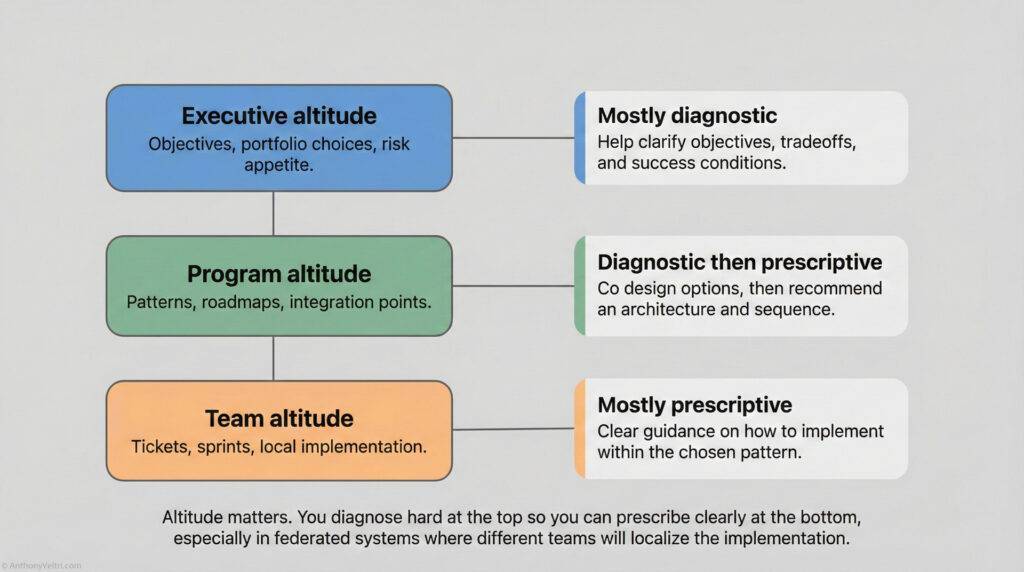
A flowchart illustrating "Executive altitude," "Program altitude," and "Team altitude," each linked to corresponding descriptions about their focus: diagnostic, prescriptive, or both in organizational implementation.
Altitude Discipline. Executives (Blue) own Objectives and Risk. Teams (Orange) own Implementation. When Executives dip into the Orange layer, they break the system.

Principle:
Leaders stay at strategic altitude. They do not micromanage.

Effect:
Managers manage. Operators operate. Architects architect.

Example:
Before altitude discipline, FRN leadership inserted Altitude 1 formatting edits. After discipline, leadership focused on legitimacy and strategic framing.


Pattern 5: Two Lane Leadership #
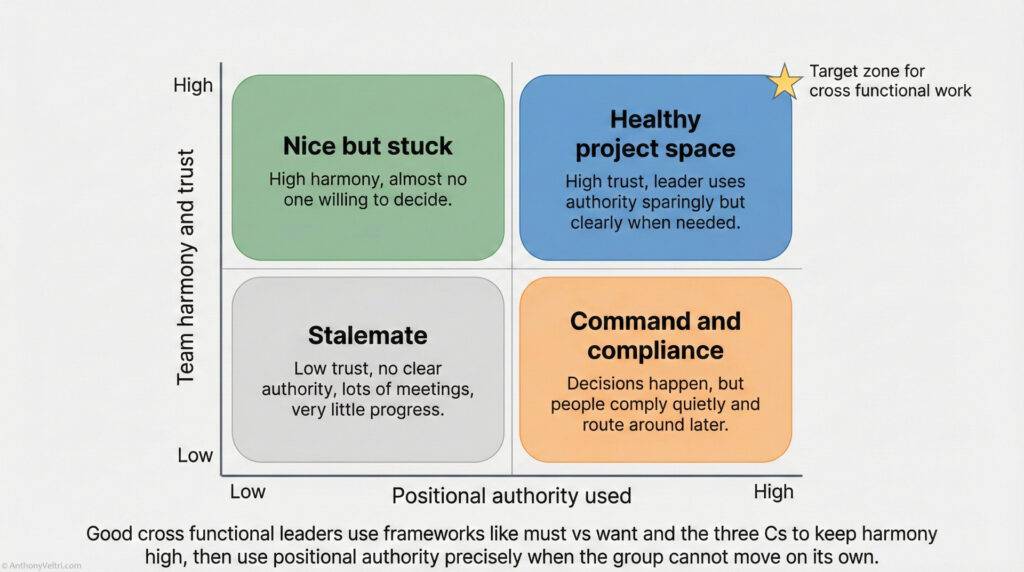
A 2x2 matrix shows team harmony/trust (vertical) vs. positional authority used (horizontal). The top right “Healthy project space” is starred. Other zones: “Nice but stuck,” “Stalemate,” and “Command and compliance.”.
The Leadership Target. A Leader’s job isn’t just to be “Nice” (Green) or “Bossy” (Orange). It is to maintain High Harmony while using Precise Authority (Blue) to set direction. Crucially, leadership must be a net gain. If the team is just as effective without you as with you, you are not leading; you are overhead. This hits hard because it gives the reader (or a practitioner) a diagnostic they can apply immediately: “Does my presence make the team faster or just more managed?”

Principle:
High tempo environments require two complementary lanes:

  • a federation lane with autonomy
  • a central lane with alignment and harmonization

Effect:
Diverse teams stay coordinated without forced uniformity.

Example:
In iCAV, partner systems remained independent while the viewer unified them.


Pattern 6: Distributed Decisions #
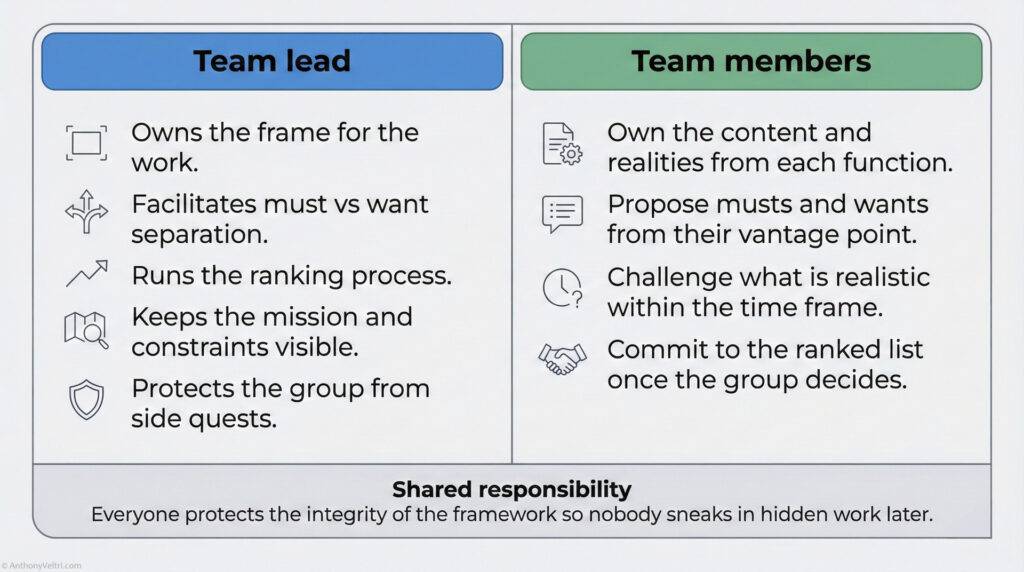
A comparison chart showing "Team lead" roles—framing work, facilitating, ranking, mission visibility, and shielding from side requests—and "Team members" roles—owning content, proposing, challenging, and committing to decisions.
Role Clarity: The Leader owns the Frame (Objective). The Member owns the Content (How). Distributed decisions work when this split is respected.

Principle:
Decisions are made at the lowest competent level.

Effect:
Less drag, fewer bottlenecks, more speed.

Example:
Operators in iCAV did not need permission to annotate stale data. They simply did it.


Pattern 7: Clear Ownership of Interfaces #

Principle:
Every interface needs two owners.
Leadership ensures this is true.

Effect:
Boundaries become predictable instead of conflict zones.

Example:
FRN workflows stabilized when each stage had a clearly defined upstream and downstream owner.


Pattern 8: Learn From Drift, Do Not Punish It #

Principle:
Drift is a signal, not a failure.

Effect:
Teams report problems early instead of hiding them.

Example:
iCAV partner drift was expected. The contracts absorbed it. No blame was required.


Pattern 9: Reduce Decision Drag #

Principle:
Leadership actively hunts for and eliminates drag in the system.

Effect:
A single decision becomes one decision, not five.

Example:
In FRNs, leadership-driven field additions multiplied work. Once drag was surfaced, these additions were filtered through proper altitudes.


Pattern 10: Leadership Sets Direction, Architecture Makes It Real #

Principle:
Leaders define the destination.
Architects design the lanes.
Managers maintain flow.
Operators drive.

Effect:
Systems move with coherence, not chaos.

Example:
iCAV succeeded because leadership did not dictate geometry rules or ingest patterns. Architecture did.


3. The Leader’s Four Questions #

Every leader evaluates decisions with four questions:

  1. What is the mission intent?
  2. What altitude should this decision live at?
  3. What boundary or interface is affected?
  4. What is the cost of waiting?

If any answer is unclear, the leader clarifies before acting.


4. Leadership Failure Modes #

Systems break when leaders fall into these traps:

Failure Mode 1: Micromanagement #

Leadership acts at Altitude 1 and overloads the system.

Failure Mode 2: Over delegation without clarity #

Teams operate without intent and drift into rework.

Failure Mode 3: Over centralization #

Leaders force unnecessary uniformity. Tempo collapses.

Failure Mode 4: Thrash #

Leaders change requirements or add fields without impact review.
This was the core FRN problem.

Failure Mode 5: Fear driven leadership #

Teams hide problems.
Drift becomes catastrophic.


5. Leadership Success Modes #

Systems thrive when leaders:

  • articulate intent in one sentence
  • set boundaries without suffocating autonomy
  • empower architecture to shape the system
  • protect teams from unnecessary visibility or scrutiny
  • eliminate drag at the seams
  • stabilize interfaces before scaling
  • reinforce clear decision altitudes
  • accept that drift is inevitable and plan for it
  • trust operators to act immediately
  • trust managers to shape flow
  • trust architects to harmonize the whole

This is the leadership environment that produces Quadrant 1 systems.


6. Leadership Examples From Your Experience #

FRN Example: Stabilizing a politically sensitive workflow #

Before leadership doctrine:

  • leadership requests arrived at the wrong altitude
  • small changes created cascading revisions
  • operators were trapped in reactive mode
  • the system slowed under scrutiny

After leadership doctrine was applied:

  • leadership limited themselves to defining the legitimacy and purpose of the notice
  • managers handled workflow, timing, and review
  • editors owned correctness and format
  • legal owned compliance
  • architecture shaped templates and contracts

Tempo increased.
Stress decreased.
Quality improved.
Visibility remained high without destabilizing the system.


iCAV Example: Leadership protecting architectural coherence #

Strong leadership behaviors:

  • allowed architects to define federation
  • empowered analysts to act without waiting
  • resisted the urge to dictate ingest rules
  • shielded teams from political noise during activations
  • kept strategic focus on mission value

These leadership behaviors enabled:

  • degraded mode to function
  • federation to scale
  • autonomy to flourish
  • partner diversity to be an asset rather than a problem

Leadership protected the architecture.
The architecture protected the mission.


7. Leadership Operating Template (Paste Ready) #


Leadership Decision Template

Intent:
Describe what must be true.

Altitude:
4, 3, 2, or 1
(Leadership should be at 4 unless shaping guidance.)

Boundaries:
What is allowed.
What is not allowed.

Ownership:
Who owns the upstream.
Who owns the downstream.

Impact:
Local, cross team, architectural, or strategic.

Risks:
Drift, delay, conflict, visibility pressure.

Tempo:
What is the cost of waiting?

Actions:
Define direction.
Delegate the rest.


8. Cross Links #

Leadership Doctrine reinforces:

  • Principle 16: Distributed decisions
  • Principle 17: Clear intent
  • Principle 18: Preventive vs contingent action
  • Principle 19: Commitment vs compliance
  • Principle 20: Leadership vs management vs supervision
  • Annex A: Human Contracts
  • Annex C: Interface Ownership
  • Annex D: Decision Altitudes
  • Annex E: Prevention–Contingency Matrix

Leadership is the human architecture that makes the technical architecture possible.


9. For Reflection: #

Ask yourself:

Where am I operating at the wrong altitude?
Where am I creating drag?
Where am I protecting clarity?
Where am I protecting the system?

Leadership is not a role.
It is a pattern.
Use the pattern deliberately.

Last Updated on December 5, 2025

Related Posts #

A diagram shows a translucent seated person labeled

Field Note: Sorting the 20-Year Backpack #

ANNEX F Pattern Library" text over a background of interconnected geometric lines, circles, and digital patterns resembling a circuit or network schematic.

ANNEX F. Pattern Library #

A digital graphic with the title "ANNEX I High-Visibility Workflows" in bold text, overlaid on a background of abstract, interconnected lines and circles resembling a technical or technological schematic.

ANNEX I. High Visibility Workflows #

A graphic with the title

ANNEX K. System and Workflow Profiles (Case Studies) #

A graphic with abstract blue and black data and circuit patterns, overlaid with a dark rectangle containing the text

Annex L: The Rosetta Stone for Data Teams: Bridging the Gap Between Technicians and Executives #

A graphic with abstract circuit-like patterns and geometric shapes. Large text reads

ANNEX H. Architecture Doctrine #

altitude, governance, leadership, visibility
Table of Contents
  • The leadership patterns that create high trust, high tempo, low drag environments
  • 1. Purpose of the Leadership Doctrine
  • 2. The Ten Patterns of High Tempo Leadership
    • Pattern 1: Intent Over Instruction
    • Pattern 2: Commitment Over Compliance
    • Pattern 3: Autonomy Within Boundaries
    • Pattern 4: Altitude Discipline
    • Pattern 5: Two Lane Leadership
    • Pattern 6: Distributed Decisions
    • Pattern 7: Clear Ownership of Interfaces
    • Pattern 8: Learn From Drift, Do Not Punish It
    • Pattern 9: Reduce Decision Drag
    • Pattern 10: Leadership Sets Direction, Architecture Makes It Real
  • 3. The Leader’s Four Questions
  • 4. Leadership Failure Modes
    • Failure Mode 1: Micromanagement
    • Failure Mode 2: Over delegation without clarity
    • Failure Mode 3: Over centralization
    • Failure Mode 4: Thrash
    • Failure Mode 5: Fear driven leadership
  • 5. Leadership Success Modes
  • 6. Leadership Examples From Your Experience
    • FRN Example: Stabilizing a politically sensitive workflow
    • iCAV Example: Leadership protecting architectural coherence
  • 7. Leadership Operating Template (Paste Ready)
  • 8. Cross Links
  • 9. For Reflection:

Share This Article :

  • Facebook
  • X
  • LinkedIn
  • Pinterest

Was it helpful ?

  • Happy
  • Normal
  • Sad
  • Privacy Policy
  • Introductions
  • Contact

© 2026 Anthony Veltri

  • Doctrine
    • Doctrine Library
    • Global Library
  • Field Notes
  • Routes
    • Route 01: When the Interface Is Breaking (and you are becoming the patch)
    • ROUTE 02: If decisions stall and meetings go nowhere, start here
    • ROUTE 03: If you have lots of projects but no portfolio clarity, start here
    • ROUTE 04: If you’re confused about federation vs integration, start here
    • ROUTE 05: If heroics are propping up your system, start here
    • ROUTE 06: If you cannot force compliance across partners, start here
    • ROUTE 07: If compliance exists but commitment does not, start here
    • ROUTE 08: If disconnected workflows create audit anxiety, start here
  • Figure Library
  • FAQ
  • About
    • Capability Statement
    • Interpreter Kit
  • Contact