Anchor examples from mission systems, federal workflows, modernization programs, international coordination, and the author’s lived domains that illuminate the doctrine #
Doctrine Claim: Doctrine is abstract until it collides with reality. This Annex defines the specific real-world systems: from federal geospatial platforms to biological recovery that stress-tested these principles. If you want to know “Does this work in real life?”, these are the test beds.
1. Purpose of Annex K #
The doctrine references multiple systems and domains to illustrate how architectural principles, leadership altitudes, drift management, and federated structures behave under real conditions.
These systems include:
- DHS operational systems such as iCAV
- Federal Register Notice workflows
- Multi partner ingest ecosystems
- High visibility bureaucratic outputs
- Mission activation cycles
- Portfolio and PMO ecosystems
- International coordination environments
- Cloud modernization programs
- Microsoft 365 federated environments
Annex K provides a clean reference for all of these systems so the doctrine does not need to redefine them each time.
2. Career and Mission Systems #
These are the systems with direct professional relevance. They anchor the doctrine’s architectural and leadership principles.
Section 2A. iCAV: Federated Mission System Profile #
Context #
iCAV (Integrated Common Analytical Viewer) was a DHS geospatial situational awareness system used during major events such as hurricanes, security incidents, and national activations. It unified partner data across agencies with very different technical maturity levels, cadences, and constraints.
Lineage and current status #
iCAV began as DHS’s first department-wide unclassified geospatial common operating picture for critical infrastructure and major events. Over time, the same mission, datasets, and design principles were replatformed into the Geospatial Information Infrastructure (GII) and the OneView web viewer. OneView is documented as replacing and extending iCAV while exposing GII services to users, so the architectural lineage of iCAV continues inside the current DHS geospatial stack.
Author’s role in iCAV #

“In the first iCAV deployment, I was not only writing requirements and diagrams. I was physically on site in the initial continuity facility in northern Virginia, standing up our first data center footprint, and then supporting the transition into the flagship data center at the NASA Stennis Space Center in Mississippi. That experience of moving between data center floors, operations centers, and executive briefings is a big part of why I speak comfortably in the language of technicians, architects, and scientists, instead of living in only one of those worlds. My title was Supervisory Scientist but I served as a lead architect and implementation owner during the first generation of iCAV.” This work included:
- Designing tolerant ingest and caching patterns so partners with very different maturity levels could still contribute
- Translating mission needs from operators and leadership into concrete geospatial workflows, schemas, and interfaces
- Standing up and operating iCAV during national activations, then feeding lessons learned back into the architecture
That early work directly informed later DHS geospatial federation patterns and the evolution toward the current GII plus OneView environment.
iCAV to GII/OneView – Enterprise Geospatial Architecture #
System Overview #
The Integrated Common Analytical Viewer (iCAV) was developed 2008-2010 as a federated geospatial coordination platform for DHS enterprise operations.
The system evolved into the Geospatial Information Infrastructure (GII) and DHS OneView, designated by the DHS CIO as the standard common operating
picture for all 22 DHS components.
Scale and Scope #
Audience Served:
- 200,000 DHS employees
- 50,000 DHS contractors
- 46,000 state/local/tribal/territorial professionals
- All 22 DHS components
- Access via HSIN (Homeland Security Information Network) authentication
Technical Infrastructure (as of 2020):
- 400+ hosted geospatial web services
- 68 communities of interest with mapping capabilities
- Portal for ArcGIS enterprise deployment
- OGC-compliant standards (WFS, WMS, REST)
Technology Evolution #
iCAV Phase (2008-2010):
- Platform: Esri Internet Map Server
- Collaborative development: DHS, Ardent Management Consulting, Esri
- Audience accessible: Full homeland security community via HSIN
- Status at transition: Operational, modernization planning complete
GII/OneView Phase (2010-2020+):
- Platform: Portal for ArcGIS
- Migration from Internet Map Server architecture
- Operational by 2012 (Hurricane Isaac, Superstorm Sandy response)
- Designated DHS CIO standard common operating picture
Architectural Patterns #
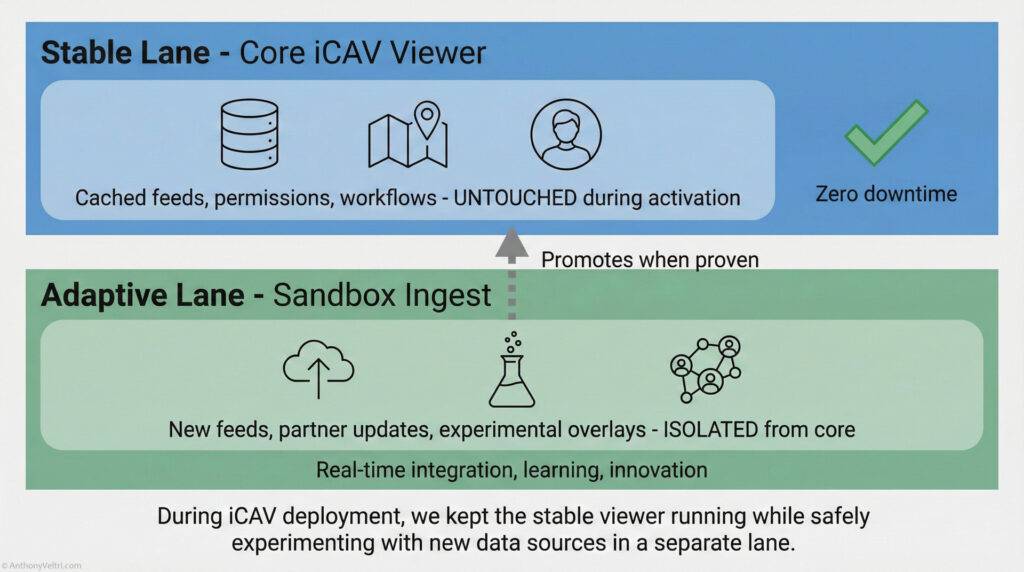
Two-Lane Architecture
- Stable lane: OGC-compliant geospatial services (WFS, WMS, REST)
- Adaptive lane: Mission-specific applications (OneView, 68 communities)
- Pattern-enabled innovation without breaking operational capabilities
- Survived platform technology transition (IMS → Portal for ArcGIS)
Federation Over Integration
- Service-oriented architecture rather than centralized data
- Design survived enterprise data center consolidation
- Enabled technology evolution without organizational disruption
- Quote from GII team: “didn’t have to transition from one data center to another”
Service Layer Governance
- 400+ hosted services with consistent quality/security standards
- Multi-classification data handling (Public, SBU, CUI)
- Access control at system and user levels
- Distributed governance across 22 DHS components
Operational Impact #
Disaster Response:
- Hurricane Isaac (2012): FEMA GeoPortal using GII services
- Superstorm Sandy (2012): Near real-time data for operations
- Ongoing emergency support functions
Special Event Security:
- Republican and Democratic National Conventions
- Presidential State of the Union addresses
- Search and rescue operations nationwide
Border and Law Enforcement:
- Critical infrastructure protection
- Border monitoring and coordination
- National operations center support
Lessons Learned #
What Enabled Successful Evolution:
- Federation approach survived infrastructure consolidation
- Two-lane architecture allowed technology modernization without operational disruption
- Organizational relationships built during iCAV phase sustained through transition
- Standards-based approach (OGC) enabled vendor/platform evolution
- Same contractor (Ardent) maintained continuity across phases
Critical Success Factors:
- Collaborative design (DHS, Ardent, Esri, 22 components)
- Service-oriented architecture over monolithic integration
- Multiple lanes enabling innovation alongside stable operations
- HSIN authentication provided enterprise-scale access from the beginning
- DHS CIO designation provided institutional mandate
Boundary Conditions:
- Federation requires mature standards (OGC compliance)
- Multi-classification requires robust access control
- Enterprise scale requires dedicated management (GMO)
- State/local partnership requires trust beyond technology
Why iCAV Matters to Doctrine #
iCAV is a pure example of federation:
- partners publish at different cadences
- schemas vary
- timestamps drift
- outages occur
- geometry varies in quality
- political pressure increases during activations
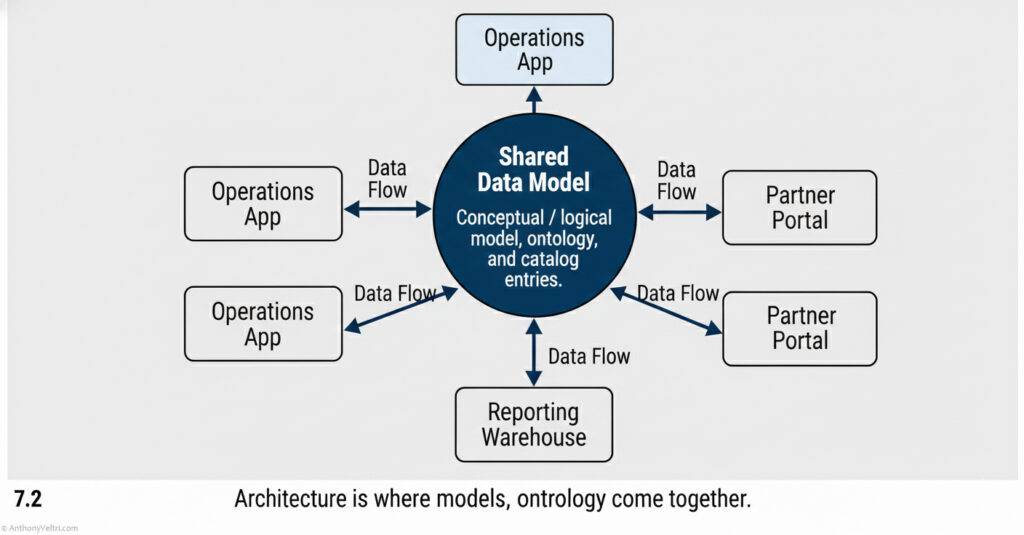
The system survived because it was designed for:
- tolerant ingest
- caching
- fallback pathways
- partial truth handling
- distributed decision making
- autonomy within boundaries
- stable interfaces
- versioning discipline
Patterns Illustrated #
- last known good
- minimum viable publication
- interface ownership
- federated diversity
- degraded operations
- two lane systems
- prevention plus contingency
- architectural guardrails reducing drag
iCAV is one of the clearest real world manifestations of the doctrine.
Author’s Note – How I Measure Impact:
In federal systems, “impact” rarely equals a consumer-style MAU chart. Many systems are engineered for mission surges, not for constant retail-level concurrency.
When I cite scale, I separate:
- Eligible footprint (who the system was available to serve)
- Operational reach (who could be supported during high-tempo events)
- Federation depth (how many contributors and how much cross-boundary participation was sustained)
- Durability (whether the governance substrate survived refresh cycles and turnover)
I do not publish sensitive operational utilization details. The claim is not “I had X daily users.” The claim is “the coordination substrate held, at enterprise scale, under surge conditions.”
Section 2B. Federal Register Notices (FRNs): High Visibility Workflow Profile #
Context #
Federal Register Notices are legally binding public publications used to announce rule changes, policy proposals, or organizational intentions to the public. They involve legal review, editorial workflows, technical template formatting, and leadership oversight. Visibility is extremely high, tolerance for error is extremely low.
Why FRNs Matter to Doctrine #
FRNs reveal a different set of stressors:
- leadership thrash
- schema instability
- shifting expectations
- unclear boundaries
- review cycles that create drift
- political pressure driving late changes
- lack of fallback
- unclear definitions of correctness
They demonstrate how high visibility can destabilize workflows unless doctrine is applied.
Patterns Illustrated #
- decision altitude failure
- need for schema freeze
- review process architecture
- data contract necessity
- minimum viable publication
- escalation discipline
- protection of operators
- human contract stabilization
- drift management with legal stakes
FRNs show the doctrine under political and legal pressure.
Section 2C. Multi-Partner Ingest and Federation Ecosystems #
Context #
Many federal mission environments involve upstream partners who publish data independently. These partners vary enormously in:
- capability
- policies
- cadence
- schema stability
- security expectations
- funding
- technical stack
Why This Matters #
These environments demonstrate:
- the necessity of federation
- why tight coupling always fails
- why ingest pathways must be tolerant
- why contracts must be explicit
- why versioning matters
- why asynchronous operations are essential
Patterns Illustrated #
- harmonization
- loose coupling
- contract driven stability
- schema variance absorption
- distributed authority
- predictable ingest shapes
These are generative examples for the federation doctrine.
Section 2D. High Visibility Bureaucratic Outputs Beyond FRNs #
Context #
Multiple federal outputs share the same traits as FRNs:
- Inspector General responses
- Congressional inquiries
- public transparency datasets
- statutory annual reports
- FOIA releases
Each carries:
- political scrutiny
- legal correctness requirements
- high pressure deadlines
Why They Matter #
These outputs show:
- altitude problems
- review cycle fragility
- pressure-driven drift
- unclear authority lines
- the need for minimum viable publication
- the role of human contracts
Patterns Illustrated #
- operator protection
- escalation discipline
- schema definition
- fallback for late changes
- clarity over precision
They are perfect examples for the high visibility workflow doctrine.
Section 2E. Mission Activation Environments #
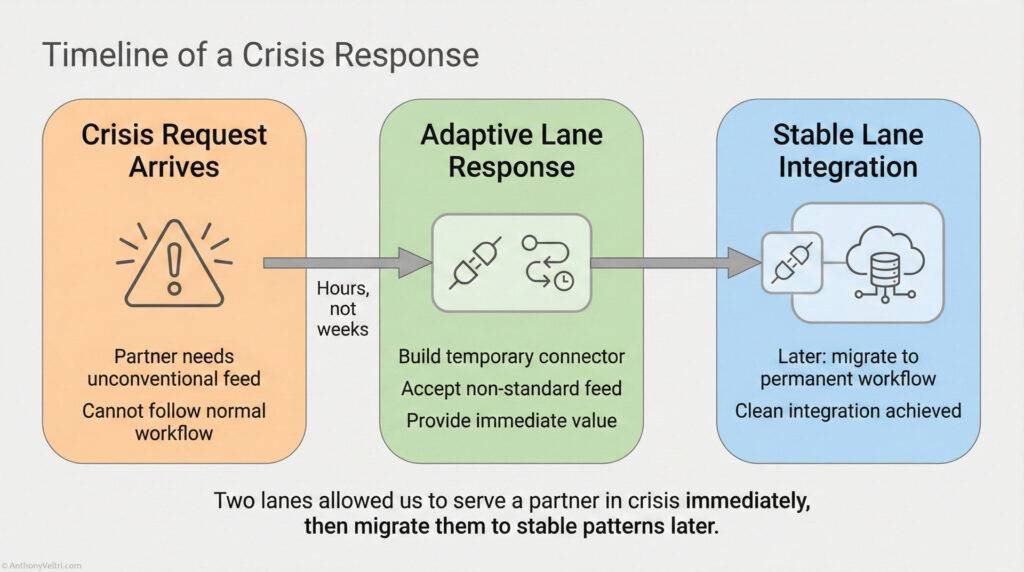
Context #
Mission activations (hurricanes, severe weather, critical events) involve:
- real-time ingest
- rapid decision cycles
- incomplete information
- partner outages
- political pressure
- operator autonomy
Why They Matter #
These environments expose:
- the cost of decision drag
- the need for distributed decisions
- how fallback stabilizes truth
- tolerance for ambiguity
- necessity of minimum viable accuracy
- autonomy within architecture
Patterns Illustrated #
- degraded operations
- fallback first
- last known good
- intent over instruction
- decision altitude clarity
Activations show doctrine principles in peak stress.
Section 2F. Portfolio and PMO Ecosystems #
Context #
Portfolio environments include:
- Multi-project prioritization
- limited budgets
- competing stakeholders
- governance boards
- KPI and reporting cycles
Why They Matter #
They demonstrate:
- doing work well vs doing the right work
- resource misalignment
- zombie projects
- false urgency
- leadership attention drift
- poor strategic clarity
Patterns Illustrated #
- portfolio thinking
- decision altitude
- clear intent
- stopping low value work
- reallocation discipline
Portfolio environments reveal the value of strategic clarity.
Section 2G. International Coordination Environments #
Context #
Examples include data or engineering collaboration with:
- The US Army Corps of Engineers abroad
- Ukraine
- Moldova
- multinational agencies
These involve mismatched:
- sovereignty
- authority structures
- technical maturity
- decision cycles
- legal frameworks
Why They Matter #
They illustrate:
- federation across sovereign boundaries
- the power of human contracts
- cross cultural interface ownership
- slow loops at high altitude
- the need for harmonization rather than integration
Patterns Illustrated #
- two owner interfaces
- drift as normal
- loose coupling
- clarity of intent
- asynchronous agreement
International coordination tests doctrine against real-world complexity.
Section 2H. Cloud Modernization and Mixed Environment Systems #
Context #
Examples include cloud migrations for federal agencies such as the US Forest Service or multi-contractor modernization programs.
They combine:
- legacy systems
- new cloud platforms
- mixed capability teams
- external constraints
- multi year evolution paths
Why They Matter #
These show:
- system evolution pressure
- fragility of old interfaces
- need for versioning
- risk of drift
- architectural load-bearing decisions
Patterns Illustrated #
- evolution paths
- drift detection
- architectural guardrails
- federated transitional states
Modernization reveals system shape over time.
Section 2I. Operational Stewardship and Microsoft 365 Ecosystems #
Context #
A federated portfolio and decision support layer built on Microsoft 365.
It uses tenants, automations, data pipelines, permissions, Power Platform components, and cross-workspace boundaries.
Why It Matters #
It illuminates:
- federation inside enterprise layers
- cross-team ownership
- tenant boundary constraints
- automation pathways
- architecture as acceleration
- the need for clear data contracts
Patterns Illustrated #
- useful interoperability
- version discipline
- automation fallback
- two lane system (governance lane and autonomy lane)
It brings doctrine into modern enterprise ecosystems.
3. Personal Domains That Illustrate Doctrine Patterns #
These sections use biographical third person, explicitly framed as context from the author’s life (that’s me).
These domains are included because they expose the same structural patterns present in mission systems, bureaucratic workflows, modernization efforts, and cross-partner coordination. They are not autobiographical anecdotes but demonstrations of how systems behave in every scale of life. The self-similar nature of complex systems makes architectural thinking relevant whether the context is neuromotor recovery, a training mat, a historic structure, a family schedule, or a multi-device media workflow.
Section 3A. Neuromotor Recovery After Guillain-Barré Syndrome (GBS) #
Context #
The author developed Guillain-Barré Syndrome during hurricane relief and disaster recovery work with the US Forest Service and the Department of Agriculture’s Food and Nutrition Service. Before the illness, the author trained regularly in CrossFit and was physically strong and active. GBS caused acute neuromuscular collapse, leaving even simple tasks such as picking up a child or putting on socks difficult or impossible. Recovery required sustained retraining of motor pathways, rebuilding coordination, and restoring inhibited or partially functional circuits.
Why This Belongs in the Doctrine #
Neuromotor recovery mirrors system drift and re-architecture. Normal pathways collapse, fallback pathways activate, inhibition and synchronization fail, and new patterns must be built gradually over time. The author’s journey from full physical capability, to collapse, to functional restoration reflects how complex systems fail and how they can be rebuilt through architectural thinking. The recovery process demonstrates pattern formation, fallback development, and minimum viable function in biological form.
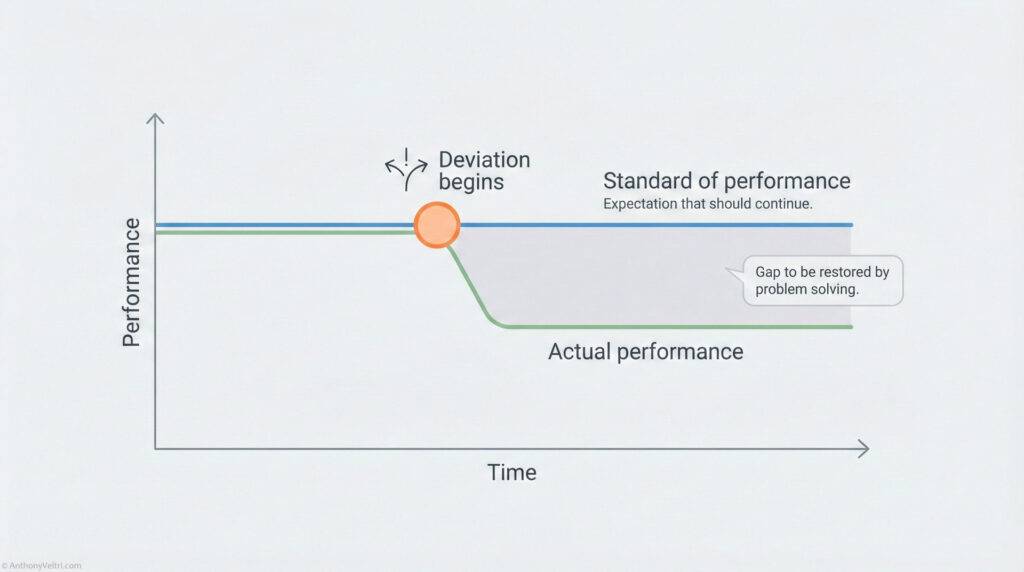
Patterns Illustrated #
- minimum viable function
- fallback pathways for impaired circuits
- drift detection during recovery
- gradual re-shaping of movement patterns
- distributed control loops
- error correction feedback
The body becomes a direct case study in system resilience.
Section 3B. Brazilian Jiu Jitsu Training, Solo Drilling, and Coaching #
Context #
Brazilian Jiu Jitsu is a grappling art centered on leverage, timing, and adaptive decisions under pressure. The author trains as a midlife practitioner, building on the recovery from GBS and prior CrossFit conditioning. Training includes positional sparring, structured drilling, movement patterns, and solo work with grappling dummies when training partners are unavailable.
Why This Belongs in the Doctrine #
Jiu Jitsu reflects doctrine principles in their purest physical form. The art requires fallback moves when primary paths fail, boundary control, interface transitions, and adaptation under stress. Fatigue introduces drift. Pressure simulates high-visibility or high-stakes environments. Drilling shapes patterns that operate automatically, just as architecture shapes automated or habitual behavior in organizations.
The author also assists in coaching children’s classes. This introduces a separate architectural challenge: designing not only a training session but an entire training room and culture. Class structure, developmental sequencing, mat rules, social safety, progression paths, and norm setting all become system architecture decisions. Coaching children highlights leadership altitude, environmental design, and culture building in a real-world setting.
Patterns Illustrated #
- escapes as fallback
- guard as boundary
- transitions as interface handoffs
- pressure as visibility pressure
- fatigue as drift generator
- drilling as architectural pattern formation
- coaching as cultural and system architecture
Jiu Jitsu is doctrine made visible in motion, behavior, and pedagogy.
Section 3C. Homestead Entropy, Infrastructure Maintenance, and Historic Stewardship #
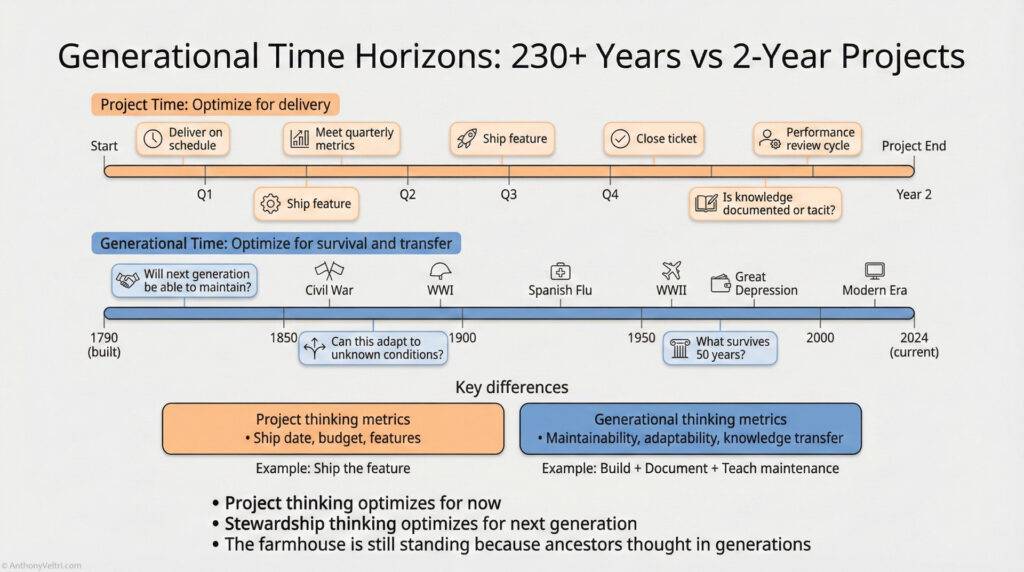
Context #
The author lives in a restored Revolutionary-era era farmhouse. The original eighteenth-century structure includes hand-built timber framing, historic joinery, stone foundation elements, and layered modern repairs. Maintaining such a home requires balancing preservation, functionality, and safety while respecting its history.
Why This Belongs in the Doctrine #
A historic structure exposes entropy in real time. Wood shifts, stone settles, plaster cracks, and modern systems interact with materials never designed for them. Every repair creates or modifies interfaces. Tasks postponed accumulate drift. Stewardship requires preventive routines, fallback strategies, and judgments about what must remain stable and what can tolerate degradation.
This environment parallels systems architecture. Decisions about maintenance, modernization, risk, and load-bearing structures closely match decisions in technical and mission environments. The house becomes a living demonstration of portfolio prioritization, preventive scaffolding, interface fragility, and the ongoing management of drift.
Patterns Illustrated #
- preventive inspection and maintenance cycles
- contingency planning for system failures
- minimum viable operation for aging structures
- fragile interfaces between historic and modern elements
- drift accumulation across seasons
- stewardship decisions grounded in risk and heritage
The historic farmhouse makes entropy, drift, and maintenance legible as system behavior.
Section 3D. Family Logistics and Household Workflow Patterns #
Context #
The author’s household includes children, schooling, athletic activities, domestic routines, work from home, and the coordination of multiple schedules and responsibilities.
Why This Belongs in the Doctrine #
A family is a federated system. Different members have different constraints, skills, energy levels, and responsibilities. Household operations reveal the same structural needs as organizational systems: clear ownership, escalation paths, fallback routines, boundaries, resource allocation, and prevention of decision overload.
The author approaches family logistics using architectural thinking: defining who owns what, which decisions belong at which altitude, how to handle inevitable drift, and how to maintain stability in high-visibility periods such as medical events or school deadlines.
Patterns Illustrated #
- clear ownership of recurring tasks
- escalation paths for exceptions
- minimum viable routines on high-stress days
- preventive scaffolding through calendars and checklists
- distributed decisions within agreed boundaries
- fallback for illness or schedule disruption
Family systems reveal doctrine principles in daily life.
Section 3E. Creative and Media Production Workflows #
Context #
The author produces audio and video content using multiple cameras, microphones, recorders, editing platforms, storage systems, and publishing tools. Projects include interviews, training content, educational materials, and documentary-style footage.
Why This Belongs in the Doctrine #
Media production is a natural demonstration of federation. Different devices create different formats, frame rates, audio levels, metadata structures, and file sizes. Files must be ingested, synchronized, color corrected, organized, versioned, archived, and published. The workflow is a chain of interfaces and failure points.
The author’s production approach mirrors doctrine: creating naming and storage conventions, designing fallback for corrupted audio or footage, using two-lane systems for capture and editing, and establishing predictable structures that reduce cognitive load.
Patterns Illustrated #
- Two-lane system: capture lane and editing lane
- metadata and naming contracts
- fallback cameras, backup audio, and redundant storage
- minimum viable production under constraint
- drift management in color, sound, and file organization
- architectural constraints shaping creative output
Creative work displays doctrine behavior at the level of files, devices, and timelines.
4. Cross Links to Doctrine #
Annex K connects to every other annex and principle:
- Federation vs Integration
- Interface Ownership
- Prevention–Contingency Matrix
- Leadership Altitudes
- Architecture Doctrine
- High Visibility Workflows
- Pattern Library
- Drift Management
Annex K is the reader’s map of the real-world contexts behind the doctrine.
5. For Reflection: #
Readers should ask:
Which system in Annex K resembles the environment being faced today?
Which doctrine patterns apply?
Which failure modes are emerging?
Which architectural or leadership corrections are needed?
Annex K is the lookup table for everything the doctrine teaches.
Field notes and examples #
- Field Note: The Wrong Tools for the Right Problem
- Field Notes: What I Learned Writing The Government Video Guide
- Respect The Envelope: Why Legal Is Not Always Safe
- Gates That Matter: Task Books, Checkrides And Real Safety
- When You Cannot Force Compliance: iCAV and the Federated View of Critical Infrastructure
Last Updated on May 3, 2026