Dead Reckoning After the Grid Goes Down: Mapping Without Live Systems
The Observation: When the Map Becomes a Trap
In stable environments, we navigate by “Instrument Flight Rules.” We trust the dashboard. We trust the map. We trust that the blue line on the screen matches the road on the ground.
In a crisis, this trust is dangerous.
Disasters (and contested environments) are high-entropy events. They change faster than the map can be updated. If you are still following the GPS when the bridge is out, the tool is no longer an asset. It is a trap.
The failure mode of most modern teams is not that they lack data. It is that they lack Regime Recognition. They continue operating in “Optimization Mode” (trusting the instruments) long after the world has shifted into “Survival Mode” (dead reckoning).

Recognizing the Operating Regime: Why Asymmetric Errors Change the Decision
As detailed in Regime Recognition, the cost of error changes when the regime changes. In a stable regime, efficiency wins. In a volatile regime, survival wins. Most algorithms (and Lieutenants) fail to spot the moment the regime flips.
The Bridge: Navigating the Debris Field
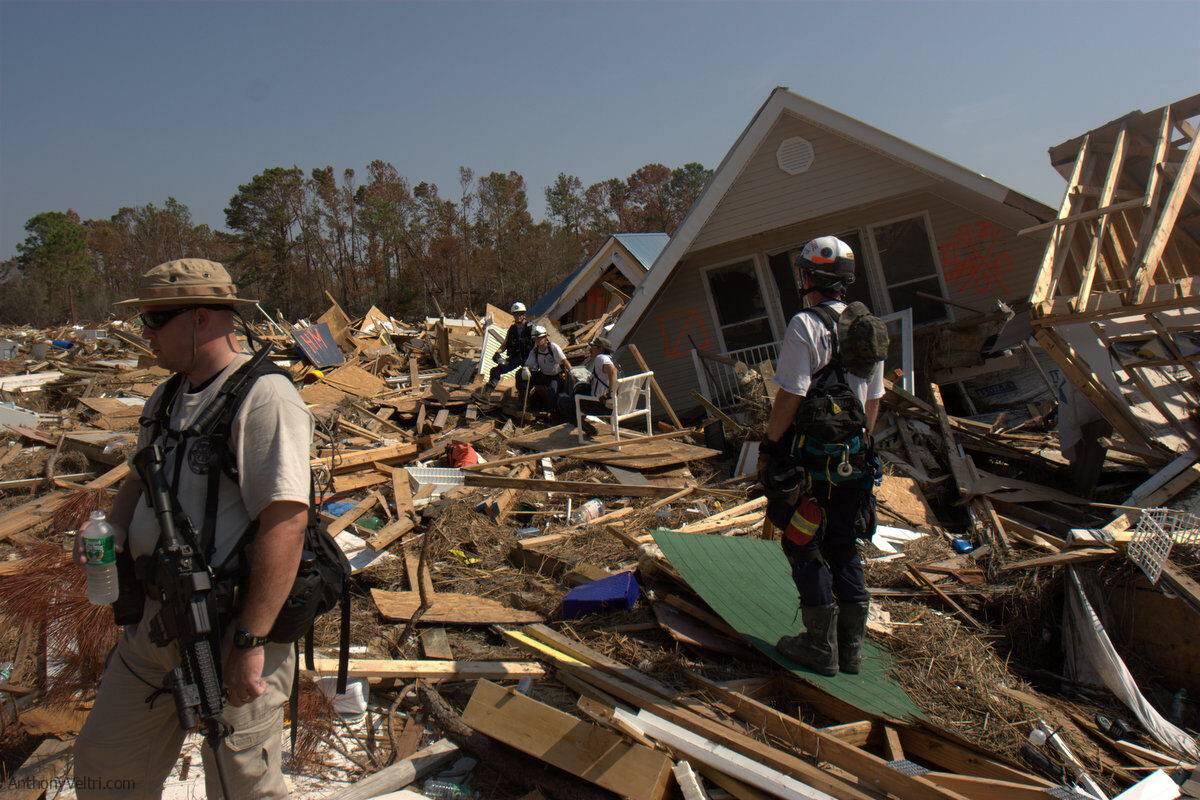
I learned the difference between a map and reality during urban search and rescue operations.
When a hurricane or a structural collapse rearranges a neighborhood, the street signs are gone. The landmarks are rubble. The digital map on your laptop shows a road that no longer exists.
You cannot navigate by what should be there. You have to navigate by what is there.
This requires a mental switch. You stop looking for “the route” and start looking for “the heading.” This is the Dead Reckoning Protocol. It is the protocol of moving forward when the grid is down and the terrain is hostile. It is not about better maps. It is about better instincts.
The Pattern: Protocols for the Unknown
Cognitive resilience is not just “being tough.” It is a structural approach to uncertainty. It relies on two specific mechanisms that allow a team to function when the plan fails.
1. Roles as Protocols (The Hot-Swap)
In a corporate hierarchy, a role is a job title (e.g., “Senior Analyst”). If that person is lost or sleeps, the capability vanishes. In a crisis, this is a single point of failure.

Roles As Protocols: Task Books And Swappability In Crisis
As detailed in Roles As Protocols, wildland fire and military units use a different model. A role is a Protocol, not a person. It is a “Task Book.” If the Incident Commander goes down, the next qualified person picks up the book and the radio. The system persists because the “Operating System” is externalized, not locked in one person’s head.
2. Trust is Pre-Positioned Inventory
You cannot invent trust in the parking lot of a disaster.

Disaster Response Staging Areas Are The Wrong Time To Start Trust
We often try to build relationships during the event. This fails. (See: Disaster Response Staging Areas…). When bandwidth is zero and stress is high, human bandwidth collapses. If you haven’t established the “Handshake Protocol” (shared vocabulary, shared risk) before the lights go out, you will treat your partners as threats, not allies.
The Directive: Train the Switch
If you want a resilient team, stop training them on the “Happy Path.”
- Kill the Feed. Run exercises where the screens go black. Force your team to make decisions based on old or partial data.
- Swap the Seats. If only one person knows how to run the model, you do not have a capability. You have a bottleneck. Rotate the roles until the process is durable, not the person.
- Define the Trigger. Explicitly define the moment you switch from “Instrument Flying” to “Visual Flying.” Who makes the call? What rules change?
The Dead Reckoning Protocol is not a piece of software. It is the discipline of admitting that the map is wrong before the vehicle drives off the cliff.
Last Updated on July 12, 2026