Skip to content

Introduced by a trusted connector?

Start Here

Anthony Veltri

  • Doctrine
    • Doctrine Library
    • Global Library
  • Field Notes
  • Routes
    • Route 01: When the Interface Is Breaking (and you are becoming the patch)
    • ROUTE 02: If decisions stall and meetings go nowhere, start here
    • ROUTE 03: If you have lots of projects but no portfolio clarity, start here
    • ROUTE 04: If you’re confused about federation vs integration, start here
    • ROUTE 05: If heroics are propping up your system, start here
    • ROUTE 06: If you cannot force compliance across partners, start here
    • ROUTE 07: If compliance exists but commitment does not, start here
    • ROUTE 08: If disconnected workflows create audit anxiety, start here
  • Figure Library
  • FAQ
  • About
    • Capability Statement
    • Interpreter Kit
  • Contact
Anthony Veltri

Architecture & Interfaces

15
  • Doctrine 01: Federation vs Integration in Mission Networks
  • Doctrine 03: Interfaces Are Where Systems Break, So They Require Stewards, Contracts, and Ownership
  • Doctrine 04: Useful Interoperability Is the Goal, Not Perfect Interoperability
  • Doctrine 05: Innovation Must Live at the Edge, Not in the Center
  • Doctrine 06: A Two-Lane System Protects Stability and Enables Evolution
  • Doctrine 14: Technical Debt Is a Leadership Signal, Not a Coding Failure
  • Doctrine 15: Architecture Must Accelerate Teams, Not Bottleneck Them
  • Doctrine 17: Architects Translate Strategy Into Engineering and Engineering Into Strategy
  • Doctrine 20: Golden Datasets: Putting Truth In One Place Without Pretending Everything Is Perfect
  • Doctrine 21: Zero Trust Is A Trust Model, Not A Card “Type”
  • Doctrine 23: Loop Closure as Load-Bearing System Infrastructure
  • ANNEX B. Data Contracts
  • ANNEX C. Interface Ownership Model
  • ANNEX H. Architecture Doctrine
  • Annex L: The Rosetta Stone for Data Teams: Bridging the Gap Between Technicians and Executives

Decision Tempo & Governance

10
  • Doctrine 02: Distributed Decisions Increase Alignment, Speed, and Resilience
  • Doctrine 07: Clear Intent Matters More Than Perfect Data
  • Doctrine 08: Clear Intent Compresses Ambiguity, Reduces Conflict, and Accelerates Action
  • Doctrine 09: Decision Drag Is the Enemy of Mission Tempo. Architecture Is the Remedy
  • Doctrine 10: Degraded Operations Are the Normal Mode, Not the Exception
  • Doctrine 11: Preventive Action and Contingent Action Must Both Be Designed Intentionally
  • Doctrine 22: When “It Depends” Is the Right Answer: How to Think in Probabilities Under Uncertainty
  • ANNEX D. Decision Altitudes Model
  • ANNEX E. Prevention–Contingency Matrix
  • ANNEX I. High Visibility Workflows

Portfolio & Alignment

4
  • Doctrine 16: Portfolio Thinking Ensures Effort Aligns With What Actually Matters
  • ANNEX F. Pattern Library
  • ANNEX J. System Evolution and Drift Management
  • ANNEX K. System and Workflow Profiles (Case Studies)

Leadership & Human Systems

6
  • Doctrine 24: Stewardship Places the Burden on the Steward, Not the Parties
  • Doctrine 18: Commitment Outperforms Compliance in High Trust, High Tempo Environments
  • Doctrine 19: Supervision, Management, and Leadership Are Three Different Jobs. Confusing Them Breaks Systems
  • Doctrine 23: Loop Closure as Load-Bearing System Infrastructure
  • ANNEX A. Human Contracts
  • ANNEX G. Leadership Doctrine

Resilience & Operations

3
  • Doctrine 24: Stewardship Places the Burden on the Steward, Not the Parties
  • Doctrine 12: Resilience Is an Emergent Property, Not a Feature
  • Doctrine 13: Problem Solving Requires Finding the Real Deviation and the Relevant Change

Doctrine Companions

7
  • Doctrine 03 Companion: The RS-CAT Framework: Converting Raw Recall into Teachable Principle
  • Doctrine 03 Companion: The Interface Void
  • Doctrine 11 Companion: Agency vs. Outcome
  • Doctrine 09 Companion: Artifacts Over Adjectives
  • Doctrine 03 Companion: Constraints: bidirectional translation: Compression vs Construction
  • Doctrine 10 Companion: Span of Control and Cross Training Are Load-Bearing Constraints
  • Doctrine 21 Companion: Claims, Roles, and Entitlements in Microsoft 365

Field Reports

1
  • Field Report: College Financing and the 5-Year Home Runway
View Categories
  • Home
  • Doctrine & Supporting Guides
  • Architecture & Interfaces
  • Doctrine 20: Golden Datasets: Putting Truth In One Place Without Pretending Everything Is Perfect

Doctrine 20: Golden Datasets: Putting Truth In One Place Without Pretending Everything Is Perfect

Anthony Veltri
Updated on December 5, 2025

7 min read

This guide defines “Truth as a Product.” It argues that data must be owned, scoped, and contracted, not just stored.

This page is a Doctrine Guide. It shows how to apply one principle from the Doctrine in real systems and real constraints. Use it as a reference when you are making decisions, designing workflows, or repairing things that broke under pressure.

Every complex system eventually trips over the same problem.

Different teams build different tools. Each tool has its own database. They all describe overlapping pieces of reality. At some point leadership asks a simple question, and five reports come back with five different answers.

At that moment, someone says “we need a single source of truth.”

Sometimes what they really need is a golden dataset.

A golden dataset is not a magic database in the sky. It is a deliberately curated representation of a specific slice of reality that your organization agrees to treat as authoritative for a defined purpose.

It is the place where truth is supposed to live for that domain.

It is also work. Real work.


Exhaust Versus Product #

Most organizations treat data as exhaust.

Applications generate data as a side effect of doing things. Logs pile up. Tables grow. Spreadsheets multiply on shared drives. People export, copy, transform and forget.

If you ask “who owns this data,” you get a list of application names or vendor logos instead of a human being.

Golden datasets flip that relationship.

Data is the product. Applications are just clients.

You are no longer saying “whatever lives inside this tool is the truth.” You are saying “this curated structure, with this schema, this lineage, and this stewardship, is our truth for this domain.”

That difference sounds subtle. It is not.

With exhaust, nobody is clearly accountable for quality. With product, someone is.


What Makes A Dataset “Golden” #
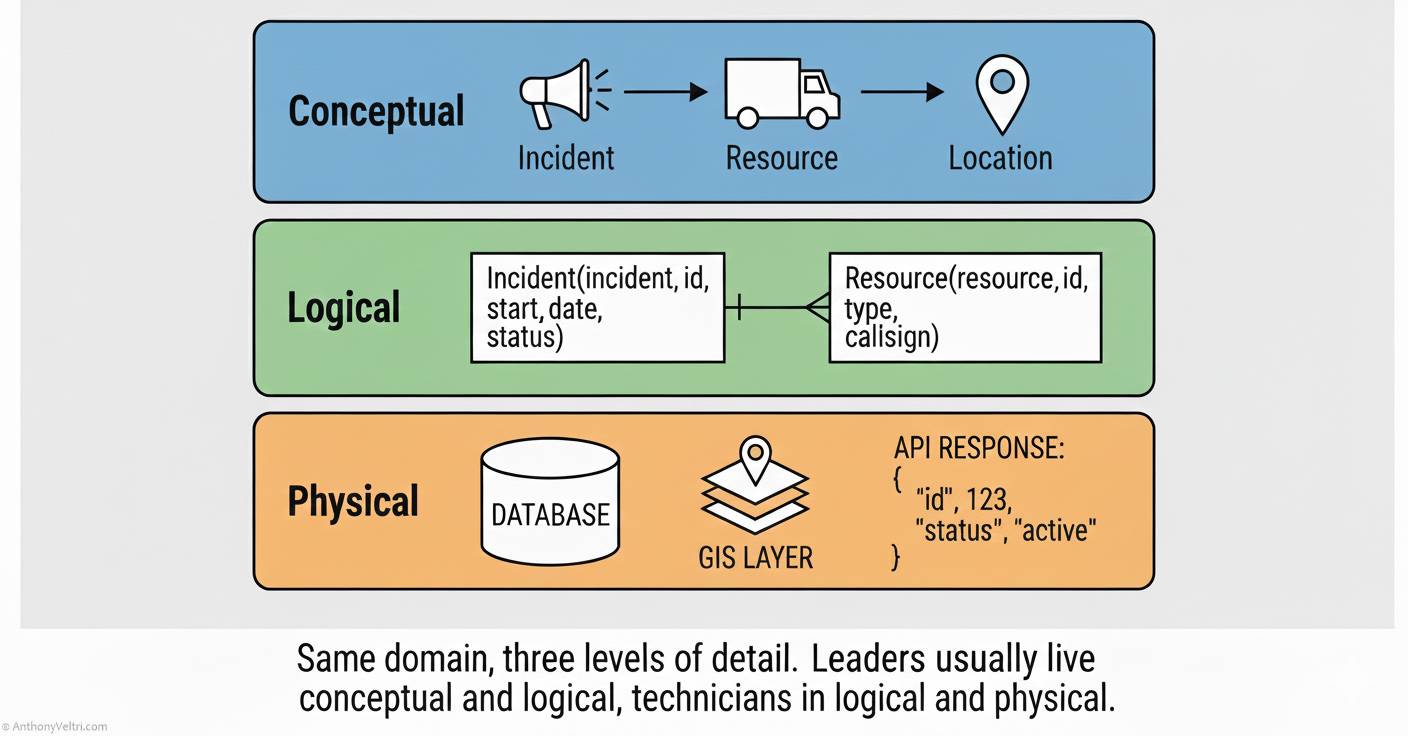
A vertical stack of three rectangles labeled “Conceptual,” “Logical,” and “Physical.” In the Conceptual box, show icons or labels like “Incident,” “Resource,” “Location,” with simple arrows between them. In the Logical box, show a simplified entity relationship style view, for example “Incident(incident_id, start_date, status)” linked to “Resource(resource_id, type, callsign).” In the Physical box, show logos or generic icons for a database, a GIS layer, and an API response snippet.
The Translation Ladder. Leaders live in the Conceptual layer (Icons/Outcomes). Engineers live in the Physical layer (Database/JSON). The Architect lives in the Logical layer, translating between the two. Same domain, three levels of detail. For a Golden Dataset isn’t just a database (Physical). It is a clearly defined concept (Conceptual) with a strict schema (Logical) that everyone agrees on.

A golden dataset is not just the biggest pile of data. It has a few specific properties.

  1. Clear scope.
    You can describe in one sentence what it represents. For example, “active wildland fire incidents in the United States,” or “approved critical infrastructure sites for iCAV display.”
  2. Declared owner.
    There is a named team or role that is responsible for the quality, evolution and availability of the dataset. Not just “IT.”
  3. Published contract.
    There is a schema, a set of definitions and rules about what each field means, how it can change and how often it is updated.
  4. Known sources and lineage.
    You can trace where the data comes from, how it is transformed and where it goes. There are no mysterious columns that “just showed up” one day.
  5. Real consumers.
    People and systems actually use it to make decisions. If nobody reads it, it is not golden. It is just tidy.

A golden dataset is not perfect. It has errors. It has lag. It has gaps. The difference is that those imperfections are visible and someone is on the hook to improve them over time.


iCAV And The Case For Golden Views #
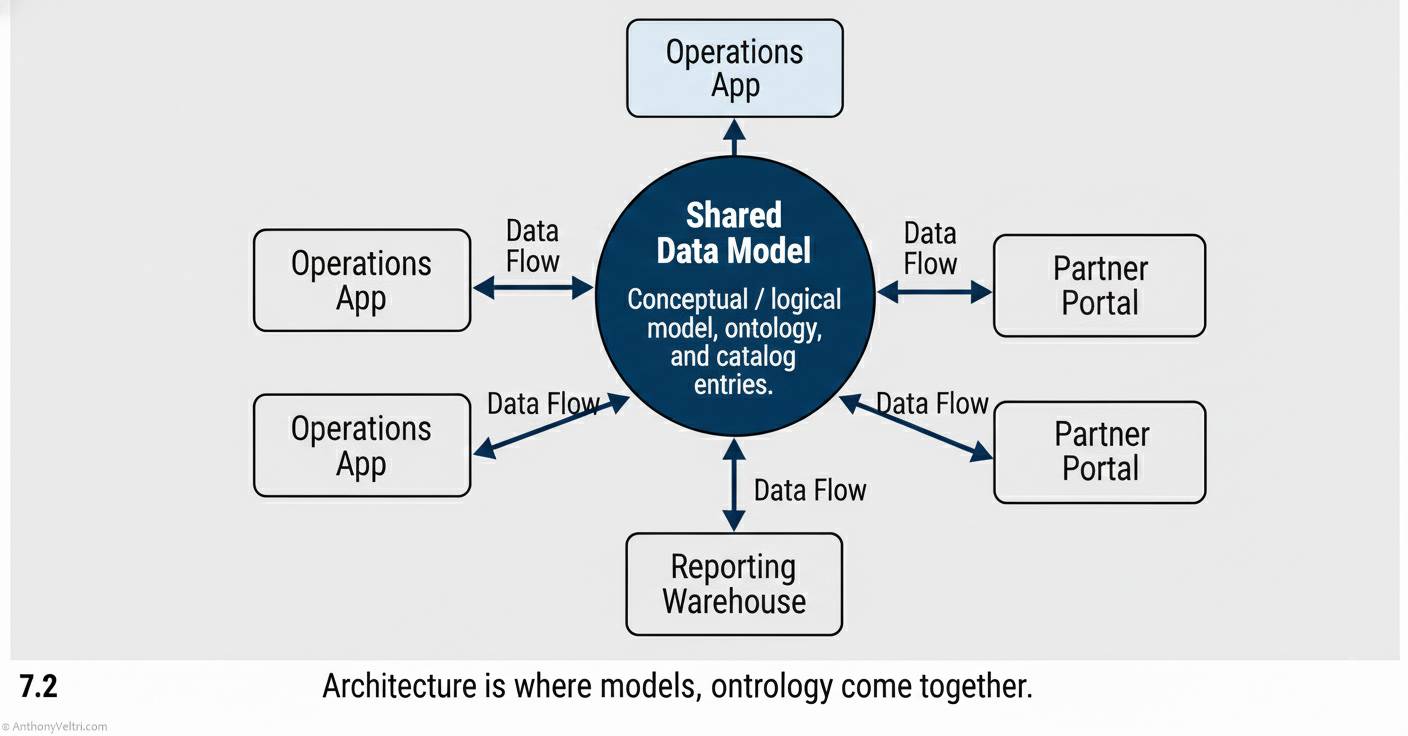
A simple architecture diagram with three or four systems (for example “Operations App,” “Reporting Warehouse,” “Partner Portal”) around a central “Shared Data Model” circle. Arrows show data flowing between the systems through the shared model. Annotate the central circle with: “Conceptual / logical model, ontology, and catalog entries.”
Architecture as Service. By providing a standard “Hub” and “Connector” pattern, we allowed partners to plug in at their own speed, rather than rebuilding the pipe every time. Golden Datasets and The Golden Hub. In a federated system, you cannot centralize everything. Instead, you create a “Shared Data Model” (Blue Center) that acts as the Golden View, while partner systems (Grey Boxes) retain their local data.

In the iCAV world, we were halfway to golden datasets without using the phrase.

We pulled data from many partners about the 19 critical infrastructure and key resource sectors at the time. Some partners refreshed regularly. Others sent DVDs. Some had meticulously maintained GIS layers. Others had shapefiles that felt like archaeological artifacts.

We could not force everyone into a single master database. Sovereignty and uneven maturity made that impossible.

What we could do was define specific slices of the federated data that functioned as golden views for certain users.

For example:

  • A curated layer of infrastructure sites that had passed basic validation.
  • A set of incident records that met agreed criteria for display to senior leadership.
  • Aggregated overlays that summarized risk without exposing all raw partner data.

Behind the scenes, we accepted that the underlying federation was messy. On the map, we offered decision makers a clearer spine to reason about.

A true golden dataset would have pushed that further. It would have:

  • Named an owner for each slice, not just “the iCAV team.”
  • Written down the rules for what made a site or incident “display worthy.”
  • Published those rules back to partners so they could align their own feeds.

Even without the full structure, we saw the value. Every time we could say “this is the list we trust for this purpose,” arguments shifted from “which list is right” to “what do we do about it.”

That is the real point.

Golden datasets do not erase politics or uncertainty. They remove one level of noise so that the harder conversations can happen.


Wildland Fire, IRWIN, And Duplicate LIDAR #

The wildland fire community learned this same lesson the hard way.

It is easy to imagine each agency keeping its own incident records completely separate. Forest Service, BLM, Park Service, states, tribes. Each with its own tool, its own codes, its own history.

In practice, that breaks the mission. Aviation safety, resource ordering and interagency coordination all depend on everyone looking at the same core picture of where incidents are, what they are called and how they are evolving.

Systems like IRWIN exist because someone decided that “incident record” is a domain that deserves a golden dataset.

That does not mean every bit of fire related data is unified. It means there is an authoritative backbone for incident identity and status that others can hang from.

Contrast that with your LIDAR story.

Multiple parts of the same organization flew overlapping LIDAR over the same terrain. Regions. Ranger districts. National program offices. Grants. They were not talking to each other. Each set was “true” in its own narrow context. Together they formed a wasteful, fragmented picture.

On fires, those same players voluntarily coordinate around shared aviation and data standards. They know they cannot afford three versions of where the aircraft is or what the fire perimeter looks like.

What changed is not just technology. It is the decision to treat some domains as deserving of golden treatment and others as “everyone does their own thing.”

Golden datasets are not primarily about storage. They are about where you decide duplication is acceptable and where it is dangerous.


Where Golden Datasets Go Wrong #
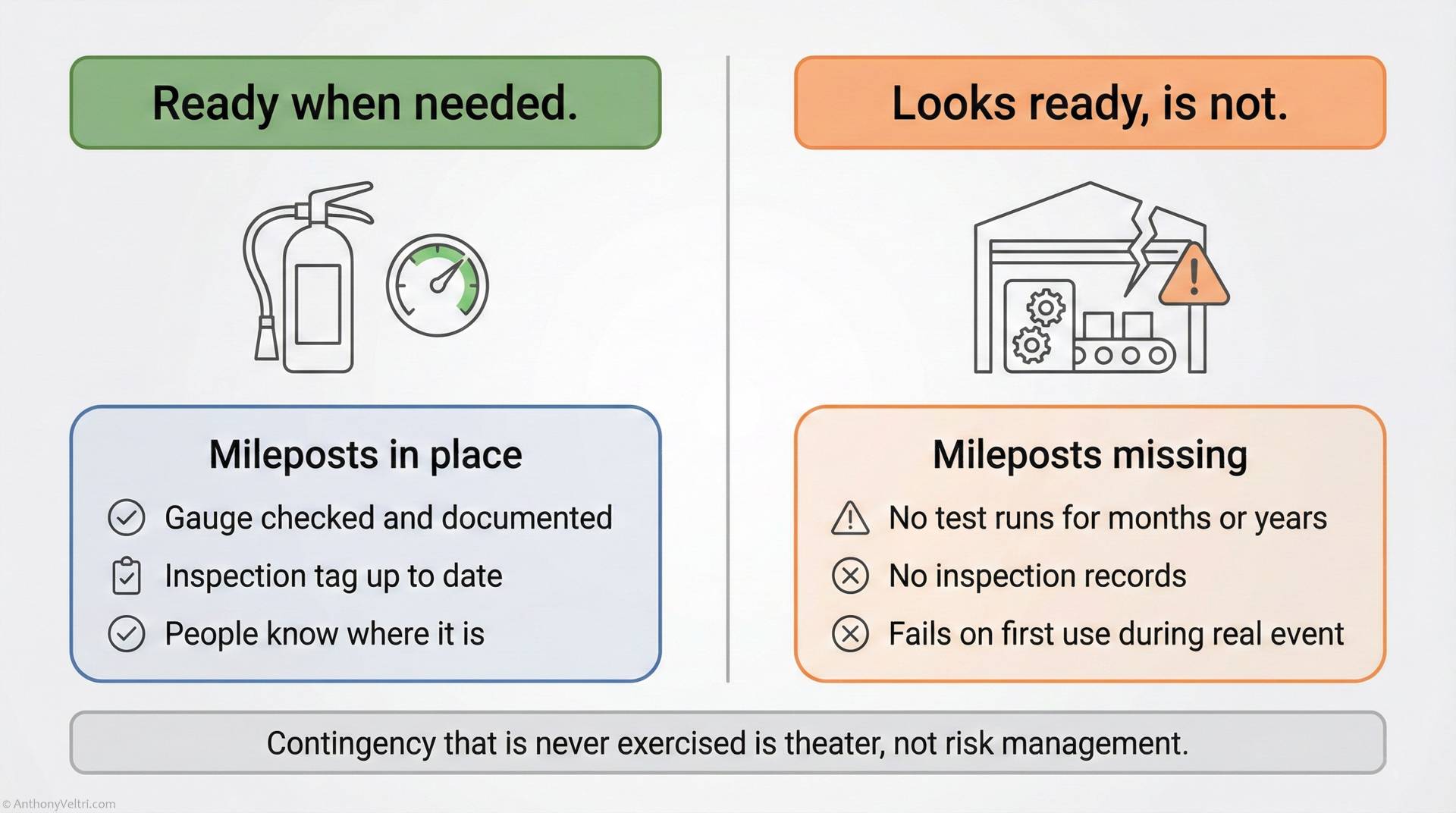
A comparison chart shows “Ready when needed” with checked fire extinguisher versus “Looks ready, is not” with a broken extinguisher box. It highlights the importance of regular checks and documentation for emergency readiness.
Golden Theater. Declaring a dataset “Golden” without governance or consumers is Theater (The Binder). True Golden Datasets are maintained, inspected, and used like critical infrastructure (The Extinguisher). A bit more background on Real vs. Fake Contingency: If you have a plan but no triggers or rehearsals, you have Theater (The Binder). Real contingency looks like a maintained fire extinguisher. “Bolting on” a plan without integration is Theater. True resilience requires the mechanics (inspections, gauges) to be built into the daily operation.

There are failure modes too.

  1. Golden in name only.
    A team declares their database “the golden source” but does nothing to improve governance or quality. Nobody agrees. Everyone carries on with their own copies.
  2. Too broad a scope.
    Someone tries to create a golden dataset for “all data about operations,” which is too vague to manage. The effort collapses under its own ambition.
  3. No visible consumers.
    A beautiful, well documented dataset is built, then nobody uses it because it was not aligned to any real decisions. It quietly decays.
  4. Hidden coupling.
    A golden dataset is used in so many places that changing it becomes impossible. People start taking copies to protect themselves from breakage. You are back where you started, but with extra ceremony.

These are not arguments against golden datasets. They are reminders that calling something “golden” does not make it so.


How To Decide What Deserves Golden Treatment #

You cannot turn everything into a golden dataset. Nor should you.

The litmus test I use is simple.

Ask:

  • Where are we repeatedly reconciling different answers to the same question
  • Where do disagreements about “what is true” slow down important decisions
  • Where do we pay real money or risk because duplicated effort and confusion are normal

If the same domain keeps lighting up, that is a candidate.

In many organizations, obvious candidates include:

  • Customers or partners
  • Assets and infrastructure
  • Incidents or cases
  • Key performance metrics that drive funding and accountability

In your world, you already see:

  • Critical infrastructure and incident views in iCAV.
  • Wildland incident records in IRWIN.
  • Resource ordering in ROSS.
  • Possibly, in the future, some alliance level datasets at NATO where sovereignty still matters but shared truth is non negotiable.

Then ask one more question:

  • Who will own this, not as a side job, but as a product

If you cannot name that person or team, you are not ready.


Doctrine: Treat Truth As A Product, Not An Accident #
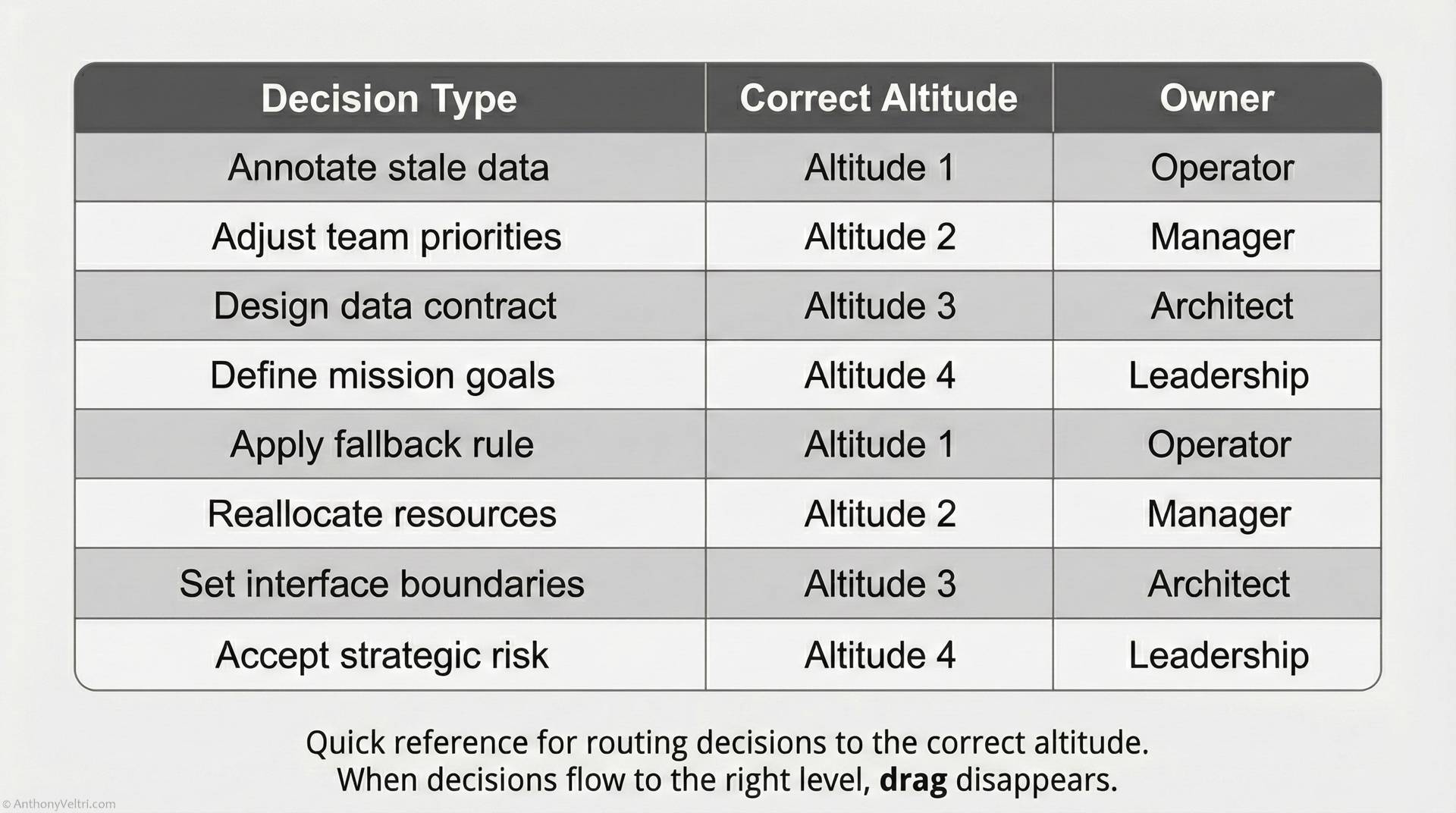
A table showing decision types, their correct altitudes, and owners: Annotate stale data—Operator; Adjust team priorities—Manager; Design data contract—Architect; Define mission goals—Leadership, with related altitudes.
Owning the Truth. Golden Datasets (among others) require explicit ownership at the right altitude. Architects own the Schema (Altitude 3). Managers own the Data Quality (Altitude 2). Operators own the Updates (Altitude 1).

Golden datasets are a discipline.

They require you to:

  • Admit that not all systems are equal. Some deserve to be clients, some deserve to be the spine.
  • Name owners who will shepherd the data over time, not just during the initial project.
  • Live with the discomfort of choosing a single authoritative view when you know reality is always more complicated.

The payoff is that, in the domains you choose, you stop burning attention on “which version” and start spending it on “what now.”

In a world of federated systems, human sovereignty, overlapping missions and messy politics, that is about as much truth as you can hope to centralize.

Not everything should be golden.
What you deliberately choose to make golden should be treated as a real product, owned and cared for, not as exhaust that just happened to land in one place.

Field notes and examples #

  • Golden Datasets: The Tracks Everyone Trusts
  • When Data And Applications Divorce: Separating The Two Without Tearing The System Apart

Last Updated on December 5, 2025

Related Posts #

Golden Datasets

Golden Datasets: The Tracks Everyone Trusts #

ANNEX F Pattern Library" text over a background of interconnected geometric lines, circles, and digital patterns resembling a circuit or network schematic.

ANNEX F. Pattern Library #

A graphic with the text

Doctrine 04: Useful Interoperability Is the Goal, Not Perfect Interoperability #

A geometric abstract design with circles, lines, and shapes in muted colors. Overlaid text reads:

Doctrine 07: Clear Intent Matters More Than Perfect Data #

This image illustrates the challenge of limited connectivity, as seen by a U.S. Forest Service vehicle in a remote, low-signal area.

Field Guide: Disconnected Editing Is Not a GIS Feature. It Is a Survival Pattern. #

A GPS screen showing a mapped route from Eugene, Oregon, heading east with a purple line to a checkered flag destination. Cities like Portland, Salem, and Medford are also visible on the map.

When Data And Applications Divorce: Separating The Two Without Tearing The System Apart #

altitude, architecture, decision-tempo, golden dataset

Leave a Reply Cancel reply

You must be logged in to post a comment.

Table of Contents
  • Exhaust Versus Product
  • What Makes A Dataset “Golden”
  • iCAV And The Case For Golden Views
  • Wildland Fire, IRWIN, And Duplicate LIDAR
  • Where Golden Datasets Go Wrong
  • How To Decide What Deserves Golden Treatment
  • Doctrine: Treat Truth As A Product, Not An Accident

Share This Article :

  • Facebook
  • X
  • LinkedIn
  • Pinterest

Was it helpful ?

  • Happy
  • Normal
  • Sad
  • Privacy Policy
  • Introductions
  • Contact

© 2026 Anthony Veltri

  • Doctrine
    • Doctrine Library
    • Global Library
  • Field Notes
  • Routes
    • Route 01: When the Interface Is Breaking (and you are becoming the patch)
    • ROUTE 02: If decisions stall and meetings go nowhere, start here
    • ROUTE 03: If you have lots of projects but no portfolio clarity, start here
    • ROUTE 04: If you’re confused about federation vs integration, start here
    • ROUTE 05: If heroics are propping up your system, start here
    • ROUTE 06: If you cannot force compliance across partners, start here
    • ROUTE 07: If compliance exists but commitment does not, start here
    • ROUTE 08: If disconnected workflows create audit anxiety, start here
  • Figure Library
  • FAQ
  • About
    • Capability Statement
    • Interpreter Kit
  • Contact