AI As an Agent of Agents: Federation’s New Middle Layer
Most talk about AI in systems work falls into two extremes.
At one extreme, AI is treated as a magic fix that will somehow unify everything without hard choices. At the other, it is treated as a threat that must be kept away from critical infrastructure until it is perfectly safe and fully understood.
Neither view is useful if you are responsible for real systems today.
The more interesting role for AI is in the middle. Not as the single brain that runs your enterprise, and not as a toy bolted onto the side, but as an agent of agents. A coordinating layer that can help federated systems behave more like a coherent whole, without pretending that everything is integrated.
In a federated environment, each node has its own logic, its own data stores and its own constraints. That is true for agencies, departments, and even teams inside one organization. It is even more true across nations or alliances.
Humans already act as agents of agents.
- The analyst who pulls from three systems, reconciles the differences and writes a daily summary.
- The planner who takes outputs from logistics, operations and finance and turns them into a single briefing.
- The engineer who reads logs from multiple services and surfaces the one pattern that matters.
These roles are real work. They are also fragile, because they rely on individual capacity and attention.
An AI agent of agents can do a version of this work continuously.
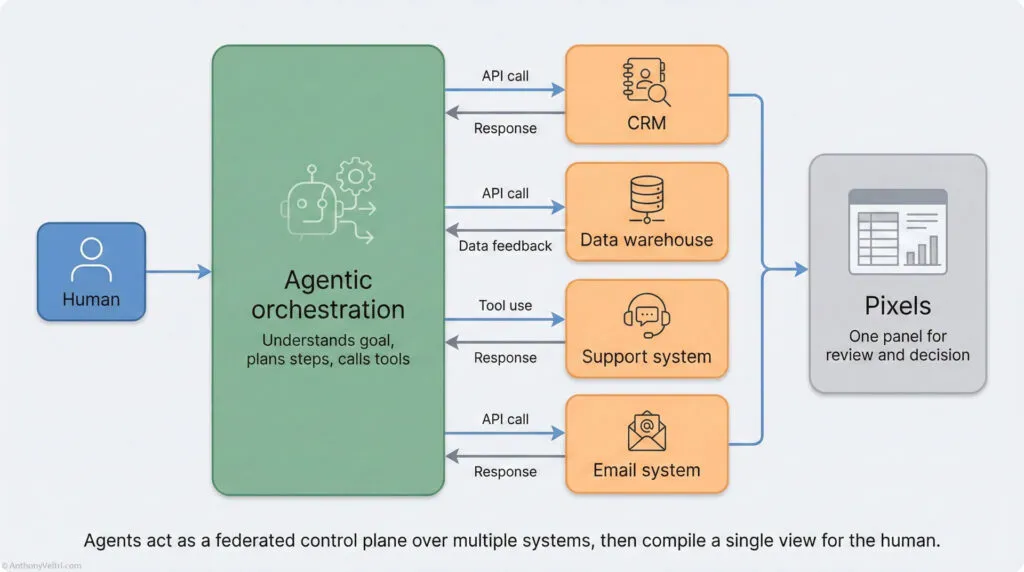
The Federated Control Plane: Humans (Left) shouldn’t have to log into five different systems (Right) to get a status update. The Agent acts as the middleware, hitting the APIs and presenting a unified view.
It can:
- Watch multiple APIs and data feeds in parallel.
- Apply consistency checks that a human would never have time to run every minute.
- Summarize divergences between systems into a simple alert instead of a sea of logs.
- Propose candidate mappings between different schemas or vocabularies, which humans can accept, adjust or reject.
Importantly, it does not replace federation. It makes federation more livable.
In a federated architecture, you already accept that you will never have perfect standardization at the edges. Different partners will keep their own systems. They will move at their own tempo. You are not going to rewrite every application just to obey a single data model.
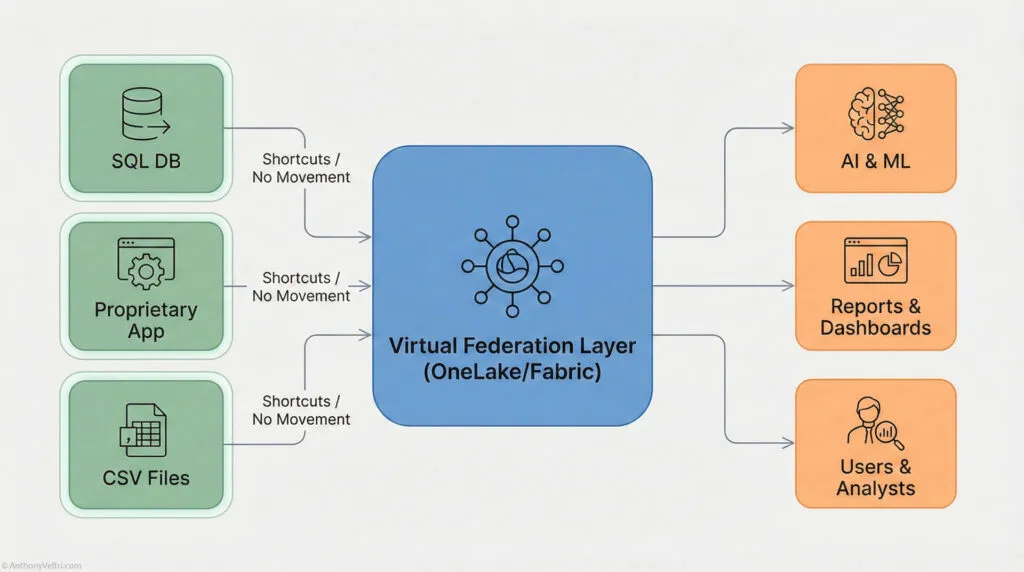
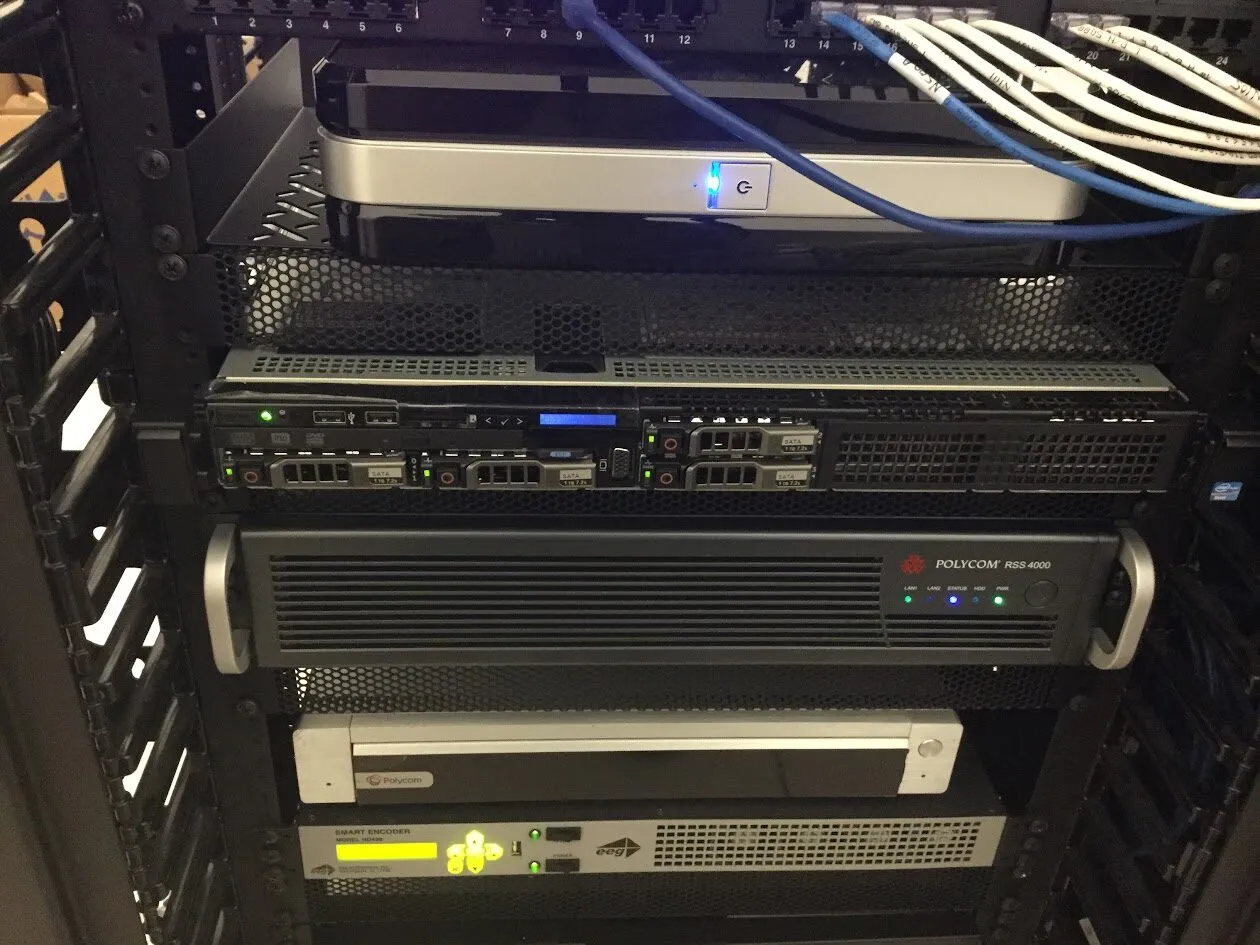
Golden Views over Federated Data: You don’t need to copy every sensor feed. You can build a “Virtual Federation Layer” (Center) that acts as the Golden View for the user, while the raw data stays where it is. Architectural Federation: Instead of forcing every partner into one database, we used a “Virtual Federation Layer” (Center) to connect disparate feeds (Left) without demanding they change their systems.
Virtual Federation: Instead of forcing migration, use a virtual layer (OneLake/Fabric) to connect disparate sources. The AI lives here, reading shortcuts rather than moving data.
What you can do is place AI agents at key interfaces and integration points.
- An agent that reads multiple representations of similar incidents and flags possible duplicates.
- An agent that reconciles naming differences for assets and locations across systems.
- An agent that predicts where data freshness is about to become a problem and nudges the right owner.
There are serious caveats.
First, you cannot outsource judgment. If your AI layer silently alters data to make things look consistent, you have simply created a more opaque failure mode. The whole point of federation is to represent reality with its uneven edges, not to smooth it into fiction.
Second, you need clear ownership. An AI agent of agents is still part of your architecture. Someone must answer for what it does and what it is allowed to decide. That includes model choice, training data, evaluation and incident response when it behaves badly.
Third, you must design for observability. Humans must be able to see what the agent saw, how it reasoned and what actions it took. A black box that sits between sovereign systems and quietly edits their messages is a governance nightmare, not an innovation.
Used well, AI at the federation layer enables three things.
- Faster feedback. Misalignments between systems surface in minutes instead of months.
- Human focus. People spend less time acting as copy and paste bridges and more time on genuine decisions.
- Negotiated standards. When you can see where systems diverge in practice, you can negotiate better standards that reflect reality rather than ideals.
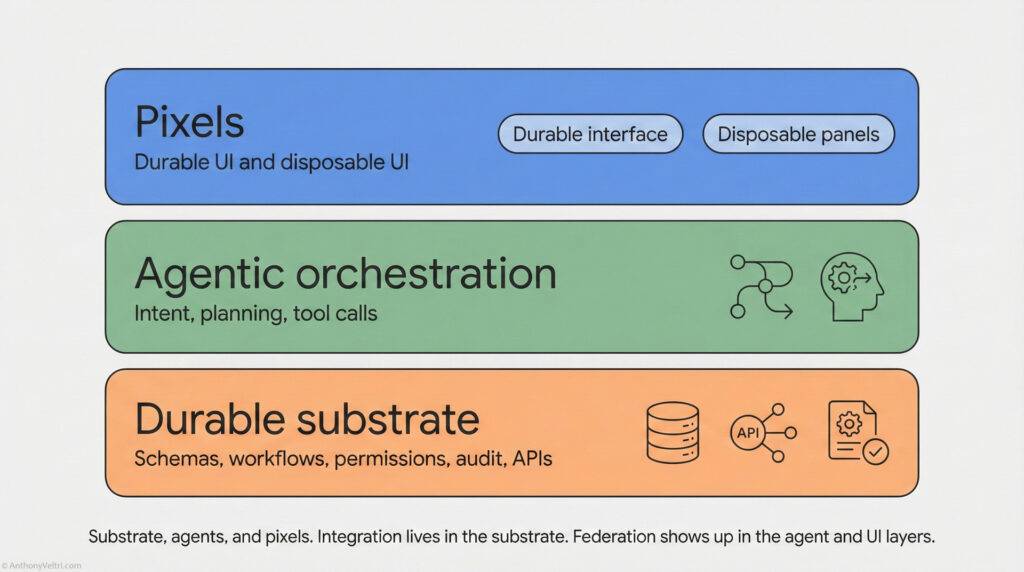
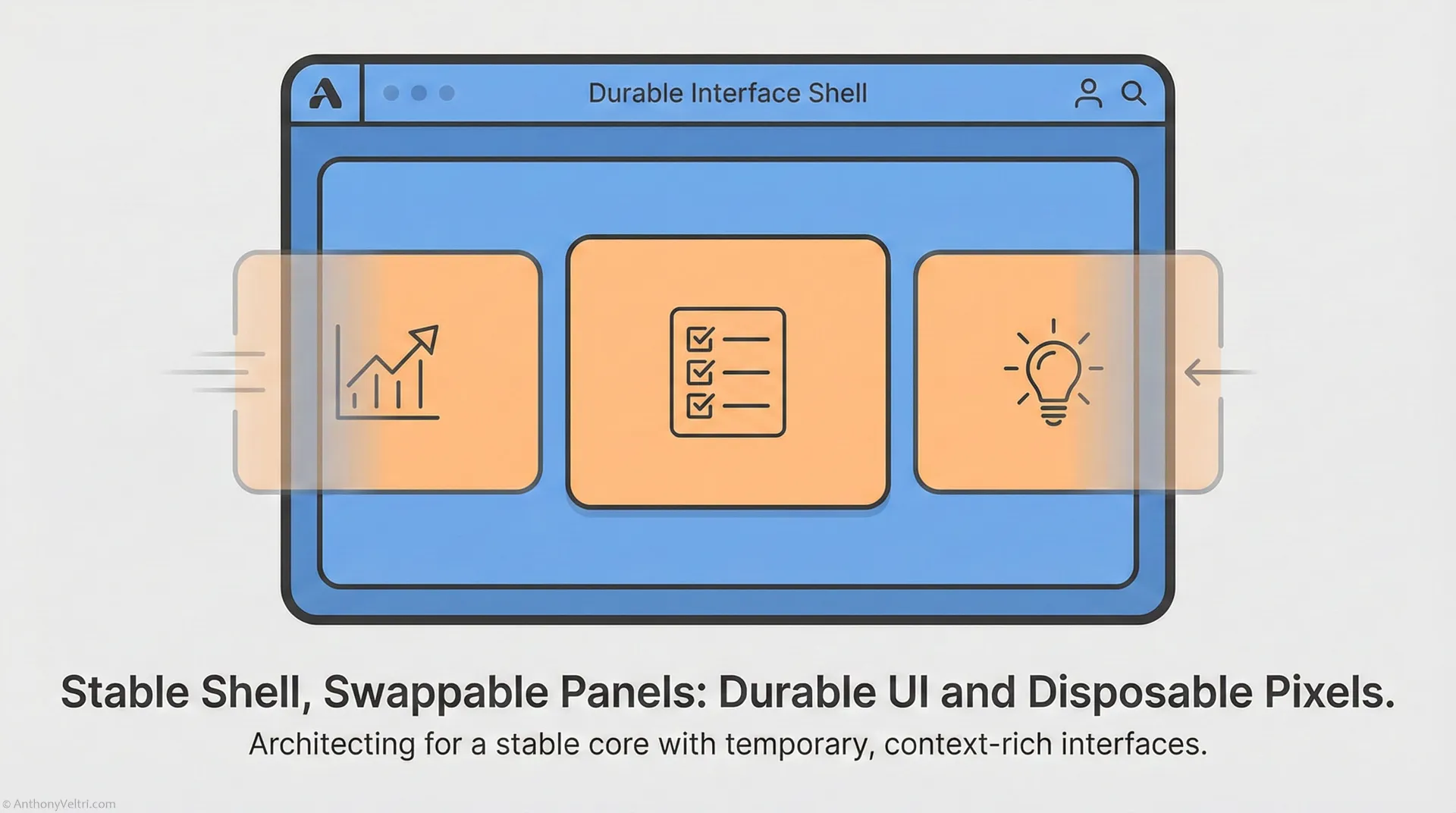
Agentic AI is rapidly bridging the gap between “the data” and traditional UI
My doctrine is this:
- Do not try to replace your messy federation with one giant AI brain.
- Use AI as an agent of agents, a middle layer that notices, compares and proposes, while humans decide.
- Treat those agents as part of your architecture, with owners, rules and visibility, instead of as clever scripts in the shadows.
Federation is about accepting variety where you must, and connection where you can. AI can help with the connection side, if you use it as a tool for clarity rather than a shortcut around hard design.
Last Updated on December 7, 2025