Why everything flows faster when people know the purpose, the boundaries, and the desired outcome #
This doctrine guide is about Focus and Speed. It argues that “Intent” is the ultimate compression algorithm for messy organizations.
This page is a Doctrine Guide. It shows how to apply one principle from the Doctrine in real systems and real constraints. Use it as a reference when you are making decisions, designing workflows, or repairing things that broke under pressure.
When intent is unclear, everything becomes harder. When intent is clear, everything becomes easier. #
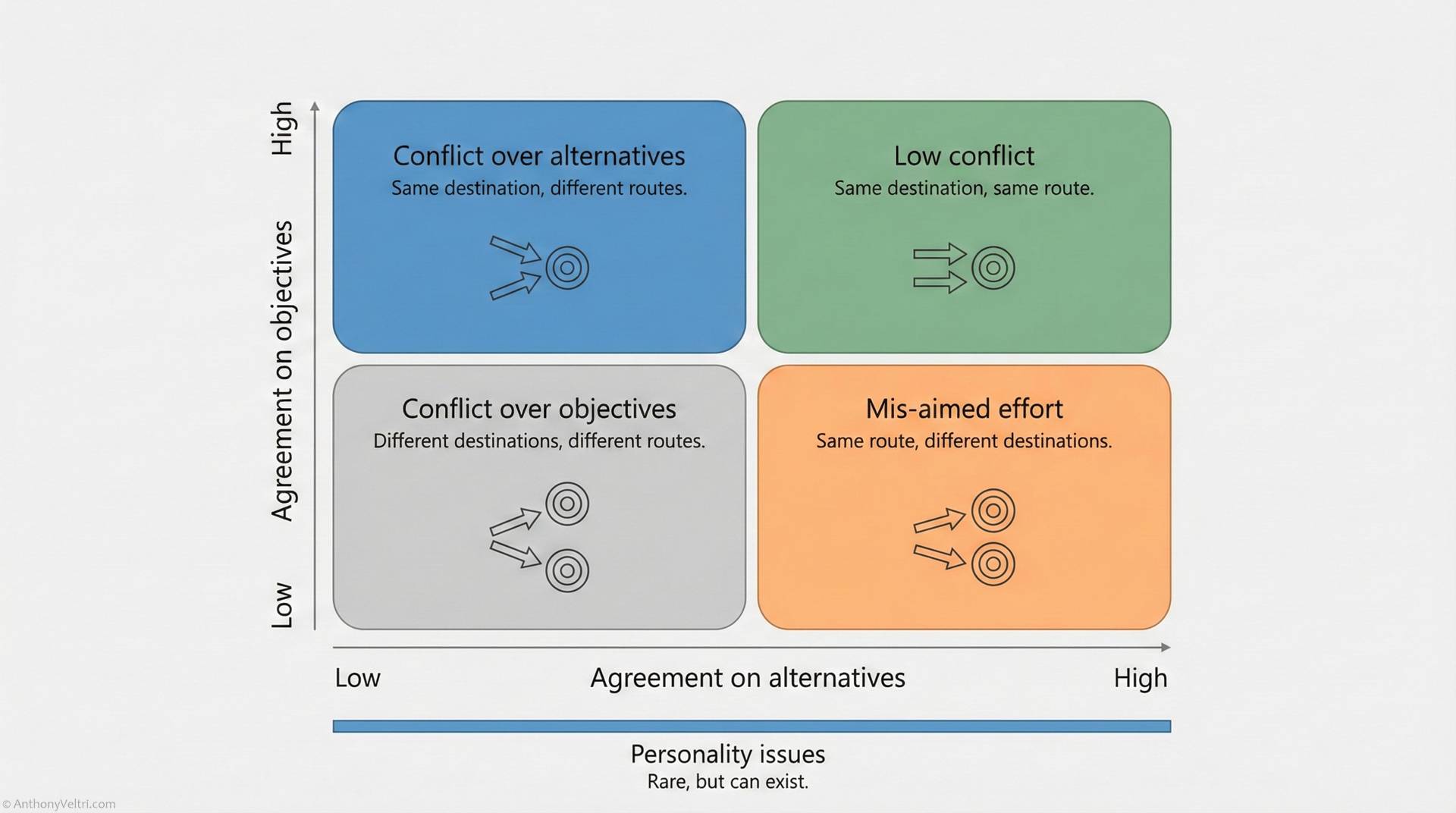
Most delays, conflicts, and misalignments do not come from:
- bad people
- bad teams
- bad data
- bad tools
They come from unclear intent.
When intent is unclear:
- teams hesitate
- people wait
- decisions escalate
- conflict grows
- assumptions diverge
- rework multiplies
- risk increases
- morale drops
When intent is clear:
- autonomy rises
- decisions move fast
- alignment increases
- conflict evaporates
- teams self-correct
- innovation accelerates
Intent is the compression algorithm for ambiguity.
Lived Example: The analyst who acted correctly because she knew the intent #
During an activation cycle, a flood model shifted and a partner feed lagged.
An analyst:
- spotted the drift
- annotated the uncertainty
- updated the viewer
- notified partners
- adjusted routing
She did not wait for approval.
She did not worry about being second-guessed.
She did not escalate.
Why?
Because she understood the intent:
- preserve mission tempo
- prioritize life safety
- maintain situational awareness
- annotate uncertainty, not hide it
Clear intent gave her authority.
Authority gave her speed.
Speed preserved the mission.
Business Terms: Intent as the anchor for all decisions #
Clear intent answers three questions:
- What are we trying to achieve?
- What boundaries do we respect?
- What tradeoffs are acceptable?
When these are known:
- teams align themselves
- ambiguity collapses
- decisions become obvious
- disagreements shrink
- unnecessary meetings disappear
- miscommunication drops
- expectations are shared
Intent is the shape of the problem.
Without it, the system wanders.
System Terms: Intent as a structural invariant #
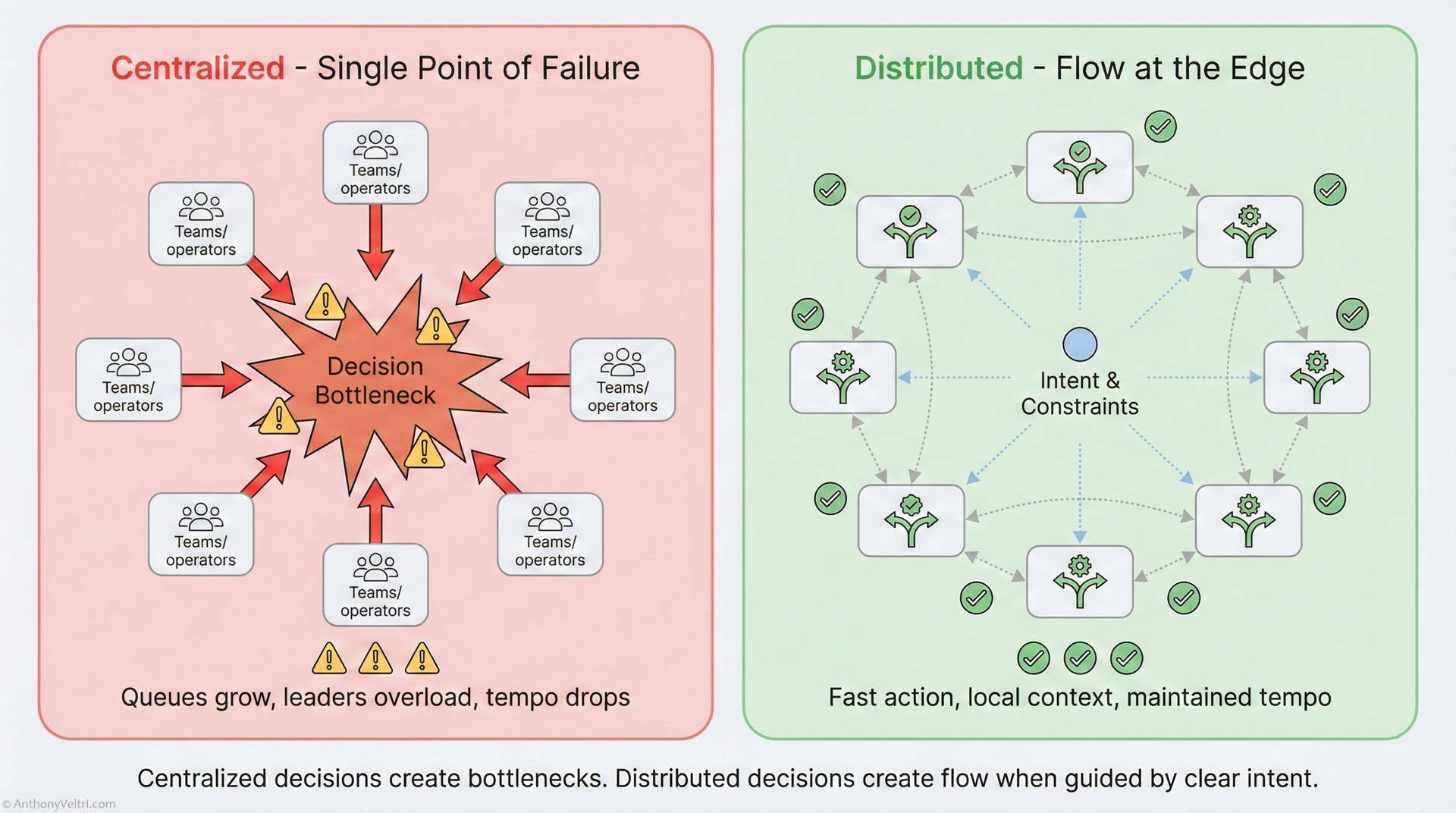
In system language, clear intent defines:
- invariants
- constraints
- priorities
- risk thresholds
- fallback modes
- acceptable error
- alignment rules
- decision altitudes
- boundaries between lanes
- escalation pathways
Intent creates structural stability in:
- distributed decisions
- degraded operations
- federation
- useful interoperability
- portfolio alignment
Intent is the system’s gravitational field.
Why Lack of Intent Creates Organizational Drag #
Business perspective #
When intent is unclear:
- teams create their own assumptions
- managers over-specify
- operators fear acting
- leaders get overloaded
- politics replace clarity
- compliance replaces commitment
- work multiplies
- trust declines
Confusion becomes the default operating mode.
System perspective #
When intent is unclear, systems:
- drift
- misallocate resources
- over synchronize
- under synchronize
- build unnecessary checks
- create brittle behavior
- escalate trivial issues
- fail to adapt under stress
Lack of intent creates turbulence everywhere.
Why Clear Intent Succeeds #
Business perspective #
Clear intent succeeds because:
- it gives people a shared mental model
- it aligns incentives
- it reduces fear
- it empowers autonomy
- it strengthens initiative
- it removes hesitation
- it prevents conflict
- it absorbs uncertainty
Intent is a force multiplier.
It turns average teams into high performing teams.
System perspective #
Clear intent succeeds because:
- it stabilizes decision pathways
- it reduces coupling
- it clarifies fallback behavior
- it simplifies interface design
- it lowers the need for approvals
- it makes degradation manageable
- it supports predictable evolution
Intent makes the system self-directing.
The Intent Stack (& Decision Altitudes) #
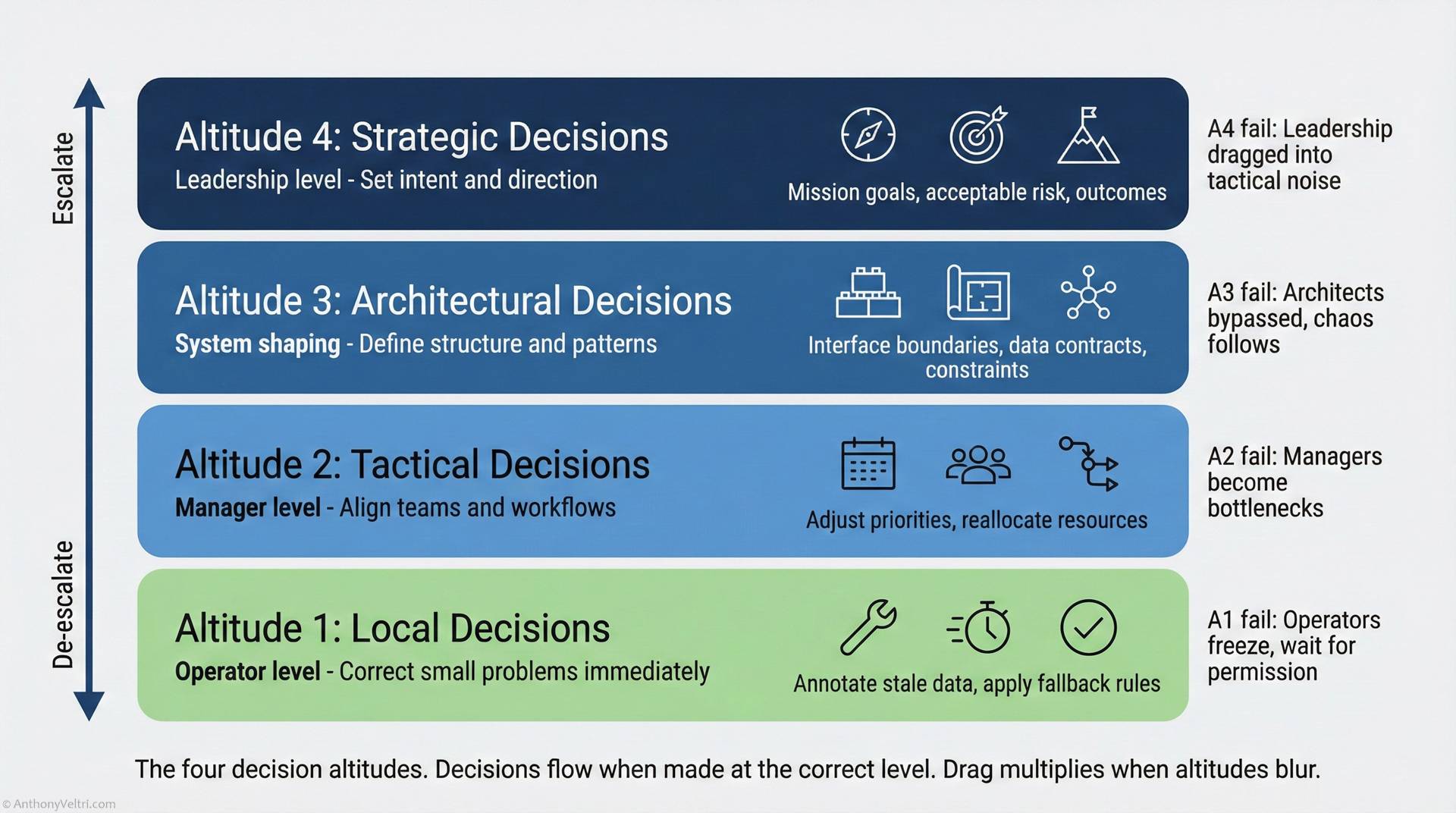
This doctrine already suggests this pattern. Now we formalize it.
Clear intent exists at four altitudes:
1. Mission intent #
The outcome we are trying to achieve.
Example: Preserve situational awareness during dynamic conditions.
2. Architectural intent #
The principles we use to shape the system.
Example: Design for degraded operations and distributed decisions.
3. Operational intent #
The choices and tradeoffs teams make.
Example: Show partial truth rather than hide stale data.
4. Local intent #
The action an operator takes in real time.
Example: Annotate drift and reroute convoys now.
When these four align, the system becomes coherent.
Business Example: The cross-agency meeting that solved itself #
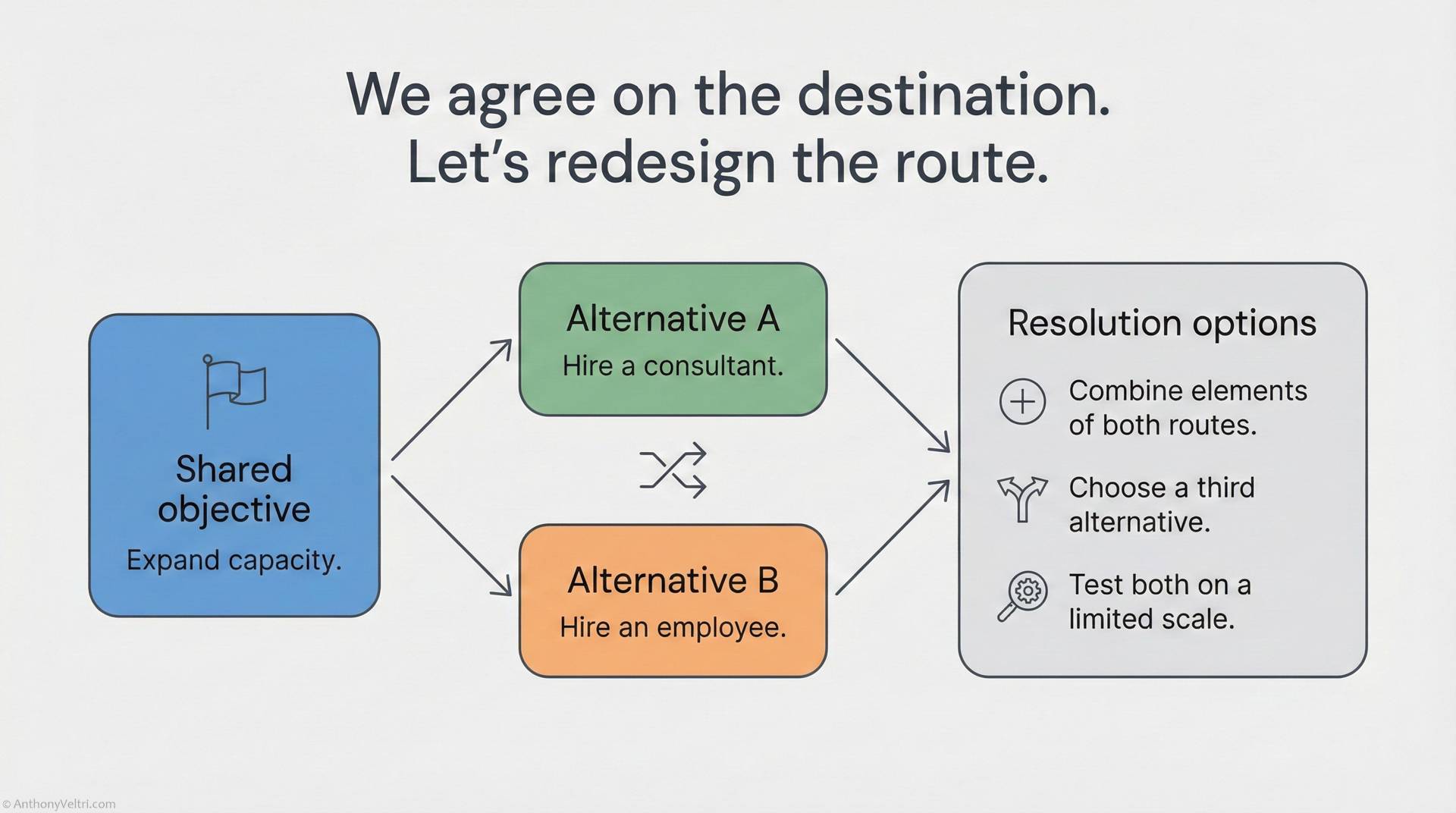
In one multi-agency friction point, three groups fought over:
- data accuracy
- publishing cadence
- ownership of a map layer
The conflict persisted for weeks.
Once leadership restated intent:
- protect mission tempo
- maximize shared visibility
- accept imperfect freshness
- synchronize only what truly matters
The disagreement collapsed in minutes.
Everyone realized they wanted the same outcome.
They were fighting over methods, not intent.
Intent compresses conflict.
System Example: iCAV aligned because intent was explicit #
iCAV worked because intent was baked in:
- render partial data
- withstand degradation
- prioritize life safety layers
- isolate failures
- absorb partner diversity
- synchronize only high-value elements
- preserve the mission picture at all times
This intent guided decisions at:
- ingest
- harmonization
- caching
- UI
- architecture
- operations
Clear intent created a coherent system across very diverse conditions.
Architect-Level Principle #
As an architect, I articulate clear intent so that teams know what the system must achieve, what must never be violated, and what can be traded.
Intent collapses ambiguity, reduces conflict, and accelerates action.
Twenty-Second Takeaway: #
“Most delays and conflicts come from unclear intent. When people know the purpose, the boundaries, and the acceptable tradeoffs, they act faster and align naturally. I ensure intent is explicit so the system becomes self-directing.”
Cross Links to Other Principles #
Clear intent reinforces:
- Distributed decisions
- Decision drag
- Architecture accelerates
- Portfolio thinking
- Useful interoperability
- Degraded operations
- Emergent resilience
- Federation
- Interfaces and ownership
Intent is the anchor of the entire doctrine.
Doctrine Diagnostic – For Reflection: #
Ask yourself:
Does your team know the intent?
Or are they guessing?
If they are guessing, you have drag.
If they know the intent, you have flow.
State the intent.
Watch ambiguity collapse.
Field notes and examples #
- Don’t Build an Army of Conscripts When You Need a Coalition of Allies
- Field Note: Rapid Goal Setting For Cross Functional Teams
- You Remember My Values, But Not Yours
- When You Cannot Force Compliance: iCAV and the Federated View of Critical Infrastructure
- Federation Without Owners: The Slow Failure Mode
- AI As an Agent of Agents: Federation’s New Middle Layer
Last Updated on February 22, 2026