Skip to content

Introduced by a trusted connector?

Start Here

Anthony Veltri

  • Doctrine
    • Doctrine Library
    • Global Library
  • Field Notes
  • Routes
    • Route 01: When the Interface Is Breaking (and you are becoming the patch)
    • ROUTE 02: If decisions stall and meetings go nowhere, start here
    • ROUTE 03: If you have lots of projects but no portfolio clarity, start here
    • ROUTE 04: If you’re confused about federation vs integration, start here
    • ROUTE 05: If heroics are propping up your system, start here
    • ROUTE 06: If you cannot force compliance across partners, start here
    • ROUTE 07: If compliance exists but commitment does not, start here
    • ROUTE 08: If disconnected workflows create audit anxiety, start here
  • Figure Library
  • FAQ
  • About
    • Capability Statement
    • Interpreter Kit
  • Contact
Anthony Veltri

Architecture & Interfaces

15
  • Doctrine 01: Federation vs Integration in Mission Networks
  • Doctrine 03: Interfaces Are Where Systems Break, So They Require Stewards, Contracts, and Ownership
  • Doctrine 04: Useful Interoperability Is the Goal, Not Perfect Interoperability
  • Doctrine 05: Innovation Must Live at the Edge, Not in the Center
  • Doctrine 06: A Two-Lane System Protects Stability and Enables Evolution
  • Doctrine 14: Technical Debt Is a Leadership Signal, Not a Coding Failure
  • Doctrine 15: Architecture Must Accelerate Teams, Not Bottleneck Them
  • Doctrine 17: Architects Translate Strategy Into Engineering and Engineering Into Strategy
  • Doctrine 20: Golden Datasets: Putting Truth In One Place Without Pretending Everything Is Perfect
  • Doctrine 21: Zero Trust Is A Trust Model, Not A Card “Type”
  • Doctrine 23: Loop Closure as Load-Bearing System Infrastructure
  • ANNEX B. Data Contracts
  • ANNEX C. Interface Ownership Model
  • ANNEX H. Architecture Doctrine
  • Annex L: The Rosetta Stone for Data Teams: Bridging the Gap Between Technicians and Executives

Decision Tempo & Governance

10
  • Doctrine 02: Distributed Decisions Increase Alignment, Speed, and Resilience
  • Doctrine 07: Clear Intent Matters More Than Perfect Data
  • Doctrine 08: Clear Intent Compresses Ambiguity, Reduces Conflict, and Accelerates Action
  • Doctrine 09: Decision Drag Is the Enemy of Mission Tempo. Architecture Is the Remedy
  • Doctrine 10: Degraded Operations Are the Normal Mode, Not the Exception
  • Doctrine 11: Preventive Action and Contingent Action Must Both Be Designed Intentionally
  • Doctrine 22: When “It Depends” Is the Right Answer: How to Think in Probabilities Under Uncertainty
  • ANNEX D. Decision Altitudes Model
  • ANNEX E. Prevention–Contingency Matrix
  • ANNEX I. High Visibility Workflows

Portfolio & Alignment

4
  • Doctrine 16: Portfolio Thinking Ensures Effort Aligns With What Actually Matters
  • ANNEX F. Pattern Library
  • ANNEX J. System Evolution and Drift Management
  • ANNEX K. System and Workflow Profiles (Case Studies)

Leadership & Human Systems

6
  • Doctrine 24: Stewardship Places the Burden on the Steward, Not the Parties
  • Doctrine 18: Commitment Outperforms Compliance in High Trust, High Tempo Environments
  • Doctrine 19: Supervision, Management, and Leadership Are Three Different Jobs. Confusing Them Breaks Systems
  • Doctrine 23: Loop Closure as Load-Bearing System Infrastructure
  • ANNEX A. Human Contracts
  • ANNEX G. Leadership Doctrine

Resilience & Operations

3
  • Doctrine 24: Stewardship Places the Burden on the Steward, Not the Parties
  • Doctrine 12: Resilience Is an Emergent Property, Not a Feature
  • Doctrine 13: Problem Solving Requires Finding the Real Deviation and the Relevant Change

Doctrine Companions

7
  • Doctrine 03 Companion: The RS-CAT Framework: Converting Raw Recall into Teachable Principle
  • Doctrine 03 Companion: The Interface Void
  • Doctrine 11 Companion: Agency vs. Outcome
  • Doctrine 09 Companion: Artifacts Over Adjectives
  • Doctrine 03 Companion: Constraints: bidirectional translation: Compression vs Construction
  • Doctrine 10 Companion: Span of Control and Cross Training Are Load-Bearing Constraints
  • Doctrine 21 Companion: Claims, Roles, and Entitlements in Microsoft 365

Field Reports

1
  • Field Report: College Financing and the 5-Year Home Runway
View Categories
  • Home
  • Doctrine & Supporting Guides
  • Leadership & Human Systems
  • Doctrine 18: Commitment Outperforms Compliance in High Trust, High Tempo Environments

Doctrine 18: Commitment Outperforms Compliance in High Trust, High Tempo Environments

Anthony Veltri
Updated on December 12, 2025

4 min read

Why teams built on commitment move faster, adapt better, and deliver more value than teams built on rule following #

This guide moves beyond the “rules vs. freedom” debate and shows why Compliance and Commitment are not binary opposites, but distinct structural layers. You use Compliance to establish a safety floor, and Commitment to unlock the performance ceiling. High-tempo systems require both.

This page is a Doctrine Guide. It shows how to apply one principle from the Doctrine in real systems and real constraints. Use it as a reference when you are making decisions, designing workflows, or repairing things that broke under pressure.


Compliance prevents the wrong thing. Commitment drives the right thing. #
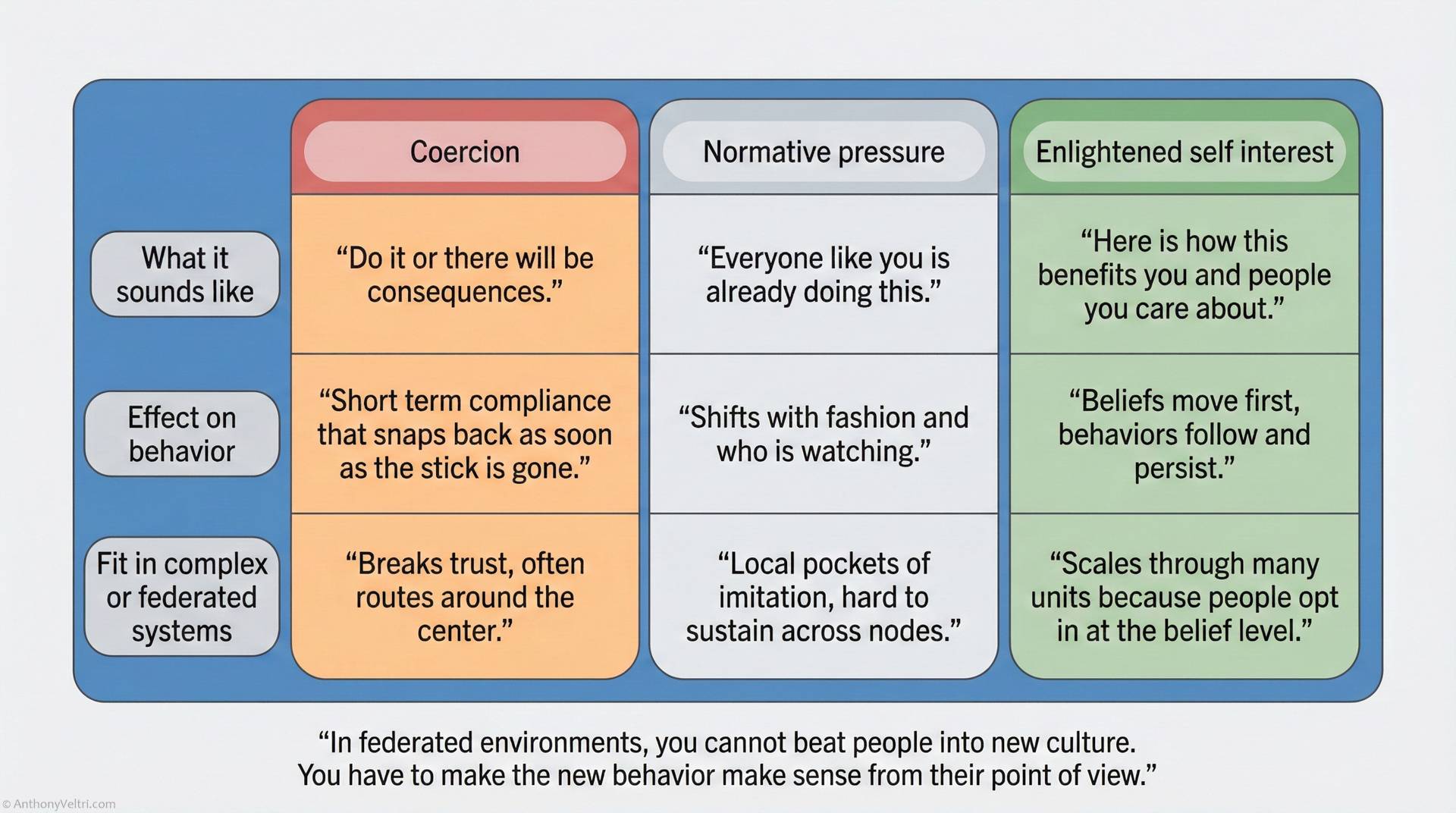
A comparison chart with three columns: Coercion, Normative Pressure, and Enlightened Self Interest, each describing what it sounds like, effects on behavior, and fit in complex systems, plus a quote about behavioral change.
The Compliance Spectrum. Coercion (Red) creates temporary compliance that snaps back. Enlightened Self-Interest (Green) creates commitment that scales.

Compliance is:

  • safe
  • predictable
  • slow
  • defensive

Commitment is:

  • proactive
  • adaptive
  • fast
  • mission focused

Compliance ensures people avoid mistakes.
Commitment ensures people advance the mission.

Compliance is the floor.
Commitment is the engine.


Lived Example: The analyst who moved the mission forward while others debated #

During a major activation, two teams argued over:

  • whether a partner feed was stale
  • who owned the update
  • whether to escalate
  • whether a meeting was needed

While they debated, an analyst who understood the intent:

  • pulled the cached layer
  • annotated the time drift
  • adjusted the affected routing
  • notified partners
  • kept the mission picture accurate

Compliance would have told her to wait.
Commitment told her to act.

She advanced the mission while others followed the rulebook.


Business Terms: Compliance is about permission. Commitment is about purpose. #

Compliance answers:

  • What am I allowed to do?
  • What am I required to do?
  • What do I avoid?

Commitment answers:

  • What advances the mission?
  • What protects tempo?
  • What supports the system?

Compliance is fear-based.
Commitment is purpose-based.

In high-tempo, high-consequence environments, fear slows everything down.
Purpose accelerates everything that matters.


System Terms: Compliance constrains, commitment harmonizes #

In system language:

Compliance systems:

  • restrict behavior
  • add friction
  • add latency
  • reduce autonomy
  • require synchronization
  • centralize decisions

Commitment systems:

  • distribute decisions
  • stabilize intent
  • reduce ambiguity
  • reduce escalation
  • tolerate variation
  • accelerate flow

Compliance protects boundaries.
Commitment advances outcomes.

Both matter, but only one moves the mission.


Why Compliance Is Necessary but Not Sufficient #
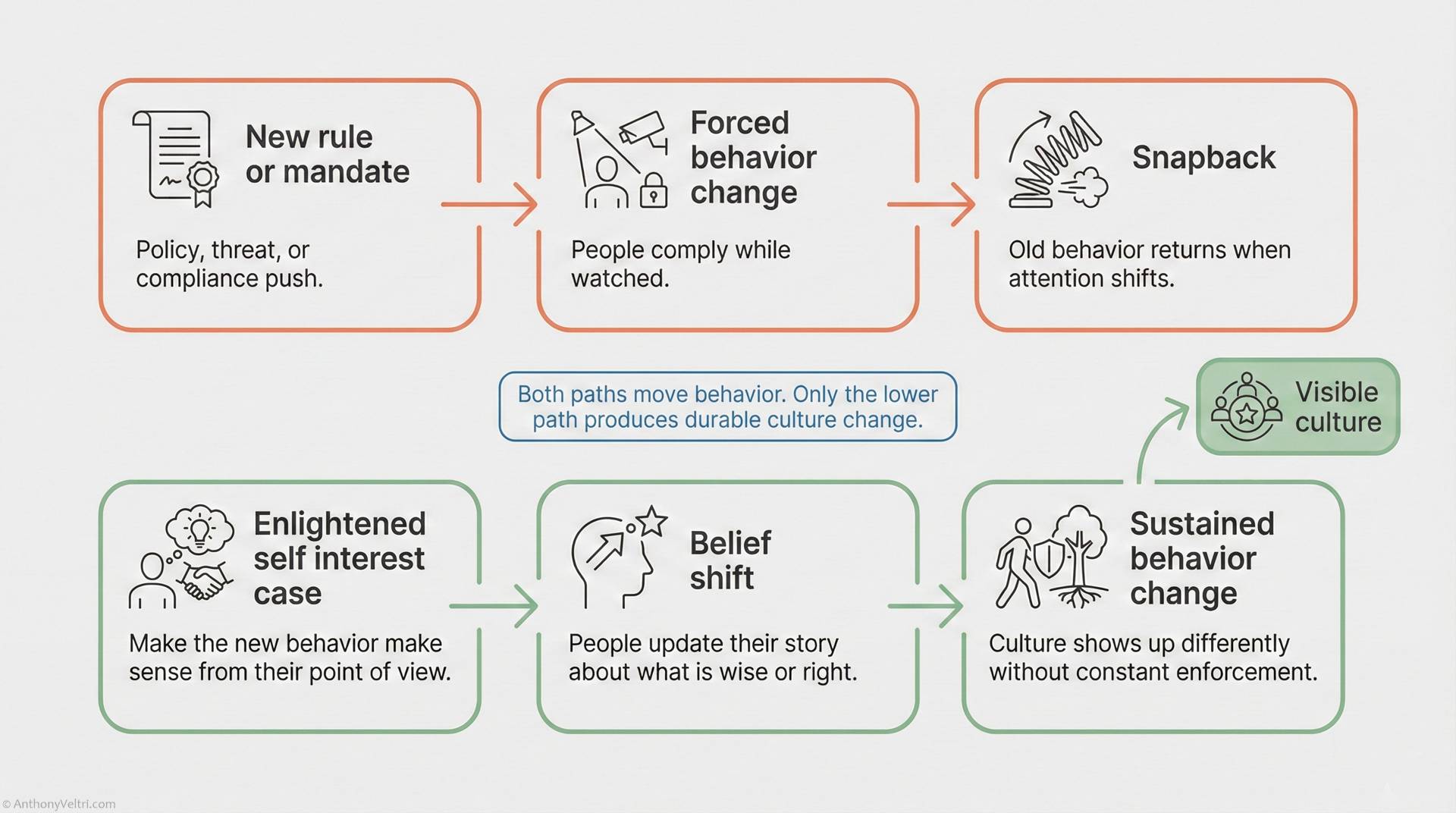
Flowchart comparing two paths to behavior change: one uses force and results in temporary change (snapback), while the other uses enlightenment and belief shift leading to sustained culture change. Icons illustrate each step.
The Snapback Effect. Mandates (Top) create forced behavior that reverts as soon as attention shifts. Commitment (Bottom) creates sustained behavior driven by belief.

Business perspective #

Compliance is the minimum viable behavior in:

  • legal environments
  • security contexts
  • safety protocols
  • regulated systems

Compliance prevents:

  • violations
  • risks
  • errors
  • political fallout

But compliance alone creates:

  • hesitation
  • waiting
  • escalation
  • defensive behavior
  • low initiative
  • slow tempo

Compliance is the guardrail, not the engine.

System perspective #

Compliance systems:

  • reduce harmful outliers
  • enforce predictable patterns
  • create structural safety
  • provide boundaries

But they also:

  • increase coupling
  • reduce autonomy
  • force decisions upward
  • slow adaptation

Systems built only on compliance collapse under variation.


Why Commitment Outperforms Compliance in Mission Systems #

Business perspective #

Commitment increases:

  • ownership
  • initiative
  • speed
  • correctness
  • morale
  • alignment
  • trust

Teams act because they believe in the mission, not because a rule told them to.

Commitment replaces:

  • hesitation with action
  • friction with flow
  • fear with clarity

Commitment is the fuel for mission tempo.

System perspective #

Commitment increases:

  • graceful degradation
  • distributed decision flow
  • local correction
  • resilience under stress
  • tolerance for partner diversity
  • adaptive behavior
  • emergent order

Systems perform better when people act in harmony with the intent, not in obedience to procedure.


Why Commitment Is Safer Than Compliance in High-Consequence Work #

This is counterintuitive but true.

Compliance avoids doing the wrong thing.
Commitment ensures you do the right thing.

Compliance protects rules.
Commitment protects outcomes.

In crisis environments, waiting is more dangerous than acting.

Commitment reduces:

  • decision drag
  • rework
  • misunderstandings
  • escalations
  • brittle synchronization
  • operational blind spots

Commitment is safer because it protects the mission, not the rulebook.


The Commitment Contract (This Model Applies Across All Doctrine) #
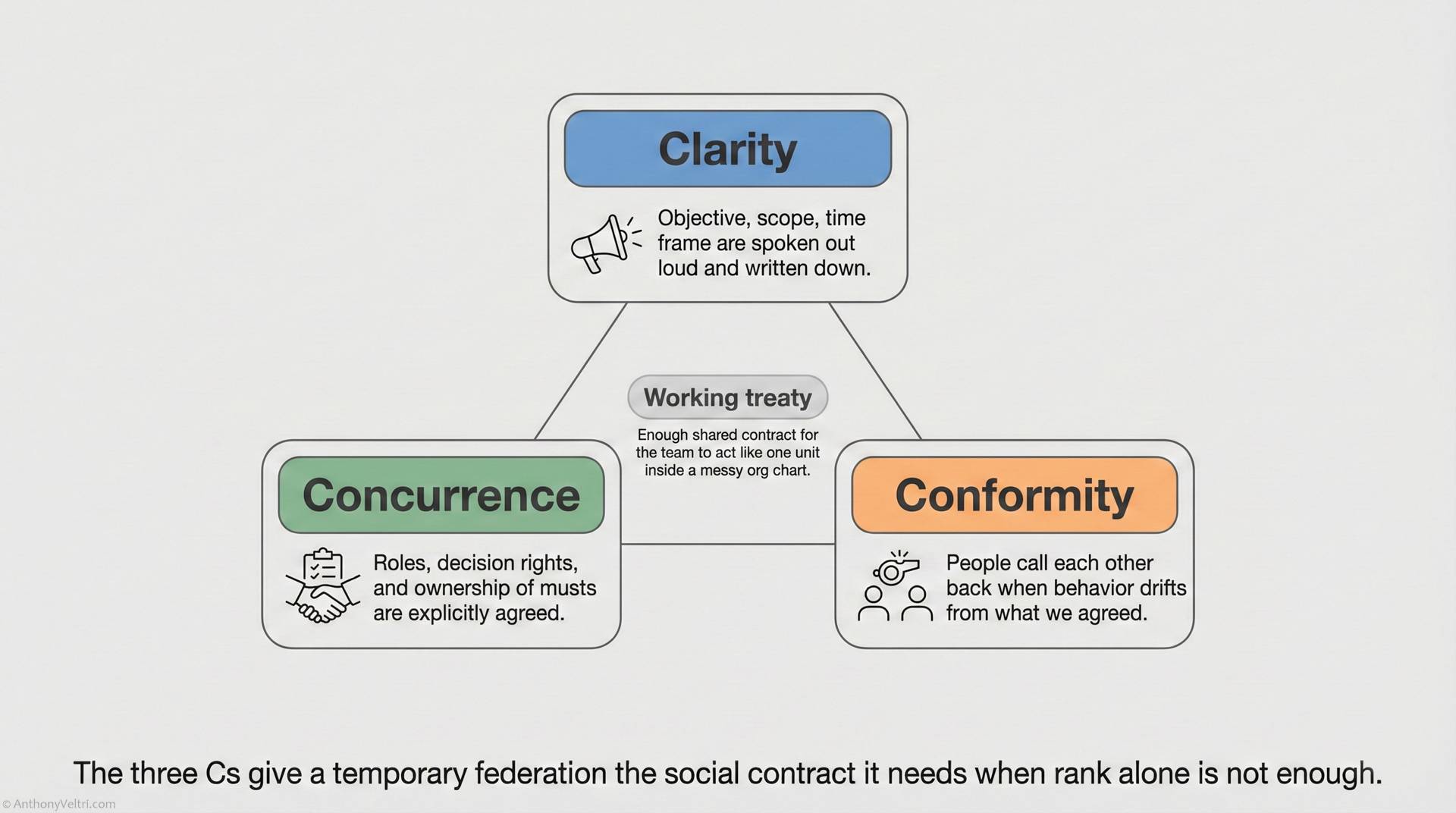
A diagram connecting three concepts: Clarity (objective, scope, and timeframe are defined), Concurrence (roles and decision rights are explicit), and Conformity (peers call out behavioral drift); central text: "Working treaty.
The Human Contract: A stable relationship requires three things: Clarity on the goal, Concurrence on the roles, and Conformity to the agreement (Standards). If one is missing, the contract fails. The Working Treaty: Commitment requires Clarity (Intent), Concurrence (Roles), and Conformity (Boundaries). This triangle is the “Psychological Contract” you need. The Reset: We moved from “Task Assignment” to a “Human Contract.” We established Clarity (The real story), Concurrence (Team shaping the plan), and Conformity (Shared risk).

Commitment systems require a psychological contract built on three pillars:

1. Shared intent #

People know what good looks like.

2. Clear boundaries #

People know what they must not violate.

3. Trust in autonomy #

People are empowered to act without waiting.

When these three exist, commitment outperforms compliance every time.


Business Example: The team that transformed once intent was clarified #
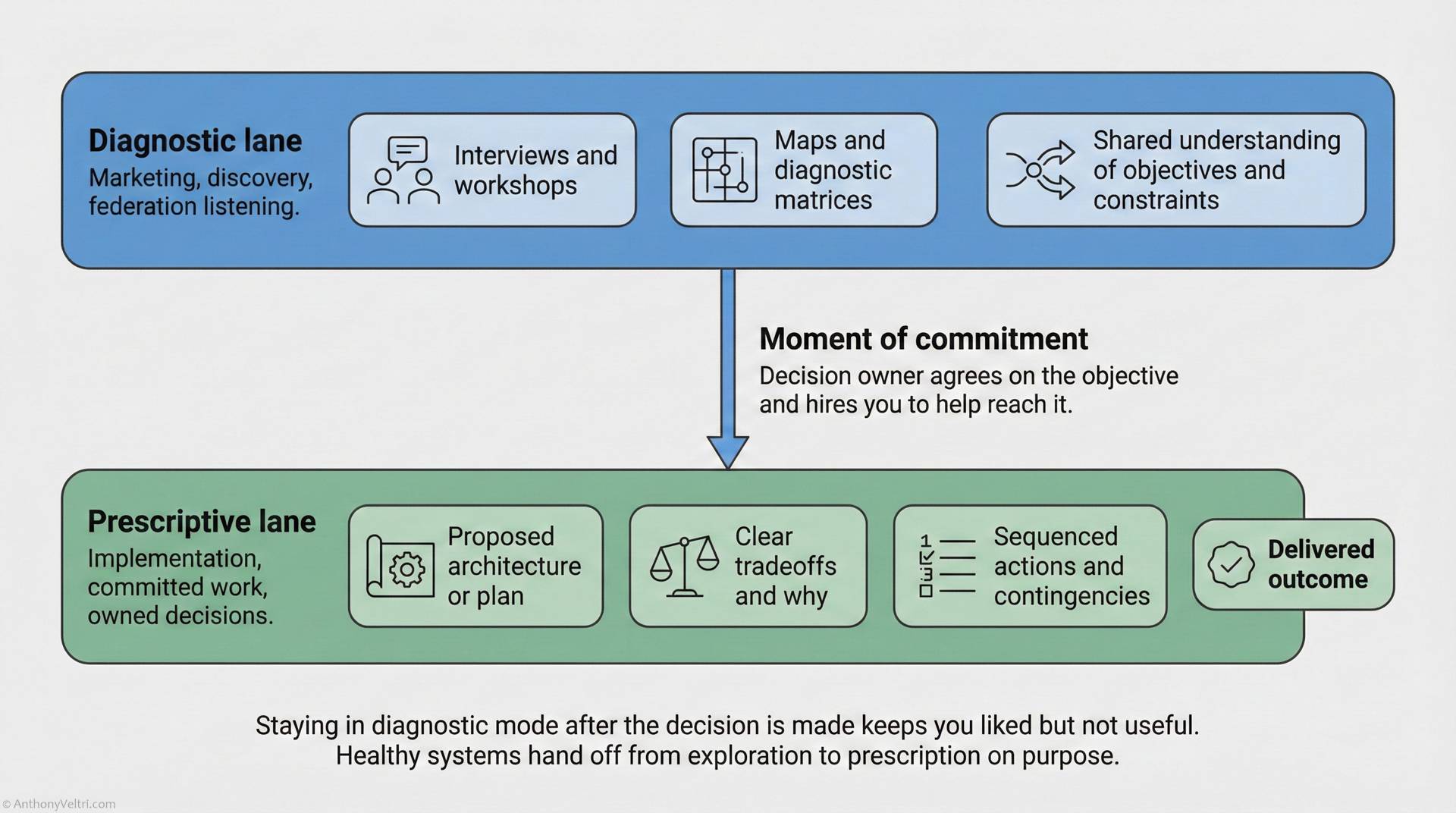
A flowchart compares the diagnostic lane (research, interviews, mapping, and sharing constraints) to the prescriptive lane (proposed plans, tradeoffs, actions, and outcomes); a commitment point links the two.
The Commitment Shift. Moving from “Diagnostic” (Finding alignment) to “Prescriptive” (Action) requires a “Moment of Commitment.” You cannot mandate this moment; you must earn it.

A team once struggled with:

  • slow approvals
  • constant friction
  • fear of being wrong
  • chronic escalation

We reset three things:

  • intent
  • boundaries
  • authority limits

Within days:

  • decisions accelerated
  • meetings reduced
  • people stopped waiting
  • trust increased
  • rework dropped

Nothing else changed.
The team went from compliance to commitment.

The difference was night and day.


System Example: iCAV’s best operators were commitment-driven #

iCAV worked because operators were:

  • committed to truth
  • committed to tempo
  • committed to clarity
  • committed to mission outcomes

They were not simply compliant with:

  • ingestion checklists
  • update ceremonies
  • release cycles

Their commitment compensated for upstream degradation and partner drift.

This human commitment, paired with architectural design, is what made the system effective.

Architecture supports commitment.
Compliance alone cannot.


Architect Level Principle #

As an architect I design environments where commitment is safe and rewarded.
Compliance prevents the wrong thing.
Commitment advances the right thing.
High trust and high tempo require commitment.


Twenty-Second Takeaway: #

“Compliance keeps people from doing the wrong thing. Commitment drives people to do the right thing. In high tempo environments, commitment is what preserves mission tempo. I design systems that make commitment safe and clear so teams can act without hesitation.”


Cross Links to Other Principles #

Commitment reinforces:

  • Clear intent
  • Distributed decisions
  • Decision drag
  • Architecture accelerates
  • Degraded operations
  • Federation
  • Useful interoperability
  • Emergent resilience
  • Preventive and contingent design

Commitment is the cultural layer that makes the architecture come alive.


Doctrine Diagnostic – For Reflection: #

Ask yourself:

Are your teams acting because they are afraid to be wrong, or because they are committed to being useful?

Only one of those produces real outcomes.

Build commitment.
Use compliance only as a boundary.

Field notes and examples #

  • Field Note: The Gift of Weaponized Compliance
  • The Loudest Listener: When Interviews Become Something Else
  • Model vs. Terrain: Bridging the Interface Void on the Merritt Parkway
  • Field Note: Defining “Operator”
  • Sphere and Spikes: Building What You Need Without Becoming a Specialist
  • Field Note: Rapid Goal Setting For Cross Functional Teams
  • Guarding the Room: A Hubbard Brook Story About Science and Funding
  • You Remember My Values, But Not Yours
  • Hoover Dam Lessons: “Proudly Maintained By Mike E.”
  • Bay St. Louis: Trust Before Logos After Hurricane Katrina

Last Updated on December 12, 2025

Related Posts #

ANNEX F Pattern Library" text over a background of interconnected geometric lines, circles, and digital patterns resembling a circuit or network schematic.

ANNEX F. Pattern Library #

This slide illustrates the principle that loop closure is structural, as highlighted by the modern, technical design elements.

Doctrine 23: Loop Closure as Load-Bearing System Infrastructure #

Two men in hard hats and safety gear stand outdoors at a work site, one writing on a yellow notepad while the other looks on. Equipment, a trailer, and several people are visible in the background.

Commitment Over Compliance: How Technical Teams Actually Deliver #

This slide illustrates the relationships among claims, roles, and entitlements in Microsoft 365, as presented in Doctrine 21.

Doctrine 21 Companion: Claims, Roles, and Entitlements in Microsoft 365 #

Zero Trust: Beyond PKI

Doctrine 21: Zero Trust Is A Trust Model, Not A Card "Type" #

Abstract graphic with geometric shapes, lines, and dots in neutral and orange tones. A large dark rectangle overlays the left side with the white text:

Doctrine 24: Stewardship Places the Burden on the Steward, Not the Parties #

decision-tempo, leadership, resilience
Table of Contents
  • Why teams built on commitment move faster, adapt better, and deliver more value than teams built on rule following
  • Compliance prevents the wrong thing. Commitment drives the right thing.
  • Lived Example: The analyst who moved the mission forward while others debated
  • Business Terms: Compliance is about permission. Commitment is about purpose.
  • System Terms: Compliance constrains, commitment harmonizes
  • Why Compliance Is Necessary but Not Sufficient
    • Business perspective
    • System perspective
  • Why Commitment Outperforms Compliance in Mission Systems
    • Business perspective
    • System perspective
  • Why Commitment Is Safer Than Compliance in High-Consequence Work
  • The Commitment Contract (This Model Applies Across All Doctrine)
    • 1. Shared intent
    • 2. Clear boundaries
    • 3. Trust in autonomy
  • Business Example: The team that transformed once intent was clarified
  • System Example: iCAV’s best operators were commitment-driven
  • Architect Level Principle
  • Twenty-Second Takeaway:
  • Cross Links to Other Principles
  • Doctrine Diagnostic - For Reflection:

Share This Article :

  • Facebook
  • X
  • LinkedIn
  • Pinterest

Was it helpful ?

  • Happy
  • Normal
  • Sad
  • Privacy Policy
  • Introductions
  • Contact

© 2026 Anthony Veltri

  • Doctrine
    • Doctrine Library
    • Global Library
  • Field Notes
  • Routes
    • Route 01: When the Interface Is Breaking (and you are becoming the patch)
    • ROUTE 02: If decisions stall and meetings go nowhere, start here
    • ROUTE 03: If you have lots of projects but no portfolio clarity, start here
    • ROUTE 04: If you’re confused about federation vs integration, start here
    • ROUTE 05: If heroics are propping up your system, start here
    • ROUTE 06: If you cannot force compliance across partners, start here
    • ROUTE 07: If compliance exists but commitment does not, start here
    • ROUTE 08: If disconnected workflows create audit anxiety, start here
  • Figure Library
  • FAQ
  • About
    • Capability Statement
    • Interpreter Kit
  • Contact