Skip to content

Introduced by a trusted connector?

Start Here

Anthony Veltri

  • Doctrine
    • Doctrine Library
    • Global Library
  • Field Notes
  • Routes
    • Route 01: When the Interface Is Breaking (and you are becoming the patch)
    • ROUTE 02: If decisions stall and meetings go nowhere, start here
    • ROUTE 03: If you have lots of projects but no portfolio clarity, start here
    • ROUTE 04: If you’re confused about federation vs integration, start here
    • ROUTE 05: If heroics are propping up your system, start here
    • ROUTE 06: If you cannot force compliance across partners, start here
    • ROUTE 07: If compliance exists but commitment does not, start here
    • ROUTE 08: If disconnected workflows create audit anxiety, start here
  • Figure Library
  • FAQ
  • About
    • Capability Statement
    • Interpreter Kit
  • Contact
Anthony Veltri

Architecture & Interfaces

15
  • Doctrine 01: Federation vs Integration in Mission Networks
  • Doctrine 03: Interfaces Are Where Systems Break, So They Require Stewards, Contracts, and Ownership
  • Doctrine 04: Useful Interoperability Is the Goal, Not Perfect Interoperability
  • Doctrine 05: Innovation Must Live at the Edge, Not in the Center
  • Doctrine 06: A Two-Lane System Protects Stability and Enables Evolution
  • Doctrine 14: Technical Debt Is a Leadership Signal, Not a Coding Failure
  • Doctrine 15: Architecture Must Accelerate Teams, Not Bottleneck Them
  • Doctrine 17: Architects Translate Strategy Into Engineering and Engineering Into Strategy
  • Doctrine 20: Golden Datasets: Putting Truth In One Place Without Pretending Everything Is Perfect
  • Doctrine 21: Zero Trust Is A Trust Model, Not A Card “Type”
  • Doctrine 23: Loop Closure as Load-Bearing System Infrastructure
  • ANNEX B. Data Contracts
  • ANNEX C. Interface Ownership Model
  • ANNEX H. Architecture Doctrine
  • Annex L: The Rosetta Stone for Data Teams: Bridging the Gap Between Technicians and Executives

Decision Tempo & Governance

10
  • Doctrine 02: Distributed Decisions Increase Alignment, Speed, and Resilience
  • Doctrine 07: Clear Intent Matters More Than Perfect Data
  • Doctrine 08: Clear Intent Compresses Ambiguity, Reduces Conflict, and Accelerates Action
  • Doctrine 09: Decision Drag Is the Enemy of Mission Tempo. Architecture Is the Remedy
  • Doctrine 10: Degraded Operations Are the Normal Mode, Not the Exception
  • Doctrine 11: Preventive Action and Contingent Action Must Both Be Designed Intentionally
  • Doctrine 22: When “It Depends” Is the Right Answer: How to Think in Probabilities Under Uncertainty
  • ANNEX D. Decision Altitudes Model
  • ANNEX E. Prevention–Contingency Matrix
  • ANNEX I. High Visibility Workflows

Portfolio & Alignment

4
  • Doctrine 16: Portfolio Thinking Ensures Effort Aligns With What Actually Matters
  • ANNEX F. Pattern Library
  • ANNEX J. System Evolution and Drift Management
  • ANNEX K. System and Workflow Profiles (Case Studies)

Leadership & Human Systems

6
  • Doctrine 24: Stewardship Places the Burden on the Steward, Not the Parties
  • Doctrine 18: Commitment Outperforms Compliance in High Trust, High Tempo Environments
  • Doctrine 19: Supervision, Management, and Leadership Are Three Different Jobs. Confusing Them Breaks Systems
  • Doctrine 23: Loop Closure as Load-Bearing System Infrastructure
  • ANNEX A. Human Contracts
  • ANNEX G. Leadership Doctrine

Resilience & Operations

3
  • Doctrine 24: Stewardship Places the Burden on the Steward, Not the Parties
  • Doctrine 12: Resilience Is an Emergent Property, Not a Feature
  • Doctrine 13: Problem Solving Requires Finding the Real Deviation and the Relevant Change

Doctrine Companions

7
  • Doctrine 03 Companion: The RS-CAT Framework: Converting Raw Recall into Teachable Principle
  • Doctrine 03 Companion: The Interface Void
  • Doctrine 11 Companion: Agency vs. Outcome
  • Doctrine 09 Companion: Artifacts Over Adjectives
  • Doctrine 03 Companion: Constraints: bidirectional translation: Compression vs Construction
  • Doctrine 10 Companion: Span of Control and Cross Training Are Load-Bearing Constraints
  • Doctrine 21 Companion: Claims, Roles, and Entitlements in Microsoft 365

Field Reports

1
  • Field Report: College Financing and the 5-Year Home Runway
View Categories
  • Home
  • Doctrine & Supporting Guides
  • Decision Tempo & Governance
  • Doctrine 10: Degraded Operations Are the Normal Mode, Not the Exception

Doctrine 10: Degraded Operations Are the Normal Mode, Not the Exception

Anthony Veltri
Updated on December 12, 2025

4 min read

Why systems must perform under partial failure, partial truth, and partial coordination #

The goal here is to visualize that “Degraded” does not mean “Broken. ” It means “Operating in a different mode.”

This page is a Doctrine Guide. It shows how to apply one principle from the Doctrine in real systems and real constraints. Use it as a reference when you are making decisions, designing workflows, or repairing things that broke under pressure.


The world almost never behaves at full fidelity. Your system should not require it. #
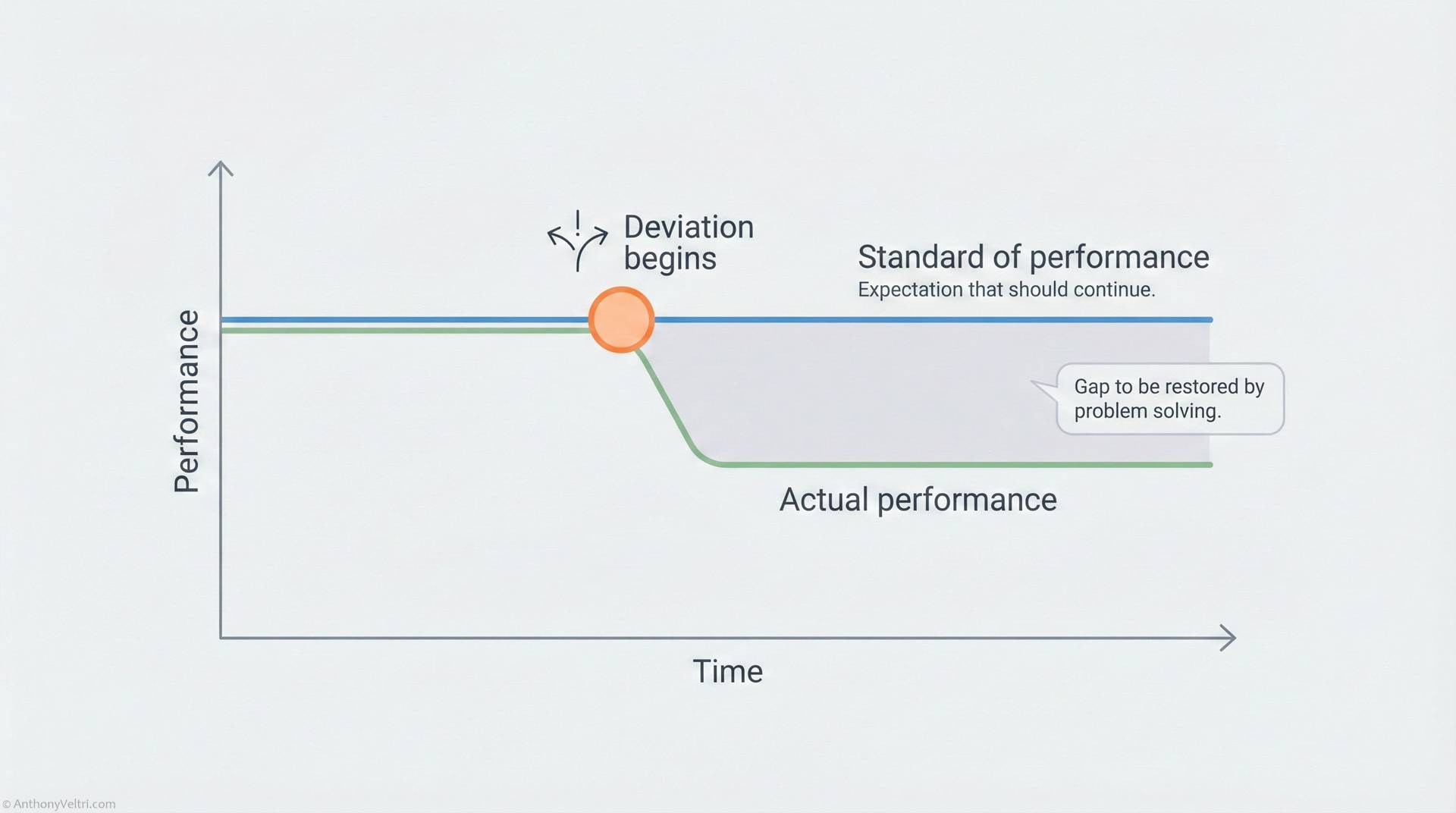
A line graph shows performance over time. At one point, actual performance drops below the standard of performance, creating a gap labeled "Gap to be restored by problem solving.
The Reality Gap. Most systems are designed for the blue line (Standard/Perfect). Real operations live on the green line (Actual/Degraded). If your system breaks the moment it deviates from the blue line, it is fragile.

Most organizations design systems for:

  • stable networks
  • synchronized updates
  • full data availability
  • clean inputs
  • predictable partners
  • ideal staffing
  • smooth approvals

But real mission environments are:

  • noisy
  • partial
  • delayed
  • uneven
  • unpredictable
  • degraded

If your system only works when everything else is perfect, your system does not work.


Lived Example: The activation where every feed degraded at once #

During a severe weather activation, we saw:

  • a major partner’s feed lag by six hours
  • another partner’s service drop intermittently
  • timestamps that drifted
  • mismatched projections
  • incomplete geometry
  • a field team unable to upload updates
  • authentication tokens expiring mid cycle
  • regional latency spikes that broke retries
  • satellite imagery delayed due to cloud cover

If the system required all feeds to be current and aligned, the operational picture would have gone dark.

Instead, because we had designed for degradation:

  • stale layers still displayed with markers
  • cached layers filled temporary gaps
  • partial updates merged cleanly
  • fallback modes activated
  • analysts worked with partial truth instead of no truth
  • decision makers never lost situational awareness

Degradation is not a failure.
Degradation is the environment.


Business Terms: Why degraded operations matter #

Degraded operations are the normal mode because:

  • partners do not update at the same speed
  • resources are uneven
  • networks degrade under load
  • crises disrupt normal behavior
  • authorities shift
  • priorities collide
  • information lags behind reality

If teams must wait for perfect inputs:

  • operations stall
  • decisions drift
  • rework skyrockets
  • coordination collapses
  • confidence erodes

Your system must provide useful truth, not perfect truth, under pressure.


System Terms: What degraded operation actually means #
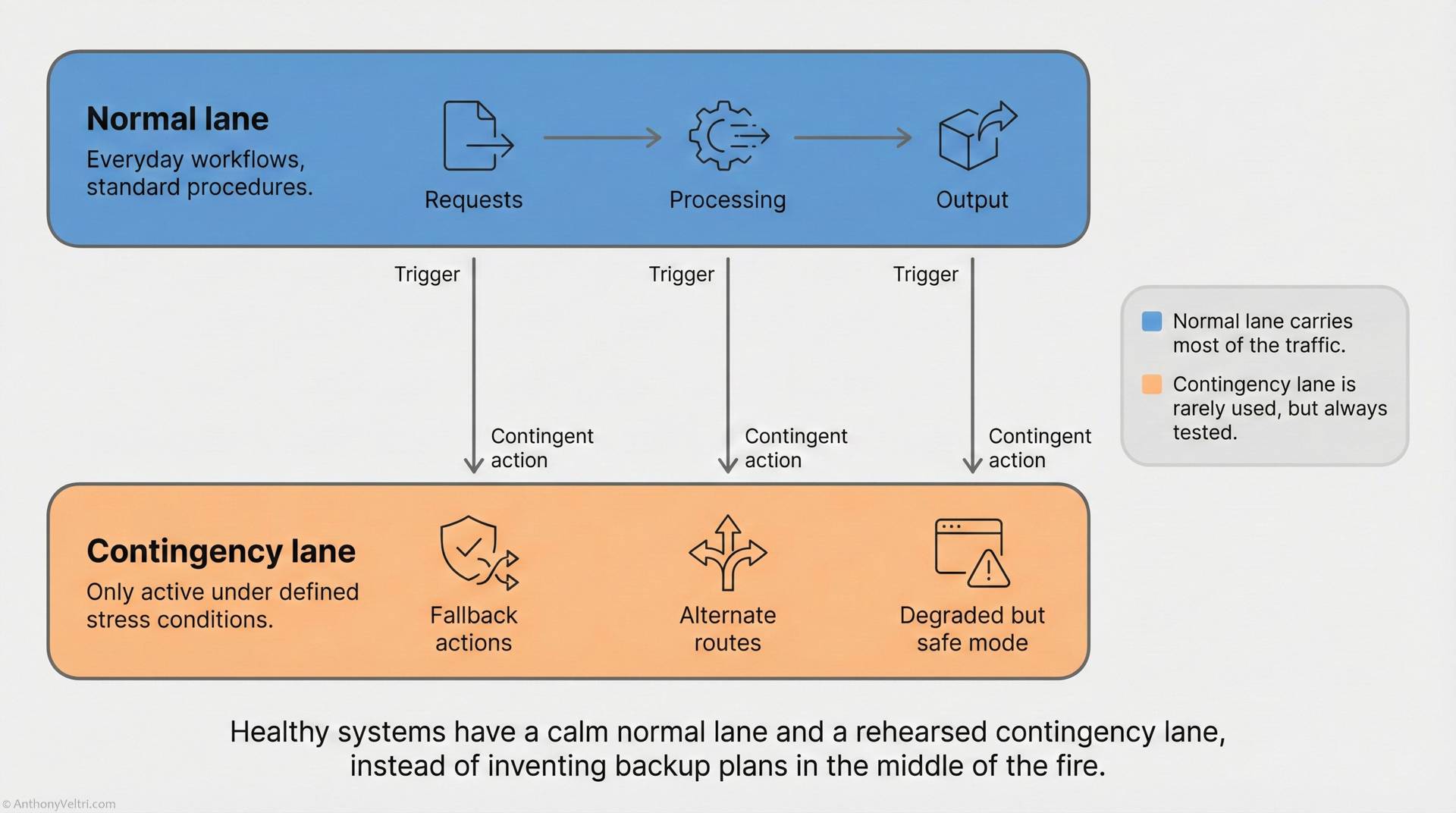
A diagram showing a "Normal lane" for routine workflows with requests, processing, and output, and a "Contingency lane" for stress conditions with fallback actions, alternate routes, and degraded mode.
Degraded Mode is a Lane, Not a Crash. A healthy architecture has a specific “Contingency Lane” (Orange) designed for when the “Normal Lane” (Blue) is blocked. Triggers move you between them safely.

A degraded operations architecture expects:

  • stale data
  • partial data
  • inconsistent data
  • asynchronous data
  • missing attributes
  • variable projections
  • unpredictable partner behavior
  • partial connectivity
  • high latency
  • resource exhaustion

So it includes:

  • caching
  • confidence scoring
  • fallback behavior
  • tolerant parsing
  • schema mapping
  • partial rendering
  • asynchronous ingest
  • retry backoff
  • minimum viable publication rules

A degraded mode system is one that:

  • does not require uniformity
  • does not collapse when inputs drift
  • does not crash when partners lag
  • does not block when upstream is unavailable
  • does not hide information when confidence is low

It presents something, not nothing.


Why Systems Fail When They Expect Perfection #
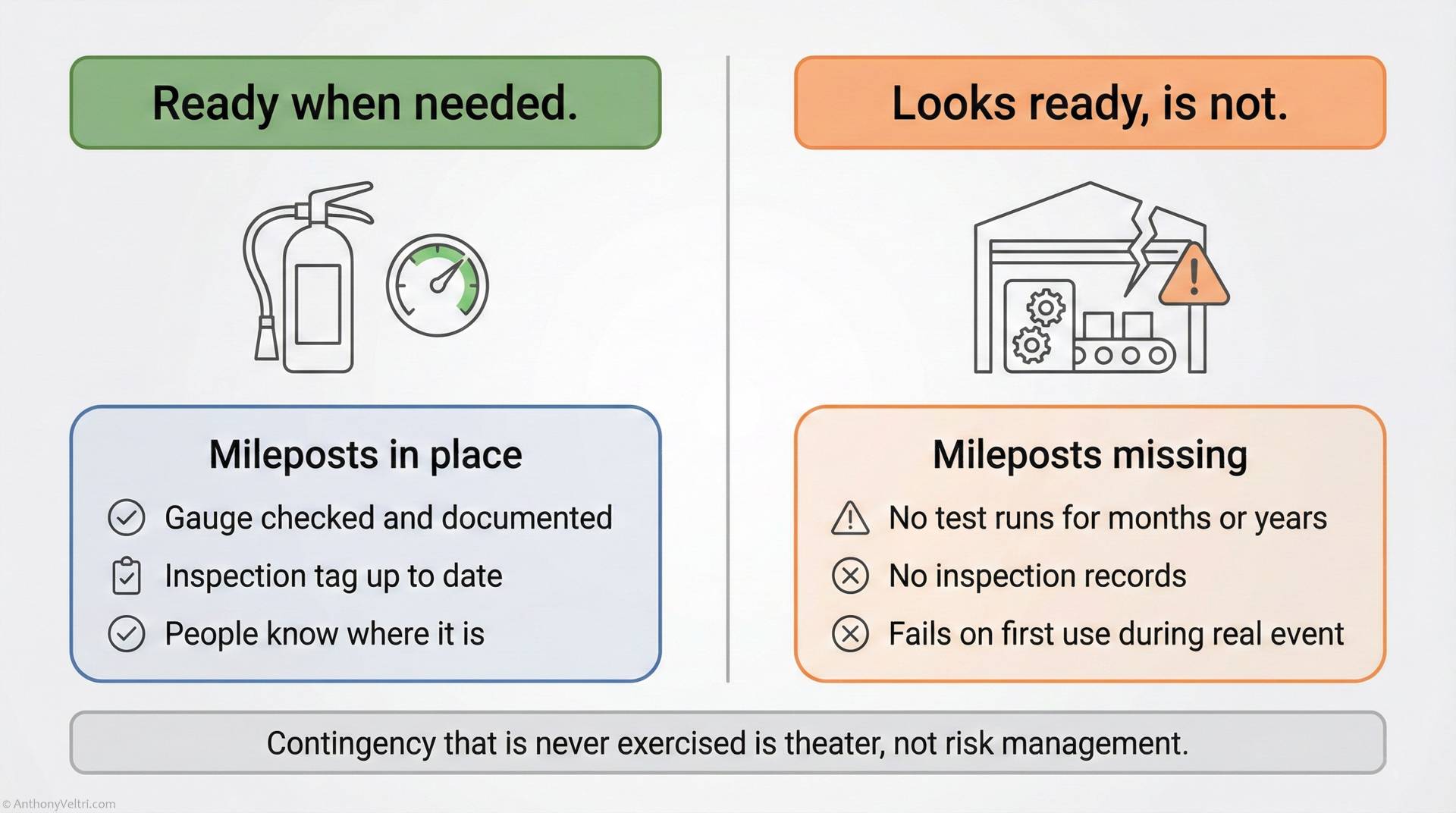
A comparison chart shows “Ready when needed” with checked fire extinguisher versus “Looks ready, is not” with a broken extinguisher box. It highlights the importance of regular checks and documentation for emergency readiness.
The Perfection Trap. Designing for perfect data is “Theater” (The Binder). Designing for degraded data is “Reality” (The Extinguisher).

Business perspective #

Systems fail because leaders assume:

  • partners will update reliably
  • information will be fresh
  • resources will be available
  • staffing will be stable
  • everyone will follow the plan
  • outages are rare
  • coordination will be tight

These assumptions hold during tabletop exercises.
They collapse during real missions.

When a system assumes perfection, a single degradation becomes a full stop.

System perspective #

Systems fail technically because:

  • synchronization requires stable conditions
  • version locks break under drift
  • strict ingest breaks on malformed data
  • no fallback exists
  • error states cascade
  • tight coupling amplifies small failures
  • central nodes become overload points

A perfect mode system fails under almost any real world disruption.


Why Degraded Mode Is a Strategic Advantage #

Business perspective #

A degraded capable system:

  • preserves mission tempo
  • supports better decisions
  • handles partner diversity
  • lowers anxiety in the chain
  • increases trust
  • prevents escalation
  • reduces workload during crises
  • keeps stakeholders aligned

Leaders remain operational even when truth is partial.

System perspective #

A degraded capable system:

  • maintains partial functionality
  • isolates failures
  • prioritizes critical pathways
  • provides graceful fallback
  • preserves the last known good state
  • conveys uncertainty without collapsing
  • treats degradation as data, not error

Resilience emerges naturally when degradation is expected, not feared.


Business Example: The “minimum viable picture” that saved three hours #
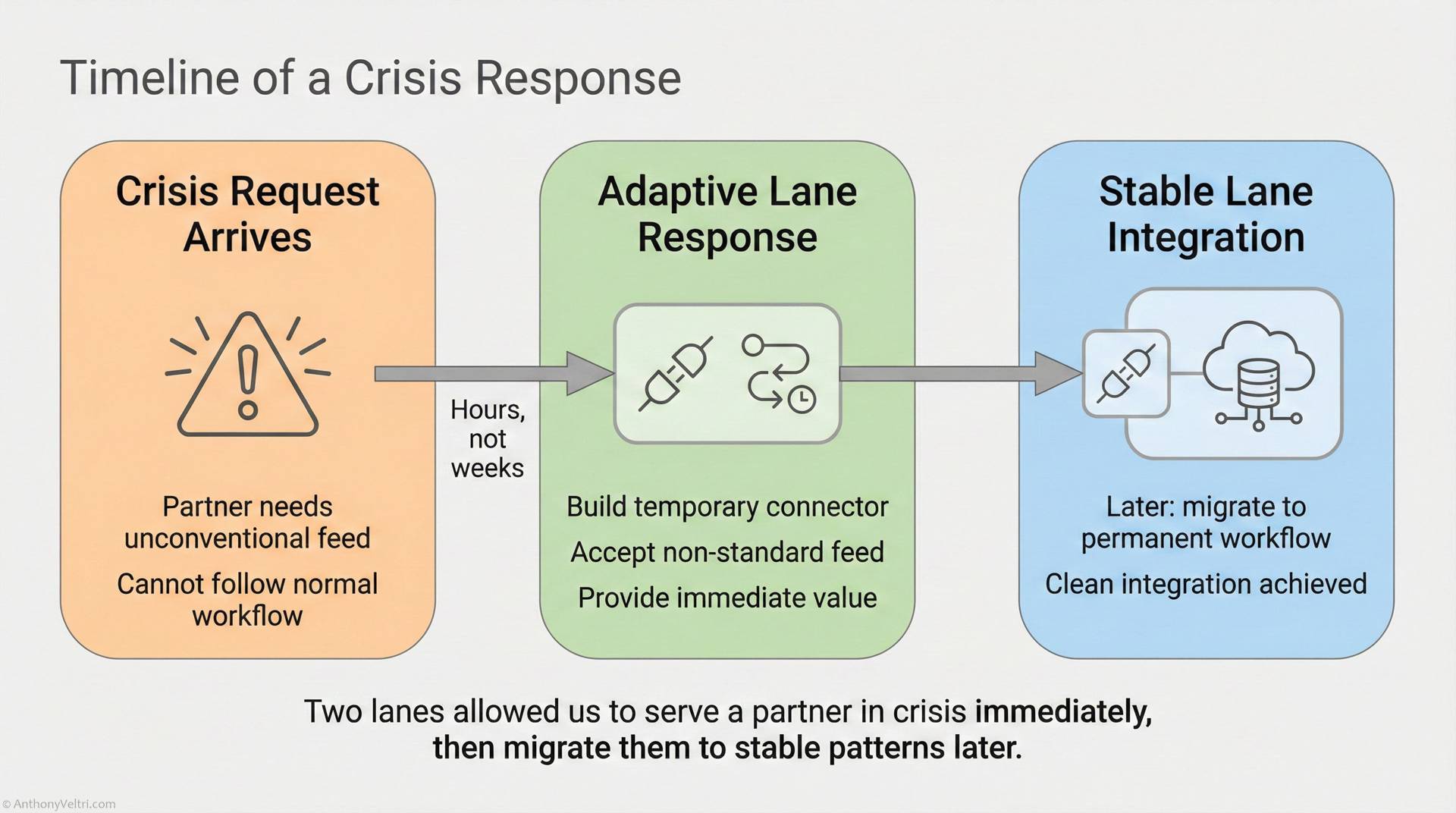
Timeline showing three stages: Crisis Request Arrives, Adaptive Lane Response, and Stable Lane Integration, connected by arrows. Each stage lists key actions for responding to and resolving a crisis request.
Crisis Request –> Adaptive Response (Hours) –> Stable Integration (Later). What is the minimum viable picture? Intent Fills the Gap. When the stable data feed fails, intent allows the team to shift instantly to an adaptive response (manual coordination, radio, local maps) without freezing.

During a flood response, a key partner feed dropped completely.

Leadership asked for status.

Instead of replying “we are waiting for the feed,” we produced:

  • cached layers
  • partial overlays
  • estimated extents
  • human-reported updates
  • annotated gaps
  • confidence indicators

This minimum viable picture enabled:

  • emergency routing
  • evacuation adjustments
  • logistics realignment

Three hours of mission tempo were preserved.
Waiting for perfect data would have cost valuable time.


System Example: iCAV’s degraded mode saved decision makers repeatedly #

In iCAV:

  • stale layers were highlighted, not removed
  • partial geometry still rendered
  • absent attributes were tolerated
  • outdated feeds were cached
  • asynchronous partners were accepted
  • multi day lags were annotated
  • missing updates did not break the viewer

The system handled true conditions.
Not the conditions leadership wished existed.

This kept the mission picture alive even when upstream sources degraded.
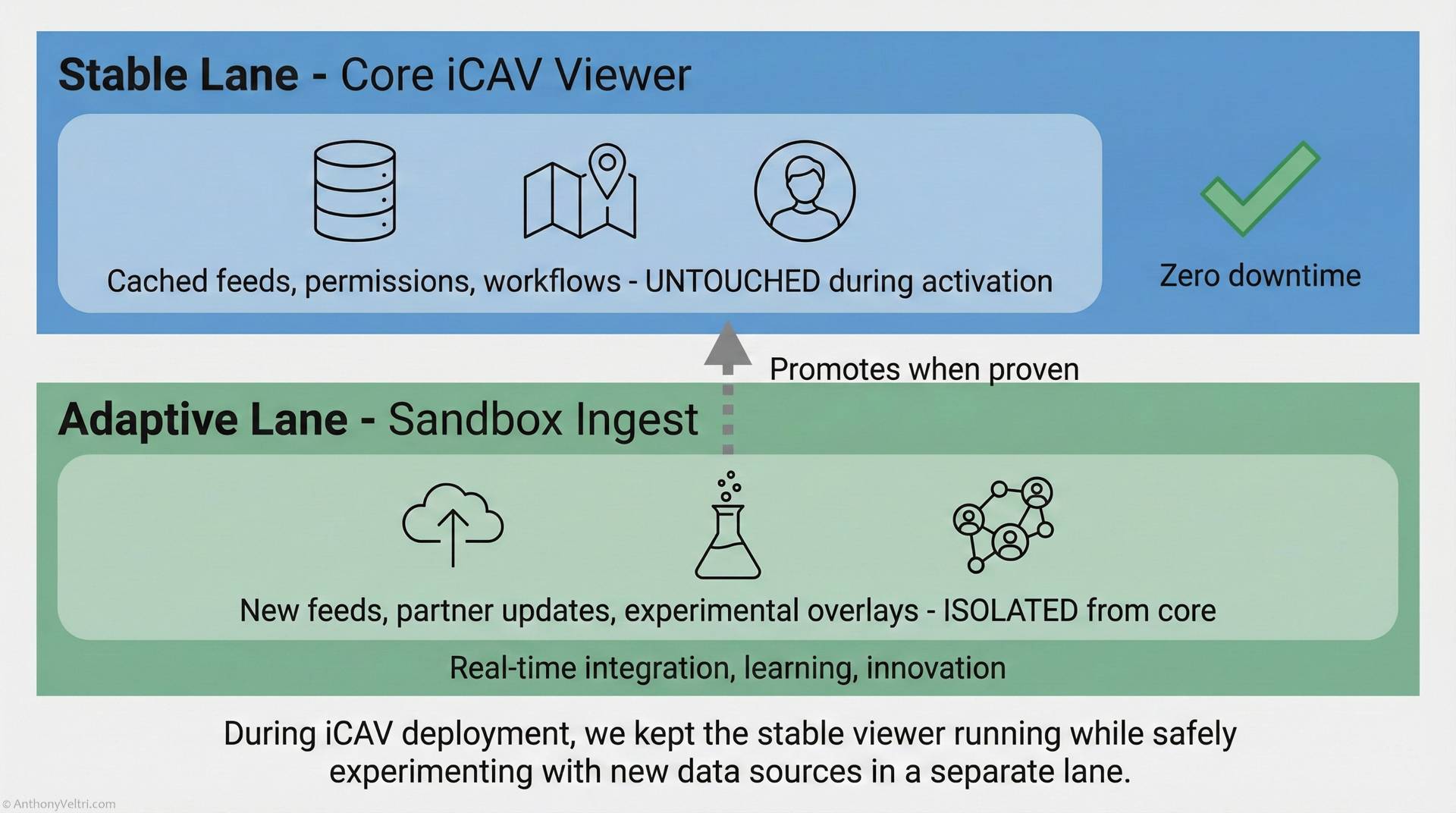
Diagram showing two lanes: "Stable Lane – Core iCAV Viewer" (blue, represents zero downtime and untouched activation) above "Adaptive Lane – Sandbox Ingest" (green, for new feeds and real-time innovation), with a promotion arrow between them.
We kept the core viewer stable (Blue) while letting the field experiment with new data in the sandbox (Green). Successful experiments were promoted; failures were discarded without breaking the mission. This is an example of Resilience in Practice. We separated the Stable Lane (Viewer) from the Adaptive Lane (Ingest). When the ingest broke, the viewer stayed up. That is emergent resilience.

Architect Level Principle #

As an architect, I build systems that operate under partial truth, partial failure, and partial connectivity.
Degraded operations are not the exception.
They are the environment.


Twenty Second Takeaway #

“Mission environments do not operate at full fidelity. Networks fail. Partners lag. Data comes in late or incomplete. I design systems for degraded operations so that decision makers always have a useful picture, even when conditions are imperfect.”


Cross Links to Other Principles #

Degraded operations are foundational to:

  • Useful interoperability
  • Federation
  • Emergent resilience
  • Two lane systems
  • Architecture accelerates
  • Distributed decisions
  • Interfaces and ownership
  • Decision drag
  • Preventive and contingent action

This principle is one of the structural pillars of your doctrine.


Doctrine Diagnostic – For Reflection: #

Ask yourself:

Does your system require ideal conditions to function?

If so, it will fail.
Not maybe.
Not sometimes.
It will fail.

Design for degraded operations now, while you still have time.

Field notes and examples #

  • Why This Site Has Four Navigation Systems
  • Stranded in Vienna, Responsible in Kyiv
  • When You Choose Integration over Federation On Purpose

Last Updated on December 12, 2025

Related Posts #

This slide illustrates the principle that loop closure is structural, as highlighted by the modern, technical design elements.

Doctrine 23: Loop Closure as Load-Bearing System Infrastructure #

A graphic with abstract blue and black data and circuit patterns, overlaid with a dark rectangle containing the text

Annex L: The Rosetta Stone for Data Teams: Bridging the Gap Between Technicians and Executives #

ANNEX F Pattern Library" text over a background of interconnected geometric lines, circles, and digital patterns resembling a circuit or network schematic.

ANNEX F. Pattern Library #

This diagram illustrates increasing salary capacities, with larger houses on higher blocks representing $6k, $24k (median), and $80k per year.

Field Report: College Financing and the 5-Year Home Runway #

A graphic with abstract circuit-like patterns and geometric shapes. Large text reads

ANNEX H. Architecture Doctrine #

A graphic with the title

ANNEX K. System and Workflow Profiles (Case Studies) #

architecture, decision-tempo, degraded-ops, resilience

Related Docs

  • Doctrine 10 Companion: Span of Control and Cross Training Are Load-Bearing Constraints
Table of Contents
  • Why systems must perform under partial failure, partial truth, and partial coordination
  • The world almost never behaves at full fidelity. Your system should not require it.
  • Lived Example: The activation where every feed degraded at once
  • Business Terms: Why degraded operations matter
  • System Terms: What degraded operation actually means
  • Why Systems Fail When They Expect Perfection
    • Business perspective
    • System perspective
  • Why Degraded Mode Is a Strategic Advantage
    • Business perspective
    • System perspective
  • Business Example: The “minimum viable picture” that saved three hours
  • System Example: iCAV’s degraded mode saved decision makers repeatedly
  • Architect Level Principle
  • Twenty Second Takeaway
  • Cross Links to Other Principles
  • Doctrine Diagnostic - For Reflection:

Share This Article :

  • Facebook
  • X
  • LinkedIn
  • Pinterest

Was it helpful ?

  • Happy
  • Normal
  • Sad
  • Privacy Policy
  • Introductions
  • Contact

© 2026 Anthony Veltri

  • Doctrine
    • Doctrine Library
    • Global Library
  • Field Notes
  • Routes
    • Route 01: When the Interface Is Breaking (and you are becoming the patch)
    • ROUTE 02: If decisions stall and meetings go nowhere, start here
    • ROUTE 03: If you have lots of projects but no portfolio clarity, start here
    • ROUTE 04: If you’re confused about federation vs integration, start here
    • ROUTE 05: If heroics are propping up your system, start here
    • ROUTE 06: If you cannot force compliance across partners, start here
    • ROUTE 07: If compliance exists but commitment does not, start here
    • ROUTE 08: If disconnected workflows create audit anxiety, start here
  • Figure Library
  • FAQ
  • About
    • Capability Statement
    • Interpreter Kit
  • Contact