Skip to content

Introduced by a trusted connector?

Start Here

Anthony Veltri

  • Doctrine
    • Doctrine Library
    • Global Library
  • Field Notes
  • Routes
    • Route 01: When the Interface Is Breaking (and you are becoming the patch)
    • ROUTE 02: If decisions stall and meetings go nowhere, start here
    • ROUTE 03: If you have lots of projects but no portfolio clarity, start here
    • ROUTE 04: If you’re confused about federation vs integration, start here
    • ROUTE 05: If heroics are propping up your system, start here
    • ROUTE 06: If you cannot force compliance across partners, start here
    • ROUTE 07: If compliance exists but commitment does not, start here
    • ROUTE 08: If disconnected workflows create audit anxiety, start here
  • Figure Library
  • FAQ
  • About
    • Capability Statement
    • Interpreter Kit
  • Contact
Anthony Veltri

Architecture & Interfaces

15
  • Doctrine 01: Federation vs Integration in Mission Networks
  • Doctrine 03: Interfaces Are Where Systems Break, So They Require Stewards, Contracts, and Ownership
  • Doctrine 04: Useful Interoperability Is the Goal, Not Perfect Interoperability
  • Doctrine 05: Innovation Must Live at the Edge, Not in the Center
  • Doctrine 06: A Two-Lane System Protects Stability and Enables Evolution
  • Doctrine 14: Technical Debt Is a Leadership Signal, Not a Coding Failure
  • Doctrine 15: Architecture Must Accelerate Teams, Not Bottleneck Them
  • Doctrine 17: Architects Translate Strategy Into Engineering and Engineering Into Strategy
  • Doctrine 20: Golden Datasets: Putting Truth In One Place Without Pretending Everything Is Perfect
  • Doctrine 21: Zero Trust Is A Trust Model, Not A Card “Type”
  • Doctrine 23: Loop Closure as Load-Bearing System Infrastructure
  • ANNEX B. Data Contracts
  • ANNEX C. Interface Ownership Model
  • ANNEX H. Architecture Doctrine
  • Annex L: The Rosetta Stone for Data Teams: Bridging the Gap Between Technicians and Executives

Decision Tempo & Governance

10
  • Doctrine 02: Distributed Decisions Increase Alignment, Speed, and Resilience
  • Doctrine 07: Clear Intent Matters More Than Perfect Data
  • Doctrine 08: Clear Intent Compresses Ambiguity, Reduces Conflict, and Accelerates Action
  • Doctrine 09: Decision Drag Is the Enemy of Mission Tempo. Architecture Is the Remedy
  • Doctrine 10: Degraded Operations Are the Normal Mode, Not the Exception
  • Doctrine 11: Preventive Action and Contingent Action Must Both Be Designed Intentionally
  • Doctrine 22: When “It Depends” Is the Right Answer: How to Think in Probabilities Under Uncertainty
  • ANNEX D. Decision Altitudes Model
  • ANNEX E. Prevention–Contingency Matrix
  • ANNEX I. High Visibility Workflows

Portfolio & Alignment

4
  • Doctrine 16: Portfolio Thinking Ensures Effort Aligns With What Actually Matters
  • ANNEX F. Pattern Library
  • ANNEX J. System Evolution and Drift Management
  • ANNEX K. System and Workflow Profiles (Case Studies)

Leadership & Human Systems

6
  • Doctrine 24: Stewardship Places the Burden on the Steward, Not the Parties
  • Doctrine 18: Commitment Outperforms Compliance in High Trust, High Tempo Environments
  • Doctrine 19: Supervision, Management, and Leadership Are Three Different Jobs. Confusing Them Breaks Systems
  • Doctrine 23: Loop Closure as Load-Bearing System Infrastructure
  • ANNEX A. Human Contracts
  • ANNEX G. Leadership Doctrine

Resilience & Operations

3
  • Doctrine 24: Stewardship Places the Burden on the Steward, Not the Parties
  • Doctrine 12: Resilience Is an Emergent Property, Not a Feature
  • Doctrine 13: Problem Solving Requires Finding the Real Deviation and the Relevant Change

Doctrine Companions

7
  • Doctrine 03 Companion: The RS-CAT Framework: Converting Raw Recall into Teachable Principle
  • Doctrine 03 Companion: The Interface Void
  • Doctrine 11 Companion: Agency vs. Outcome
  • Doctrine 09 Companion: Artifacts Over Adjectives
  • Doctrine 03 Companion: Constraints: bidirectional translation: Compression vs Construction
  • Doctrine 10 Companion: Span of Control and Cross Training Are Load-Bearing Constraints
  • Doctrine 21 Companion: Claims, Roles, and Entitlements in Microsoft 365

Field Reports

1
  • Field Report: College Financing and the 5-Year Home Runway
View Categories
  • Home
  • Doctrine & Supporting Guides
  • Architecture & Interfaces
  • Doctrine 21: Zero Trust Is A Trust Model, Not A Card “Type”

Doctrine 21: Zero Trust Is A Trust Model, Not A Card “Type”

Anthony Veltri
Updated on December 15, 2025

6 min read

Doctrine Claim:
PKI proves who you are. Zero trust constantly questions what you should be allowed to do. It allocates risk explicitly through policy, context, and least privilege.

This page is a Doctrine Guide. It shows how to apply one principle from the Doctrine in real systems and real constraints. Use it as a reference when you are making decisions, designing workflows, or repairing things that broke under pressure.


Core statement #

Zero trust is not a new card, new VPN, or new identity technology.
It is a trust model that assumes you are already breached and forces every access decision to earn its way through policy, context, and least privilege.

CAC, PIV, and LinkPass cards are strong identity tokens inside that model.
They are not the model itself.


Why this doctrine exists #

Most people in government and big enterprises still think:

  • “You have a CAC and you are on the internal network, so you are good.”

That is the old perimeter mindset.

This doctrine exists to:

  • Break the “inside = trusted” habit.
  • Stop people from confusing identity tech (cards, certs, MFA) with a trust model.
  • Anchor conversations on authorization, segmentation, and blast radius, not just login mechanics.

Framing upgrade: Zero trust is a risk allocation model, not a security product. It does not eliminate risk. It decides where risk lives (Identity owners, Devices, Applications, Data Stewards External Partners, etc), when trust must be re-evaluated, (At login only, continuously, etc), and what should happen when signals degrade (Graceful reduction of access, Forced re authentication, Isolation of the session, etc) . In practice, it forces leaders to make explicit tradeoffs between security, mission tempo, and operational continuity. If “zero trust” becomes random lockouts and operator pain, the problem is usually not the idea of zero trust. The problem is that risk was allocated poorly, or the policy was designed for a perfect world instead of real operations.

The pattern #
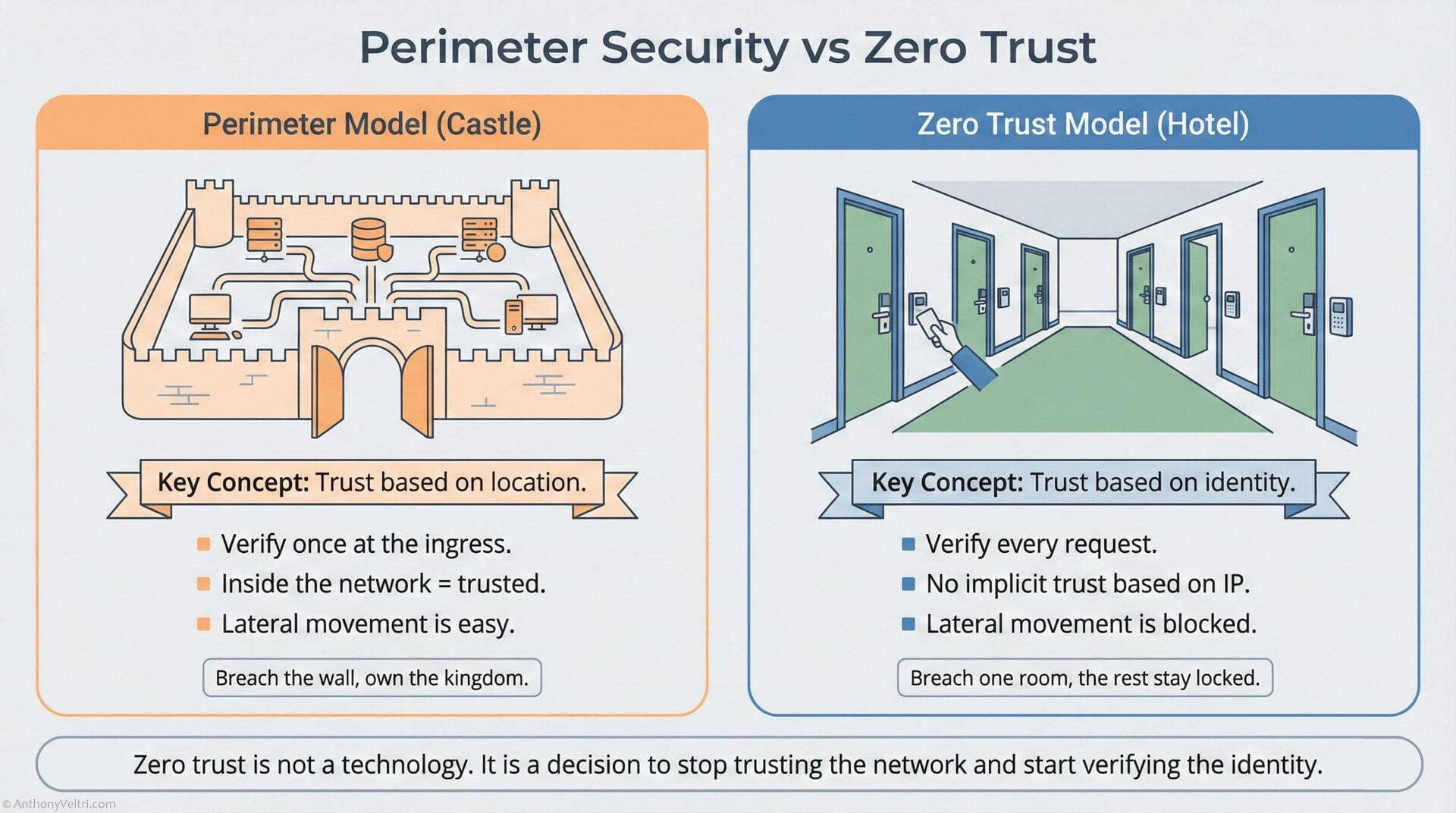
This diagram illustrates Perimeter Security as a castle and Zero Trust as hotel rooms, outlining core concepts and breach management.
The Security Shift: The Perimeter Model acts like a Castle: once you cross the moat, you are trusted. The Zero Trust Model acts like a Hotel: you need a key card for the front door, the elevator, and your specific room (and the fitness studio, and the pool). Identity replaces location.

Old model: Castle and moat #

Typical CAC/PKI era pattern:

  • Strong auth at the edge:
    • CAC / PIV authenticates the user.
  • Network perimeter as primary control:
    • VPNs, firewalls, “inside = trusted”.
  • Coarse authorization:
    • Big AD groups, large shared drives, “everyone in this org” access.
  • Breach is treated as:
    • Edge case.
    • Unlikely scenario.

Effect:

  • Once you are in, the system behaves as if you are safe.
  • Compromised credentials or an insider can move laterally with little resistance.

Zero trust model: Continuous skepticism #

Zero trust flips several defaults:

  • Never trust; always verify
    • Every request is treated as untrusted.
    • Internal traffic is not magically “trusted” because of location.
  • Identity plus device plus context
    • Not just “CAC valid”.
    • Also:
      • Device posture.
      • Location and time.
      • Behavioral pattern.
  • Least privilege everywhere
    • Fine-grained access tied to:
      • Role.
      • Task.
      • Data sensitivity.
      • Current risk level.
  • Assume breach
    • Design as if:
      • An account is already compromised.
      • A host is already infected.
      • An internal system is already leaking.
  • Contain the blast radius
    • Micro segmentation.
    • Per application and per dataset controls.
    • Strong logging and detection.

Effect:

  • CAC / PKI becomes one signal in a richer decision.
  • Compromise still hurts, but damage stays bounded.

Comparison: CAC-era use vs zero trust #

“We used to treat the CAC like a master key to the castle.
If you had it and you were on the right network, you were basically in.

Zero trust keeps the CAC, but it also puts a lock on every room, checks who you are and what you are carrying at each door, and assumes one of those rooms is already on fire.
The CAC is still important, it is just no longer the whole story.”

Old CAC / PKI use

  • CAC proves identity at login.
  • Inside the network, many resources are assumed safe to expose.
  • Network location is treated as a major trust signal.
  • Authorization is broad and role mapping is often fuzzy.
  • Breach is a “black swan” to be prevented, not assumed.

Zero trust use

  • CAC is one strong factor in each access decision.
  • Every resource is guarded individually, regardless of network location.
  • Network is treated as untrusted transport.
  • Authorization is precise, time bound, and regularly reviewed.
  • Breach is assumed and architecture is built to contain it.

How to use this doctrine in practice #

Use this doctrine to redirect conversations that get stuck at the “card and login” layer.

When you hear:

  • “We are zero trust because we use CAC, MFA, and TLS.”

You respond with:

  • “Those are important building blocks, but zero trust is the trust model they live inside. Show me how access to System X and Dataset Y is re-evaluated every time, even from internal networks.”

Concrete moves:

  1. Reframe identity tech as signals
    • CAC, certs, passwords, FIDO keys, device certs:
      • Treat them as inputs to policy, not as policy itself.
  2. Insist on per-resource policy
    • For any high value system, ask:
      • “Who can get in?”
      • “Under what conditions?”
      • “What can they see or change once inside?”
      • “What limits lateral movement if this account is compromised?”
  3. Inject “assume breach” into design reviews
    • When reviewing an architecture:
      • “If this account is hijacked, what can the attacker touch?”
      • “What stops them from pivoting to higher value systems?”
  4. Tie CAC / PKI into the model explicitly
    • “Yes, we will keep CAC for strong identity.”
    • “But we will stop treating it as a master key to the castle.”

Common failure modes #
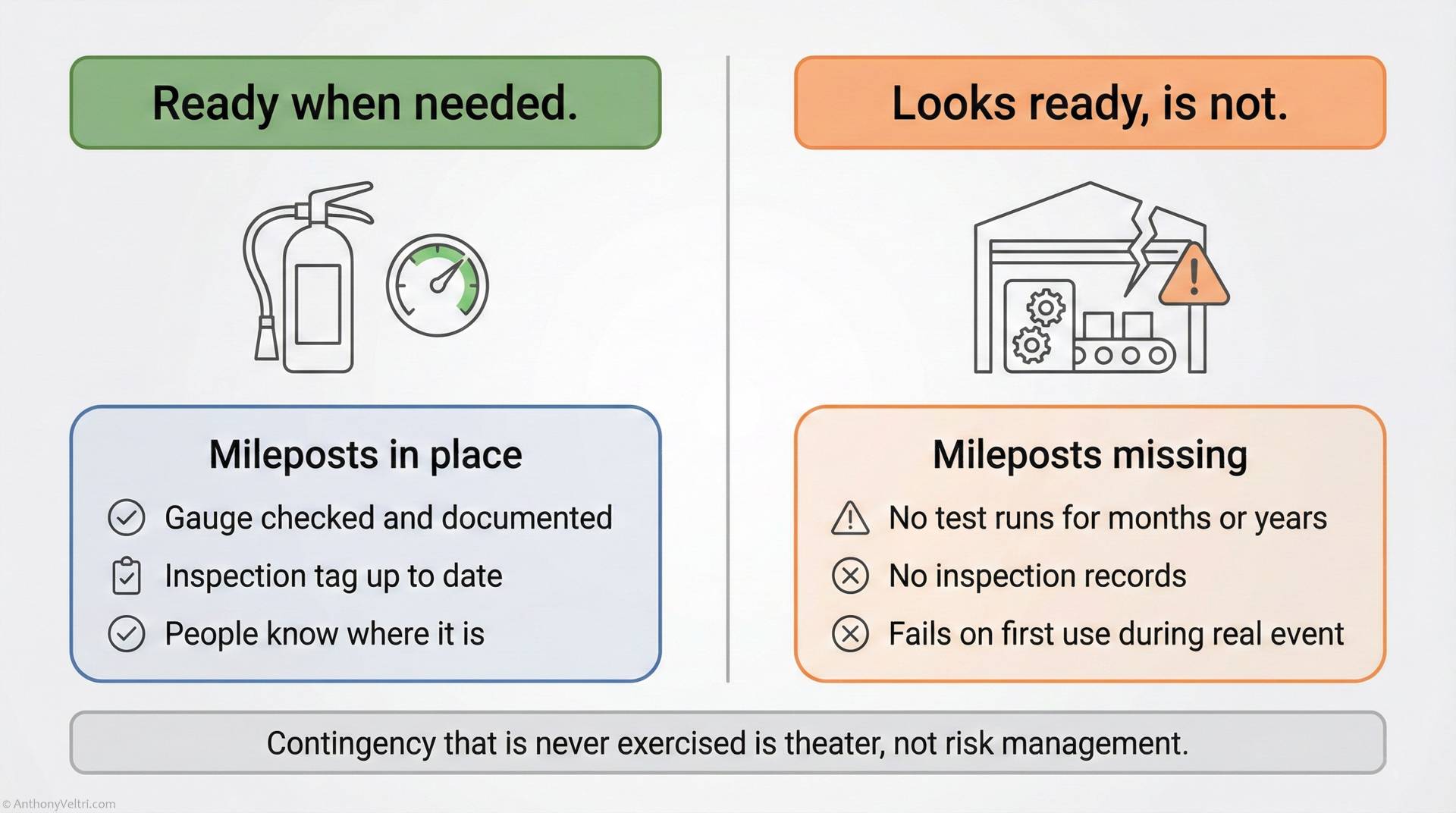
A comparison chart shows “Ready when needed” with checked fire extinguisher versus “Looks ready, is not” with a broken extinguisher box. It highlights the importance of regular checks and documentation for emergency readiness.
Zero Trust Theater. Buying the tools (Cards/TLS) without changing the policy is Theater (The Binder). True Zero Trust requires the operational reality of verifying every request (The Extinguisher). More background on Real vs. Fake Contingency: If you have a plan but no triggers or rehearsals, you have Theater (The Binder). Real contingency looks like a maintained fire extinguisher. “Bolting on” a plan without integration is Theater. True resilience requires the mechanics (inspections, gauges) to be built into the daily operation.

Use these as red flags during reviews.

  • Card worship
    • “We issued CACs and enforced TLS, so we are zero trust.”
    • Reality: you hardened the door, you did not change the floor plan.
  • Perimeter nostalgia
    • Heavy reliance on “inside the VPN” as a trust signal.
    • Little scrutiny of internal east–west traffic.
  • Static entitlements
    • Roles and groups created once, never cleaned up.
    • People accrete access over careers and nothing is reclaimed.
  • Logging without teeth
    • “We log everything” but:
      • No one looks.
      • No real-time detection.
      • No playbooks for response.
  • Micro segmentation theater
    • Lots of VLANs and docs.
    • In reality most key services still reachable broadly.

Doctrine Diagnostic: Review questions (for portfolio or system reviews) #

You can treat this as a zero trust doctrine checklist.
For a given system or data set, ask:

If you cannot give a clean answer to these, you are not operating with a real zero-trust model, no matter how many CAC readers you own.

  1. Identity
    • Is CAC / PKI the only real gate, or one of several signals?
  2. Context
    • Does access depend on device health, location, and time?
  3. Granularity
    • Can we easily answer “who can see this specific table, file, or queue”?
  4. Blast radius
    • If one account is fully compromised, what is the maximum realistic damage?
  5. Monitoring
    • Will unusual use of that account be detected and acted on quickly?
  6. Lifecycle
    • How fast are entitlements updated when people change jobs or leave?

Field notes and examples #

  • Session Hijacking in 1999: What A URL Bug Taught Me About Trust Models
  • Living With Incomplete Pictures: Notes From High Tempo Systems

Last Updated on December 15, 2025

Related Posts #

This slide illustrates the relationships among claims, roles, and entitlements in Microsoft 365, as presented in Doctrine 21.

Doctrine 21 Companion: Claims, Roles, and Entitlements in Microsoft 365 #

Abstract graphic with geometric shapes, lines, and dots in neutral and orange tones. A large dark rectangle overlays the left side with the white text:

Doctrine 24: Stewardship Places the Burden on the Steward, Not the Parties #

A graphic with abstract blue and black data and circuit patterns, overlaid with a dark rectangle containing the text

Annex L: The Rosetta Stone for Data Teams: Bridging the Gap Between Technicians and Executives #

This diagram illustrates increasing salary capacities, with larger houses on higher blocks representing $6k, $24k (median), and $80k per year.

Field Report: College Financing and the 5-Year Home Runway #

Two vintage TVs on a stained paper background. The left TV shows piles of cash labeled

Field Note: Handbook vs Terrain - When Constraint Forecasting Failed and Indications Won #

This slide illustrates the principle that loop closure is structural, as highlighted by the modern, technical design elements.

Doctrine 23: Loop Closure as Load-Bearing System Infrastructure #

architecture, cybersecurity, pki, zero trust

Related Docs

  • Doctrine 21 Companion: Claims, Roles, and Entitlements in Microsoft 365

Leave a Reply Cancel reply

You must be logged in to post a comment.

Table of Contents
  • Core statement
  • Why this doctrine exists
  • The pattern
    • Old model: Castle and moat
    • Zero trust model: Continuous skepticism
  • Comparison: CAC-era use vs zero trust
  • How to use this doctrine in practice
  • Common failure modes
  • Doctrine Diagnostic: Review questions (for portfolio or system reviews)

Share This Article :

  • Facebook
  • X
  • LinkedIn
  • Pinterest

Was it helpful ?

  • Happy
  • Normal
  • Sad
  • Privacy Policy
  • Introductions
  • Contact

© 2026 Anthony Veltri

  • Doctrine
    • Doctrine Library
    • Global Library
  • Field Notes
  • Routes
    • Route 01: When the Interface Is Breaking (and you are becoming the patch)
    • ROUTE 02: If decisions stall and meetings go nowhere, start here
    • ROUTE 03: If you have lots of projects but no portfolio clarity, start here
    • ROUTE 04: If you’re confused about federation vs integration, start here
    • ROUTE 05: If heroics are propping up your system, start here
    • ROUTE 06: If you cannot force compliance across partners, start here
    • ROUTE 07: If compliance exists but commitment does not, start here
    • ROUTE 08: If disconnected workflows create audit anxiety, start here
  • Figure Library
  • FAQ
  • About
    • Capability Statement
    • Interpreter Kit
  • Contact