Skip to content

Introduced by a trusted connector?

Start Here

Anthony Veltri

  • Doctrine
    • Doctrine Library
    • Global Library
  • Field Notes
  • Routes
    • Route 01: When the Interface Is Breaking (and you are becoming the patch)
    • ROUTE 02: If decisions stall and meetings go nowhere, start here
    • ROUTE 03: If you have lots of projects but no portfolio clarity, start here
    • ROUTE 04: If you’re confused about federation vs integration, start here
    • ROUTE 05: If heroics are propping up your system, start here
    • ROUTE 06: If you cannot force compliance across partners, start here
    • ROUTE 07: If compliance exists but commitment does not, start here
    • ROUTE 08: If disconnected workflows create audit anxiety, start here
  • Figure Library
  • FAQ
  • About
    • Capability Statement
    • Interpreter Kit
  • Contact
Anthony Veltri

Architecture & Interfaces

15
  • Doctrine 01: Federation vs Integration in Mission Networks
  • Doctrine 03: Interfaces Are Where Systems Break, So They Require Stewards, Contracts, and Ownership
  • Doctrine 04: Useful Interoperability Is the Goal, Not Perfect Interoperability
  • Doctrine 05: Innovation Must Live at the Edge, Not in the Center
  • Doctrine 06: A Two-Lane System Protects Stability and Enables Evolution
  • Doctrine 14: Technical Debt Is a Leadership Signal, Not a Coding Failure
  • Doctrine 15: Architecture Must Accelerate Teams, Not Bottleneck Them
  • Doctrine 17: Architects Translate Strategy Into Engineering and Engineering Into Strategy
  • Doctrine 20: Golden Datasets: Putting Truth In One Place Without Pretending Everything Is Perfect
  • Doctrine 21: Zero Trust Is A Trust Model, Not A Card “Type”
  • Doctrine 23: Loop Closure as Load-Bearing System Infrastructure
  • ANNEX B. Data Contracts
  • ANNEX C. Interface Ownership Model
  • ANNEX H. Architecture Doctrine
  • Annex L: The Rosetta Stone for Data Teams: Bridging the Gap Between Technicians and Executives

Decision Tempo & Governance

10
  • Doctrine 02: Distributed Decisions Increase Alignment, Speed, and Resilience
  • Doctrine 07: Clear Intent Matters More Than Perfect Data
  • Doctrine 08: Clear Intent Compresses Ambiguity, Reduces Conflict, and Accelerates Action
  • Doctrine 09: Decision Drag Is the Enemy of Mission Tempo. Architecture Is the Remedy
  • Doctrine 10: Degraded Operations Are the Normal Mode, Not the Exception
  • Doctrine 11: Preventive Action and Contingent Action Must Both Be Designed Intentionally
  • Doctrine 22: When “It Depends” Is the Right Answer: How to Think in Probabilities Under Uncertainty
  • ANNEX D. Decision Altitudes Model
  • ANNEX E. Prevention–Contingency Matrix
  • ANNEX I. High Visibility Workflows

Portfolio & Alignment

4
  • Doctrine 16: Portfolio Thinking Ensures Effort Aligns With What Actually Matters
  • ANNEX F. Pattern Library
  • ANNEX J. System Evolution and Drift Management
  • ANNEX K. System and Workflow Profiles (Case Studies)

Leadership & Human Systems

6
  • Doctrine 24: Stewardship Places the Burden on the Steward, Not the Parties
  • Doctrine 18: Commitment Outperforms Compliance in High Trust, High Tempo Environments
  • Doctrine 19: Supervision, Management, and Leadership Are Three Different Jobs. Confusing Them Breaks Systems
  • Doctrine 23: Loop Closure as Load-Bearing System Infrastructure
  • ANNEX A. Human Contracts
  • ANNEX G. Leadership Doctrine

Resilience & Operations

3
  • Doctrine 24: Stewardship Places the Burden on the Steward, Not the Parties
  • Doctrine 12: Resilience Is an Emergent Property, Not a Feature
  • Doctrine 13: Problem Solving Requires Finding the Real Deviation and the Relevant Change

Doctrine Companions

7
  • Doctrine 03 Companion: The RS-CAT Framework: Converting Raw Recall into Teachable Principle
  • Doctrine 03 Companion: The Interface Void
  • Doctrine 11 Companion: Agency vs. Outcome
  • Doctrine 09 Companion: Artifacts Over Adjectives
  • Doctrine 03 Companion: Constraints: bidirectional translation: Compression vs Construction
  • Doctrine 10 Companion: Span of Control and Cross Training Are Load-Bearing Constraints
  • Doctrine 21 Companion: Claims, Roles, and Entitlements in Microsoft 365

Field Reports

1
  • Field Report: College Financing and the 5-Year Home Runway
View Categories
  • Home
  • Doctrine & Supporting Guides
  • Architecture & Interfaces
  • Doctrine 06: A Two-Lane System Protects Stability and Enables Evolution

Doctrine 06: A Two-Lane System Protects Stability and Enables Evolution

Anthony Veltri
Updated on December 25, 2025

4 min read

Why mature systems need both a stable lane and an adaptive lane to survive real conditions #

This guide overlaps with Doctrine 05 (Innovation at the Edge), but it is distinct: Doctrine 05 is about where innovation happens (the Edge), while Doctrine 06 is about how the system structures itself to handle it (Two Lanes).

This page is a Doctrine Guide. It shows how to apply one principle from the Doctrine in real systems and real constraints. Use it as a reference when you are making decisions, designing workflows, or repairing things that broke under pressure.


If everything must be stable, nothing can evolve. If everything can evolve, nothing stays stable. #

High consequence systems fail at the extremes.

If you lock everything down, you:

  • smother innovation
  • freeze progress
  • slow mission tempo
  • increase technical debt
  • force workarounds

If you open everything up, you:

  • destabilize operations
  • break integrations
  • increase outages
  • overload teams
  • erode trust

The answer is not choosing one or the other.
The answer is two lanes.

A stable lane for today.
An adaptive lane for tomorrow.


Lived Example: How we kept iCAV running while evolving it in real time #

During several activation cycles, iCAV needed updates, new feeds, and refinements.
But it also had to remain fully operational for decision makers.

We created a natural two lane pattern:

  • Stable lane
    The core viewer, cached feeds, permissions, and workflows remained untouched during activation.
  • Adaptive lane
    A temporary “sandbox ingest” accepted new feeds, partner updates, and experimental overlays without risking the main system.

This allowed:

  • real time innovation
  • real time learning
  • real time integration of partner data

And zero operational downtime.

Two lanes made evolution safe.


Business Terms: Why two lanes solve real organizational problems #

A two lane approach gives you:

  • predictable operations for leadership
  • safe space for experimentation
  • lower risk of outages
  • faster timelines for innovation
  • less friction between teams
  • clear expectations for partners
  • fewer surprises
  • higher morale
  • reduced conflict between “move fast” and “move carefully” cultures

Organizations often argue about speed vs stability.
A two lane system ends the argument.

Both exist.
In different lanes.
By design.


System Terms: What a two lane architecture actually looks like #
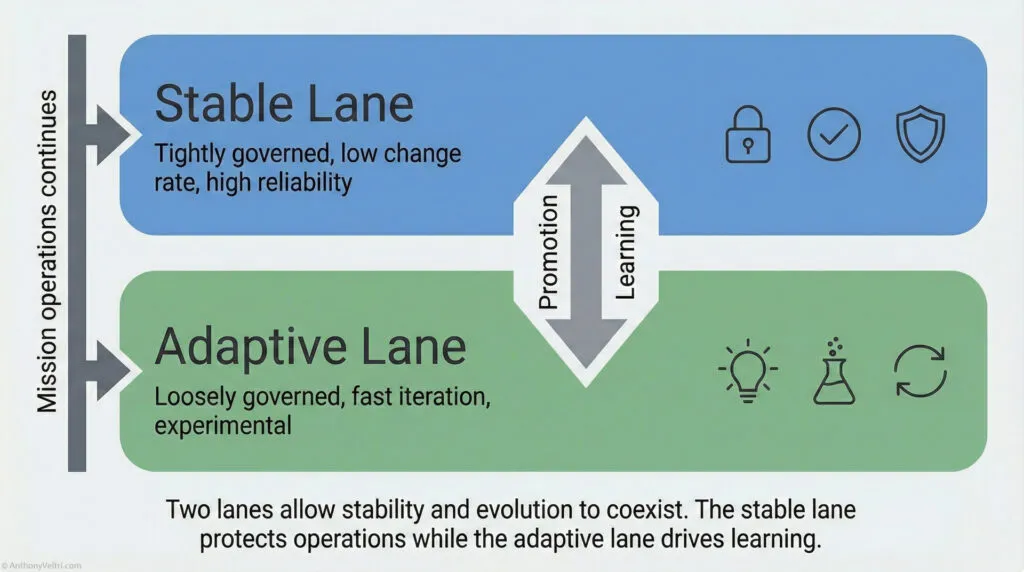
A diagram shows two lanes: Stable Lane (blue, reliable, low change rate) and Adaptive Lane (green, experimental, fast iteration). An arrow between them indicates promotion and learning. Text explains the lanes' complementary roles.
The Two-Lane Model. The stable lane (Blue) protects operations. The adaptive lane (Green) drives learning. The arrows show the relationship: Promotion (Up) and Learning (Down).

A two lane system is a structural pattern:

Stable lane:

  • tightly governed
  • low change rate
  • high reliability
  • backward compatible
  • tested
  • documented
  • feeds the mission
  • minimal variance

Adaptive lane:

  • loosely governed
  • fast iteration
  • high variability
  • experimental
  • reversible
  • versioned
  • designed for learning
  • isolated from core operations

The stability lane carries the load.
The adaptive lane carries the learning.

Stability without evolution causes collapse.
Evolution without stability causes chaos.


Why Single Lane Systems Fail #

Business perspective #

Single lane stability systems fail because:

  • nothing can change fast enough
  • political pressure builds for exceptions
  • people build shadow systems
  • innovators work around governance
  • leaders lose patience
  • technical debt grows
  • the organization ossifies

Single lane innovation systems fail because:

  • instability erodes trust
  • outages increase
  • partners lose confidence
  • production data becomes experimental
  • compliance risk spikes
  • leadership clamps down hard

Both extremes break.

System perspective #
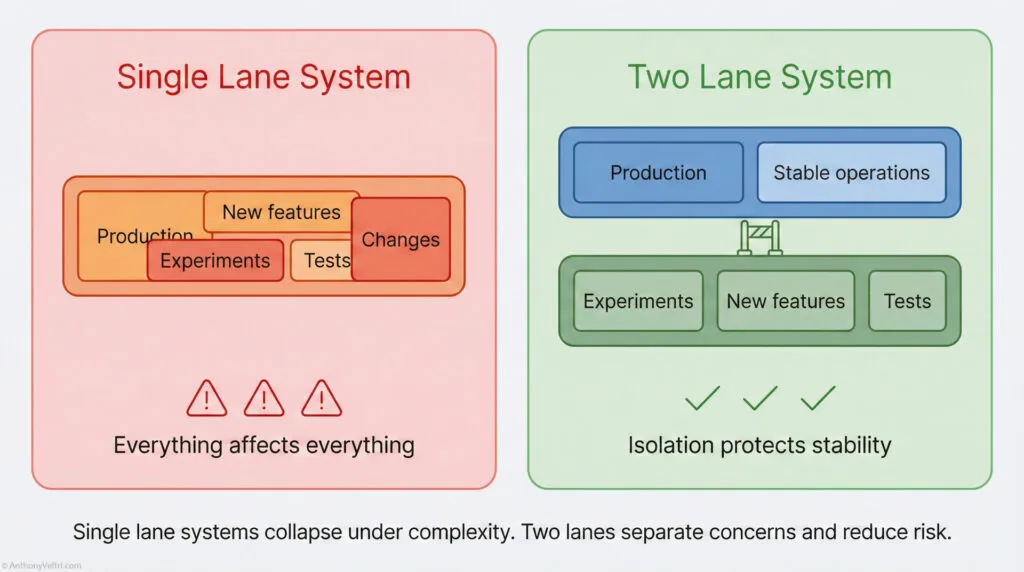
A diagram compares a Single Lane System, where changes, tests, experiments, and features overlap and cause risks, with a Two Lane System, where production and experiments are separated, protecting stability.
Why the Center Cannot Experiment. A single-lane system (Red) collapses if you try to experiment in production. To innovate safely, you must split the architecture into a Stable Lane and an Adaptive Lane (Green).

Technical single lane architectures fail because:

  • coupling grows
  • upgrades become all or nothing
  • risk accumulates
  • load cannot shift
  • interfaces drift
  • the system cannot evolve gracefully
  • changes propagate further than intended

Single lane systems collapse under complexity.


Why Two Lanes Succeed #

Business perspective #
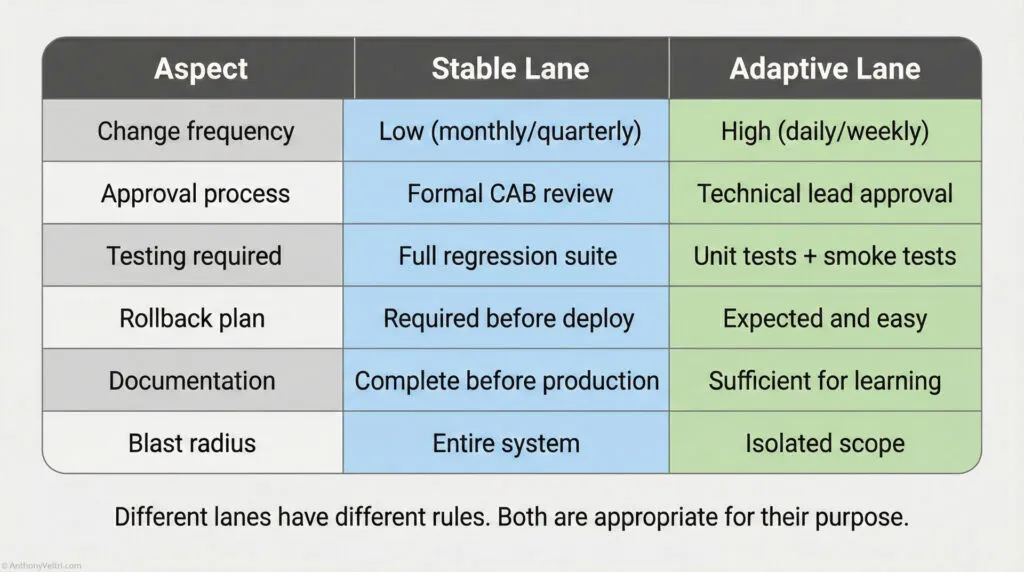
A table compares Stable Lane and Adaptive Lane across six aspects: change frequency, approval process, testing, rollback plan, documentation, and blast radius, highlighting stricter controls in Stable Lane and flexibility in Adaptive Lane.
Different Rules for Different Lanes. The edge (Adaptive Lane) needs speed, peer review, and isolated scope. The center (Stable Lane) needs regression testing and zero downtime. You cannot run both with one rulebook.

Two lane systems succeed because they:

  • protect mission tempo
  • reduce approval cycles
  • lower political risk
  • allow innovation without fear
  • prevent emergency workarounds
  • create space for R and D
  • define where testing belongs
  • keep stakeholders aligned

Everyone knows which lane they are in.
Everyone knows the rules of their lane.

System perspective #

Two lanes succeed because:

  • coupling is controlled
  • blast radius is contained
  • upgrades flow through predictable stages
  • rollback is simple
  • migrations can be staged
  • new capabilities can be piloted safely
  • unusual experiments do not threaten uptime
  • stable lane remains the bedrock

The system becomes evolvable and reliable.


Business Example: The partner who needed a special workflow during a crisis #
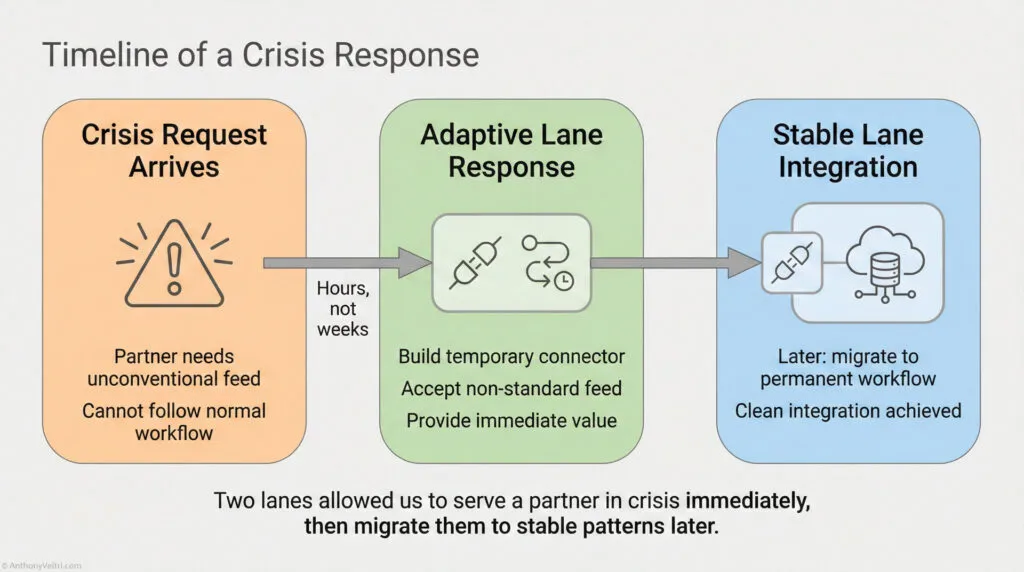
Timeline showing three stages: Crisis Request Arrives, Adaptive Lane Response, and Stable Lane Integration, connected by arrows. Each stage lists key actions for responding to and resolving a crisis request.
Crisis Request –> Adaptive Response (Hours) –> Stable Integration (Later).

A partner agency needed a new data ingest workflow during an activation.
Their system did not follow normal publishing practices.

In a single lane environment, this request would have:

  • disrupted stable operations
  • required emergency exceptions
  • risked downtime
  • triggered delay and debate

In the two lane model:

  • we put them in the adaptive lane
  • built a temporary connector
  • accepted their unconventional feed
  • provided value during the activation
  • later migrated them cleanly into the stable lane

This would not have worked in a single lane system.


System Example: How staging lanes saved a major deployment #

During a modernization wave, a major upgrade needed testing under real conditions, but not in production.

The two lane architecture allowed:

  • testing in the adaptive lane
  • validating ingest
  • checking schema tolerance
  • resolving security friction
  • verifying caching behavior
  • confirming usability

Once proven, the stable lane adopted the new pattern without disruption.

Two lanes reduced deployment risk from high to near zero.


Architect Level Principle #

As an architect I design two lane systems so that stability and evolution can coexist.
The stable lane protects operations.
The adaptive lane drives learning.
This pattern is the backbone of resilient progress.


Twenty Second Takeaway: #

“High consequence systems need stability and innovation at the same time. A two-lane architecture solves this by giving one lane for reliable operations and one lane for experimentation and evolution. I design with this pattern so systems can learn without breaking.”


Cross Links to Other Principles #

Two lane systems naturally connect with:

  • Innovation at the edge
  • Degraded operations
  • Technical debt as leadership signal
  • Useful interoperability
  • Federation
  • Architecture accelerates
  • Emergent resilience
  • Decision drag

This pattern supports nearly the entire doctrine.


Doctrine Diagnostic – For Reflection: #

Ask yourself:
Where does your system evolve?
Where does it stay stable?

If the answer is “in the same place,” you are running a one lane system.
And that system is already in trouble.

Add the second lane before failure forces you to.

Field notes and examples #

  • Field Note: Compass-X Recognition Patterns and Strategic Framing
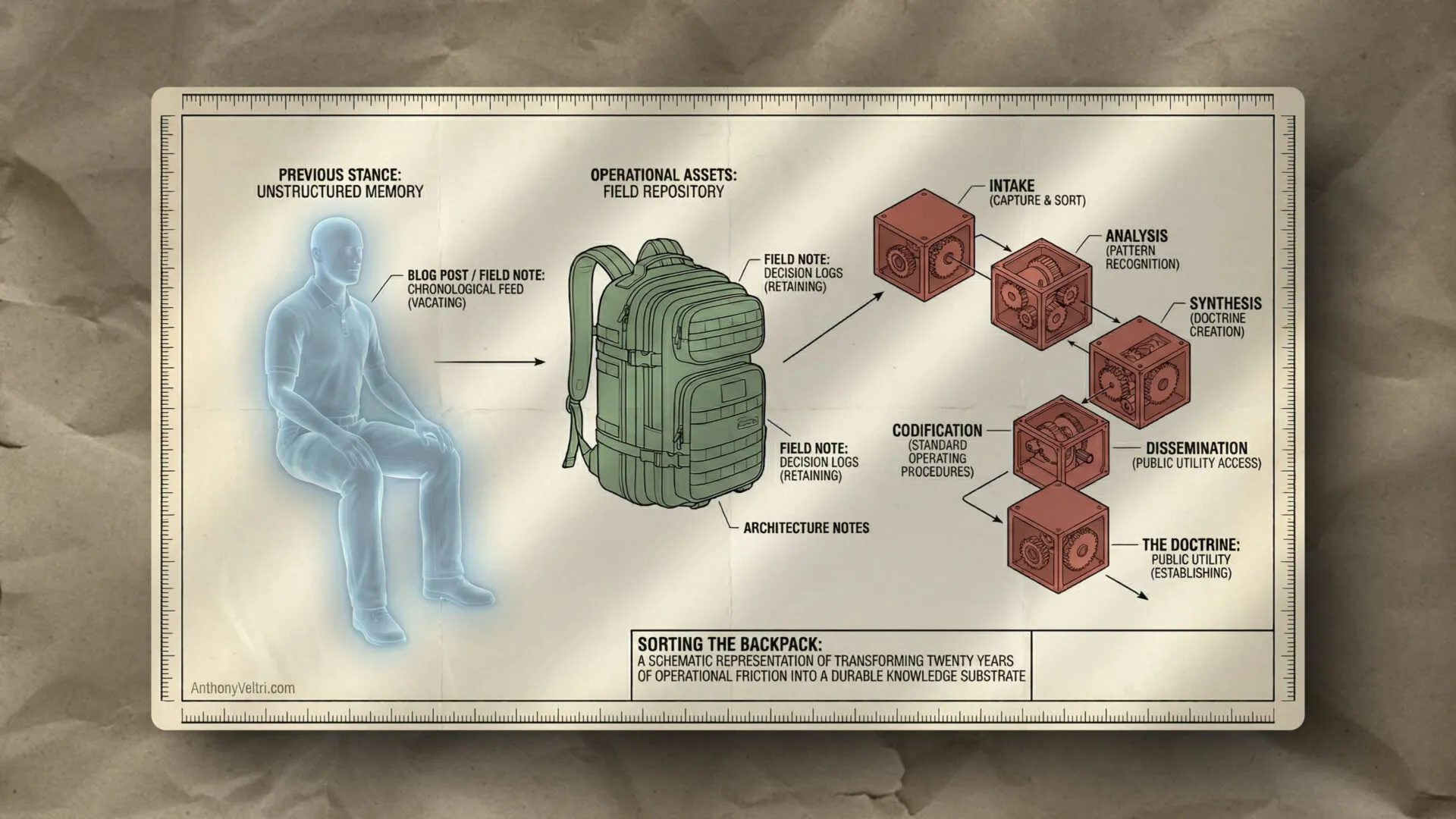
  • Field Note: Sorting the 20-Year Backpack
  • The Scalpel vs. The Swiss Army Knife: When Solo Integration Beats Federation
  • Disposable Pixels (UI) On A Durable Substrate
  • Stranded in Vienna, Responsible in Kyiv
  • Respect The Envelope: Why Legal Is Not Always Safe
  • Gates That Matter: Task Books, Checkrides And Real Safety
  • Commitment Over Compliance: How Technical Teams Actually Deliver

Last Updated on December 25, 2025

Related Posts #

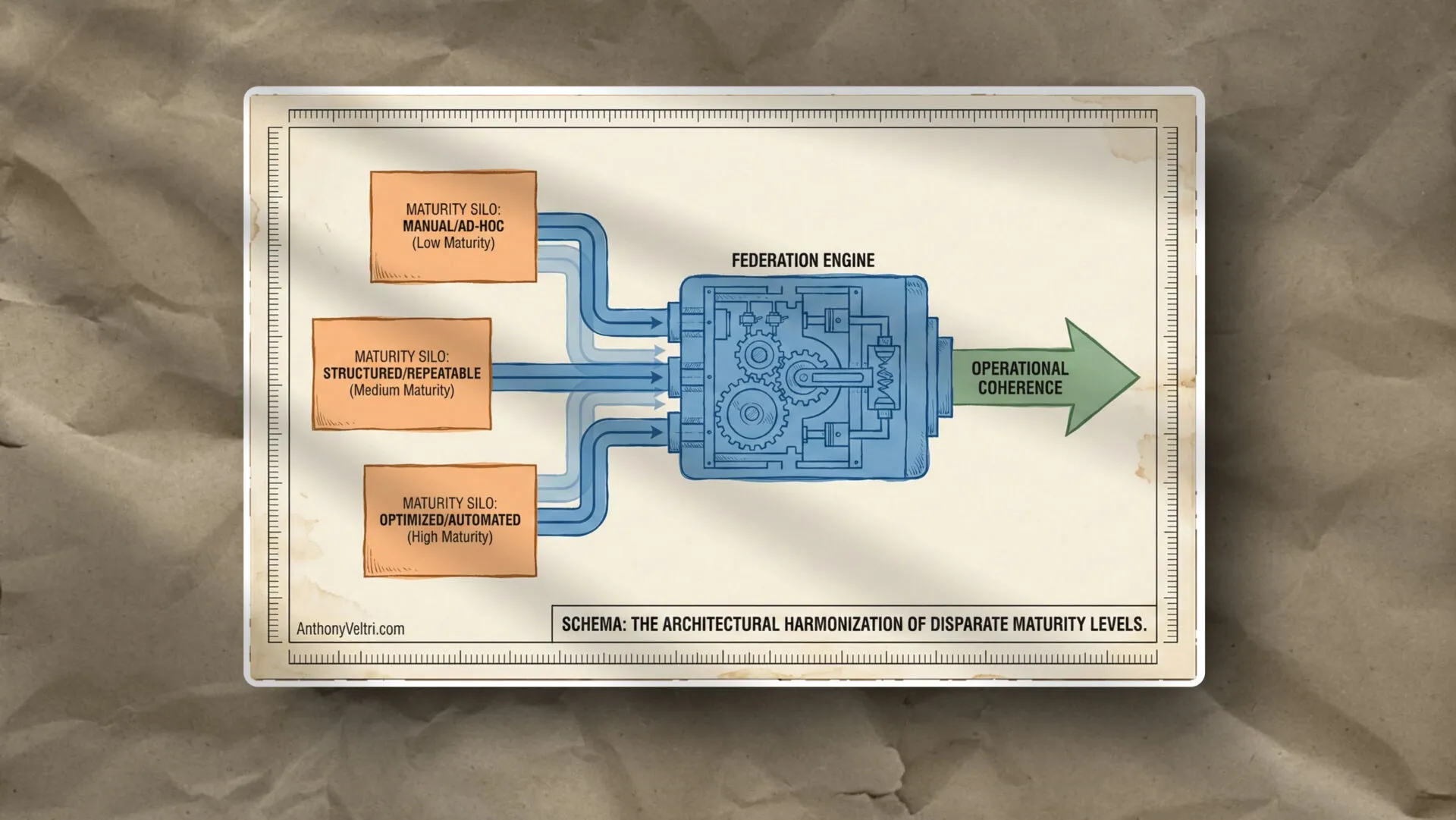
A diagram depicts three orange boxes labeled “Maturity Silo” (low, medium, high) feeding blue lines into a central “Federation Engine,” which outputs an arrow labeled “Operational Coherence.” The background looks like wrinkled brown paper.

Field Note: Compass-X Recognition Patterns and Strategic Framing #

ANNEX J System Evolution and Drift

ANNEX J. System Evolution and Drift Management #

A graphic with the title

ANNEX K. System and Workflow Profiles (Case Studies) #

This diagram illustrates increasing salary capacities, with larger houses on higher blocks representing $6k, $24k (median), and $80k per year.

Field Report: College Financing and the 5-Year Home Runway #

This sepia-toned image highlights early logging practices, as seen by seven men on felled logs amid equipment and pine trees.

Field Note: Integration Debt vs Temporal Arbitrage #

This slide illustrates the principle that loop closure is structural, as highlighted by the modern, technical design elements.

Doctrine 23: Loop Closure as Load-Bearing System Infrastructure #

altitude, contracts, interfaces, resilience, technical-debt
Table of Contents
  • Why mature systems need both a stable lane and an adaptive lane to survive real conditions
  • If everything must be stable, nothing can evolve. If everything can evolve, nothing stays stable.
  • Lived Example: How we kept iCAV running while evolving it in real time
  • Business Terms: Why two lanes solve real organizational problems
  • System Terms: What a two lane architecture actually looks like
  • Why Single Lane Systems Fail
    • Business perspective
    • System perspective
  • Why Two Lanes Succeed
    • Business perspective
    • System perspective
  • Business Example: The partner who needed a special workflow during a crisis
  • System Example: How staging lanes saved a major deployment
  • Architect Level Principle
  • Twenty Second Takeaway:
  • Cross Links to Other Principles
  • Doctrine Diagnostic - For Reflection:

Share This Article :

  • Facebook
  • X
  • LinkedIn
  • Pinterest

Was it helpful ?

  • Happy
  • Normal
  • Sad
  • Privacy Policy
  • Introductions
  • Contact

© 2026 Anthony Veltri

  • Doctrine
    • Doctrine Library
    • Global Library
  • Field Notes
  • Routes
    • Route 01: When the Interface Is Breaking (and you are becoming the patch)
    • ROUTE 02: If decisions stall and meetings go nowhere, start here
    • ROUTE 03: If you have lots of projects but no portfolio clarity, start here
    • ROUTE 04: If you’re confused about federation vs integration, start here
    • ROUTE 05: If heroics are propping up your system, start here
    • ROUTE 06: If you cannot force compliance across partners, start here
    • ROUTE 07: If compliance exists but commitment does not, start here
    • ROUTE 08: If disconnected workflows create audit anxiety, start here
  • Figure Library
  • FAQ
  • About
    • Capability Statement
    • Interpreter Kit
  • Contact