Skip to content

Introduced by a trusted connector?

Start Here

Anthony Veltri

  • Doctrine
    • Doctrine Library
    • Global Library
  • Field Notes
  • Routes
    • Route 01: When the Interface Is Breaking (and you are becoming the patch)
    • ROUTE 02: If decisions stall and meetings go nowhere, start here
    • ROUTE 03: If you have lots of projects but no portfolio clarity, start here
    • ROUTE 04: If you’re confused about federation vs integration, start here
    • ROUTE 05: If heroics are propping up your system, start here
    • ROUTE 06: If you cannot force compliance across partners, start here
    • ROUTE 07: If compliance exists but commitment does not, start here
    • ROUTE 08: If disconnected workflows create audit anxiety, start here
  • Figure Library
  • FAQ
  • About
    • Capability Statement
    • Interpreter Kit
  • Contact
Anthony Veltri

Architecture & Interfaces

15
  • Doctrine 01: Federation vs Integration in Mission Networks
  • Doctrine 03: Interfaces Are Where Systems Break, So They Require Stewards, Contracts, and Ownership
  • Doctrine 04: Useful Interoperability Is the Goal, Not Perfect Interoperability
  • Doctrine 05: Innovation Must Live at the Edge, Not in the Center
  • Doctrine 06: A Two-Lane System Protects Stability and Enables Evolution
  • Doctrine 14: Technical Debt Is a Leadership Signal, Not a Coding Failure
  • Doctrine 15: Architecture Must Accelerate Teams, Not Bottleneck Them
  • Doctrine 17: Architects Translate Strategy Into Engineering and Engineering Into Strategy
  • Doctrine 20: Golden Datasets: Putting Truth In One Place Without Pretending Everything Is Perfect
  • Doctrine 21: Zero Trust Is A Trust Model, Not A Card “Type”
  • Doctrine 23: Loop Closure as Load-Bearing System Infrastructure
  • ANNEX B. Data Contracts
  • ANNEX C. Interface Ownership Model
  • ANNEX H. Architecture Doctrine
  • Annex L: The Rosetta Stone for Data Teams: Bridging the Gap Between Technicians and Executives

Decision Tempo & Governance

10
  • Doctrine 02: Distributed Decisions Increase Alignment, Speed, and Resilience
  • Doctrine 07: Clear Intent Matters More Than Perfect Data
  • Doctrine 08: Clear Intent Compresses Ambiguity, Reduces Conflict, and Accelerates Action
  • Doctrine 09: Decision Drag Is the Enemy of Mission Tempo. Architecture Is the Remedy
  • Doctrine 10: Degraded Operations Are the Normal Mode, Not the Exception
  • Doctrine 11: Preventive Action and Contingent Action Must Both Be Designed Intentionally
  • Doctrine 22: When “It Depends” Is the Right Answer: How to Think in Probabilities Under Uncertainty
  • ANNEX D. Decision Altitudes Model
  • ANNEX E. Prevention–Contingency Matrix
  • ANNEX I. High Visibility Workflows

Portfolio & Alignment

4
  • Doctrine 16: Portfolio Thinking Ensures Effort Aligns With What Actually Matters
  • ANNEX F. Pattern Library
  • ANNEX J. System Evolution and Drift Management
  • ANNEX K. System and Workflow Profiles (Case Studies)

Leadership & Human Systems

6
  • Doctrine 24: Stewardship Places the Burden on the Steward, Not the Parties
  • Doctrine 18: Commitment Outperforms Compliance in High Trust, High Tempo Environments
  • Doctrine 19: Supervision, Management, and Leadership Are Three Different Jobs. Confusing Them Breaks Systems
  • Doctrine 23: Loop Closure as Load-Bearing System Infrastructure
  • ANNEX A. Human Contracts
  • ANNEX G. Leadership Doctrine

Resilience & Operations

3
  • Doctrine 24: Stewardship Places the Burden on the Steward, Not the Parties
  • Doctrine 12: Resilience Is an Emergent Property, Not a Feature
  • Doctrine 13: Problem Solving Requires Finding the Real Deviation and the Relevant Change

Doctrine Companions

7
  • Doctrine 03 Companion: The RS-CAT Framework: Converting Raw Recall into Teachable Principle
  • Doctrine 03 Companion: The Interface Void
  • Doctrine 11 Companion: Agency vs. Outcome
  • Doctrine 09 Companion: Artifacts Over Adjectives
  • Doctrine 03 Companion: Constraints: bidirectional translation: Compression vs Construction
  • Doctrine 10 Companion: Span of Control and Cross Training Are Load-Bearing Constraints
  • Doctrine 21 Companion: Claims, Roles, and Entitlements in Microsoft 365

Field Reports

1
  • Field Report: College Financing and the 5-Year Home Runway
View Categories
  • Home
  • Doctrine & Supporting Guides
  • Leadership & Human Systems
  • ANNEX A. Human Contracts

ANNEX A. Human Contracts

Anthony Veltri
Updated on December 5, 2025

5 min read

The interpersonal agreements that make federated systems, distributed decisions, and high visibility work possible #

Technical systems run on code – federated systems run on trust. A Human Contract is the “interpersonal scaffolding” that prevents political friction from becoming a technical outage. It defines who owns the boundary, how we escalate, and what “done” actually means.


1. Purpose of Human Contracts #
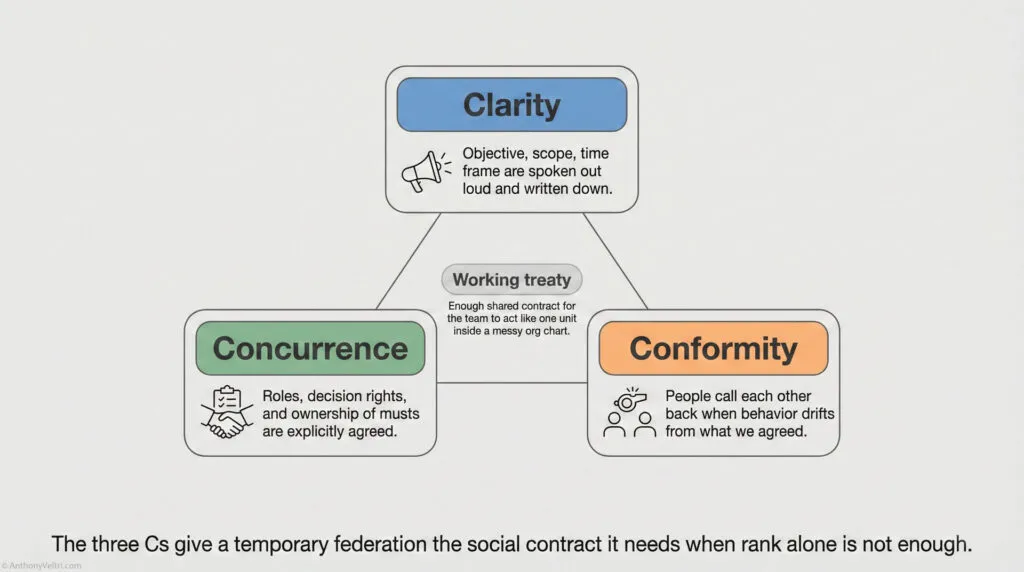
A diagram connecting three concepts: Clarity (objective, scope, and timeframe are defined), Concurrence (roles and decision rights are explicit), and Conformity (peers call out behavioral drift); central text: "Working treaty.
The Human Contract: A stable relationship requires three things: Clarity on the goal, Concurrence on the roles, and Conformity to the agreement. If one is missing, the contract fails. The Working Treaty: Commitment requires Clarity (Intent), Concurrence (Roles), and Conformity (Boundaries). This triangle is the “Psychological Contract” you need.

Human contracts define how people behave at boundaries.
They are the interpersonal scaffolding that makes technical architecture workable.

They exist because:

  • every interface involves two people or two teams
  • expectations differ across roles and altitudes
  • political visibility creates pressure that distorts behavior
  • leadership demands often arrive faster than systems can adapt
  • boundary friction grows unless expectations are explicit

Technical contracts govern the data.
Human contracts govern the humans who must produce and manage that data.

When organizations do not define human contracts, people interpret boundaries differently.
Misalignment becomes predictable.


2. Why Human Contracts Matter #
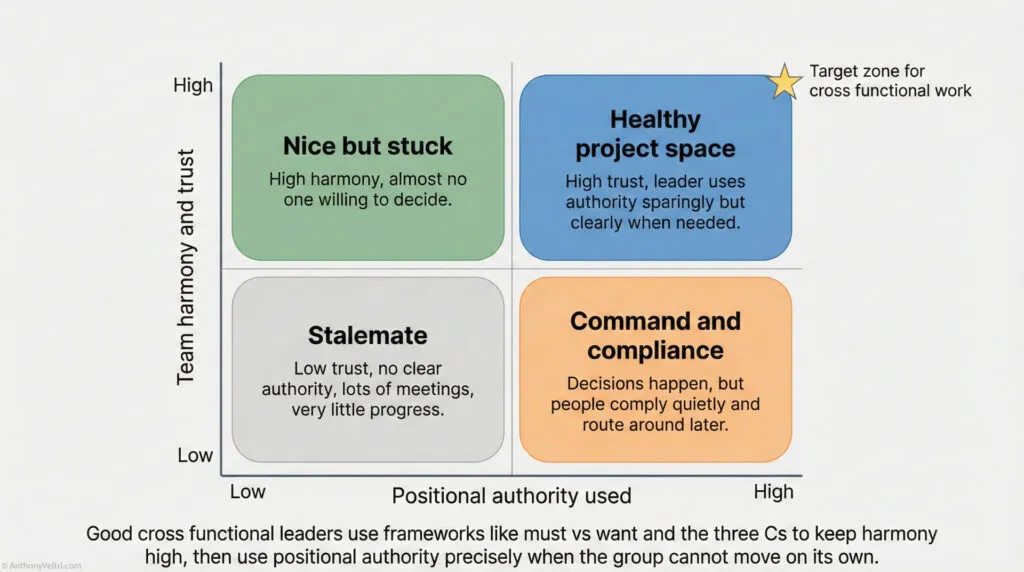
A 2x2 matrix shows team harmony/trust (vertical) vs. positional authority used (horizontal). The top right “Healthy project space” is starred. Other zones: “Nice but stuck,” “Stalemate,” and “Command and compliance.”.
The Leadership Target: A Leader’s job isn’t just to be “Nice” (Green) or “Bossy” (Orange). It is to maintain High Harmony while using Precise Authority (Blue) to set direction. Human contracts move teams out of “Stalemate” (Grey) and “Compliance” (Orange) into the “Healthy Project Space” (Blue), where trust and authority are balanced.

Crucially, leadership must be a net gain. If the team is just as effective without you as with you, you are not leading; you are overhead.

This hits hard because it gives the reader (or a practitioner) a diagnostic they can apply immediately: “Does my presence make the team faster or just more managed?”

Human contracts:

  • stabilize relationships
  • reduce conflict
  • protect mission tempo
  • protect timelines
  • prevent leadership driven thrash
  • create predictable communication
  • clarify ownership
  • reduce political heat
  • reduce fear based behavior
  • enable distributed decisions
  • reduce decision drag

You need human contracts when:

  • leadership expectations shift
  • partners interpret requirements differently
  • visibility is high and tolerance for error is low
  • politics distort priorities
  • teams feel pressure from outside stakeholders

Human contracts soften political turbulence.


3. The Five Elements of a Human Contract #
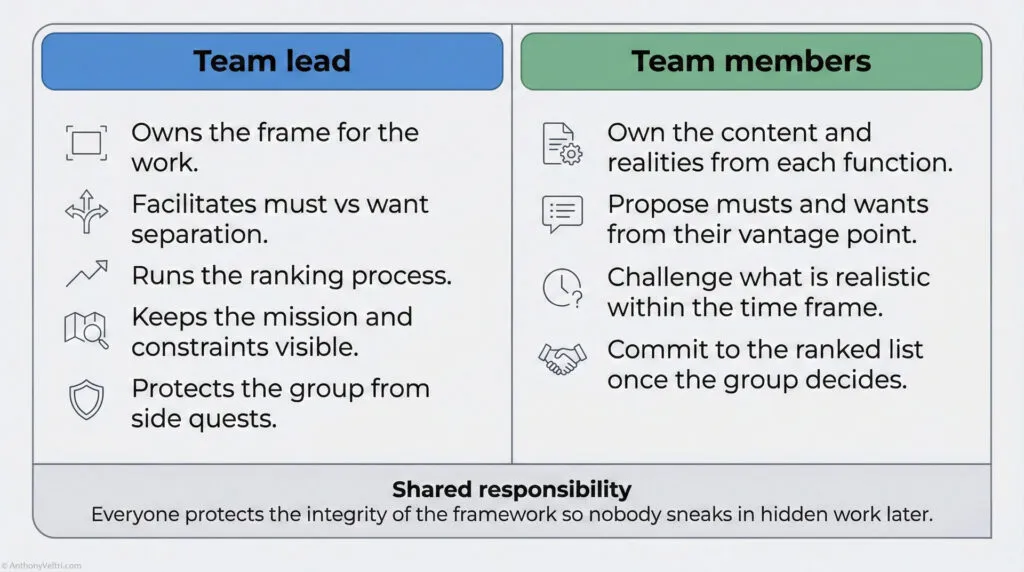
A comparison chart showing "Team lead" roles—framing work, facilitating, ranking, mission visibility, and shielding from side requests—and "Team members" roles—owning content, proposing, challenging, and committing to decisions.
Role Clarity: The Leader owns the Frame (Objective). The Member owns the Content (How). Distributed decisions work when this split is respected. Defining Responsibilities: A contract fails if roles are fuzzy. This simple split, the Lead owns the Frame, the Member owns the Content, is the building block of a good agreement.

A complete human contract contains five agreements.

1. Ownership #

Two named owners, one on each side of the boundary.

2. Responsiveness #

A shared expectation for how quickly people respond, both during normal operations and during heightened demand.

3. Change communication #

A predictable routine for announcing changes, deviations, outages, schema adjustments, and timeline shifts.

4. Escalation pathway #

A defined sequence of steps that prevents unnecessary panic, unnecessary meetings, and unnecessary leadership involvement.

5. Interpretation of intent #

A shared understanding of the underlying mission or legal purpose so both sides act in harmony and do not drift into superficial compliance.


4. Human Contract Altitudes #
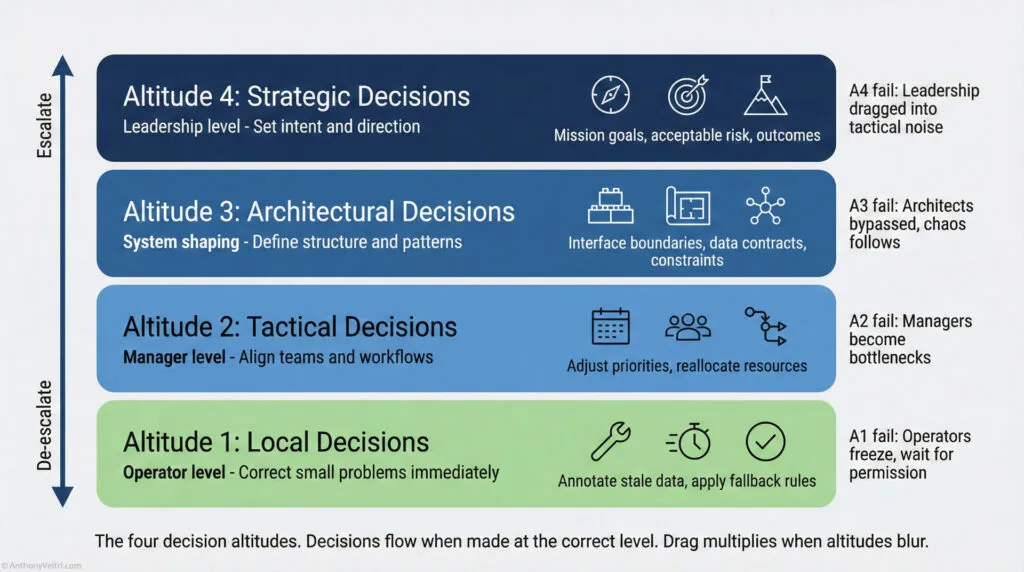
A flowchart with four colored layers: Strategic, Architectural, Tactical, and Local Decisions, each with descriptions of their roles, responsibilities, and consequences if made at the wrong level.
Intent must exist at every altitude: Strategic Intent (Level 4) guides Architectural Intent (Level 3), which constrains Local Intent (Level 1). If a layer is missing, the signal breaks. Alignment by Altitude: A Human Contract must hold at all three levels. If Leaders agree (L4) but Operators (L1) are at war, the system breaks.

Human contracts must align across three altitudes.

Altitude 1: Operators #

Day to day producers, analysts, editors, ingest owners, or clerks.

Altitude 2: Managers #

People who shape workflows, timelines, resource allocation, and process consistency.

Altitude 3: Leadership #

People who shape intent, define strategic outcomes, and introduce new requirements.

Human contracts collapse when:

  • operators agree but managers disagree
  • managers align but leadership changes direction
  • leadership aligns but operators do not receive the message

This altitude drift is exactly what happened in your FRN experience.


5. How Human Contracts Support the Doctrine #
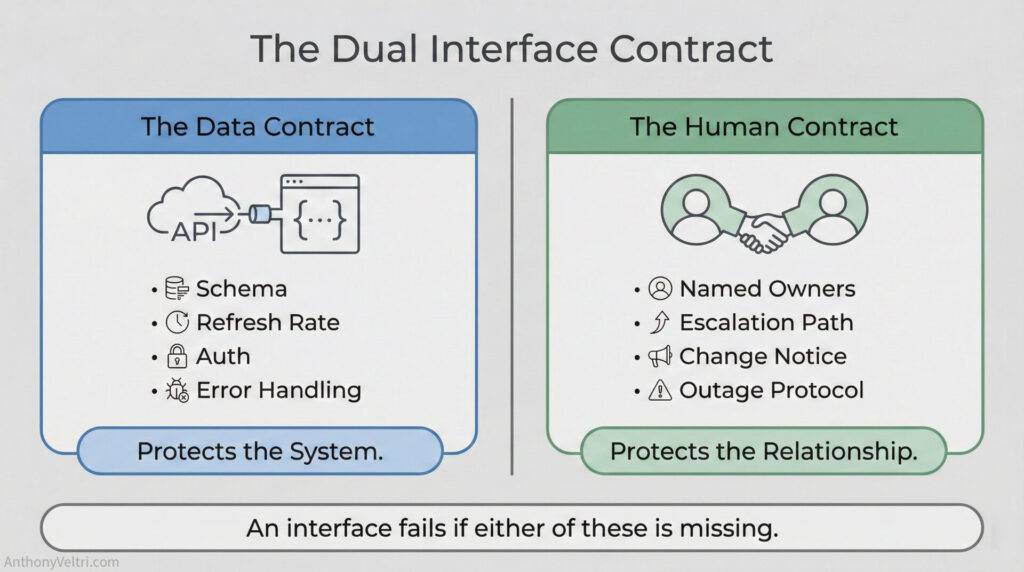
A diagram titled "The Dual Interface Contract" shows two sections: The Data Contract, with technology icons and bullet points for schema, refresh rate, auth, error handling, and "Protects the System"; and The Human Contract, with handshake icons and bullet points for named owners, escalation path, change notice, outage protocol, and "Protects the Relationship." A note below states an interface fails if either contract is missing.
The Other Half of the handshake: The Data Contract (Left) handles the schema. The Human Contract (Right) handles the relationship. You need both.

Human contracts are not optional. They directly support:

  • federation
  • useful interoperability
  • distributed decisions
  • commitment over compliance
  • portfolio thinking
  • degraded operations
  • decision altitude
  • clear intent
  • architecture as acceleration

Failures in doctrine almost always map to failures in human contracts.

Examples:

  • a partner publishes an update without notice
  • leadership introduces a new requirement without understanding impact
  • a team withholds information because they fear blame
  • a supervisor enforces a rule that contradicts strategic intent
  • a manager overcorrects because expectations are unclear

Human contracts cure these.


6. Business Example: Federal Register Notices (FRN) as a High-Visibility Human Contract Failure #

The FRN environment is the perfect example of high-profile, low-Tier operational value work where human contracts matter even more than technical contracts.

The failures we saw were classic human contract failures:

  • leadership added fields based on personal preference rather than business need
  • operators received new requirements with no warning
  • timelines were dictated externally
  • process expectations differed across teams
  • the meaning of “correct” shifted depending on who asked
  • oversight bodies expected perfection without understanding constraints
  • responsibilities were unclear
  • escalation routes were unpredictable

The workflow became unpredictable because altitude was confused and expectations drifted.

To stabilize it, our team unconsciously created a set of human contracts:

  • declared owners for each section or field
  • set realistic expectations for timeline and revision cycles
  • established predictable change notification routines
  • created a clear and mutual escalation path
  • agreed on what was non negotiable (legal compliance)
  • agreed on what was negotiable (stylistic preferences)
  • aligned everyone on the real intent of the notice
  • reduced leadership thrash by clarifying impacts and tradeoffs

We did not call these agreements human contracts at the time.
But that is exactly what they were.

Human contracts were what allowed our team to deliver FRNs under pressure and maintain quality despite shifting demands.


7. System Example: iCAV’s Human Contract Layer #

In iCAV, human contracts were less explicit but deeply real:

  • each partner had a liaison
  • ingest owners and partner publishers communicated regularly
  • deviations were announced quickly
  • outages were acknowledged without blame
  • analysts trusted ingest to handle drift
  • leadership trusted analysts to act within intent
  • expectations were consistent
  • boundaries were understood

This human contract layer absorbed:

  • partner drift
  • schema changes
  • stale data
  • political pressure
  • inconsistent publishing
  • degraded operations

Without these human contracts, iCAV would have collapsed during activations.


8. Human Contract Template (Refined) #

Paste this as a reusable block.


Human Contract Template

Purpose:
Describe the mission or regulatory outcome this partnership supports.

Owners:
Partner owner:
Our owner:

Responsibilities:
Partner responsibilities:
Our responsibilities:

Communication Expectations:
Normal operations:
During high visibility periods or activations:
Channels:

Change Notifications:
Advance notice required:
Required details:
Fallback behavior if notice cannot occur:

Escalation Ladder:
Step 1:
Step 2:
Step 3:
Final escalation if unresolved:

Interpretation of Intent:
What the system or process is trying to achieve:
What must never be violated:
What tradeoffs are acceptable:

Boundaries:
Inside scope:
Outside scope:


9. Cross Links #

Human contracts directly support:

  • Annex B: Data Contracts
  • Annex C: Interface Ownership
  • Principle 7: Interfaces
  • Principle 17: Clear Intent
  • Principle 19: Commitment over compliance

In FRN work, human contracts prevent leadership-driven thrash.
In mission work, human contracts prevent operational drift.


10. For Reflection: #

Ask yourself:

Where in your current systems are human expectations unspoken?
Where does leadership pressure create unnecessary friction?
Where are operators forced to guess?

Write the contract.
Reduce the friction.
Align the altitudes.


If you would like, I can now generate Annex B. Data Contracts, or we can refine Annex A further to include other non-mission, high-visibility work like:

  • FOIA responses
  • Congressional Requests
  • Annual reports
  • Public transparency portals

Last Updated on December 5, 2025

Related Posts #

ANNEX F Pattern Library" text over a background of interconnected geometric lines, circles, and digital patterns resembling a circuit or network schematic.

ANNEX F. Pattern Library #

A graphic with the title

ANNEX B. Data Contracts #

A digital graphic with the title "ANNEX I High-Visibility Workflows" in bold text, overlaid on a background of abstract, interconnected lines and circles resembling a technical or technological schematic.

ANNEX I. High Visibility Workflows #

A diagram shows a translucent seated person labeled

Field Note: Sorting the 20-Year Backpack #

A graphic with the title

ANNEX K. System and Workflow Profiles (Case Studies) #

A large, damaged building with exposed beams and debris, surrounded by palm trees and overgrown plants, under a clear blue sky. The structure appears partially collapsed and abandoned.

Human Contracts Under The Air Picture #

altitude, governance, leadership, visibility
Table of Contents
  • The interpersonal agreements that make federated systems, distributed decisions, and high visibility work possible
  • 1. Purpose of Human Contracts
  • 2. Why Human Contracts Matter
  • 3. The Five Elements of a Human Contract
    • 1. Ownership
    • 2. Responsiveness
    • 3. Change communication
    • 4. Escalation pathway
    • 5. Interpretation of intent
  • 4. Human Contract Altitudes
    • Altitude 1: Operators
    • Altitude 2: Managers
    • Altitude 3: Leadership
  • 5. How Human Contracts Support the Doctrine
  • 6. Business Example: Federal Register Notices (FRN) as a High-Visibility Human Contract Failure
  • 7. System Example: iCAV’s Human Contract Layer
  • 8. Human Contract Template (Refined)
  • 9. Cross Links
  • 10. For Reflection:

Share This Article :

  • Facebook
  • X
  • LinkedIn
  • Pinterest

Was it helpful ?

  • Happy
  • Normal
  • Sad
  • Privacy Policy
  • Introductions
  • Contact

© 2026 Anthony Veltri

  • Doctrine
    • Doctrine Library
    • Global Library
  • Field Notes
  • Routes
    • Route 01: When the Interface Is Breaking (and you are becoming the patch)
    • ROUTE 02: If decisions stall and meetings go nowhere, start here
    • ROUTE 03: If you have lots of projects but no portfolio clarity, start here
    • ROUTE 04: If you’re confused about federation vs integration, start here
    • ROUTE 05: If heroics are propping up your system, start here
    • ROUTE 06: If you cannot force compliance across partners, start here
    • ROUTE 07: If compliance exists but commitment does not, start here
    • ROUTE 08: If disconnected workflows create audit anxiety, start here
  • Figure Library
  • FAQ
  • About
    • Capability Statement
    • Interpreter Kit
  • Contact