Skip to content

Introduced by a trusted connector?

Start Here

Anthony Veltri

  • Doctrine
    • Doctrine Library
    • Global Library
  • Field Notes
  • Routes
    • Route 01: When the Interface Is Breaking (and you are becoming the patch)
    • ROUTE 02: If decisions stall and meetings go nowhere, start here
    • ROUTE 03: If you have lots of projects but no portfolio clarity, start here
    • ROUTE 04: If you’re confused about federation vs integration, start here
    • ROUTE 05: If heroics are propping up your system, start here
    • ROUTE 06: If you cannot force compliance across partners, start here
    • ROUTE 07: If compliance exists but commitment does not, start here
    • ROUTE 08: If disconnected workflows create audit anxiety, start here
  • Figure Library
  • FAQ
  • About
    • Capability Statement
    • Interpreter Kit
  • Contact
Anthony Veltri

Architecture & Interfaces

15
  • Doctrine 01: Federation vs Integration in Mission Networks
  • Doctrine 03: Interfaces Are Where Systems Break, So They Require Stewards, Contracts, and Ownership
  • Doctrine 04: Useful Interoperability Is the Goal, Not Perfect Interoperability
  • Doctrine 05: Innovation Must Live at the Edge, Not in the Center
  • Doctrine 06: A Two-Lane System Protects Stability and Enables Evolution
  • Doctrine 14: Technical Debt Is a Leadership Signal, Not a Coding Failure
  • Doctrine 15: Architecture Must Accelerate Teams, Not Bottleneck Them
  • Doctrine 17: Architects Translate Strategy Into Engineering and Engineering Into Strategy
  • Doctrine 20: Golden Datasets: Putting Truth In One Place Without Pretending Everything Is Perfect
  • Doctrine 21: Zero Trust Is A Trust Model, Not A Card “Type”
  • Doctrine 23: Loop Closure as Load-Bearing System Infrastructure
  • ANNEX B. Data Contracts
  • ANNEX C. Interface Ownership Model
  • ANNEX H. Architecture Doctrine
  • Annex L: The Rosetta Stone for Data Teams: Bridging the Gap Between Technicians and Executives

Decision Tempo & Governance

10
  • Doctrine 02: Distributed Decisions Increase Alignment, Speed, and Resilience
  • Doctrine 07: Clear Intent Matters More Than Perfect Data
  • Doctrine 08: Clear Intent Compresses Ambiguity, Reduces Conflict, and Accelerates Action
  • Doctrine 09: Decision Drag Is the Enemy of Mission Tempo. Architecture Is the Remedy
  • Doctrine 10: Degraded Operations Are the Normal Mode, Not the Exception
  • Doctrine 11: Preventive Action and Contingent Action Must Both Be Designed Intentionally
  • Doctrine 22: When “It Depends” Is the Right Answer: How to Think in Probabilities Under Uncertainty
  • ANNEX D. Decision Altitudes Model
  • ANNEX E. Prevention–Contingency Matrix
  • ANNEX I. High Visibility Workflows

Portfolio & Alignment

4
  • Doctrine 16: Portfolio Thinking Ensures Effort Aligns With What Actually Matters
  • ANNEX F. Pattern Library
  • ANNEX J. System Evolution and Drift Management
  • ANNEX K. System and Workflow Profiles (Case Studies)

Leadership & Human Systems

6
  • Doctrine 24: Stewardship Places the Burden on the Steward, Not the Parties
  • Doctrine 18: Commitment Outperforms Compliance in High Trust, High Tempo Environments
  • Doctrine 19: Supervision, Management, and Leadership Are Three Different Jobs. Confusing Them Breaks Systems
  • Doctrine 23: Loop Closure as Load-Bearing System Infrastructure
  • ANNEX A. Human Contracts
  • ANNEX G. Leadership Doctrine

Resilience & Operations

3
  • Doctrine 24: Stewardship Places the Burden on the Steward, Not the Parties
  • Doctrine 12: Resilience Is an Emergent Property, Not a Feature
  • Doctrine 13: Problem Solving Requires Finding the Real Deviation and the Relevant Change

Doctrine Companions

7
  • Doctrine 03 Companion: The RS-CAT Framework: Converting Raw Recall into Teachable Principle
  • Doctrine 03 Companion: The Interface Void
  • Doctrine 11 Companion: Agency vs. Outcome
  • Doctrine 09 Companion: Artifacts Over Adjectives
  • Doctrine 03 Companion: Constraints: bidirectional translation: Compression vs Construction
  • Doctrine 10 Companion: Span of Control and Cross Training Are Load-Bearing Constraints
  • Doctrine 21 Companion: Claims, Roles, and Entitlements in Microsoft 365

Field Reports

1
  • Field Report: College Financing and the 5-Year Home Runway
View Categories
  • Home
  • Doctrine & Supporting Guides
  • Decision Tempo & Governance
  • ANNEX I. High Visibility Workflows

ANNEX I. High Visibility Workflows

Anthony Veltri
Updated on December 5, 2025

4 min read

How to stabilize work that is high profile but not always high mission value #

This Annex serves as a guide for managing work that has disproportionate political risk but low operational tolerance for error


1. Purpose of High Visibility Workflow Doctrine #

High visibility workflows include:

  • Federal Register Notices
  • Congressional inquiries
  • Inspector General requests
  • Annual reports
  • Public communications
  • Legal compliance submissions
  • Media sensitive releases

These workflows have three characteristics:

  1. They attract disproportionate attention.
  2. Mistakes have political or legal consequences.
  3. They are often not Tier 1 in mission importance.

This creates a dangerous environment:

  • high pressure
  • low tolerance for error
  • unclear authority
  • sudden leadership involvement
  • shifting expectations
  • constant rework
  • enormous decision drag

This annex gives you the doctrine for stabilizing these workflows.


2. The Core Problem With High-Visibility Workflows #

The fundamental pathology is this:

Visibility increases, but clarity does not.

This leads to:

  • leadership acting at the wrong altitude
  • ad hoc changes
  • schema drift
  • inconsistent definitions
  • unpredictable timelines
  • rework from well intentioned people
  • conflict between roles
  • fear based edits
  • operators frozen by scrutiny

High visibility without doctrine creates chaos.


3. The High-Visibility Workflow Stabilization Model #

There are five pillars that stabilize high-visibility work.


Pillar 1: Clarify Altitude Before Work Begins #
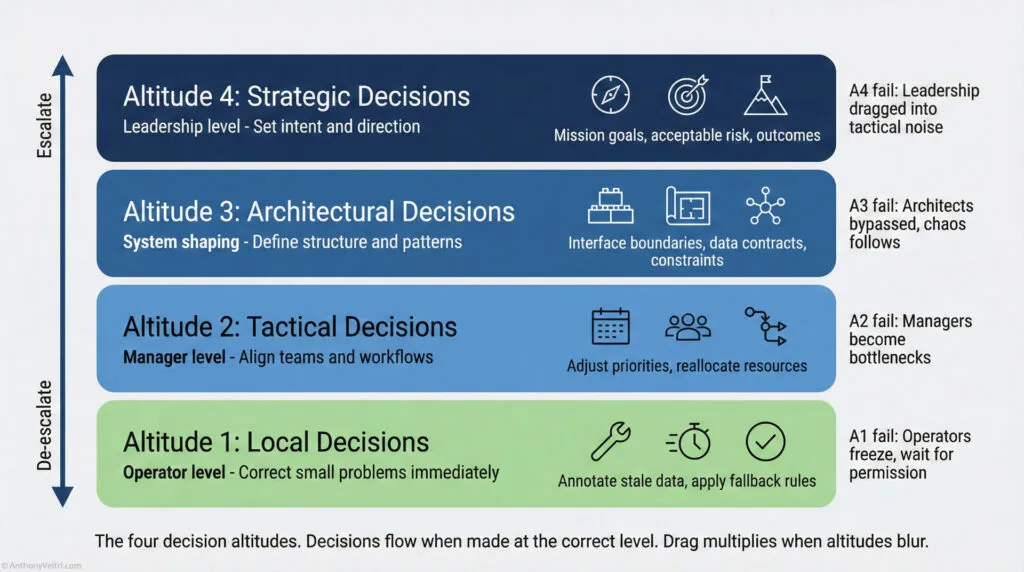
A flowchart with four colored layers: Strategic, Architectural, Tactical, and Local Decisions, each with descriptions of their roles, responsibilities, and consequences if made at the wrong level.
Intent must exist at every altitude. Strategic Intent (Level 4) guides Architectural Intent (Level 3), which constrains Local Intent (Level 1). If a layer is missing, the signal breaks. The Altitude Stack: High visibility work fails when Leadership (L4) tries to edit commas (L1). Stability comes from forcing decisions to their correct level.

High visibility workflows fail when:

  • leaders make Altitude 1 edits
  • operators are unsure what decisions they own
  • managers cannot protect boundaries
  • legal or oversight bodies inject noise

You stabilize the system by assigning roles by altitude:

  • Altitude 4 (Leadership): legitimacy, intent, political framing
  • Altitude 3 (Architecture): templates, boundaries, schema, fallback
  • Altitude 2 (Management): workflow, timelines, sequencing, review cycles
  • Altitude 1 (Operators): correctness, formatting, detail

If you do not do this, the system will collapse under leadership thrash.


Pillar 2: Freeze the Schema Early #

FRNs are the perfect case study:

Before stabilization:

  • fields changed mid cycle
  • leadership added attributes at random
  • terms were interpreted differently
  • definitions were unclear
  • compliance vs preference was confused

After stabilization:

  • schema locked
  • required vs optional fields defined
  • versioning applied
  • changes passed through altitude logic
  • field meaning clarified
  • human contracts stabilized the process

Schema takes the beating that would otherwise fall on humans.


Pillar 3: Define Minimum Viable Publication #
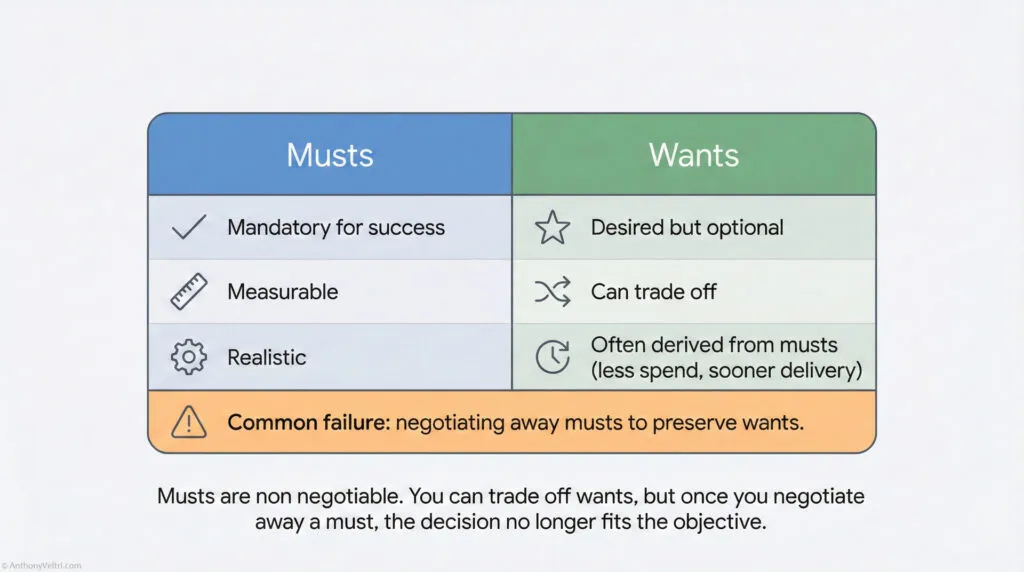
A chart compares "Musts" (mandatory, measurable, realistic) and "Wants" (optional, can trade off, often derived from musts). A warning says negotiating away musts to preserve wants is a common failure.
The MVP Filter. Minimum Viable Publication is defined by “Musts” (Mandatory/Legal). Everything else is a “Want” that can be cut if time runs out.

High visibility work often creates perfectionism spirals.

Without a minimum viable publication definition:

  • fear grows
  • revision cycles explode
  • deadlines become impossible
  • structural changes occur too late
  • decision drag multiplies

With MVP defined:

  • teams know what absolutely must be correct
  • non critical items can slide to next cycle
  • panic edits decrease
  • timeline becomes reliable
  • fear drops
  • leadership pressure becomes manageable

For FRNs, MVP meant:

  • legal accuracy
  • required fields correct
  • formatting within tolerance
  • optional sections negotiable

This transformed the workflow overnight.


Pillar 4: Protect Operators From Visibility Pressure #

Visibility creates fear.
Fear creates freezing.

In high-visibility work, operators often become the target of last-minute revisions and leadership pressure. This creates:

  • over editing
  • decision paralysis
  • defensive behavior
  • over compliance
  • delay cascades

To prevent this:

  • managers buffer operators
  • architects protect boundaries
  • leadership stays at the right altitude
  • human contracts define communication rules
  • operators focus on correctness, not politics

When operators are protected, output quality rises.


Pillar 5: Use Fallback Paths for Late Stage Chaos #
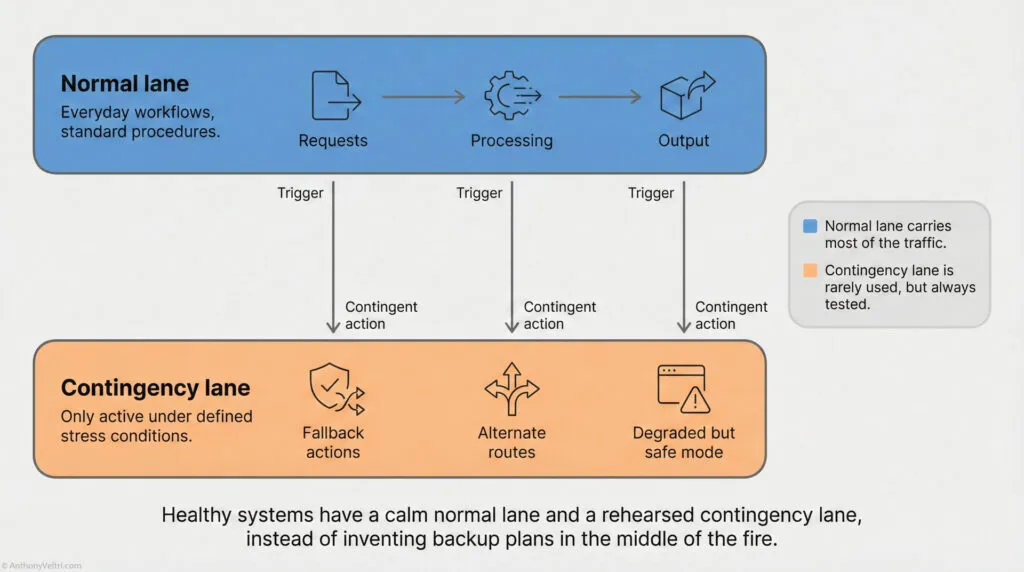
A diagram showing a "Normal lane" for routine workflows with requests, processing, and output, and a "Contingency lane" for stress conditions with fallback actions, alternate routes, and degraded mode.
Degraded Mode is a Lane, Not a Crash. A healthy architecture has a specific “Contingency Lane” (Orange) designed for when the “Normal Lane” (Blue) is blocked. Triggers move you between them safely. Do not mix your crisis response with your normal operations. Build a specific “Contingency Lane” (Orange) that activates when the “Normal Lane” (Blue) is blocked. Also, pay attention to designing the fallback. When the “Perfect” path (Normal Lane) gets blocked by late edits, you must have a pre-approved “Contingency Lane” (Deferral/Annotation) to keep the workflow moving.

High-visibility environments generate last-minute surprises.

Without fallback:

  • teams restart work
  • tempers flare
  • timelines fail
  • quality plummets

Fallback paths include:

  • annotated changes
  • deferral of non-critical content
  • parallel legal review
  • after action publication updates
  • patches in the next cycle

Fallback is the release valve for leadership driven change.


4. High Visibility Workflow Lessons From Our Experience and Perspective #

Lesson 1: Leadership Thrash Is a Structural Problem, Not a Person Problem #

The FRN issue was not difficult personalities.
It was bad altitude discipline and no architecture.

Once structure existed, thrash ended.


Lesson 2: Upstream Clarity Prevents Downstream Collapse #

When leadership clarified why a notice existed, not how it should look, the operators were free to work.

Intent is upstream.
Correctness is downstream.


Lesson 3: High Visibility Work Requires Stronger Contracts #

Human contracts define expectations and prevent emotional escalations.
Data contracts define schema and prevent technical drift.

FRNs required both at a stronger level than iCAV because political visibility amplified the impact of small errors.


Lesson 4: Visibility Should Be Buffered, Not Eliminated #

The goal is not to hide from visibility.
It is to:

  • shape it
  • buffer it
  • channel it
  • prevent it from hitting the wrong altitude

You learned this the hard way.
Now it is doctrine.


5. The High Visibility Workflow Template (Paste Ready) #


High Visibility Workflow Template

Intent:
What this workflow must accomplish.

Visibility Level:
Legal, political, public, oversight, media.

Roles by Altitude:
Altitude 4 (Leadership):
Altitude 3 (Architecture):
Altitude 2 (Management):
Altitude 1 (Operators):

Schema:
Required fields:
Optional fields:
Versioning plan:

Minimum Viable Publication:
Non negotiables:
Negotiables:

Fallback Paths:
Late stage edits:
Last known good:
Parallel review:

Human Contracts:
Communication rules:
Boundaries:
Owners:

Risks:
Leadership thrash, drift, last minute changes, external scrutiny.

Final Quality Gate:
Checklist for publication readiness.


6. Cross Links #

High Visibility Workflow Doctrine draws directly from:

  • Annex A: Human Contracts
  • Annex B: Data Contracts
  • Annex C: Interface Ownership
  • Annex D: Decision Altitudes
  • Annex E: Prevention–Contingency Matrix
  • Annex G: Leadership Doctrine
  • Architecture Doctrine
  • Principle 19: Commitment vs Compliance
  • Principle 20: Leadership vs Management vs Supervision

High visibility workflows are leadership and architecture under a magnifying glass.


7. For Reflection: #

Ask yourself:

Where is your system exposed to high visibility risk?
Where is leadership entering at the wrong altitude?
Where is schema unstable?
Where is fear slowing tempo?
Where are fallback paths missing?

Stabilize the structure.
Protect the operators.
Clarify the altitudes.
Freeze the schema.
Define the fallback.

High visibility demands strong doctrine.

Last Updated on December 5, 2025

Related Posts #

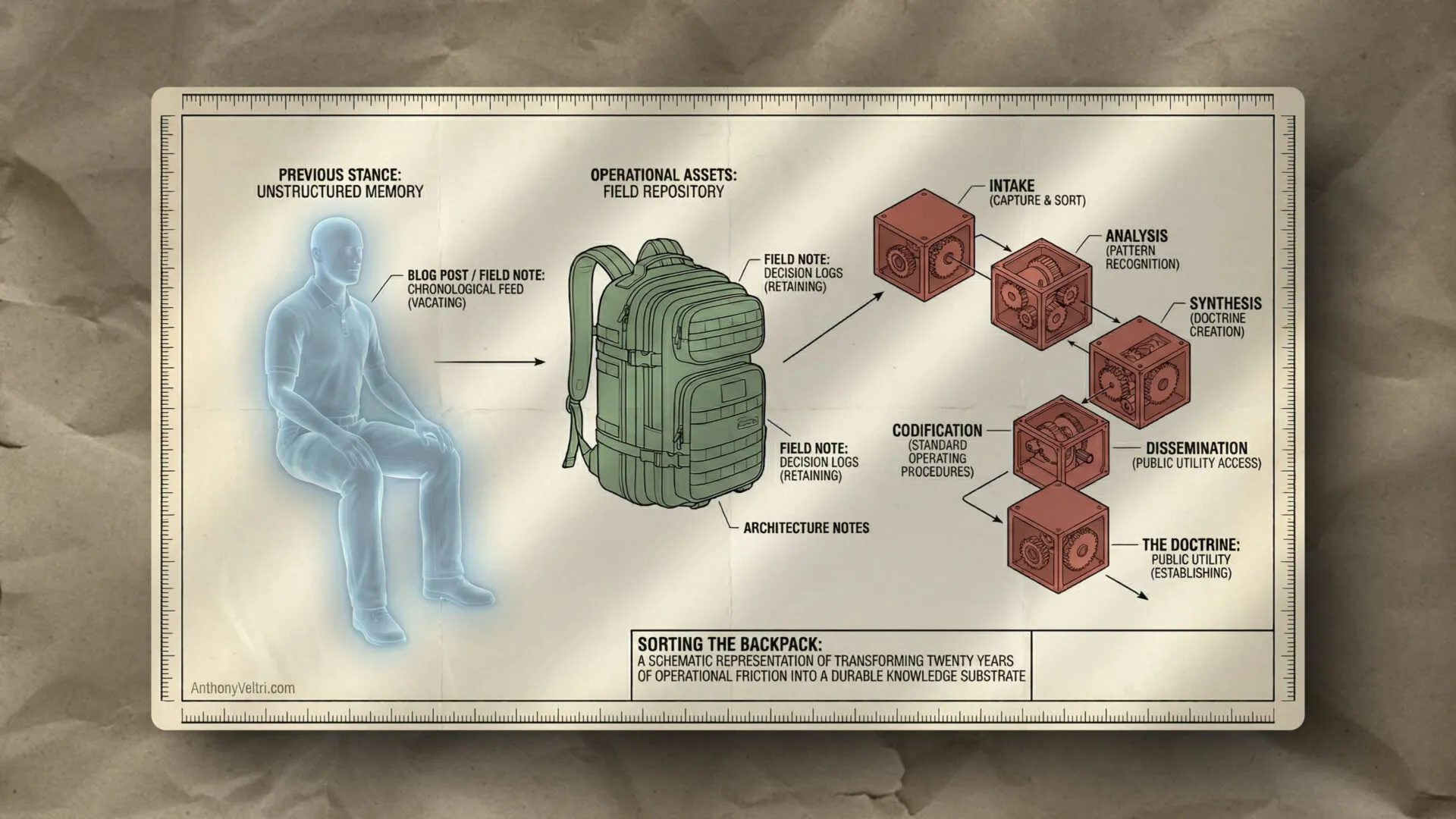
A diagram shows a translucent seated person labeled

Field Note: Sorting the 20-Year Backpack #

A graphic with the title

ANNEX K. System and Workflow Profiles (Case Studies) #

ANNEX F Pattern Library" text over a background of interconnected geometric lines, circles, and digital patterns resembling a circuit or network schematic.

ANNEX F. Pattern Library #

A graphic with abstract blue and black data and circuit patterns, overlaid with a dark rectangle containing the text

Annex L: The Rosetta Stone for Data Teams: Bridging the Gap Between Technicians and Executives #

A graphic with the text

ANNEX A. Human Contracts #

Dark box with large white text “ANNEX G” and smaller text “Leadership Doctrine” overlays a complex blue and gray technical, circuit-like abstract background design.

ANNEX G. Leadership Doctrine #

decision-tempo, governance
Table of Contents
  • How to stabilize work that is high profile but not always high mission value
  • 1. Purpose of High Visibility Workflow Doctrine
  • 2. The Core Problem With High-Visibility Workflows
  • 3. The High-Visibility Workflow Stabilization Model
    • Pillar 1: Clarify Altitude Before Work Begins
    • Pillar 2: Freeze the Schema Early
    • Pillar 3: Define Minimum Viable Publication
    • Pillar 4: Protect Operators From Visibility Pressure
    • Pillar 5: Use Fallback Paths for Late Stage Chaos
  • 4. High Visibility Workflow Lessons From Our Experience and Perspective
    • Lesson 1: Leadership Thrash Is a Structural Problem, Not a Person Problem
    • Lesson 2: Upstream Clarity Prevents Downstream Collapse
    • Lesson 3: High Visibility Work Requires Stronger Contracts
    • Lesson 4: Visibility Should Be Buffered, Not Eliminated
  • 5. The High Visibility Workflow Template (Paste Ready)
  • 6. Cross Links
  • 7. For Reflection:

Share This Article :

  • Facebook
  • X
  • LinkedIn
  • Pinterest

Was it helpful ?

  • Happy
  • Normal
  • Sad
  • Privacy Policy
  • Introductions
  • Contact

© 2026 Anthony Veltri

  • Doctrine
    • Doctrine Library
    • Global Library
  • Field Notes
  • Routes
    • Route 01: When the Interface Is Breaking (and you are becoming the patch)
    • ROUTE 02: If decisions stall and meetings go nowhere, start here
    • ROUTE 03: If you have lots of projects but no portfolio clarity, start here
    • ROUTE 04: If you’re confused about federation vs integration, start here
    • ROUTE 05: If heroics are propping up your system, start here
    • ROUTE 06: If you cannot force compliance across partners, start here
    • ROUTE 07: If compliance exists but commitment does not, start here
    • ROUTE 08: If disconnected workflows create audit anxiety, start here
  • Figure Library
  • FAQ
  • About
    • Capability Statement
    • Interpreter Kit
  • Contact