Skip to content

Introduced by a trusted connector?

Start Here

Anthony Veltri

  • Doctrine
    • Doctrine Library
    • Global Library
  • Field Notes
  • Routes
    • Route 01: When the Interface Is Breaking (and you are becoming the patch)
    • ROUTE 02: If decisions stall and meetings go nowhere, start here
    • ROUTE 03: If you have lots of projects but no portfolio clarity, start here
    • ROUTE 04: If you’re confused about federation vs integration, start here
    • ROUTE 05: If heroics are propping up your system, start here
    • ROUTE 06: If you cannot force compliance across partners, start here
    • ROUTE 07: If compliance exists but commitment does not, start here
    • ROUTE 08: If disconnected workflows create audit anxiety, start here
  • Figure Library
  • FAQ
  • About
    • Capability Statement
    • Interpreter Kit
  • Contact
Anthony Veltri

Architecture & Interfaces

15
  • Doctrine 01: Federation vs Integration in Mission Networks
  • Doctrine 03: Interfaces Are Where Systems Break, So They Require Stewards, Contracts, and Ownership
  • Doctrine 04: Useful Interoperability Is the Goal, Not Perfect Interoperability
  • Doctrine 05: Innovation Must Live at the Edge, Not in the Center
  • Doctrine 06: A Two-Lane System Protects Stability and Enables Evolution
  • Doctrine 14: Technical Debt Is a Leadership Signal, Not a Coding Failure
  • Doctrine 15: Architecture Must Accelerate Teams, Not Bottleneck Them
  • Doctrine 17: Architects Translate Strategy Into Engineering and Engineering Into Strategy
  • Doctrine 20: Golden Datasets: Putting Truth In One Place Without Pretending Everything Is Perfect
  • Doctrine 21: Zero Trust Is A Trust Model, Not A Card “Type”
  • Doctrine 23: Loop Closure as Load-Bearing System Infrastructure
  • ANNEX B. Data Contracts
  • ANNEX C. Interface Ownership Model
  • ANNEX H. Architecture Doctrine
  • Annex L: The Rosetta Stone for Data Teams: Bridging the Gap Between Technicians and Executives

Decision Tempo & Governance

10
  • Doctrine 02: Distributed Decisions Increase Alignment, Speed, and Resilience
  • Doctrine 07: Clear Intent Matters More Than Perfect Data
  • Doctrine 08: Clear Intent Compresses Ambiguity, Reduces Conflict, and Accelerates Action
  • Doctrine 09: Decision Drag Is the Enemy of Mission Tempo. Architecture Is the Remedy
  • Doctrine 10: Degraded Operations Are the Normal Mode, Not the Exception
  • Doctrine 11: Preventive Action and Contingent Action Must Both Be Designed Intentionally
  • Doctrine 22: When “It Depends” Is the Right Answer: How to Think in Probabilities Under Uncertainty
  • ANNEX D. Decision Altitudes Model
  • ANNEX E. Prevention–Contingency Matrix
  • ANNEX I. High Visibility Workflows

Portfolio & Alignment

4
  • Doctrine 16: Portfolio Thinking Ensures Effort Aligns With What Actually Matters
  • ANNEX F. Pattern Library
  • ANNEX J. System Evolution and Drift Management
  • ANNEX K. System and Workflow Profiles (Case Studies)

Leadership & Human Systems

6
  • Doctrine 24: Stewardship Places the Burden on the Steward, Not the Parties
  • Doctrine 18: Commitment Outperforms Compliance in High Trust, High Tempo Environments
  • Doctrine 19: Supervision, Management, and Leadership Are Three Different Jobs. Confusing Them Breaks Systems
  • Doctrine 23: Loop Closure as Load-Bearing System Infrastructure
  • ANNEX A. Human Contracts
  • ANNEX G. Leadership Doctrine

Resilience & Operations

3
  • Doctrine 24: Stewardship Places the Burden on the Steward, Not the Parties
  • Doctrine 12: Resilience Is an Emergent Property, Not a Feature
  • Doctrine 13: Problem Solving Requires Finding the Real Deviation and the Relevant Change

Doctrine Companions

7
  • Doctrine 03 Companion: The RS-CAT Framework: Converting Raw Recall into Teachable Principle
  • Doctrine 03 Companion: The Interface Void
  • Doctrine 11 Companion: Agency vs. Outcome
  • Doctrine 09 Companion: Artifacts Over Adjectives
  • Doctrine 03 Companion: Constraints: bidirectional translation: Compression vs Construction
  • Doctrine 10 Companion: Span of Control and Cross Training Are Load-Bearing Constraints
  • Doctrine 21 Companion: Claims, Roles, and Entitlements in Microsoft 365

Field Reports

1
  • Field Report: College Financing and the 5-Year Home Runway
View Categories
  • Home
  • Doctrine & Supporting Guides
  • Portfolio & Alignment
  • ANNEX J. System Evolution and Drift Management

ANNEX J. System Evolution and Drift Management

Anthony Veltri
Updated on December 5, 2025

4 min read

ANNEX J. System Evolution and Drift Management #

How systems change over time, why drift is inevitable, and how to manage evolution without losing coherence #


1. Purpose of System Evolution and Drift Management #
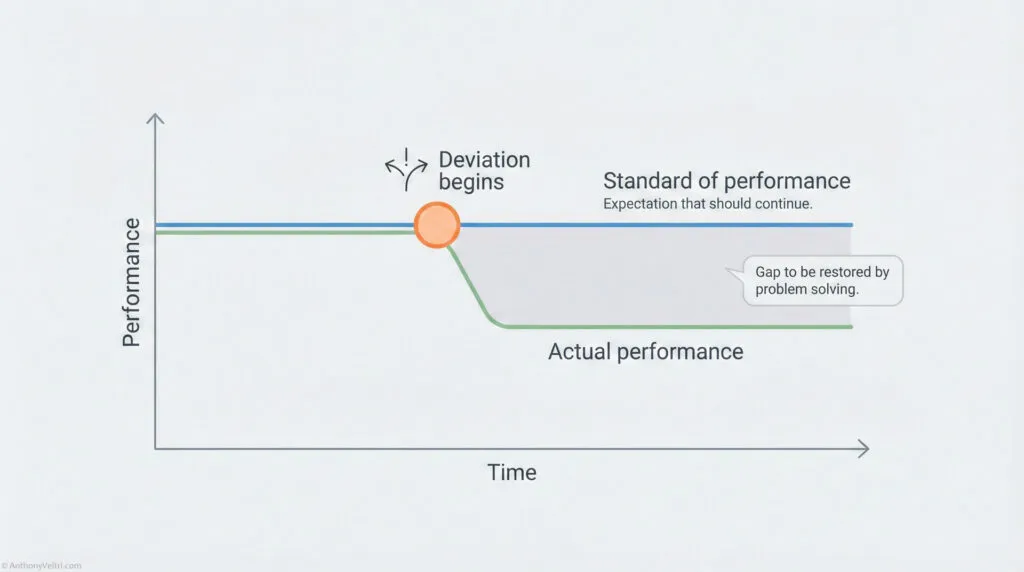
A line graph shows performance over time. At one point, actual performance drops below the standard of performance, creating a gap labeled "Gap to be restored by problem solving.
The Reality Gap & The Deviation Gap. A problem is not just “something bad.” It is a measurable divergence (Green Line) from an expected standard (Blue Line). If you cannot draw this gap, you do not have a problem statement. If you don’t measure this gap, you cannot manage it.

Every real system evolves:

  • requirements change
  • partners shift tools
  • staffing changes
  • leadership priorities move
  • schemas drift
  • political visibility increases
  • technology matures
  • workflows adapt

Evolution is normal.
Drift is inevitable.
Unmanaged drift becomes fragility.

This annex explains how to manage evolution intentionally so systems remain resilient instead of degrading into chaos.


2. The Three Forces of System Evolution #

Every system is shaped by three forces.


Force 1: Natural Drift #

Drift occurs because:

  • partners update independently
  • teams interpret rules differently
  • people rotate in and out
  • language diverges
  • data shapes change
  • political pressures reshape priorities

Drift is not a failure.
It is a signal that the system is alive.


Force 2: Intentional Adaptation #

Leadership, architecture, and management all introduce planned changes such as:

  • new fields
  • new partners
  • new templates
  • new ingest pathways
  • new compliance requirements
  • new workflows

This is the evolution that keeps the system relevant.


Force 3: External Shock #

External shocks include:

  • legal changes
  • public scrutiny
  • oversight bodies
  • partner outages
  • policy shifts
  • sudden mission needs

These shocks stress the system and reveal its load-bearing structures.


3. Why Drift Must Be Managed, Not Eliminated #

Many organizations try to eliminate drift.
This is impossible and harmful.

If drift is suppressed:

  • people hide issues
  • silent failures grow
  • leadership becomes blind
  • edge use cases become brittle
  • the architecture becomes unrealistic
  • surprises become catastrophic

Managed drift is transparency.
Suppressed drift is denial.


4. The Drift Management Cycle #

Systems remain healthy when drift is processed through a four-step cycle.
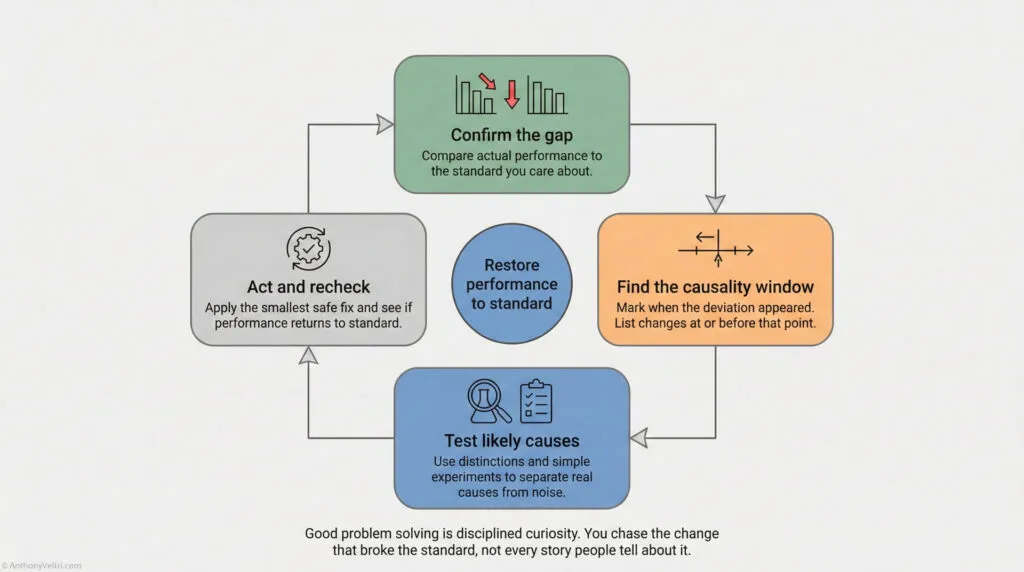
A flowchart showing a problem-solving cycle: Confirm the gap, Find the causality window, Test likely causes, Act and recheck, all revolving around restoring performance to standard. Text at bottom emphasizes disciplined curiosity.
The Resolution Loop. Disciplined problem solving moves in a cycle: Confirm the Gap –> Find the Causality Window –> Test Likely Causes –> Act and Recheck. As with an OODA loop, interruptions of the cycle can be disorienting and costly. You cannot manage drift linearly. You must cycle through Confirming the Gap, Finding the Cause, Testing the Fix, and Updating the Standard.

Step 1: Detect Drift #

Detection methods include:

  • schema validation
  • timestamp monitoring
  • diff checking
  • manual spot checks
  • cross-team reviews
  • quality gates
  • operator feedback

This is the early warning system.


Step 2: Classify Drift #

Determine whether the drift is:

  • benign
  • acceptable variation
  • early stage degradation
  • incorrect but recoverable
  • critical and requiring immediate action

Classification prevents overreaction.


Step 3: Absorb or Correct Drift #

Absorb drift when:

  • it falls within tolerance
  • it does not violate intent
  • it does not break consistency

Correct drift when:

  • it violates required fields
  • it breaks workflows
  • it causes chain reactions
  • it introduces risk
  • it degrades truth
  • it affects public output

Absorption uses flexibility.
Correction uses architecture.


Step 4: Update the Contract or Architecture #

If drift is recurring:

  • update the schema
  • update the boundary
  • update the fallback rules
  • update the human contract
  • update timelines
  • update ownership
  • update the architecture

This turns lived experience into system evolution.


5. Evolution Paths: How Systems Grow Without Breaking #

Healthy systems evolve through predictable paths.


Path 1: Edge Innovation → Standardization → Architecture #

Teams innovate at the edge.
Useful patterns become standard.
Architecture formalizes them.

This preserves creativity without chaos.


Path 2: Temporary Fix → Stabilization → Design Update #

A quick fix solves an urgent problem.
Stabilization absorbs the fix.
The architecture updates the underlying structure.

This prevents emergencies from hardcoding bad patterns.


Path 3: Partner Variation → Federation → Harmonization #
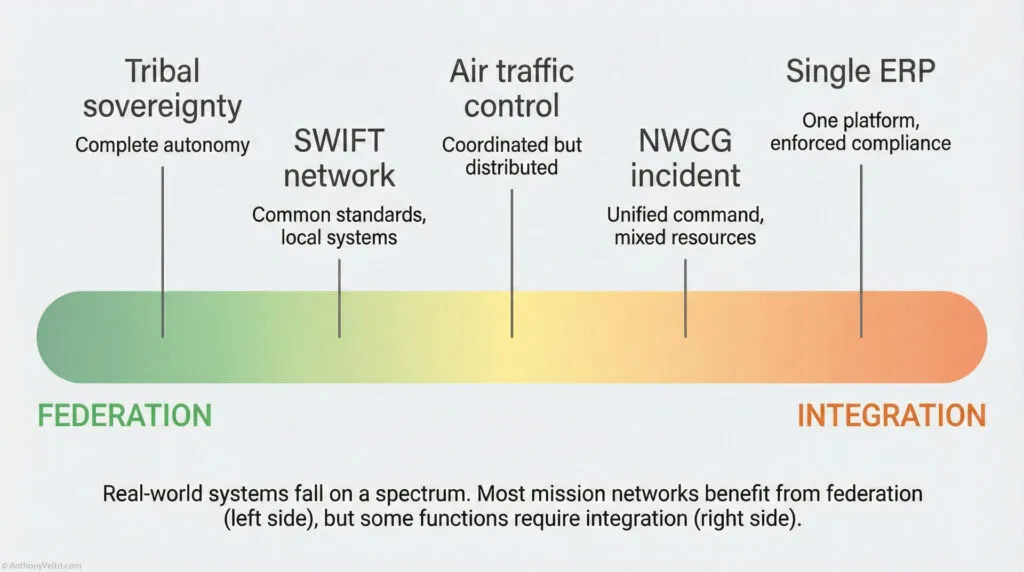
A spectrum from "Federation" to "Integration" shows examples: Tribal sovereignty (autonomy), SWIFT network (common standards), air traffic control (coordinated), NWCG incident (unified command), and Single ERP (enforced compliance).
Absorbing Variation. Integrated systems (Right) break when one partner drifts. Federated systems (Left) absorb drift because partners are loosely coupled. Note on Air Traffic Control: We place ATC in the middle because, at a global level, it is a federation of sovereign systems handing off aircraft via protocol. However, if you zoom in to a single US Area Center or the National Airspace System, the system shifts to the far right (Tight Integration). The Lesson: Successful systems are often integrated locally (for control) but federated globally (for scale).

Partners change independently.
Federation absorbs variation.
Harmonization aligns meaning.

This is the core of durable, multi-partner systems.


6. How Evolution Failed in High-Visibility Workflows #

High-visibility workflows, such as FRNs, often suffered from unmanaged evolution:

  • new fields introduced without planning
  • leadership-driven changes without impact review
  • text requirements changed mid-cycle
  • implicit rules replaced explicit boundaries
  • updates introduced late in the workflow
  • versioning was not applied
  • fallback rules were undefined

Without drift management, every cycle felt unstable.

With drift management:

  • schema became stable
  • versioning occurred intentionally
  • fallback reduced chaos
  • changes were communicated clearly
  • operators were protected from late surprises
  • leadership pressure no longer created collapse

Evolution became deliberate instead of accidental.


7. How Evolution Succeeded in Mission Systems #
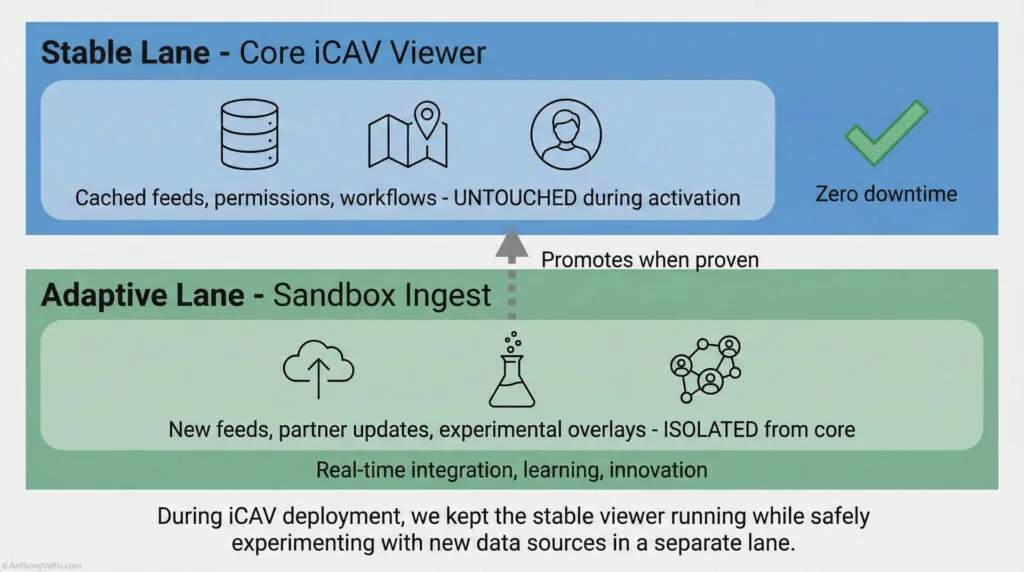
Diagram showing two lanes: "Stable Lane – Core iCAV Viewer" (blue, represents zero downtime and untouched activation) above "Adaptive Lane – Sandbox Ingest" (green, for new feeds and real-time innovation), with a promotion arrow between them.
We kept the core viewer stable (Blue) while letting the field experiment with new data in the sandbox (Green). Successful experiments were promoted; failures were discarded without breaking the mission. This is an example of Resilience in Practice. We separated the Stable Lane (Viewer) from the Adaptive Lane (Ingest). When the ingest broke, the viewer stayed up. That is emergent resilience.

Mission systems like iCAV succeeded because drift management was structural:

  • partners drifted, but federation absorbed variation
  • schemas changed, but versioning controlled breakage
  • ingest updated, but fallback preserved truth
  • politics shifted, but architecture kept the system coherent
  • operators adapted, but boundaries kept them safe

Evolution remained survivable because the architecture expected drift.


8. Drift Management Template (Paste Ready) #


Drift Management Template

Drift Detected:
Describe the deviation.

Type of Drift:
Benign, tolerable, correctable, critical.

Detection Method:
How the drift was discovered.

Impact:
Local, cross-team, architectural, strategic.

Tolerance:
Inside or outside allowed variation.

Action:
Absorb or correct.

Next Step:
Update schema, boundary, contract, fallback, versioning, or workflow.


9. Cross Links #

System Evolution and Drift Management ties directly to:

  • Architecture Doctrine
  • Prevention–Contingency Matrix
  • Interface Ownership
  • Data Contracts
  • Human Contracts
  • Pattern Library
  • Decision Altitudes
  • High Visibility Workflows

Drift management is the bridge between real conditions and designed systems.


10. For Reflection: #

Ask:

Where does drift accumulate?
Where has drift become normalized?
Where is drift hidden?
Where is drift unacknowledged?
Where does drift reveal missing architecture?

Manage the drift.
Adapt the architecture.
Strengthen the system.

Last Updated on December 5, 2025

Related Posts #

A graphic with the title

ANNEX K. System and Workflow Profiles (Case Studies) #

A graphic with abstract circuit-like patterns and geometric shapes. Large text reads

ANNEX H. Architecture Doctrine #

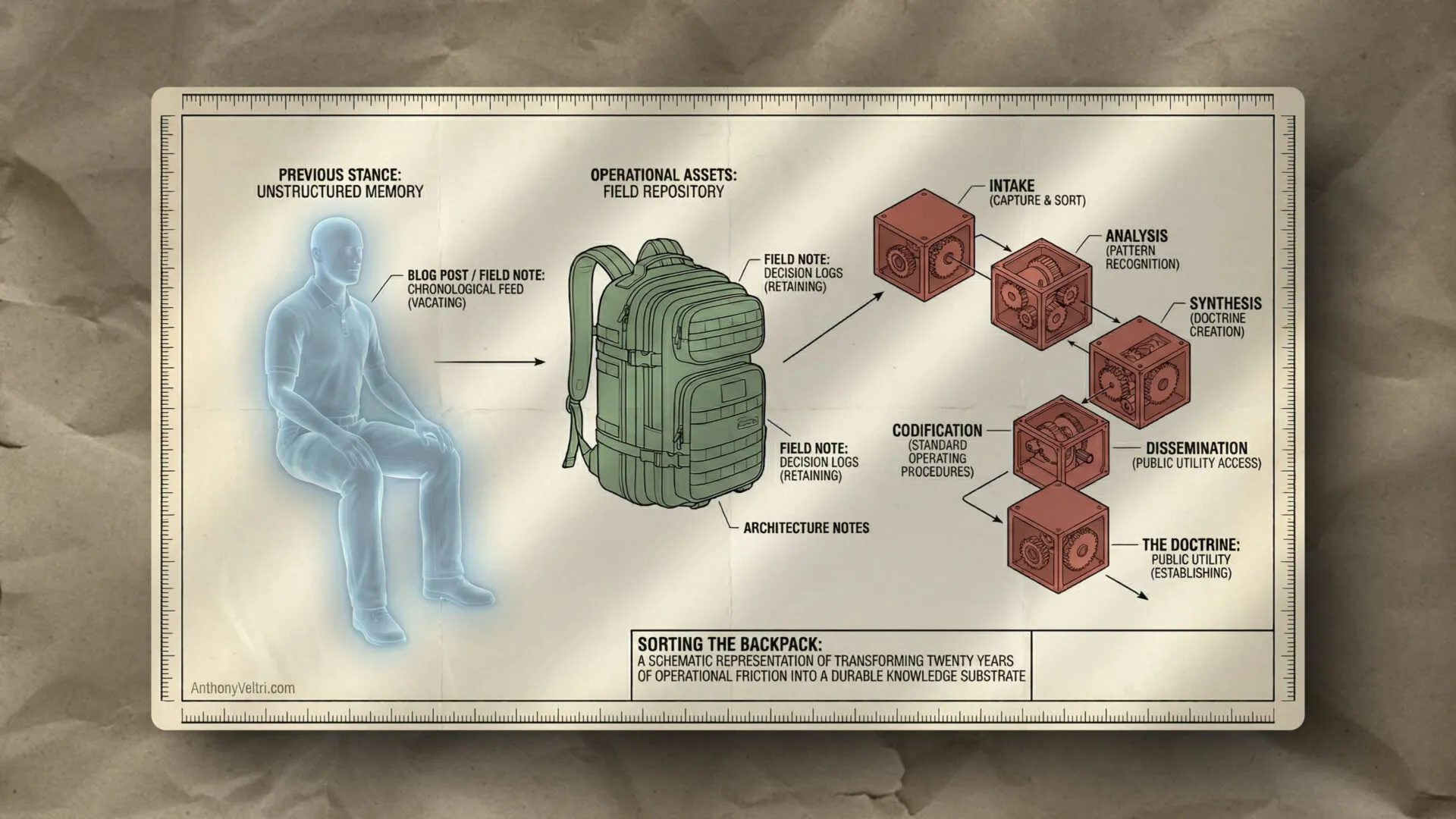
A diagram shows a translucent seated person labeled

Field Note: Sorting the 20-Year Backpack #

ANNEX F Pattern Library" text over a background of interconnected geometric lines, circles, and digital patterns resembling a circuit or network schematic.

ANNEX F. Pattern Library #

A graphic with the title

ANNEX B. Data Contracts #

A digital graphic with the title "ANNEX I High-Visibility Workflows" in bold text, overlaid on a background of abstract, interconnected lines and circles resembling a technical or technological schematic.

ANNEX I. High Visibility Workflows #

architecture, governance, portfolio, visibility
Table of Contents
  • ANNEX J. System Evolution and Drift Management
    • How systems change over time, why drift is inevitable, and how to manage evolution without losing coherence
  • 1. Purpose of System Evolution and Drift Management
  • 2. The Three Forces of System Evolution
    • Force 1: Natural Drift
    • Force 2: Intentional Adaptation
    • Force 3: External Shock
  • 3. Why Drift Must Be Managed, Not Eliminated
  • 4. The Drift Management Cycle
    • Step 1: Detect Drift
    • Step 2: Classify Drift
    • Step 3: Absorb or Correct Drift
    • Step 4: Update the Contract or Architecture
  • 5. Evolution Paths: How Systems Grow Without Breaking
    • Path 1: Edge Innovation → Standardization → Architecture
    • Path 2: Temporary Fix → Stabilization → Design Update
    • Path 3: Partner Variation → Federation → Harmonization
  • 6. How Evolution Failed in High-Visibility Workflows
  • 7. How Evolution Succeeded in Mission Systems
  • 8. Drift Management Template (Paste Ready)
  • 9. Cross Links
  • 10. For Reflection:

Share This Article :

  • Facebook
  • X
  • LinkedIn
  • Pinterest

Was it helpful ?

  • Happy
  • Normal
  • Sad
  • Privacy Policy
  • Introductions
  • Contact

© 2026 Anthony Veltri

  • Doctrine
    • Doctrine Library
    • Global Library
  • Field Notes
  • Routes
    • Route 01: When the Interface Is Breaking (and you are becoming the patch)
    • ROUTE 02: If decisions stall and meetings go nowhere, start here
    • ROUTE 03: If you have lots of projects but no portfolio clarity, start here
    • ROUTE 04: If you’re confused about federation vs integration, start here
    • ROUTE 05: If heroics are propping up your system, start here
    • ROUTE 06: If you cannot force compliance across partners, start here
    • ROUTE 07: If compliance exists but commitment does not, start here
    • ROUTE 08: If disconnected workflows create audit anxiety, start here
  • Figure Library
  • FAQ
  • About
    • Capability Statement
    • Interpreter Kit
  • Contact