Why waiting multiplies work and how architectural clarity keeps decisions flowing #
This page is a Doctrine Guide. It shows how to apply one principle from the Doctrine in real systems and real constraints. Use it as a reference when you are making decisions, designing workflows, or repairing things that broke under pressure.
One decision made early replaces five decisions made late. #
Decision drag is the hidden tax on every mission environment.
Most leaders and engineers see:
- delays
- confusion
- escalations
- endless meetings
- repeated reviews
- unanswered questions
- multiple versions of the truth
What they do not see is the multiplication effect.
Every delayed decision:
- grows new dependencies
- collides with new risks
- acquires more stakeholders
- demands more alignment
- increases political cost
- expands rework
- becomes more emotionally loaded
- forces more decisions later
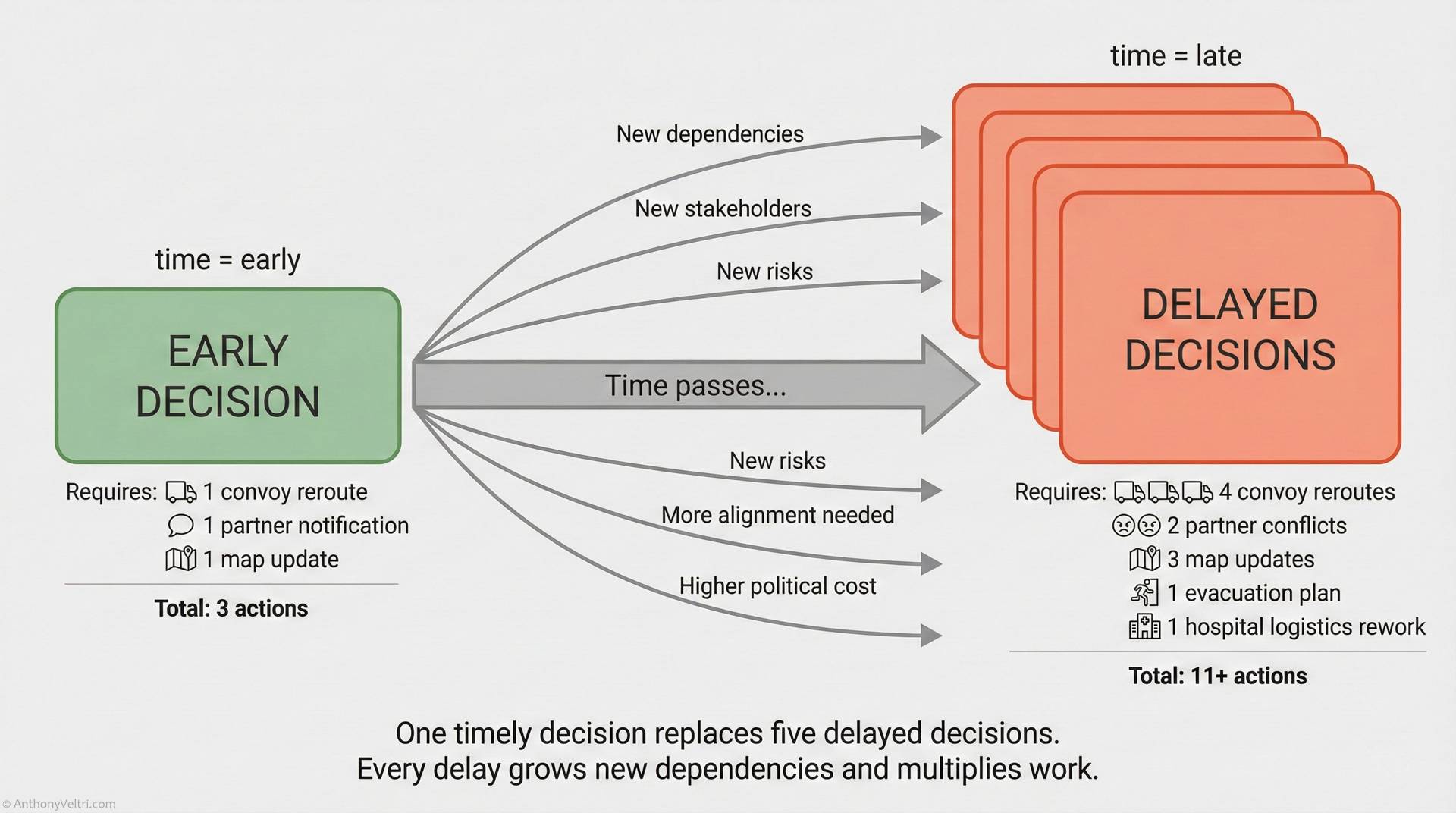
One timely decision becomes five delayed decisions.
That is decision drag.
Architecture removes it.
Lived Example: The routing decision that multiplied because it waited #
During a severe weather activation, we needed to decide whether to close a logistics corridor.
If made early, the decision would have required:
- Rerouting one convoy
- Notifying one partner
- Updating one map layer
Instead, leadership waited for:
- a perfect data feed
- a second confirmation
- a new forecast model
- a call with another agency
- a higher level sign off
By the time the decision was made:
- four convoys were en route
- two partner agencies had made conflicting assumptions
- an evacuation plan had changed
- a hospital logistics plan needed reworking
- three map layers had to be updated
One early decision became five late decisions.
The problem was not leadership.
The problem was decision drag.
Architecture fixes the environment that creates drag.
Business Terms: What decision drag looks like in daily operations #
Decision drag appears as:
- waiting for one more update
- waiting for one more meeting
- waiting for one more approval
- waiting for perfect information
- unclear boundaries
- unclear ownership
- unclear criteria
- unclear tradeoffs
- unclear authority
Decision drag is not indecision.
Decision drag is the natural outcome of unclear design.
Teams get trapped because the system does not support timely action.
System Terms: Decision drag as structural latency #
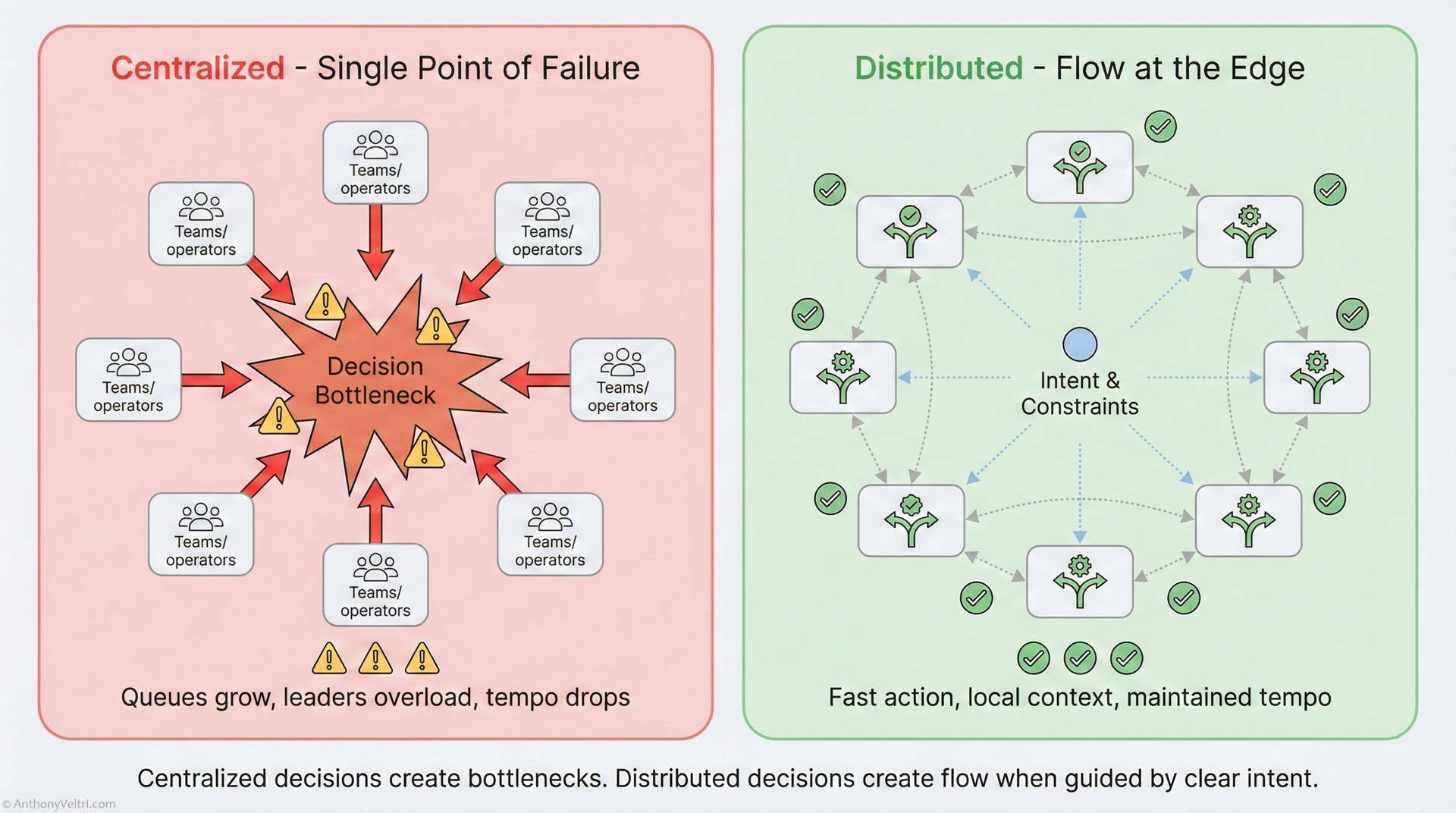
In system language, decision drag is:
- latency in decision pathways
- overload at the center
- high coupling between decision nodes
- unclear escalation routes
- ambiguous invariants
- lack of constraints
- missing guardrails
- unclear interfaces between teams
- decision dependency chains that keep growing
Decision drag is a system behavior, not a personality trait.
Drag emerges from structure.
Why Decision Drag Multiplies Effort #
Decision drag is expensive because:
- conditions change while you wait
- misalignment grows
- partners act independently
- side effects accumulate
- risk increases
- political stakes get higher
- the cognitive load rises
- the social cost of being wrong grows
- each delay adds new variables
By the time a delayed decision is made, the problem is five times harder.
Drag compounds like interest.
Why Humans Get Stuck in Drag #
Business perspective #
People fall into drag because:
- they fear being wrong
- they are waiting for someone more senior
- incentives reward caution
- requirements are ambiguous
- ownership is unclear
- escalation is safer than autonomy
- leadership sends mixed signals
- meetings replace movement
Decision drag is not a lack of courage.
It is a lack of clarity.
System perspective #
Systems fall into drag because:
- pathways are uncertain
- “must haves” are mixed with “nice to haves”
- priorities shift silently
- dependencies are not mapped
- interfaces are poorly defined
- governance is slow
- data expectations are unrealistic
Drag is structural misalignment.
Why Architecture Eliminates Decision Drag #
Architecture provides:
- clear intent
- clear boundaries
- clear ownership
- clear constraints
- clear allowable autonomy
- clear fallback behavior
- clear invariants
- clear interfaces
- clear decision altitudes
When these are present, decisions move fast.
Architecture reduces cognitive load.
Reduced load increases autonomy.
Increased autonomy preserves tempo.
Architecture is how you design decision flow into the system.
The Decision Funnel (Musts, Wants, Risks) #
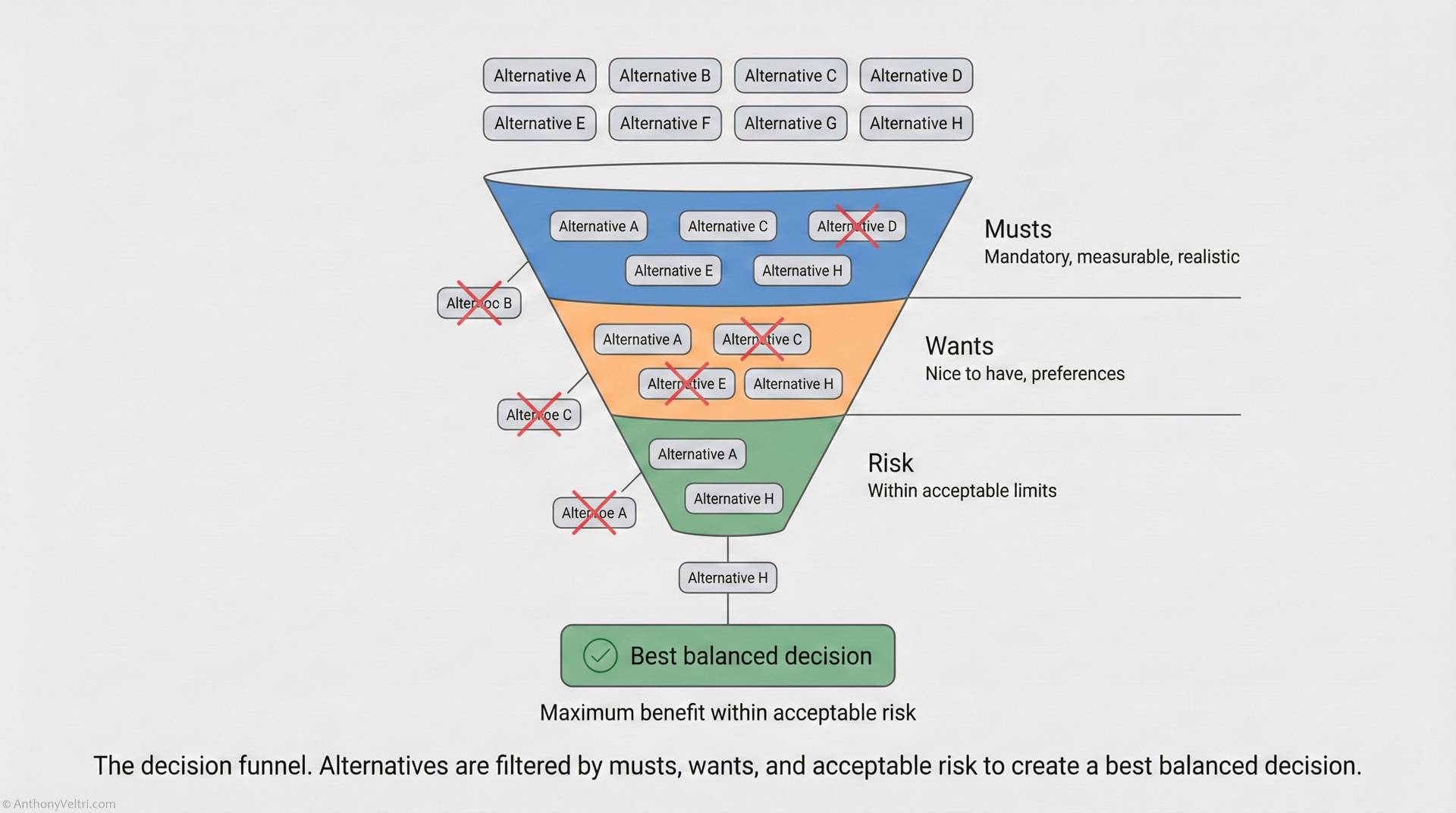
Strong decision architectures classify inputs into:
- Musts
Non-negotiable criteria that anchor the decision. - Wants
Preferences that improve the decision but are not required. - Risks
Factors that shape timing, escalation, or fallback.
Drag happens when:
- musts and wants are confused
- risks are unspoken
- tradeoffs are implicit
- criteria shift mid stream
A clean funnel eliminates 80 percent of drag by stabilizing the decision frame.
Business Example: The four day delay that became a four week problem #
Leadership once delayed a small decision about standardizing a feed schema.
That four-day stall resulted in:
- a blocked development sprint
- a partner that built to the old schema
- a second team duplicating work
- a testing window missed
- a political disagreement between managers
- a downstream conflict that required director level involvement
One early decision could have resolved everything.
Drag multiplied the cost.
System Example: iCAV’s decision flow reduced drag by design #
In iCAV:
- ingest patterns were predefined
- partner connectors had known behavior
- emergency ingest had fallback rules
- decision altitudes were clear
- data tolerances were baked in
- change windows were scheduled
- critical layers had priority slots
- minimum viable publication was defined
This eliminated the need to debate most decisions in real time.
The architecture decided for us.
The system flowed because the pathways were already designed.
Architect Level Principle #
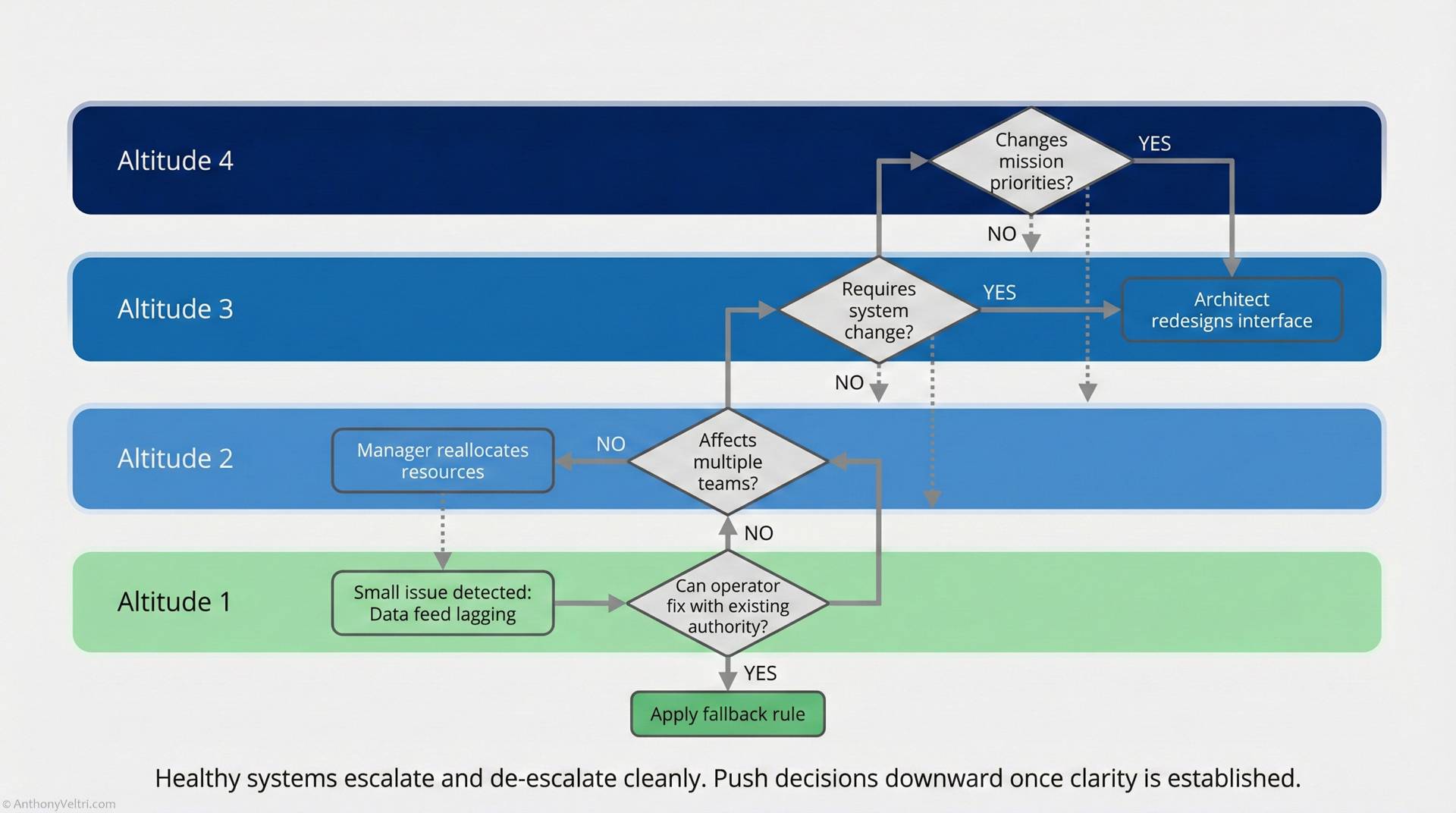
As an architect I design systems that eliminate decision drag.
I create clear pathways, boundaries, contracts, and invariants so teams can act early and decisively.
Timely decisions preserve mission tempo.
Delayed decisions multiply work.
Twenty-Second Takeaway: #
“Decision drag turns one early decision into five delayed decisions. It multiplies effort and slows mission tempo. I design architectures that remove drag by clarifying ownership, intent, pathways, and constraints so teams can act quickly without waiting for perfect information.”
Cross Links to Other Principles #
Decision drag ties directly to:
- Clear intent
- Distributed decisions
- Architecture accelerates
- Interfaces and ownership
- Portfolio thinking
- Useful interoperability
- Degraded operations
- Preventive and contingent action
- Emergent resilience
Decision drag is the negative space that good architecture resolves.
Doctrine Diagnostic – For Reflection: #
Ask yourself:
Where in your system does work multiply when decisions stall?
Identify the drag.
Redesign the pathway.
Stop paying the tax.
Field notes and examples #
- Field Note: The Stamp Fallacy at the Interface
- Field Note: Compass-X Recognition Patterns and Strategic Framing
- Field Note: Sorting the 20-Year Backpack
- Field Note: Guided Sensemaking Interview
- Why This Site Has Four Navigation Systems
- Field Note: Snake or Stick?!
- Business Analysis Center of Excellence – How To Stop Committing Project Malpractice
- When You Choose Integration over Federation On Purpose
Last Updated on February 22, 2026