Skip to content

Introduced by a trusted connector?

Start Here

Anthony Veltri

  • Doctrine
    • Doctrine Library
    • Global Library
  • Field Notes
  • Routes
    • Route 01: When the Interface Is Breaking (and you are becoming the patch)
    • ROUTE 02: If decisions stall and meetings go nowhere, start here
    • ROUTE 03: If you have lots of projects but no portfolio clarity, start here
    • ROUTE 04: If you’re confused about federation vs integration, start here
    • ROUTE 05: If heroics are propping up your system, start here
    • ROUTE 06: If you cannot force compliance across partners, start here
    • ROUTE 07: If compliance exists but commitment does not, start here
    • ROUTE 08: If disconnected workflows create audit anxiety, start here
  • Figure Library
  • FAQ
  • About
    • Capability Statement
    • Interpreter Kit
  • Contact
Anthony Veltri

Architecture & Interfaces

15
  • Doctrine 01: Federation vs Integration in Mission Networks
  • Doctrine 03: Interfaces Are Where Systems Break, So They Require Stewards, Contracts, and Ownership
  • Doctrine 04: Useful Interoperability Is the Goal, Not Perfect Interoperability
  • Doctrine 05: Innovation Must Live at the Edge, Not in the Center
  • Doctrine 06: A Two-Lane System Protects Stability and Enables Evolution
  • Doctrine 14: Technical Debt Is a Leadership Signal, Not a Coding Failure
  • Doctrine 15: Architecture Must Accelerate Teams, Not Bottleneck Them
  • Doctrine 17: Architects Translate Strategy Into Engineering and Engineering Into Strategy
  • Doctrine 20: Golden Datasets: Putting Truth In One Place Without Pretending Everything Is Perfect
  • Doctrine 21: Zero Trust Is A Trust Model, Not A Card “Type”
  • Doctrine 23: Loop Closure as Load-Bearing System Infrastructure
  • ANNEX B. Data Contracts
  • ANNEX C. Interface Ownership Model
  • ANNEX H. Architecture Doctrine
  • Annex L: The Rosetta Stone for Data Teams: Bridging the Gap Between Technicians and Executives

Decision Tempo & Governance

10
  • Doctrine 02: Distributed Decisions Increase Alignment, Speed, and Resilience
  • Doctrine 07: Clear Intent Matters More Than Perfect Data
  • Doctrine 08: Clear Intent Compresses Ambiguity, Reduces Conflict, and Accelerates Action
  • Doctrine 09: Decision Drag Is the Enemy of Mission Tempo. Architecture Is the Remedy
  • Doctrine 10: Degraded Operations Are the Normal Mode, Not the Exception
  • Doctrine 11: Preventive Action and Contingent Action Must Both Be Designed Intentionally
  • Doctrine 22: When “It Depends” Is the Right Answer: How to Think in Probabilities Under Uncertainty
  • ANNEX D. Decision Altitudes Model
  • ANNEX E. Prevention–Contingency Matrix
  • ANNEX I. High Visibility Workflows

Portfolio & Alignment

4
  • Doctrine 16: Portfolio Thinking Ensures Effort Aligns With What Actually Matters
  • ANNEX F. Pattern Library
  • ANNEX J. System Evolution and Drift Management
  • ANNEX K. System and Workflow Profiles (Case Studies)

Leadership & Human Systems

6
  • Doctrine 24: Stewardship Places the Burden on the Steward, Not the Parties
  • Doctrine 18: Commitment Outperforms Compliance in High Trust, High Tempo Environments
  • Doctrine 19: Supervision, Management, and Leadership Are Three Different Jobs. Confusing Them Breaks Systems
  • Doctrine 23: Loop Closure as Load-Bearing System Infrastructure
  • ANNEX A. Human Contracts
  • ANNEX G. Leadership Doctrine

Resilience & Operations

3
  • Doctrine 24: Stewardship Places the Burden on the Steward, Not the Parties
  • Doctrine 12: Resilience Is an Emergent Property, Not a Feature
  • Doctrine 13: Problem Solving Requires Finding the Real Deviation and the Relevant Change

Doctrine Companions

7
  • Doctrine 03 Companion: The RS-CAT Framework: Converting Raw Recall into Teachable Principle
  • Doctrine 03 Companion: The Interface Void
  • Doctrine 11 Companion: Agency vs. Outcome
  • Doctrine 09 Companion: Artifacts Over Adjectives
  • Doctrine 03 Companion: Constraints: bidirectional translation: Compression vs Construction
  • Doctrine 10 Companion: Span of Control and Cross Training Are Load-Bearing Constraints
  • Doctrine 21 Companion: Claims, Roles, and Entitlements in Microsoft 365

Field Reports

1
  • Field Report: College Financing and the 5-Year Home Runway
View Categories
  • Home
  • Doctrine & Supporting Guides
  • Decision Tempo & Governance
  • Doctrine 02: Distributed Decisions Increase Alignment, Speed, and Resilience

Doctrine 02: Distributed Decisions Increase Alignment, Speed, and Resilience

Anthony Veltri
Updated on December 9, 2025

3 min read

Why mission systems move faster and survive more when decisions are made at the lowest competent level #

This page is a Doctrine Guide. It shows how to apply one principle from the Doctrine in real systems and real constraints. Use it as a reference when you are making decisions, designing workflows, or repairing things that broke under pressure.


1. Centralization Creates Fragility #
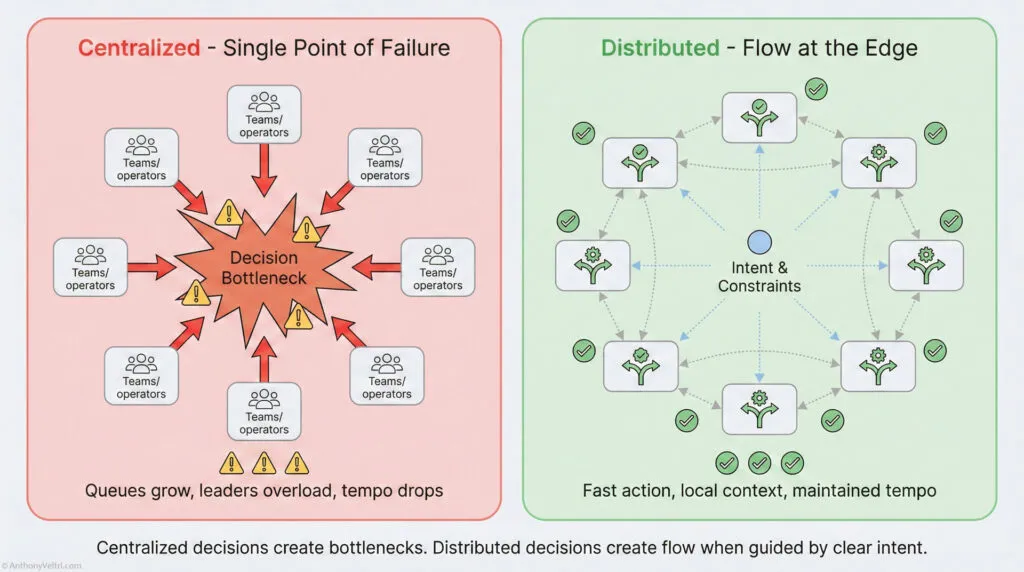
Infographic comparing centralized (single point of failure) with distributed (flow at the edge) decision-making. Centralized shows bottlenecks and overload; distributed shows quick, local decisions guided by intent and constraints.
A decision-making comparison between centralized (single point of failure) with distributed (flow at the edge) decision-making. Centralized shows bottlenecks and overload; distributed shows quick, local decisions guided by intent and constraints.

Centralized control feels safe during planning.

It appears orderly. Predictable. Controlled.

But once an environment becomes dynamic, uncertain, or degraded, centralized decision making collapses under its own load:

  • information queues grow
  • approval paths saturate
  • leaders overload
  • operators freeze
  • mission tempo drops

Centralization creates a single point of decision failure.

Distributed decisions create flow.


2. Why Distributed Decisions Work #
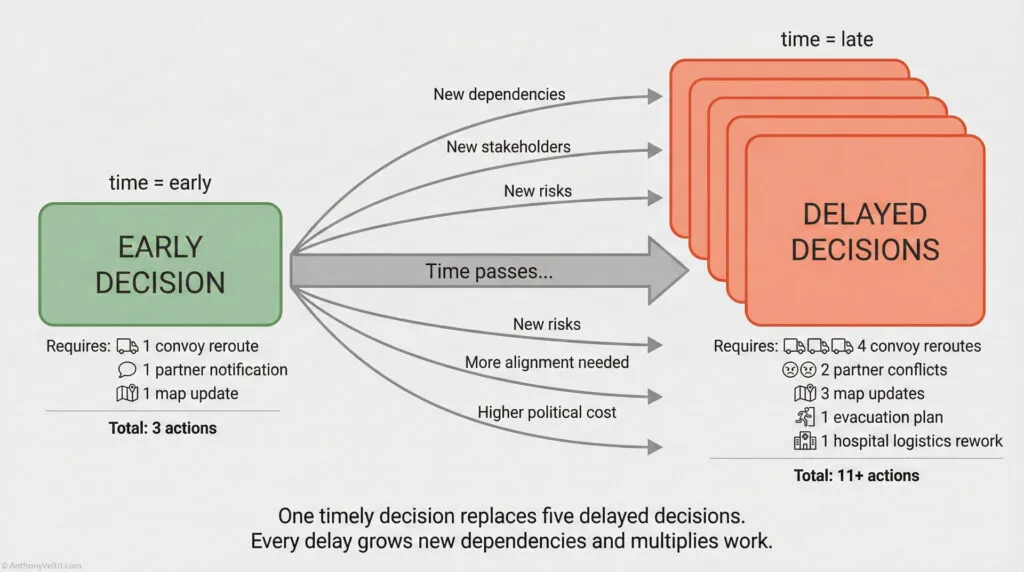
A flowchart compares early and delayed decisions. Early decision (left) leads to 3 actions; delayed decisions (right) lead to 11+ actions, more risks, costs, and dependencies. Text below states delays multiply work.
Early decision (left) leads to 3 actions; delayed decisions (right) lead to 11+ actions, more risks, costs, and dependencies.

Distributed decisions move decision authority closer to the edge, where people:

  • see the problem first
  • understand local conditions
  • act faster than escalation pathways can respond
  • adapt to drift
  • execute intent without waiting

Distributed decisions are not chaos.
Distributed decisions are designed autonomy inside clear intent and boundaries.


3. Lived Example: When the Central Desk Went Dark #

During a severe weather activation at DHS, a communications outage severed a minor regional hub from the central coordination node. For about thirty minutes, the center was blind.

The field teams did not freeze.

Teams in affected districts:

  • rerouted traffic locally
  • deployed generators
  • coordinated via radio
  • prepared evacuation staging
  • preserved routes to critical facilities

They acted because intent was known:

  • preserve life
  • preserve mobility
  • preserve access to critical facilities

Distributed authority protected mission tempo.

If every decision had required central approval, the activation would have lost an hour.


4. Lived Example: The Analyst Who Moved Without Waiting #

During another activation, an analyst noticed:

  • a partner feed lagging
  • a flood zone shifting
  • a road closure layer drifting out of sync

She understood the intent and her authority.

She:

  • adjusted the routing overlay
  • annotated stale data
  • pulled from cached layers
  • notified the partner of drift

By the time leadership reviewed the picture, it was already correct.

If she had waited for:

  • a meeting
  • perfect data
  • confirmation
  • direction

The system would have lost tempo.

Distributed decisions preserved alignment and action.


5. Why Centralization Fails #

Business Perspective #

Centralization fails because it:

  • slows decision flow
  • overloads leaders
  • creates bottlenecks
  • requires perfect information
  • encourages waiting
  • increases emotional load
  • suppresses initiative
  • multiplies decision drag

Centralization is a bottleneck disguised as discipline.

System Perspective #

Centralized systems fail because they:

  • tightly couple decisions
  • expand global failure domains
  • increase synchronization pressure
  • propagate local issues systemwide
  • reduce throughput at the center
  • eliminate degraded mode operation

The system becomes synchronous, fragile, and brittle.


6. Why Distributed Decisions Succeed #

Business Perspective #

Distributed decisions succeed because they:

  • accelerate mission tempo
  • preserve alignment through intent
  • reduce escalation volume
  • lower waiting time
  • strengthen trust
  • increase correctness through local context
  • improve commitment over compliance
  • reduce rework

People work better when trusted to act inside clear boundaries.

System Perspective #

Distributed systems succeed because they:

  • isolate failure
  • reduce coupling
  • improve throughput
  • tolerate drift
  • operate asynchronously
  • preserve function during outages
  • maintain effectiveness under stress

Distributed architectures self stabilize and degrade gracefully.


7. The Decision Altitude Model #
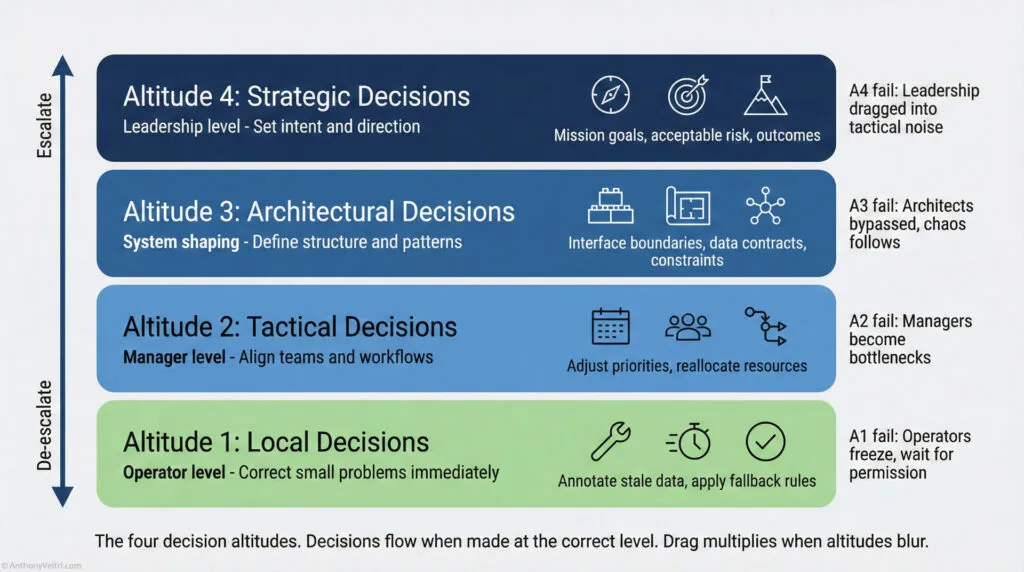
A flowchart with four colored layers: Strategic, Architectural, Tactical, and Local Decisions, each with descriptions of their roles, responsibilities, and consequences if made at the wrong level.
Consequences flow and accrue differently depending on the altitude of the decision.

Distributed decisions only work when altitudes are clear.

Altitude 4: Strategic Intent #

Leadership defines the mission, the boundaries, and the outcomes.
They define the why, not the how.

Altitude 3: System Shaping #

Architects define structures, patterns, interfaces, invariants, and fallback rules.
They set the frame.

Altitude 2: Tactical Alignment #

Team leads adjust priorities, triage drift, coordinate partners, and maintain flow.
They communicate but do not wait.

Altitude 1: Local Correctness #

Operators make dozens of micro decisions inside constraints.
They adjust data, update layers, correct errors, and move.

Flow forms when altitudes are respected.
Drag forms when altitudes are blurred.


8. Business Example: FEMA Field Teams Moving First #

Field staff in FEMA missions often outperform the coordination center because they:

  • see conditions immediately
  • know local geography
  • understand community needs
  • act before queues form
  • implement corrective measures faster than centralized paths

When intent is clear, field teams become engines of resilience.


9. System Example: iCAV Survived Because Decisions Were Distributed #

iCAV relied on distributed ingest and display decisions:

  • connector level ingest choices
  • harmonization layer corrections
  • local visualization logic
  • analyst level adjustments
  • architectural constraints at altitude 3
  • strategic intent at altitude 4

The system never required synchronized perfection.

Asynchronous updates kept truth alive even when major feeds failed.

Distributed decisions were embedded in the architecture itself.


10. Architect-Level Principle #
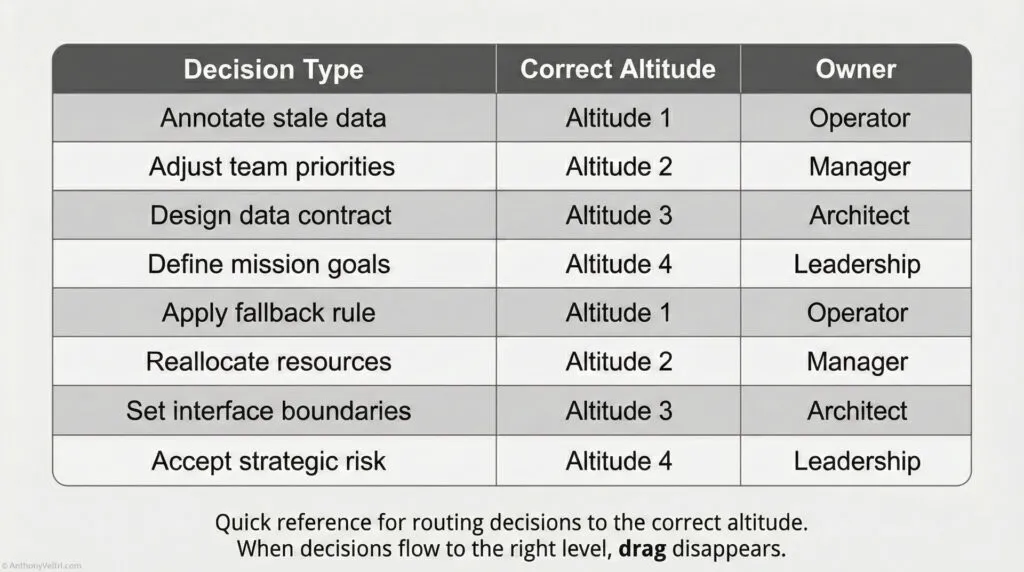
A table showing decision types, their correct altitudes, and owners: Annotate stale data—Operator; Adjust team priorities—Manager; Design data contract—Architect; Define mission goals—Leadership, with related altitudes.
Types of decisions, who owns them, and their “decision altitude.” Only you can prevent decision drag.

Architects create pathways that push authority to the lowest competent level.

This:

  • increases alignment
  • accelerates decisions
  • reduces drag
  • strengthens resilience
  • distributes load
  • protects the mission under stress

Centralization creates fragility.
Distribution creates flow.


11. Twenty Second Takeaway #

“Decisions made at the edge are faster and more correct because they use real context. Architectures must push decisions downward, guided by clear intent. Distributed decisions protect speed, alignment, and resilience when conditions degrade.”


12. Cross Links to Other Principles #

Distributed decisions directly reinforce:

  • Clear Intent
  • Decision Drag
  • Two Lane Systems
  • Degraded Operations
  • Emergent Resilience
  • Federation
  • Interface Ownership
  • Useful Interoperability
  • Portfolio Thinking

Distributed decisions flow only when intent, authority, and boundaries are clear.


Doctrine Diagnostic – For Reflection: #

Ask:

  • Who is closest to the truth right now?
  • Are they allowed to act?
  • Or are they waiting for permission?

If people closest to the work are waiting, the architecture is slowing the mission.

Fix the pathways.

Field notes and examples #

  • Field Note: The Human Cost of Interoperability (and the Legal Cost of Speed)
  • Model vs. Terrain: Bridging the Interface Void on the Merritt Parkway
  • Field Note: Snake or Stick?!
  • How Wildland Fire Actually Moves: A Guide To The Three Tier Dispatch System
  • Field Notes: What The Mobile Mapping Unit Taught Me About Forward-Deployed Systems
  • Bay St. Louis: Trust Before Logos After Hurricane Katrina
  • When You Cannot Force Compliance: iCAV, Hurricane Katrina, And Lessons In Federation

Last Updated on December 9, 2025

Related Posts #

A geometric abstract design with circles, lines, and dots in muted colors, featuring a dark rectangle with the white text

Doctrine 12: Resilience Is an Emergent Property, Not a Feature #

A person in a gray sweater holds a white mug with a colorful logo showing a sunrise, trees, and mountains, and the text “RESILIENCE@USDA.GOV” on the front.

You Remember My Values, But Not Yours #

A graphic with the text

Doctrine 04: Useful Interoperability Is the Goal, Not Perfect Interoperability #

Abstract geometric background with circles and lines in neutral and orange tones. A dark semi-transparent box overlays the left side, displaying the text

Doctrine 19: Supervision, Management, and Leadership Are Three Different Jobs. Confusing Them Breaks Systems #

This slide illustrates the principle that loop closure is structural, as highlighted by the modern, technical design elements.

Doctrine 23: Loop Closure as Load-Bearing System Infrastructure #

Thinking in Probabilities featured title card

Doctrine 22: When "It Depends" Is the Right Answer: How to Think in Probabilities Under Uncertainty #

architecture, decision-tempo, leadership, resilience
Table of Contents
  • Why mission systems move faster and survive more when decisions are made at the lowest competent level
  • 1. Centralization Creates Fragility
  • 2. Why Distributed Decisions Work
  • 3. Lived Example: When the Central Desk Went Dark
  • 4. Lived Example: The Analyst Who Moved Without Waiting
  • 5. Why Centralization Fails
    • Business Perspective
    • System Perspective
  • 6. Why Distributed Decisions Succeed
    • Business Perspective
    • System Perspective
  • 7. The Decision Altitude Model
    • Altitude 4: Strategic Intent
    • Altitude 3: System Shaping
    • Altitude 2: Tactical Alignment
    • Altitude 1: Local Correctness
  • 8. Business Example: FEMA Field Teams Moving First
  • 9. System Example: iCAV Survived Because Decisions Were Distributed
  • 10. Architect-Level Principle
  • 11. Twenty Second Takeaway
  • 12. Cross Links to Other Principles
  • Doctrine Diagnostic - For Reflection:

Share This Article :

  • Facebook
  • X
  • LinkedIn
  • Pinterest

Was it helpful ?

  • Happy
  • Normal
  • Sad
  • Privacy Policy
  • Introductions
  • Contact

© 2026 Anthony Veltri

  • Doctrine
    • Doctrine Library
    • Global Library
  • Field Notes
  • Routes
    • Route 01: When the Interface Is Breaking (and you are becoming the patch)
    • ROUTE 02: If decisions stall and meetings go nowhere, start here
    • ROUTE 03: If you have lots of projects but no portfolio clarity, start here
    • ROUTE 04: If you’re confused about federation vs integration, start here
    • ROUTE 05: If heroics are propping up your system, start here
    • ROUTE 06: If you cannot force compliance across partners, start here
    • ROUTE 07: If compliance exists but commitment does not, start here
    • ROUTE 08: If disconnected workflows create audit anxiety, start here
  • Figure Library
  • FAQ
  • About
    • Capability Statement
    • Interpreter Kit
  • Contact