Why experiments succeed closer to real problems and fail inside central offices #
This page is a Doctrine Guide. It shows how to apply one principle from the Doctrine in real systems and real constraints. Use it as a reference when you are making decisions, designing workflows, or repairing things that broke under pressure.
Real innovation comes from friction, not conference rooms. Innovation happens where reality is felt. #
Innovation does not originate in headquarters. It grows at the edge where operators face real conditions, see drift first, feel friction, and test solutions in live environments. Central nodes play a vital role in defining what must stay correct, what can vary, and where the boundaries lie. But the actual discovery of better methods, useful shortcuts, smarter processes, and new patterns happens in the places where information arrives first and where consequences are immediate. When architecture clearly defines which elements are invariant and which can be adapted, the edge becomes a safe and productive space for experimentation. Innovation becomes a system property rather than a personality trait or an accident. The result is a mission that improves itself in real time rather than waiting for top top-down transformation.
Organizations often believe that innovation happens in:
- the headquarters
- the program office
- the lab
- the strategic boardroom
But the most meaningful innovations rarely originate there.
They come from the edge.
They come from the field.
They come from people living with the problem every day.
Innovation is created where pain is felt.
The center discovers ideas.
The edge invents them.
Lived Example: The field analyst who invented a workflow the central team never imagined #
During a mission cycle involving cross agency data, one analyst in the field created a lightweight workflow to stitch together:
- fire perimeters
- evacuation zones
- shelter status
- road closures
- partner data feeds
It was simple.
It was ugly.
It was brilliant.
It solved a real problem with real constraints.
Meanwhile, a central team elsewhere had been designing an elegant enterprise feature to solve the same issue.
The field workflow worked immediately.
The central feature was still six months away.
That analyst’s rough prototype became the seed for a later enterprise capability because:
- it solved something real
- it demonstrated true user need
- it operated under live constraints
- it did not wait for permissions
- it emerged from the edge
The innovation lived at the edge first.
The center adopted it later.
Business Terms: Why edge innovation wins #
Innovation succeeds at the edge because:
- people closest to problems see them first
- solutions emerge from actual constraints
- iterations are fast
- failure is cheap
- feedback loops are immediate
- motivation is high
- bureaucracy is low
- teams own what they create
- the usefulness is obvious, not theoretical
Center driven innovation often:
- solves hypothetical problems
- requires committees
- depends on full funding
- moves slowly
- produces beautiful designs without operational value
The edge produces what works.
The center produces what is approved.
System Terms: The mechanics of edge innovation #
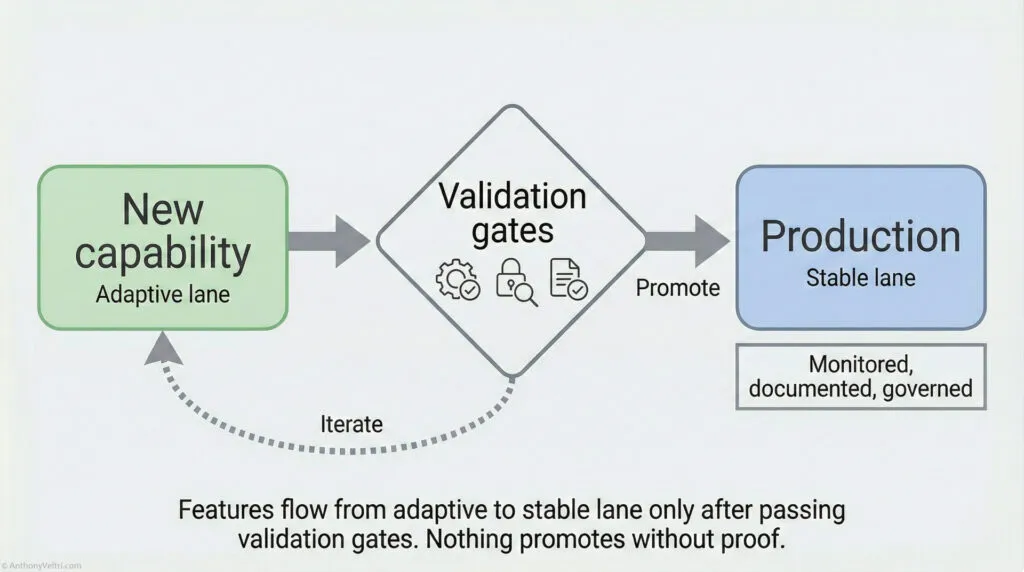
In system language, edge innovation thrives because:
- latency to problem context is minimal
- user feedback forms a tight loop
- coupling is local, not global
- risk exposure is limited
- prototyping is unconstrained
- system variation encourages exploration
- boundary conditions are visible
- workflows are real, not imagined
Central innovation is disadvantaged because:
- context is missing
- the problem landscape is filtered
- failure is more expensive
- coupling is higher
- experiments are slower
- scale requirements dominate design
- assumptions fill the gaps
Edge innovation is exploration.
Central innovation is refinement.
Why Central Innovation Fails (and keeps failing) #
Business perspective #
Central innovation fails because:
- it is disconnected from lived reality
- solutions are designed for abstract users
- committees slow iteration
- budgets control creativity
- leadership overestimates uniformity
- approvals kill momentum
- political incentives skew priorities
The result is technically beautiful, strategically irrelevant work.
System perspective #
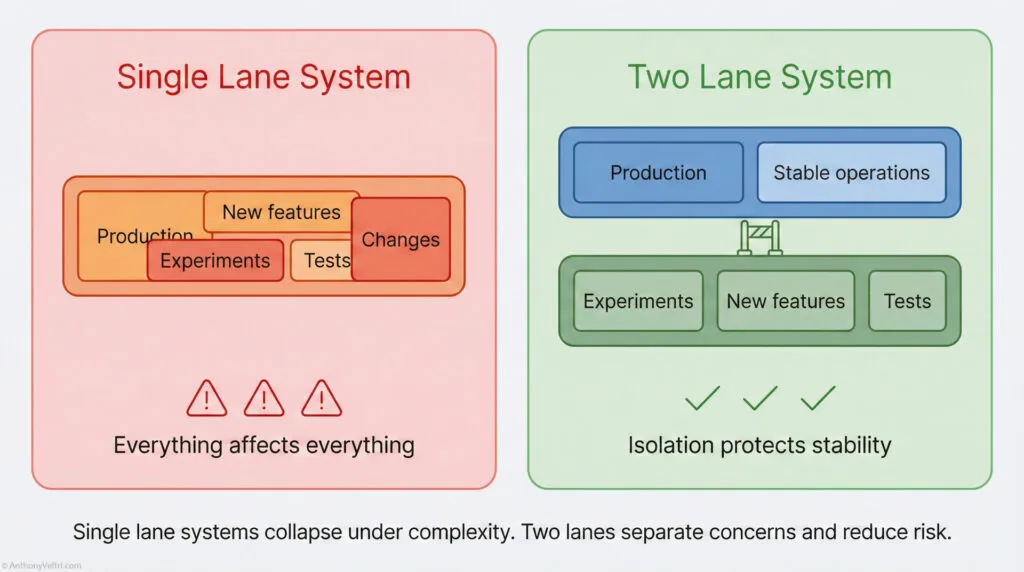
Central innovation fails because:
- the systems are too coupled to experiment safely
- versioning requirements prevent fast changes
- testing environments do not match real ones
- edge cases are invisible
- signals are filtered
- complexity hides true constraints
The center builds theoretical elegance.
The edge builds usable truth.
Why Edge Innovation Succeeds #
Business perspective #
Edge innovation works because:
- users build what they need
- ideas emerge organically from friction
- failures are small
- successes are obvious
- ownership drives adoption
- no one needs a steering committee for a script
- small wins scale upward
The center almost never has the problem first.
The edge always does.
System perspective #
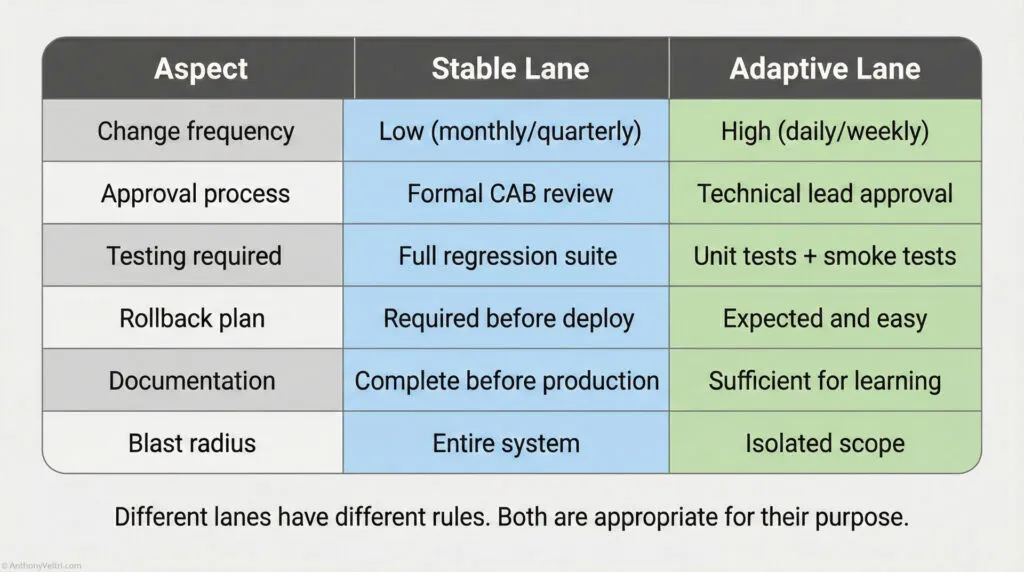
Edge innovation works because:
- local systems are loosely coupled
- experimentation is cheap
- integration requirements are simpler
- live constraints shape design
- patterns emerge naturally
- workflow context is immediate
The edge is a laboratory.
The center is a courtroom.
Business Example: The partner created the tool leadership wished they had funded #
A partner agency built a rough but highly effective mapping tool to visualize road closures and reroute logistics convoys faster than the main system could update.
Leadership was impressed.
But this tool never would have been approved through the central development pipeline because:
- it bypassed standard processes
- it solved a problem the center did not understand
- it used tools not on the enterprise roadmap
- it was built in two days instead of two quarters
The center eventually adopted its logic into the main platform.
The idea lived at the edge first.
System Example: iCAV’s best features started as edge hacks #
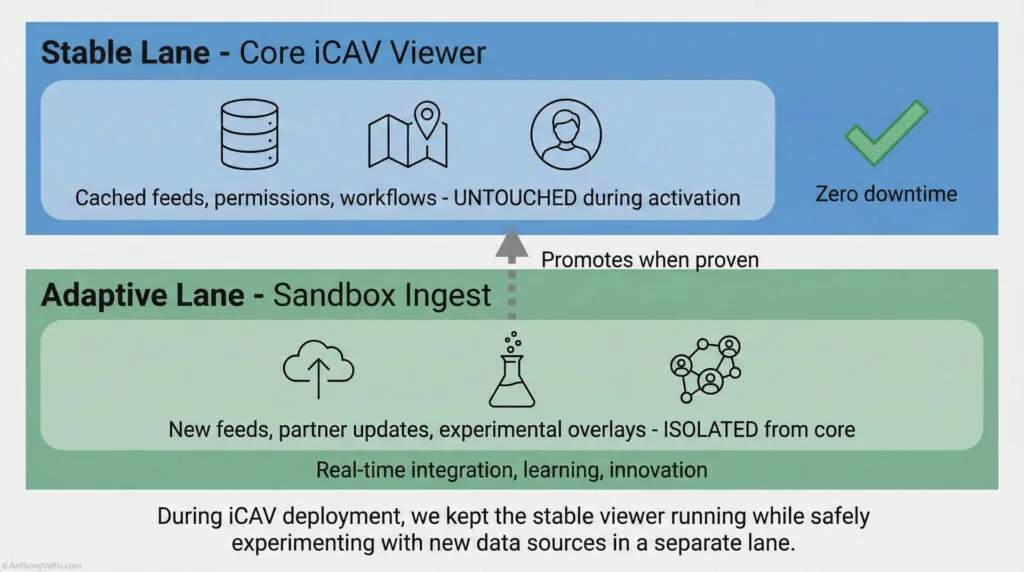
Many of the best iCAV features were born not in planning meetings but in:
- field analyst workflows
- operator scripts
- partner built preprocessors
- hacky data normalization routines
- pilot deployments with a handful of users
The central team rarely invented the solution.
The field did.
The central team then:
- refined
- secured
- standardized
- scaled
- hardened
Innovation came from the edge.
Enterprise strength came from the center.
This is the correct sequence.
Architect-Level Principle #
As an architect, I design environments where innovation starts at the edge.
The center refines, secures, and scales.
The edge discovers truth.
The center codifies it.
Twenty Second Takeaway #
“Innovation does not start in program offices. It starts at the edge where people feel the problem directly. My job as an architect is to create the guardrails and pathways that let edge innovations emerge safely, then bring the best of them into the center to refine and scale.”
Cross Links to Other Principles #
Edge innovation directly supports:
- Two-lane systems
- Distributed decisions
- Useful interoperability
- Federation
- Degraded operations
- Portfolio thinking
- Architecture accelerates
These principles reinforce each other.
Doctrine Diagnostic – For Reflection: #
Ask yourself:
Are the people closest to the problem allowed to experiment, or is every idea routed through headquarters first?
If the second is true, you are killing your own innovation.
Fix the pathways.
Field notes and examples #
Last Updated on February 22, 2026