Skip to content

Introduced by a trusted connector?

Start Here

Anthony Veltri

  • Doctrine
    • Doctrine Library
    • Global Library
  • Field Notes
  • Routes
    • Route 01: When the Interface Is Breaking (and you are becoming the patch)
    • ROUTE 02: If decisions stall and meetings go nowhere, start here
    • ROUTE 03: If you have lots of projects but no portfolio clarity, start here
    • ROUTE 04: If you’re confused about federation vs integration, start here
    • ROUTE 05: If heroics are propping up your system, start here
    • ROUTE 06: If you cannot force compliance across partners, start here
    • ROUTE 07: If compliance exists but commitment does not, start here
    • ROUTE 08: If disconnected workflows create audit anxiety, start here
  • Figure Library
  • FAQ
  • About
    • Capability Statement
    • Interpreter Kit
  • Contact
Anthony Veltri

Architecture & Interfaces

15
  • Doctrine 01: Federation vs Integration in Mission Networks
  • Doctrine 03: Interfaces Are Where Systems Break, So They Require Stewards, Contracts, and Ownership
  • Doctrine 04: Useful Interoperability Is the Goal, Not Perfect Interoperability
  • Doctrine 05: Innovation Must Live at the Edge, Not in the Center
  • Doctrine 06: A Two-Lane System Protects Stability and Enables Evolution
  • Doctrine 14: Technical Debt Is a Leadership Signal, Not a Coding Failure
  • Doctrine 15: Architecture Must Accelerate Teams, Not Bottleneck Them
  • Doctrine 17: Architects Translate Strategy Into Engineering and Engineering Into Strategy
  • Doctrine 20: Golden Datasets: Putting Truth In One Place Without Pretending Everything Is Perfect
  • Doctrine 21: Zero Trust Is A Trust Model, Not A Card “Type”
  • Doctrine 23: Loop Closure as Load-Bearing System Infrastructure
  • ANNEX B. Data Contracts
  • ANNEX C. Interface Ownership Model
  • ANNEX H. Architecture Doctrine
  • Annex L: The Rosetta Stone for Data Teams: Bridging the Gap Between Technicians and Executives

Decision Tempo & Governance

10
  • Doctrine 02: Distributed Decisions Increase Alignment, Speed, and Resilience
  • Doctrine 07: Clear Intent Matters More Than Perfect Data
  • Doctrine 08: Clear Intent Compresses Ambiguity, Reduces Conflict, and Accelerates Action
  • Doctrine 09: Decision Drag Is the Enemy of Mission Tempo. Architecture Is the Remedy
  • Doctrine 10: Degraded Operations Are the Normal Mode, Not the Exception
  • Doctrine 11: Preventive Action and Contingent Action Must Both Be Designed Intentionally
  • Doctrine 22: When “It Depends” Is the Right Answer: How to Think in Probabilities Under Uncertainty
  • ANNEX D. Decision Altitudes Model
  • ANNEX E. Prevention–Contingency Matrix
  • ANNEX I. High Visibility Workflows

Portfolio & Alignment

4
  • Doctrine 16: Portfolio Thinking Ensures Effort Aligns With What Actually Matters
  • ANNEX F. Pattern Library
  • ANNEX J. System Evolution and Drift Management
  • ANNEX K. System and Workflow Profiles (Case Studies)

Leadership & Human Systems

6
  • Doctrine 24: Stewardship Places the Burden on the Steward, Not the Parties
  • Doctrine 18: Commitment Outperforms Compliance in High Trust, High Tempo Environments
  • Doctrine 19: Supervision, Management, and Leadership Are Three Different Jobs. Confusing Them Breaks Systems
  • Doctrine 23: Loop Closure as Load-Bearing System Infrastructure
  • ANNEX A. Human Contracts
  • ANNEX G. Leadership Doctrine

Resilience & Operations

3
  • Doctrine 24: Stewardship Places the Burden on the Steward, Not the Parties
  • Doctrine 12: Resilience Is an Emergent Property, Not a Feature
  • Doctrine 13: Problem Solving Requires Finding the Real Deviation and the Relevant Change

Doctrine Companions

7
  • Doctrine 03 Companion: The RS-CAT Framework: Converting Raw Recall into Teachable Principle
  • Doctrine 03 Companion: The Interface Void
  • Doctrine 11 Companion: Agency vs. Outcome
  • Doctrine 09 Companion: Artifacts Over Adjectives
  • Doctrine 03 Companion: Constraints: bidirectional translation: Compression vs Construction
  • Doctrine 10 Companion: Span of Control and Cross Training Are Load-Bearing Constraints
  • Doctrine 21 Companion: Claims, Roles, and Entitlements in Microsoft 365

Field Reports

1
  • Field Report: College Financing and the 5-Year Home Runway
View Categories
  • Home
  • Doctrine & Supporting Guides
  • Resilience & Operations
  • Doctrine 12: Resilience Is an Emergent Property, Not a Feature

Doctrine 12: Resilience Is an Emergent Property, Not a Feature

Anthony Veltri
Updated on December 5, 2025

4 min read

Why resilience cannot be bolted on and only appears when the system is aligned at every layer #

This doctrine argues that resilience is the result of getting all the other patterns right.

This page is a Doctrine Guide. It shows how to apply one principle from the Doctrine in real systems and real constraints. Use it as a reference when you are making decisions, designing workflows, or repairing things that broke under pressure.


You cannot “add resilience.” You must architect conditions where it emerges. #
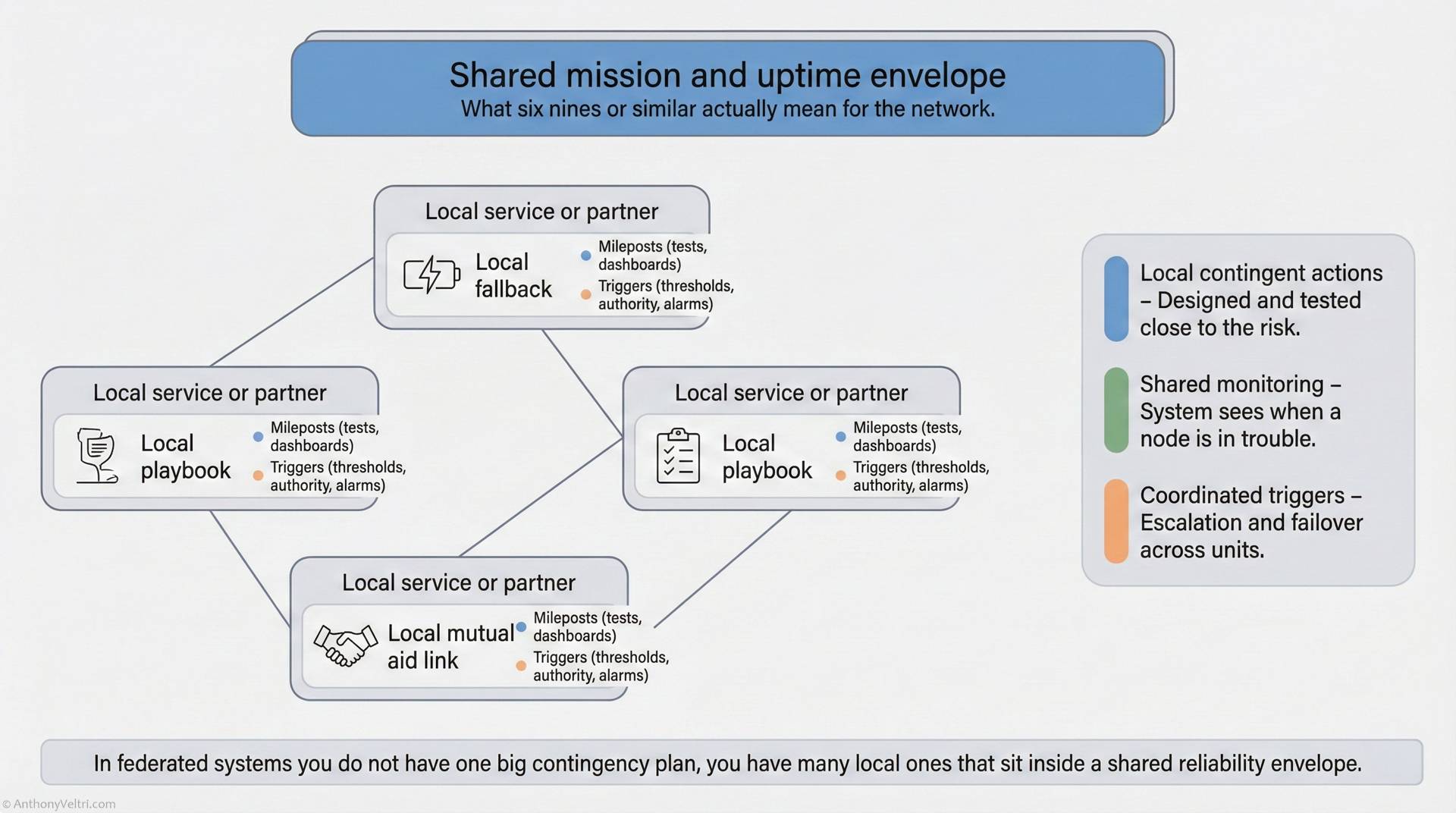
A flowchart titled "Shared mission and uptime envelope" explains network reliability, showing interconnected local services or partners with local fallback, playbook, and mutual aid link options, and local contingency actions in blue side-box.
Resilience is Structural. In a federated system, resilience emerges because local nodes (Blue) have their own playbooks but share a mission envelope (Grey). If one node fails, the network survives.

Most organizations want resilience.
Few understand what it actually is.

They try to add resilience with:

  • new tools
  • redundancy
  • new processes
  • new rules
  • more staff
  • more checklists

These help only a little.
None of them create true resilience.

Resilience is not a thing you add.
Resilience is a thing that emerges when the entire system is aligned.


Lived Example: The activation that “should have” collapsed but didn’t #

During one hurricane season, multiple failures happened at once:

  • partner feeds lagged
  • a regional hub lost connectivity
  • authentication tokens expired
  • an upstream server crashed
  • a field team went offline
  • weather shifted faster than models predicted

By all logic, the mission picture should have collapsed.

But it did not, because:

  • we had degraded mode behavior
  • we had caching
  • we had partial layer rendering
  • we had clear intent
  • we had distributed decisions
  • we had tolerant ingest
  • we had partners acting independently
  • we had a harmonization layer that accepted differences

Resilience did not come from one feature.
It came from the interaction of many aligned patterns.

Resilience emerged.


Business Terms: What resilience actually is #

Resilience is:

  • the ability to function when things break
  • the ability to adapt when conditions shift
  • the ability to preserve mission tempo
  • the ability to maintain alignment under stress
  • the ability to self correct
  • the ability to continue providing value under degraded truth

Resilience does not come from:

  • one tool
  • one policy
  • one team
  • one fix
  • one feature

Resilience is the outcome of the entire system behaving coherently.


System Terms: Resilience as an emergent property #
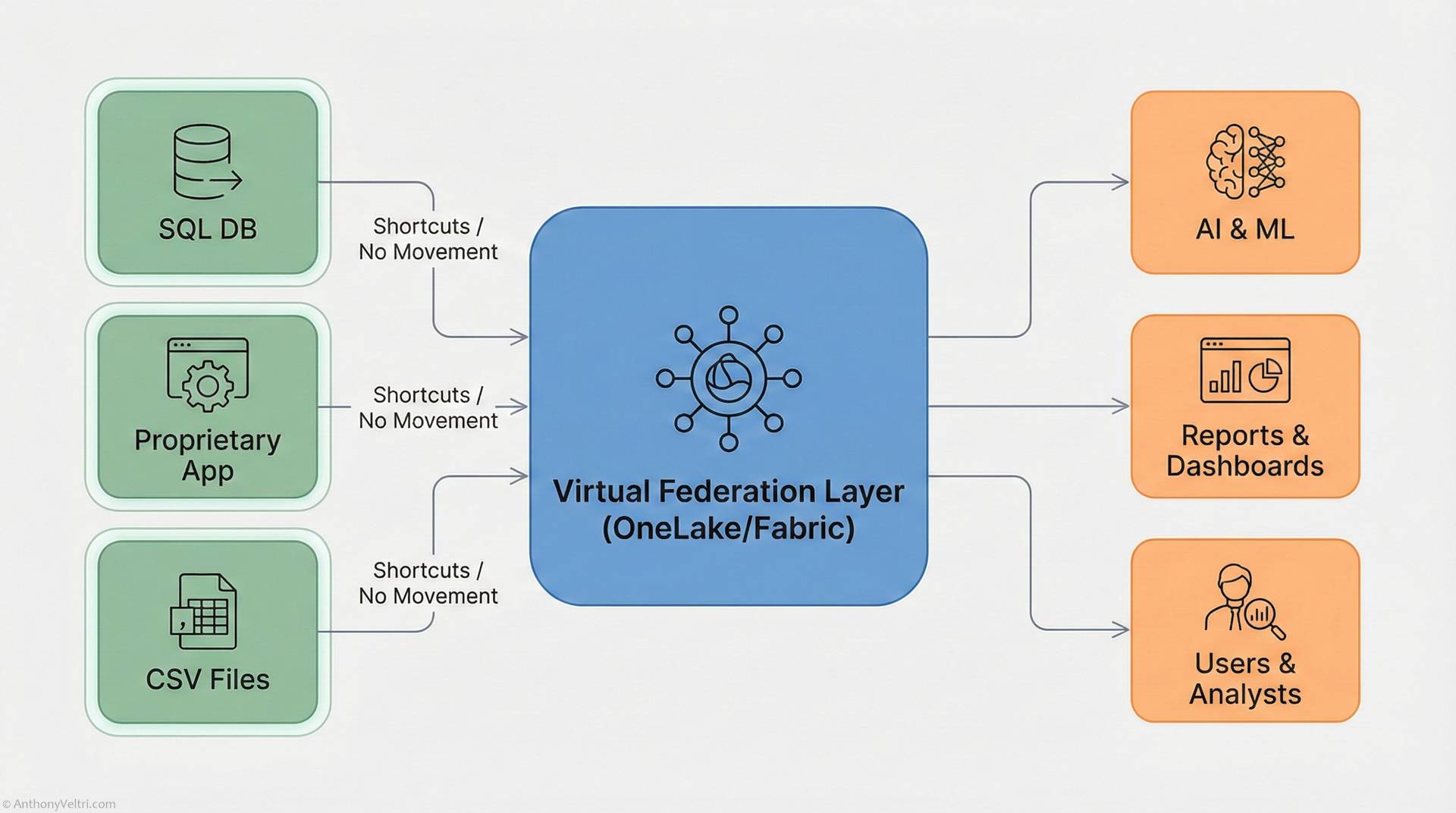
Diagram showing SQL DB, Proprietary App, and CSV Files connecting via a Virtual Federation Layer (OneLake/Fabric) to AI & ML, Reports & Dashboards, and Users & Analysts. Shortcuts/No Movement noted for each input source.
Loose Coupling Creates Survival. By using a virtual federation layer (shortcuts) instead of rigid integration (copies), the system can survive the loss of any single source (Green Boxes). This chart visualizes the exact architecture we are describing: taking disparate inputs (CSV, SQL) and harmonizing them via shortcuts/connectors.

In system language, resilience is emergent when:

  • coupling is low
  • boundaries are clear
  • interfaces are governed
  • fallback paths exist
  • synchronization is optional
  • update delays are tolerated
  • decision making is distributed
  • constraints are visible
  • intent is strong
  • innovation happens at the edge
  • systems degrade gracefully

One feature does not produce this.
Many small patterns interacting produce it.

Resilience is not a module.
It is a state.


Why “Bolted On” Resilience Fails #
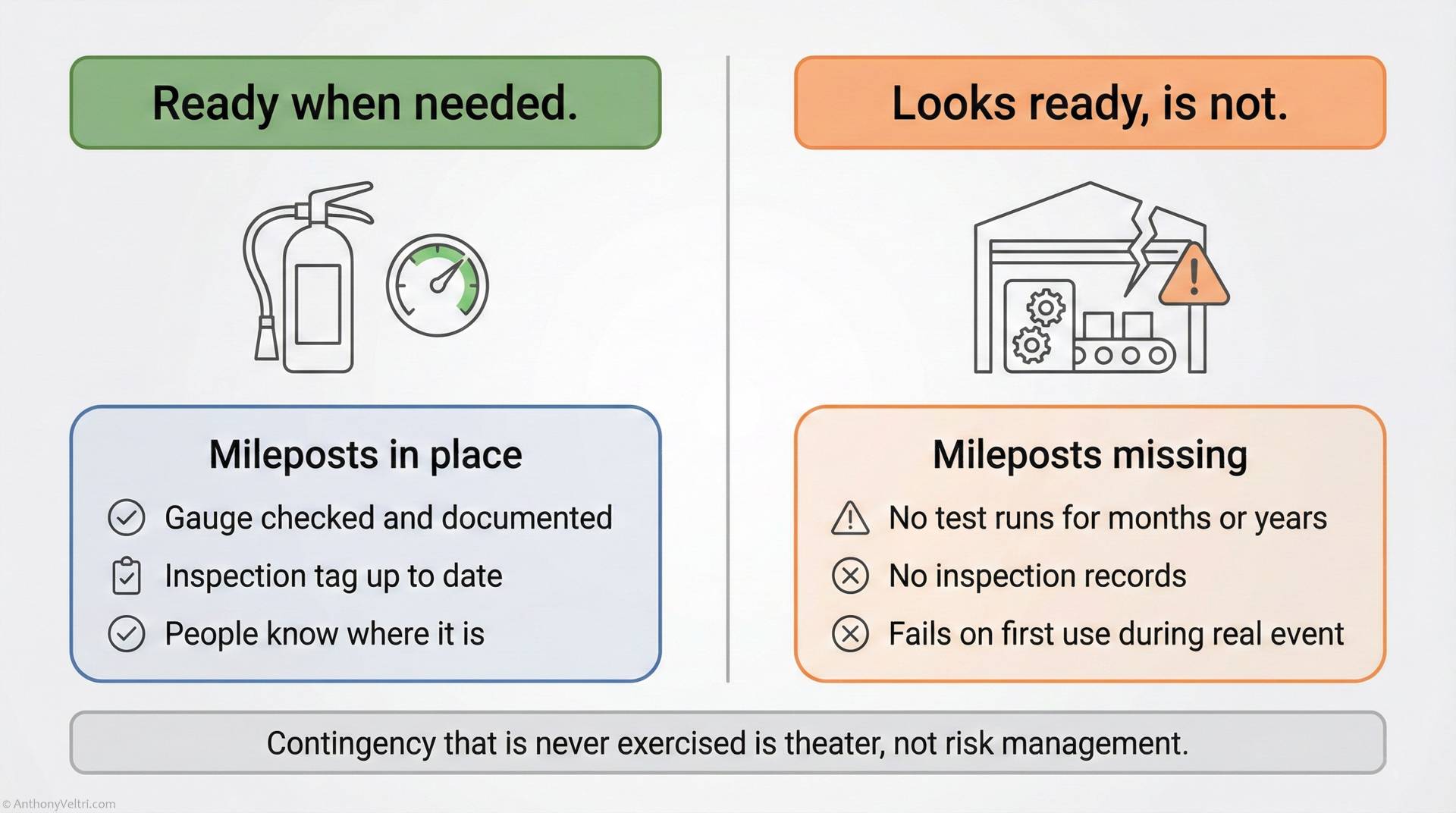
A comparison chart shows “Ready when needed” with checked fire extinguisher versus “Looks ready, is not” with a broken extinguisher box. It highlights the importance of regular checks and documentation for emergency readiness.
Real vs. Fake Contingency. If you have a plan but no triggers or rehearsals, you have Theater (The Binder). Real contingency looks like a maintained fire extinguisher. “Bolting on” a plan without integration is Theater. True resilience requires the mechanics (inspections, gauges) to be built into the daily operation.

Business perspective #

Organizations try to add resilience as a late-stage patch:

  • add a redundant system
  • add more staff
  • add more reviews
  • add stricter rules
  • add more documentation

These produce rituals, not resilience.

The system still breaks because the underlying structure is brittle.

System perspective #

Bolt on resilience fails because:

  • redundancy without alignment still fails
  • failover without contracts still fails
  • backups with mismatched schemas still fail
  • untested fallback paths still fail
  • extra tools increase complexity
  • patches increase coupling
  • dependencies multiply

Resilience cannot be layered onto a brittle structure.

It must be designed into the structure itself.


Why Emergent Resilience Succeeds #

Business perspective #

A system with emergent resilience:

  • does not rely on heroics
  • does not stall under imperfect conditions
  • makes better decisions with less information
  • reduces escalation
  • protects leadership from overload
  • converts uncertainty into manageable variation
  • increases trust from partners
  • reduces operational anxiety

This is not theory.
This is lived experience from every major activation you have supported.

System perspective #

A system with emergent resilience:

  • isolates failures
  • maintains partial functionality
  • compensates for upstream drift
  • accepts asynchronous updates
  • adapts to varied partner maturity
  • falls back instead of failing
  • contains errors
  • heals when nodes recover
  • preserves enough accuracy to act

This behavior cannot be built in one place.
It emerges across places.


Business Example: The continuity that emerged from many small design choices #

During a multi-day incident:

  • field updates were inconsistent
  • partner feeds drifted
  • satellite imagery lagged
  • analysts were overloaded
  • security tokens rotated at the wrong time

But because:

  • the caching was solid
  • the UI could display partial truth
  • the harmonization layer was tolerant
  • analysts understood intent
  • distributed decisions were authorized
  • team boundaries were clear

The mission picture never went down.

No single feature caused this.
The interaction of patterns caused it.


System Example: iCAV’s resilience came from the structure, not a module #
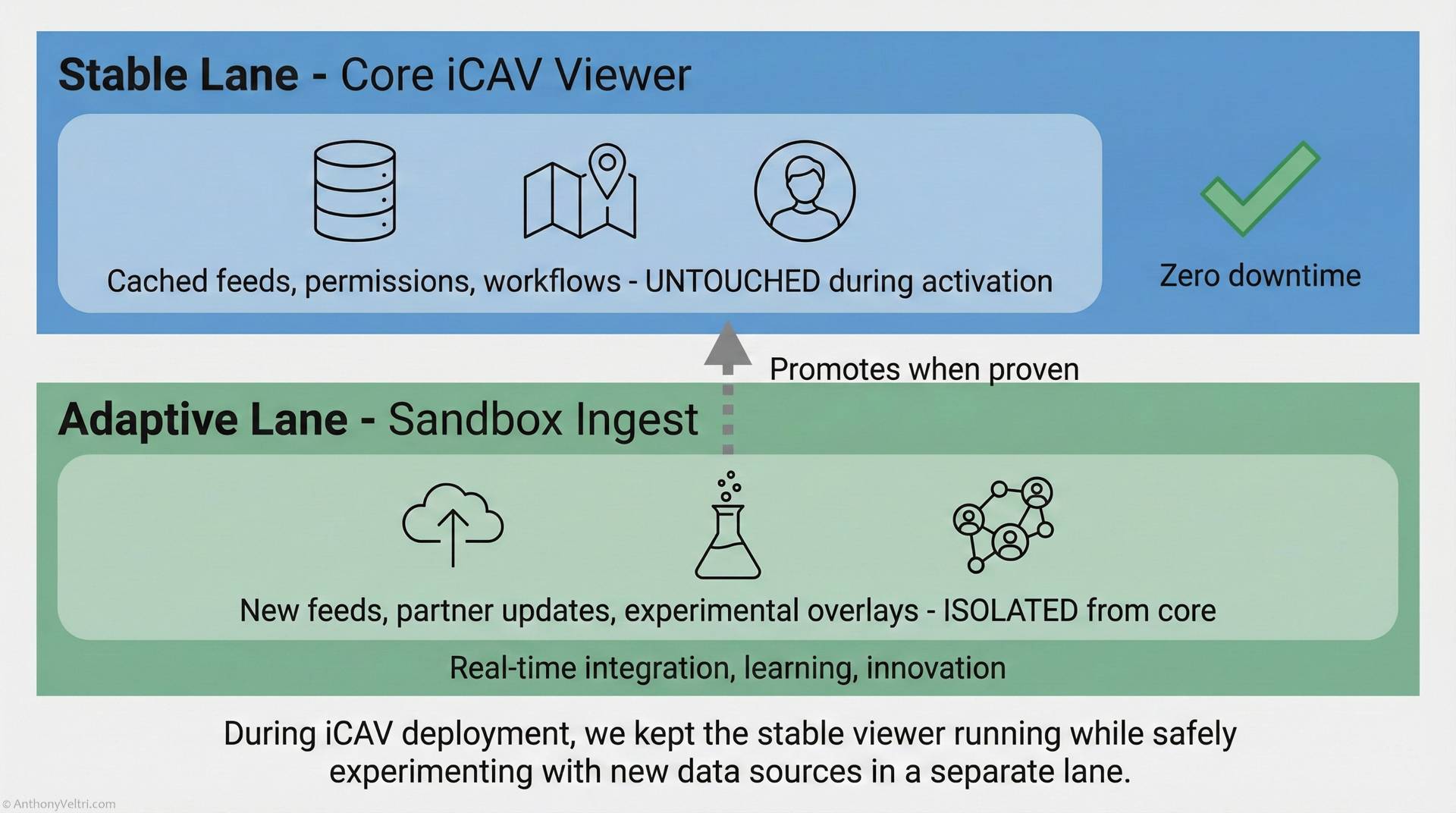
Diagram showing two lanes: "Stable Lane – Core iCAV Viewer" (blue, represents zero downtime and untouched activation) above "Adaptive Lane – Sandbox Ingest" (green, for new feeds and real-time innovation), with a promotion arrow between them.
We kept the core viewer stable (Blue) while letting the field experiment with new data in the sandbox (Green). Successful experiments were promoted; failures were discarded without breaking the mission. This is an example of Resilience in Practice. We separated the Stable Lane (Viewer) from the Adaptive Lane (Ingest). When the ingest broke, the viewer stayed up. That is emergent resilience.

In iCAV, resilience arose because:

  • ingest was tolerant
  • connectors were loosely coupled
  • refresh rates varied safely
  • slow feeds did not block fast ones
  • failure domains were isolated
  • caching preserved useful truth
  • interfaces had owners
  • the viewer did not require global synchronization
  • degraded mode was intentional
  • partial data still displayed

None of these on their own produce resilience.
Together they produced a system that survived real world chaos.

This is emergent behavior.


Architect Level Principle #

As an architect I do not add resilience.
I design the conditions for resilience to emerge.
Resilience comes from alignment across people, process, data, and technology.
It is the system behaving as a coherent whole under stress.


Twenty-Second Takeaway: #

“Resilience is not a feature. It is an emergent property of a well-designed system. You cannot bolt it on. You must design for clear intent, distributed decisions, tolerant ingest, loose coupling, and graceful degradation. When these align, resilience appears naturally.”


Cross Links to Other Principles #

Emergent resilience is the convergence of:

  • Degraded operations
  • Useful interoperability
  • Federation
  • Two-lane systems
  • Interfaces and ownership
  • Preventive and contingent action
  • Distributed decisions
  • Clear intent
  • Technical debt as leadership signal
  • Architecture accelerates

This principle is one of the doctrinal pillars.


Doctrine Diagnostic – For Reflection: #

Ask yourself:

Are you trying to add resilience?
Or are you designing the conditions where resilience can appear?

One will fail.
One will create the system you actually want.

Field notes and examples #

  • Field Note: Defining “Operator”
  • The Scalpel vs. The Swiss Army Knife: When Solo Integration Beats Federation
  • Disposable Pixels (UI) On A Durable Substrate
  • Systems Built On Heroics Are Brittle
  • You Remember My Values, But Not Yours
  • Hoover Dam Lessons: “Proudly Maintained By Mike E.”
  • When You Choose Integration over Federation On Purpose
  • When You Become The Interface: A System “Tell” In Disguise

Last Updated on December 5, 2025

Related Posts #

This diagram illustrates increasing salary capacities, with larger houses on higher blocks representing $6k, $24k (median), and $80k per year.

Field Report: College Financing and the 5-Year Home Runway #

A person in a gray sweater holds a white mug with a colorful logo showing a sunrise, trees, and mountains, and the text “RESILIENCE@USDA.GOV” on the front.

You Remember My Values, But Not Yours #

This diagram illustrates the distinction between strategic planning at headquarters and operational response in crisis conditions.

Field Note: Defining "Operator" #

Abstract geometric shapes and lines in black, gray, and orange with the text

Doctrine 05: Innovation Must Live at the Edge, Not in the Center #

Thinking in Probabilities featured title card

Doctrine 22: When "It Depends" Is the Right Answer: How to Think in Probabilities Under Uncertainty #

Abstract graphic with geometric shapes and lines, featuring the text

Doctrine 02: Distributed Decisions Increase Alignment, Speed, and Resilience #

altitude, leadership, resilience
Table of Contents
  • Why resilience cannot be bolted on and only appears when the system is aligned at every layer
  • You cannot “add resilience.” You must architect conditions where it emerges.
  • Lived Example: The activation that “should have” collapsed but didn’t
  • Business Terms: What resilience actually is
  • System Terms: Resilience as an emergent property
  • Why “Bolted On” Resilience Fails
    • Business perspective
    • System perspective
  • Why Emergent Resilience Succeeds
    • Business perspective
    • System perspective
  • Business Example: The continuity that emerged from many small design choices
  • System Example: iCAV’s resilience came from the structure, not a module
  • Architect Level Principle
  • Twenty-Second Takeaway:
  • Cross Links to Other Principles
  • Doctrine Diagnostic - For Reflection:

Share This Article :

  • Facebook
  • X
  • LinkedIn
  • Pinterest

Was it helpful ?

  • Happy
  • Normal
  • Sad
  • Privacy Policy
  • Introductions
  • Contact

© 2026 Anthony Veltri

  • Doctrine
    • Doctrine Library
    • Global Library
  • Field Notes
  • Routes
    • Route 01: When the Interface Is Breaking (and you are becoming the patch)
    • ROUTE 02: If decisions stall and meetings go nowhere, start here
    • ROUTE 03: If you have lots of projects but no portfolio clarity, start here
    • ROUTE 04: If you’re confused about federation vs integration, start here
    • ROUTE 05: If heroics are propping up your system, start here
    • ROUTE 06: If you cannot force compliance across partners, start here
    • ROUTE 07: If compliance exists but commitment does not, start here
    • ROUTE 08: If disconnected workflows create audit anxiety, start here
  • Figure Library
  • FAQ
  • About
    • Capability Statement
    • Interpreter Kit
  • Contact