Skip to content

Introduced by a trusted connector?

Start Here

Anthony Veltri

  • Doctrine
    • Doctrine Library
    • Global Library
  • Field Notes
  • Routes
    • Route 01: When the Interface Is Breaking (and you are becoming the patch)
    • ROUTE 02: If decisions stall and meetings go nowhere, start here
    • ROUTE 03: If you have lots of projects but no portfolio clarity, start here
    • ROUTE 04: If you’re confused about federation vs integration, start here
    • ROUTE 05: If heroics are propping up your system, start here
    • ROUTE 06: If you cannot force compliance across partners, start here
    • ROUTE 07: If compliance exists but commitment does not, start here
    • ROUTE 08: If disconnected workflows create audit anxiety, start here
  • Figure Library
  • FAQ
  • About
    • Capability Statement
    • Interpreter Kit
  • Contact
Anthony Veltri

Architecture & Interfaces

15
  • Doctrine 01: Federation vs Integration in Mission Networks
  • Doctrine 03: Interfaces Are Where Systems Break, So They Require Stewards, Contracts, and Ownership
  • Doctrine 04: Useful Interoperability Is the Goal, Not Perfect Interoperability
  • Doctrine 05: Innovation Must Live at the Edge, Not in the Center
  • Doctrine 06: A Two-Lane System Protects Stability and Enables Evolution
  • Doctrine 14: Technical Debt Is a Leadership Signal, Not a Coding Failure
  • Doctrine 15: Architecture Must Accelerate Teams, Not Bottleneck Them
  • Doctrine 17: Architects Translate Strategy Into Engineering and Engineering Into Strategy
  • Doctrine 20: Golden Datasets: Putting Truth In One Place Without Pretending Everything Is Perfect
  • Doctrine 21: Zero Trust Is A Trust Model, Not A Card “Type”
  • Doctrine 23: Loop Closure as Load-Bearing System Infrastructure
  • ANNEX B. Data Contracts
  • ANNEX C. Interface Ownership Model
  • ANNEX H. Architecture Doctrine
  • Annex L: The Rosetta Stone for Data Teams: Bridging the Gap Between Technicians and Executives

Decision Tempo & Governance

10
  • Doctrine 02: Distributed Decisions Increase Alignment, Speed, and Resilience
  • Doctrine 07: Clear Intent Matters More Than Perfect Data
  • Doctrine 08: Clear Intent Compresses Ambiguity, Reduces Conflict, and Accelerates Action
  • Doctrine 09: Decision Drag Is the Enemy of Mission Tempo. Architecture Is the Remedy
  • Doctrine 10: Degraded Operations Are the Normal Mode, Not the Exception
  • Doctrine 11: Preventive Action and Contingent Action Must Both Be Designed Intentionally
  • Doctrine 22: When “It Depends” Is the Right Answer: How to Think in Probabilities Under Uncertainty
  • ANNEX D. Decision Altitudes Model
  • ANNEX E. Prevention–Contingency Matrix
  • ANNEX I. High Visibility Workflows

Portfolio & Alignment

4
  • Doctrine 16: Portfolio Thinking Ensures Effort Aligns With What Actually Matters
  • ANNEX F. Pattern Library
  • ANNEX J. System Evolution and Drift Management
  • ANNEX K. System and Workflow Profiles (Case Studies)

Leadership & Human Systems

6
  • Doctrine 24: Stewardship Places the Burden on the Steward, Not the Parties
  • Doctrine 18: Commitment Outperforms Compliance in High Trust, High Tempo Environments
  • Doctrine 19: Supervision, Management, and Leadership Are Three Different Jobs. Confusing Them Breaks Systems
  • Doctrine 23: Loop Closure as Load-Bearing System Infrastructure
  • ANNEX A. Human Contracts
  • ANNEX G. Leadership Doctrine

Resilience & Operations

3
  • Doctrine 24: Stewardship Places the Burden on the Steward, Not the Parties
  • Doctrine 12: Resilience Is an Emergent Property, Not a Feature
  • Doctrine 13: Problem Solving Requires Finding the Real Deviation and the Relevant Change

Doctrine Companions

7
  • Doctrine 03 Companion: The RS-CAT Framework: Converting Raw Recall into Teachable Principle
  • Doctrine 03 Companion: The Interface Void
  • Doctrine 11 Companion: Agency vs. Outcome
  • Doctrine 09 Companion: Artifacts Over Adjectives
  • Doctrine 03 Companion: Constraints: bidirectional translation: Compression vs Construction
  • Doctrine 10 Companion: Span of Control and Cross Training Are Load-Bearing Constraints
  • Doctrine 21 Companion: Claims, Roles, and Entitlements in Microsoft 365

Field Reports

1
  • Field Report: College Financing and the 5-Year Home Runway
View Categories
  • Home
  • Doctrine & Supporting Guides
  • Architecture & Interfaces
  • Doctrine 04: Useful Interoperability Is the Goal, Not Perfect Interoperability

Doctrine 04: Useful Interoperability Is the Goal, Not Perfect Interoperability

Anthony Veltri
Updated on December 9, 2025

5 min read

Why forcing perfect alignment destroys participation and slows down missions #

This page is a Doctrine Guide. It shows how to apply one principle from the Doctrine in real systems and real constraints. Use it as a reference when you are making decisions, designing workflows, or repairing things that broke under pressure.


Perfect interoperability is a myth. Useful interoperability is a skill. #
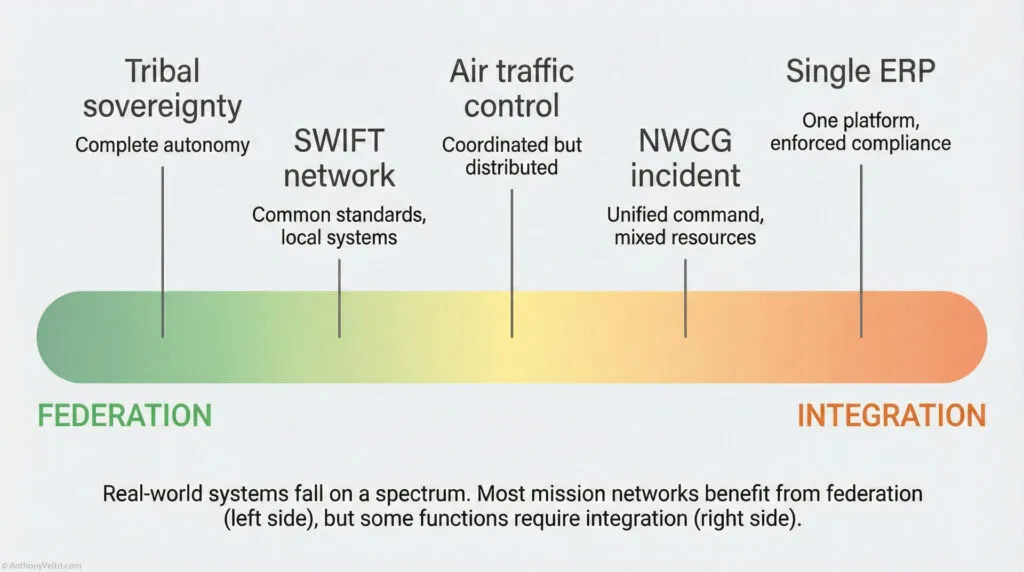
A spectrum from "Federation" to "Integration" shows examples: Tribal sovereignty (autonomy), SWIFT network (common standards), air traffic control (coordinated), NWCG incident (unified command), and Single ERP (enforced compliance).
Note on Air Traffic Control: We place ATC in the middle because, at a global level, it is a federation of sovereign systems handing off aircraft via protocol. However, if you zoom in to a single US Area Center or the National Airspace System, the system shifts to the far right (Tight Integration). The Lesson: Successful systems are often integrated locally (for control) but federated globally (for scale).

Mission environments are too diverse, too fast, and too asymmetric for perfect alignment.

  • Partners use different tools.
  • Data arrives in different formats.
  • Systems update at different cadences.
  • Authorities and budgets differ.
  • Security rules conflict across organizations.

If you insist on perfect interoperability, you end up with no interoperability.

The architect chooses useful interoperability.
The least amount of alignment required to make the system valuable.


Lived Example: The partner with the aging server and the partner with the brand new cloud stack #

During a multi-agency activation, we had two partners:

Partner A

  • modern Azure cloud stack
  • real time publishing
  • clean JSON schemas
  • strong metadata discipline
  • automated availability monitoring

Partner B

  • a server older than some of their staff
  • arcane file formats
  • inconsistent timestamps
  • manual updates
  • unpredictable publishing windows

If we demanded perfect interoperability:

  • Partner B could not participate
  • Partner A would be forced to dumb down their system
  • We would delay the mission waiting for alignment
  • The published picture would shrink, not grow

Instead we aimed for useful interoperability:

  • harmonize what can be harmonized
  • annotate what cannot
  • merge what is compatible
  • preserve what is distinct
  • deliver a composite picture that works

The operational picture was not perfect.
It was useful.
And during a crisis, useful wins.


Business Terms: What useful interoperability looks like #

Useful interoperability:

  • produces value with the minimum viable alignment
  • accepts diversity as a feature, not a flaw
  • grows participation instead of restricting it
  • lowers the barrier for partners to contribute
  • respects differing authorities and systems
  • prevents political friction
  • delivers faster
  • reduces rework
  • keeps the mission moving

Perfect interoperability requires perfect alignment.
Perfect alignment requires perfect control.
Perfect control never exists.


System Terms: The actual mechanics of useful interoperability #
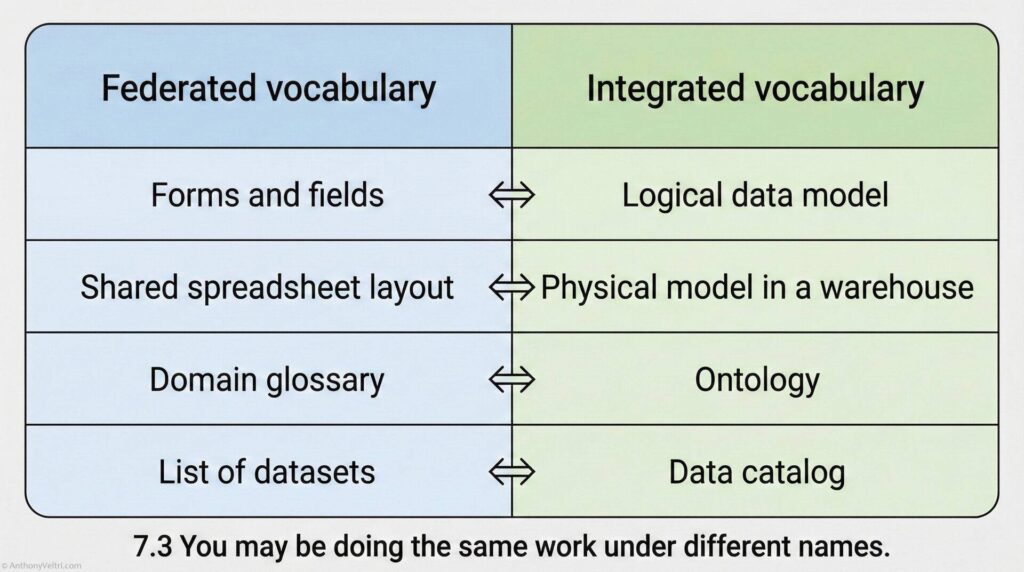
A two column table or side by side boxes. Left side labeled “Federated vocabulary.” Right side labeled “Integrated vocabulary.” Example rows: “Forms and fields” ↔ “Logical data model” “Shared spreadsheet layout” ↔ “Physical model in a warehouse” “Domain glossary” ↔ “Ontology” “List of datasets” ↔ “Data catalog”
You may be doing the same work under different names.

Useful interoperability is a set of architectural techniques:

  • schema mapping
  • partial harmonization
  • caching of last known good data
  • confidence scoring
  • asynchronous updates
  • fallback formats
  • tolerant ingestion
  • conversion at the edges
  • context aware merging

It is about tolerance, not uniformity.

Perfect interoperability demands:

  • synchronized schemas
  • uniform security models
  • identical update rates
  • total consistency
  • global version locks
  • brittle, tightly coupled systems

In real environments these requirements collapse under pressure.


Why Perfect Interoperability Fails #

Business Perspective #

Perfect interoperability fails because:

  • funding cycles differ
  • technology baselines differ
  • staffing differs
  • politics differ
  • partner incentives differ
  • migration timelines differ
  • adoption costs overwhelm smaller partners

Perfect interoperability shrinks participation.

Eventually, only well-resourced participants remain, and the mission picture becomes biased and incomplete.

System Perspective #

Perfect interoperability fails because:

  • systems drift
  • updates diverge
  • partners upgrade at different times
  • schemas evolve independently
  • networks degrade
  • unequal refresh rates break synchronization
  • legacy systems cannot comply

Perfect interoperability collapses under real world variation.


Why Useful Interoperability Succeeds #

Business Perspective #

Useful interoperability succeeds because:

  • it lowers expectations to what is actually needed
  • it allows partial participation
  • it grows the network of contributors
  • it increases trust
  • it encourages voluntary adoption
  • it tolerates unequal maturity
  • it meets partners where they are

Useful interoperability expands participation.

System Perspective #
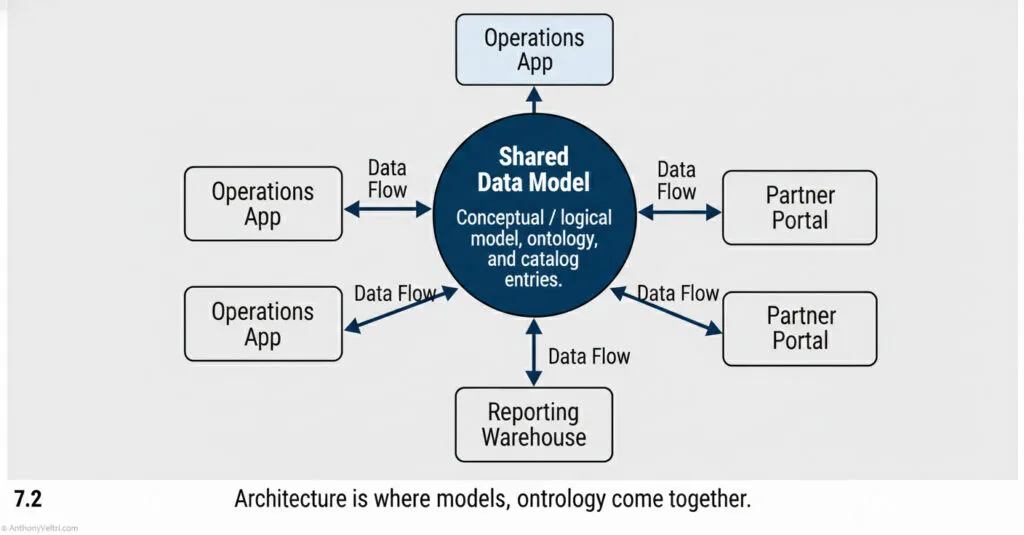
A simple architecture diagram with three or four systems (for example “Operations App,” “Reporting Warehouse,” “Partner Portal”) around a central “Shared Data Model” circle. Arrows show data flowing between the systems through the shared model. Annotate the central circle with: “Conceptual / logical model, ontology, and catalog entries.”
Architecture is where models, ontology, and catalog come together.

Useful interoperability succeeds because it:

  • absorbs variation
  • isolates failures
  • handles partial updates
  • provides fallback behavior
  • tolerates stale data
  • aligns only what matters
  • evolves gradually
  • scales without breaking

This is the architecture of resilient coalitions, not uniform empires.


Business Example: The “good enough” model that saved time #

Leadership often asks for data to be:

  • complete
  • current
  • consistent
  • identical across partners

But during an activation, we once created a “good enough overlay” in two hours that provided:

  • partial but relevant data
  • annotations for known gaps
  • confidence indicators
  • harmonized geometry
  • clear time stamps

This imperfect product supported decisive action when a perfect product would have arrived too late to matter.


System Example: iCAV and tolerance as a design rule #

In iCAV:

  • not every partner published the same geometry
  • not every feed had the same projection
  • some feeds had missing attributes
  • some feeds updated every six minutes
  • some only updated once per quarter!
  • some were accurate but stale
  • some were current but low fidelity

The system did not fail.

Why?
Because it was built for useful interoperability:

  • normalization at the intake
  • tolerant parsing
  • marking stale layers
  • prioritizing high value feeds
  • merging where appropriate
  • caching intelligently
  • presenting inconsistent truth as contextualized truth

This allowed decision makers to work with a functional picture, not a perfect one.


Architect-Level Principle #
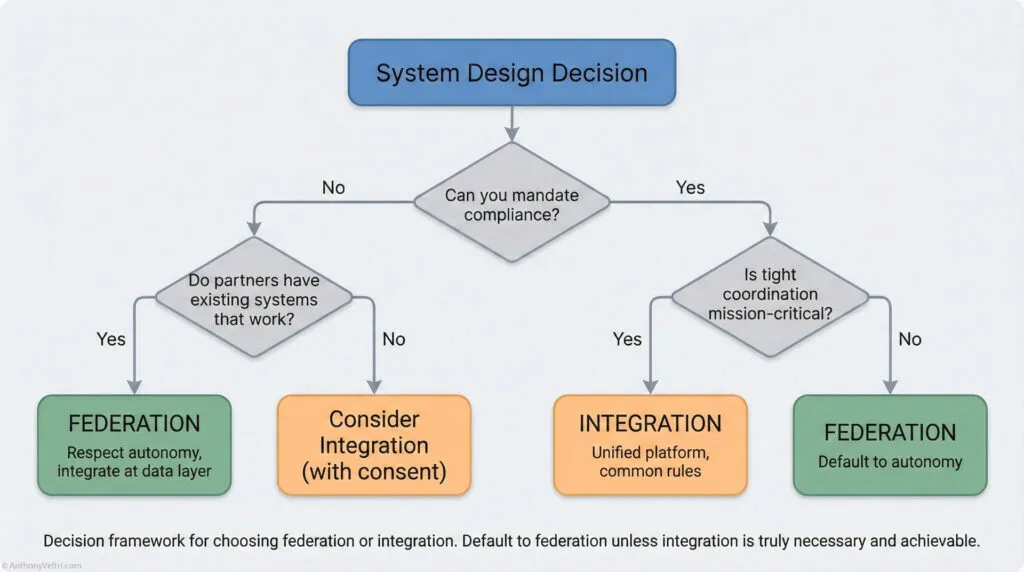
A flowchart guides system design decisions, asking about mandating compliance and mission-critical coordination to choose between federation (autonomy) or integration (unified platform) based on system needs and consent.
Mental flowchart to help answer the question: “When do I accept ‘Useful’ instead of ‘Perfect’?” It guides the practitioner to “Federation” unless they have a mandate for strict compliance.

As an architect, I design systems for useful interoperability.
I aim for the alignment required to support the mission, not the alignment required to achieve perfection.
This increases participation, reduces fragility, and accelerates outcomes.


Twenty-Second Take: #

“Perfect interoperability does not exist in mission environments. Different partners have different systems, timelines, and constraints. Useful interoperability focuses on the alignment that actually delivers value. It respects diversity while still producing a shared picture. That is what I design for.”


Cross Links to Other Principles #

Useful interoperability directly supports:

  • Federation vs integration
  • Interfaces and ownership
  • Degraded operations
  • Emergent resilience
  • Two-lane systems
  • Architecture accelerates
  • Decision drag
  • Portfolio thinking

This principle is the operational twin of federation.


Doctrine Diagnostic – For Reflection: #

Ask yourself:
Do you really need perfect alignment, or do you need useful alignment?

If you choose useful alignment, you gain speed, participation, and resilience.

If you choose perfect alignment, you get delay, friction, and fragility.

Choose the model that works in the real world.


Field notes and examples #

  • Field Note: The Human Cost of Interoperability (and the Legal Cost of Speed)
  • Bay St. Louis: Trust Before Logos After Hurricane Katrina
  • When Data And Applications Divorce: Separating The Two Without Tearing The System Apart
  • When You Choose Integration over Federation On Purpose

Last Updated on December 9, 2025

Related Posts #

A geometric abstract design with circles, lines, and shapes in muted colors. Overlaid text reads:

Doctrine 07: Clear Intent Matters More Than Perfect Data #

Abstract geometric art with circles, lines, and shapes in muted colors. A dark semi-transparent box contains the white text:

Doctrine 10: Degraded Operations Are the Normal Mode, Not the Exception #

A hand writes on a whiteboard displaying a

Field Note: Rapid Goal Setting For Cross Functional Teams #

This sepia-toned image highlights early logging practices, as seen by seven men on felled logs amid equipment and pine trees.

Field Note: Integration Debt vs Temporal Arbitrage #

Thinking in Probabilities featured title card

Doctrine 22: When "It Depends" Is the Right Answer: How to Think in Probabilities Under Uncertainty #

Abstract geometric shapes and lines in muted colors form a modern design. A dark, semi-transparent box on the left contains the text

Doctrine 16: Portfolio Thinking Ensures Effort Aligns With What Actually Matters #

contracts, governance, interfaces, interoperability
Table of Contents
  • Why forcing perfect alignment destroys participation and slows down missions
  • Perfect interoperability is a myth. Useful interoperability is a skill.
  • Lived Example: The partner with the aging server and the partner with the brand new cloud stack
  • Business Terms: What useful interoperability looks like
  • System Terms: The actual mechanics of useful interoperability
  • Why Perfect Interoperability Fails
    • Business Perspective
    • System Perspective
  • Why Useful Interoperability Succeeds
    • Business Perspective
    • System Perspective
  • Business Example: The “good enough” model that saved time
  • System Example: iCAV and tolerance as a design rule
  • Architect-Level Principle
  • Twenty-Second Take:
  • Cross Links to Other Principles
  • Doctrine Diagnostic - For Reflection:

Share This Article :

  • Facebook
  • X
  • LinkedIn
  • Pinterest

Was it helpful ?

  • Happy
  • Normal
  • Sad
  • Privacy Policy
  • Introductions
  • Contact

© 2026 Anthony Veltri

  • Doctrine
    • Doctrine Library
    • Global Library
  • Field Notes
  • Routes
    • Route 01: When the Interface Is Breaking (and you are becoming the patch)
    • ROUTE 02: If decisions stall and meetings go nowhere, start here
    • ROUTE 03: If you have lots of projects but no portfolio clarity, start here
    • ROUTE 04: If you’re confused about federation vs integration, start here
    • ROUTE 05: If heroics are propping up your system, start here
    • ROUTE 06: If you cannot force compliance across partners, start here
    • ROUTE 07: If compliance exists but commitment does not, start here
    • ROUTE 08: If disconnected workflows create audit anxiety, start here
  • Figure Library
  • FAQ
  • About
    • Capability Statement
    • Interpreter Kit
  • Contact