Don’t Build an Army of Conscripts When You Need a Coalition of Allies
Stakeholder Engagement Architecture for Federated Systems
Audience: Enterprise architects facing impossible stakeholder roles, and leaders trying to understand why “leaning harder” destroys the relationships they’re trying to build
Scene
You’re the stakeholder coordinator for a federal interoperability initiative. Six months in, you’ve engaged 50+ agencies across federal, state, local, and tribal jurisdictions. Some are participating actively. Many are evaluating. A few have declined.
Your weekly status call with leadership:
“Participation is slower than expected. We need everyone on board. This is a priority initiative. Push harder. Make it clear participation isn’t optional.”
You explain: half these stakeholders are external entities. State agencies, local governments, tribal nations. You have no authority over them. They operate in their own jurisdictions.
Leadership response:
“That’s why we hired someone good at stakeholder management. Find a way to get them on board. This needs to happen.”
So you escalate pressure. Urgent emails. References to executive priorities. Language implying mandatory participation.
Short-term result: Participation numbers rise. More agencies attend meetings. Leadership is satisfied.
Medium-term reality:
- Agencies that were genuinely interested start sending junior staff instead of decision-makers.
- Participation becomes performative.
- The agencies attending meetings are not the ones making integration decisions.
Long-term outcome:
- Integration does not happen.
- Governance is not adopted.
- The stakeholders you pressured remember.
- Next time a coordination effort launches, they recognize you as someone who does not respect jurisdictional boundaries.
Leadership conclusion:
“The coordinator couldn’t deliver stakeholder buy-in. We need better stakeholder management.”
Actual problem: Leadership demanded you build an army when you needed to form a coalition. You were told to conscript when you needed to enroll allies. When you tried to manufacture authority through pressure, you destroyed the voluntary enrollment that was actually working.
Break
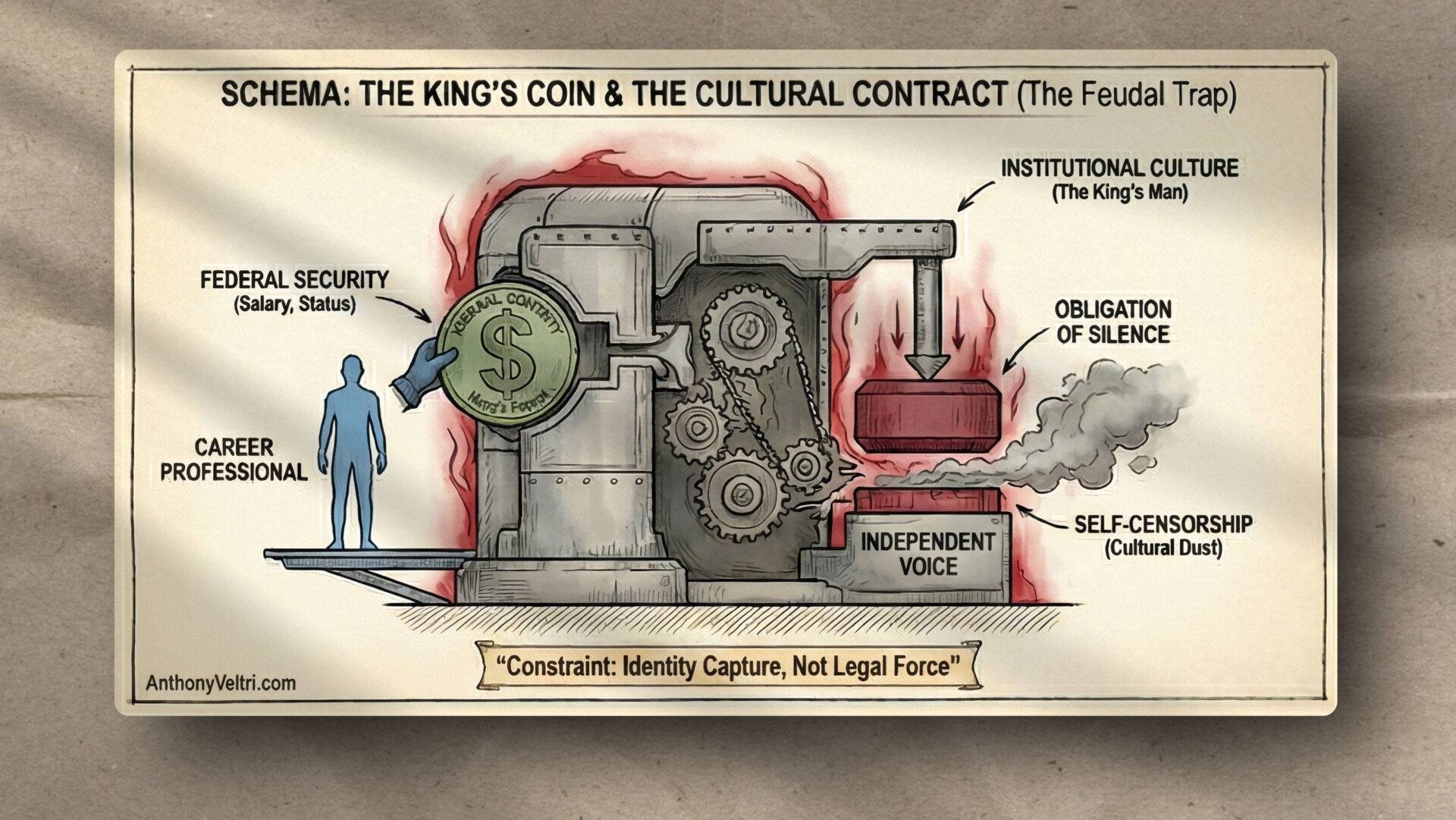
The failure is not coordination skill. The failure is treating stakeholder engagement as uniform when it requires fundamentally different approaches based on authority relationships.
The First Question You Must Answer Up Front
Before hiring anyone. Before defining success metrics. Before launching the initiative:
Do we have legitimate authority to compel these stakeholders, or is this a federation play?
This is not philosophical. It is structural. It has a binary answer:
If authority exists
- Stakeholders report within your hierarchy, or
- You have legal or regulatory authority to compel participation.
If authority does not exist (federation)
- Stakeholders operate in separate jurisdictions
- They have independent decision rights
- Participation is voluntary enrollment, not compliance
If the answer is federation, then every subsequent decision must acknowledge reality.
You cannot:
- Demand participation as if you have authority
- Measure coordinators on compliance outcomes
- Expect external entities to treat your priorities as obligations
- Use hierarchical management approaches as your default
The Catastrophic Failure Mode: Organizational Make-Believe
Organizations that need federation often pretend they’re hierarchy.
They hire coordinators and say:
“Get these stakeholders on board. Make sure they participate. This is a priority.”
The language implies authority. The metrics assume compliance. The expectations presume hierarchy.
But the authority does not exist.
So the coordinator is pushed into make-believe: pretend you have authority you do not have, then create compliance appearance through pressure.
Why this happens: Leadership has spent careers in hierarchical environments where authority exists. When they encounter federation challenges, they apply the only mental model they know.
Why this fails: External stakeholders recognize make-believe immediately. Attempted compulsion where no authority exists destroys credibility and relationships.
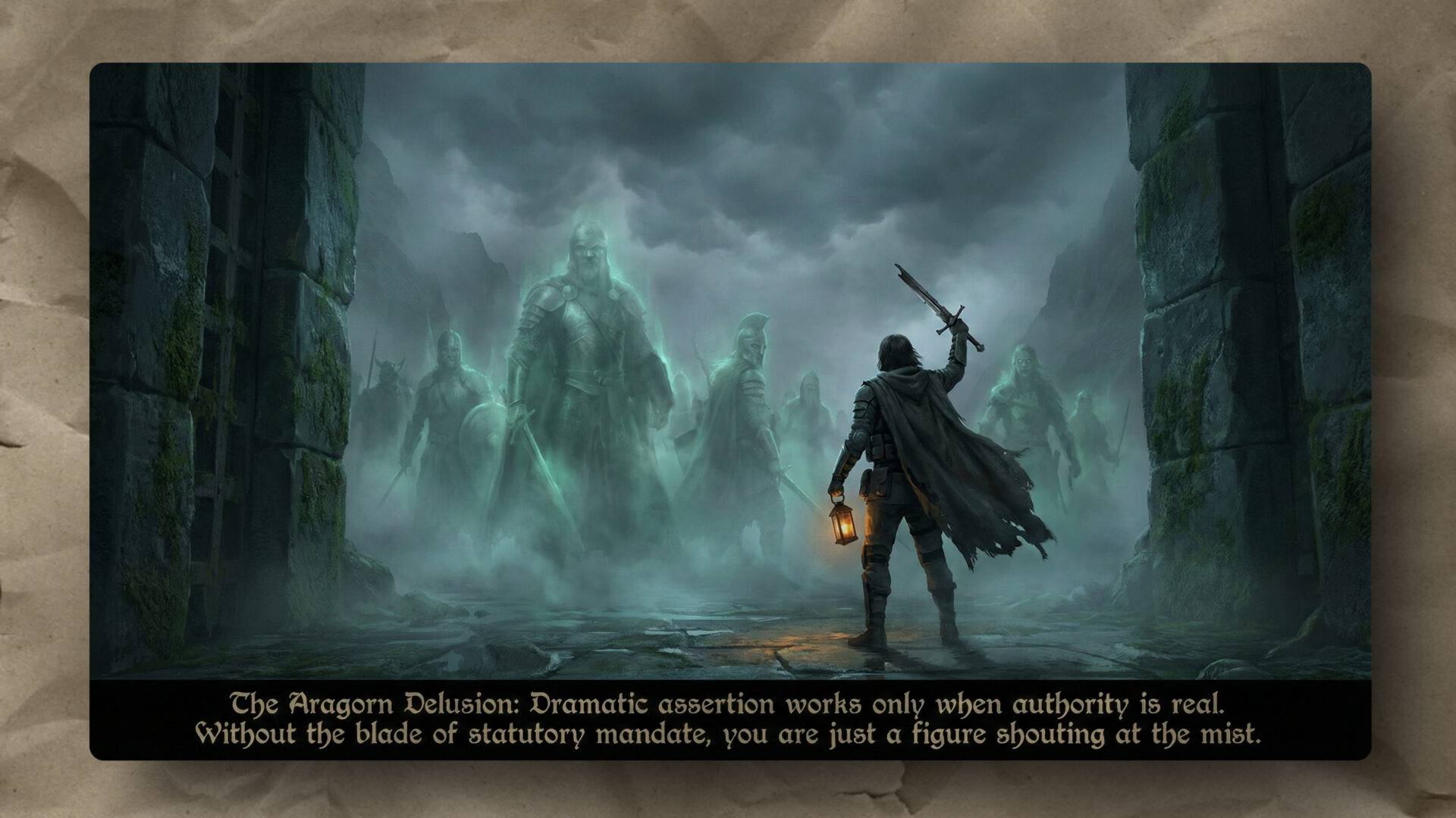
The Aragorn Delusion
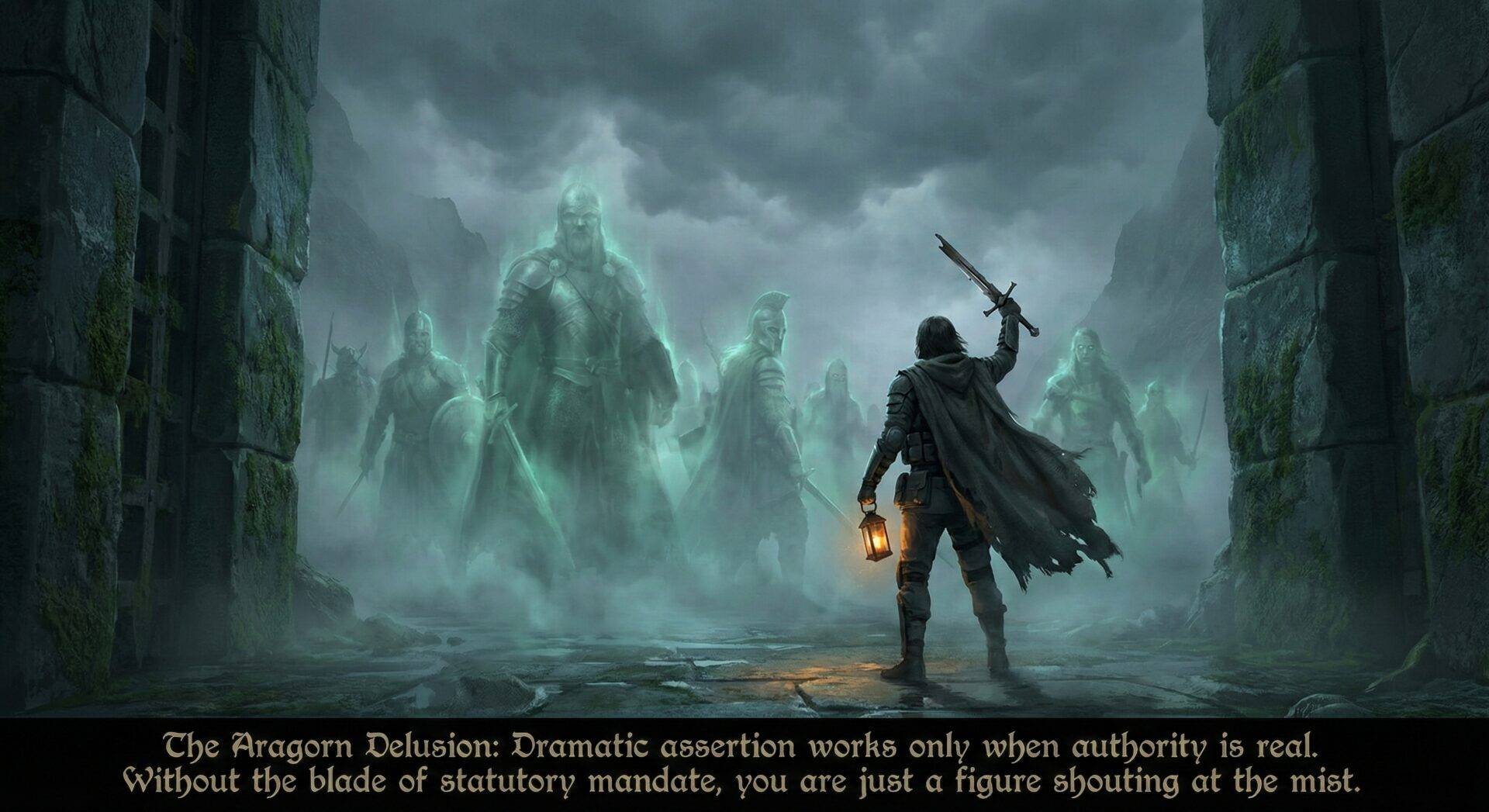
In The Return of the King, Aragorn confronts the Army of the Dead. They are oath-breakers bound until the rightful king calls them to fulfill their oath.
Aragorn asserts authority because he has legitimate proof: Anduril, the reforged sword, and the right to release them from their curse. The oath is binding. The authority relationship is real.
What made Aragorn’s dramatic assertion work
- Legitimate authority (rightful heir)
- Proof of legitimacy (Anduril reforged)
- Ability to fulfill binding obligation (power to release them)
- Actual authority relationship (they are oath-bound)
What organizations in federation contexts actually have
- No legitimate authority over external stakeholders
- No proof of authority
- No ability to compel
- No binding oath relationship
So when organizations try the Aragorn move in a federation context:
- “This is a priority”
- “Everyone must participate”
- “You’re obligated to support this initiative”
External stakeholders look for the reforged sword.
There isn’t one.
They recognize the play instantly: dramatic assertion without legitimate authority is not leadership. It is make-believe.
The lesson: Dramatic assertion works only when authority is legitimate, provable, and binding. Without that, it produces withdrawal, performative compliance, and lasting relationship damage.
Making “Anduril” Concrete: Authority Instruments
If you want to compel, you need a real instrument. In organizational terms, “Anduril” is something like:
- Statutory mandate: A specific law requiring participation
- Regulatory authority: A regulation governing operations that requires alignment
- Funding leverage: Grants or budget authority with enforceable conditions
- Legal obligation: Binding agreements, MOUs, contracts
Diagnostic question:
What specific statutory, regulatory, funding, or legal instrument requires participation?
If the answer is:
- “This is a priority”
- “Leadership expects it”
- “Everyone should participate”
- “It’s the right thing to do”
That is not authority. That is persuasion dressed up as compulsion.
If the answer is:
- “Section X of Public Law Y”
- “CFR Z.ZZ”
- “Grant requirement under Program A”
- “Signed MOU dated MM/DD/YYYY”
Then authority exists, and compulsion is real.
The Core Distinction: Internal vs External Stakeholders
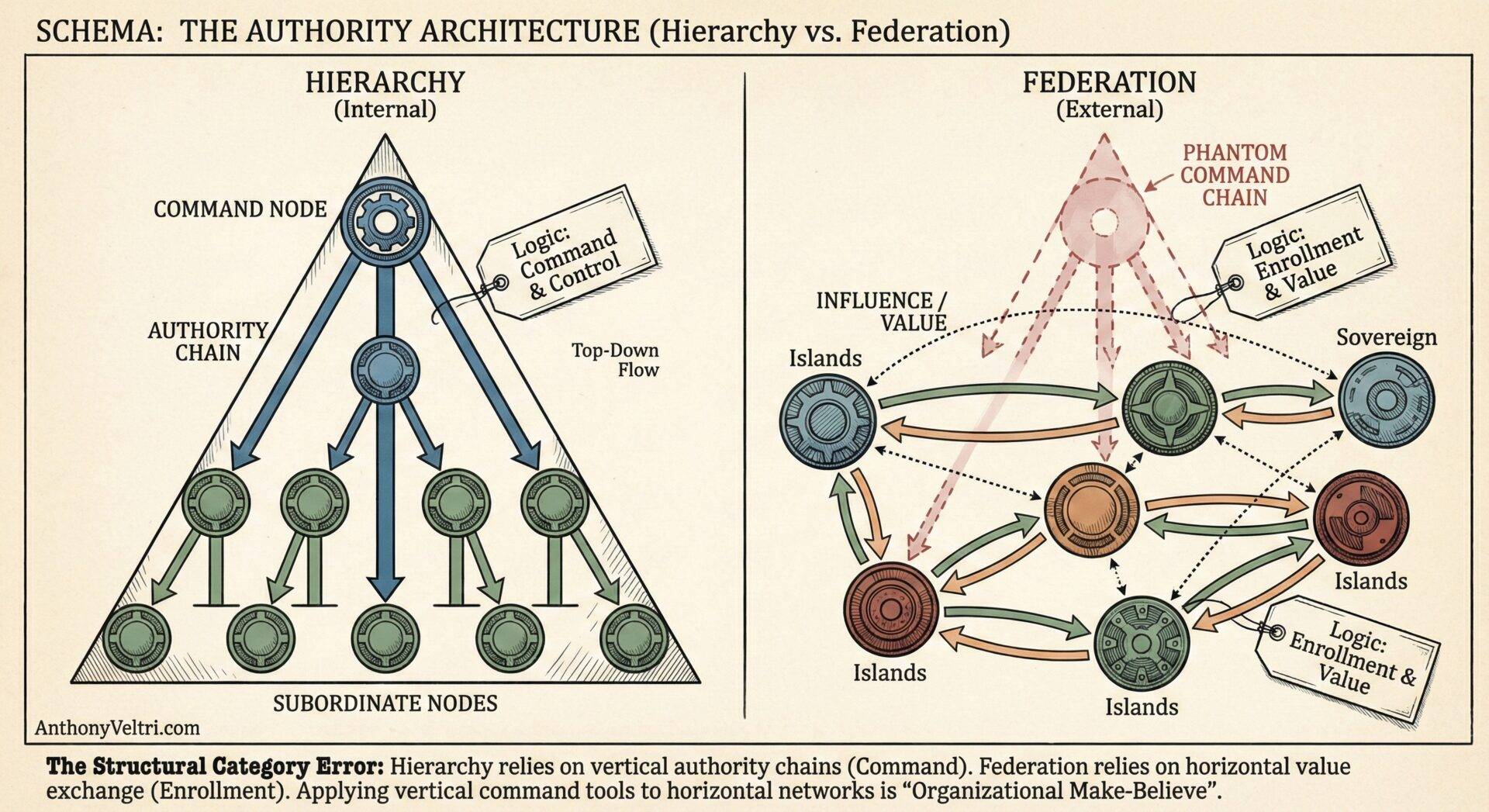
Internal stakeholders (shared authority structure)
Characteristics
- Same organization or clear hierarchy
- Escalation path exists
- Sustained refusal carries political cost
- Compulsion exists as a backstop (even if rarely used)
Approach
- Prefer voluntary alignment
- Use dialectic and soft rhetoric
- Keep escalation as last resort
- Avoid “argument to win” tactics even here
Metrics
- Integration outcomes
- Governance adoption
- Interoperability results
External stakeholders (separate authority structures)
Characteristics
- Separate jurisdictions
- Independent decision rights
- Participation is voluntary
- Compulsion is not available
Approach
- Pure enrollment
- Demonstrate mission value
- Reduce integration burden
- Respect autonomy without exception
- Never treat evaluation as compliance
Metrics
- Relationship health
- Quality of voluntary participation
- Enrollment effectiveness
- Integration support delivered
- Avoid outcome metrics that imply authority you do not have
Why “Lean Harder” Destroys External Stakeholder Relationships
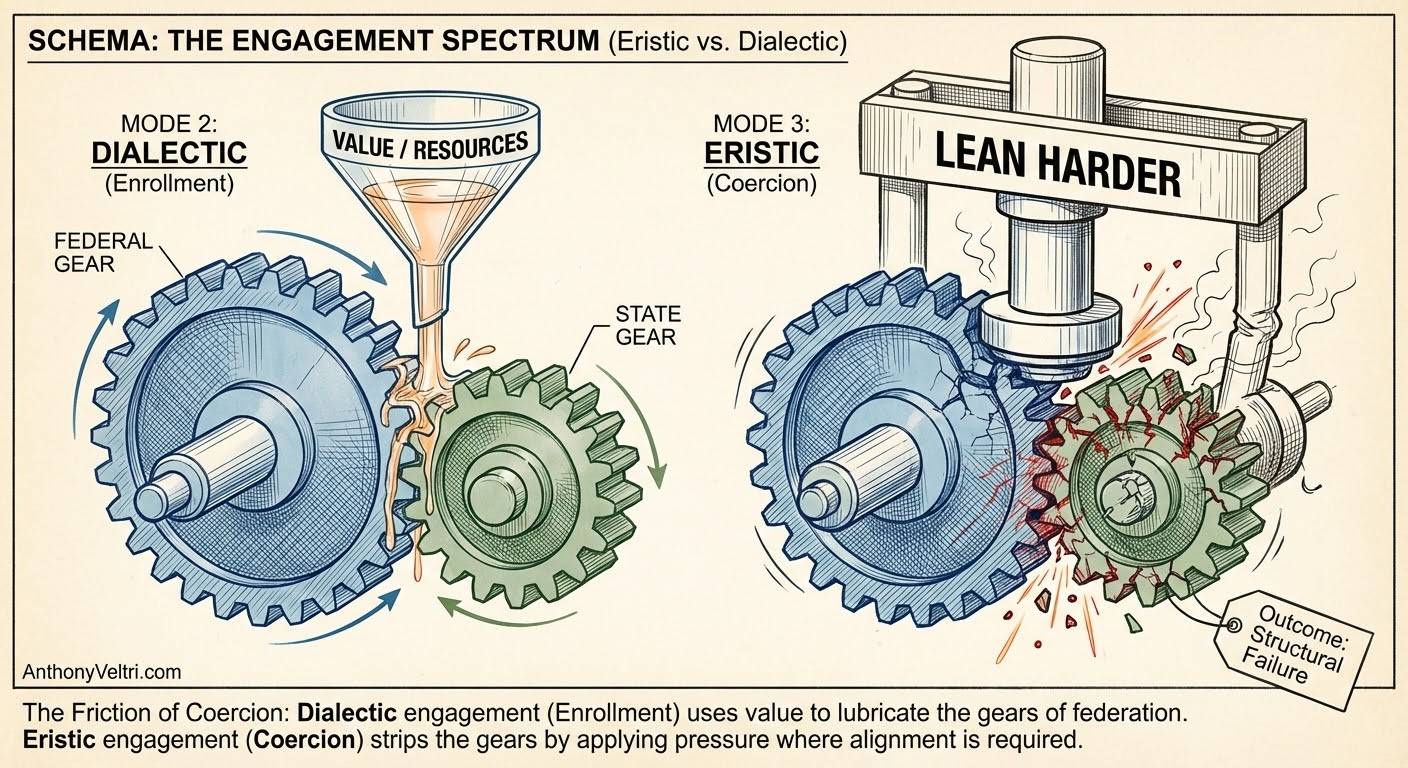
Inside hierarchy, “lean harder” can sometimes work because authority exists. People comply because the escalation path is real.
In federation, “lean harder” is an instruction to simulate authority you do not have.
External stakeholders respond in predictable ways:
- Genuine participants withdraw
They see coercion and exit. They have seen this pattern before. - Skeptical participants comply temporarily
They send minimal participation while looking for an exit. - Performative participants show up without committing
Junior staff attend. Boxes get checked. No integration decisions happen.
This is how you end up with conscripts, not allies.
Conscripts flee at the first opportunity. Allies stay because the mission serves them.
Three Engagement Modes Organizations Confuse
Most organizations think “stakeholder coordination” is one thing. It is not. It splits into three modes:
Mode 1: Facilitation (necessary, insufficient)
- Schedule meetings
- Document discussions
- Track action items
This supports coordination, but it does not create enrollment.
Mode 2: Enrollment (Dialectic + Soft Rhetoric)
Dialectic: understand where stakeholders actually are
- Mission imperatives
- Political constraints
- Operational realities
- Resource limits
- Incentives and history
Soft rhetoric: demonstrate value without coercion
- Concrete operational benefits
- Risk reduction
- Capability gains
- Peer validation
- Reduced burden through support
This is enrollment architecture, not “being personable.”
Mode 3: Eristic argument (what “lean harder” becomes)
- Argue to win
- Dominate and intimidate
- Demand compliance where none is owed
- Assert authority without legitimacy
This produces short-term compliance appearance and long-term failure.
Why Traditional Hierarchical Training Predictably Fails Here
Most project managers and enterprise architects were trained in hierarchy:
- Clear reporting structures
- Escalation paths
- Authority as a backstop
- Success measured by outcomes they can control
So when leadership says “get them on board,” and metrics imply compliance, the coordinator defaults to the familiar playbook: escalate pressure and demand participation.
This is not individual incompetence.
It is a structural setup for failure.
Case Study: DHS iCAV Stakeholder Engagement (What Worked)
The challenge: Build shared situational awareness across:
- Internal: DHS components (authority backstop exists)
- External: state, local, tribal, and other federal entities (no compulsion)
The crucial decision: DHS did not pretend external stakeholders were subordinate. No make-believe.
Internal approach (authority exists, but not the default tool)
- Dialectic + soft rhetoric
- Value demonstration
- Authority backstop existed but was rarely needed
External approach (no authority, pure enrollment)
- Participation framed as voluntary
- Value proposition led
- Burden reduced with support (technical help, training, documentation)
- Autonomy respected as non-negotiable
Counterfactual: If DHS had applied pressure to external stakeholders, it would have triggered the “Aragorn without Anduril” failure mode: withdrawal, performative participation, stalled integration, and lasting relationship damage.
Consequence Documentation: The Strategic Advisory Shield (CAPR)
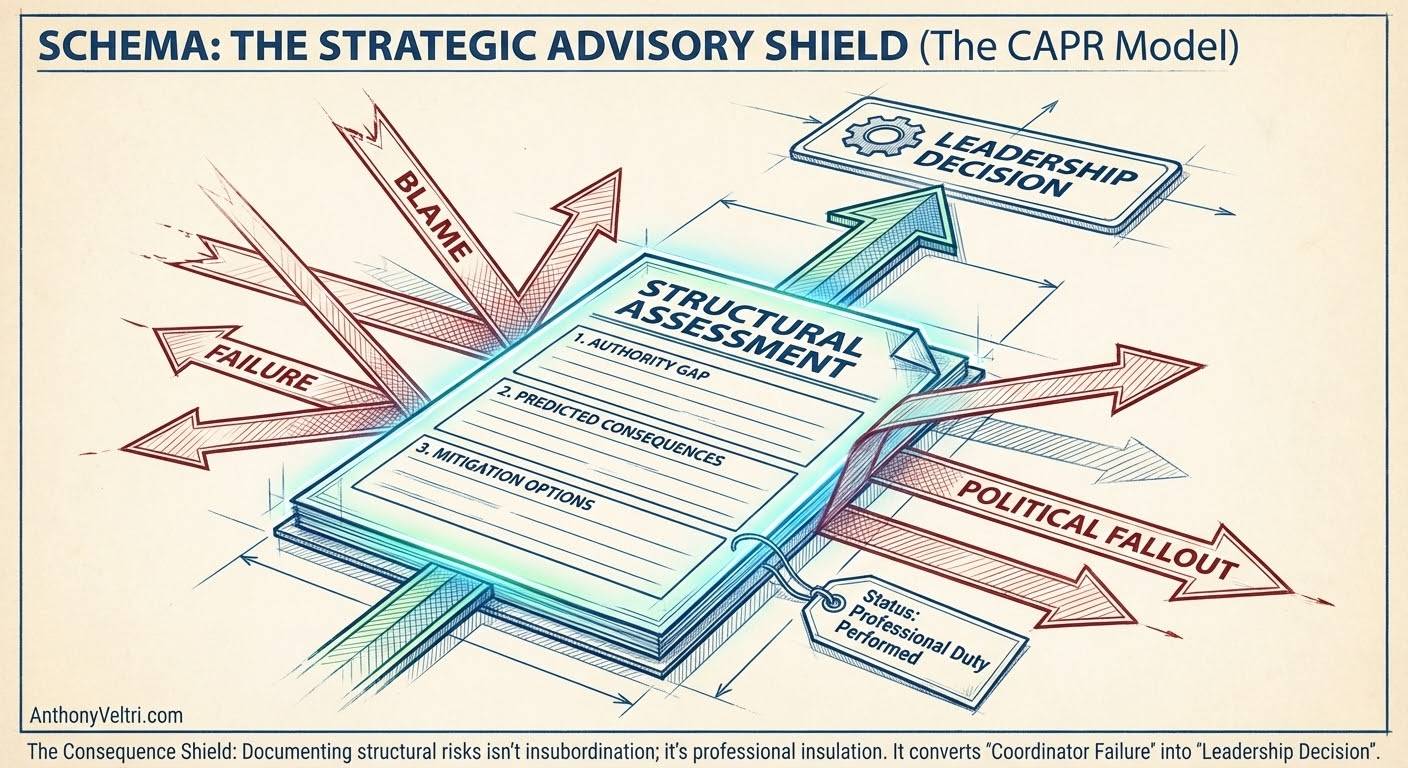
Consequence documentation feels uncomfortable to people trained in hierarchy because it can look like pushback.
In federation, it is not pushback. It is professional duty.
Frame it like this:
- Not: “I won’t do this.”
- Instead: “Here’s what this approach produces. Here’s what different outcomes require. Which approach should I execute?”
What this gives leadership
- Clear decision space: options, requirements, outcomes
- Structural clarity: what authority and resources exist, and what they produce
- Organizational memory: risks identified, mitigation offered, decision requested
The template (copyable)
STAKEHOLDER ENGAGEMENT STRUCTURAL ASSESSMENT
CONTEXT:
- Initiative name, scope, stakeholder universe
STAKEHOLDER CATEGORIZATION:
- Internal stakeholders (authority backstop exists):
- External stakeholders (no compulsion possible):
AUTHORITY INSTRUMENTS (ANDURIL):
- Statutory mandate:
- Regulatory authority:
- Funding leverage:
- Legal obligation:
CURRENT APPROACH:
- Language (hierarchy vs federation framing):
- Metrics (outcome vs process):
- Resources (enrollment support provided):
PREDICTED CONSEQUENCES (IF FEDERATION + HIERARCHY SIGNALS):
- Pressure escalates
- External stakeholders look for proof of authority
- Finding none, they withdraw or go performative
- Integration stalls despite attendance
- Relationship damage persists into future efforts
MITIGATION OPTIONS:
- Option A: Provide legitimate authority instruments
- Option B: Fund enrollment resources and revise metrics
- Option C: Accept consequences and stop pretending outcomes are controllable
REQUESTED DECISION:
- Which option should I execute?
The documentation template
STAKEHOLDER ENGAGEMENT STRUCTURAL ASSESSMENT

CONTEXT:
[Initiative name, scope, stakeholder universe]

STAKEHOLDER CATEGORIZATION:
Internal stakeholders (compulsion authority exists): [list with authority instruments]
External stakeholders (no compulsion authority): [list with jurisdictional notes]

CURRENT APPROACH:
Language: [document hierarchical vs. federation framing]
Metrics: [document outcome vs. process measures]
Resources: [document enrollment resources provided]

AUTHORITY INSTRUMENTS:
Statutory mandates: [list specific statutes if exist, "none" if not]
Regulatory authority: [list specific regulations if exist, "none" if not]
Funding leverage: [list specific mechanisms if exist, "none" if not]

STRUCTURAL MISMATCH ASSESSMENT:
☐ No mismatch - Authority exists and approach aligns
☐ Mismatch exists - Federation context with hierarchical approach

IF MISMATCH EXISTS:

PREDICTED CONSEQUENCES:
[Use consequence pattern documented above]

Timeline to visible failure: [specify]
Mission impact: [specify]
Relationship damage: [specify]

MITIGATION OPTIONS:
[Document Option 1, 2, or 3 with specific requirements]

RESOURCE REQUIREMENTS FOR SUCCESS:
[If Option 2, document specific enrollment resources needed]

RECOMMENDED APPROACH:
[Option 1, 2, or 3 with rationale]

CONSEQUENCES IF RECOMMENDATION NOT IMPLEMENTED:
[Specific consequences with timeline]
The Structural Solution
For leadership
- Decide honestly: federation or hierarchy
- If federation, stop using hierarchy language (“mandatory,” “ensure compliance,” “push harder”)
- If federation, stop using hierarchy metrics (compliance rates, mandatory participation, integration completion without resources)
- Fund enrollment resources or accept a voluntary timeline
- Reward consequence documentation as strategic advisory, not attitude
For enterprise architects and coordinators
- Demand the upfront answer: authority or federation
- If federation, demand resources and metrics that match reality
- Document consequences early, using the CAPR frame
- Do not try to be Aragorn unless you can point to Anduril
Principle to Remember
Document structure. Document consequences. Document options. Request a decision.
That is how you build a coalition of allies instead of an army of conscripts.
Last Updated on February 22, 2026