Federation Without Owners: The Slow Failure Mode
So far we have talked about federation as a positive pattern. Respect sovereignty. Allow variety. Federate data instead of forcing everyone into one box.
There is a darker version. That is federation without clear ownership and without clear standards. It is slow failure.
You can see hints of it anywhere multiple systems are stitched together by law or habit, but nobody is truly responsible for the whole.
One example from my world involves the way some federal processes rely on the Federal Register and external publication. From the perspective of an agency like the Forest Service, you can modernize your own internal systems, clean up your data, and automate workflows. You can get your side of the house into good shape.
Then you hit the boundary.
To complete the process, you must interact with an external system that is not under your control and that does not own the standards that drive your work. The Federal Register owns publication. It does not own the policy or the technical rules behind your content. Your agency owns the substance. Nobody truly owns the full pipeline end to end.
That is federation, but not the healthy kind.
In healthy federation:
- Data contracts and standards have clear stewards.
- Interfaces are treated as products, not as accidents.
- Each participant knows what they are responsible for and what they can expect from others.
In unhealthy federation:
- Everyone is responsible for their fragment and nobody is responsible for the whole.
- Standards exist on paper but have no clear guardians.
- Integration points are the place where good intentions go to die.
The forest of Federal Register Notices that rely on partially modernized upstream systems is a cautionary tale. You can have a modern interface feeding a legacy process which then pushes into a somewhat modern publication platform. Each piece is respectable in isolation. As a system, it feels brittle and slow.
The danger is that this kind of federation looks productive. Work goes in. Work comes out. You can count things. You can report status. It is not obviously broken in the way a downed system is broken.
The cost shows up in latency, duplicated work and invisible human effort. People reformat the same content three times. They manually bridge systems that were never meant to touch. They create little one person APIs with copy and paste.
In alliance contexts, this pattern is even more risky. If nobody owns the end to end experience of a shared workflow, the default outcome is entropy. Everyone builds clever workarounds. The true system lives in email and side agreements. The official architecture diagram becomes a work of fiction.
My doctrine for avoiding this slow failure mode has three parts.
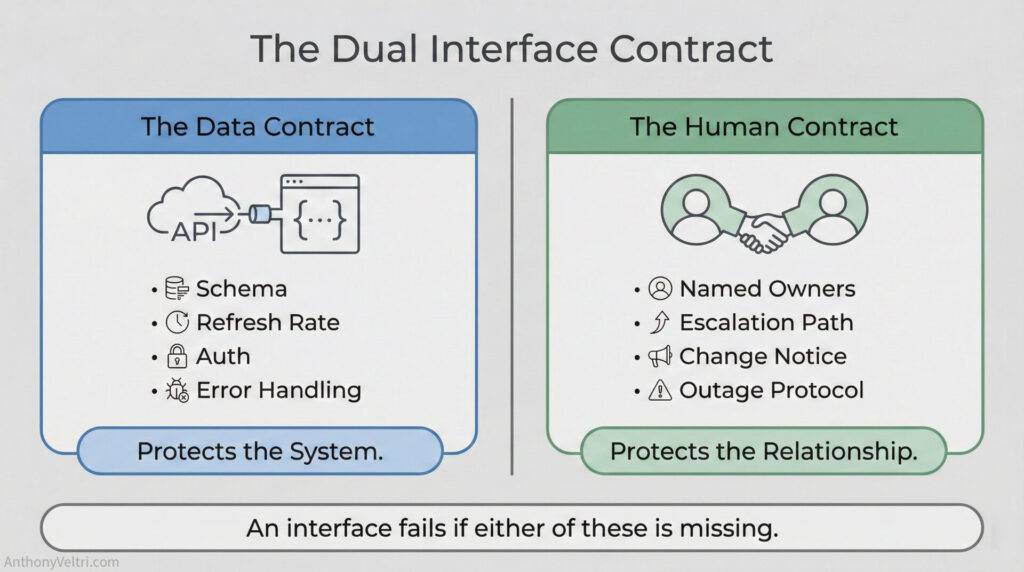
- Whenever you say “federated,” ask “who owns the interfaces.” If there is no clear answer, you have found a risk.
- Treat integration points as first class systems. They need budgets, stewards and feedback loops, not just one time projects.
- Look for places where people are acting as manual glue between tools. That is where your architecture is quietly offloading cost onto individuals.
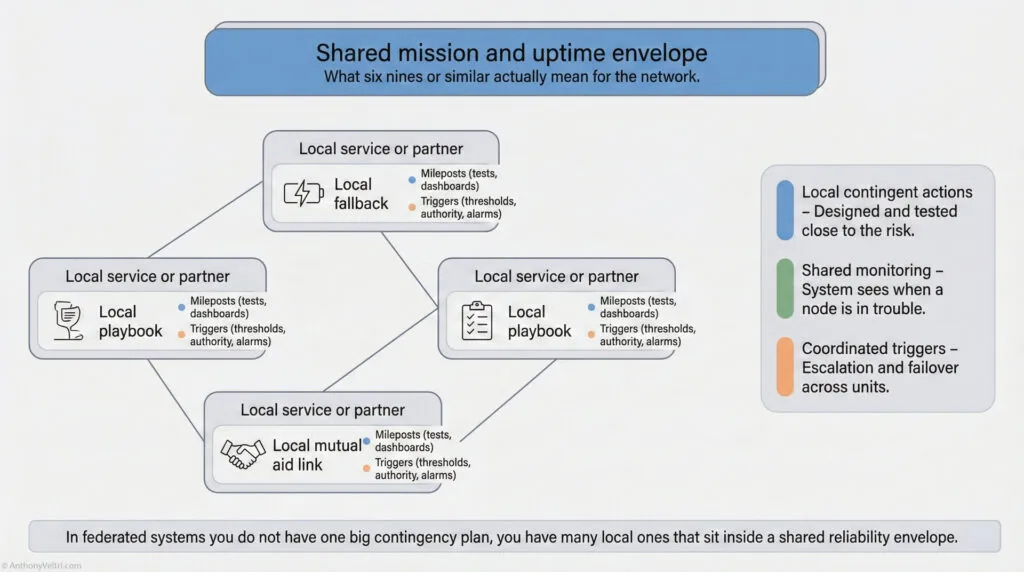
Federation is not a shortcut around responsibility. It is a different way of holding responsibility. Instead of one central authority owning everything, each node in the network owns its piece and the shared connections.
Without that shared ownership, federation is just fragmentation with better branding.
Last Updated on December 7, 2025