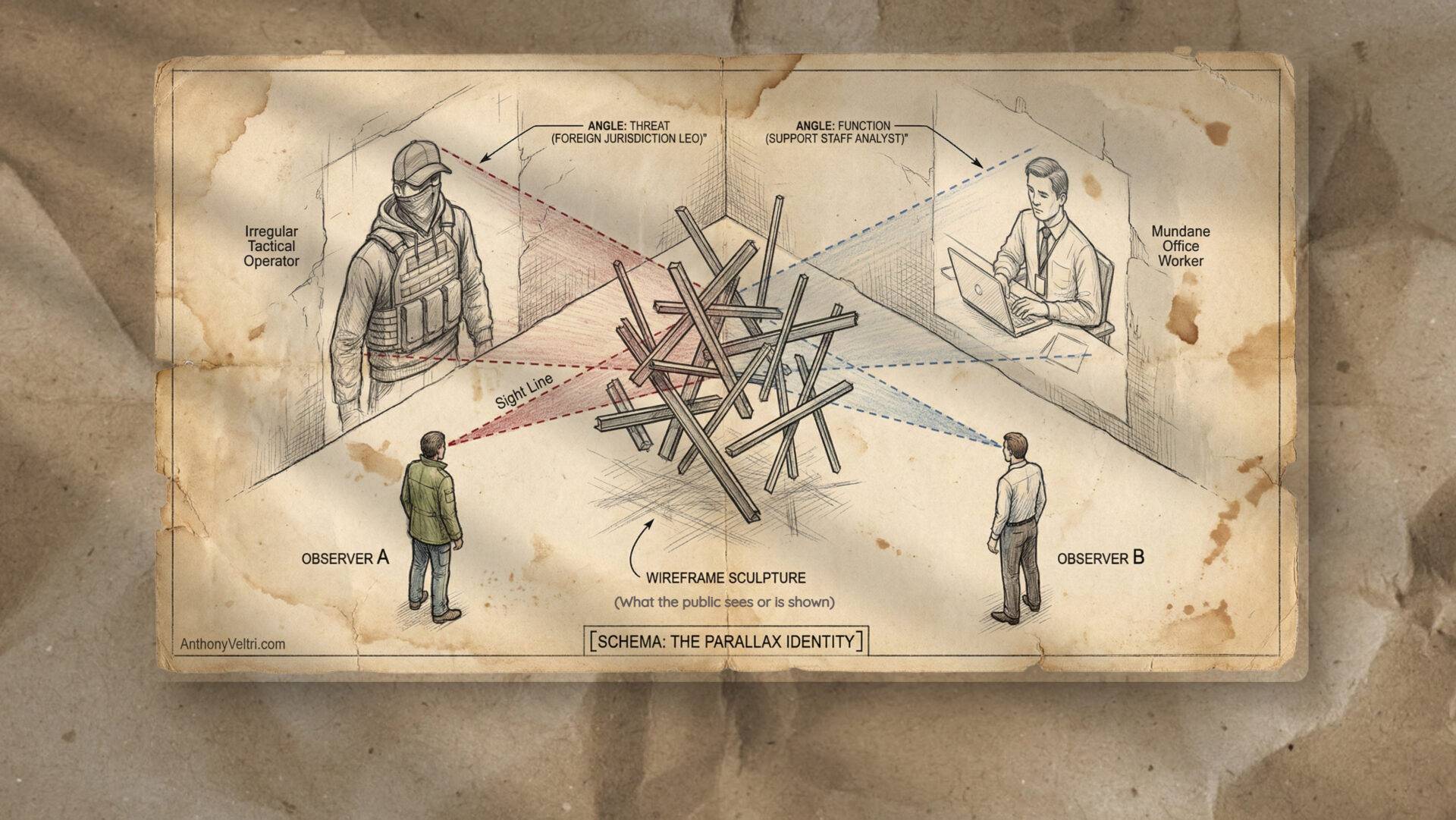
Field Note: Loosely Coupled Power Grabs
How Coordination Happens Without Conspiracy (And Why “Proof” Is the Wrong Gate)
Note: “Power grab” describes the effect and direction, not proof of a single planner.
Why this note exists
This archive is not a news feed. It is a place to map mechanics.
There is a structural gap in how we analyze power. People demand a single coordinating memo, a single smoking gun, a single mastermind. If they cannot prove centralized orchestration, they treat patterns as coincidence or hysteria.
That proof standard is often appropriate for prosecution.
It is not appropriate for forecasting, self-protection, or timing decisions under asymmetric error costs.
This field note names the missing mechanism that explains how large systems drift into new equilibria through many semi-independent moves that share the same incentives, permissions, and targets. You can get coherent outcomes without coherent planning. You can get coordination without conspiracy.
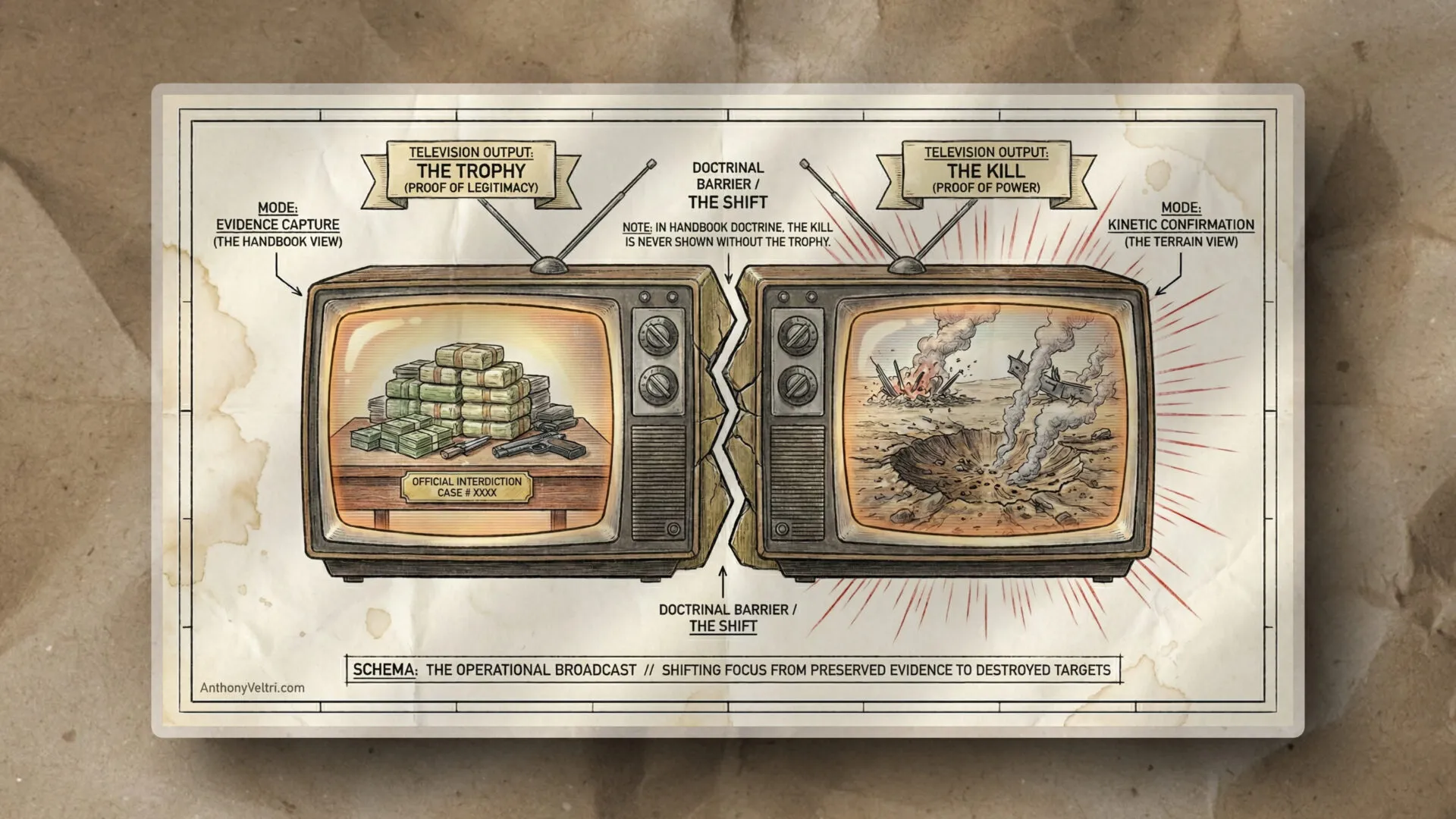
This is a companion to Field Note: Handbook vs Terrain, which shows how constraint-first forecasting fails when the environment becomes exception-driven. This note explains why.
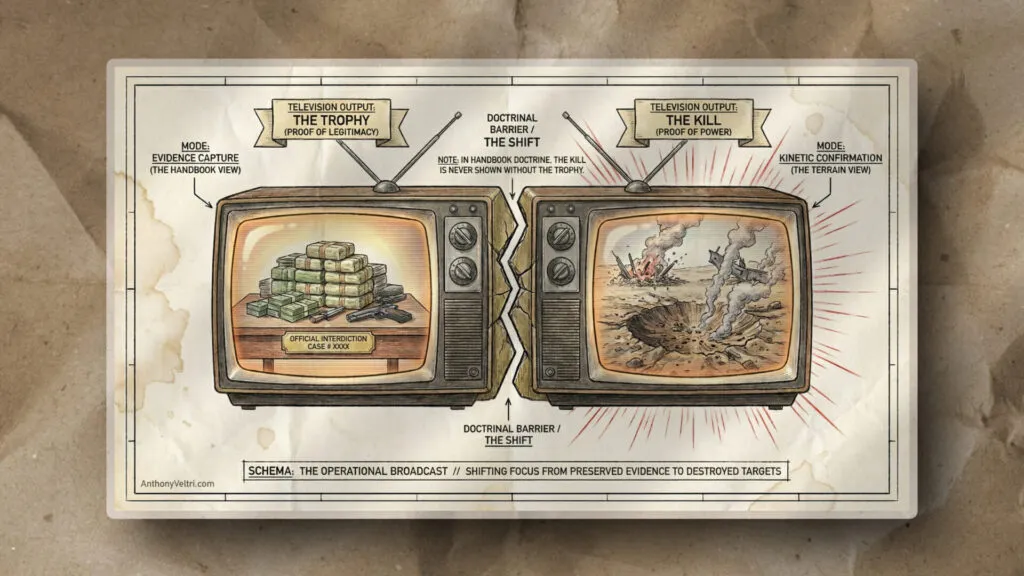
Field Note: Handbook vs Terrain – When Constraint Forecasting Failed and Indications Won
Scope and limitations
What this field note does:
- Defines loose coupling as a forecasting mechanism
- Explains why “no conspiracy” does not mean “no pattern”
- Upgrades both constraint-based and behavior-based models
- Provides a practical grouping function for pattern recognition (the Bundle Test)
- Adds anti-paranoia guardrails to keep the method calibrated
What this field note does not do:
- Provide operational guidance for “winning” against a power-asymmetric system
- Prove a single intentional plan behind multiple incidents
- Replace your existing tripwire dashboard in Handbook vs Terrain
If you want exit timing and decoupling strategy, this note points you back to the companion work on strategic decoupling. This note is the mechanism layer.
Calibration is not a crusade
Pattern recognition is not moral permission. Forecasting is distinct from judgment. A predictive model helps you navigate the terrain; it does not obligate you to fix it.
A predictive model can be valid without creating an obligation to “eradicate” anyone. The goal is options preservation. Seeing smoke early gives you time to move toward exits before the stairwell fills.
This is forecasting and self-protection. Not labeling. Not revenge.
Scene: Smoke, Not Proof
My burden of proof is not “beyond a reasonable doubt.”
My burden of proof is “I am in a crowded building, I smell smoke, the lights just went out, and the alarm has not sounded yet.”
In a well-maintained building, you trust alarms. In a degraded building, you do not.
You move toward exits early because the cost of a false negative is catastrophic and the cost of a false positive is usually just embarrassment.
That is the forecasting standard this note assumes.
Bridge: The Argument That Keeps Repeating
In Handbook vs Terrain, I described a recurring mismatch:
Model A forecasts from rules, institutions, procedures, and “how it is supposed to work.”
Model B forecasts from incentives, revealed preferences, rehearsal signals, and “how it is actually being played.”
In an exception-driven environment, Model B starts landing predictions while Model A keeps saying “that is not how it works.”
This note explains how that happens without requiring a single mastermind.
Break: What “Loosely Coupled” Means (Without Jargon)
A loosely coupled set is a collection of actions that:
- Are not centrally coordinated (or cannot be proven to be)
- May involve different actors and different domains
- Can be individually explained or dismissed
- But still share a recognizable frame, method, target, and effect
Loose coupling creates a pattern that looks coordinated because it is.
It is coordinated by the environment.
The shared incentives and shared permissions create synchronized movement even if no one is “in charge” in the cinematic sense.
If you already read Handbook vs Terrain, you have seen this mechanism under a different name.
You called it the vulture pattern.
Biologists call it stigmergy, meaning indirect coordination through the environment, like termites building a cathedral without a blueprint.
Break: Coordination Without Conspiracy (The Vulture Pattern, Re-stated)
Vultures do not meet in secret. They do not draw plans. They do not assign roles.
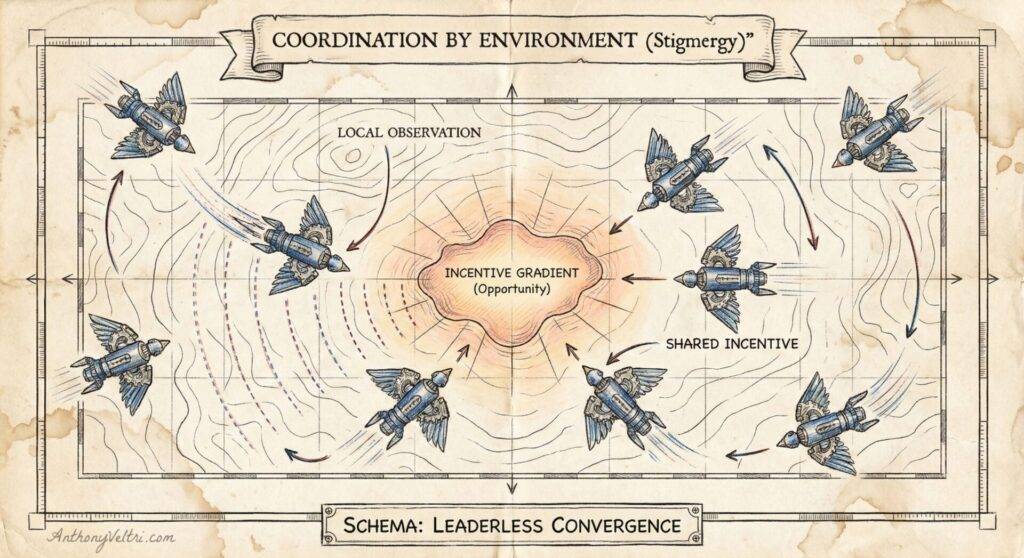
Yet they arrive at the same carcass at the same time.
How?
Each vulture watches the environment for signals. When one descends, others see that descent. The environment provides coordination signals. The shared incentive gradient does the rest.
Human systems can operate the same way:
- Actors monitor the same channels
- Incentives reward speed and aggression
- Permissions are ambiguous on purpose
- Dissenters are removed or learn to stay quiet
- Opportunists escalate because escalation pays
This produces behavior that looks coordinated because it is. Just not how people expect.
A plan is not required.
This is why “prove the conspiracy” is the wrong gate for forecasting.
Break: The Two Clocks Model (The Missing Layer)
Once you accept loose coupling, the forecasting problem becomes a race between two clocks.
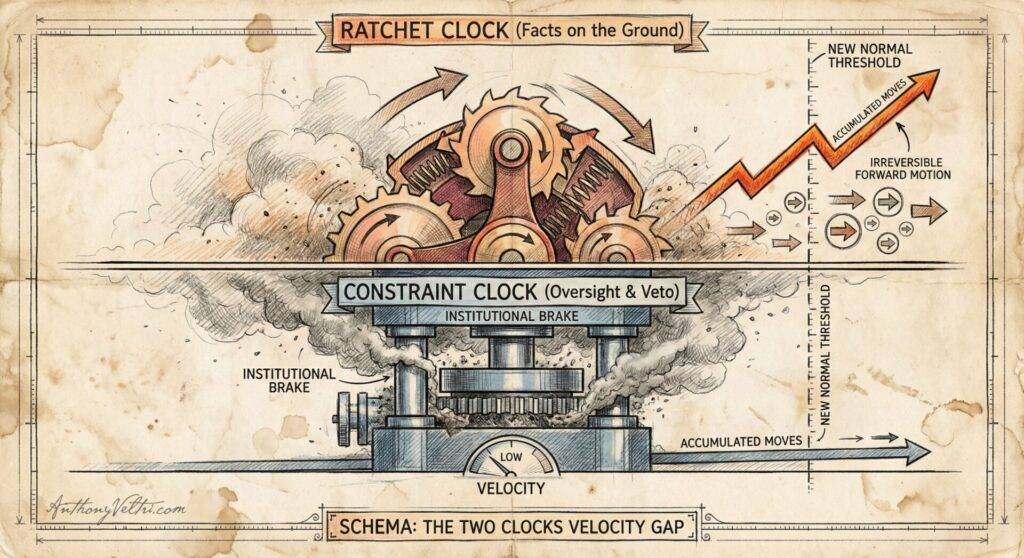
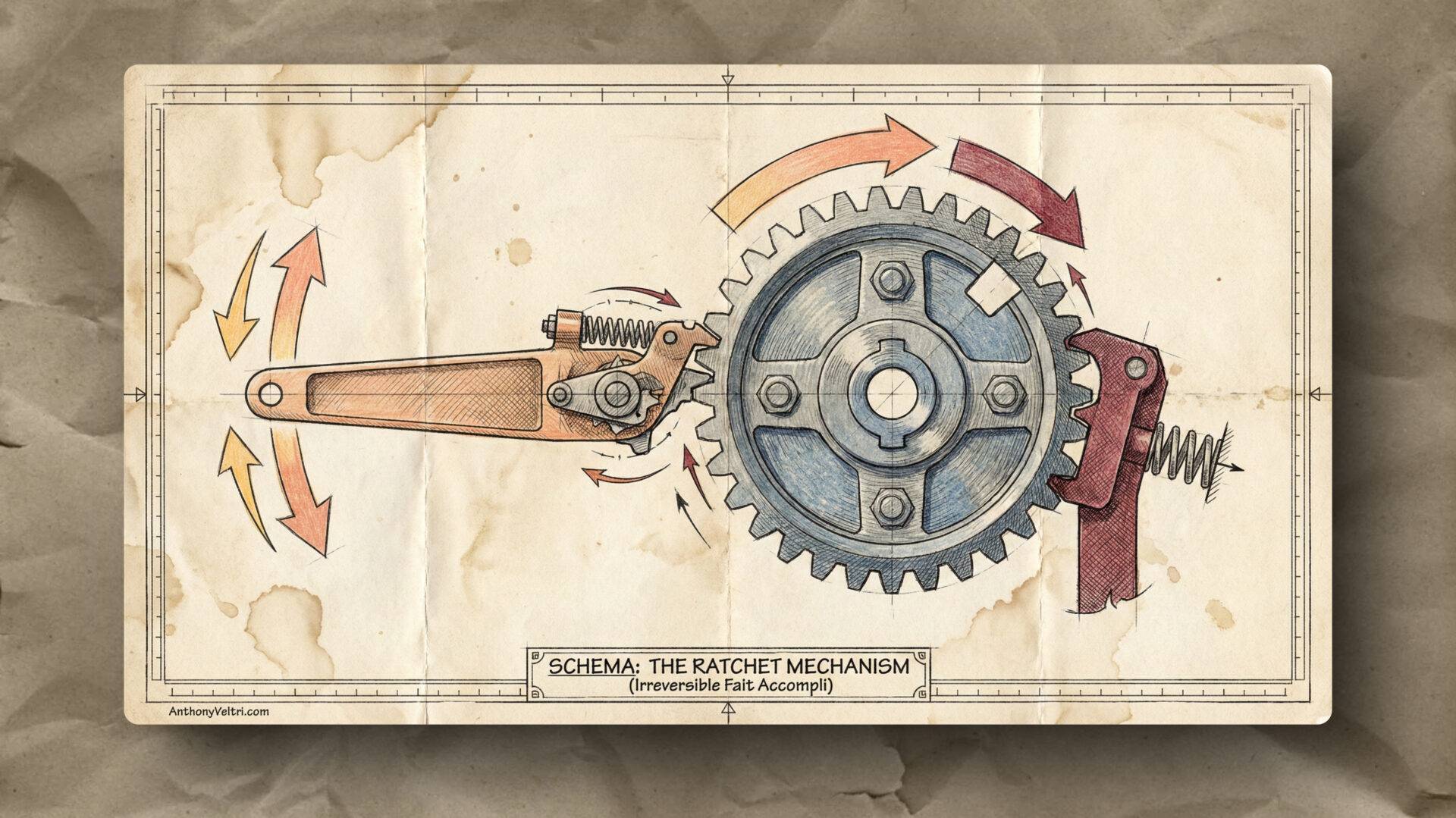
Clock 1: Ratchet Speed
How quickly can new facts on the ground be created?
This clock is powered by:
- Speed over process
- Ambiguity over clarity
- Under-threshold moves
- Narrative compression (“we had to act now”)
- Distributed action by semi-independent actors
Clock 2: Constraint Enforcement
How quickly can veto players impose real cost or reversal?
This clock is powered by:
- Courts and timelines
- Legislatures and oversight cycles
- Allies and permission control
- Reputational collapse
- Market and resource limits
In a stable system, the constraint clock usually wins.
In a degraded system, the ratchet clock wins often enough to establish a new normal before the constraint clock even clears its throat. Note: for our purposes, a ratchet is a mechanism that allows continuous motion in one direction while preventing motion in the opposite direction. In this context, it means facts on the ground are created instantly, while reversal requires months of procedure.
That is the central prediction upgrade.
Watch for this: When ratchet speed consistently beats constraint enforcement, you are in an exception-governed environment. Incrementalism becomes the default prediction.
Break: How This Upgrades Constraint-Based Forecasting
Constraint-first forecasting often treats constraints like walls.
Loose coupling forces a different view.
Constraints are not only walls. They are also:
- Latency (how long until a response arrives)
- Leakage (how many moves slip through anyway)
- Scope (which domains are enforceable in practice)
- Cost externalization (who pays the cost first)
A constraint can exist on paper and still fail as a governor if:
- Enforcement is slow
- Enforcement is partial
- The first costs are paid by someone else
- The move is ambiguous enough to delay consensus
This is the “shoot first, ask questions later” advantage.
The constraint model does not become useless. It becomes probabilistic and time-bound.
It starts answering different questions:
- What can be done before a veto activates?
- What can be done below threshold?
- What can be done in ways that force others to bear the first costs?
Break: How This Upgrades Behavior-Based Forecasting
Behavior-first forecasting often watches a leader.
Loose coupling widens the lens to a posture.
A posture can be enacted by:
- Agencies
- Contractors
- Proxies
- Aligned media
- Opportunists
- Silent compliers
You do not need a single order to see a pattern.
You only need:
- Rewarded escalation
- Ambiguous permission
- Selective punishment of dissent
- Repeated rehearsal in multiple domains
This creates a distributed machine.
It can produce coherent outcomes even if the leader is inconsistent, distracted, or improvisational.
That is the part the handbook tends to miss.
Break: The Bundle Test (A Practical Grouping Function)
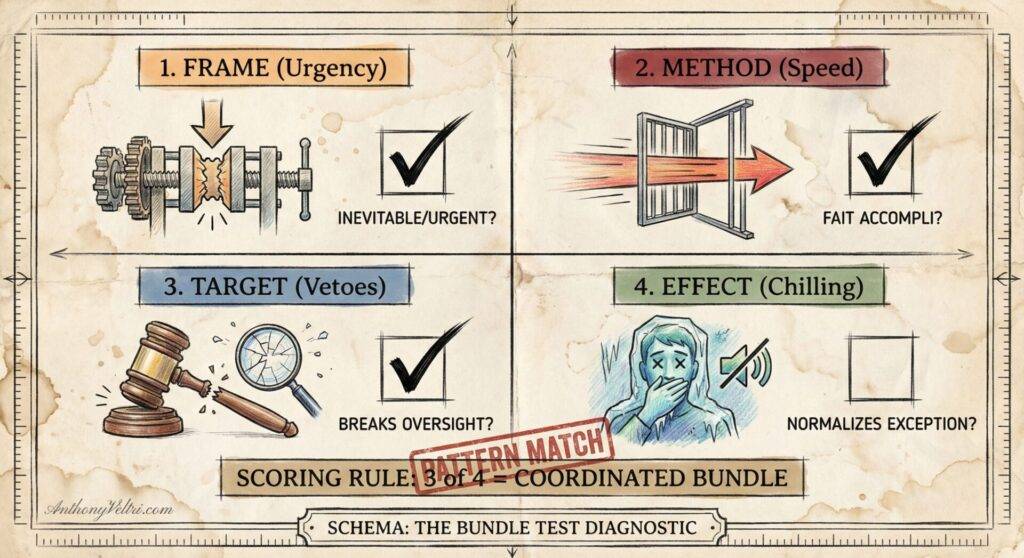
When a new incident shows up, do not ask: “Is it connected?”
Ask: “Does it belong to the same bundle?”
A bundle match has four components.
1) Frame
- Inevitability (“we have no choice”)
- Threat inflation
- Urgency compression (“now or never”)
- Moral inversion (“we are the victim”)
2) Method
- Speed over consultation
- Ambiguity over clarity
- Faits accomplis
- Under-threshold action
- Reversible steps that become irreversible through repetition
3) Target
- Veto players (courts, legislatures, allies, oversight)
- Credibility nodes (career gatekeepers, prosecutors, inspectors general)
- Shared meaning infrastructure (definitions, records, provenance)
4) Effect
- Chilling effect
- Compliance through uncertainty
- Precedent creation
- Coalition splitting
- Normalization of exception
How to Score a “Bundle”: To determine if disparate events are part of a loosely coupled power grab, look for these four matches.
1) The Frame Check:
- Is the action framed as inevitable (“we have no choice”) or urgent (“now or never”)?
- Yes = Matches Pattern.
2) The Method Check:
- Does the action rely on speed over consultation or ambiguous under-threshold steps?
- Yes = Matches Pattern.
3) The Target Check:
- Is the action aimed at neutralizing Veto Players (courts, oversight, allies) or destroying shared meaning?
- Yes = Matches Pattern. (Note: The move isn’t trying to use these players; it is trying to break them or bypass them.)
4) The Effect Check:
- Does the action create a chilling effect or normalize an exception?
- Yes = Matches Pattern.
The Scoring Rule: If 3 of 4 are YES, treat it as the same syndrome.
Result: It is a coordinated pattern (Loose Coupling), not a random incident (Rogue Captain).
Not proof. Not a conviction. A forecast.
This gives you a disciplined middle path:
- Not “everything is coordinated.”
- Not “nothing is connected.”
Instead: A syndrome is a pattern defined by shared mechanics, not shared authorship.
You do not need to prove a memo. You need to recognize the repeating bundle.
This protects you from two traps:
- Handbook hypnosis: “It cannot happen here because it violates rules.”
- Conspiracy overreach: “Everything is one plan.”
Loose coupling says: patterns can be real without central orchestration.
Schema: How This Connects to the Tripwire Dashboard
If you read Handbook vs Terrain, you already have a tripwire dashboard:
- Domain creep
- Theater creep
- Process substitution
- Secrecy as strategy
- Selective enforcement
- Survivor treatment shift
- Mainstream target broadening
Use those tripwires as your instrument panel.
Use the Bundle Test as your grouping function.
Tripwires tell you what to watch.
Bundles tell you when multiple signals belong to the same mechanical pattern.
Together, they prevent overreaction to single anecdotes while still allowing early movement when the pattern is emerging.
Break: Phase Transitions (When Smoke Becomes Enough)
This is the decision problem.
You are rarely choosing between certainty and uncertainty.
You are choosing between:
- Acting early with incomplete information
- Acting late with complete information but reduced options
Phase transition indicators that matter more than rhetoric:
Indicator 1: Operational signature
Concrete preparations that have distinctive logistics, contracting, posture, or permissions requirements.
Indicator 2: Legal posture shifts
Redefinitions of terms that widen discretion and reduce consultation requirements.
Indicator 3: Coalition fracture attempts
Threats or punishments aimed at partners, especially when paired with bilateral side deals.
If two of three show up in a short window, “move toward exits” becomes rational even if no single incident is dispositive.
Break: Pacing Predictions (Incrementalism vs Speed)
The Two Clocks model does not just tell you if a pattern will continue. It tells you how fast it will move.
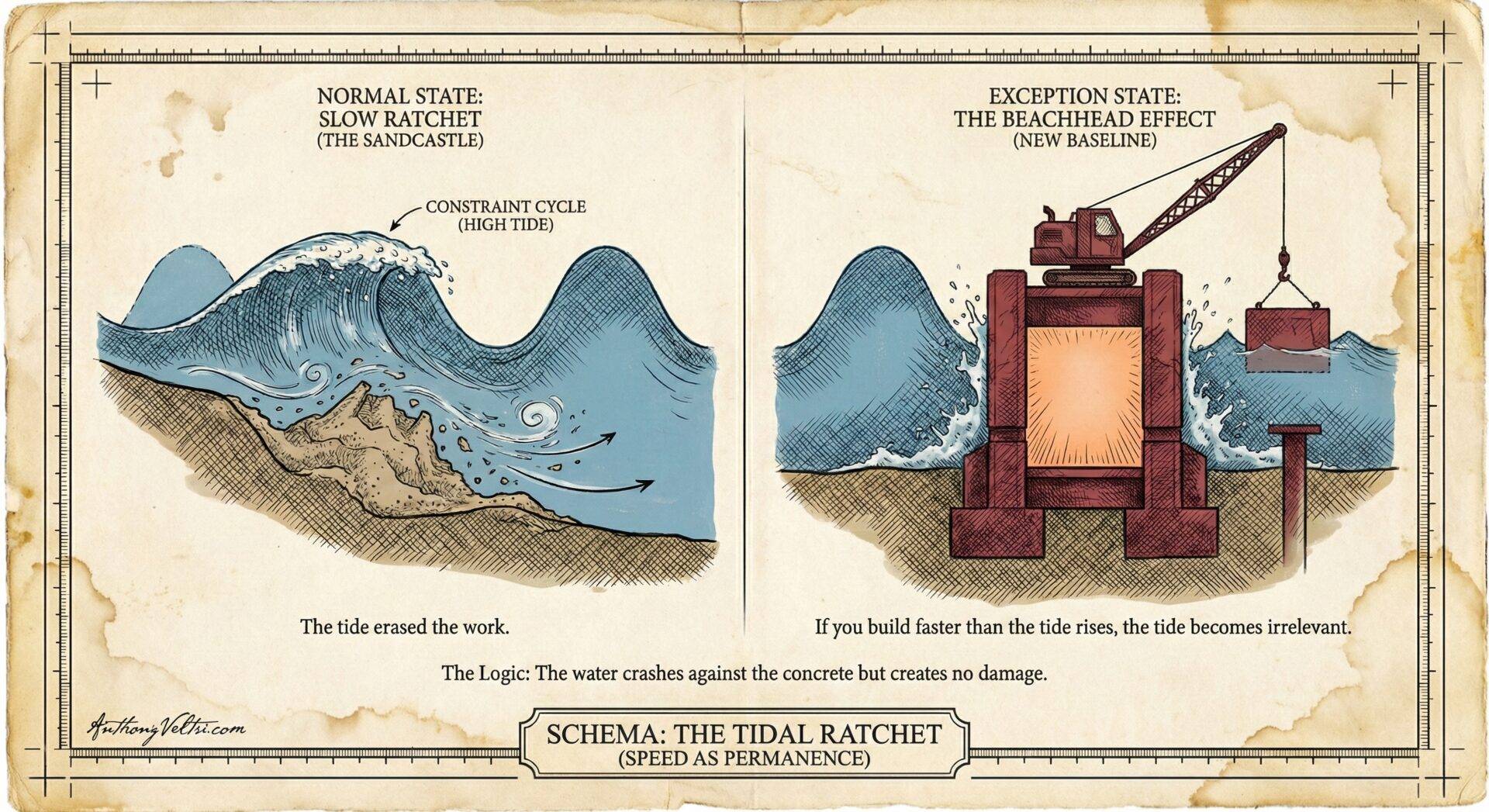
When the ratchet clock dominates:
- Expect incrementalism
- Under-threshold moves that accumulate
- Normalization through repetition
- Slow boil, not sudden shock
When the constraint clock is broken (not just slow):
- Expect acceleration
- Faits accomplis
- Theater expansion in compressed timelines
- “Emergency” justifications for speed
The tell: Watch whether actors pause after pushback or escalate through it.
- Pause = constraint clock still has friction
- Escalate = constraint clock is decorative
This upgrades your forecast from “will it happen” to “how fast will it happen.”
Break: Anti-Paranoia Guardrails (How Not to Become a Conspiracy Theorist)
Loose coupling is powerful. It can also overfit if you do not apply guardrails.
Use these five checks.
Guardrail 1: Base rate check
Is this behavior historically common, or is it a true shift in frequency, openness, or targets?
Guardrail 2: Dependency check
What does the actor still need?
Banks. Logistics. Allies. Platforms. Legitimacy. Skilled personnel.
Even strong actors have dependencies.
Guardrail 3: Real cost check
Are they paying real costs or only rhetorical costs?
Criticism is not cost. Denied permissions and lost capabilities are cost.
Guardrail 4: Alternative explanations check
- Prefer incompetence over malice when both fit. Clarification note: we must distinguish between random incompetence (which creates noise) and directional incompetence (which consistently errors in favor of the grab).
- Prefer bureaucracy over conspiracy when both fit.
- But do not use “plausible” as a sedative when the pattern keeps repeating.
Guardrail 5: Signal stacking check
- One anecdote is not a pattern.
- A multi-domain bundle with independent indicators is.
These guardrails keep the method calibrated and prevent it from becoming identity.
Break: What This Predicts (If the Pattern Is Real)
Loose coupling shifts you away from binary forecasts like “invasion or no invasion.”
It predicts incrementalism.
Prediction 1: Under-threshold faits accomplis
Moves designed to create a new baseline, then challenge others to reverse it.
Prediction 2: Procedural weaponization
The process becomes the punishment:
- Investigations
- Audits
- Delays
- Selective enforcement
- Documentation denial
Prediction 3: Bilateralization and coalition splitting
Divide collective constraints into case-by-case negotiations.
Prediction 4: Incident opportunism
Ambiguous confrontations become accelerants.
Urgency becomes a tool to bypass consultation.
Prediction 5: Selection effects
Dissenters exit. Compliers rise. The machine becomes more coherent over time.
None of this requires a single mastermind.
It requires a posture that rewards escalation and a system whose constraints are slow.
Closing: The Goal Is Options Preservation
The point of this model is not to win a debate.
The point is to time decisions under asymmetric error costs.
In a loosely coupled environment, you can get a new normal through many small moves that are individually deniable.
That is how people argue about whether the fire is real while smoke is already in the stairwell.
If you want the origin story and the tripwire dashboard, read Handbook vs Terrain.
If you want exit timing and decoupling moves, read Regime Recognition and the Cost of Asymmetric Errors (also see: Doctrine 22 Thinking in Probabilities in Exception-Governed Environments.)
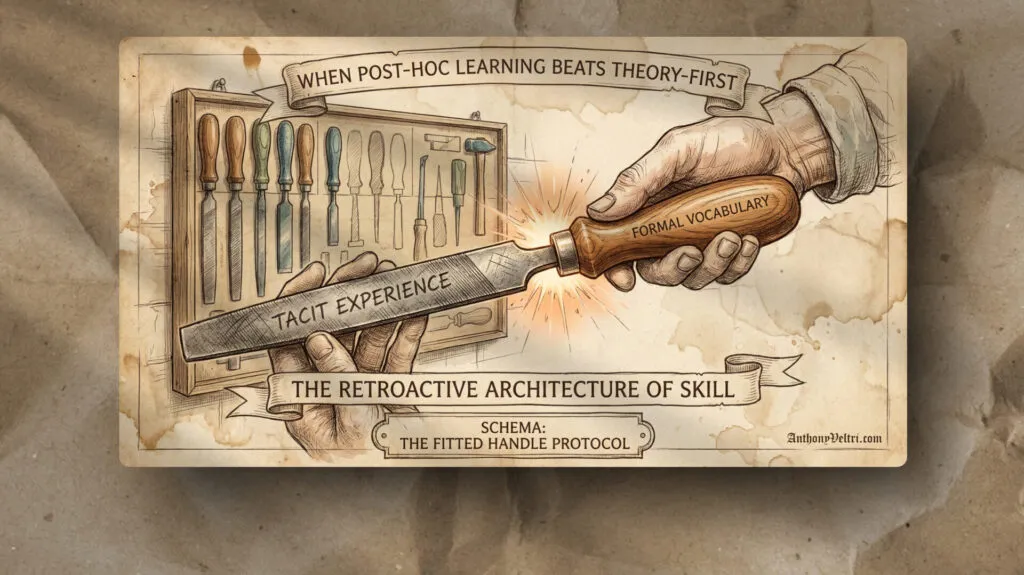
Regime Recognition and the Cost of Asymmetric Errors: When Post-Hoc Learning Beats Theory-First
This note is the missing mechanism layer between them.
Last Updated on January 23, 2026