Field Note: The Integration Confusion Stumbling Block
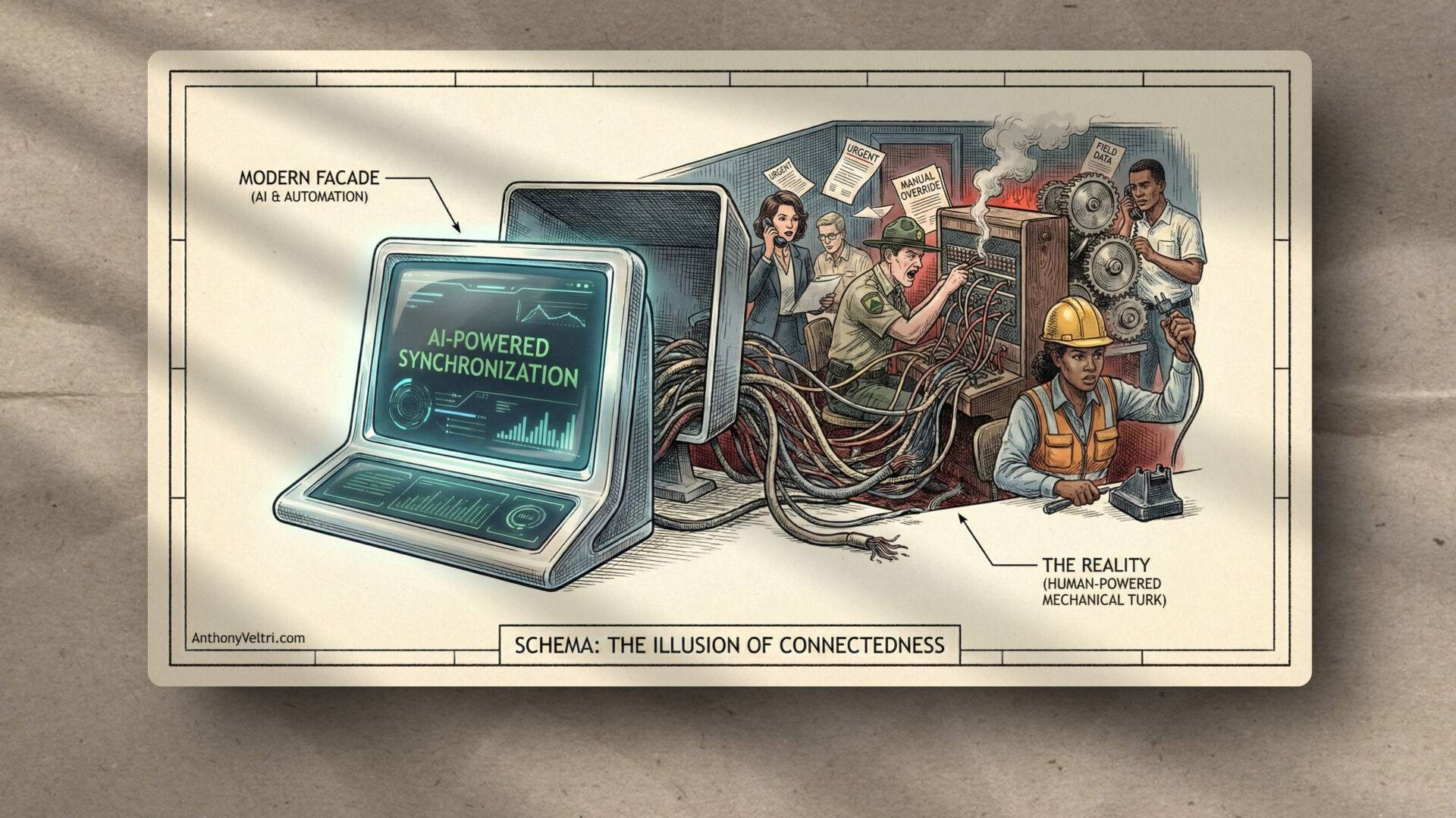
We have never been more ‘integrated’ …we have APIs, connectors, and automated flows, yet we still rely on a recurring 50-person meeting to find out what is actually happening. Why?
Editor’s Note: This Field Note diagnoses a specific operational pattern (the “Iron Chef” coordination meeting). If you recognize this symptom but struggle to explain why it keeps happening despite your best technical efforts, read the companion piece: When Everyone Uses the Same Words But Means Different Things. That note provides the diagnostic vocabulary (from Annex L) to identify whether you are facing a schema break, a semantic conflict, or a cognitive mismatch.
Scene: The Weekly FRN Coordination Call Where You Brief Without Knowing the Question
Forest Service Washington Office, policy coordination with USDA Office of Communications. Fifty to a hundred people on the call. Sometimes more. Every week.
Not just policy staff. Not just communications people.
Subject matter experts. Technical specialists. Naturalists. Ranger district staff who need this Federal Register notification published so they can do their actual mission work.
Regional leadership. Multiple layers up the chain because the FRN approval has to flow through command structure.
Office of General Counsel reviewing for legal compliance.
Tribal Relations if the notification might impact a tribe.
Sometimes external partners. Sometimes staff from Department of Interior if it’s a joint project.
All of them waiting to get through the USDA Office of Communications final approval so the FRN can enter the Federal Register pipeline and the field can proceed with mission activities.
How the Meeting Worked
The meeting runs like this: they scroll through a list of reporting entities. When they get to your name (or your office/role), they ask about a Federal Register notification. You don’t know which one until your name is called. Repeat for each reporting entity on the call.
Not “you didn’t know the day before.” Not “you didn’t see the agenda in advance.”
You didn’t know the question until you were live, on the spot, in front of fifty to a hundred people who had their own deadlines, their own leadership chains, their own mission dependencies.
So you prepared for everything. You researched every active FRN in your pipeline. You anticipated what they might ask. You coordinated with General Counsel on legal language. You checked with Tribal Relations on consultation status. You verified with the subject matter experts that the technical details were current. You tracked where each notification sat in regional approval chains.
You planned for questions like you were prepping for a panel interview. Every single week.
Why This Happened
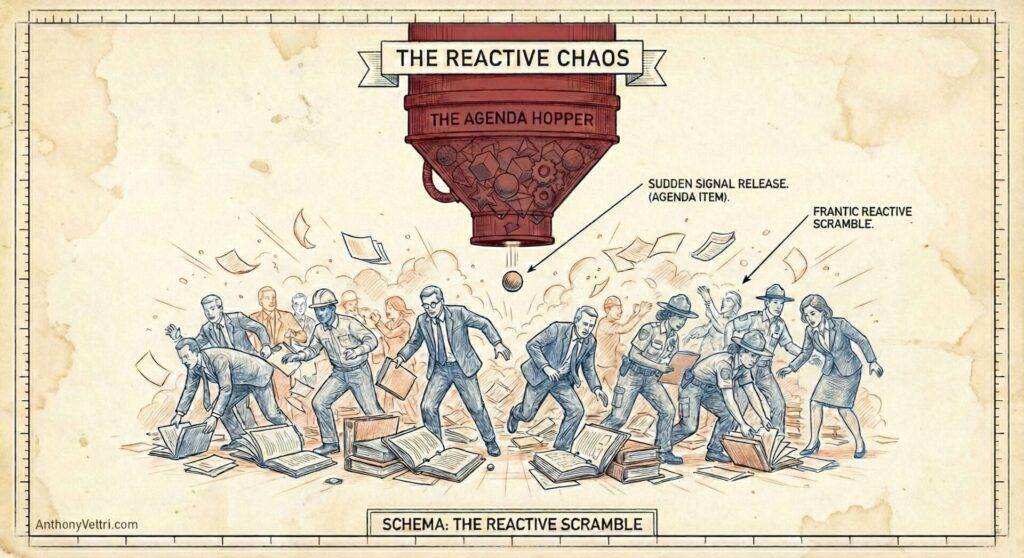
This wasn’t external pressure. This was your own organization, plus inter-agency partners, plus tribal coordination requirements, creating Iron Chef conditions where the secret ingredient gets announced when the clock starts, except you don’t even get the few minutes Iron Chef contestants get to think. You get called on and you answer.
In front of technical specialists who need to get back to actual field work. In front of regional leaders managing entire territories. In front of legal counsel who have other cases waiting. In front of tribal coordination staff managing sensitive government-to-government relationships.
Why couldn’t the Office of Communications share their tracking in advance?
Data sovereignty. Some items contained sensitive announcements that couldn’t be visible before public release. This was legitimate. A real operational constraint.
But the architecture treated legitimate sovereignty as if it were obstruction, and the coordination cost fell on everyone who had to operate blind.
It is important to state clearly: The Office of Communications was doing exactly what they were charged to do.
They were the final line of defense for the Department’s public voice. They were protecting the Secretary’s intent, ensuring legal defensibility, and preventing ‘Policy Collision’ (where one agency accidentally announces something that contradicts another.)
They weren’t hiding the agenda to be difficult. They were hiding it because they lacked a mechanism to separate security from visibility.
Without a federation architecture, the only way for them to ensure safety was to lock the doors. They were effectively acting as a manual firewall for the entire agency, absorbing immense pressure to ensure nothing went out the door that would embarrass the Department.”
Everything ran downhill from USDA Office of Communications approval. They were the final gate before the Federal Register service. So everyone upstream had to be ready, synchronized, and available even though they didn’t know which items would be called until the moment arrived.
The Coordination Tax
The meeting itself might be 30 minutes to an hour. But getting to that point required 5 hours of preparation meetings beforehand, multiplied by however many people attended those meetings, multiplied by every reporting entity on the call.
Subject matter experts spending hours in coordination meetings instead of doing their technical work. Regional leadership pulled into sync calls. Legal counsel reviewing draft language. Tribal Relations running consultation processes. All of it cascading through the organization week after week.
Not because people were lazy. Because every interface between autonomous entities was a gap where information got copied wrong, updated at different speeds, or required manual checking because there was no other way to know if you had the latest version.
The anxiety wasn’t about the work. It was about areas you had no control over because they were autonomous or semi-autonomous partners with their own systems, their own definitions, their own tempo, their own legitimate sovereignty boundaries.
And this tax hit the Office of Communications just as hard as it hit the field.
The staff running that meeting were not villains wringing their hands. They were dedicated public servants trying to manage a torrential river of information using manual sluice gates.
They had to manually track, verify, and secure hundreds of moving targets. They likely dreaded the ‘Blind Question’ dynamic just as much as the attendees did, because they knew they were the bottleneck. But without a system that allowed for ‘Metadata Visibility’ without ‘Content Exposure,’ they had no choice. They were doing a heroic job of maintaining discipline in an architecture that offered them no leverage.
The Stakes
The urgency was real. Federal Register notices have deadlines. Field operations are waiting. Mission activities can’t proceed until the FRN publishes. Once you clear the Office of Communications at USDA, you enter the Federal Register’s pipeline and their deadlines become yours.
And the entire time, leadership kept asking: “Can we add a new column? Can we add a dashboard indicator? Can we send an alert email?”
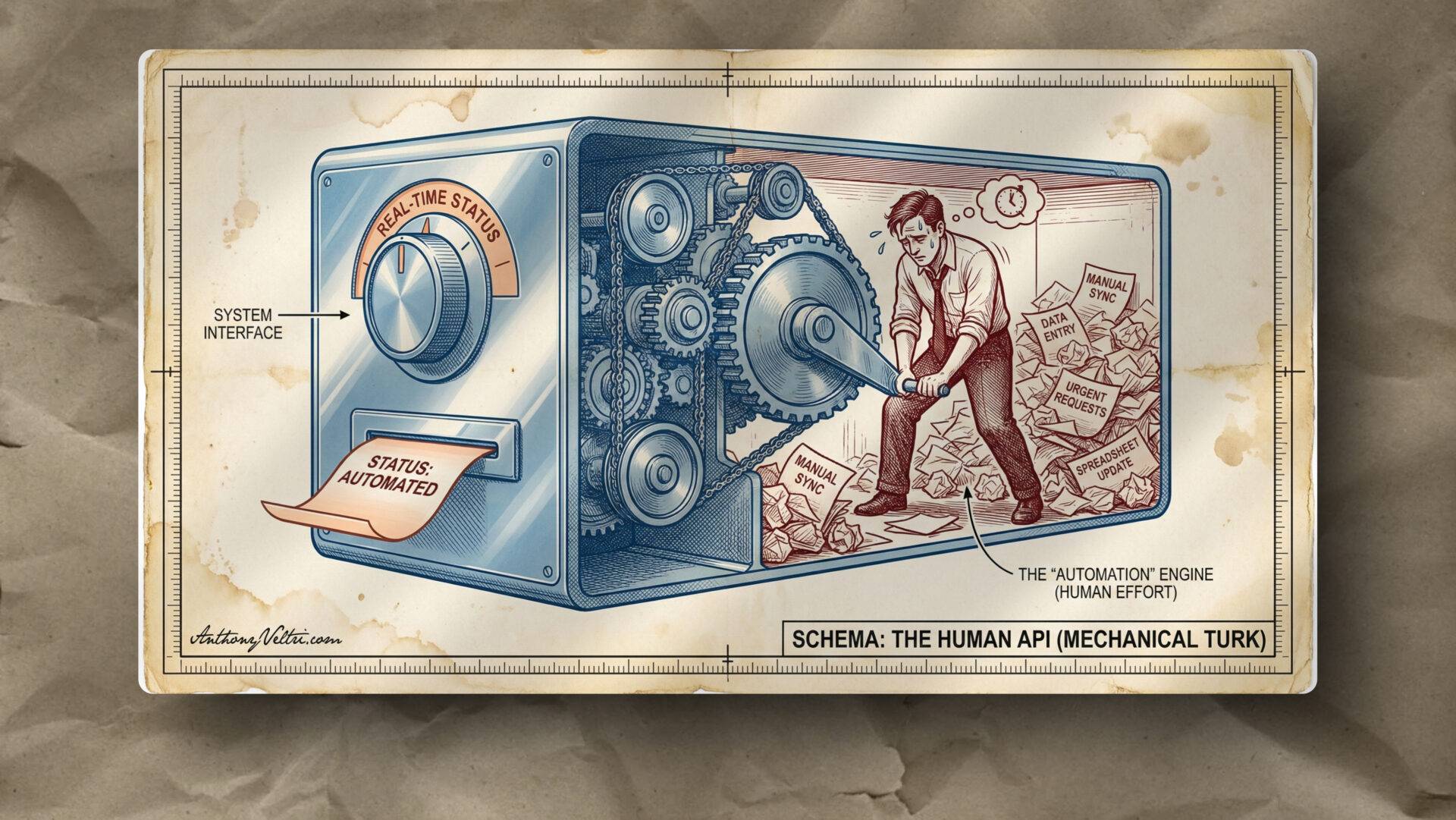
There was no sprint backlog. There was no development team. There was usually just one person, “other duties as assigned,” heroically maintaining a production system that only worked because they personally kept it running.
This repeats itself throughout government. Probably throughout any large organization with semi-autonomous entities, external coordination requirements, and mission-critical dependencies on approval processes that cross sovereignty boundaries.
Break: When “Integration” Means Connectors Instead of Coordination Architecture
Here’s why this keeps happening:
When technical people hear “integration,” they think: connectors, APIs, webhooks, Zapier, “Does it integrate with Jira?”
Integration in that sense is good. It reduces manual handling. It moves data closer to where people work. It’s a positive signal of system maturity.
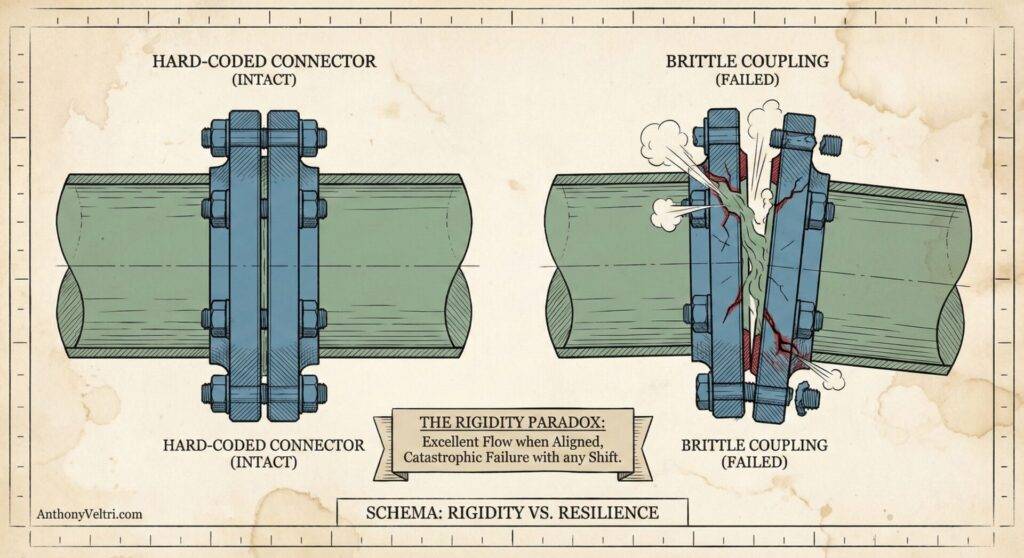
So when you say “integration creates brittleness,” it sounds like you’re contradicting basic IT principles.
The Three-Meaning Problem
The problem is that “integration” has three different meanings, and most conversations use the same word for all three without noticing.
The technical audience has been conditioned to see integration as unambiguously good. It’s what makes Jira useful. It’s what makes Google Drive sync work. It’s automation, efficiency, modernity.
Now you’re saying integration can be brittle, and governance people understand why, but IT people hear it as: “You’re telling me connectors are bad? That APIs are wrong? That we should keep doing manual data entry?”
That’s not what you’re saying. But that’s what they hear.
Why the Confusion Persists
Because they’ve never been introduced to the governance meaning of integration. They’ve never had to think about what happens when you try to operationally integrate across sovereignty boundaries that cannot be dissolved.
The majority of the room probably has the software definition in their heads. The governance people know both definitions but assume everyone else does too. And now you’re trying to introduce a third concept, federation, which most people have never encountered outside of political science class.
This is a difficult translation challenge (bluntly, the permission to think differently). You have to introduce a nuanced governance concept to a room that is conditioned to think about software connectors. The challenge is to introduce ‘Federation’ without making the technical staff feel like you are dismissing their work on APIs, while simultaneously waking up the governance staff to the fact that their policy documents aren’t enough.”
You can’t just say “federation is better than integration” because to half the room, you just said “don’t use APIs.
You need a reframe.
Schema: Three Integration Meanings and When Each Applies
Use this when someone says “integration” and you need to clarify which kind matters for the problem at hand.
Integration Meaning #1: Software Integration (Tool Chain)
What it answers: Can systems connect and exchange data?
When it helps: Reduces manual handling, moves data closer to work, enables automation
When it misleads: You can integrate ten systems and still have incompatible definitions, incomparable statuses, contradictory truth claims, and a rollup that is fast but not decision-grade
Examples:
- ServiceNow tickets created automatically from risk flags
- Google Docs synced into a repository
- Jira epics mapped to milestones
- Slack alerts when KPIs cross thresholds
- ETL pipelines feeding data warehouses
Integration Meaning #2: Operational Integration (Governance)
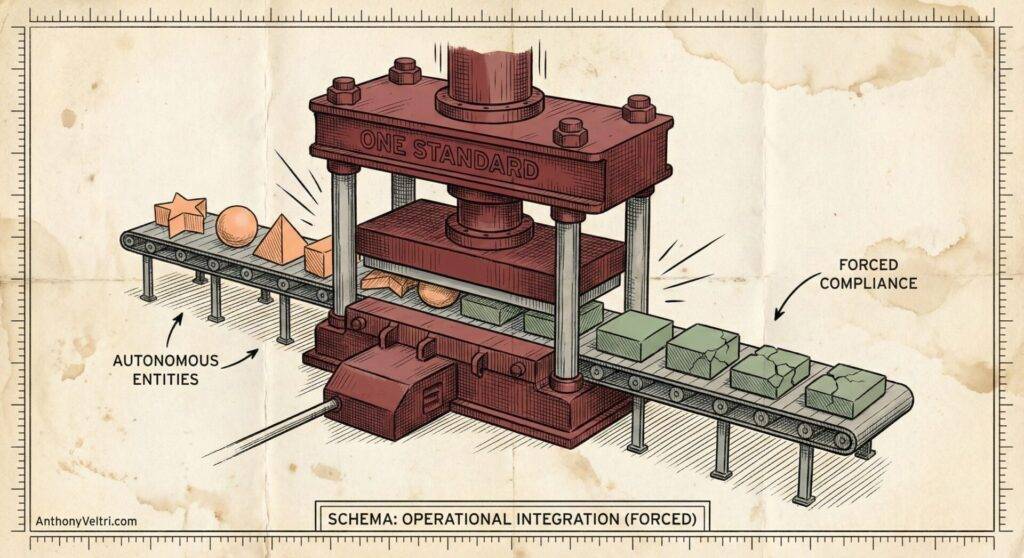
What it answers: Can we enforce one standard and one process?
When it works: You have authority, alignment, shared tools, willingness to subordinate local optimization to enterprise coherence
When it fails: Sovereignty is real and cannot be dissolved. Entities have legitimate reasons to operate differently. Forcing sameness creates either rebellion or theater.
Examples:
- One PMO defines status criteria and everyone follows it
- One portfolio intake gate with single scoring model
- One cadence: weekly updates due Friday, reviewed Monday, decisions Tuesday
- One definition of green/yellow/red/blocked
- One source of truth, one owner for data quality enforcement
Integration Meaning #3: Operational Federation (Coordination Across Sovereignty)
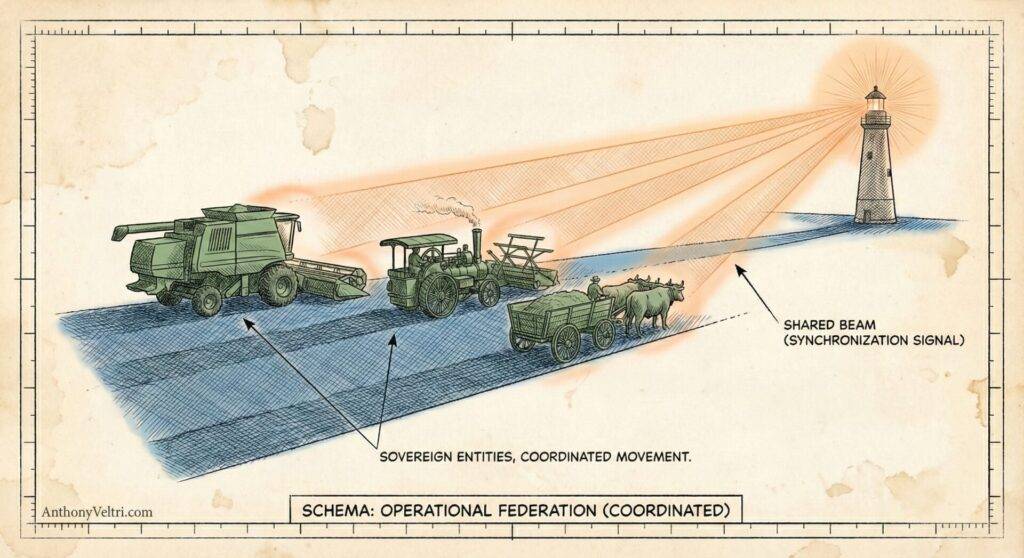
What it answers: How do we coordinate across autonomy when we cannot enforce standards but still need coherent decisions?
When it’s required: Multiple entities with their own tools, maturity, tempo. Cannot force compliance. Cannot wait for consensus. Still need shared picture that is decision-grade.
When it fails predictably:
- Drift: Templates change, fields get reinterpreted, rollups become translation problems
- Definition mismatch: One team’s “green” means on track, another’s means no escalation yet
- Heroic reporting: A few people become human adapters, chasing updates, normalizing language, reconciling contradictions
- Decision latency: Leadership stops trusting the rollup because it’s not decision-grade
Examples:
- Federal agencies coordinating with states, tribes, municipalities, NGOs
- National programs with regional offices that operate differently by necessity
- Post-acquisition companies where business units keep local systems
- Matrix orgs where functional and product teams co-own delivery
- USDA Office of Communications coordinating with Forest Service policy office on FRN reviews where sovereignty boundaries are legitimate and unavoidable
The Scoreboard vs. The Rules of the Game
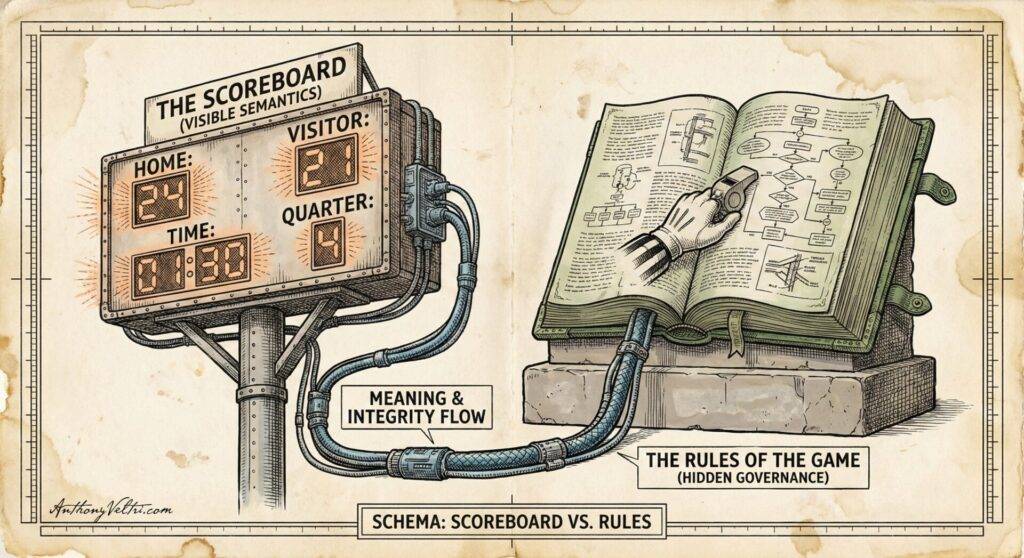
Here’s where the confusion compounds:
Modern data-first organizations build beautiful semantic models. They can represent the scoreboard: projects, milestones, spend, risks, KPIs, rollups. They can slice by region, bureau, portfolio, program. The dashboards look real.
Then reality hits.
Because a semantic model is the scoreboard, not the rules of the game.
The scoreboard answers: “What are the numbers?”
The rules answer: “What do these numbers mean, how are they produced, and who is accountable for their integrity?”
Without the rules, the scoreboard becomes a high-speed way to produce disagreements.
What Goes Missing When You Stop at the Semantic Model
- Schema discipline: What fields exist, which are required, what values allowed, what “complete” means
- Definitions: What counts as green, what triggers yellow, what qualifies as blocked
- Governance: Who can change fields, who approves changes, how changes are communicated, how drift is prevented
- Cadence and enforcement: When updates are due, what happens when late, how exceptions are handled
- Provenance: Where each value came from, when last updated, who attested to it
- Normalization rules: How you reconcile different local realities into comparable truth without flattening nuance into lies
When those rules are absent, everyone sees the same dashboard and still disagrees about what it means.
The organization discovers it did not build a decision system. It built a reporting surface.
The SharePoint Hero and the Feature Request Cascade
About a year before this writing, the Forest Service moved from Excel spreadsheet tracking to SharePoint for their FRN and Rules & Directives tracking. A talented person, other duties as assigned, learned SharePoint and made it work. Heroic effort. It got done.
Then leadership said: “Can we add a new column? Can we add a dashboard indicator? Can we send alert emails?”
There was no sprint backlog. Just: “SharePoint guy, add this feature.”
He was doing great work. It was excellent. It was heroic. It was also unsustainable.
And there was a hidden timer on the wall that no one was watching: The Retirement Cliff.
Like much of the federal workforce, our “SharePoint Guy” was eligible for retirement. He had been for years. He stayed because he cared about the mission and he took pride in the tool he built.
But federal hiring rules generally do not allow for “overlap hiring.” You often cannot hire the replacement until the seat is physically empty.
This means there is no knowledge transfer period. There is no apprenticeship. When the Hero leaves, the system does not just lose a worker; it loses its architect, its debugger, and its memory.
A system that relies on a specific human being’s willingness to not retire is not a system. It is a gamble.
Compass-X shifts the load from the “Hero” to the “Architecture.” It ensures that when the inevitable retirement party happens, the schema survives the departure.
And all his hard work ended at his office boundary because the Office of Communications had their own data sovereignty to protect.
Software integration (SharePoint connectors, email alerts) helped reduce manual handling within his office.
But it didn’t solve the federation problem. It didn’t make the 50-person call less adversarial. It didn’t reduce the 5-hour preparation cascade.
It just moved the ambiguity faster.
What Functional Federation Actually Requires
Federation without mechanism is just a promise.
If federation relies on goodwill and memory, it will fail.
Functional federation requires mechanism that:
- Makes participation low friction
- Constrains degrees of freedom enough to preserve comparability
- Creates a durable shared picture that doesn’t reset to zero every briefing cycle
- Protects leadership tempo by producing decision-grade rollups without human glue
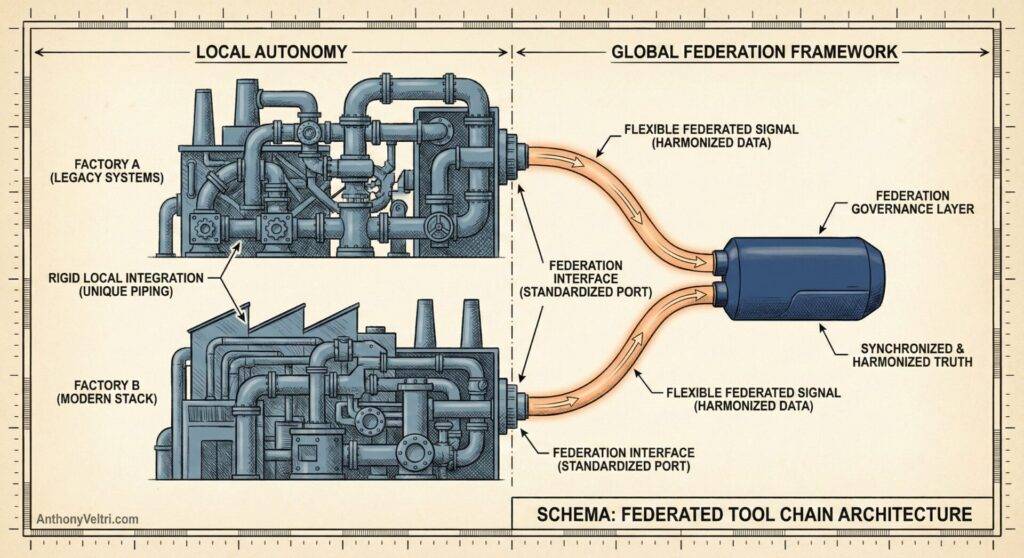
- Respects sovereignty because teams keep local systems while contributing to shared picture
- Makes the rules of the game durable through enforceable schema, definitions, governance, cadence, and provenance so the semantic model stays meaningful under pressure
This is the gap between federation as concept and federation as capability.
Schema: The “FedEx” Solution to Secrecy (Metadata vs. Payload)
This is the specific mechanism that solves the “Blind Question” meeting.
The most common objection to federation is: “We can’t list our projects on a shared dashboard because the content is sensitive (CUI, pre-decisional, embargoed).”
This objection confuses the Payload (the secret) with the Metadata (the status).
Think of a FedEx package.
- The Payload: Inside the box might be confidential legal documents or a prototype part. Only the sender and receiver are allowed to open it.
- The Metadata: The barcode on the outside tells the entire logistics network: Where is it? Is it late? Is it damaged? Who has it now?
You do not need to open the box to know that the truck is stalled in Memphis.
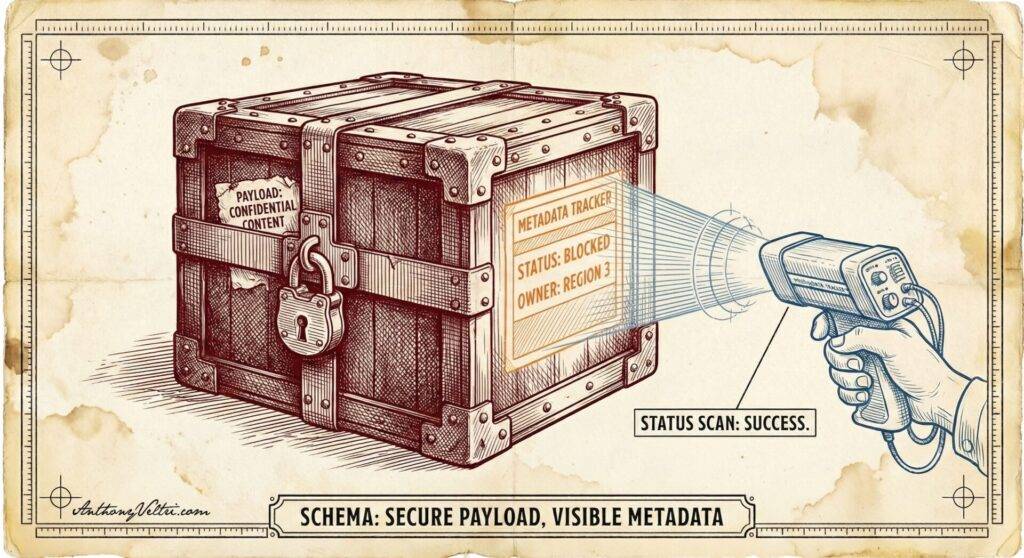
Operational Federation separates these two layers:
- Layer 1 (The Payload): The detailed Office of Communications or Federal Register text remains locked in the Office of Communications’ secure SharePoint, accessible only to cleared staff.
- Layer 2 (The Metadata): The Compass-X dashboard displays a record: “FRN #402 – Status: BLOCKED – Owner: Region 3.”
If the title itself is secret, you federate a code name. If the details are sensitive, you federate only the health signal (Green/Red).
This allows the 50-person coordination call to see the friction (Red/Blocked items) without exposing the secrets. We can coordinate the “when” and the “who” without violating the sovereignty of the “what.”
Permission Structure for Technical Audiences
When you need to help someone cross from “integration = good Jira connectors” to “integration can mean brittle coupling,” here’s the reframe:
Software integration is still good. APIs are still valuable. Connectors still reduce manual work. We’re not arguing against those.
What we’re adding is a second question: After you connect the systems, how do you keep the meaning comparable when different teams have different definitions, different maturity, different tempo, and legitimate sovereignty boundaries?
That’s not a connector problem. That’s a coordination architecture problem.
Federation is what you build when you need coherent decisions across teams that cannot be forced into sameness.
It’s not instead of integration. It’s what makes integration meaningful when sovereignty is real.”
Why This Matters for Compass-X
Compass-X is not primarily about connecting apps.
Compass-X is a shared strategic layer that turns scattered reporting into comparable truth and decision-grade rollups without forcing everyone into the same tool or process.
It prevents federation from staying theoretical by doing what humans cannot sustain:
- Reduces drift by making reporting structure persistent and constrained
- Protects comparability by normalizing status and metadata across teams
- Cuts heroic reporting by producing rollups without slide deck labor
- Improves decision tempo by shrinking the gap between reality and leadership visibility
- Respects sovereignty because teams keep local systems while contributing to shared picture
- Makes the rules of the game durable so the semantic model stays meaningful under pressure
Culture can start federation. Mechanism keeps it alive.
And if you want it to survive, you need architecture that makes the shared reality harder to break than it is to maintain.
That’s why Compass-X exists.
And that’s why I’m so adamant about educating on these topics. Organizations cannot build what they cannot name. If the vocabulary stays trapped in “integration means connectors,” the coordination architecture never gets built. The FRN coordination nightmare repeats itself. The heroic SharePoint maintainer gets overwhelmed. The 5-hour meeting cascade continues.
Teaching the distinction between software integration, operational integration, and operational federation isn’t academic. It’s the prerequisite to building systems that actually work when sovereignty is real.
You do not need to dissolve sovereignty to gain visibility. By separating the Payload (The Secret) from the Metadata (The Status), we can coordinate perfectly without forcing everyone to open their books.
Last Updated on January 14, 2026