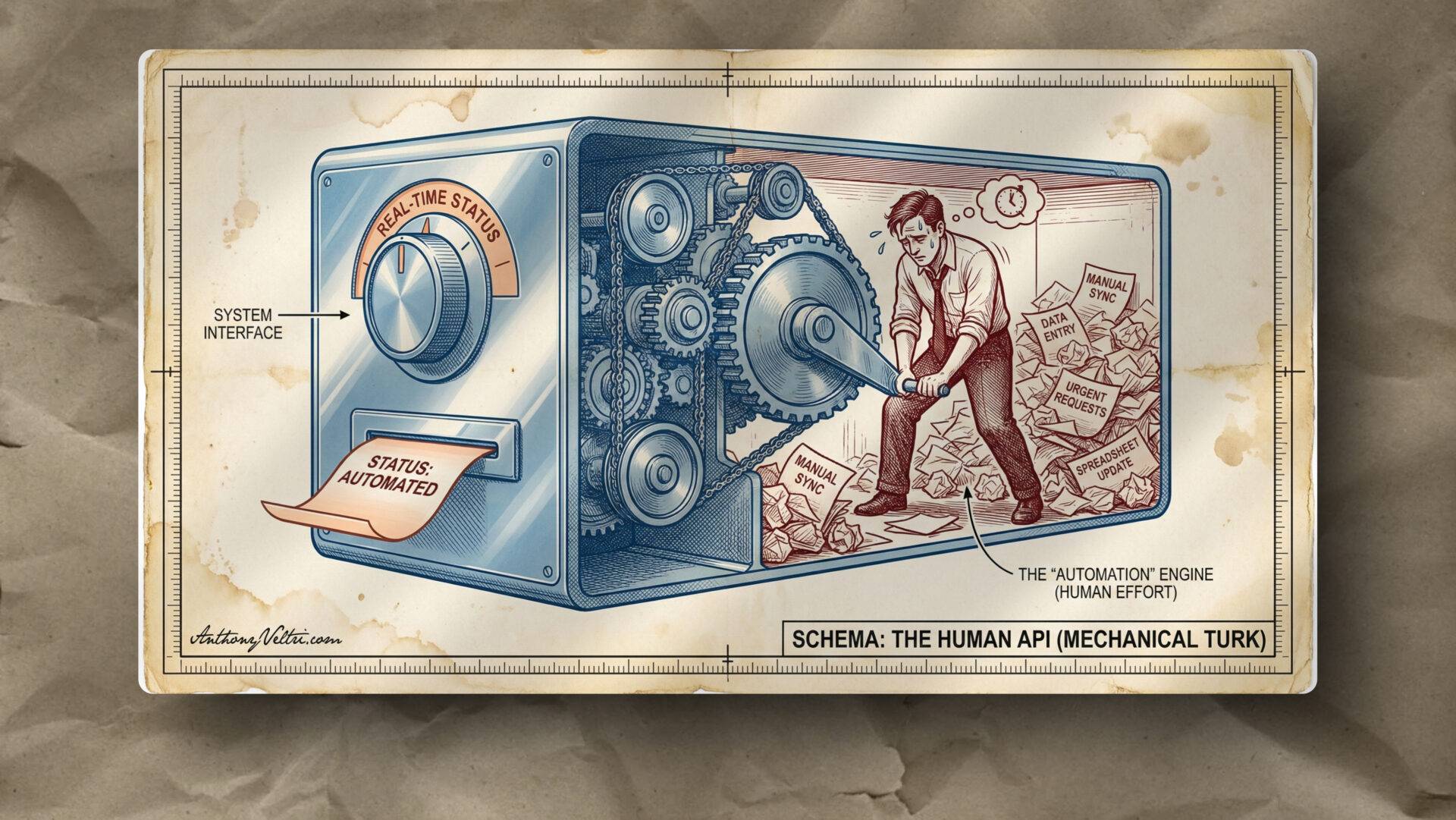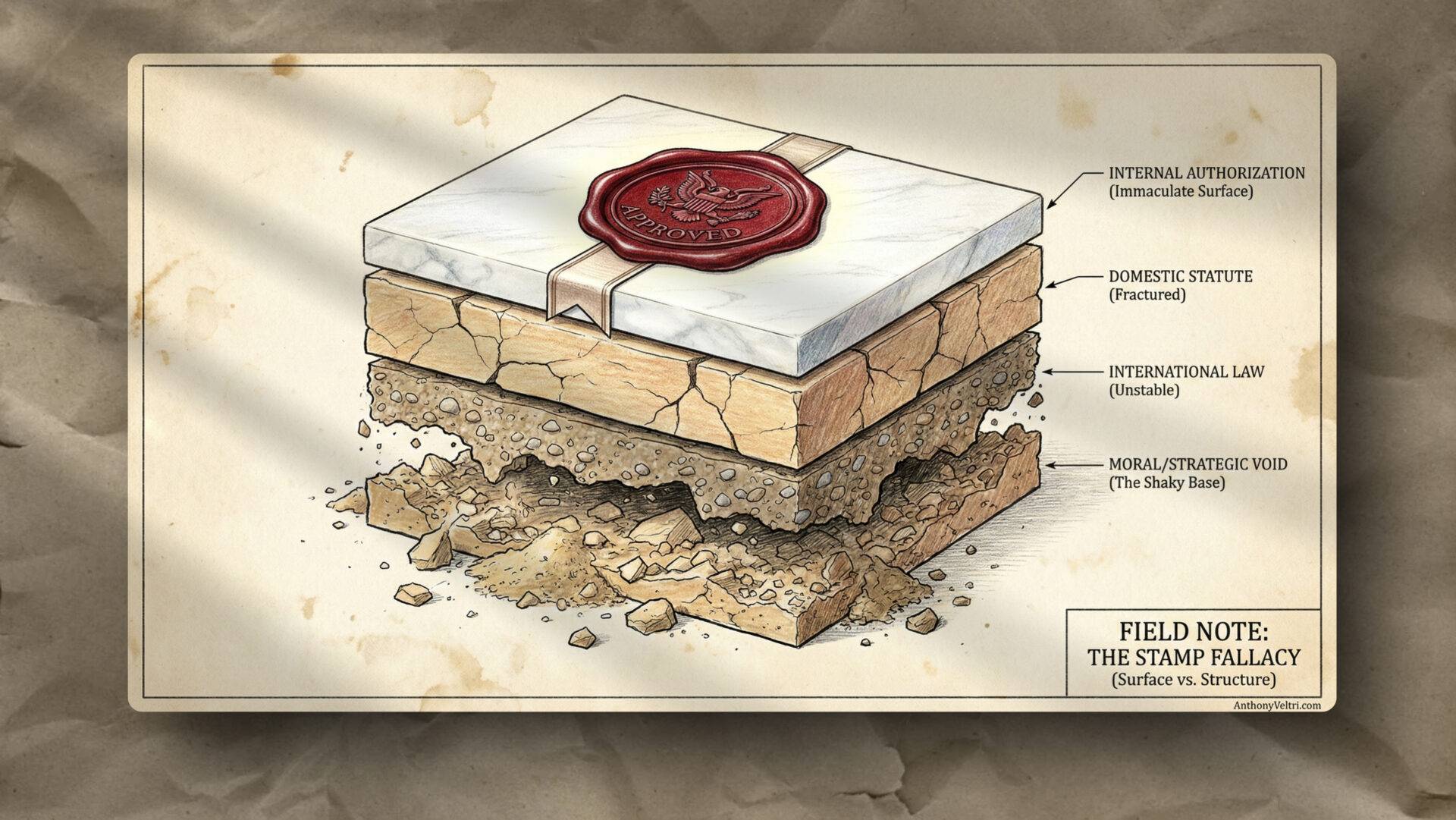
Field Note: The Stamp Fallacy at the Interface
Approval predicts compliance. It does not certify legitimacy.
Scene
“It had legal clearance.”
Someone says it with finality. Higher headquarters approved it. The lawyers signed off. There’s a memo. A stamp. Closure.
You feel relief. A hard gate has been passed.
That relief is the trap.
Break
The Stamp Fallacy defined
Stamp Fallacy: treating internal authorization as if it settles the full legality and legitimacy question.
Why good people miss this for an entire career
A service member or law enforcement officer can go 20 to 30 years without ever having to parse “legal” beyond the stamp.
Why? Because most of their career runs inside a constraint-based environment:
- Stable checks and balances
- Predictable oversight
- A chain-of-command culture that mostly self-corrects
- The “sprint clock” stays secondary to the “governance clock”
So “approved” is usually a reliable proxy for “within the rails.”
The danger is not ordinary time. The danger is the interface.
The interface hazard
The exceptionally dangerous zone is the interface between:
Constraint-based governance: checks, balances, slow legitimacy building
Exception-based operations: rapid rushes, fait accompli, sprint clock dominance
At the interface, “legal clearance” can become a tool for:
- Memo laundering (creating an internal story that something is permissible)
- Inevitability shaping (“it’s approved, so it’s happening”)
- Responsibility diffusion (“the lawyers cleared it, so I’m clean”)
This is why the stamp fallacy is a present danger right now, not just an interesting civics lesson.
The three meanings of “legal” people keep collapsing
1) Descriptive legality
What the institution will treat as authorized, and therefore execute. This is a forecasting input.
2) Normative legality
Whether the act conforms to higher rules the institution claims bind it (constitution, statute, international law). This is a standards question.
3) Enforceable legality
Whether anyone can impose consequences. This is jurisdiction and power.
Authority-style arguments often slide from (1) into (2) and (3) without saying so.
Connection to the Ladder: The Legality Ladder (below) shows WHERE authority comes from. The three meanings show WHAT KIND of claim is being made. Someone can have descriptive legality (internal approval) without normative legality (constitutional compliance) or enforceable legality (anyone with power to impose consequences).
Schema
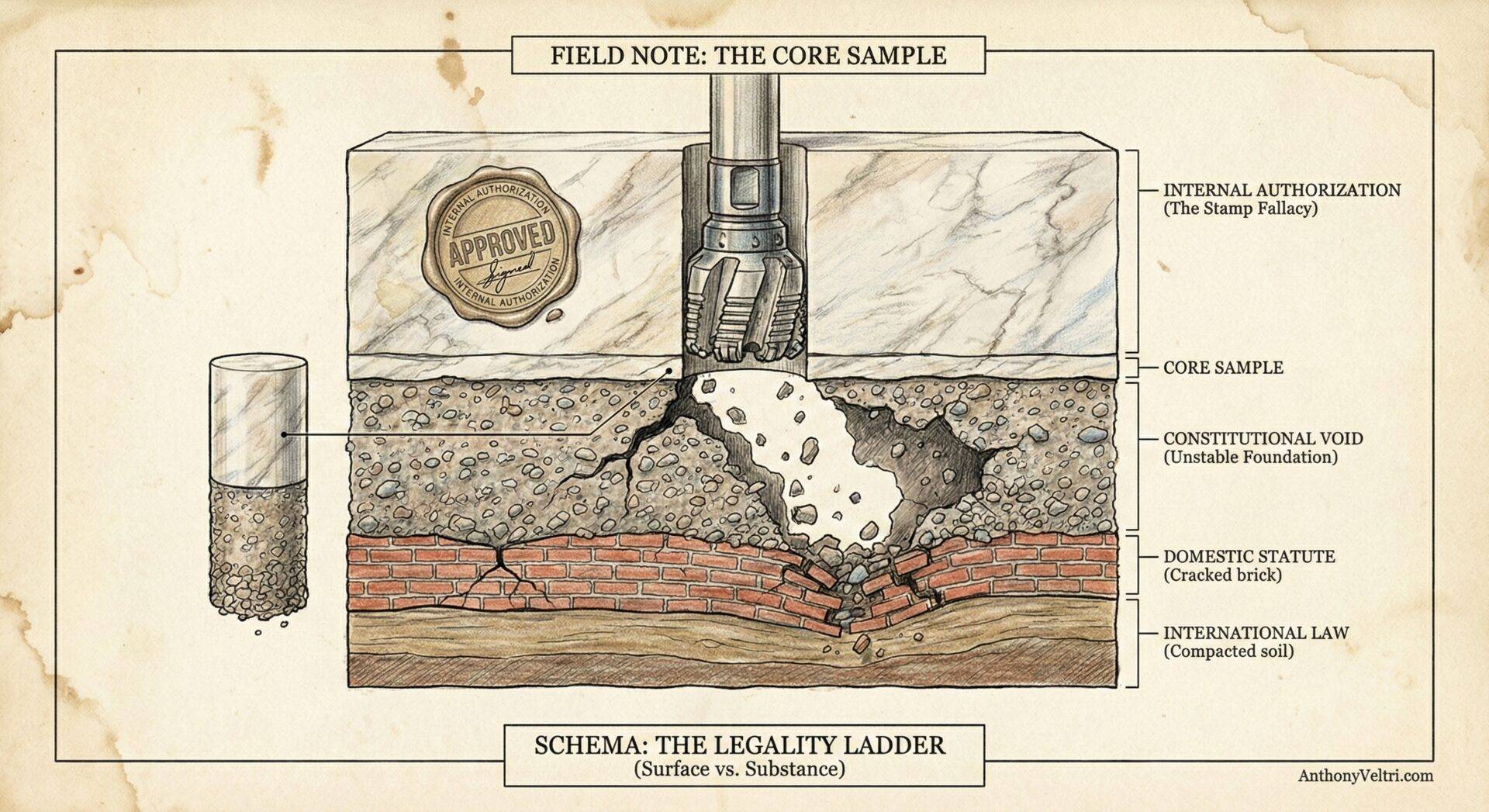
The Legality Ladder
Treat “legal” as a stack, not a stamp.
Internal authorization
Who signed, which counsel reviewed, what order was issued.
Domestic authority
Which statute or delegated power actually authorizes it.
Constitutional constraint
Even if authorized by statute, is it prohibited by higher law.
International law
War crimes standards, treaty obligations, customary international law.
Legitimacy
Even if technically lawful, is it abusive, coercive, or strategically catastrophic.
Cliff Test: Where distinctions become decision-relevant
Use these to separate pedantry from mechanism. Each example shows where the ladder matters for next moves.
Cliff Test 1: Internal clearance vs statutory authorization
“JAG cleared it” versus “Congress authorized it”
In 1952, President Truman ordered the seizure of steel mills to prevent a strike during the Korean War. He had internal executive branch legal support for the action.
The Supreme Court ruled 6-3 in Youngstown Sheet & Tube Co. v. Sawyer that the seizure was unconstitutional. No statute authorized it, and inherent executive power did not reach that far.
Material distinction: If it’s only internal clearance, your leverage point is oversight and courts. If it’s statutory authorization, your leverage point includes Congress and the statute itself. Different actors, different next moves.
Cliff Test 2: Deployment versus rules of engagement
“They are deployed” versus “They are authorized to use force”
In 1994, U.S. forces were deployed to Haiti for Operation Uphold Democracy. Initial deployment was under restrictive ROE focused on presence and deterrence.
When the mission expanded to active stability operations, ROE changed to permit broader use of force. Deployment status stayed the same. Authority to act changed fundamentally.
Material distinction: Deployment can be lawful and bounded. Rules of engagement and mission scope change risk and behavior. This changes what civilians should expect and what safeguards must be demanded.
Cliff Test 3: Domestic legal versus internationally prosecutable
“Domestic sign-off” versus “external jurisdiction exposure”
In 1998, former Chilean dictator Augusto Pinochet was arrested in London on a Spanish warrant for human rights violations. Chile’s 1978 amnesty law had granted him domestic immunity.
The UK Law Lords ruled that head-of-state immunity did not extend to torture, which Chile had committed to prosecute under international treaties. Domestic legal protection did not prevent international legal process.
Material distinction: Domestic sign-off might cover internal compliance, but exposure to external jurisdiction changes incentives, timing, and accountability planning.
Case study: My Lai as the Stamp Fallacy in the wild
This is included because it forces the full stack into view.
The event and the “stamp story”
On March 16, 1968, Charlie Company entered My Lai (Sơn Mỹ) and the operation degenerated into mass killing of unarmed civilians. Lt. William Calley was later charged and convicted.
The stamp story in these situations is always some variant of:
- “We were told this was the mission.”
- “This was cleared.”
- “This was the order.”
The intervenor and the cost of real-time dissent
Warrant Officer Hugh Thompson did not file a report from an air-conditioned office with a cold drink. He landed his helicopter, confronted what was happening, and on a subsequent pass ordered his crew to train their guns on U.S. soldiers pursuing civilians while coordinating evacuation of civilians to safety.
Then came the institutional tax:
- Thompson reported the events to superiors the same day
- He was ostracized by many peers
- He was sent into increasingly dangerous situations, was shot down multiple times, and suffered severe injury
- Decades later, he was formally recognized with the Soldier’s Medal
Why “intervenor” is cleaner than “whistleblower”: A Whistleblower documents the wreckage. An Intervenor grabs the wheel. The difference is the assumption of immediate physical risk to stop the event in progress. Whistleblower implies passive reporting after the fact. Thompson actively stopped the event in progress, then reported. The distinction matters because the costs and courage involved are categorically different. We need language that captures intervention under fire, not just documentation from safety.
The accountability signal and its ceiling
Calley was the only one convicted. His sentence was reduced and he ultimately served a limited period under house arrest.
The point is not to relitigate Vietnam. The point is to show the ladder:
- Internal stamps can exist
- Atrocity can still happen
- Dissent can be costly even when later praised
- Accountability often lands on executors, not decision architects
Memo laundering: How internal opinions manufacture cover
Memo laundering is the practice of generating internal legal opinions to create a paper trail that predetermined actions are “legal” rather than genuinely evaluating constraints.
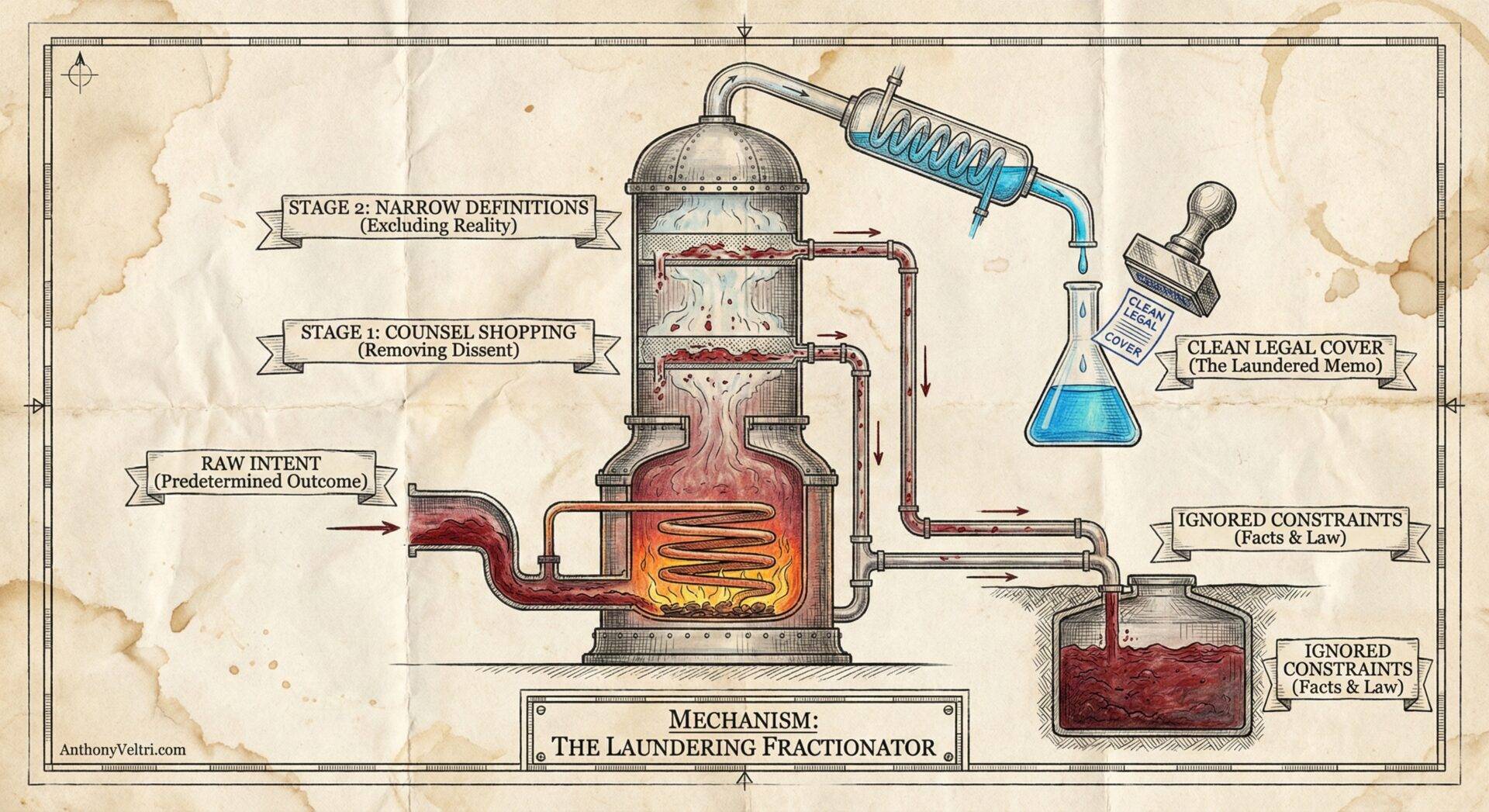
How it works:
- Decision-makers want to do X
- They seek legal counsel who will approve X
- If counsel objects, they shop for different counsel or different framing
- Eventually, a memo is produced blessing X
- The memo becomes the “legal clearance” shield
The torture memos as case study:
Between 2002 and 2005, the Office of Legal Counsel produced opinions authorizing interrogation techniques that most legal scholars and later government reviews concluded constituted torture. The memos:
- Redefined torture using extremely narrow definitions
- Concluded techniques that caused severe pain were lawful if they didn’t cause organ failure or death
- Created internal “legal” cover for a predetermined program
Years later, DOJ publicly withdrew these opinions, stating they “no longer represent the views” of OLC. But the program had already run. The memos served their purpose as shields during execution.
Detection pattern: If you cannot get straight answers about which facts the legal opinion relied on, what contrary analysis was considered, or who reviewed it independently, you may be seeing laundered legal cover rather than genuine constraint evaluation.
Mental model: Internal stamps do not settle legitimacy
Here are concrete examples you can cite quickly when someone says “it was legal.”
Example 1: Nuremberg rejects “domestic legality” as a shield
The Nuremberg Charter’s framing of crimes against humanity explicitly treats them as punishable “whether or not” they violated the domestic law where they were committed. Following orders or having internal authorization was not a defense.
Example 2: Korematsu shows stamps can be “legal” and still wrong, then reversed
The Supreme Court upheld Japanese American internment in 1944 in Korematsu v. United States. In 2018, the Court called Korematsu “gravely wrong” and said it has “no place in law under the Constitution.” Separately, Congress passed the Civil Liberties Act of 1988 providing a formal apology and reparations to surviving internees.
Example 3: “Golden shield” legal opinions can be withdrawn
As noted above with the torture memos, DOJ has publicly stated that certain OLC opinions were withdrawn. Internal legal clearance does not prevent later repudiation.
Example 4: Positive case – Courts block, government complies
When constraint-based governance is working, you see patterns like the Youngstown steel seizure case: executive action taken, courts rule against it, government complies. Crisis averted through functioning checks. This is the baseline we’re measuring against.
Bridging to civilian application: PG&E and expert opinion laundering
The stamp fallacy operates identically in corporate and municipal contexts.
In the Pacific Gas & Electric groundwater contamination case that Erin Brockovich investigated, PG&E’s expert hydrogeologists produced analyses claiming the chromium contamination was minimal, slow-spreading, and posed no significant risk to Hinkley residents.
When independent hydrogeologists reviewed the calculations, they found critical errors in how PG&E’s experts applied Darcy’s Law, the fundamental equation for groundwater flow:
The first error: PG&E treated Darcy flux (the flow rate per unit area) as actual groundwater velocity, failing to account for the aquifer’s effective porosity of approximately 20%. This made it appear contaminants would travel five times slower than they actually could.
The second error: To reconcile their false “slow spread” claims with the fact that contamination HAD reached distant wells, PG&E’s model required hydraulic gradients approaching 1 (a 100% slope). This would mean the water table at the source would have to be above ground level, creating extreme artesian conditions where groundwater would be discharging at the surface across Hinkley. The town would be a swamp. The numbers were physically impossible.
This is memo laundering in the corporate/technical domain: finding experts who will produce the opinions you need, regardless of whether those opinions withstand basic scrutiny. The stamp (“our experts say”) becomes the shield, even when the underlying analysis violates principles taught to first-year hydrogeology students.
Whether it’s ROE at the interface or emergency executive orders that bypass city council or corporate legal opinions blessing environmental harm, the stamp fallacy operates the same way.
Falsifiability tests: Are we at the interface right now?
These are real-time checks, not hindsight standards. Hugh Thompson used them in the moment. You can use them today.
If we are still firmly constraint-based, you should observe most of the following:
Independent veto power is real and used
Courts, inspectors general, and oversight bodies block or reshape time-sensitive actions, and the system actually complies.
Legal reasoning is legible, not vibes
Decisions cite authorities, define standards, and publish rationale rather than relying on “trust me” or “I know how it works.”
Dissent is not punished as disloyalty
People who raise lawful objections are protected, not sidelined, smeared, or placed in career-jeopardizing lanes.
No sprint-clock bypass pattern
You do not see repeated “act first, litigate later” cycles that create faits accomplis.
Accountability has bite
When lines are crossed, consequences land on decision owners, not only on low-ranking executors.
If several of these fail repeatedly, you are likely in interface territory, where the stamp fallacy becomes operationally dangerous.
Preempting the speed objection
Someone will say: “Your framework makes necessary speed impossible. In crisis, we can’t lawyer every decision up the ladder. You’re building paralysis.”
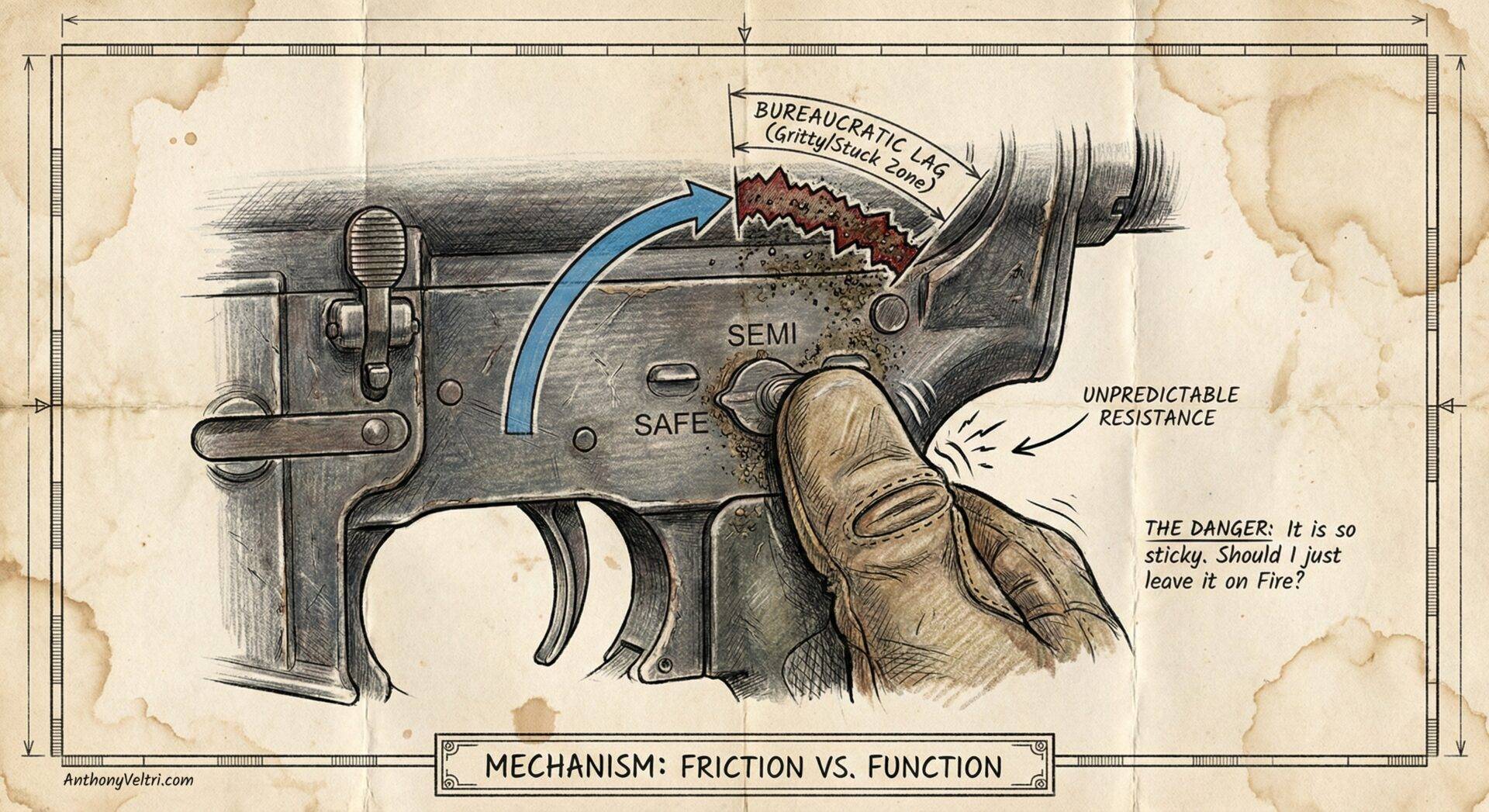
Response: Distinguish between speed of execution and adequacy of constraint.
Speed of execution can and should be fast when the situation demands it. But what should not be rushed is the adequacy of constraint evaluation before you enter sprint mode.
Speed of Execution vs Adequacy of constraint can be collapsed to: Latency vs. Lag.
- Constraint Latency is the necessary time to verify safety (like a safety catch on a weapon).
- Bureaucratic Lag is wasted time.
- We want to eliminate Lag, not remove the Safety Catch.
The problem is not fast action. The problem is sprint clocks that bypass governance clocks entirely, creating a pattern where exception becomes the norm.
If you’re doing something outside normal bounds, you should not be doing it again until we’ve figured out why it was necessary and whether the constraints held. What’s happening at the interface is normalization of bypass, not legitimate crisis response.
Translation protocol for authority-style claims
When someone says “it was legal,” do this:
- “I believe you that it was approved. (Status acknowledged. Now verify the stack.)”
- “Approved at which level of the ladder?”
- “What standard did the approval apply, and what facts did it rely on?”
- “Who can overturn it, and what would cause that reversal?”
- “What would change your mind?”
If they cannot answer (5), you are not hearing analysis. You are hearing identity.
Pocket script card
“Approval predicts compliance. It does not settle legitimacy across the full stack.”
“Legal under which authority, and enforceable by whom?”
“What would falsify your confidence?”
“If you cannot answer these questions, you may be executing rather than evaluating.”
Last Updated on January 24, 2026