Why resilient systems require both prevention and contingency, and how the balance determines performance under stress #
Doctrine Claim: You cannot prevent every failure, and you cannot firefight your way to stability. Resilient systems require two distinct layers of defense: Prevention (to reduce the probability of error) and Contingency (to reduce the impact of error). This matrix forces you to design for survival, not just perfection.
1. Purpose of the Prevention–Contingency Matrix #
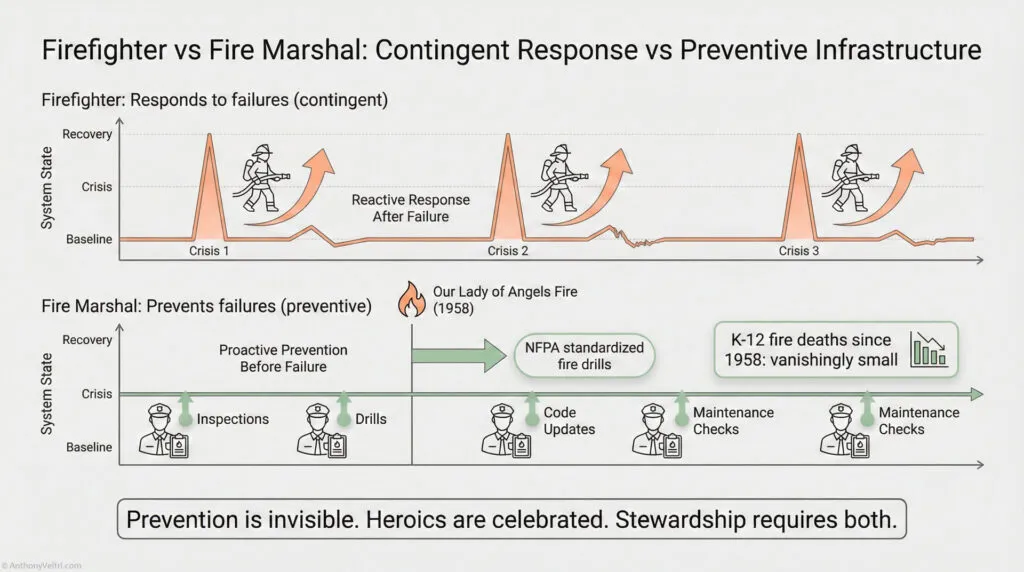
Organizations often make a fatal mistake:
They build systems only for prevention
or
they build systems only for contingency.
Either extreme fails.
Prevention supports stability.
Contingency supports resilience.
The Prevention–Contingency Matrix shows why you must intentionally design both.
2. The Four Quadrants of System Resilience #
The matrix has four conditions.
Everything you build will fall into one of them.
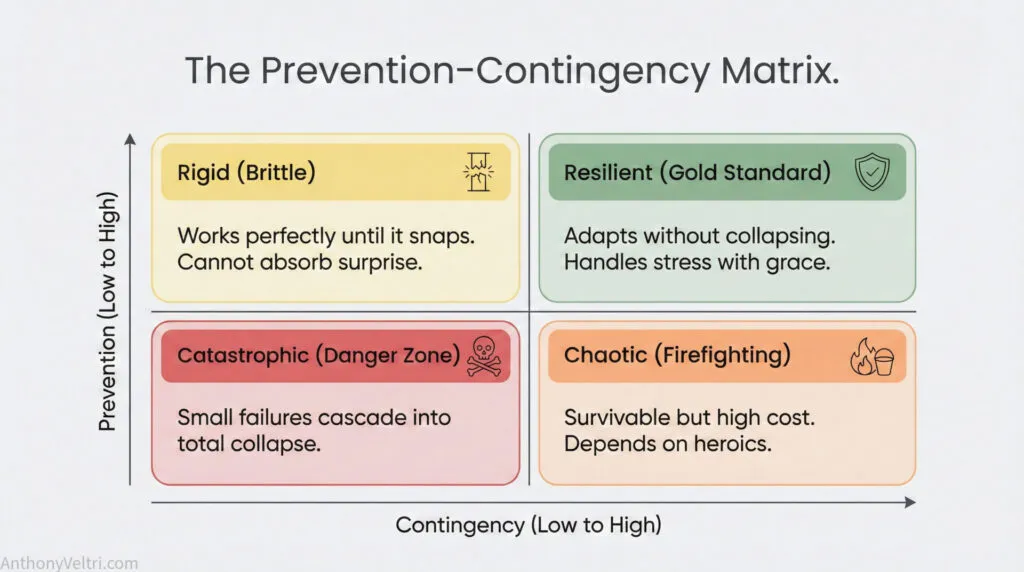
Quadrant 1: Strong Prevention, Strong Contingency #
Best case. The gold standard.
This is what you design for.
The system:
- handles expected conditions with ease
- handles unexpected conditions with grace
- adapts without collapsing
- maintains tempo under stress
Rare in the wild.
Always deliberate.
Quadrant 2: Strong Prevention, Weak Contingency #
Rigid. Looks strong until stress hits. Then it breaks.
The system:
- works perfectly under ideal conditions
- collapses when anything deviates
- requires synchronized correctness
- cannot absorb partner drift
- fails under surprise
This is common in heavily centralized or overly integrated systems.
Quadrant 3: Weak Prevention, Strong Contingency #
Chaotic but survivable.
High stress. High cost.
The system:
- constantly reacts
- constantly patches
- operates like firefighting
- depends on heroics
- compensates for unclear rules
- does not scale
This is where many FRN workflows lived before stabilization.
Quadrant 4: Weak Prevention, Weak Contingency #
Catastrophic.
Small failures cascade into large failures.
The system:
- cannot prevent errors
- cannot respond to them
- fails during normal operations
- completely collapses during stress
This quadrant is the danger zone.
3. Prevention: What It Is and What It Does #
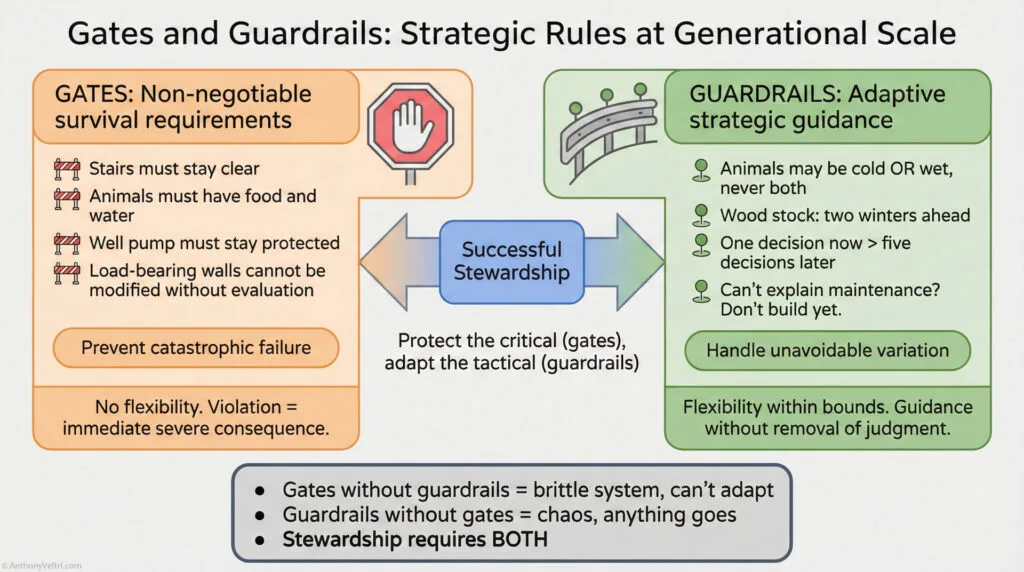
Prevention is the set of constraints, agreements, and structures that reduce the number of avoidable failures.
Prevention includes:
- clear intent
- data contracts
- human contracts
- interface ownership
- stable workflows
- predictable schemas
- versioning discipline
- consistent communication
- defined time rules
- known boundaries
Prevention reduces:
- confusion
- avoidable errors
- unnecessary escalations
- misinterpretation
- thrash
- leadership driven drift
- political heat
Prevention is structure.
Prevention is clarity.
Prevention is sanity.
4. Contingency: What It Is and What It Does #
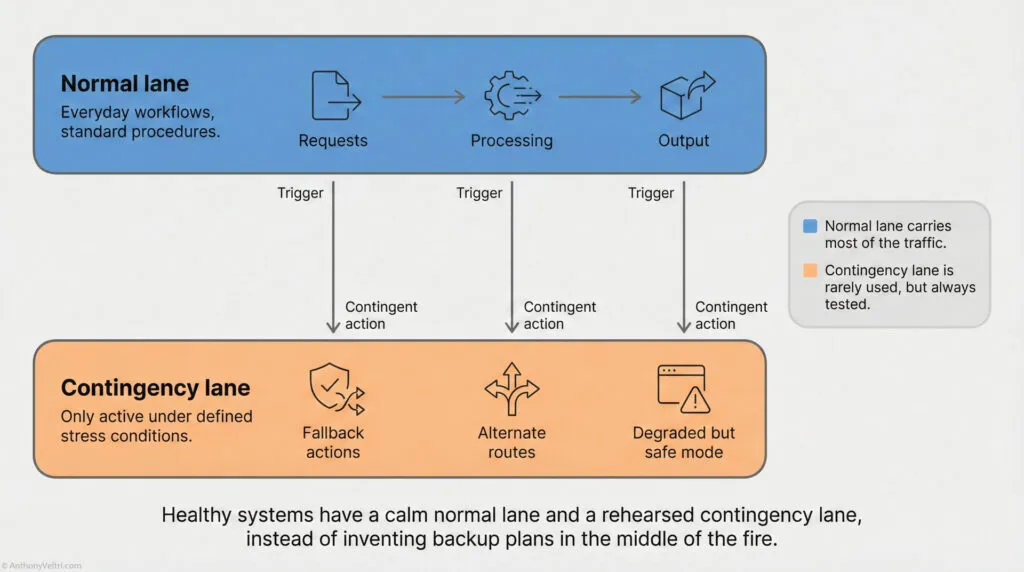
Contingency is the ability to absorb the failures that prevention cannot stop.
Contingency includes:
- fallback behavior
- tolerant ingest
- cached layers
- degraded mode
- last known good values
- partial updates
- manual overrides
- asynchronous operation
- autonomy at the edge
Contingency reduces:
- mission impact of failures
- fragility
- decision drag
- downtime
- brittleness
- panic
- escalation
Contingency is resilience.
Contingency is optionality.
Contingency is life support.
5. Why You Must Engineer Both Layers #
Prevention without contingency is brittle.
Contingency without prevention is chaos.
Both are required because:
- conditions vary
- partners drift
- leadership changes
- data degrades
- outages occur
- political visibility grows
- constraints shift
A balanced system is hard to break even when reality breaks the rules.
6. Business Example: FRN workflows as a weak prevention, weak contingency system #
Before stabilization, the FRN environment lived in Quadrant 4:
Weak prevention:
- no stable schema
- shifting requirements
- leadership driven edits
- unclear responsibilities
- inconsistent review expectations
- vague definitions of correctness
Weak contingency:
- no fallback for late edits
- no tolerance for last minute changes
- no method to isolate drift
- errors cascaded through all stages
- timelines collapsed under pressure
The workflow was brittle and chaotic.
Once your team introduced both prevention and contingency:
Prevention:
- fixed schema
- stable templates
- clear ownership
- rules for legal vs preference
- predictable revision cycles
Contingency:
- partial acceptance of changes
- triage rules
- allowable late edits
- communication routines
- quick harmonization paths
FRNs moved into Quadrant 1:
High prevention, high contingency.
This is why quality and predictability immediately improved.
7. System Example: iCAV as a Quadrant 1 system #
iCAV is a textbook example of Quadrant 1.
Strong prevention:
- stable schemas
- known schemas
- format and geometry rules
- agreed boundaries
- partner expectations
- interface owners
- predictable ingest shapes
Strong contingency:
- tolerant ingest
- cached values
- last known good state
- asynchronous flows
- degraded mode
- partial truth rendering
This is why iCAV survived:
- partner outages
- stale data
- inconsistent timestamps
- drift
- political pressure
- schema variation
Quadrant 1 is not luck.
It is architecture.
8. Prevention–Contingency Evaluation Tool (Paste Ready) #
Here is a reusable evaluation block:
Prevention–Contingency Evaluation
Boundary or System:
Prevention Rating (1 to 5):
Rules:
Contracts:
Predictability:
Stability:
Clarity:
Contingency Rating (1 to 5):
Fallback:
Tolerance:
Recovery:
Isolation:
Degraded mode:
Quadrant:
1, 2, 3, or 4
Risks Identified:
List them.
Actions:
Increase prevention by:
Increase contingency by:
9. Cross Links #
The matrix ties directly to:
- Principle 17: Clear intent
- Principle 18: Preventive vs contingent design
- Principle 19: Commitment vs compliance
- Annex A: Human contracts
- Annex B: Data contracts
- Annex C: Interface ownership
- Annex D: Decision altitudes
- Annex F: Pattern library
The matrix is the health check for all doctrine.
10. For Reflection: #
Ask yourself:
Is your system built only for stability?
Or only for crisis?
Or neither?
Only Quadrant 1 systems survive real conditions.
Move your system there now.
Last Updated on December 5, 2025