ANNEX J. System Evolution and Drift Management #
How systems change over time, why drift is inevitable, and how to manage evolution without losing coherence #
1. Purpose of System Evolution and Drift Management #
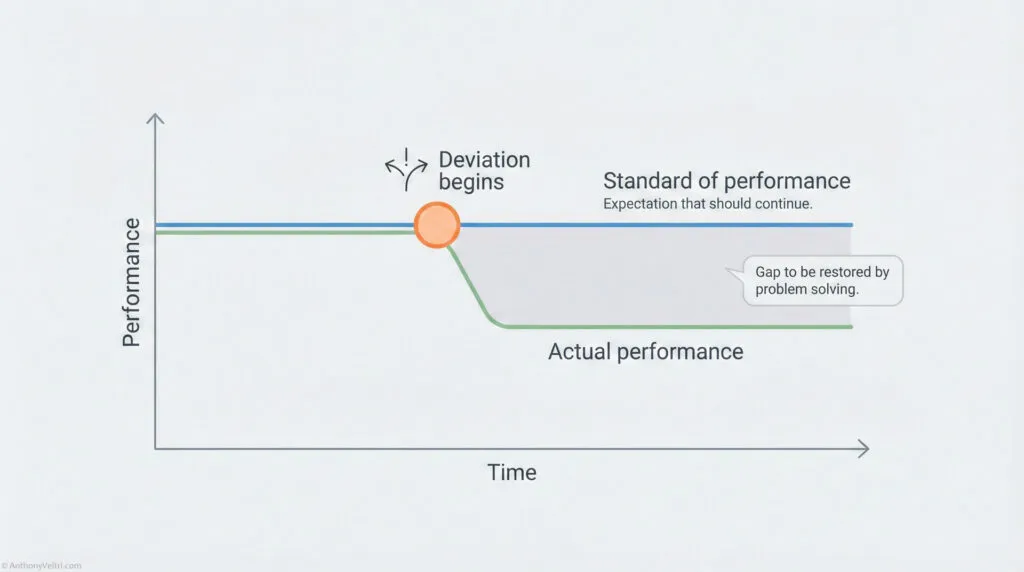
Every real system evolves:
- requirements change
- partners shift tools
- staffing changes
- leadership priorities move
- schemas drift
- political visibility increases
- technology matures
- workflows adapt
Evolution is normal.
Drift is inevitable.
Unmanaged drift becomes fragility.
This annex explains how to manage evolution intentionally so systems remain resilient instead of degrading into chaos.
2. The Three Forces of System Evolution #
Every system is shaped by three forces.
Force 1: Natural Drift #
Drift occurs because:
- partners update independently
- teams interpret rules differently
- people rotate in and out
- language diverges
- data shapes change
- political pressures reshape priorities
Drift is not a failure.
It is a signal that the system is alive.
Force 2: Intentional Adaptation #
Leadership, architecture, and management all introduce planned changes such as:
- new fields
- new partners
- new templates
- new ingest pathways
- new compliance requirements
- new workflows
This is the evolution that keeps the system relevant.
Force 3: External Shock #
External shocks include:
- legal changes
- public scrutiny
- oversight bodies
- partner outages
- policy shifts
- sudden mission needs
These shocks stress the system and reveal its load-bearing structures.
3. Why Drift Must Be Managed, Not Eliminated #
Many organizations try to eliminate drift.
This is impossible and harmful.
If drift is suppressed:
- people hide issues
- silent failures grow
- leadership becomes blind
- edge use cases become brittle
- the architecture becomes unrealistic
- surprises become catastrophic
Managed drift is transparency.
Suppressed drift is denial.
4. The Drift Management Cycle #
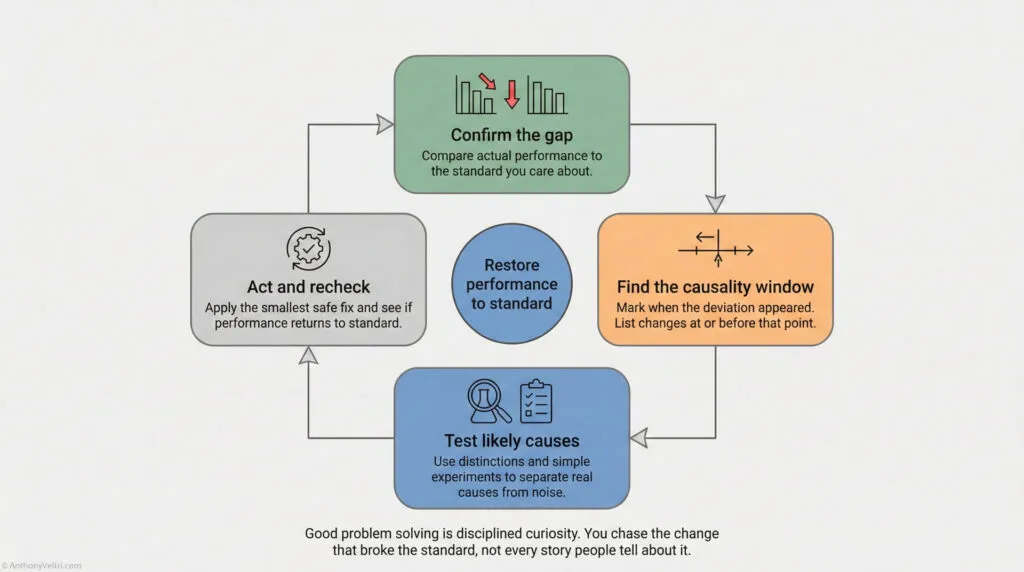
Systems remain healthy when drift is processed through a four-step cycle.
Step 1: Detect Drift #
Detection methods include:
- schema validation
- timestamp monitoring
- diff checking
- manual spot checks
- cross-team reviews
- quality gates
- operator feedback
This is the early warning system.
Step 2: Classify Drift #
Determine whether the drift is:
- benign
- acceptable variation
- early stage degradation
- incorrect but recoverable
- critical and requiring immediate action
Classification prevents overreaction.
Step 3: Absorb or Correct Drift #
Absorb drift when:
- it falls within tolerance
- it does not violate intent
- it does not break consistency
Correct drift when:
- it violates required fields
- it breaks workflows
- it causes chain reactions
- it introduces risk
- it degrades truth
- it affects public output
Absorption uses flexibility.
Correction uses architecture.
Step 4: Update the Contract or Architecture #
If drift is recurring:
- update the schema
- update the boundary
- update the fallback rules
- update the human contract
- update timelines
- update ownership
- update the architecture
This turns lived experience into system evolution.
5. Evolution Paths: How Systems Grow Without Breaking #
Healthy systems evolve through predictable paths.
Path 1: Edge Innovation → Standardization → Architecture #
Teams innovate at the edge.
Useful patterns become standard.
Architecture formalizes them.
This preserves creativity without chaos.
Path 2: Temporary Fix → Stabilization → Design Update #
A quick fix solves an urgent problem.
Stabilization absorbs the fix.
The architecture updates the underlying structure.
This prevents emergencies from hardcoding bad patterns.
Path 3: Partner Variation → Federation → Harmonization #
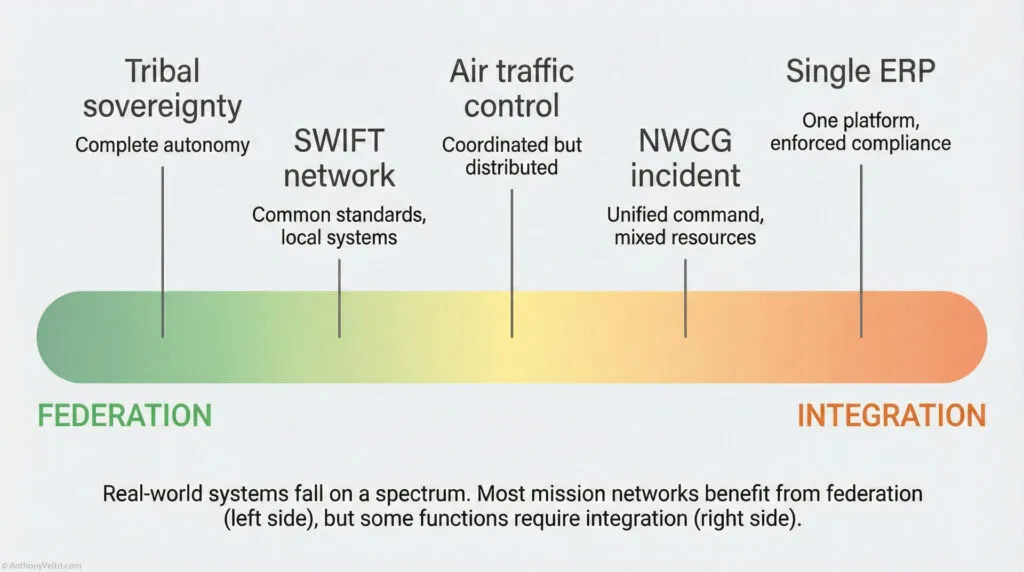
Partners change independently.
Federation absorbs variation.
Harmonization aligns meaning.
This is the core of durable, multi-partner systems.
6. How Evolution Failed in High-Visibility Workflows #
High-visibility workflows, such as FRNs, often suffered from unmanaged evolution:
- new fields introduced without planning
- leadership-driven changes without impact review
- text requirements changed mid-cycle
- implicit rules replaced explicit boundaries
- updates introduced late in the workflow
- versioning was not applied
- fallback rules were undefined
Without drift management, every cycle felt unstable.
With drift management:
- schema became stable
- versioning occurred intentionally
- fallback reduced chaos
- changes were communicated clearly
- operators were protected from late surprises
- leadership pressure no longer created collapse
Evolution became deliberate instead of accidental.
7. How Evolution Succeeded in Mission Systems #
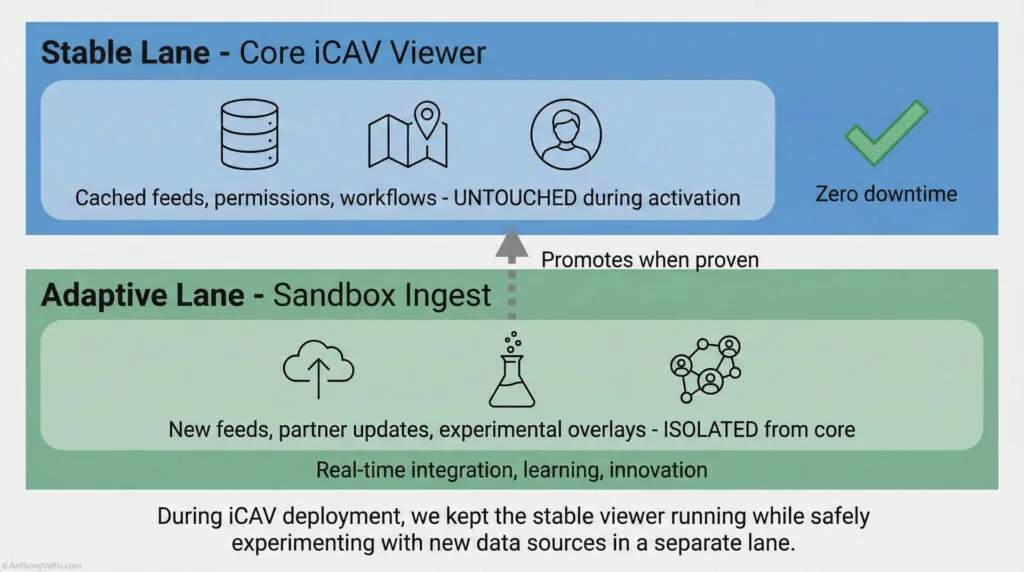
Mission systems like iCAV succeeded because drift management was structural:
- partners drifted, but federation absorbed variation
- schemas changed, but versioning controlled breakage
- ingest updated, but fallback preserved truth
- politics shifted, but architecture kept the system coherent
- operators adapted, but boundaries kept them safe
Evolution remained survivable because the architecture expected drift.
8. Drift Management Template (Paste Ready) #
Drift Management Template
Drift Detected:
Describe the deviation.
Type of Drift:
Benign, tolerable, correctable, critical.
Detection Method:
How the drift was discovered.
Impact:
Local, cross-team, architectural, strategic.
Tolerance:
Inside or outside allowed variation.
Action:
Absorb or correct.
Next Step:
Update schema, boundary, contract, fallback, versioning, or workflow.
9. Cross Links #
System Evolution and Drift Management ties directly to:
- Architecture Doctrine
- Prevention–Contingency Matrix
- Interface Ownership
- Data Contracts
- Human Contracts
- Pattern Library
- Decision Altitudes
- High Visibility Workflows
Drift management is the bridge between real conditions and designed systems.
10. For Reflection: #
Ask:
Where does drift accumulate?
Where has drift become normalized?
Where is drift hidden?
Where is drift unacknowledged?
Where does drift reveal missing architecture?
Manage the drift.
Adapt the architecture.
Strengthen the system.
Last Updated on December 5, 2025