Skip to content

Introduced by a trusted connector?

Start Here

Anthony Veltri

  • Doctrine
    • Doctrine Library
    • Global Library
  • Field Notes
  • Routes
    • Route 01: When the Interface Is Breaking (and you are becoming the patch)
    • ROUTE 02: If decisions stall and meetings go nowhere, start here
    • ROUTE 03: If you have lots of projects but no portfolio clarity, start here
    • ROUTE 04: If you’re confused about federation vs integration, start here
    • ROUTE 05: If heroics are propping up your system, start here
    • ROUTE 06: If you cannot force compliance across partners, start here
    • ROUTE 07: If compliance exists but commitment does not, start here
    • ROUTE 08: If disconnected workflows create audit anxiety, start here
  • Figure Library
  • FAQ
  • About
    • Capability Statement
    • Interpreter Kit
  • Contact
Anthony Veltri

Architecture & Interfaces

15
  • Doctrine 01: Federation vs Integration in Mission Networks
  • Doctrine 03: Interfaces Are Where Systems Break, So They Require Stewards, Contracts, and Ownership
  • Doctrine 04: Useful Interoperability Is the Goal, Not Perfect Interoperability
  • Doctrine 05: Innovation Must Live at the Edge, Not in the Center
  • Doctrine 06: A Two-Lane System Protects Stability and Enables Evolution
  • Doctrine 14: Technical Debt Is a Leadership Signal, Not a Coding Failure
  • Doctrine 15: Architecture Must Accelerate Teams, Not Bottleneck Them
  • Doctrine 17: Architects Translate Strategy Into Engineering and Engineering Into Strategy
  • Doctrine 20: Golden Datasets: Putting Truth In One Place Without Pretending Everything Is Perfect
  • Doctrine 21: Zero Trust Is A Trust Model, Not A Card “Type”
  • Doctrine 23: Loop Closure as Load-Bearing System Infrastructure
  • ANNEX B. Data Contracts
  • ANNEX C. Interface Ownership Model
  • ANNEX H. Architecture Doctrine
  • Annex L: The Rosetta Stone for Data Teams: Bridging the Gap Between Technicians and Executives

Decision Tempo & Governance

10
  • Doctrine 02: Distributed Decisions Increase Alignment, Speed, and Resilience
  • Doctrine 07: Clear Intent Matters More Than Perfect Data
  • Doctrine 08: Clear Intent Compresses Ambiguity, Reduces Conflict, and Accelerates Action
  • Doctrine 09: Decision Drag Is the Enemy of Mission Tempo. Architecture Is the Remedy
  • Doctrine 10: Degraded Operations Are the Normal Mode, Not the Exception
  • Doctrine 11: Preventive Action and Contingent Action Must Both Be Designed Intentionally
  • Doctrine 22: When “It Depends” Is the Right Answer: How to Think in Probabilities Under Uncertainty
  • ANNEX D. Decision Altitudes Model
  • ANNEX E. Prevention–Contingency Matrix
  • ANNEX I. High Visibility Workflows

Portfolio & Alignment

4
  • Doctrine 16: Portfolio Thinking Ensures Effort Aligns With What Actually Matters
  • ANNEX F. Pattern Library
  • ANNEX J. System Evolution and Drift Management
  • ANNEX K. System and Workflow Profiles (Case Studies)

Leadership & Human Systems

6
  • Doctrine 24: Stewardship Places the Burden on the Steward, Not the Parties
  • Doctrine 18: Commitment Outperforms Compliance in High Trust, High Tempo Environments
  • Doctrine 19: Supervision, Management, and Leadership Are Three Different Jobs. Confusing Them Breaks Systems
  • Doctrine 23: Loop Closure as Load-Bearing System Infrastructure
  • ANNEX A. Human Contracts
  • ANNEX G. Leadership Doctrine

Resilience & Operations

3
  • Doctrine 24: Stewardship Places the Burden on the Steward, Not the Parties
  • Doctrine 12: Resilience Is an Emergent Property, Not a Feature
  • Doctrine 13: Problem Solving Requires Finding the Real Deviation and the Relevant Change

Doctrine Companions

7
  • Doctrine 03 Companion: The RS-CAT Framework: Converting Raw Recall into Teachable Principle
  • Doctrine 03 Companion: The Interface Void
  • Doctrine 11 Companion: Agency vs. Outcome
  • Doctrine 09 Companion: Artifacts Over Adjectives
  • Doctrine 03 Companion: Constraints: bidirectional translation: Compression vs Construction
  • Doctrine 10 Companion: Span of Control and Cross Training Are Load-Bearing Constraints
  • Doctrine 21 Companion: Claims, Roles, and Entitlements in Microsoft 365

Field Reports

1
  • Field Report: College Financing and the 5-Year Home Runway
View Categories
  • Home
  • Doctrine & Supporting Guides
  • Architecture & Interfaces
  • Doctrine 17: Architects Translate Strategy Into Engineering and Engineering Into Strategy

Doctrine 17: Architects Translate Strategy Into Engineering and Engineering Into Strategy

Anthony Veltri
Updated on December 5, 2025

5 min read

Why missions fail when strategy and engineering do not speak the same language #

This guide established a framework for the Architect as a “Translator” between the boardroom and the server room.

This page is a Doctrine Guide. It shows how to apply one principle from the Doctrine in real systems and real constraints. Use it as a reference when you are making decisions, designing workflows, or repairing things that broke under pressure.


Strategy talks in outcomes. Engineering talks in mechanisms. Someone must connect the two. #
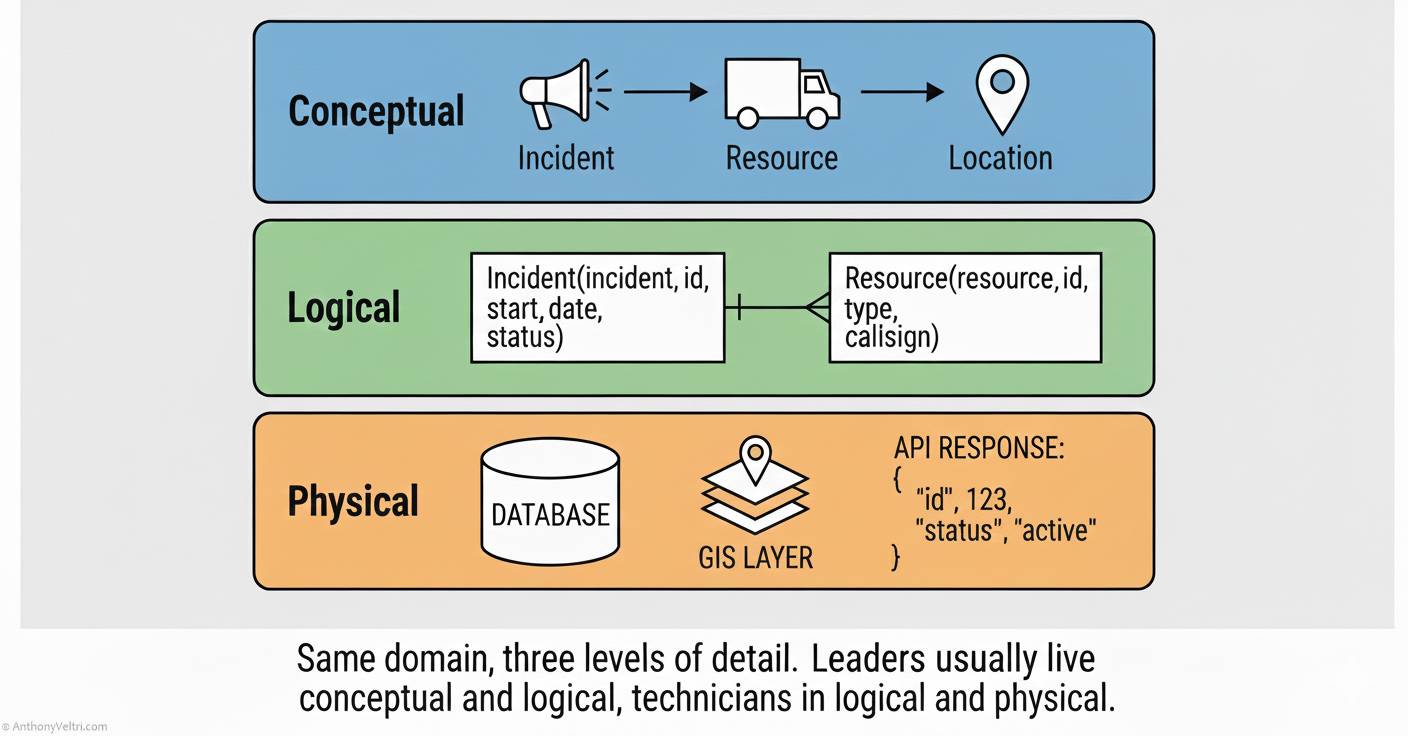
A vertical stack of three rectangles labeled “Conceptual,” “Logical,” and “Physical.” In the Conceptual box, show icons or labels like “Incident,” “Resource,” “Location,” with simple arrows between them. In the Logical box, show a simplified entity relationship style view, for example “Incident(incident_id, start_date, status)” linked to “Resource(resource_id, type, callsign).” In the Physical box, show logos or generic icons for a database, a GIS layer, and an API response snippet.
The Translation Ladder. Leaders live in the Conceptual layer (Icons/Outcomes). Engineers live in the Physical layer (Database/JSON). The Architect lives in the Logical layer, translating between the two. Same domain, three levels of detail.

Executives speak in priorities.
Engineers speak in specifics.
Operators speak in constraints.
Partners speak in obligations.

If no one connects these languages, missions drift, systems misalign, and teams build technically correct solutions that fail strategically.

The architect is the translator that keeps intent, design, and execution aligned.


Lived Example: The wildfire overlay that almost derailed a mission #

During a wildfire activation, leadership requested a “simple overlay” that showed evacuation zones, weather, and fire lines on one map.

Engineering interpreted this as a full workflow:

  • ingest three new feeds
  • resolve schema mismatches
  • handle projection issues
  • manage stale partner updates
  • integrate weather forecasts
  • perform stamp and cache validation
  • overcome degraded upstream endpoints

They estimated two weeks.

Leadership expected two hours.

Both groups were right.
Neither group understood the other.

My role as architect was to translate:

Leadership intent:
“Give us a combined view to support evacuation decisions in the next operational period.”

Engineering reality:
“A perfect integration requires days but a minimum viable visual can be delivered in hours.”

The solution:
We produced a temporary partial overlay for decision making that night and scheduled the deeper integration for later.

Strategy informed engineering.
Engineering informed strategy.
The mission stayed aligned.


Business Terms: Why translation matters #

Translation preserves:

  • alignment between mission and engineering
  • clarity of scope
  • realistic expectations
  • trust between teams
  • accurate timelines
  • decision quality
  • morale and momentum

Without translation:

  • leaders assume technical work is trivial
  • engineers assume leadership demands are unrealistic
  • teams talk past each other
  • friction replaces cooperation
  • roadmaps break down
  • strategic impact is lost

The architect keeps them talking in one direction.


System Terms: What translation actually is #

In system language, translation means:

  • mapping intent to constraints
  • defining system boundaries
  • converting business goals into behavioral requirements
  • converting engineering limitations into strategic decisions
  • identifying coupling and decoupling points
  • shaping flow of information, control, and responsibility
  • aligning invariants across layers

Translation is not communication.
Translation is structural alignment.


Why systems fail without translation #
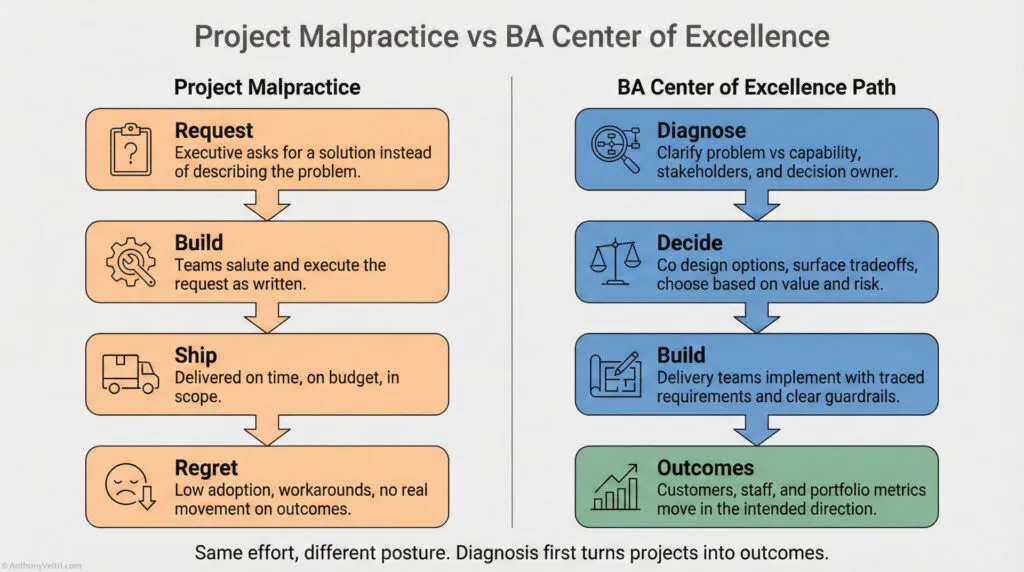
A comparison chart of "Project Malpractice" and "BA Center of Excellence Path," showing steps for each approach in project management. The BA path emphasizes diagnosis, decision, build, and measurable outcomes, while malpractice leads to regret.
The Trap of Malpractice. The “Project Malpractice” path (Red) optimizes for building the request. The “CoE Path” (Blue) optimizes for diagnosing the need. Portfolio thinking forces the Blue path. This introduces Translation Failure (at an interface). Without an architect to diagnose the request (Blue Path), engineering simply builds the order (Red Path), leading to regret.

Business perspective #

Systems fail when:

  • leadership declares outcomes without understanding complexity
  • teams build what they think was asked rather than what is needed
  • roadmaps reflect fantasy timelines
  • priorities collide without mediation
  • stakeholders believe their needs were ignored
  • engineers feel undervalued or misunderstood

The system becomes a political map, not an architectural one.

System perspective #

Systems fail when:

  • interface boundaries are unclear
  • requirements are ambiguous
  • technical constraints are invisible
  • coupling is unrecognized
  • edge cases are ignored
  • stability and evolution are confused
  • patterns are not standardized

These failures multiply rapidly.


Why the architect must stand between worlds #
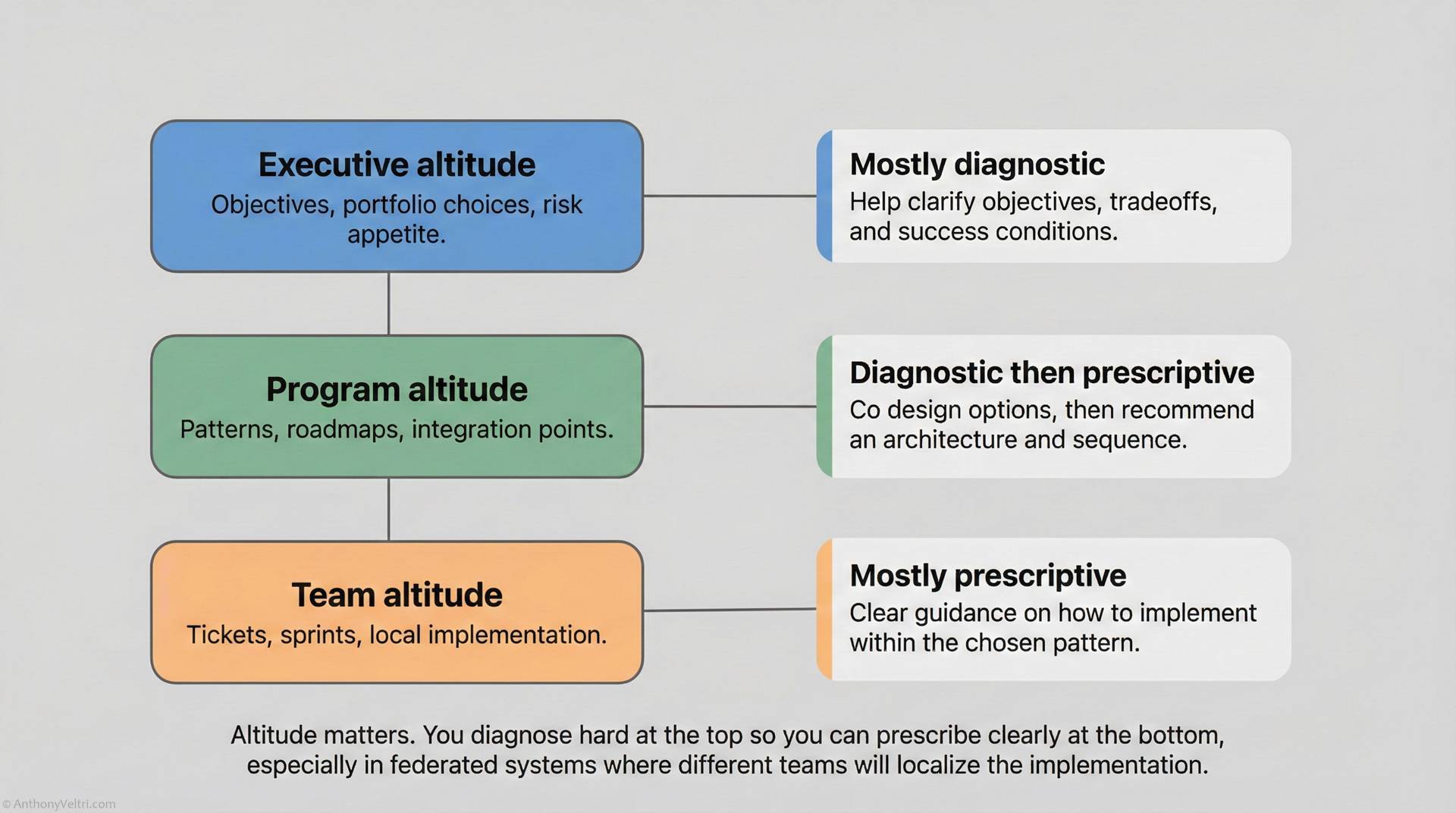
A diagram with three altitudes: Executive (diagnostic), Program (diagnostic then prescriptive), and Team (prescriptive), showing how responsibilities and clarity increase from objectives to implementation.
Altitude Translation. The Executive Altitude sees “Objectives.” The Team Altitude sees “Tickets.” The Architect connects them at the Program Altitude.

The architect is the:

  • interpreter
  • negotiator
  • strategist
  • technical truth teller
  • boundary keeper
  • pattern builder
  • intent carrier

This role cannot be outsourced.
It requires:

  • technical fluency
  • strategic literacy
  • political awareness
  • human insight

When this role is absent, assumptions fill the gap.

Assumptions are usually wrong.


Business Example: Translating modernization strategy into real constraints #

During a cloud migration for a national agency, leadership declared:

“We want full cloud adoption in twelve months.”

Engineering responded internally with:

“Impossible. Too many legacy dependencies. Too many partner integrations.”

My role:

  • clarify the real strategic intent
    (reduce operational risk and improve partner access)
  • decompose the migration into three phases
  • define what had to be moved vs what could stay hybrid
  • set constraints for each partner feed
  • define what “success” meant in concrete operational terms

The strategy became realistic.
The engineering became achievable.


System Example: Translation during iCAV evolution #

In iCAV:

  • strategists wanted better situational awareness
  • partners wanted to keep their systems
  • engineers wanted stable schemas
  • operators wanted faster updates
  • security wanted tighter controls

No single group was wrong.
They were simply speaking different languages.

As architect, I translated:

  • strategic goals into system requirements
  • partner constraints into ingestion rules
  • engineering limits into program decisions
  • operator needs into interface priority
  • security requirements into design guardrails

The system evolved without breaking its mission.


Architect-Level Principle #
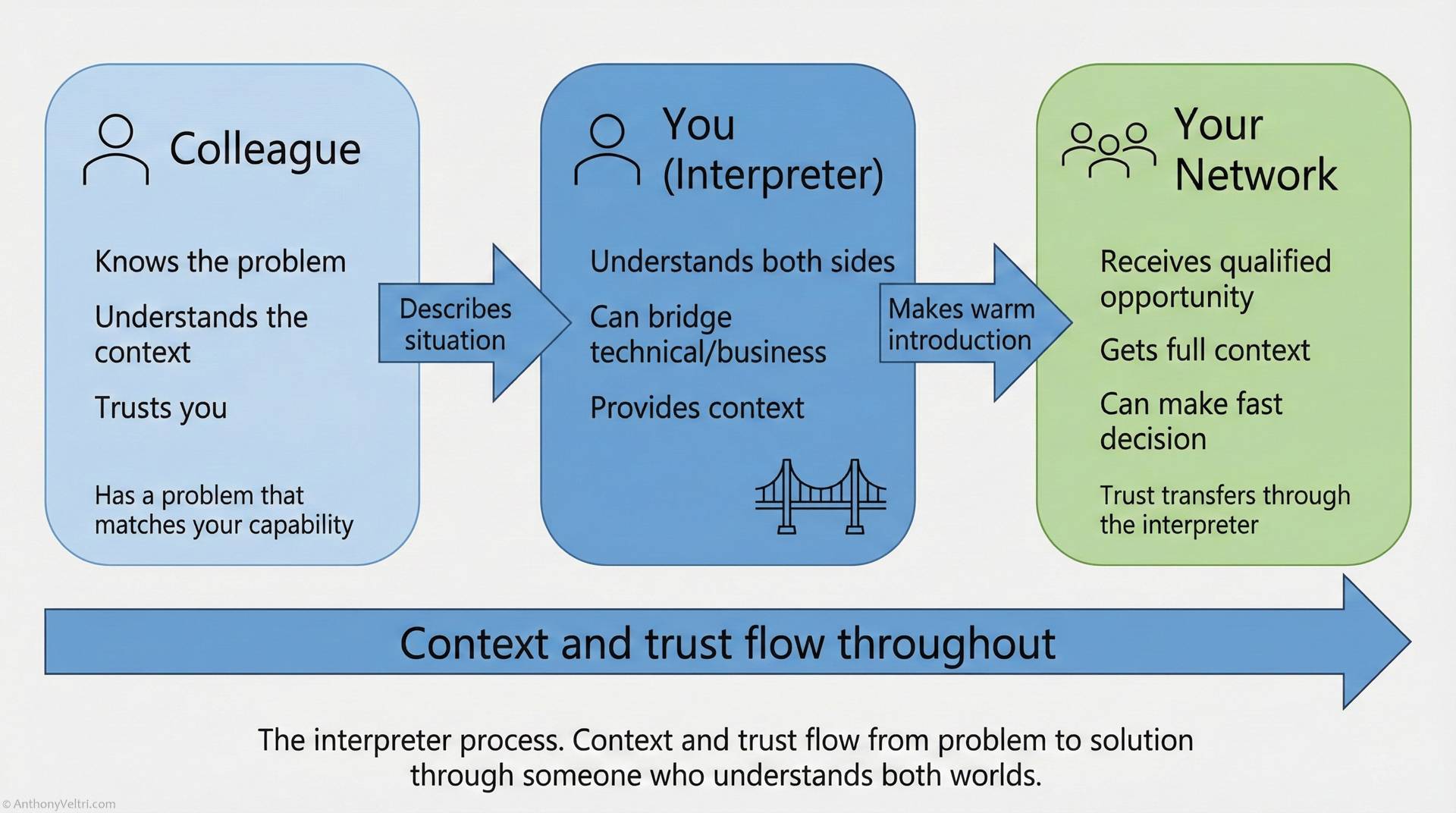
A flowchart showing three groups: Colleague (knows problem, trusts you), You (the interpreter bridging both sides), and Your Network (offers solutions). Arrows show information and trust flowing between each group.
The Architect as Interpreter. Strategy (Colleague) knows the problem. Engineering (Network) has the solution. The Architect provides the context bridge that makes the connection possible.

As an architect, I serve as the translator between strategy and engineering.
Strategy defines the mission.
Engineering defines what is possible.
Translation brings the two into alignment without distortion.


Twenty-Second Version #

“Leaders speak outcomes and engineers speak mechanisms. If no one connects the two, missions drift. My role as an architect is to translate strategy into engineering decisions and translate engineering constraints back into strategic choices. This keeps systems aligned and avoids failure through misunderstanding.”


Cross Links to Other Principles #

This principle is tightly linked to:

  • Clear intent
  • Distributed decisions
  • Interfaces and ownership
  • Technical debt as leadership signal
  • Two lane systems
  • Decision drag
  • Portfolio thinking

Translation is the connective tissue of the entire doctrine.


Doctrine Diagnostic – For Reflection: #

Ask yourself:
Does everyone understand the mission the same way?
Does everyone understand the constraints the same way?

If not, you are missing the translation layer.
Add it now, before the system drifts.

Last Updated on December 5, 2025

Related Posts #

This diagram illustrates increasing salary capacities, with larger houses on higher blocks representing $6k, $24k (median), and $80k per year.

Field Report: College Financing and the 5-Year Home Runway #

Abstract geometric design with circles and lines, overlaid by a dark rectangle containing the text “Technical Debt as Signal.”.

Doctrine 14: Technical Debt Is a Leadership Signal, Not a Coding Failure #

A graphic with abstract blue and black data and circuit patterns, overlaid with a dark rectangle containing the text

Annex L: The Rosetta Stone for Data Teams: Bridging the Gap Between Technicians and Executives #

Dark box with large white text “ANNEX G” and smaller text “Leadership Doctrine” overlays a complex blue and gray technical, circuit-like abstract background design.

ANNEX G. Leadership Doctrine #

A geometric abstract design with lines, circles, and shapes in muted tones. Overlayed text reads,

Doctrine 01: Federation vs Integration in Mission Networks #

A digital background with abstract circuits and nodes. Overlaid text reads

ANNEX D. Decision Altitudes Model #

architecture, governance, leadership, visibility
Table of Contents
  • Why missions fail when strategy and engineering do not speak the same language
  • Strategy talks in outcomes. Engineering talks in mechanisms. Someone must connect the two.
  • Lived Example: The wildfire overlay that almost derailed a mission
  • Business Terms: Why translation matters
  • System Terms: What translation actually is
  • Why systems fail without translation
    • Business perspective
    • System perspective
  • Why the architect must stand between worlds
  • Business Example: Translating modernization strategy into real constraints
  • System Example: Translation during iCAV evolution
  • Architect-Level Principle
  • Twenty-Second Version
  • Cross Links to Other Principles
  • Doctrine Diagnostic - For Reflection:

Share This Article :

  • Facebook
  • X
  • LinkedIn
  • Pinterest

Was it helpful ?

  • Happy
  • Normal
  • Sad
  • Privacy Policy
  • Introductions
  • Contact

© 2026 Anthony Veltri

  • Doctrine
    • Doctrine Library
    • Global Library
  • Field Notes
  • Routes
    • Route 01: When the Interface Is Breaking (and you are becoming the patch)
    • ROUTE 02: If decisions stall and meetings go nowhere, start here
    • ROUTE 03: If you have lots of projects but no portfolio clarity, start here
    • ROUTE 04: If you’re confused about federation vs integration, start here
    • ROUTE 05: If heroics are propping up your system, start here
    • ROUTE 06: If you cannot force compliance across partners, start here
    • ROUTE 07: If compliance exists but commitment does not, start here
    • ROUTE 08: If disconnected workflows create audit anxiety, start here
  • Figure Library
  • FAQ
  • About
    • Capability Statement
    • Interpreter Kit
  • Contact