Skip to content

Introduced by a trusted connector?

Start Here

Anthony Veltri

  • Doctrine
    • Doctrine Library
    • Global Library
  • Field Notes
  • Routes
    • Route 01: When the Interface Is Breaking (and you are becoming the patch)
    • ROUTE 02: If decisions stall and meetings go nowhere, start here
    • ROUTE 03: If you have lots of projects but no portfolio clarity, start here
    • ROUTE 04: If you’re confused about federation vs integration, start here
    • ROUTE 05: If heroics are propping up your system, start here
    • ROUTE 06: If you cannot force compliance across partners, start here
    • ROUTE 07: If compliance exists but commitment does not, start here
    • ROUTE 08: If disconnected workflows create audit anxiety, start here
  • Figure Library
  • FAQ
  • About
    • Capability Statement
    • Interpreter Kit
  • Contact
Anthony Veltri

Architecture & Interfaces

15
  • Doctrine 01: Federation vs Integration in Mission Networks
  • Doctrine 03: Interfaces Are Where Systems Break, So They Require Stewards, Contracts, and Ownership
  • Doctrine 04: Useful Interoperability Is the Goal, Not Perfect Interoperability
  • Doctrine 05: Innovation Must Live at the Edge, Not in the Center
  • Doctrine 06: A Two-Lane System Protects Stability and Enables Evolution
  • Doctrine 14: Technical Debt Is a Leadership Signal, Not a Coding Failure
  • Doctrine 15: Architecture Must Accelerate Teams, Not Bottleneck Them
  • Doctrine 17: Architects Translate Strategy Into Engineering and Engineering Into Strategy
  • Doctrine 20: Golden Datasets: Putting Truth In One Place Without Pretending Everything Is Perfect
  • Doctrine 21: Zero Trust Is A Trust Model, Not A Card “Type”
  • Doctrine 23: Loop Closure as Load-Bearing System Infrastructure
  • ANNEX B. Data Contracts
  • ANNEX C. Interface Ownership Model
  • ANNEX H. Architecture Doctrine
  • Annex L: The Rosetta Stone for Data Teams: Bridging the Gap Between Technicians and Executives

Decision Tempo & Governance

10
  • Doctrine 02: Distributed Decisions Increase Alignment, Speed, and Resilience
  • Doctrine 07: Clear Intent Matters More Than Perfect Data
  • Doctrine 08: Clear Intent Compresses Ambiguity, Reduces Conflict, and Accelerates Action
  • Doctrine 09: Decision Drag Is the Enemy of Mission Tempo. Architecture Is the Remedy
  • Doctrine 10: Degraded Operations Are the Normal Mode, Not the Exception
  • Doctrine 11: Preventive Action and Contingent Action Must Both Be Designed Intentionally
  • Doctrine 22: When “It Depends” Is the Right Answer: How to Think in Probabilities Under Uncertainty
  • ANNEX D. Decision Altitudes Model
  • ANNEX E. Prevention–Contingency Matrix
  • ANNEX I. High Visibility Workflows

Portfolio & Alignment

4
  • Doctrine 16: Portfolio Thinking Ensures Effort Aligns With What Actually Matters
  • ANNEX F. Pattern Library
  • ANNEX J. System Evolution and Drift Management
  • ANNEX K. System and Workflow Profiles (Case Studies)

Leadership & Human Systems

6
  • Doctrine 24: Stewardship Places the Burden on the Steward, Not the Parties
  • Doctrine 18: Commitment Outperforms Compliance in High Trust, High Tempo Environments
  • Doctrine 19: Supervision, Management, and Leadership Are Three Different Jobs. Confusing Them Breaks Systems
  • Doctrine 23: Loop Closure as Load-Bearing System Infrastructure
  • ANNEX A. Human Contracts
  • ANNEX G. Leadership Doctrine

Resilience & Operations

3
  • Doctrine 24: Stewardship Places the Burden on the Steward, Not the Parties
  • Doctrine 12: Resilience Is an Emergent Property, Not a Feature
  • Doctrine 13: Problem Solving Requires Finding the Real Deviation and the Relevant Change

Doctrine Companions

7
  • Doctrine 03 Companion: The RS-CAT Framework: Converting Raw Recall into Teachable Principle
  • Doctrine 03 Companion: The Interface Void
  • Doctrine 11 Companion: Agency vs. Outcome
  • Doctrine 09 Companion: Artifacts Over Adjectives
  • Doctrine 03 Companion: Constraints: bidirectional translation: Compression vs Construction
  • Doctrine 10 Companion: Span of Control and Cross Training Are Load-Bearing Constraints
  • Doctrine 21 Companion: Claims, Roles, and Entitlements in Microsoft 365

Field Reports

1
  • Field Report: College Financing and the 5-Year Home Runway
View Categories
  • Home
  • Doctrine & Supporting Guides
  • Architecture & Interfaces
  • Doctrine 15: Architecture Must Accelerate Teams, Not Bottleneck Them

Doctrine 15: Architecture Must Accelerate Teams, Not Bottleneck Them

Anthony Veltri
Updated on December 5, 2025

4 min read

Why architecture succeeds only when it makes teams faster, clearer, and more capable #

This guide is a argument against most “Ivory Tower” architecture. It argues that if architecture doesn’t make the team faster, it’s useless.

This page is a Doctrine Guide. It shows how to apply one principle from the Doctrine in real systems and real constraints. Use it as a reference when you are making decisions, designing workflows, or repairing things that broke under pressure.


If your architecture slows people down, it is not architecture. It is obstruction. #
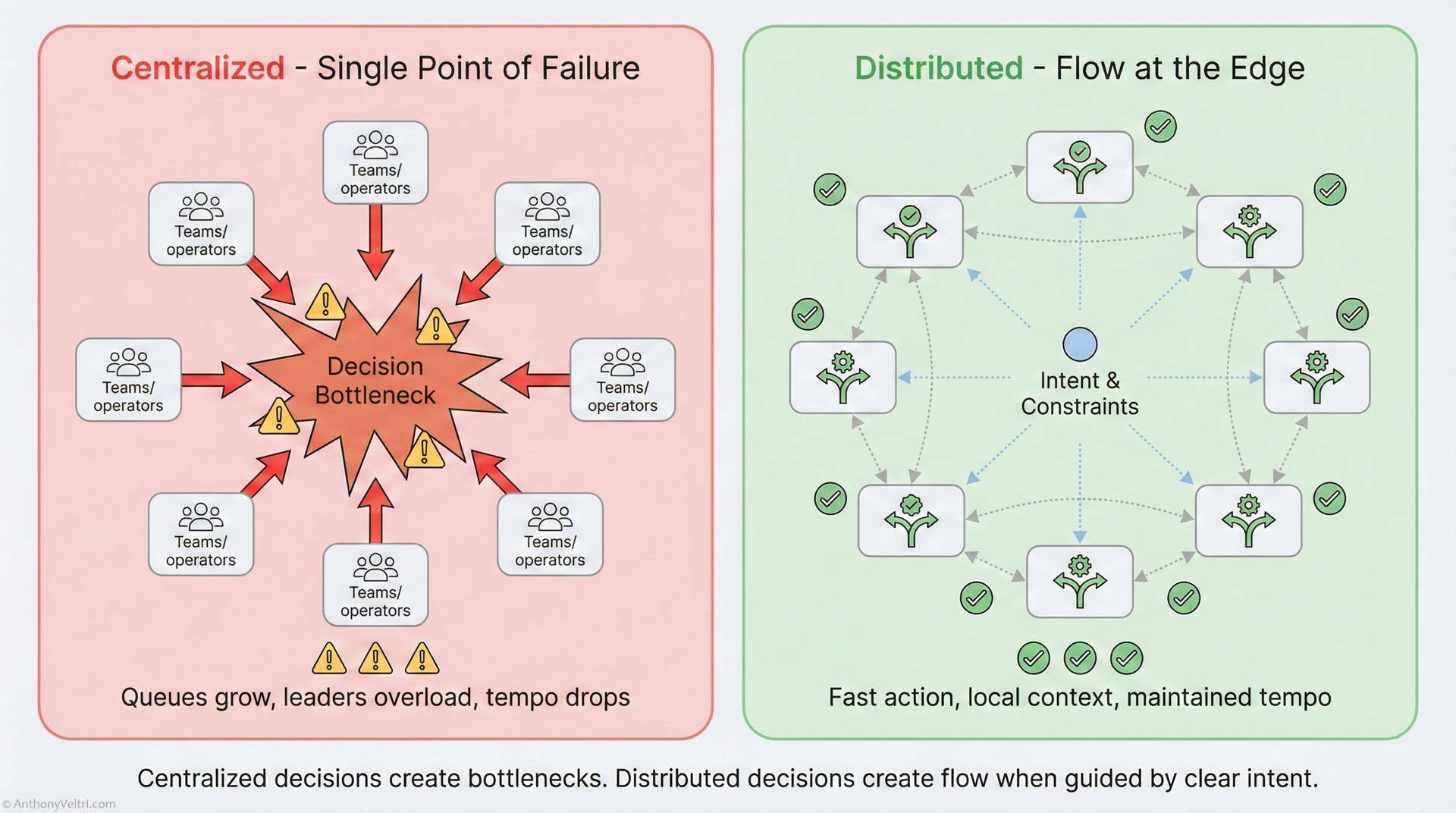
Infographic comparing centralized (single point of failure) with distributed (flow at the edge) decision-making. Centralized shows bottlenecks and overload; distributed shows quick, local decisions guided by intent and constraints.
Intent Enables Flow. Without intent (Red), every decision must route to the center for data validation. With intent (Green), the center sets constraints, and the nodes can act immediately on local data. Structure creates or reduces drag. Centralized systems (Red) create drag by forcing every decision through a single overloaded node (bottleneck). Distributed systems (Green) remove drag by pushing authority to the edge.

Architecture is often misunderstood as:

  • documentation
  • diagrams
  • governance meetings
  • compliance reviews
  • approval checkpoints

But real architecture is none of these.

Real architecture removes friction.
Real architecture reduces ambiguity.
Real architecture makes the next step obvious.

If your architecture bottlenecks teams, you have built a wall.
If your architecture accelerates teams, you have built a runway.


Lived Example: The workflow that slowed a team for six months #

A partner team once needed to onboard three new data feeds.
The architecture group at the time insisted on:

  • a full documentation package
  • a multi step review
  • a cross agency governance check
  • a strict certification process
  • a six week cadence for decisions

The engineering team began quietly building workarounds:

  • scripts outside governance
  • parallel shadow environments
  • temporary transforms
  • manual processes

These workarounds worked because they were fast.
The architectural process did not work because it was slow.

The team succeeded despite the architecture, not because of it.

That is failure.

Architecture that slows people down collapses under real pressure.


Business Terms: What acceleration means #

Architecture should:

  • clarify what good looks like
  • simplify decision making
  • reduce rework
  • reduce escalation
  • reduce delays
  • reduce misalignment
  • reduce approval cycles
  • reduce ambiguity

Acceleration means:

  • faster onboarding
  • faster integration
  • faster iteration
  • faster understanding
  • faster adoption
  • faster delivery

Architecture accelerates by doing less of the wrong work and more of the right scaffolding.

It gives teams lift, not drag.


System Terms: What acceleration looks like in technical architecture #

Acceleration in system language means:

  • reusable patterns
  • stable interfaces
  • standardized contracts
  • consistent error handling
  • predictable versioning
  • known invariants
  • clear boundaries
  • low coupling
  • low ceremony
  • high clarity

Acceleration is not speed of code.
Acceleration is speed of coordination.

Architecture accelerates when teams know:

  • where to plug in
  • how to extend
  • how to evolve
  • what not to touch
  • what will break downstream
  • how to comply without slowing down

Acceleration is baked into system topology.


Why Architecture Bottlenecks Happen #
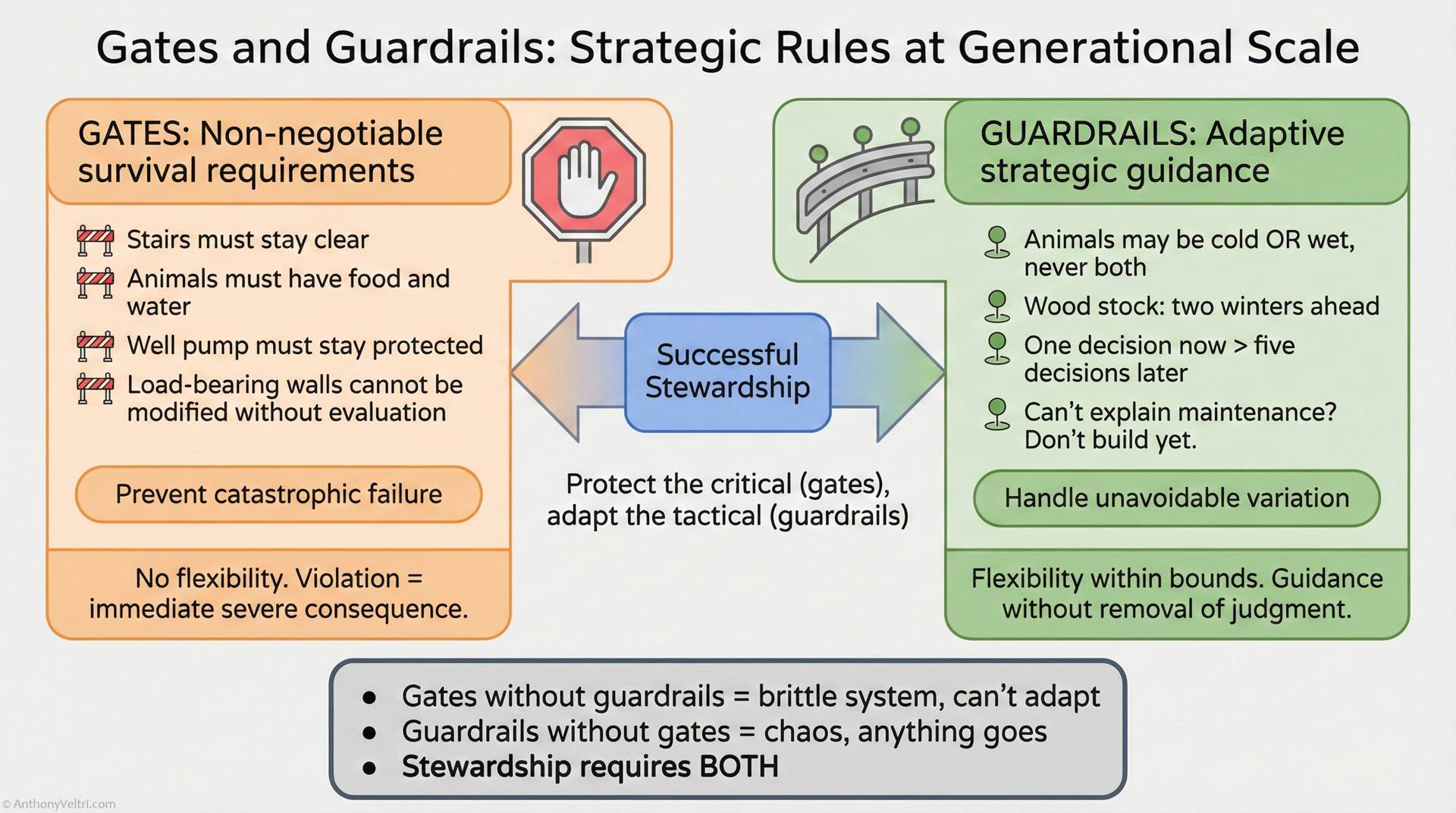
A diagram contrasts "Gates" (non-negotiable survival requirements, like food and water) with "Guardrails" (adaptive strategic guidance, like seasonal animal needs), both leading to successful stewardship of critical systems.
Gates vs. Guardrails. Bad architecture relies on Gates that stop traffic to check for defects. Good architecture uses Guardrails to shape the work product upstream, ensuring that what arrives at the boundary is already compliant, rather than jamming the gate with bad requests. Prevention acts as a Gate (Binary, Stop/Go). Contingency acts as a Guardrail (Keeps you on the road when you drift). A resilient system uses Gates for critical safety and Guardrails for variance.

Business perspective #

Architecture bottlenecks form when:

  • governance is too heavy
  • approvals take too long
  • priorities are unclear
  • architects try to control everything
  • leadership treats architecture as a gate
  • teams fear doing things “wrong”
  • architects operate with compliance, not commitment

This creates:

  • waiting
  • frustration
  • shadow systems
  • political avoidance
  • low morale

Bottlenecks kill initiative.

System perspective #

Technical bottlenecks form when:

  • interfaces are too strict
  • coupling is too high
  • patterns are too rigid
  • the architecture is designed for ideal conditions
  • anti patterns are forbidden instead of tolerated and contained
  • updates require synchronized releases
  • reviewers are overloaded

When the architecture becomes more complicated than the problem, teams go around it.


Why Acceleration Is the Architect’s Real Job #

Architects accelerate by:

  • setting patterns
  • clarifying boundaries
  • owning decisions
  • preventing rework
  • offering guidance early
  • translating intent
  • removing redundant steps
  • designing predictable interfaces
  • building templates, not gates
  • shielding teams from leadership noise
  • reducing dependency chains

Acceleration is not about moving fast and breaking things.
Acceleration is about moving clearly and coordinating well.

Fast is useless if it is chaotic.
Slow is useless if it kills initiative.
Clear is the answer.


Business Example: The onboarding pattern that cut a month of work down to two hours #
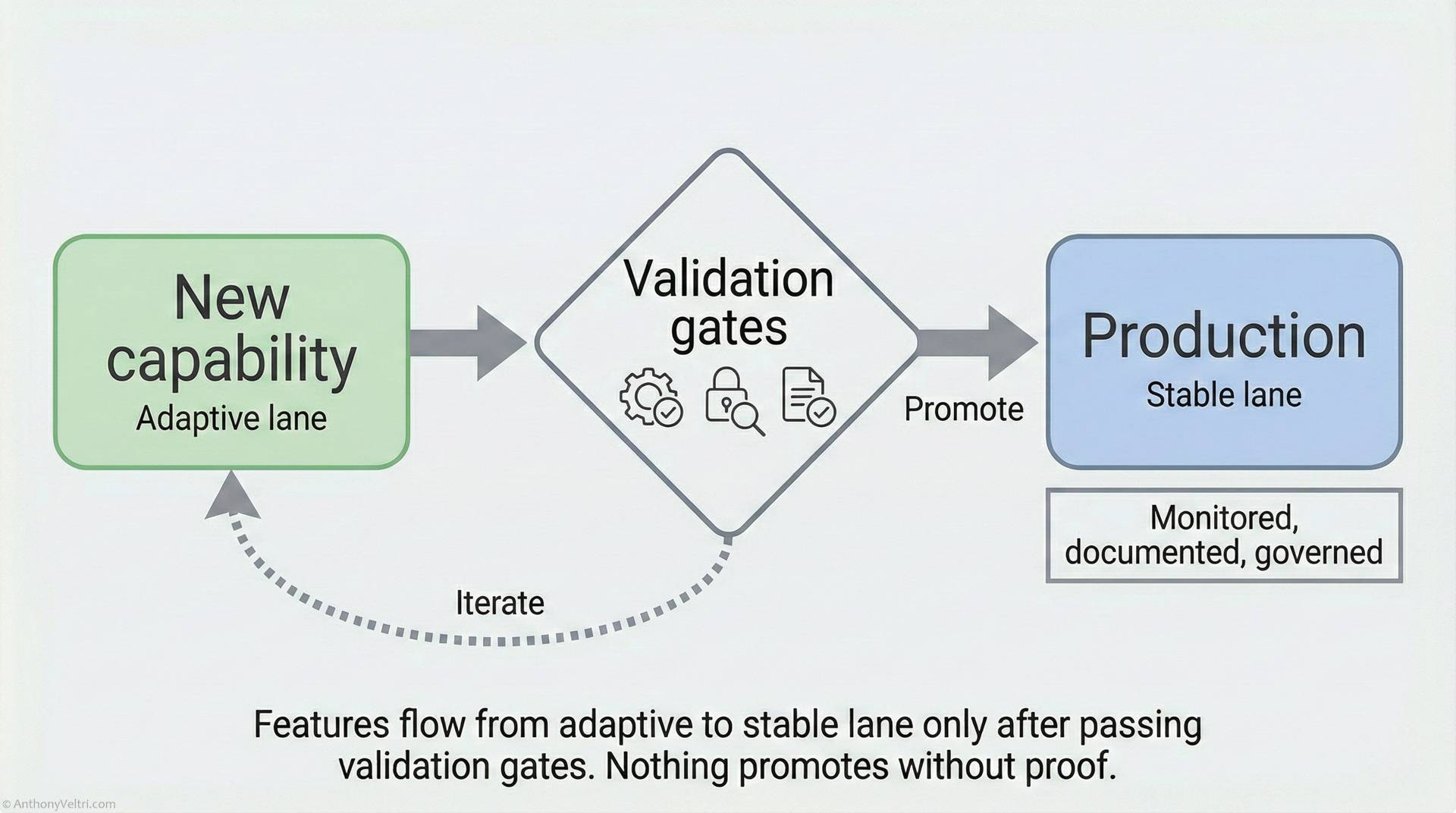
A flowchart showing “New capability” in a green box, passing “Validation gates,” then “Production” in a blue box. Features only move to production if validated; iteration returns features to new capability if needed.
The Innovation/Acceleration Loop. The edge (Green) is where new capabilities are born. The center’s job isn’t to invent them, but to validate them through a gate before promoting them to production (Blue). Instead of ad-hoc reviews, we built a standard “Validation Gate.” Teams knew exactly what tests to pass to move from “New” to “Production” without asking for permission.

Teams used to spend weeks onboarding partner feeds because each integration required custom alignment.

As architect, we created:

  • a standard ingest pattern
  • a checklist
  • a basic transformation template
  • a clear versioning guide
  • confidence indicators
  • required and optional fields
  • fallback behavior

Once this pattern existed, a partner could onboard themselves.

What took a month took two hours.

That is architectural acceleration.


System Example: The reusable connector that eliminated 90 percent of effort #
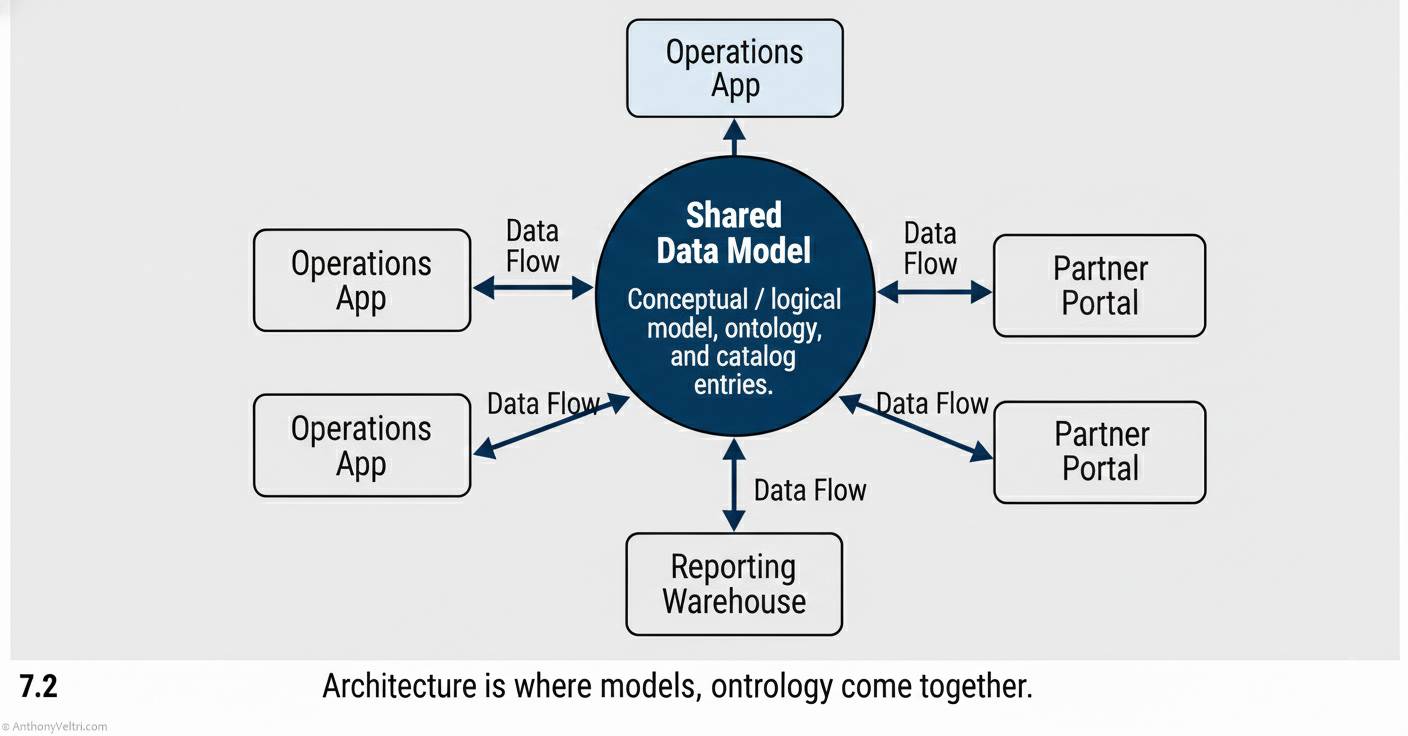
A simple architecture diagram with three or four systems (for example “Operations App,” “Reporting Warehouse,” “Partner Portal”) around a central “Shared Data Model” circle. Arrows show data flowing between the systems through the shared model. Annotate the central circle with: “Conceptual / logical model, ontology, and catalog entries.”
Architecture as Service. By providing a standard “Hub” and “Connector” pattern, we allowed partners to plug in at their own speed, rather than rebuilding the pipe every time.

In iCAV, early feed connectors were hand-built.

Later, we created a reusable connector pattern:

  • shared parsing
  • shared caching
  • shared error handling
  • shared schema mapping
  • shared logging
  • shared confidence scoring

This allowed:

  • small variations to be handled easily
  • partner diversity to be absorbed
  • new feeds to appear quickly
  • troubleshooting to become predictable
  • upgrades to be safer

Teams could build on top of a stable foundation instead of starting from scratch.

That is acceleration through architecture.


Architect Level Principle #

As an architect, I design patterns, boundaries, and contracts that accelerate teams.
Architecture is successful only when it makes the path forward clearer, faster, and safer.
If it becomes a bottleneck, it has failed.


Twenty Second Takeaway: #

“Architecture should never slow teams down. My job is to create patterns and boundaries that make it easier and faster to deliver value. When the architecture removes friction and reduces decisions, teams accelerate. If architecture becomes a bottleneck, it is not architecture.”


Cross Links to Other Principles #

Acceleration is supported by:

  • Useful interoperability
  • Two-lane systems
  • Interfaces and ownership
  • Innovation at the edge
  • Distributed decisions
  • Clear intent
  • Portfolio thinking
  • Decision drag

Acceleration is the outcome when the rest of the doctrine is implemented correctly.


Doctrine Diagnostic – For Reflection: #

Ask yourself:

Does your architecture lift teams up or slow them down?

If the answer is slowdown, the architecture is wrong.
Fix the friction.
Build the runway.

Field notes and examples #

  • Disposable Pixels (UI) On A Durable Substrate
  • Guardrails, Not Gates: Designing Systems That Bend Without Breaking
  • Roles As Protocols: Task Books And Swappability In Crisis

Last Updated on December 5, 2025

Related Posts #

A geometric abstract design with circles, lines, and shapes in muted colors. Overlaid text reads:

Doctrine 08: Clear Intent Compresses Ambiguity, Reduces Conflict, and Accelerates Action #

This slide illustrates the principle that loop closure is structural, as highlighted by the modern, technical design elements.

Doctrine 23: Loop Closure as Load-Bearing System Infrastructure #

A graphic with abstract circuit-like patterns and geometric shapes. Large text reads

ANNEX H. Architecture Doctrine #

Abstract geometric shapes and lines form a modern background. Large, bold text in a dark rectangle reads, “Decision Drag Is the Enemy.”.

Doctrine 09: Decision Drag Is the Enemy of Mission Tempo. Architecture Is the Remedy #

Abstract graphic with geometric shapes and lines, featuring the text

Doctrine 02: Distributed Decisions Increase Alignment, Speed, and Resilience #

Abstract geometric background with circles and lines, overlaid by a dark rectangle containing the text

Doctrine 18: Commitment Outperforms Compliance in High Trust, High Tempo Environments #

altitude, architecture, decision-tempo, leadership
Table of Contents
  • Why architecture succeeds only when it makes teams faster, clearer, and more capable
  • If your architecture slows people down, it is not architecture. It is obstruction.
  • Lived Example: The workflow that slowed a team for six months
  • Business Terms: What acceleration means
  • System Terms: What acceleration looks like in technical architecture
  • Why Architecture Bottlenecks Happen
    • Business perspective
    • System perspective
  • Why Acceleration Is the Architect’s Real Job
  • Business Example: The onboarding pattern that cut a month of work down to two hours
  • System Example: The reusable connector that eliminated 90 percent of effort
  • Architect Level Principle
  • Twenty Second Takeaway:
  • Cross Links to Other Principles
  • Doctrine Diagnostic - For Reflection:

Share This Article :

  • Facebook
  • X
  • LinkedIn
  • Pinterest

Was it helpful ?

  • Happy
  • Normal
  • Sad
  • Privacy Policy
  • Introductions
  • Contact

© 2026 Anthony Veltri

  • Doctrine
    • Doctrine Library
    • Global Library
  • Field Notes
  • Routes
    • Route 01: When the Interface Is Breaking (and you are becoming the patch)
    • ROUTE 02: If decisions stall and meetings go nowhere, start here
    • ROUTE 03: If you have lots of projects but no portfolio clarity, start here
    • ROUTE 04: If you’re confused about federation vs integration, start here
    • ROUTE 05: If heroics are propping up your system, start here
    • ROUTE 06: If you cannot force compliance across partners, start here
    • ROUTE 07: If compliance exists but commitment does not, start here
    • ROUTE 08: If disconnected workflows create audit anxiety, start here
  • Figure Library
  • FAQ
  • About
    • Capability Statement
    • Interpreter Kit
  • Contact