Pre-Commitment Frame Indexing for Interface Integrity #
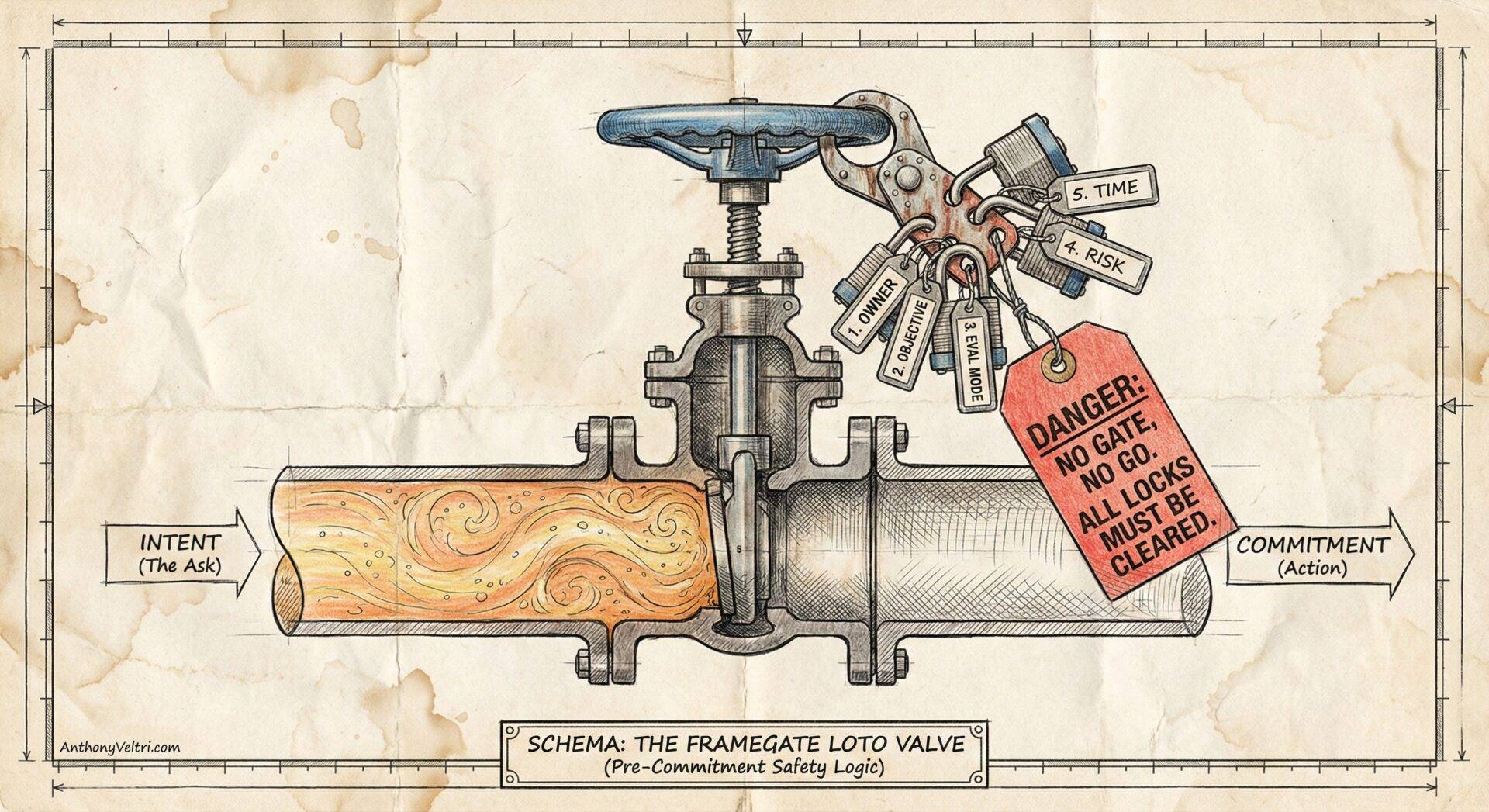
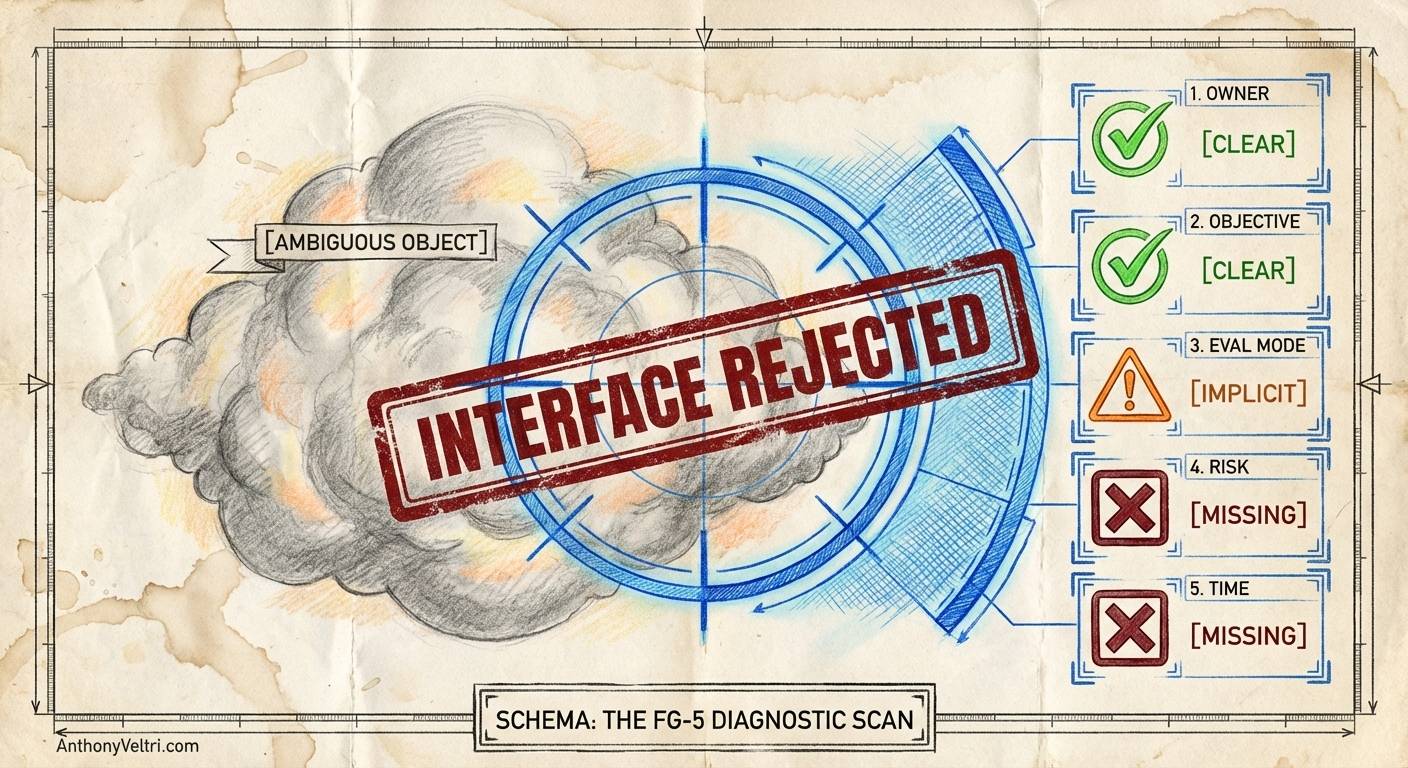
Most downstream failures are frame entry failures, not execution failures. FrameGate enforces five minimal capture tags before commitment: Decision Owner, Objective, Evaluation Mode, Risk Posture, and Time Horizon. If two or more tags are undefined, the only valid action is frame clarification. This prevents helpful people from getting trapped in obligations they never consented to, and it creates instrumented action that RS-CAT can extract patterns from. FrameGate doesn’t slow action. It prevents misaligned action.
Scene: The Project That Never Ended #
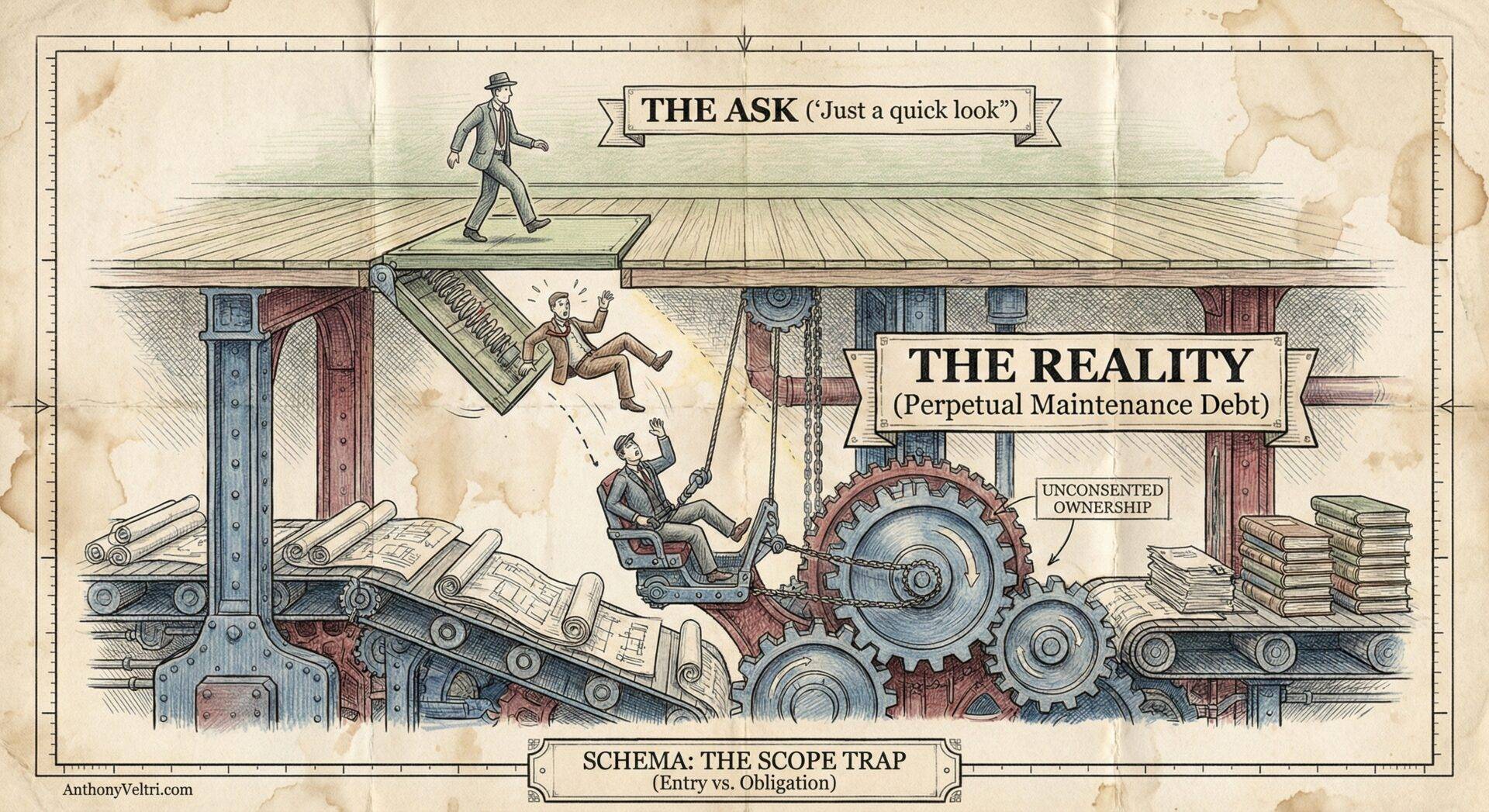
You’re in a meeting. Someone asks if you can “take a quick look” at their integration architecture. You say yes because you’re helpful and you know the domain.
Three weeks later, you’re in a conference room defending design decisions you never made. Six months later, you’re listed as the technical owner in a production runbook. A year later, you’re being asked why the system you “built” doesn’t scale.
You never agreed to build it. You agreed to take a quick look.
What failed wasn’t your execution. What failed was the frame at commitment.
Nobody defined:
- Who owned the decision (you thought you were advising, they thought you were deciding)
- What success looked like (you optimized for correctness, they needed speed)
- Whether this was exploratory or binding (you were workshopping, they were grading)
- Who absorbed the risk (you thought they owned rollback, they thought you did)
- What the time horizon was (you thought “quick look,” they thought “stewardship”)
This is not a communication failure. This is an interface failure.
It happened at commitment, not at execution.
Break: Frame Entry Failures vs. Execution Failures #
Most downstream failures are not execution failures. They are frame entry failures.
The symptoms show up months later:
- You’re being held accountable for decisions you weren’t empowered to make
- You’re delivering durable solutions to disposable problems
- You’re being evaluated against criteria nobody mentioned until the review
- You’re absorbing risk that was never explicitly transferred to you
- You’re discovering ownership gaps only after consequences surface
These failures occurred before action began, but they’re diagnosed as execution problems after damage is done.
FrameGate exists to surface and stabilize frames at the decision interface, before commitment collapses optionality.
Schema: What FrameGate Is (and Is Not) #
FrameGate is NOT: #
- A decision-making framework
- A prioritization method
- A values or ethics system
- A substitute for judgment or experience
- Additional bureaucracy
FrameGate IS: #
- A minimal contract-enforcement mechanism
- A perceptual scaffold applied at the moment of commitment
- A guardrail against role capture and unconsented obligation
- Interface hygiene for high-consequence decisions
FrameGate does not slow action. It prevents misaligned action.
The Problem: Implicit Frames at Decision Interfaces #
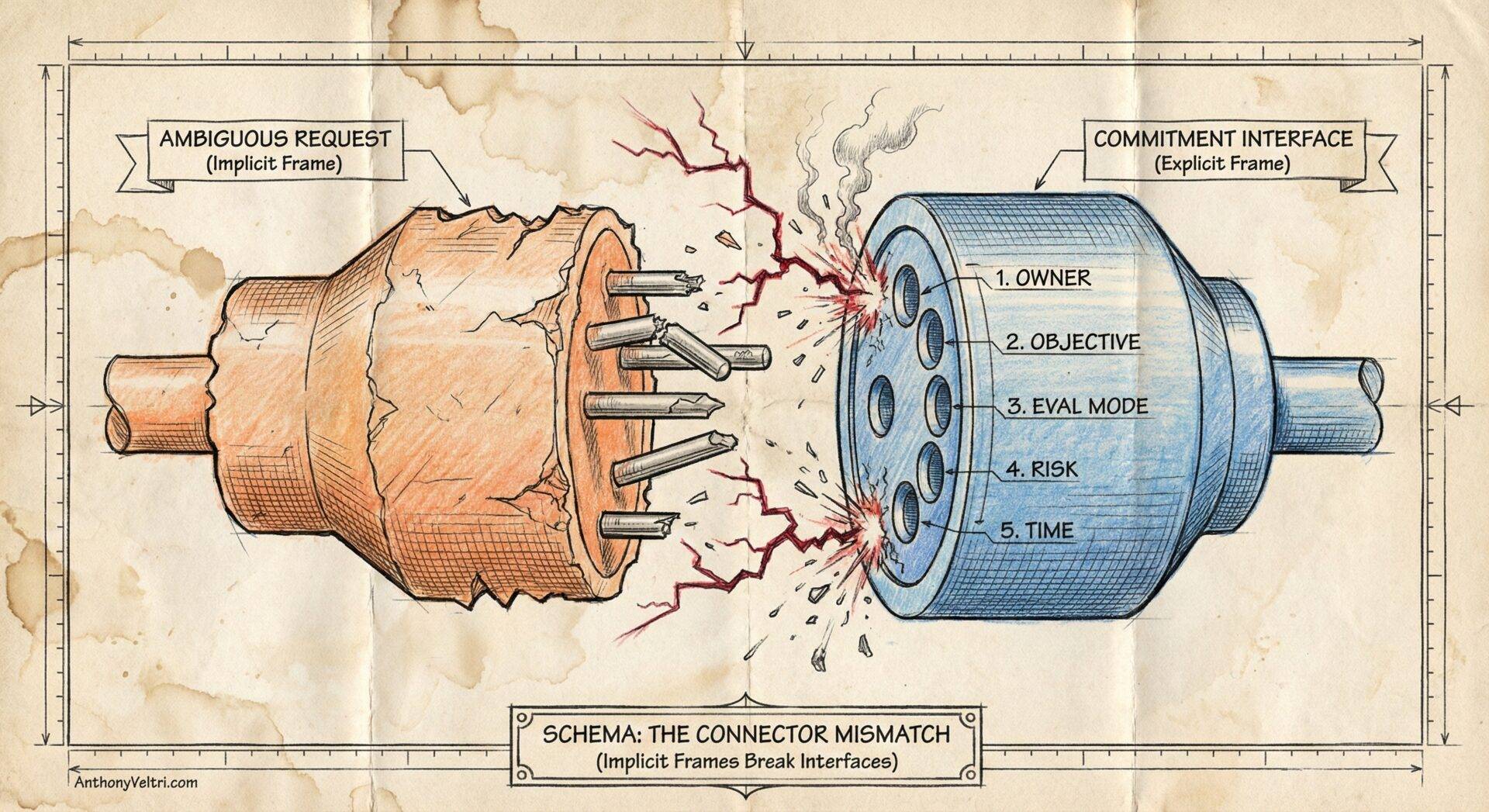
In complex systems, most interfaces fail because the frames on each side don’t match. You think you’re contributing; they think you’re committing. You think you’re exploring options; they think you’re making recommendations. You think you’re helping; they think you’re stewarding.
This applies to both technical systems AND knowledge stewardship:
Technical systems example: You agree to “consult on the data architecture.” Six months later, you’re the designated expert who gets called at 2am when the pipeline breaks.
Knowledge stewardship example: You agree to “share what you know about the last incident.” Next thing you know, you’re listed as the primary subject matter expert and people are scheduling recurring meetings on your calendar to “maintain institutional memory.”
The pattern is identical:
- Ambiguous request
- Helpful response
- Implicit frame mismatch
- Downstream obligation capture
- Late discovery of misalignment
FrameGate prevents this by making frames explicit before you say yes.
Be aware: FrameGate forces leadership to burn strategic ambiguity. Weak leaders will hate this protocol because it removes their ability to shift goalposts later. Expect friction.”
The FrameGate Capture Tags (FG-5) #
FrameGate enforces five capture tags. These are intentionally small, load-bearing, and usable in real time (you can run through all five in under 90 seconds if everyone is aligned, or you can discover in 90 seconds that you’re not aligned and shouldn’t proceed). Important Detail: The diagnostic takes 90 seconds. The resulting negotiation to fix a broken frame may take an hour (or more). But that hour saves you six months of unauthorized stewardship.”
1. Decision Owner #
Who has authority to decide, approve, or veto, and who absorbs consequences if the decision fails.
Not who’s doing the work. Who owns the outcome.
Failure mode when missing: You’re held accountable for decisions you weren’t empowered to make. You have responsibility without authority. You become the “go-to person” by default because nobody else claimed ownership up front.
Example question: “If this goes wrong, whose decision was it?”
2. Objective (One Sentence) #
A single sentence describing what “success” means at this decision altitude.
Not a list of requirements. Not competing success criteria. One sentence that captures what we’re optimizing for.
Failure mode when missing: You discover post-hoc that “success” meant speed but you optimized for accuracy. Or you optimized for correctness but they needed optics. Or you solved the right problem but nobody told you the stakeholder changed.
Example question: “If we could only deliver one outcome, what would make this worth doing?”
3. Evaluation Mode #
Is this a working session or a grading session? Draft or final? Exploratory or binding?
Are we truth-seeking or are we reputation-protecting? Are we building or are we performing?
Failure mode when missing: You truth-optimize in a system that rewards optics. You show rough work in a session that was actually a demonstration to leadership. You treat a working session like a review and withhold useful but incomplete thoughts. You get penalized for honesty in a frame that was actually political.
Example question: “Are we trying to find the best answer, or trying to look good finding an acceptable answer?”
4. Risk Posture #
Is risk shared, retained, or transferred? Is rollback possible?
If this fails, who pays? If we need to reverse course, can we? If this creates downstream obligations, who absorbs them?
Failure mode when missing: You become the shock absorber. You discover you’re the designated failure point for a system designed without rollback capability. You absorb technical debt because nobody clarified that “helping” meant “owning the cleanup forever.”
Example question: “If this breaks in production, who gets the 2am call?”
5. Time Horizon #
Is this a one-off deliverable or a stewardship commitment?
Are we solving a disposable problem or building durable infrastructure? Is this a favor or a responsibility? Is this temporary assistance or permanent ownership?
Failure mode when missing: You say yes to a “quick project” and discover six months later you’re the permanent steward of a system you never agreed to maintain. Long-term maintenance gets disguised as short-term help. You get trapped in obligation you never consented to.
Example question: “When does my obligation end?”
Operational Rule: No Gate, No Go #
If ‘Decision Owner’ is missing, STOP. If any other tag is missing, PAUSE. Do not allow movement without an owner.
This is not obstruction. This is interface hygiene.
You don’t start coding before you know what success looks like. You don’t commit to stewardship before you know the time horizon. You don’t accept evaluation before you know the evaluation mode.
Clarifying frames is faster than repairing frame failures.
FrameGate and RS-CAT: Ex Ante and Ex Post (The Filter vs. The Distiller) #
FrameGate is the ex ante / pre-commitment complement to RS-CAT.
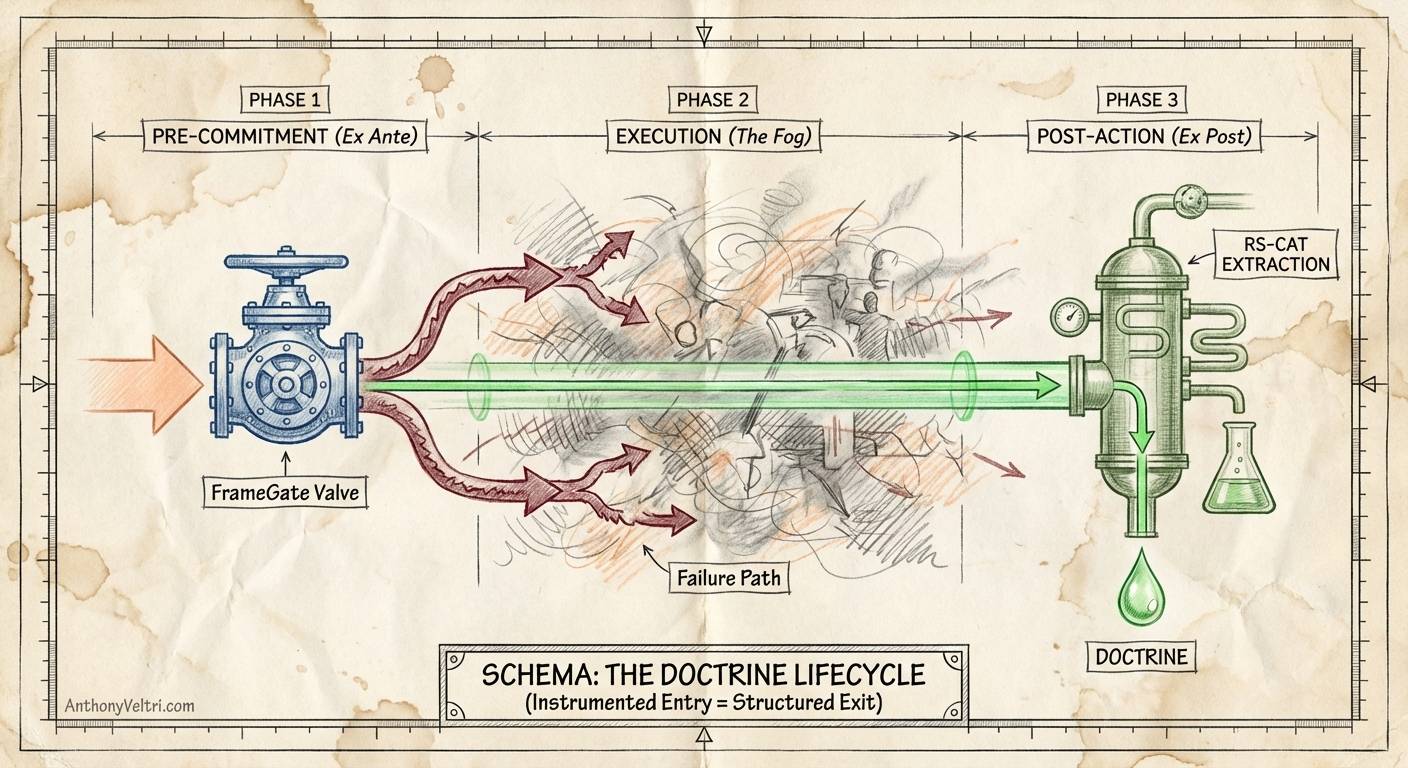
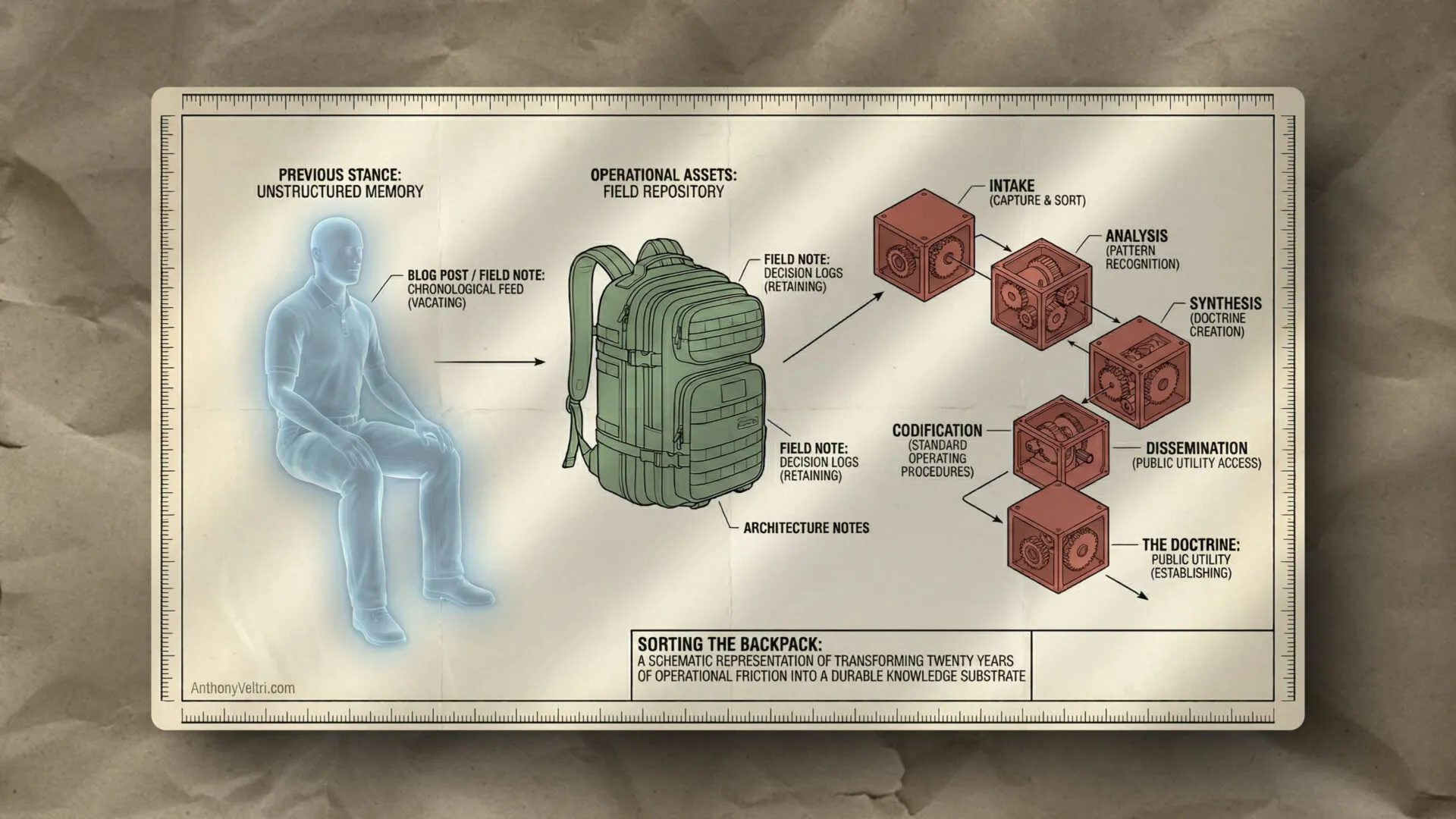
RS-CAT (ex post / post-hoc): Converts chaotic operational recall into structured, teachable patterns after action is complete. It extracts signal from noise after you’ve already lived through the friction.
FrameGate (ex ante / pre-commitment): Prevents entropy at the decision interface before action begins. It instruments your action so the recall is already structured.
How They Connect #
Without FrameGate: You complete a mission. You try to extract lessons learned. You can’t remember what you were optimizing for. You can’t remember who had authority to decide. You can’t remember whether you were supposed to be building a prototype or production infrastructure. RS-CAT has to reconstruct the frame from fragmented recall.
With FrameGate: You complete a mission. The frame was explicit from the start. You know what the objective was (you wrote it down in one sentence). You know who owned the decision (it was documented before commitment). You know what the evaluation criteria were (you clarified them up front). RS-CAT now extracts patterns from instrumented action rather than reconstructing context from chaos.
FrameGate creates instrumented action. RS-CAT extracts portable patterns.
The relationship:
- FrameGate preserves extractable signal by enforcing frame clarity before commitment
- RS-CAT converts that signal into teachable doctrine after action
- Together they enforce contracts on both sides of the interface: before (FrameGate) and after (RS-CAT)
FrameGate improves RS-CAT yield. When you instrument your commitments with FG-5 tags, your post-action recall has structure. You don’t waste RS-CAT cycles reconstructing “what were we even trying to do?” You spend RS-CAT cycles extracting the pattern that made the mission succeed or fail.
Diagnostic Table: Assessing Frame Clarity #
Architected diagnostic table to assess frame clarity states.
Let me create a diagnostic table that helps readers assess frame clarity in real time. This should show what Present, Implicit, and Missing frames look like, plus the consequence of each state.
| Capture Tag | Present (Clear) | Implicit (Assumed) | Missing (Undefined) | Consequence When Missing |
|---|---|---|---|---|
| Decision Owner | Named person with authority | “Leadership will decide” | Unspecified | Distributed accountability, concentrated blame. You get held responsible for decisions you couldn’t make. |
| Objective | One-sentence success definition | Multiple unstated goals | Undefined | Post-hoc goal shifting. You optimized for speed but they wanted accuracy. Or vice versa. Discovered at review. |
| Evaluation Mode | Explicit working vs. grading | Assumed but not stated | Unspecified | Truth-optimized answers in optics-optimized rooms. Career consequences for honesty. |
| Risk Posture | Documented risk ownership | “We’ll figure it out” | Unspecified | You become the shock absorber. Silent risk transfer. You inherit the failure point without consent. |
| Time Horizon | Explicit duration/endpoint | “Just help out for now” | Unspecified | One-off deliverables become permanent stewardship. You’re trapped in maintenance obligations you never agreed to. |
Signal Check: If you can’t fill in the “Present” column for at least three of these tags before committing, you’re operating in implicit-frame territory. That’s where interface failures breed.
Business Case: Why This Matters to Leadership #
FrameGate prevents three expensive patterns that consistently drain organizational capacity:
1. Talent Trap: Competence Becomes Captivity #
Your most capable people get trapped maintaining systems they never agreed to steward. They said yes to “quick help” and ended up owning permanent obligations. FrameGate’s Time Horizon tag surfaces this trap before commitment, allowing explicit negotiation of ongoing responsibilities.
Cost when missing: Your best architects spend 60% of their time maintaining systems they built as “one-off favors” instead of working on strategic initiatives.
2. Optimization Mismatch: Solutions for Wrong Problems #
Deliverables get optimized for unstated criteria, creating expensive rework cycles. The team builds for durability when you needed speed, or for accuracy when you needed optics. FrameGate’s Objective tag forces one-sentence clarity before resources are committed.
Cost when missing: Six-week delivery cycles followed by “this isn’t what we needed” revelations and complete rework.
3. Risk Transfer Without Consent #
Risk gets transferred silently to people who never agreed to absorb it, creating brittle single points of failure. FrameGate’s Risk Posture tag makes ownership explicit, allowing proper resource allocation for risk management.
Cost when missing: Mission-critical systems with no redundancy because the “temporary expert” is now the permanent failure point, and they’re one resignation away from catastrophic knowledge loss.
Leadership value: FrameGate creates instrumented commitments. When decisions fail (and some will), you know who owned the decision, what they were optimizing for, and what constraints they operated under. This enables learning instead of blame distribution.
When NOT to Use FrameGate #
FrameGate is interface hygiene for high-consequence commitments. It’s not needed everywhere.
Skip FrameGate when:
Established relationships with proven patterns: If you’ve worked with this team for three years and the roles, evaluation mode, and time horizons are already well-understood through repeated successful interactions, explicit framing is redundant. Pattern recognition beats protocol.
Routine operations with clear precedent: If this is the 47th time you’re running the quarterly report using documented procedures with known ownership, you don’t need to re-establish the frame. The frame is already load-bearing.
True emergencies requiring immediate action: If the building is on fire, you don’t run FrameGate checks before grabbing the extinguisher. Some situations genuinely require “act now, clarify later.” But these are rarer than people claim.
Exploratory conversations with zero commitment: If you’re genuinely just talking through ideas with no decision pending and no action imminent, FrameGate is premature. The conversation itself will surface whether frames need clarification.
Low-consequence decisions with fast feedback loops: If the decision is easily reversible, low-cost, and provides rapid feedback (like choosing which documentation tool to trial for a week), the cost of frame clarification exceeds the cost of getting it wrong.
The test: If the worst-case failure mode is “wasted afternoon” rather than “trapped in multi-year obligation,” you probably don’t need FrameGate.
However: Watch for situations that look low-consequence but aren’t. “Quick favor” requests from leadership often carry hidden time horizons. “Temporary assignments” often become permanent. When in doubt, run the tags. Ninety seconds of clarification prevents months of misalignment.
Field notes and examples #
Last Updated on February 22, 2026