Doctrine Claim: Knowledge transfer in mission-critical environments is a process of signal extraction, not information dumping. The RS-CAT Framework is the specific methodology used to bypass the “Expert Blind Spot,” the psychological reality where a practitioner cannot see the architecture of their own expertise while operating inside it. By re-indexing unstructured event data into pedagogical logic, we transform tacit operational knowledge into explicit, transferable doctrine.
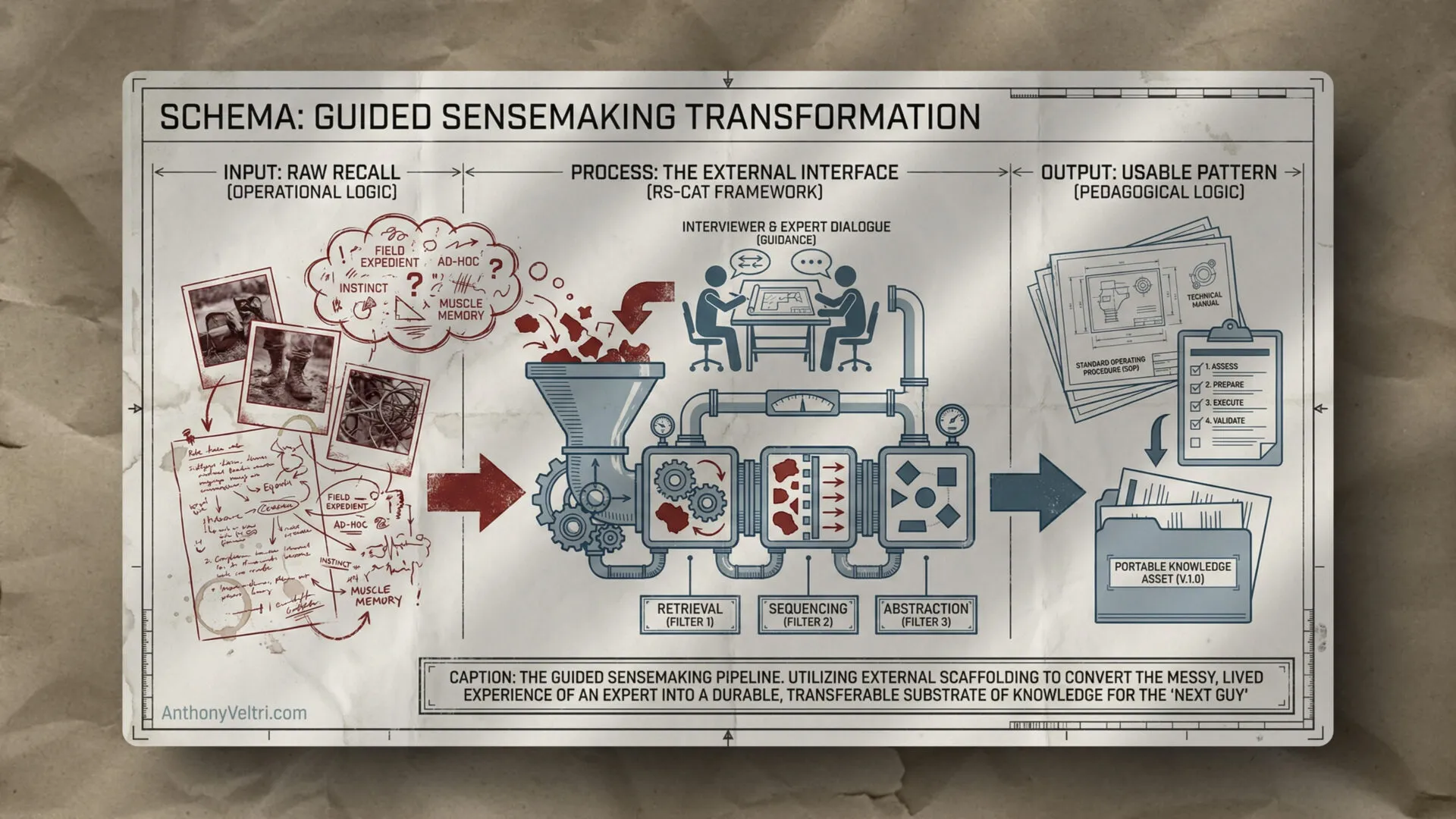
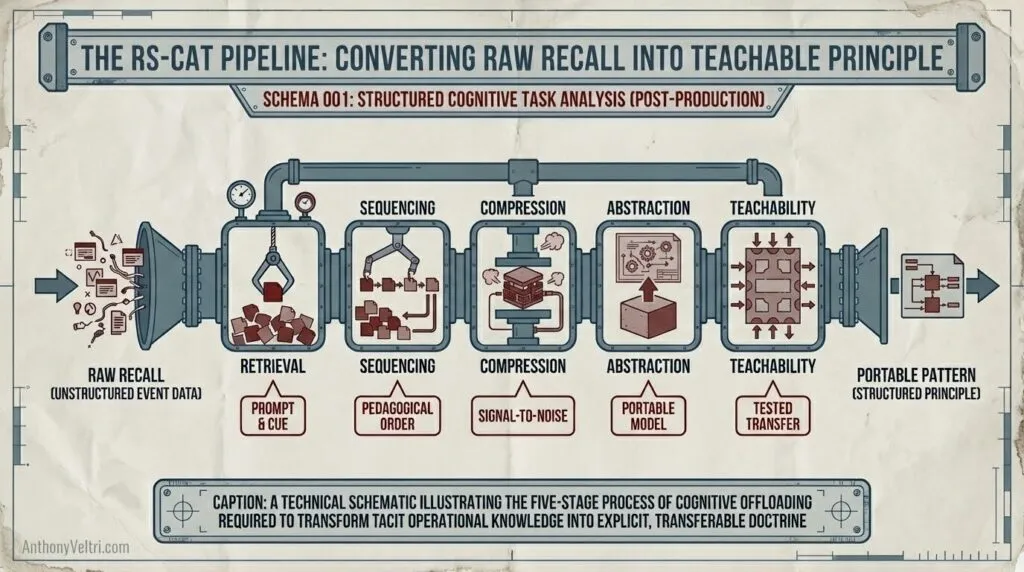
The RS-CAT Framework is the technical process of converting raw, lived experience into a durable substrate of knowledge. It is the specific methodology used to bypass the “Expert Blind Spot.” This is the psychological reality where a practitioner cannot see the architecture of their own expertise because they are too busy using it to survive the mission.
The pipeline converts Raw Recall (which is often chaotic and trapped in operational logic) into Usable Patterns (which are pedagogical and portable). The framework consists of the following steps: Retrieval, Sewuencing, Compression, Abstraction, and finally Teachability/Transfer. We abbreviate it as RS-CAT.
The Problem: The Expert Blind Spot #
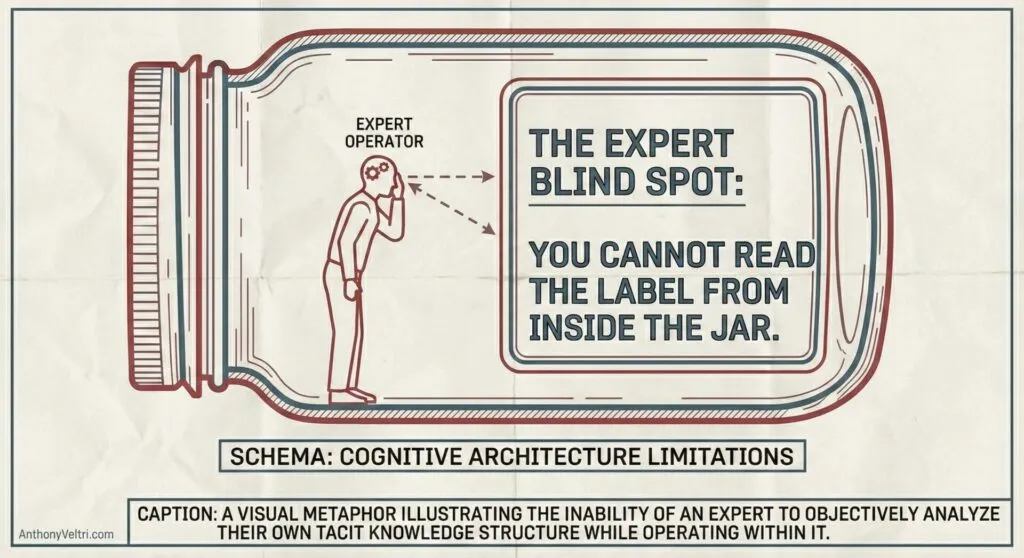
True expertise often feels like intuition, but it is actually a high-resolution mental model operating at high tempo. This creates a barrier for the “Next Guy”:
- The Jar Principle: As the saying goes, “You cannot read the label from inside the jar.” An expert is too focused on the mission to objectively analyze the structure of their own capability.
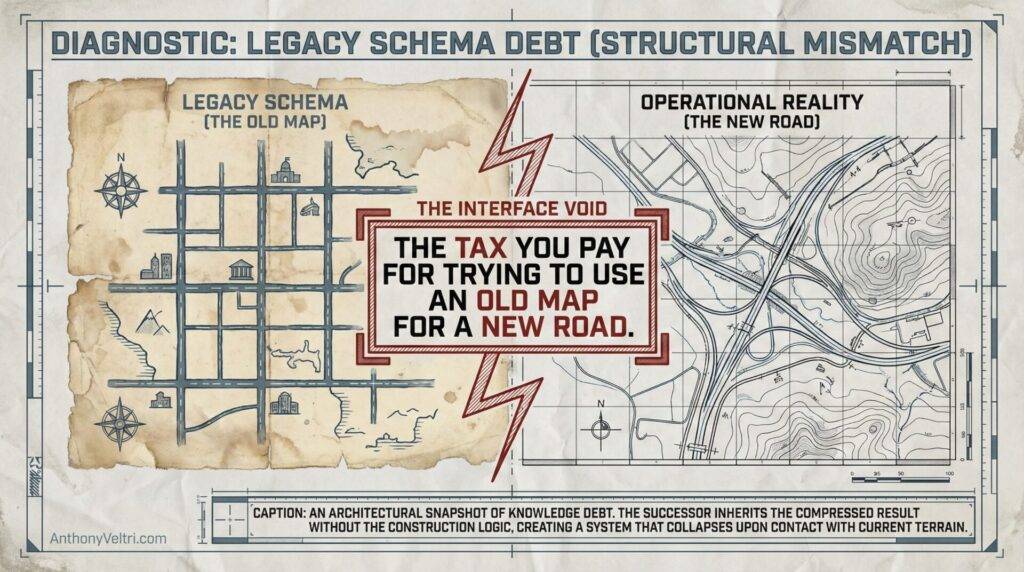
- Legacy Schema Debt: Without a formal process to extract the why and the how, we leave behind “Compressed” results without the “Construction” logic, forcing successors to guess at our reasoning.
RS-CAT in Context: Ex Post / Post-Hoc vs Ex Ante / Pre-Commitment Knowledge Work #
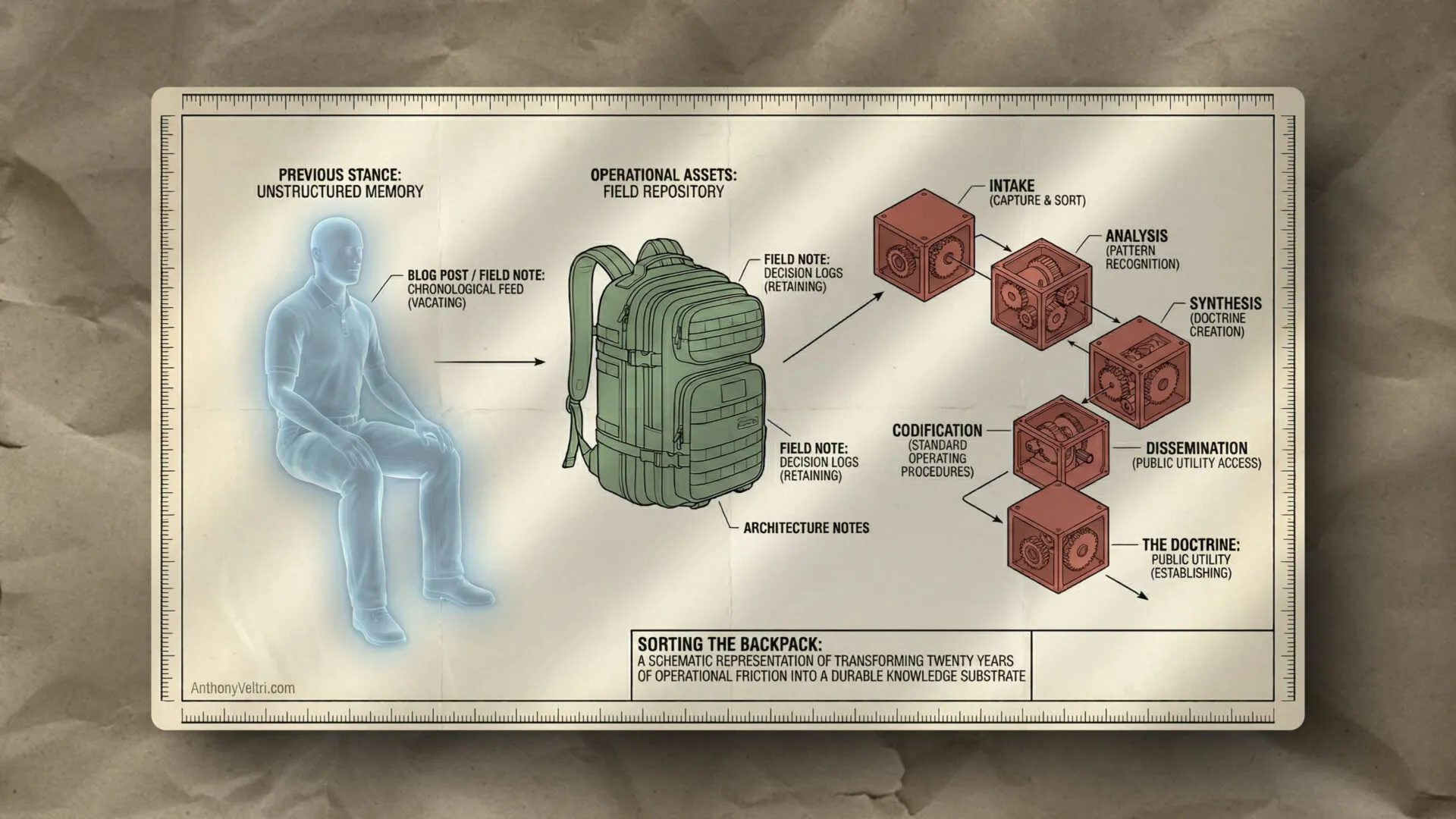
RS-CAT operates ex post (post-hoc): it converts chaotic operational recall into structured, teachable patterns after action is complete. It extracts signal from noise after you have already lived through the friction.
This positions RS-CAT in a temporal pairing with FrameGate, which operates ex ante (pre-commitment): it prevents entropy at the decision interface before action begins. FrameGate instruments your action so the recall is already structured when you need to extract it later.
The Temporal Relationship #
Ex Post / Post-Hoc (RS-CAT):
- Applied after operational experience accumulates
- Converts existing chaotic recall into teachable patterns
- Addresses the Expert Blind Spot through systematic extraction
- Recovers signal from unstructured memory
- Failure mode when missing: Knowledge dies when expert leaves. Successors repeat failures that predecessors learned to avoid.
Ex Ante / Pre-Commitment (FrameGate):
- Applied before decisions are made
- Structures future recall at the moment of action
- Instruments decision-making to preserve extraction-ready data
- Pre-commits to capture criteria before outcome is known
- Failure mode when missing: You discover post-hoc that “success” meant speed but you optimized for accuracy. Or you optimized for correctness but they needed optics. Or you solved the right problem but nobody told you the stakeholder changed.
Why Both Matter #
RS-CAT and FrameGate address different failure modes in knowledge work:
RS-CAT solves the Legacy Schema Debt problem: Operational knowledge trapped in expert’s head, inaccessible to successors. Without systematic extraction, the Next Guy inherits compressed results without construction logic.
FrameGate solves the Retrospective Interpretation Drift problem: Success criteria change after action completes, but without pre-commitment record, you cannot prove what the original mission was. Stakeholders redefine “success” to match whatever happened, erasing the decision architecture.
Used together: FrameGate creates extraction-ready data structures during operations. RS-CAT then converts that structured recall into portable doctrine. The combination preserves both what happened (FrameGate’s instrumentation) and what it means (RS-CAT’s pattern extraction).
Practical Application #
If you have no structured operational data:
Start with RS-CAT alone. Extract what you can from memory, accept some signal loss, build teachable patterns from imperfect recall. This is recovery mode – better than losing everything.
If you are planning new operations:
Implement FrameGate first. Pre-commit to what constitutes success, instrument decision points, preserve the decision architecture as it happens. Then apply RS-CAT later to extract patterns from the structured data. This is optimal mode – maximum signal preservation.
If you have existing operations and can influence future ones:
Apply RS-CAT to past experience (extract what’s recoverable), implement FrameGate for current/future work (prevent further loss), then re-apply RS-CAT to FrameGate-instrumented operations later (extract high-fidelity patterns). This is transition mode – stop the bleeding, then optimize.
The Stewardship Obligation #
Both frameworks serve the same ultimate purpose: preventing organizational memory loss.
RS-CAT (ex post / post-hoc) addresses the question: “How do I transfer what I know before I leave?”
FrameGate (ex ante / pre-commitment) addresses the question: “How do I preserve decision context so future extraction is possible?”
Together, they form a complete knowledge stewardship system: capture the decision architecture in real-time, then systematically extract the teachable patterns after sufficient operational experience accumulates.
RS-CAT Pipeline: Canonical Definitions #
R: Retrieval: Extracting the Signal #
Retrieval is the act of pulling a memory forward through the use of specific prompts, cues, and constraints. It is not an exhaustive history. Instead, it is a surgical extraction of the pieces that matter for a specific teaching objective. The goal is to distinguish between Operational Detail (the context you needed to survive the event) and Transferable Principle (the pattern the learner needs to absorb).
S: Sequencing: The Logic of the Learner #
Sequencing is the process of reordering information to match Pedagogical Logic (how humans learn) rather than Operational Logic (the chronological order of how it happened). An expert experienced the event linearly, but a learner needs the pattern structured as: Context, Friction, Choice, Consequence, and Takeaway. This re-indexing is what allows the knowledge to move from “My Story” to “A System.”
C: Compression: Optimizing the Signal-to-Noise Ratio #
Compression identifies the Minimum Viable Detail required to preserve the authenticity of the event without overwhelming the learner’s working memory. Experts often include “contextual noise” because they remember every detail as being vital at the time. Compression serves as a form of cognitive offloading for the recipient. It ensures that the “pixels” of the story do not obscure the “dragon” of the pattern.
A: Abstraction: The Balance of Texture #
Abstraction extracts the underlying rule while maintaining enough texture to make it believable and applicable. This stage is the balance point. If the information is too abstract, it becomes “Consultant-speak” (disconnected from reality). If it is too concrete, it remains an “Anecdote” (trapped in a single context). A successful abstraction is a portable model grounded in real consequence.
T: Teachability: Ensuring Portability #
Teachability is the final conversion of the expertise into a format that someone else can apply in their own domain. This involves identifying the Dynamic Variables (things that can change, such as scale or resources) and the Fixed Pattern (the logic that holds true regardless of the environment). This is the stage where the information officially becomes Doctrine.
3. Abstraction vs. Construction #
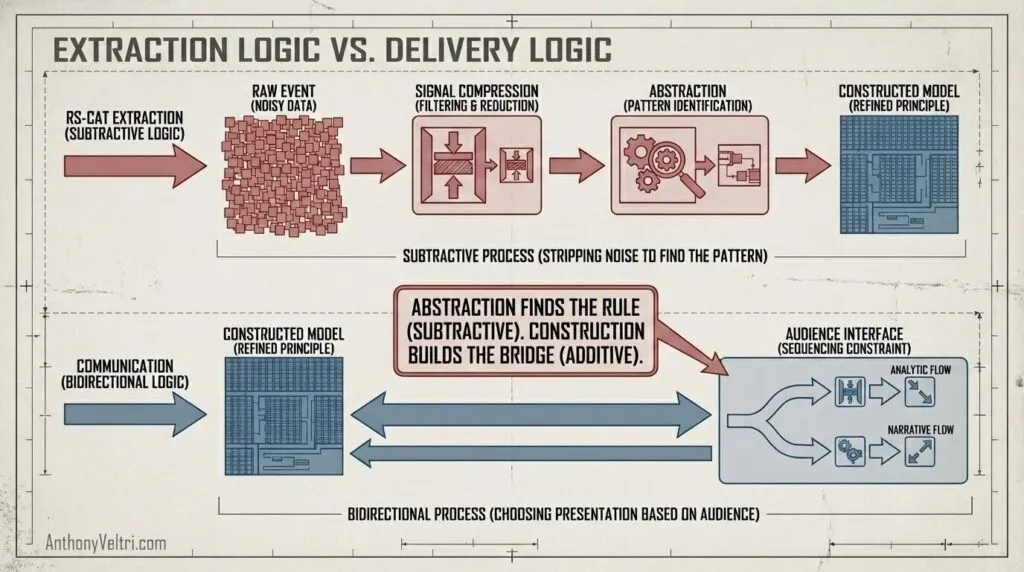
While deeply related, these two moves happen in opposite directions:
- Abstraction (Subtractive): The RS-CAT move. Stripping context to isolate the rule.
- Construction (Additive): The Pedagogical move. Building the mental scaffold (the checklist, the figure, the label) so a learner can carry the rule.
The Mission Architect’s Path: We compress reality to find the signal (Extraction), abstract the rule, and then construct the teachable model. This ensures the doctrine is grounded in the Durable Substrate of real world results.
4. Doctrine Diagnostic: The Signal Check #
| Phase | Purpose | Failure Mode |
| Retrieval | Isolate Signal | Data Dump/Noise |
| Sequencing | Learner Logic | Chronological “Story” |
| Compression | Cognitive Offloading | Working Memory Overload |
| Abstraction | Rule Discovery | Trapped in Anecdote |
| Teachability | Domain Portability | “Consultant-speak” |
Field notes and examples #
- Why Ledger/Visibility Collapse is everywhere in 2026
- Regime Recognition and the Cost of Asymmetric Errors: When Post-Hoc Learning Beats Theory-First
- The Loudest Listener: When Interviews Become Something Else
- Field Note: Guided Sensemaking Interview
- Field Notes: Why Facts Don’t Change Minds: Motivation And Story Frameworks For Leaders
Last Updated on February 22, 2026