Skip to content

Introduced by a trusted connector?

Start Here

Anthony Veltri

  • Doctrine
    • Doctrine Library
    • Global Library
  • Field Notes
  • Routes
    • Route 01: When the Interface Is Breaking (and you are becoming the patch)
    • ROUTE 02: If decisions stall and meetings go nowhere, start here
    • ROUTE 03: If you have lots of projects but no portfolio clarity, start here
    • ROUTE 04: If you’re confused about federation vs integration, start here
    • ROUTE 05: If heroics are propping up your system, start here
    • ROUTE 06: If you cannot force compliance across partners, start here
    • ROUTE 07: If compliance exists but commitment does not, start here
    • ROUTE 08: If disconnected workflows create audit anxiety, start here
  • Figure Library
  • FAQ
  • About
    • Capability Statement
    • Interpreter Kit
  • Contact
Anthony Veltri

Architecture & Interfaces

15
  • Doctrine 01: Federation vs Integration in Mission Networks
  • Doctrine 03: Interfaces Are Where Systems Break, So They Require Stewards, Contracts, and Ownership
  • Doctrine 04: Useful Interoperability Is the Goal, Not Perfect Interoperability
  • Doctrine 05: Innovation Must Live at the Edge, Not in the Center
  • Doctrine 06: A Two-Lane System Protects Stability and Enables Evolution
  • Doctrine 14: Technical Debt Is a Leadership Signal, Not a Coding Failure
  • Doctrine 15: Architecture Must Accelerate Teams, Not Bottleneck Them
  • Doctrine 17: Architects Translate Strategy Into Engineering and Engineering Into Strategy
  • Doctrine 20: Golden Datasets: Putting Truth In One Place Without Pretending Everything Is Perfect
  • Doctrine 21: Zero Trust Is A Trust Model, Not A Card “Type”
  • Doctrine 23: Loop Closure as Load-Bearing System Infrastructure
  • ANNEX B. Data Contracts
  • ANNEX C. Interface Ownership Model
  • ANNEX H. Architecture Doctrine
  • Annex L: The Rosetta Stone for Data Teams: Bridging the Gap Between Technicians and Executives

Decision Tempo & Governance

10
  • Doctrine 02: Distributed Decisions Increase Alignment, Speed, and Resilience
  • Doctrine 07: Clear Intent Matters More Than Perfect Data
  • Doctrine 08: Clear Intent Compresses Ambiguity, Reduces Conflict, and Accelerates Action
  • Doctrine 09: Decision Drag Is the Enemy of Mission Tempo. Architecture Is the Remedy
  • Doctrine 10: Degraded Operations Are the Normal Mode, Not the Exception
  • Doctrine 11: Preventive Action and Contingent Action Must Both Be Designed Intentionally
  • Doctrine 22: When “It Depends” Is the Right Answer: How to Think in Probabilities Under Uncertainty
  • ANNEX D. Decision Altitudes Model
  • ANNEX E. Prevention–Contingency Matrix
  • ANNEX I. High Visibility Workflows

Portfolio & Alignment

4
  • Doctrine 16: Portfolio Thinking Ensures Effort Aligns With What Actually Matters
  • ANNEX F. Pattern Library
  • ANNEX J. System Evolution and Drift Management
  • ANNEX K. System and Workflow Profiles (Case Studies)

Leadership & Human Systems

6
  • Doctrine 24: Stewardship Places the Burden on the Steward, Not the Parties
  • Doctrine 18: Commitment Outperforms Compliance in High Trust, High Tempo Environments
  • Doctrine 19: Supervision, Management, and Leadership Are Three Different Jobs. Confusing Them Breaks Systems
  • Doctrine 23: Loop Closure as Load-Bearing System Infrastructure
  • ANNEX A. Human Contracts
  • ANNEX G. Leadership Doctrine

Resilience & Operations

3
  • Doctrine 24: Stewardship Places the Burden on the Steward, Not the Parties
  • Doctrine 12: Resilience Is an Emergent Property, Not a Feature
  • Doctrine 13: Problem Solving Requires Finding the Real Deviation and the Relevant Change

Doctrine Companions

7
  • Doctrine 03 Companion: The RS-CAT Framework: Converting Raw Recall into Teachable Principle
  • Doctrine 03 Companion: The Interface Void
  • Doctrine 11 Companion: Agency vs. Outcome
  • Doctrine 09 Companion: Artifacts Over Adjectives
  • Doctrine 03 Companion: Constraints: bidirectional translation: Compression vs Construction
  • Doctrine 10 Companion: Span of Control and Cross Training Are Load-Bearing Constraints
  • Doctrine 21 Companion: Claims, Roles, and Entitlements in Microsoft 365

Field Reports

1
  • Field Report: College Financing and the 5-Year Home Runway
View Categories
  • Home
  • Doctrine & Supporting Guides
  • Doctrine Companions
  • Doctrine 10 Companion: Span of Control and Cross Training Are Load-Bearing Constraints

Doctrine 10 Companion: Span of Control and Cross Training Are Load-Bearing Constraints

Anthony Veltri
Updated on December 12, 2025

2 min read

TLDR (Read This First) #

Organizations fail when they expect humans to track, decide, and support more than their cognitive limits allow.

Most people can reliably manage three to seven direct relationships, decisions, or workstreams. Beyond that, performance degrades and risk rises.

Span of control and cross training are not management preferences.
They are human constraints that must be designed for.

If a system collapses when one person is unavailable, the system is fragile, not efficient.


Why This Matters #

Many organizations assume that overload can be solved with:

  • Better leadership
  • More effort
  • Stronger accountability
  • “Stepping up”

None of these change human cognitive limits.

When span of control is exceeded and cross training is absent, systems do not fail loudly. They fail quietly through delay, burnout, missed signals, and heroics.
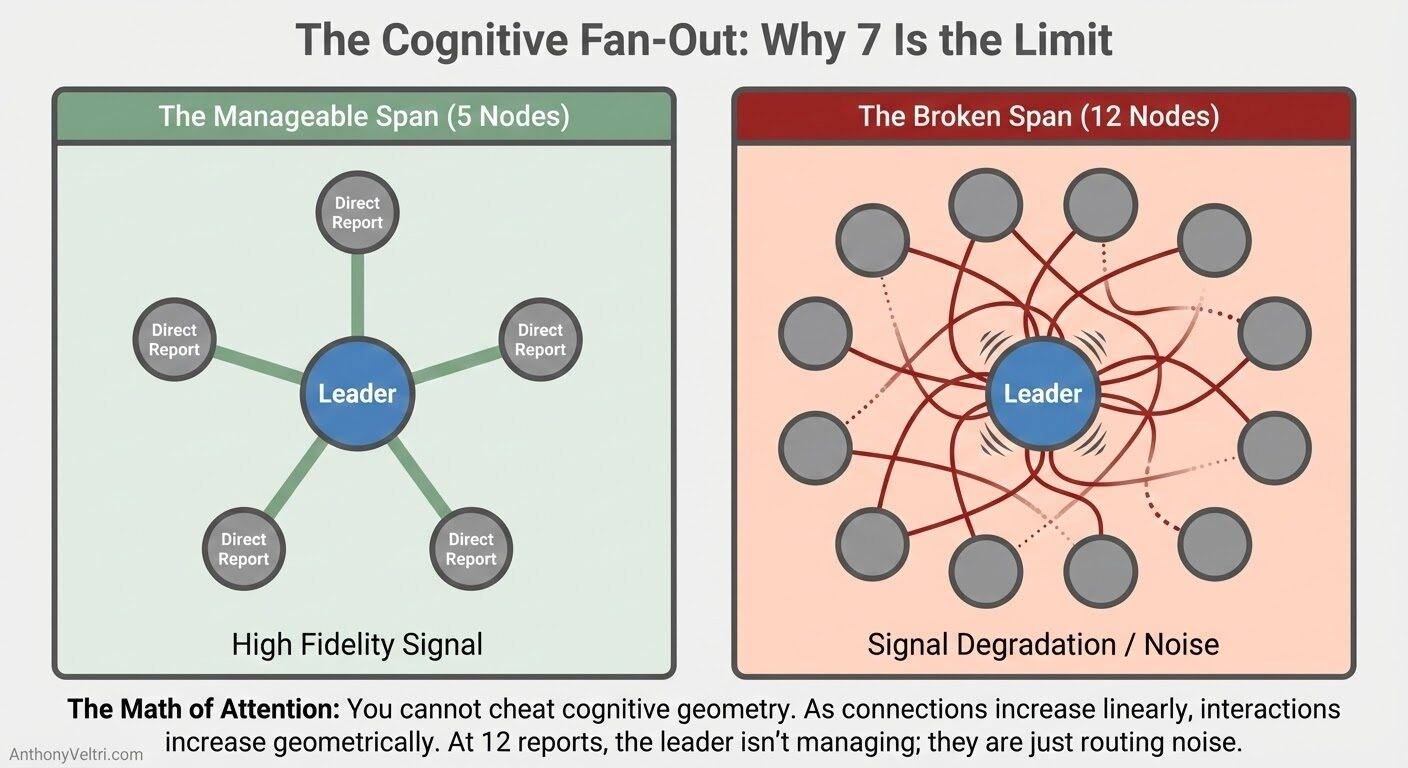
This diagram illustrates how smaller, clear connections support high-fidelity signals, while larger, tangled spans may introduce noise.
The Math of Attention: You cannot cheat cognitive geometry. As connections increase linearly, interactions increase geometrically. At 12 reports, the leader isn’t managing; they are just routing noise.

Span of Control (The Constraint) #

Span of control is the number of people, decisions, or workstreams a single human can reliably track, prioritize, and support.

Operational disciplines such as fire, aviation, emergency response, and systems engineering converge on the same range:

Approximately three to seven direct relationships.

Beyond this:

  • Memory becomes unreliable.
  • Exceptions are missed.
  • Decisions bottleneck upward.
  • Leaders appear informed but are not.
  • Subordinates wait instead of acting.

This is not a leadership flaw.
It is a biological and cognitive limit.


What Happens When Span of Control Is Ignored #

Systems that exceed span of control without redesign show predictable patterns:

  • One person becomes the invisible buffer.
  • Absence causes disproportionate disruption.
  • “Just one more thing” becomes permanent.
  • Decisions migrate upward under stress.
  • Heroics replace design.
  • Burnout becomes structural.

These are architectural symptoms, not individual failures.


Delegation Is Not Optional #

Once span of control exceeds human limits, delegation is mandatory.

Delegation means:

  • Explicit authority.
  • Clear decision boundaries.
  • Known standards.
  • Trust reinforced by structure, not hope.

Systems that refuse to delegate do not become safer.
They become slower, more brittle, and more political.


Cross Training (What It Is) #
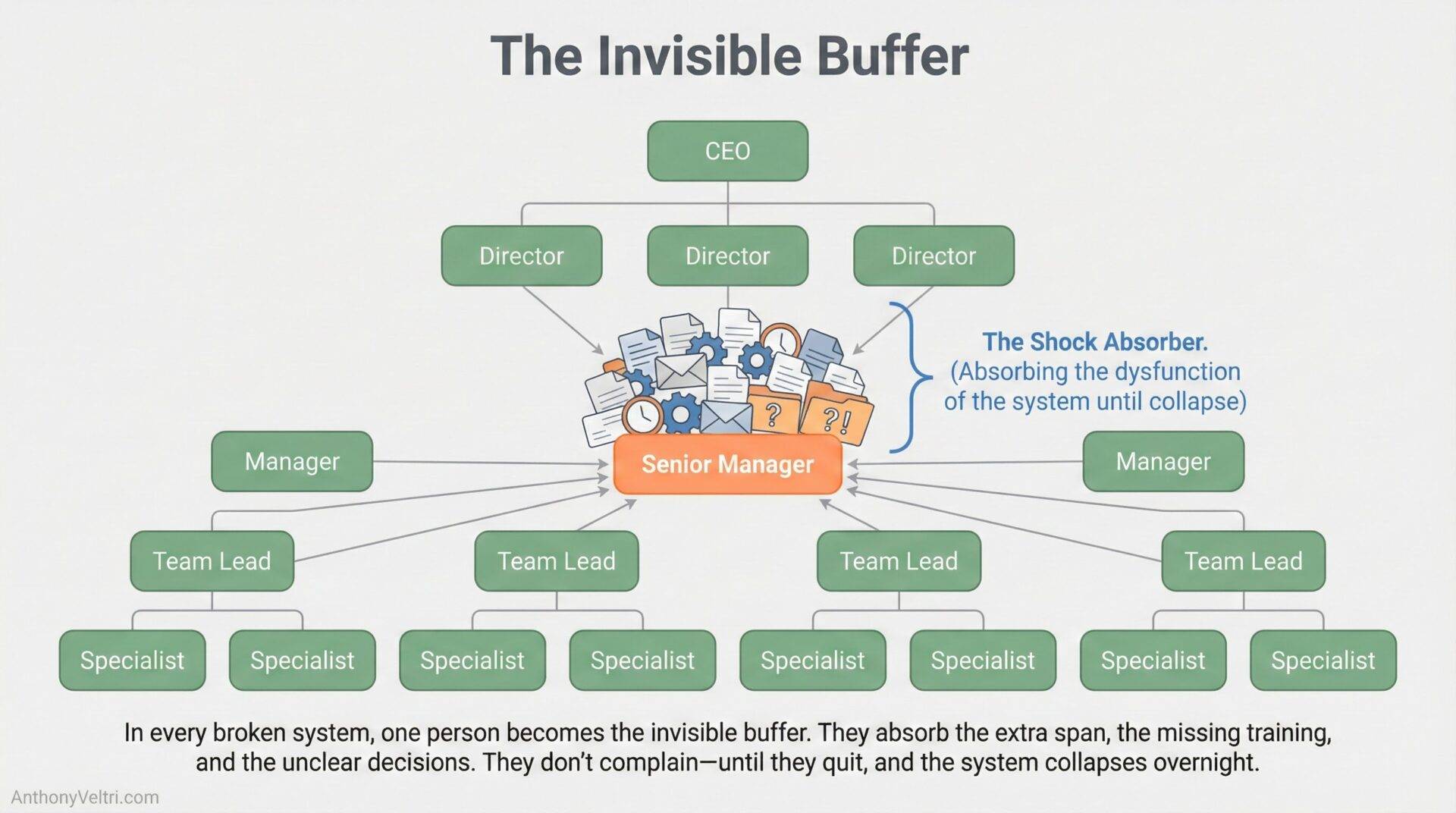
This diagram illustrates how systemic dysfunction may be absorbed at the senior manager level, as seen in this organizational chart.
In every broken system, one person becomes the invisible buffer. They absorb the extra span, the missing training, and the unclear decisions. They don’t complain (until they quit), and the system collapses overnight.

Cross training is not about making everyone do everything.

It is about ensuring that no critical role exists in only one head.

Cross training enables:

  • Continuity during absence.
  • Surge capacity under load.
  • Graceful degradation instead of collapse.
  • Reduced reliance on heroics.

If cross training only exists on paper or “for emergencies,” it does not exist.


Failure Pattern: Heroics as a Substitute for Design #
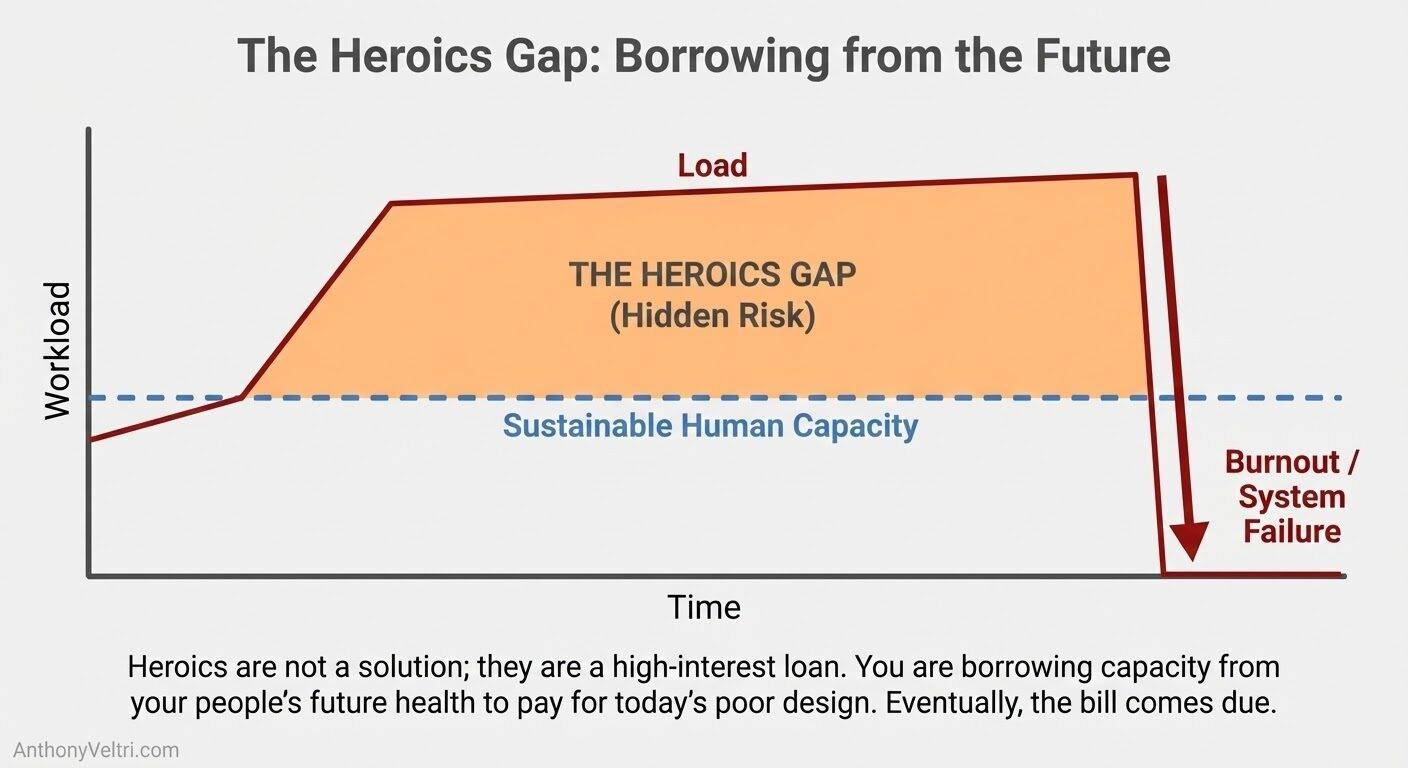
This diagram illustrates workload surpassing sustainable capacity, indicating that reliance on heroics may lead to burnout or failure.
Heroics are not a solution; they are a high-interest loan. You are borrowing capacity from your people’s future health to pay for today’s poor design. Eventually, the bill comes due

Organizations often praise:

  • “Can-do spirit”
  • “We’ll figure it out”
  • “Going the extra mile”

These behaviors are valuable only when:

  • Time-bound
  • Explicitly exceptional
  • Actively paid down afterward

When normalized, they hide risk and consume people instead of solving problems.

Heroics are a warning signal, not a success metric.


Constraint #

If a system cannot tolerate:

  • One person being unavailable, or
  • One leader exceeding seven meaningful direct relationships

without operational degradation, it is not resilient.

It is borrowing capacity from people instead of designing for reality.


Corollary (Compression-First) #

If you cannot lose someone, you have already overloaded them.
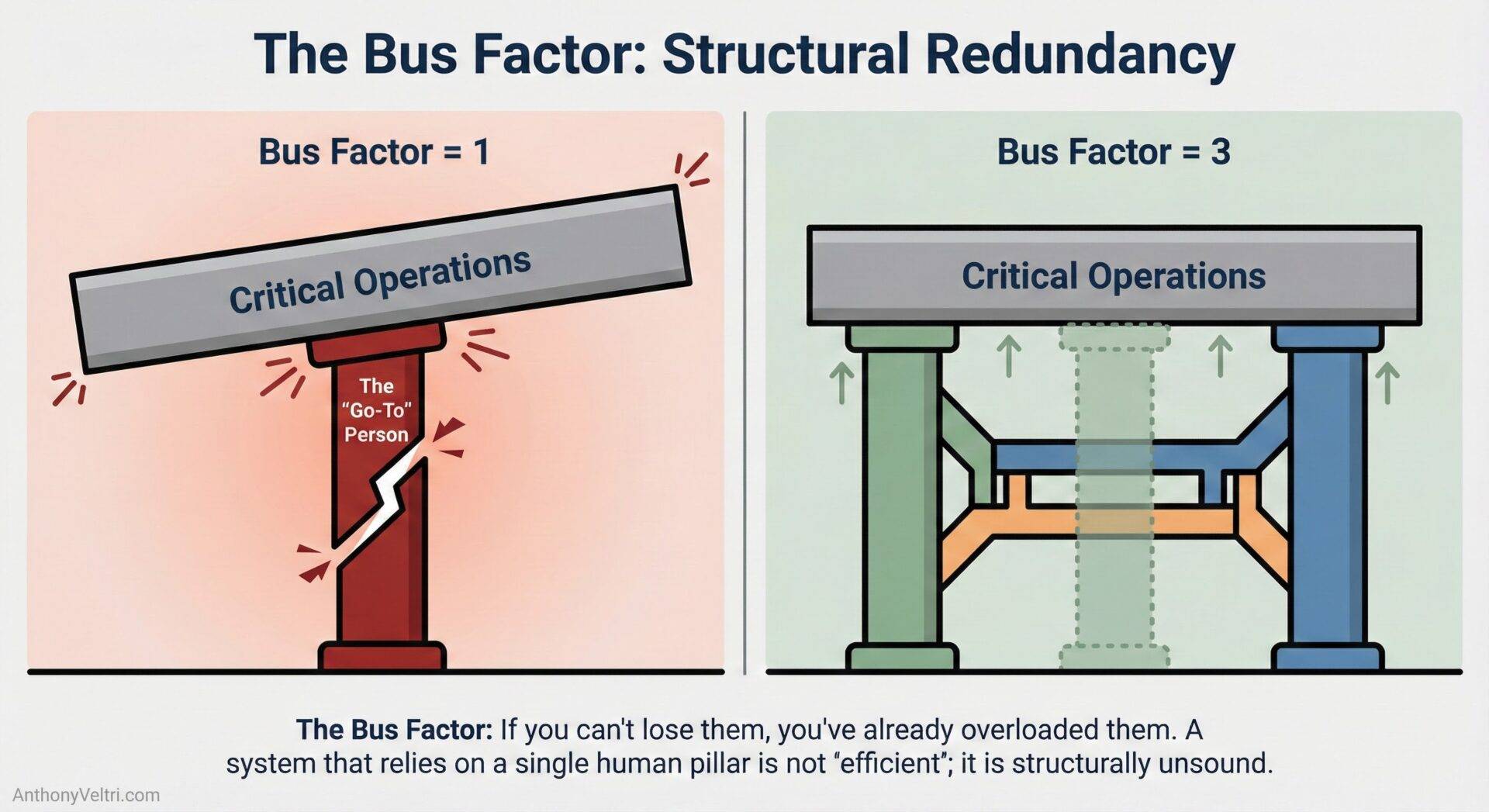
This diagram illustrates how cross-training, depicted by multiple green pillars, can support critical operations with greater stability.
Yep

The “Bus Factor” Metric #

Engineers use a morbid but useful metric called the Bus Factor: The number of team members who can be suddenly lost (hit by a bus, won the lottery, quit) before a project stalls or collapses.

  • Bus Factor = 1: If Steve leaves, the system dies. (Critical Risk)
  • Bus Factor = 2+: If Steve leaves, Sarah can keep the lights on. (Resilient)

A Bus Factor of 1 is not “job security.” It is a structural defect. If your organization relies on individuals who cannot be lost, you are not managing a team; you are gambling on their health and loyalty every single day.


Related Doctrines #

  • Degraded Operations Are the Normal Mode, Not the Exception
  • Resilience Is an Emergent Property, Not a Feature
  • Architecture Must Accelerate Teams, Not Bottleneck Them

Last Updated on December 12, 2025

Related Posts #

This slide illustrates the principle that loop closure is structural, as highlighted by the modern, technical design elements.

Doctrine 23: Loop Closure as Load-Bearing System Infrastructure #

This slide illustrates the relationships among claims, roles, and entitlements in Microsoft 365, as presented in Doctrine 21.

Doctrine 21 Companion: Claims, Roles, and Entitlements in Microsoft 365 #

This diagram illustrates increasing salary capacities, with larger houses on higher blocks representing $6k, $24k (median), and $80k per year.

Field Report: College Financing and the 5-Year Home Runway #

An illustrated hand labeled

Regime Recognition and the Cost of Asymmetric Errors: When Post-Hoc Learning Beats Theory-First #

Thinking in Probabilities featured title card

Doctrine 22: When "It Depends" Is the Right Answer: How to Think in Probabilities Under Uncertainty #

ANNEX F Pattern Library" text over a background of interconnected geometric lines, circles, and digital patterns resembling a circuit or network schematic.

ANNEX F. Pattern Library #

Related Docs

  • Doctrine 10: Degraded Operations Are the Normal Mode, Not the Exception
  • Doctrine 12: Resilience Is an Emergent Property, Not a Feature
  • Doctrine 15: Architecture Must Accelerate Teams, Not Bottleneck Them

Leave a Reply Cancel reply

You must be logged in to post a comment.

Table of Contents
  • TLDR (Read This First)
    • Why This Matters
    • Span of Control (The Constraint)
    • What Happens When Span of Control Is Ignored
    • Delegation Is Not Optional
    • Cross Training (What It Is)
    • Failure Pattern: Heroics as a Substitute for Design
    • Constraint
    • Corollary (Compression-First)
    • The "Bus Factor" Metric
    • Related Doctrines

Share This Article :

  • Facebook
  • X
  • LinkedIn
  • Pinterest

Was it helpful ?

  • Happy
  • Normal
  • Sad
  • Privacy Policy
  • Introductions
  • Contact

© 2026 Anthony Veltri

  • Doctrine
    • Doctrine Library
    • Global Library
  • Field Notes
  • Routes
    • Route 01: When the Interface Is Breaking (and you are becoming the patch)
    • ROUTE 02: If decisions stall and meetings go nowhere, start here
    • ROUTE 03: If you have lots of projects but no portfolio clarity, start here
    • ROUTE 04: If you’re confused about federation vs integration, start here
    • ROUTE 05: If heroics are propping up your system, start here
    • ROUTE 06: If you cannot force compliance across partners, start here
    • ROUTE 07: If compliance exists but commitment does not, start here
    • ROUTE 08: If disconnected workflows create audit anxiety, start here
  • Figure Library
  • FAQ
  • About
    • Capability Statement
    • Interpreter Kit
  • Contact