Skip to content

Introduced by a trusted connector?

Start Here

Anthony Veltri

  • Doctrine
    • Doctrine Library
    • Global Library
  • Field Notes
  • Routes
    • Route 01: When the Interface Is Breaking (and you are becoming the patch)
    • ROUTE 02: If decisions stall and meetings go nowhere, start here
    • ROUTE 03: If you have lots of projects but no portfolio clarity, start here
    • ROUTE 04: If you’re confused about federation vs integration, start here
    • ROUTE 05: If heroics are propping up your system, start here
    • ROUTE 06: If you cannot force compliance across partners, start here
    • ROUTE 07: If compliance exists but commitment does not, start here
    • ROUTE 08: If disconnected workflows create audit anxiety, start here
  • Figure Library
  • FAQ
  • About
    • Capability Statement
    • Interpreter Kit
  • Contact
Anthony Veltri

Architecture & Interfaces

15
  • Doctrine 01: Federation vs Integration in Mission Networks
  • Doctrine 03: Interfaces Are Where Systems Break, So They Require Stewards, Contracts, and Ownership
  • Doctrine 04: Useful Interoperability Is the Goal, Not Perfect Interoperability
  • Doctrine 05: Innovation Must Live at the Edge, Not in the Center
  • Doctrine 06: A Two-Lane System Protects Stability and Enables Evolution
  • Doctrine 14: Technical Debt Is a Leadership Signal, Not a Coding Failure
  • Doctrine 15: Architecture Must Accelerate Teams, Not Bottleneck Them
  • Doctrine 17: Architects Translate Strategy Into Engineering and Engineering Into Strategy
  • Doctrine 20: Golden Datasets: Putting Truth In One Place Without Pretending Everything Is Perfect
  • Doctrine 21: Zero Trust Is A Trust Model, Not A Card “Type”
  • Doctrine 23: Loop Closure as Load-Bearing System Infrastructure
  • ANNEX B. Data Contracts
  • ANNEX C. Interface Ownership Model
  • ANNEX H. Architecture Doctrine
  • Annex L: The Rosetta Stone for Data Teams: Bridging the Gap Between Technicians and Executives

Decision Tempo & Governance

10
  • Doctrine 02: Distributed Decisions Increase Alignment, Speed, and Resilience
  • Doctrine 07: Clear Intent Matters More Than Perfect Data
  • Doctrine 08: Clear Intent Compresses Ambiguity, Reduces Conflict, and Accelerates Action
  • Doctrine 09: Decision Drag Is the Enemy of Mission Tempo. Architecture Is the Remedy
  • Doctrine 10: Degraded Operations Are the Normal Mode, Not the Exception
  • Doctrine 11: Preventive Action and Contingent Action Must Both Be Designed Intentionally
  • Doctrine 22: When “It Depends” Is the Right Answer: How to Think in Probabilities Under Uncertainty
  • ANNEX D. Decision Altitudes Model
  • ANNEX E. Prevention–Contingency Matrix
  • ANNEX I. High Visibility Workflows

Portfolio & Alignment

4
  • Doctrine 16: Portfolio Thinking Ensures Effort Aligns With What Actually Matters
  • ANNEX F. Pattern Library
  • ANNEX J. System Evolution and Drift Management
  • ANNEX K. System and Workflow Profiles (Case Studies)

Leadership & Human Systems

6
  • Doctrine 24: Stewardship Places the Burden on the Steward, Not the Parties
  • Doctrine 18: Commitment Outperforms Compliance in High Trust, High Tempo Environments
  • Doctrine 19: Supervision, Management, and Leadership Are Three Different Jobs. Confusing Them Breaks Systems
  • Doctrine 23: Loop Closure as Load-Bearing System Infrastructure
  • ANNEX A. Human Contracts
  • ANNEX G. Leadership Doctrine

Resilience & Operations

3
  • Doctrine 24: Stewardship Places the Burden on the Steward, Not the Parties
  • Doctrine 12: Resilience Is an Emergent Property, Not a Feature
  • Doctrine 13: Problem Solving Requires Finding the Real Deviation and the Relevant Change

Doctrine Companions

7
  • Doctrine 03 Companion: The RS-CAT Framework: Converting Raw Recall into Teachable Principle
  • Doctrine 03 Companion: The Interface Void
  • Doctrine 11 Companion: Agency vs. Outcome
  • Doctrine 09 Companion: Artifacts Over Adjectives
  • Doctrine 03 Companion: Constraints: bidirectional translation: Compression vs Construction
  • Doctrine 10 Companion: Span of Control and Cross Training Are Load-Bearing Constraints
  • Doctrine 21 Companion: Claims, Roles, and Entitlements in Microsoft 365

Field Reports

1
  • Field Report: College Financing and the 5-Year Home Runway
View Categories
  • Home
  • Doctrine & Supporting Guides
  • Doctrine Companions
  • Doctrine 11 Companion: Agency vs. Outcome

Doctrine 11 Companion: Agency vs. Outcome

Anthony Veltri
Updated on December 22, 2025

3 min read

Companion to Numbered Doctrine 11: Preventive and Contingent Action

In a Contact Environment, the system always has a vote. Whether you are managing a fire line, a medical crisis, or a crashing server, reality possesses its own agency and can push back with overwhelming force.

There is a common fallacy (often pushed by those in the Evaluation Environment) that technical mastery guarantees a successful outcome. This is a dangerous misunderstanding of the Operator’s role.
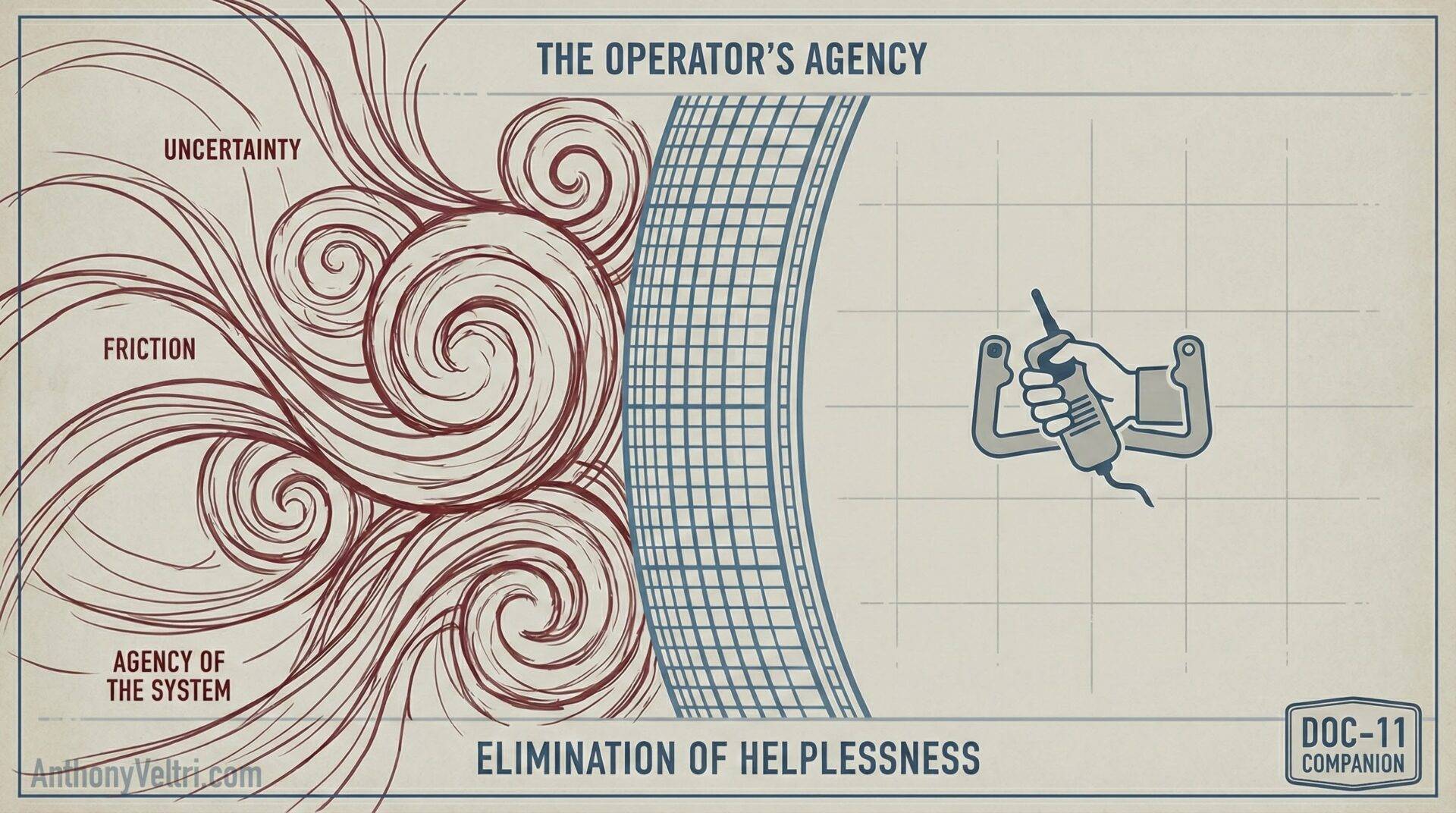
This diagram illustrates the transition from systemic uncertainty and friction to operator agency, highlighting elimination of helplessness.
The transition from systemic uncertainty and friction to operator agency. A successful outcome is never guaranteed, but Technical Mastery and training sure do help.

The Core Distinction #

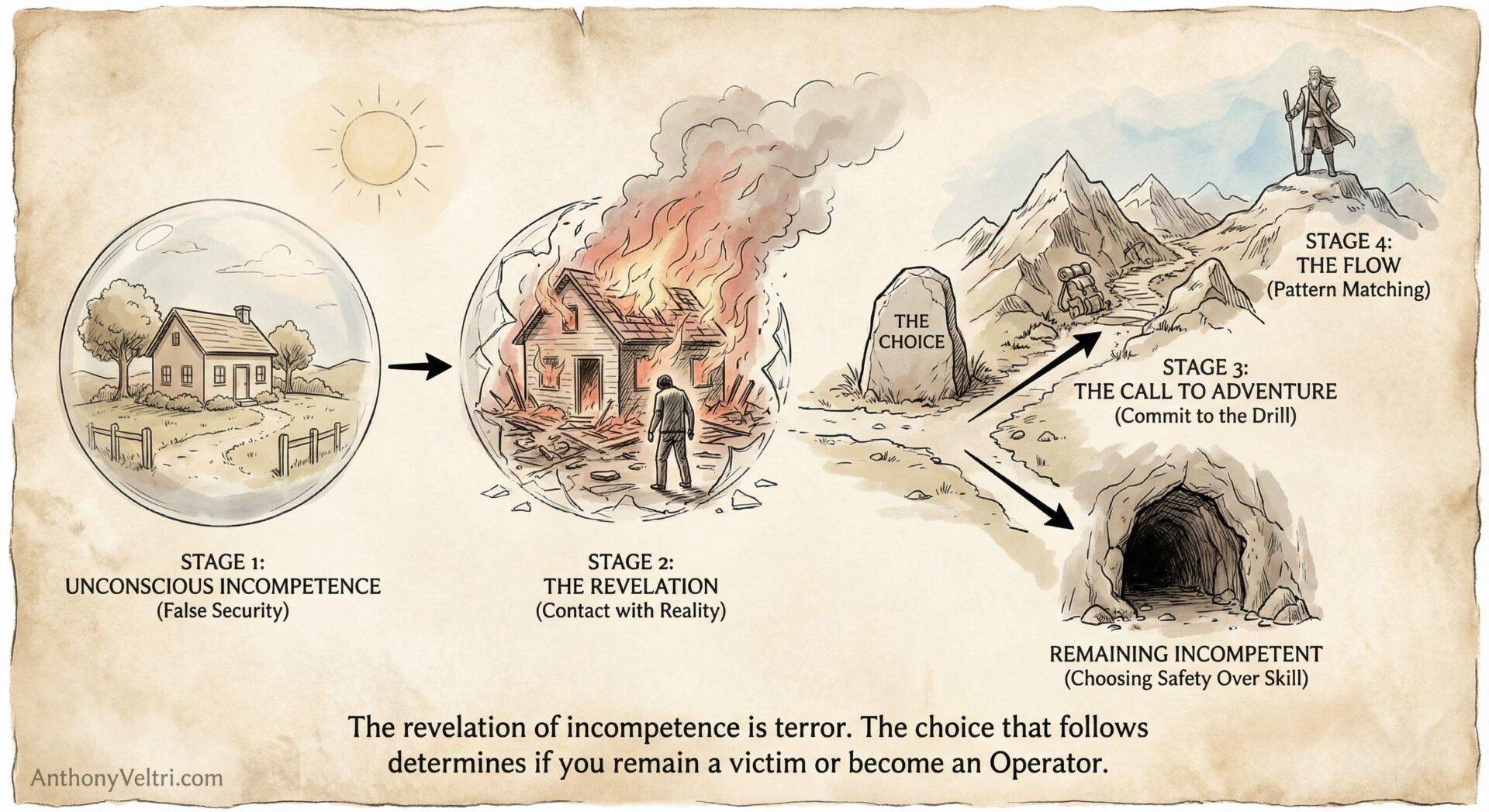
This diagram illustrates a four-stage journey: from safety, through crisis and choice, to the divergent paths of growth or stasis.
A four-stage journey: from safety, through crisis and choice, to the divergent paths of growth or stasis. Most adult learning follows this progression, but the critical point is the level of stakes revealed at Stage 2: The Revelation. There is a fundamental difference between learning a skill for enjoyment and learning one for survival. For example, learning to play the piano for pleasure is a choice of convenience… however, learning CPR because you witnessed a failure and realized you were powerless to help is a response to Contact with Reality.

Taking the Path of the Drill is not a gamble on a “win.” It is a commitment to Agency.

  • Outcome: The final state of the mission (Success or Failure). This is often determined by variables outside of your control: weather, physics, or systemic debt.
  • Agency: Your ability to exert influence over the system at the interface. This is entirely within your control through mastery and preparation.

The Elimination of Helplessness #

The “Terror of Uselessness” experienced during a Stage 2 Revelation is the feeling of having zero agency. It is the realization that you are a spectator to a catastrophe you should be managing.

When you commit to the Stage 3 Drill, you are not buying an insurance policy that ensures you will never “lose.” You are buying the certainty that you will never again be a bystander.

The Operator’s Maxim: You may follow the protocol perfectly and still lose the patient, the airframe, or the network… but you will never stand there useless while it happens.

Why This Matters for Stewardship #

If we frame our work as always “saving the day,” we create Systemic Heroics. We build brittle organizations that break when a “win” isn’t possible. By framing our work as the pursuit of Agency, we build resilient systems. We acknowledge that while we cannot always control the Outcome, we have a Stewardship Obligation to ensure our teams possess the technical mastery to engage the resistance until the very end.


The Divergent Path: The Four Stages of Operational Competence #

Why Technical Mastery is a Response to the Terror of Uselessness #

We (I) do not view learning as a linear progression of credits. We view it as a series of encounters with reality. Most adult learning follows the standard hierarchy of competence… however, in high-consequence environments, these stages are marked by a shift in Decision Altitude and personal risk.

Stage 1: Unconscious Incompetence (The Garden) #

This is the state of theoretical safety. You possess the “Ritual” of the work (degrees, certifications, or academic models) but have not yet faced Contact. In The Garden, you believe your map is the territory because you have never seen the map fail. You are safe because you do not yet know the stakes.

Stage 2: Conscious Incompetence (The Revelation) #

This stage is entered through a catalyst: a bouldering fall, a server crash, or a fire line that jumps the break. It is marked by the “Terror of Uselessness.” You suddenly see the massive gap between your theoretical models and the resisting system in front of you. You are no longer a researcher (you are a spectator to a catastrophe). Many people choose to retreat back to The Garden at this point to avoid the discomfort of this realization.

Stage 3: Conscious Competence (The Drill) #

This is the “Path of the Operator.” You have made a deliberate choice to engage with the friction. You are committing to the Drill (repetition, field academies, and EMT training) to bridge the gap found in Stage 2. The work here is slow and deliberate. You are not yet “fast,” but you are no longer a bystander. You have traded the comfort of ignorance for the burden of Agency.

Stage 4: Unconscious Competence (The Flow) #

This is the state of mastery where the system becomes an extension of the operator. In The Flow, you are managing energy, physics, and resistance without active deliberation. You have moved past the kata of the drill into the reality of the mission. You still face System Resistance, but you possess the “stick and rudder” skills to maintain uptime under pressure.
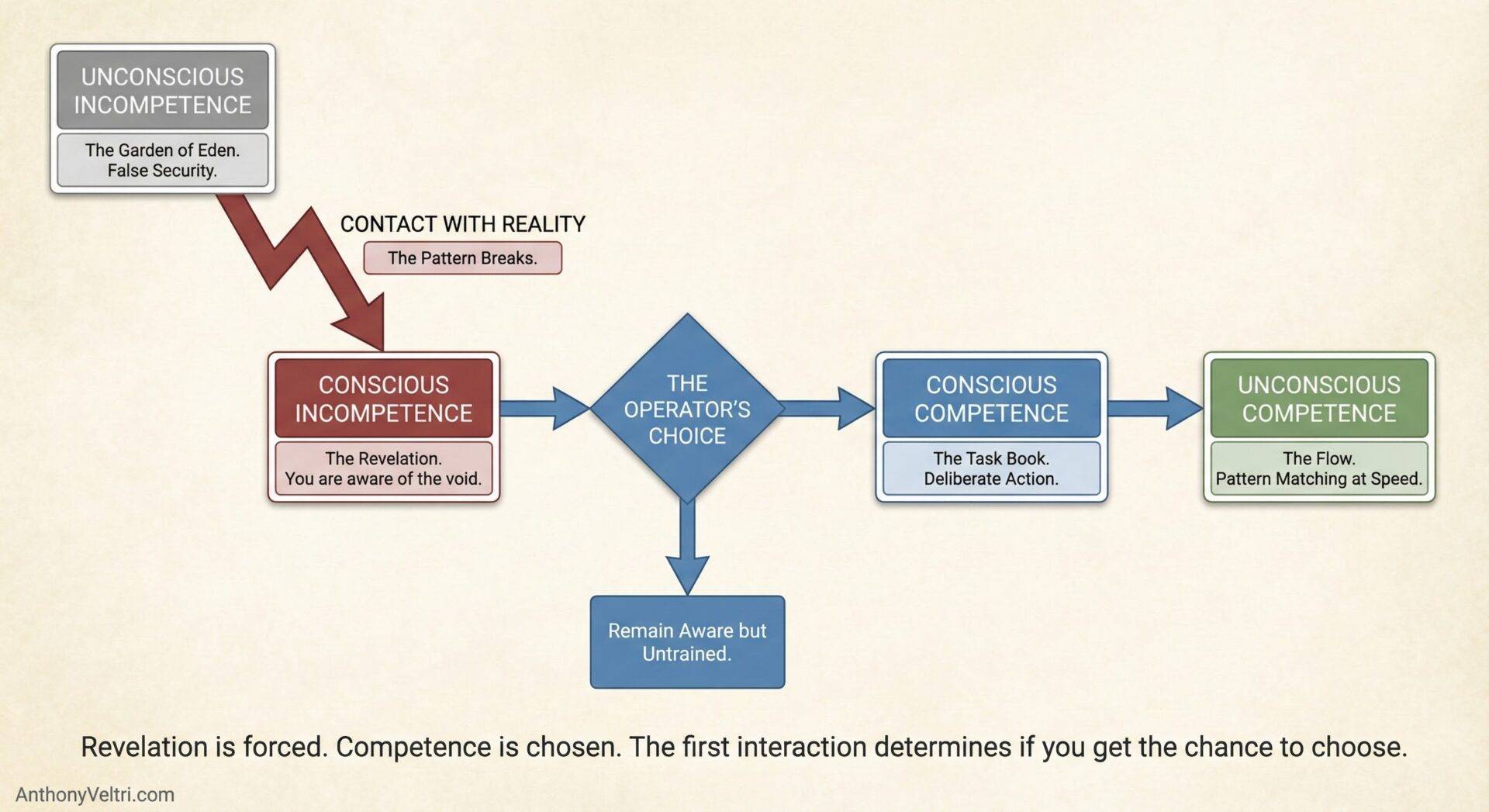
This diagram illustrates four stages of competence, indicating typical progress and decision points as described in the note below.
Four stages of competence, indicating typical progress and decision points.

The “Helplessness” Correction #

It is important to remember that Stage 4 does not guarantee a victory. The environment still has a vote. However, the operator who has walked the path from the Revelation to the Flow will never again experience the specific terror of being a helpless bystander. You have earned the right to engage.

Field notes and examples #

  • Seeing the Dragon: The Magic Eye of Modern Governance
  • Field Note: “I already know that” and “I disagree” are learning kill switches
  • Field Note: The Lab and the Line
  • Why This Site Has Four Navigation Systems

Last Updated on December 22, 2025

Related Posts #

This slide illustrates the relationships among claims, roles, and entitlements in Microsoft 365, as presented in Doctrine 21.

Doctrine 21 Companion: Claims, Roles, and Entitlements in Microsoft 365 #

This diagram illustrates increasing salary capacities, with larger houses on higher blocks representing $6k, $24k (median), and $80k per year.

Field Report: College Financing and the 5-Year Home Runway #

This slide illustrates the

Doctrine 09 Companion: Artifacts Over Adjectives #

This slide illustrates the distinction between Construction and Compression, as presented in Doctrine Companion, using a geometric theme.

Doctrine 03 Companion: Constraints: bidirectional translation: Compression vs Construction #

This slide illustrates the

Doctrine 03 Companion: The RS-CAT Framework: Converting Raw Recall into Teachable Principle #

This slide illustrates

Doctrine 10 Companion: Span of Control and Cross Training Are Load-Bearing Constraints #

Leave a Reply Cancel reply

You must be logged in to post a comment.

Table of Contents
  • The Core Distinction
  • The Elimination of Helplessness
  • Why This Matters for Stewardship
  • The Divergent Path: The Four Stages of Operational Competence
    • Why Technical Mastery is a Response to the Terror of Uselessness
    • Stage 1: Unconscious Incompetence (The Garden)
    • Stage 2: Conscious Incompetence (The Revelation)
    • Stage 3: Conscious Competence (The Drill)
    • Stage 4: Unconscious Competence (The Flow)
    • The "Helplessness" Correction

Share This Article :

  • Facebook
  • X
  • LinkedIn
  • Pinterest

Was it helpful ?

  • Happy
  • Normal
  • Sad
  • Privacy Policy
  • Introductions
  • Contact

© 2026 Anthony Veltri

  • Doctrine
    • Doctrine Library
    • Global Library
  • Field Notes
  • Routes
    • Route 01: When the Interface Is Breaking (and you are becoming the patch)
    • ROUTE 02: If decisions stall and meetings go nowhere, start here
    • ROUTE 03: If you have lots of projects but no portfolio clarity, start here
    • ROUTE 04: If you’re confused about federation vs integration, start here
    • ROUTE 05: If heroics are propping up your system, start here
    • ROUTE 06: If you cannot force compliance across partners, start here
    • ROUTE 07: If compliance exists but commitment does not, start here
    • ROUTE 08: If disconnected workflows create audit anxiety, start here
  • Figure Library
  • FAQ
  • About
    • Capability Statement
    • Interpreter Kit
  • Contact