When Coordination Infrastructure Becomes Compliance Theater #
The Pattern #
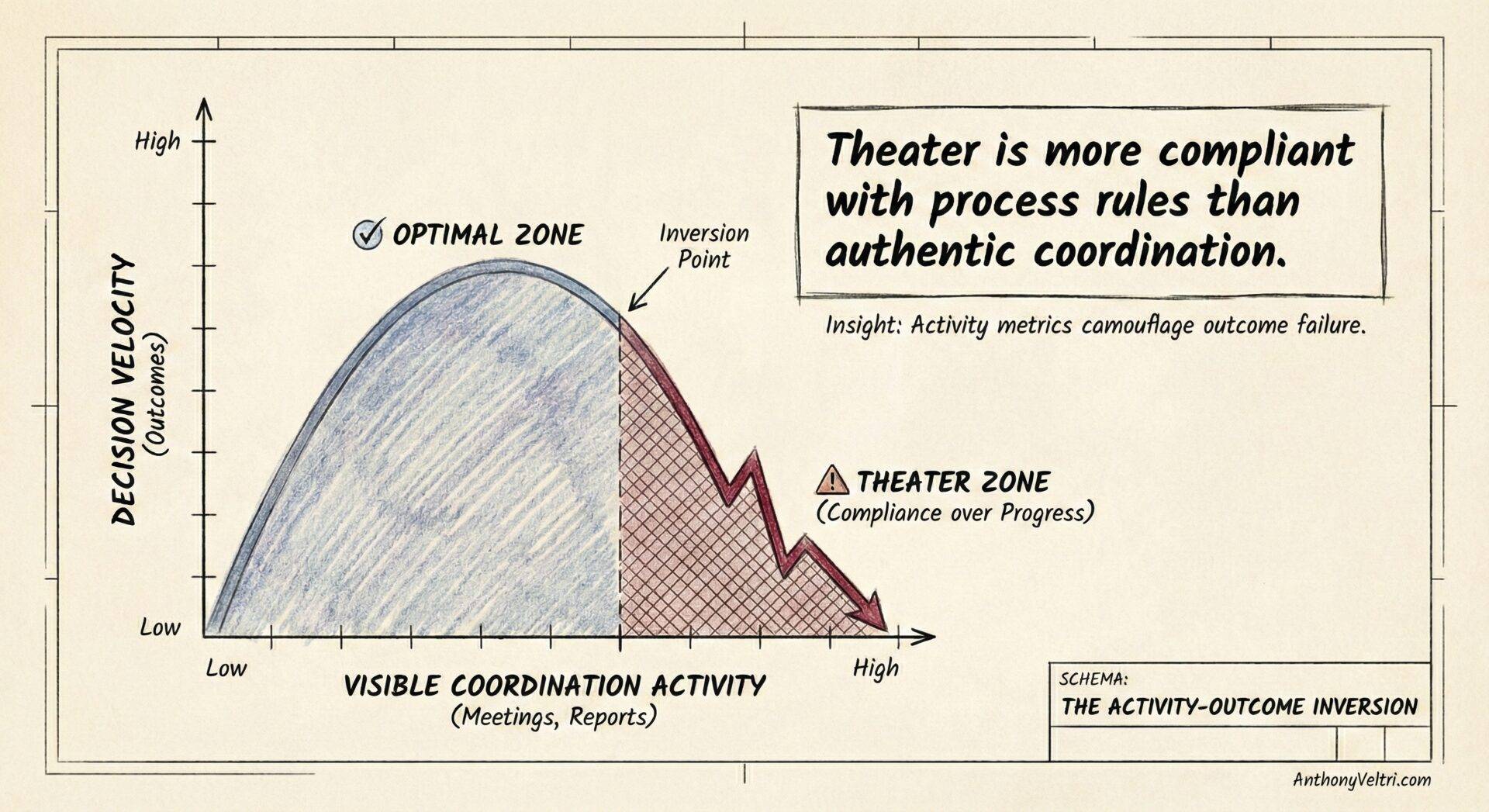
Coordination offices measure activity (meetings held, attendance rates, documents produced) while decision latency increases and stakeholder satisfaction decreases. The coordination infrastructure looks busy but doesn’t improve coordination outcomes.
Recognition signals:
- High meeting attendance, slow decisions
- Calendar full of “alignment” meetings that produce no commitments
- Coordination metrics track participation, not results
- “We’re always coordinating but nothing gets decided”
This is a companion to:
Doctrine 15: Architecture Must Accelerate Teams, Not Bottleneck Them #
Why This Happens #
Organizations default to measuring what’s easy to count rather than what matters:
Easy to measure (activity metrics):
- Meeting attendance percentage
- Number of coordination meetings held
- Documents produced
- Participation rates
- Email response times
Hard to measure (outcome metrics):
- Time from issue identification to decision
- Percentage of decisions that stick (not reversed/reworked)
- Stakeholder trust in coordination effectiveness
- Decision quality (outcomes achieved vs. intended)
- Coordination friction (effort required to coordinate)
Pattern: Activity metrics feel like progress. Outcome metrics reveal whether coordination actually works.
The Activity-Outcome Inversion #
When coordination offices optimize for activity metrics, they often inverse-correlate with outcomes:
Example: The Weekly Status Meeting
- Activity: 87% attendance (looks good!)
- Outcome: Decision latency +40% (actually bad)
- Why: Meeting consumes time without producing decisions
Example: The Governance Council
- Activity: 12 meetings held, minutes documented (looks good!)
- Outcome: Zero binding decisions, recommendations ignored (actually bad)
- Why: Council has responsibility without authority
Example: The Coordination Dashboard
- Activity: Real-time visibility into all stakeholder activities (looks good!)
- Outcome: Still doing manual aggregation for executive briefs (actually bad)
- Why: Schema doesn’t match semantic model executives need
Governance Theater vs. Decision Forums #
Governance theater characteristics:
- Mandatory attendance tracked
- No decision authority in charter
- Representatives “take back to teams” but nothing changes
- Success measured by meeting completion, not outcomes
- Continues from inertia after original purpose ends
Decision forum characteristics:
- Attendance optional (people come because decisions get made)
- Clear decision authority documented
- Decisions binding or escalation path explicit
- Success measured by decision quality and implementation
- Ends when decision need ends
The test: If the meeting stopped happening, would decisions slow down? If no, it’s theater.
Meeting Proliferation Failure Modes #
1. Meetings-About-Meetings #
Pattern: Pre-briefs before board meetings, alignment meetings before decision meetings, coordination meetings to prepare for coordination meetings
Why it happens: Actual decision forum lacks psychological safety or clear decision rights, so stakeholders rehearse privately
The fix: Make actual forum safe for real discussion and clarify decision authority
2. Zombie Meetings #
Pattern: Meeting outlives its purpose but continues from inertia
Recognition: “It’s on everyone’s calendar” as reason for continuing, “relationship maintenance” as stated value, no clear coordination decision the meeting makes
The fix: Explicit sunset clauses or periodic purpose reviews with default to cancel
3. Information Sharing Theater #
Pattern: Synchronous meetings for asynchronous information transfer
Recognition: Presentations with no discussion, status updates with no decisions, “FYI” content that could be email
The fix: Async first, synchronous only for actual decisions or conflict resolution
4. Consensus Theater #
Pattern: “Building consensus” in meetings where no one has authority to commit their organization
Recognition: Everyone nods in meeting, nothing changes after, representatives “take it back to teams,” decisions need to be “socialized”
The fix: Clarify whether meeting is decision forum (binding) or advisory (recommendations)
Auditing Your Coordination Infrastructure #
For each regular meeting, ask:
- Decision authority: Does this meeting make binding decisions?
- Yes → Who can make them? What’s the scope?
- No → Why is it synchronous? Should it exist?
- Outcome measurement: What changes because this meeting happened?
- If answer is “visibility” or “alignment” → probably theater
- If answer is “X decision made, Y commitment secured” → probably valuable
- Failure mode: If this meeting stopped, what would break?
- If answer is “nothing” → it’s theater, cancel it
- If answer is “decisions would slow” → it’s valuable, keep it
- If answer is “people would be upset” → it’s relationship theater, address underlying trust/communication needs differently
- Attendance pattern: Do people attend because they must or because decisions get made?
- Mandatory attendance with tracked compliance → theater
- Optional attendance with consistent participation → valuable
- Time-to-decision: Has this meeting series reduced decision latency?
- Measure before/after implementing meeting
- If latency increased → meeting is overhead, not enabler
Better Coordination Metrics #
Instead of tracking:
- Meeting attendance
- Number of coordination meetings
- Participation rates
- Documents produced
Track:
- Decision cycle time (issue → decision → implementation)
- Decision quality (reversals, rework, stakeholder satisfaction)
- Coordination friction (effort required to coordinate)
- Stakeholder engagement (voluntary participation in coordination)
- Decision implementation rate (decisions that actually get executed)
Pattern: Measure decision flow, not meeting flow.
The Meeting Reduction Trap #
Blunt meeting reduction initiatives (“No Meeting Fridays,” “Mandatory Agendas,” “45-Minute Caps”) usually backfire. Instead of reducing waste, they accidentally purge the most valuable interactions while leaving the theater intact.
The Compliance Paradox: Governance Theater is always more compliant than authentic coordination.
- Theater is scripted. It can easily adjust to “45 minutes” or “send materials 48 hours in advance” because the outcome is pre-determined. It survives the audit because it ticks every box.
- Authentic Coordination is messy, urgent, and reactive. It breaks the rules (calling a crisis meeting on a “No Meeting Friday,” skipping the agenda because the data just arrived).
When you enforce strict process constraints, you create Compliance Camouflage:
- You filter OUT the messy, urgent, rule-breaking meetings that actually solve problems.
- You filter IN the polished, rule-following meetings that produce nothing but minutes.
Better approach:
- Audit for Consequence, not Compliance: Don’t ask “Did they have an agenda?” Ask “Did they make a decision?”
- Protect the Mess: Explicitly exempt “Decision Forums” from reduction mandates.
- Target the Scripts: If a meeting series has perfect attendance, perfect agendas, and zero decisions, cancel it immediately. It is theater.
When Meetings Are Actually Necessary #
Synchronous coordination makes sense for:
- Making decisions together when outcome affects all and no one party has authority
- Resolving conflicts that require real-time discussion and trust-building
- Building relationships before coordination is needed (investment, not overhead)
- Rapid response to emerging situations requiring immediate coordination
Synchronous coordination doesn’t make sense for:
- Information sharing that could be asynchronous
- Status updates where no decisions get made
- Compliance signaling where attendance is the output
- Relationship maintenance after relationship is established (this should be organic, not scheduled)
Field Evidence #
iCAV activation example: During activations, iCAV coordination didn’t use standing meetings. Coordination happened when decisions were needed. System supported 296,000 users because it enabled decisions rather than creating meeting overhead.
Pattern: Emergency response gets coordination right because there’s no time for theater. Regular operations should learn from this.
Coalition coordination example: Effective coalition coordination happens at liaison officer level through relationships and clear escalation paths, not through proliferation of “alignment” meetings. When coordination councils multiply, coordination often slows.
Implementation Guidance #
To shift from activity to outcome measurement:
- Audit existing meetings using the framework above
- Cancel governance theater (meetings without decision authority)
- Clarify decision forums (who can decide what, with what scope)
- Shift to async-first (meetings only for decisions or conflicts)
- Measure decision latency before and after changes
- Protect valuable decision meetings from reduction initiatives
Warning signs you’re optimizing for wrong metrics:
- Meeting attendance rates high, stakeholder satisfaction low
- Calendar full, decisions slow
- More coordination staff needed to handle coordination overhead
- Stakeholders avoid coordination office because it’s “too many meetings”
Connections #
This pattern connects to:
- Doctrine 15: Architecture Must Accelerate Teams – coordination infrastructure should speed decisions, not slow them
- Doctrine 24: Stewardship – stewards should protect stakeholders from coordination overhead
- Field Note: When You Call a Committee a Team – committees can’t make decisions that teams make
- Template Trap – meeting templates (standing agendas, mandatory participation) applied without examining whether meeting serves purpose
- Budget Proximity Trap – meeting proliferation often signals captured coordination office creating theater to justify existence
Summary #
Coordination infrastructure exists to enable decisions. When it creates compliance theater instead, it becomes overhead rather than enabler.
Key insights:
- Activity metrics (attendance, meeting count) often inverse-correlate with outcomes (decision speed, quality)
- Governance theater looks like coordination but produces only visibility, not decisions
- Meeting proliferation happens when coordination offices measure activity rather than outcomes
- Effective coordination measures decision latency, not meeting participation
The test: If coordination stopped, would decisions slow? If no, you’re doing theater not coordination.
Last Updated on February 22, 2026