When Coordination Offices Absorb Unresolved Tensions Rather Than Clarify Ownership #
Companion to: Educational Diagnostic #5 (The Conflict Buffer), Doctrine 24: Stewardship Places the Burden on the Steward, and Doctrine 03: Interfaces Are Where Systems Break.
Core insight: Coordination offices are often positioned to absorb blame for coordination failures that stem from stakeholder unwillingness to engage, commit resources, or resolve conflicts. The office becomes a political shock absorber – blamed for poor coordination outcomes while actual parties avoid accountability for their own coordination failures.
Reader Note
This companion describes a failure mode that occurs when coordination offices are asked to resolve conflicts they are not empowered to address.
It does not assume that all coordination roles are intended to function as system-correcting authorities.
In practice, some coordination offices are deliberately designed to buffer conflict rather than resolve it. These roles can be successful when their intent, authority, and evaluation criteria are aligned.
The risk described here emerges when buffering functions are presented or staffed as if they were corrective, decision-forcing roles.
This companion is descriptive, not accusatory. The pattern does not require malice. It often emerges from rational institutional incentives, risk management, and the desire to preserve relationships while reforms are underway. The practical objective is to align mandate, authority, and evaluation criteria so the office is not set up to fail or used as a substitute for decision ownership. This is not about bad people. It is about misaligned design.
This is a companion to:
Doctrine 24: Stewardship Places the Burden on the Steward, Not the Parties #
The Pattern #
Organizations create coordination offices when stakeholders won’t coordinate directly. But when those same stakeholders remain unwilling to commit resources, resolve conflicts, or grant decision authority, the coordination office absorbs blame for coordination failures it has no power to prevent.
Recognition signal: Coordination office is blamed for slow decisions, poor outcomes, or coordination failures while stakeholders who created the failures avoid accountability.
Why this matters: Conflict buffer positions are deputization traps. Office has responsibility for coordination outcomes without authority to compel stakeholder engagement, resource commitment, or conflict resolution. When coordination fails (inevitably, given lack of authority), office absorbs blame while parties escape accountability.
How Conflict Buffering Works #
The Setup #
Phase 1: Stakeholders won’t coordinate directly
- Parties have unresolved tensions, competing interests, or historical conflicts
- Direct coordination is uncomfortable, politically risky, or threatens autonomy
- Organization creates coordination office to “facilitate” coordination
Phase 2: Office positioned between conflicting parties
- Coordination office sits “between” stakeholders
- Responsibility: make coordination work
- Authority: none (stakeholders retain all decision rights)
Phase 3: Stakeholders maintain conflicts while office coordinates
- Parties continue underlying disagreements
- Office expected to produce coordination outcomes despite parties’ unwillingness
- When coordination fails, office is blamed
Phase 4: Office absorbs consequences of stakeholder failures
- Slow decisions blamed on “poor coordination” (not stakeholder resistance)
- Failed initiatives blamed on “coordination office didn’t align parties” (not parties’ refusal to align)
- Resource constraints blamed on “coordination office didn’t make the case” (not stakeholders’ unwillingness to commit)
- When an office absorbs blame long enough, just working there becomes a career stain. People leave not because the work is hard, but because the “smell of failure” sticks to them.
The trap: Office has responsibility for coordination success while parties retain all the power to make coordination fail.
Recognition Patterns #
Pattern 1: Blamed for Stakeholder Non-Engagement #
What it looks like:
- Coordination office schedules meetings, stakeholders don’t attend or send junior staff
- Office blamed for “poor stakeholder engagement”
- Actual problem: stakeholders don’t want to engage but won’t say so
Example: Cross-agency coordination office establishes governance council. Three agencies send senior representatives, two send junior staff, one doesn’t participate. When coordination fails, executive brief says “coordination office struggled with stakeholder engagement.” Reality: two agencies didn’t want to coordinate but wouldn’t explicitly refuse.
Why this is conflict buffering: Office blamed for stakeholder choices (non-engagement) it can’t control. Stakeholders who refused to participate escape accountability. Office absorbs political cost of their resistance.
What office should say (but often can’t): “Agencies X and Y refused to engage at appropriate level. We cannot coordinate parties who won’t participate. This is stakeholder choice, not coordination failure.”
Pattern 2: Blamed for Stakeholder Resource Refusal #
What it looks like:
- Coordination office identifies resource needs for cross-boundary initiative
- Stakeholders won’t commit resources
- Initiative fails or is under-resourced
- Office blamed for “not making compelling case” or “poor planning”
Example: Coordination office develops shared capability requiring $2M and 5 FTE from each of 4 departments. Three departments commit resources, one refuses. Capability is under-resourced and fails. Post-mortem blames “coordination office for inadequate resource planning.” Reality: one department refused to commit and others wouldn’t proceed without full participation.
Why this is conflict buffering: Office blamed for department’s resource refusal. Department that refused escapes accountability (“we had budget priorities”). Office absorbs political cost of their unwillingness.
What office should say (but often can’t): “Department Z refused to commit required resources. Initiative cannot succeed without their participation. This is resource commitment failure, not coordination planning failure.”
Pattern 3: Blamed for Unresolved Stakeholder Conflicts #
What it looks like:
- Coordination office identifies conflict between stakeholders
- Parties won’t negotiate or resolve
- Coordination proceeds with unresolved conflict
- Coordination fails due to underlying conflict
- Office blamed for “not resolving stakeholder issues” or “poor conflict management”
Example: Two agencies have competing claims to lead coordination domain. Coordination office escalates to leadership. Leadership says “work it out.” Agencies won’t negotiate. Office proceeds with ambiguous leadership. Coordination fails when both agencies claim authority. Office blamed for “not clarifying governance.” Reality: leadership and agencies both refused to resolve conflict.
Why this is conflict buffering: Office blamed for conflict parties and leadership refused to resolve. Both parties escape accountability for maintaining conflict. Office absorbs political cost of their unwillingness to negotiate.
What office should say (but often can’t): “Agencies maintain unresolved competing claims. Leadership declined to resolve. We cannot coordinate through fundamental authority conflicts parties refuse to address.”
Pattern 4: Blamed for Stakeholder Veto Without Accountability #
What it looks like:
- Coordination office develops consensus approach
- One stakeholder vetoes but won’t propose alternative
- Coordination stalls
- Office blamed for “inability to achieve alignment” or “poor stakeholder management”
Example: Coordination office facilitates 6-month process developing data sharing framework. Five stakeholders support, one vetoes citing “concerns.” Veto stakeholder won’t specify concerns or propose modifications. Framework dies. Office blamed for “failing to achieve consensus.” Reality: one stakeholder vetoed without accountability for their objections.
Why this is conflict buffering: Office blamed for stakeholder’s unexplained veto. Veto stakeholder escapes accountability for blocking without alternatives. Office absorbs political cost of their obstruction.
What office should say (but often can’t): “Stakeholder X vetoed without specifying addressable concerns or proposing alternatives. This is stakeholder obstruction, not coordination failure to achieve consensus.”
Pattern 5: Blamed for Leadership’s Unwillingness to Decide #
What it looks like:
- Coordination requires executive decision (budget allocation, authority grant, conflict resolution)
- Leadership won’t decide
- Coordination stalls waiting for decision
- Office blamed for “not driving decisions” or “lack of progress”
Example: Coordination office escalates resource allocation conflict to executive sponsor. Sponsor says “keep working the issue.” Office continues coordinating without resolution authority. Stakeholders remain deadlocked. Quarterly review blames coordination office for “slow progress on resource allocation.” Reality: executive refused to make decision.
Why this is conflict buffering: Office blamed for executive’s decision avoidance. Executive escapes accountability for not deciding. Office absorbs political cost of leadership’s unwillingness.
What office should say (but often can’t): “Executive decision required on resource allocation. Sponsor declined to decide. Coordination cannot proceed without executive resolution of stakeholder conflict.”
Pattern 6: Blamed for Systemic Coordination Barriers #
What it looks like:
- Coordination fails due to incompatible stakeholder constraints (legal, budget, operational)
- Office can’t change constraints
- Coordination proceeds knowing constraints prevent success
- Office blamed for “not overcoming barriers” or “lack of creative solutions”
Example: Federal-state coordination office tasked with aligning emergency response. Federal agency bound by specific regulations, state agencies bound by incompatible state laws. Office identifies incompatibility, escalates to leadership. Leadership says “find workarounds.” No legal workarounds exist. Coordination fails during actual emergency. Review blames coordination office for “insufficient planning for legal constraints.” Reality: incompatible legal frameworks that only legislation could resolve.
Why this is conflict buffering: Office blamed for systemic constraints it can’t change. Stakeholders and leadership who could address constraints (legislation, budget authority, policy changes) escape accountability. Office absorbs blame for systemic failures.
What office should say (but often can’t): “Coordination fails due to incompatible legal constraints. Office cannot override law. Requires legislative action or executive policy change. This is systemic barrier, not coordination planning failure.”
Why Organizations Create Conflict Buffers #
Reason 1: Avoiding Direct Accountability for Coordination Failure #
Stakeholders don’t want to be blamed for refusing to coordinate. Coordination office provides scapegoat.
Example: Agencies won’t share data but don’t want to be seen as “not team players.” Coordination office created to “facilitate data sharing.” When sharing fails, office blamed for “not achieving data sharing goals.” Agencies escape accountability for refusing to share.
Reason 2: Creating Appearance of Coordination Without Commitment #
Leadership wants appearance of coordination without forcing stakeholder commitment.
Example: Executive creates coordination council to show “enterprise alignment effort.” But executive won’t grant council authority to compel stakeholder participation or resolve conflicts. When coordination fails, council blamed for “not driving alignment.” Executive escapes accountability for not granting authority.
Reason 3: Delaying Hard Decisions #
Leadership doesn’t want to make difficult decisions (resource allocation, conflict resolution, priority setting). Coordination office provides delay mechanism.
Example: Two business units compete for same market segment. Executive creates “market coordination office” instead of deciding which unit leads. Office expected to “coordinate” units’ competing strategies. When coordination fails (inevitable – units have genuinely conflicting interests), office blamed for “poor coordination.” Executive escaped making hard choice.
Reason 4: Diffusing Conflict Visibility #
Stakeholder conflicts are politically uncomfortable. Coordination office absorbs conflicts making them less visible to senior leadership.
Example: Departments have 3-year history of territorial disputes. Leadership creates coordination office positioned “between” departments to “manage interface.” Office absorbs ongoing conflicts. Leadership doesn’t see conflict (office is buffering it). When coordination outcomes are poor, office blamed. Conflict remains unresolved but invisible.
Reason 5: Relationship Preservation #
Direct negotiation between conflicting parties risks damaging relationships. Coordination office provides indirect channel.
Example: Two agencies have good executive relationships but staff-level conflicts. Executives create coordination office to “facilitate staff coordination” avoiding executive confrontation about their staff’s conflicts. Office absorbs staff conflicts. Executives preserve relationship. Office blamed when coordination fails.
The Cost of Conflict Buffering #
For the Coordination Office #
Impossible position:
- Responsibility without authority
- Blamed for failures caused by parties’ choices
- Cannot succeed because parties won’t engage/commit/resolve
- Career risk (associated with coordination failures)
Talent loss:
- Competent coordinators recognize the trap
- Office becomes career dead-end
- Turnover increases
- Remaining staff demoralized
For the Organization #
Unresolved conflicts persist:
- Creating coordination office doesn’t resolve underlying stakeholder conflicts
- Conflicts continue beneath coordination layer
- Real coordination impossible while conflicts remain
Coordination theater:
- Organization appears to coordinate (office exists!)
- Actual coordination doesn’t happen (office can’t compel it)
- Leadership loses visibility into coordination barriers
Delayed accountability:
- Stakeholder coordination failures remain unaddressed
- Office absorbs blame quarter after quarter
- Real problems never fixed because they’re not acknowledged
For Stakeholders #
Moral hazard:
- Stakeholders learn they can refuse to coordinate without accountability
- Office absorbs consequences of their refusals
- Incentive to continue refusing (no cost to them)
Coordination degradation:
- As office becomes scapegoat, less actual coordination happens
- Stakeholders disengage further (office will be blamed anyway)
- Coordination capability degrades over time
How to Recognize You’re a Conflict Buffer #
Warning signs:
- Blame asymmetry: When coordination succeeds, stakeholders claim credit. When it fails, office is blamed. (Credit flows up, blame stops with you)
- Authority questions met with “work the issue”: When you escalate for decision authority, response is “coordinate better” not “here’s authority to resolve.”
- Stakeholder refusals invisible in reporting: Your reports say “stakeholder engagement challenges” rather than “Stakeholder X refused to participate despite repeated requests.”
- Conflicts you identify aren’t resolved: You surface stakeholder conflicts. Leadership says “work through it.” Conflicts persist. You’re blamed for poor conflict management.
- You’re tired of saying “we can’t force them”: Constant reminder that office has no authority to compel stakeholder action, yet blamed for their inaction.
- Stakeholders say “that’s what the coordination office is for”: When you ask stakeholders to resolve their conflicts, they redirect responsibility back to coordination office.
- Performance reviews blame you for stakeholder choices: Evaluated on “stakeholder engagement” when stakeholders won’t engage, “conflict resolution” when parties won’t resolve, “decision speed” when leadership won’t decide.
Design Tests: Are You Being Asked to Coordinate or to Govern? #
You can often determine whether the role is intended to buffer conflict or correct it by asking three design questions:
- Decision ownership
- When stakeholders disagree, is there a named decision owner who can decide, or is the office expected to “work it out” indefinitely?
- Commitment capture
- Can the office record commitments, caveats, and refusals in a durable way that remains visible to leadership and boards, or is it expected to soften the record to preserve harmony?
- Authority alignment
- Is the office accountable for outcomes it cannot compel, or is it accountable for the quality of process, options, and decision traceability?
If these answers are unclear, the role will drift into conflict buffering even if its stated intent is enterprise coherence.
What To Do About It #
If You’re the Coordination Office #
Option 1: Force visibility to actual barriers
Stop softening stakeholder failures in reports. Document explicitly:
- “Department X refused to commit required resources”
- “Agencies Y and Z maintain unresolved competing claims to authority”
- “Executive sponsor declined to resolve stakeholder conflict”
- “Coordination cannot succeed while parties refuse to [engage/commit/resolve]”
Risk: You’ll be seen as “not a team player” or “making excuses”
Benefit: Forces accountability clarity. If leadership won’t acknowledge stakeholder barriers, you’ve documented the trap.
Option 2: Escalate for actual authority
Request authority matching responsibility:
- “Grant office authority to compel stakeholder participation”
- “Grant office budget authority to fund coordination capabilities”
- “Grant office decision authority to resolve stakeholder conflicts”
Expected response: “That’s not how we do coordination” or “stakeholders won’t accept that”
Your reply: “Then coordination success depends on stakeholder voluntary engagement, which office cannot control. Office cannot be accountable for stakeholder choices.”
Benefit: Forces leadership to acknowledge they want coordination outcomes without granting coordination authority.
Option 3: Reframe success metrics
Stop accepting responsibility for stakeholder choices. Propose metrics office can control:
- NOT “achieve stakeholder alignment” (office can’t force)
- INSTEAD “provide stakeholder alignment opportunities” (office can provide)
- NOT “resolve stakeholder conflicts” (office can’t compel resolution)
- INSTEAD “escalate unresolved conflicts to appropriate authority” (office can escalate)
- NOT “drive decision speed” (office can’t make decisions)
- INSTEAD “identify decision bottlenecks and escalation needs” (office can identify)
Benefit: Clarifies where office responsibility ends and stakeholder/leadership accountability begins.
Option 4: Document the trap and exit
Some coordination offices are structurally designed to fail (conflict buffer by design). If leadership won’t grant authority or acknowledge stakeholder barriers:
- Document the structural trap
- Share with trusted advisors
- Plan exit strategy
- Leave before association with “coordination failure” damages career
Rationale: Can’t fix structural conflict buffering from inside the buffer.
If You’re Leadership Creating Coordination Office #
Avoid creating conflict buffer:
- Resolve fundamental conflicts before creating coordination office
- Don’t create office to “manage” unresolved stakeholder conflicts
- Resolve authority conflicts, resource allocation disputes, competing claims
- Create office to coordinate willing partners, not referee unwilling combatants
- Grant authority matching responsibility
- If office accountable for engagement, grant authority to compel participation
- If office accountable for resources, grant budget authority
- If office accountable for decisions, grant decision authority
- Otherwise: office is buffer, not coordinator
- Important Note: Leaders sometimes create buffering roles precisely because they are not ready to grant decision authority. If the intent is to buy time, be explicit about that intent with the Director. Do not imply the office will be evaluated as corrective if it is resourced only to stabilise.
- Make stakeholder accountability explicit
- Document stakeholder commitments (participation, resources, decision-making)
- Hold stakeholders accountable for commitments
- Don’t let office absorb blame for stakeholder refusals
- Resolve conflicts office surfaces
- When office escalates stakeholder conflicts, resolve them
- Don’t redirect back to office with “work it out”
- Office identifies conflicts, leadership resolves, stakeholders negotiate
- Accept coordination may fail due to stakeholder unwillingness
- If stakeholders won’t coordinate, coordination will fail
- This is stakeholder choice, not office failure
- Don’t create office to absorb blame for stakeholder resistance
If You’re a Stakeholder #
Don’t participate in conflict buffering:
- If you won’t commit, say so explicitly
- Don’t participate in coordination you won’t support
- Don’t blame coordination office for your unwillingness
- Better: “We’re not committing resources” than office blamed for “poor resource planning”
- If you have conflicts with other stakeholders, negotiate directly
- Don’t expect coordination office to resolve conflicts between you and others
- Negotiate directly or escalate to appropriate authority
- Don’t blame office for conflicts you won’t resolve
- If you veto coordination approaches, propose alternatives
- Don’t veto without accountability for your objections
- Propose alternatives or negotiate modifications
- Don’t leave office to explain your unexplained veto
Why a Steward Takes the Job (The Governance Mandate) #
A Steward does not take the job to pick fights or embarrass stakeholders. The mandate is narrower and more disciplined. The office converts ambiguity into decision-relevant clarity while preserving professional relationships and institutional legitimacy. The goal is not conflict. The goal is traceable commitments, explicit tradeoffs, and escalation that results in decisions.
If this role is a structural trap, why would any competent operator take it? A well-intentioned coordinator takes it because they don’t see the trap. They absorb responsibility without authority. A Steward takes it because they see the trap and plan to convert it into decision-relevant clarity in service of the mission.
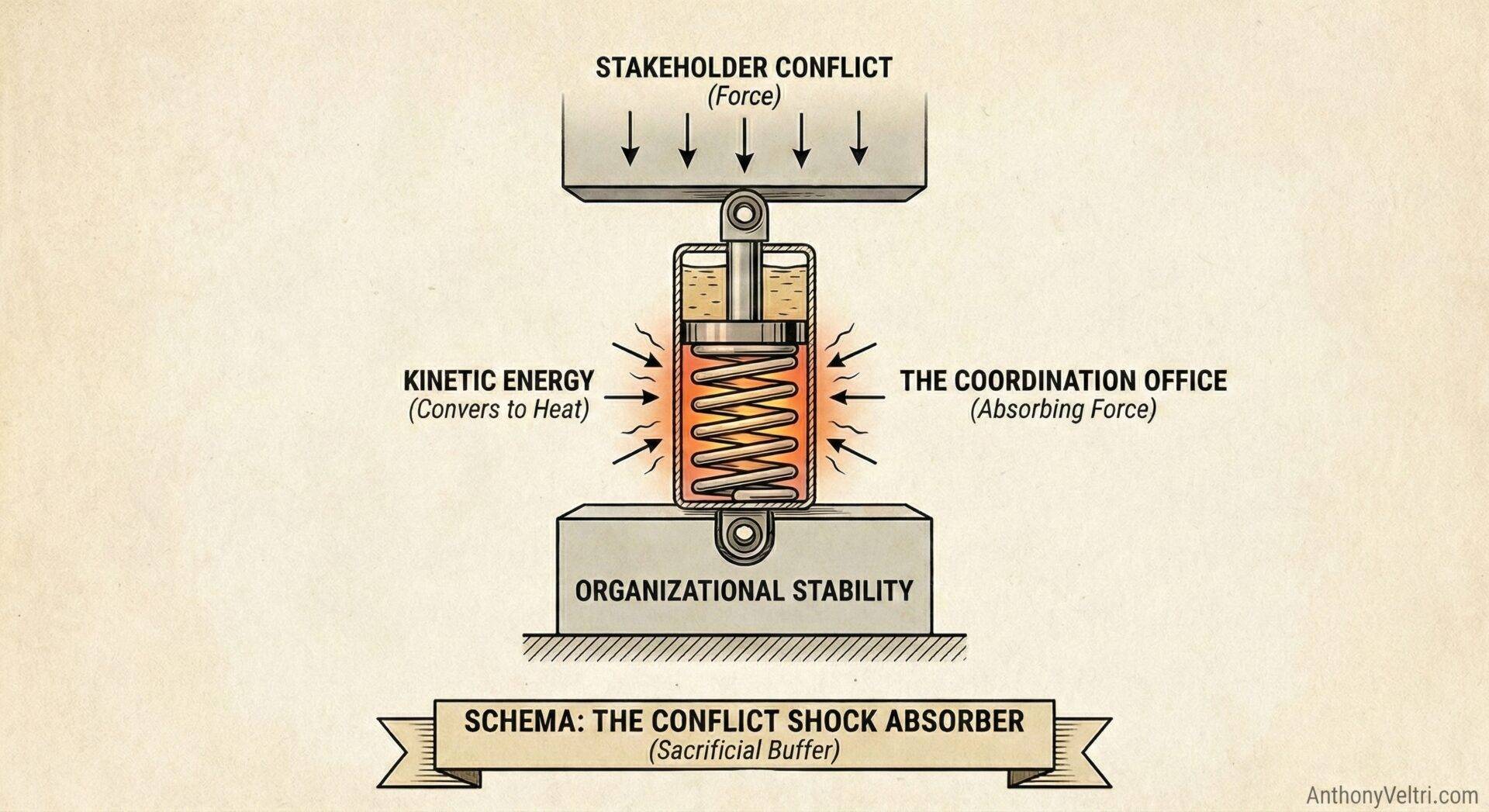
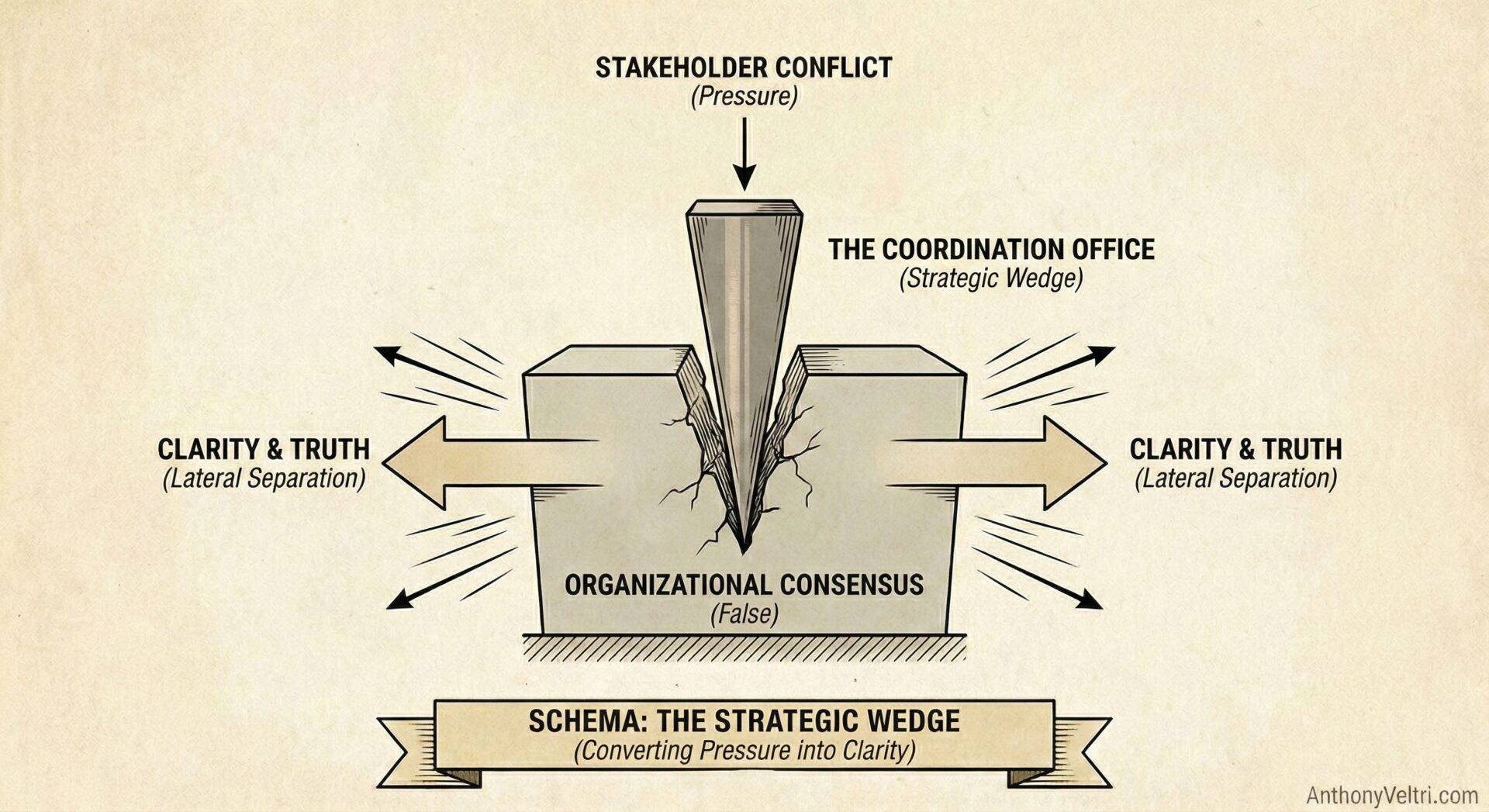
They do not take the job to be the Shock Absorber. They take it to be The Wedge.
1. The Wedge Strategy (Converting Pressure into Clarity) #
In some enterprises, the buffer function is intentional and can be the correct design choice. The Steward’s role is to recognise which design is intended and ensure the office is not evaluated as corrective when it is resourced and authorised only to stabilise.
A Shock Absorber takes vertical pressure (conflict) and converts it into heat (burnout) to keep the system stable. A Wedge takes vertical pressure and converts it into horizontal separation (clarity).
The Steward refuses to only buffer the conflict. Instead, they use the office to force the organization to acknowledge its own fractures.
- The Move: When Stakeholders A and B refuse to align, do not “smooth it over.” Document the misalignment in high-fidelity. Publish the “Cost of Non-Alignment” upward.
- The Effect: You reduce information filtering to ensure leadership has full visibility of under-functioning or broken governance (and what is working as well). You use the pressure to validate whether consensus is substantive (force clarity at the decision level).
2. The “360-Degree Truth” #
The Coordination Office is often the only place in the enterprise that sees the whole system.
- Agencies see their silos.
- HQ sees its policy.
- You see the Gap.
You take the job to be the “Chief Epistemology Officer” (Some might say the “Chief Reality Officer,” the person who can explain why outcomes are failing in decision-relevant terms, the one person who knows exactly why things are failing). Even if you cannot fix it today, you are creating the map that will be used to reconstruct the system after the inevitable failure. You are building the “Black Box” that records the crash so the next flight survives.
3. The Crisis Switch (The iCAV Model) #
In peacetime, these offices are treated as buffers. In crisis, they often become the only functioning command post. When the hurricane hits (or the no-notice event occurs), the “Stakeholder Politics” dissolve because survival is at stake. The “Governance Theater” stops. The only thing that matters is: “Who holds the accurate map of enterprise capability and real authority when the formal organizational chart dissolves?” The value of the Coordination Office in a crisis isn’t just tactical data; it is possessing the only accurate map of latent authority and capability across the fragmented enterprise.
- The Trade: You accept and can tolerate being a “Sacrificial Buffer” 90% of the time for the privilege of being the “Essential Connector” the 10% of the time it actually matters.
- The Preparation: You endure the theater, but you quietly wire the building for the emergency.
4. The “Resignation” Power #
The strongest position is a Steward who has a resignation letter ready in the drawer.
- A careerist fears being fired, so they buffer the conflict to please the boss.
- A Steward is willing to be fired, so they tell the truth about the conflict to save the mission.
Paradoxically, this reduces capture risk. A leader who is not dependent on approval is more capable of maintaining integrity under pressure and documenting constraints without distortion.
Summary: Don’t take the job to be the Cushion. Take the job to be the Wedge.
Relationship to Other Patterns #
Conflict Buffer vs. Escalation Sink (Diagnostic #1) #
Overlap: Both involve responsibility without authority
Distinction:
- Escalation Sink: Deputization without authority to make decisions or compel compliance
- Conflict Buffer: Positioned to absorb blame for stakeholder coordination failures
How they combine: Coordination offices are often both – deputized without authority AND positioned to absorb blame for stakeholder refusals. Double trap.
Conflict Buffer vs. Budget Proximity Trap (Diagnostic #4) #
Different mechanisms:
- Capture: Office aligns with dominant stakeholder (budget, location, hiring)
- Buffering: Office absorbs blame for all stakeholders’ coordination failures
How they combine: Captured office buffering conflicts for dominant stakeholder. Office blamed for other stakeholders’ “poor engagement” when actually dominant stakeholder won’t compromise.
Conflict Buffer vs. Meeting Proliferation (Diagnostic #3) #
Connection: Conflict buffer offices often create meeting proliferation (governance theater) to demonstrate “coordination activity” even when actual coordination fails due to stakeholder unwillingness.
Pattern: Can’t produce coordination outcomes (stakeholders won’t engage), so produce coordination activities (many meetings) to justify existence.
Field Evidence #
Post-Katrina federal coordination: iCAV worked because participating agencies wanted to coordinate. When similar coordination offices created later for agencies that didn’t want to coordinate, offices became conflict buffers – blamed for “poor interagency coordination” when agencies refused to share information.
NATO partnership coordination: Effective liaison offices coordinate willing partners. When liaison offices positioned between nations with unresolved conflicts, they become conflict buffers – blamed for “coordination challenges” stemming from national policy conflicts they can’t resolve.
Corporate shared services: Shared services that coordinate willing business units succeed. When shared services created to force coordination between competing units, they become conflict buffers – blamed for “lack of business unit alignment” when units maintain competing strategies.
Summary #
Coordination offices become conflict buffers when positioned to absorb blame for coordination failures caused by stakeholder unwillingness to engage, commit resources, resolve conflicts, or negotiate compromises.
Key insights:
- Organizations create buffers to avoid stakeholder accountability
- Office has responsibility for outcomes stakeholders control
- When coordination fails (inevitably), office absorbs blame
- Stakeholders and leadership escape accountability for their choices
- This is deputization trap: responsibility without authority
Recognition signals:
- Blamed for stakeholder non-engagement
- Blamed for stakeholder resource refusals
- Blamed for unresolved stakeholder conflicts
- Blamed for leadership’s unwillingness to decide
- Credit flows up (stakeholders), blame stops at buffer (office)
The choice for coordination offices:
- Force visibility to stakeholder barriers
- Escalate for authority matching responsibility
- Reframe success metrics to what office controls
- Document trap and exit
The choice for leadership:
- Resolve fundamental conflicts before creating coordination office
- Grant authority matching responsibility
- Hold stakeholders accountable for coordination commitments
- Accept that coordination may fail due to stakeholder unwillingness
Last Updated on January 26, 2026