How Coordination Offices Lose Independence #
Companion to: Educational Diagnostic #4 (The Budget Proximity Trap), Doctrine 24, and Doctrine 03.
Core insight: Coordination offices require structural independence to coordinate neutrally across stakeholders. But multiple dependencies on one dominant stakeholder create compound capture that makes neutral coordination impossible.
This document is a companion to:
Doctrine 24: Stewardship Places the Burden on the Steward, Not the Parties #
The Pattern #
Coordination offices established to serve multiple stakeholders gradually align with whoever controls their resources. This isn’t corruption or individual failure – it’s structural gravity. Budget proximity, physical location, hiring pipelines, political support, and other dependencies create gravitational pull toward dominant stakeholder.
Why this matters: Captured coordination offices claim neutrality while serving one stakeholder. Smaller stakeholders see this and disengage. Office becomes dominant stakeholder’s extended team while maintaining facade of neutral coordination.
The invisibility problem: Captured offices are often last to recognize their own capture. External stakeholders see it clearly. The office sees efficiency, relationships, and support. Stakeholders see bias, favoritism, and alignment.
The Eight Capture Mechanisms #
Mechanism 1: Budget Dependency #
How capture happens:
- Coordination office funded entirely by one stakeholder
- Or: Dominant stakeholder provides 70%+ of budget
- Or: Budget controlled by stakeholder the office coordinates
What this creates:
- Rational fear of defunding if office doesn’t prioritize funder
- “We fund you” becomes “you serve us”
- Other stakeholders see office as funder’s internal capability
- Office unconsciously prioritizes funder to ensure survival
Recognition signal: When funding stakeholder says “Why are you spending time on other stakeholders’ priorities when we fund your office?” they’re articulating the structural reality everyone else already sees.
Example: Coordination office sits in Agency A’s budget line. When Agency B requests support, Agency A leadership questions why office serves B. Other agencies already knew office serves A – only the office thought it was neutral.
Test: If your funding source can defund you for supporting other stakeholders, you’re captured.
Mitigation:
- Federated funding (all stakeholders contribute proportionally)
- Neutral third-party funding (oversight body, shared services)
- Charter protection (but charter doesn’t override budget reality)
Mechanism 2: Physical Colocation #
How capture happens:
- Coordination office located in one stakeholder’s headquarters
- Office uses that stakeholder’s IT, cafeteria, security systems
- Staff attend stakeholder’s all-hands, participate in their culture
- Other stakeholders face barriers visiting (security clearance, distance)
What this creates:
- Information asymmetry (daily exposure to one stakeholder’s priorities)
- Vocabulary absorption (speaking their language)
- Social network bias (relationships with their personnel)
- Cultural capture (their perspective becomes “normal”)
Recognition signal: When office knows one stakeholder’s priorities intimately but struggles to understand others’, or when vocabulary has shifted to match dominant stakeholder’s terminology.
Example: Coordination office in Department X’s building. After 18 months, staff know Dept X’s priorities better than others’, vocabulary shifted to X’s terms, Y’s leaders rarely visit (security clearance required). X sees this as efficiency. Y sees capture.
Test: Can all stakeholders easily access your office physically and culturally? If one stakeholder’s location/security/culture creates barriers for others, proximity is creating capture.
Mitigation:
- Neutral location outside any stakeholder
- Rotating physical presence across stakeholders
- Remote-first operations to eliminate proximity bias
- Deliberate immersion time at other stakeholders’ locations
Mechanism 3: Hiring Pipeline #
How capture happens:
- Coordination office hires exclusively (or 70%+) from one stakeholder
- Or: Rotational assignments from one stakeholder only
- Or: Hiring process favors candidates from dominant stakeholder
What this creates:
- Cultural homogeneity (all staff share stakeholder’s perspective)
- Loyalty networks (former colleague relationships)
- Career incentives (potential return to home stakeholder)
- Internalized perspective (stakeholder’s view as baseline)
Recognition signal: When staff raise concerns about “creating problems for our former colleagues” or when office can’t coordinate against any stakeholder’s interests due to staff loyalties.
Example: Coordination office hires all 8 staff from Organization A (streamlined process, known people). When Organization B proposes initiative conflicting with A’s strategy, staff worried about creating problems for former colleagues. Office is culturally Organization A.
Test: If your staff would feel conflicted coordinating against their former employer’s interests, you’re captured by hiring pipeline.
Mitigation:
- Diversify hiring across all stakeholders
- Include external hires with no stakeholder history
- Limit rotational assignments from any single stakeholder to <40% of staff
- Recognize that easy hiring from one source creates long-term capture
Mechanism 4: Political Air Cover #
How capture happens:
- One stakeholder defends coordination office in budget battles
- Or: Stakeholder vouches for office when others question value
- Or: Stakeholder provides executive sponsorship and protection
What this creates:
- Dependency on protector for political survival
- Reporting bias (can’t assess protector honestly)
- Soft-pedaling protector’s problems
- Highlighting other stakeholders’ issues more prominently
Recognition signal: When staff suggest “framing findings diplomatically” about political supporter, or when office can’t publish unflattering but accurate assessments of protector.
Example: Agency C defends coordination office in budget discussions. Office prepares assessment revealing C’s poor data sharing. Staff suggest “diplomatic framing since C protects us politically.” Office can’t tell truth to power when power protects them.
Test: If you can’t publish unflattering but accurate assessments of your political supporter without fear of losing support, you’re captured.
Mitigation:
- Distributed political support (multiple stakeholders defend you)
- Independent oversight body provides protection
- Acknowledge dependency and address structural issue, not just tactical framing
Mechanism 5: System Dependency #
How capture happens:
- Coordination uses one stakeholder’s IT systems exclusively
- Or: Coordination platform built on stakeholder’s infrastructure
- Or: Stakeholder’s tools become “enterprise standard” for coordination
What this creates:
- Asymmetric participation costs (one stakeholder at zero cost, others pay adaptation costs)
- Operational advantage for system owner
- Vocabulary alignment with system owner’s terminology
- Barrier for other stakeholders (must learn external systems)
Recognition signal: When one stakeholder can coordinate using their native systems while others must adapt workflows, learn new interfaces, follow external IT policies.
Example: Coordination office uses Division D’s systems (project tracking, documents, communication). D participates at zero cost. Everyone else adapts to D’s systems. When E complains, D says “our systems are enterprise-standard” (meaning: we declared our systems the standard).
Test: If one stakeholder can coordinate without changing systems while others must adapt, you’ve created asymmetric capture through infrastructure.
Mitigation:
- Neutral third-party platforms
- Federated approach (interfaces to each stakeholder’s systems)
- Explicit acknowledgment that using one stakeholder’s systems favors that stakeholder
Mechanism 6: Response Time Differential #
How capture happens:
- Coordination office responds faster to one stakeholder (2 days)
- Slower to others (5-9 days)
- Staff explain: “We understand their context better”
What this creates:
- Service quality differential
- Self-reinforcing capture (fast service → more engagement → better understanding → faster service)
- Perception of favoritism
- Rational disengagement by slower-served stakeholders
Recognition signal: When response times vary more than 2x across stakeholders, and “we understand them better” explains the gap rather than “we’re aligned with them.”
Example: Organization F gets 2-day responses, Organization I gets 9-day responses. Staff say “F’s requests are simpler because we understand their context.” But asymmetric understanding is symptom of capture, not justification for service differential.
Test: Track response times across stakeholders. If differential >2x, investigate which capture mechanisms (budget, colocation, hiring) created knowledge asymmetry.
Mitigation:
- Measure and publish response time metrics
- Set service level agreements equal across stakeholders
- Address root cause (why does office understand one stakeholder better?)
- Hire staff with expertise in slower-served stakeholders
Mechanism 7: Vocabulary Drift #
How capture happens:
- Coordination office adopts one stakeholder’s terminology (70%+ of time)
- Or: Reports use stakeholder’s frameworks and acronyms
- Or: Dominant stakeholder can read coordination documents natively, others must “translate”
What this creates:
- Conceptual alignment with stakeholder’s frameworks
- Thinking in stakeholder’s categories
- Translation burden for other stakeholders
- Cognitive advantage for vocabulary source
Recognition signal: When one stakeholder finds coordination documents immediately readable while others need to translate, or when office uses stakeholder-specific acronyms without explanation.
Example: Coordination office reports use Company J’s terminology 85% of time. J’s staff find documents immediately readable. K’s staff feel coordination is “written for J, translated for them.” Vocabulary reveals who coordination office thinks like.
Test: Could you identify which stakeholder funds/houses your office based solely on vocabulary in coordination documents? If yes, vocabulary drift reveals capture.
Mitigation:
- Stakeholder-neutral vocabulary (create new terms)
- Explicitly multilingual documents (present concepts in multiple stakeholder vocabularies)
- Vocabulary crosswalks (Rosetta Stone approach)
- Audit reports for terminology bias
Mechanism 8: Performance Metrics #
How capture happens:
- Coordination metrics defined by one stakeholder’s priorities
- Or: Success measured as “alignment with dominant stakeholder’s objectives”
- Or: Metrics track items important to one stakeholder, ignore others’ concerns
What this creates:
- Measuring stakeholder-service rather than coordination-effectiveness
- Office optimizes for metrics = optimizes for dominant stakeholder
- Other stakeholders see metrics don’t represent their priorities
- Coordination success conflated with dominant stakeholder success
Recognition signal: When performance metrics measure “how well others align with dominant stakeholder” rather than “decision flow across all stakeholders.”
Example: Metrics are: (1) Speed of alignment with Partner L’s objectives, (2) Partners adopting L’s standards, (3) Reduction in exceptions to L’s processes. Other partners ask “Why are we measuring L’s priorities as coordination success?” Because office serves L.
Test: Remove stakeholder names from metrics. Would external observer know which stakeholder dominates based on what gets measured? If yes, metrics reveal capture.
Mitigation:
- Coordination metrics (decision cycle time, cross-stakeholder initiative success, satisfaction surveyed equally)
- Not stakeholder metrics (compliance with dominant stakeholder’s preferences)
- Distributed metric definition (all stakeholders participate)
Compound Capture #
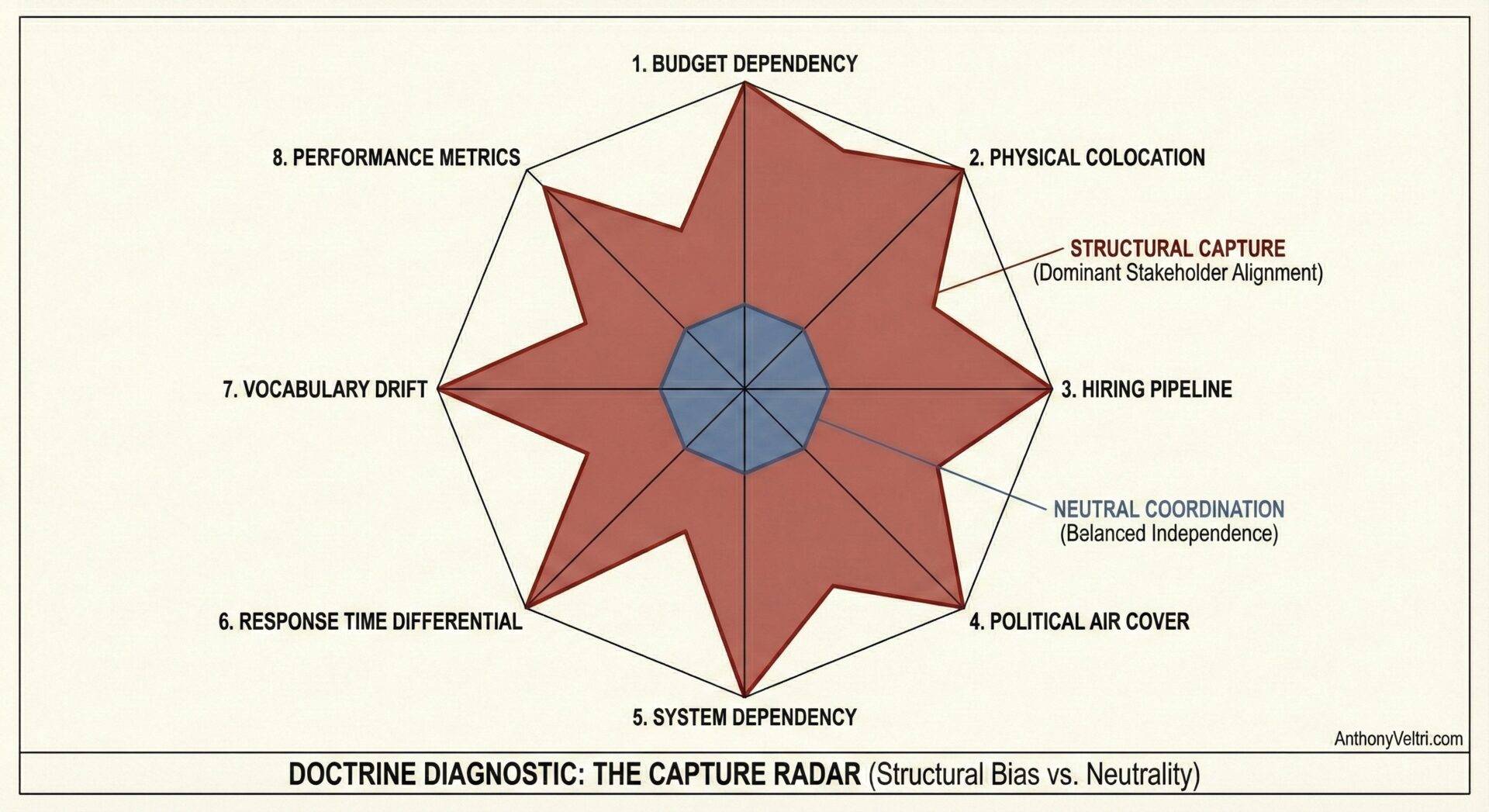
Single dependencies might be manageable. Budget from one source but neutral location. Or physical colocation but federated funding.
Multiple dependencies compound. Six of eight mechanisms aligned with same stakeholder creates structural capture that no amount of stated neutrality overcomes.
Compound Capture Test #
If your coordination office exhibits 4+ of these with same stakeholder:
- Funded by Stakeholder N
- Located in N’s headquarters
- Staff hired from N
- Uses N’s IT systems
- Performance metrics defined by N’s priorities
- Director has strong social ties to N’s leadership
- Reports use N’s vocabulary
- Responds fastest to N’s requests
You are structurally captured. Other stakeholders see this and disengage. You may be last to realize.
Why Capture Is Invisible to Captured #
Familiarity bias: Dominant stakeholder’s approaches feel superior because you know them intimately. You’ve lost ability to evaluate neutrally.
Rationalization: “We respond faster to them because their requests are simpler” (no – you understand them better because you’re aligned). “Their vocabulary is becoming enterprise standard” (no – you’re imposing their vocabulary). “Their priorities benefit the whole enterprise” (no – you’re conflating their success with coordination success).
Last to know: Cultural capture makes dominant stakeholder’s perspective feel like “normal” and others’ as “different.” External stakeholders see your bias clearly. You see efficiency and good relationships.
Structural blindness: When six dependencies align with same stakeholder, your office IS that stakeholder’s extended team. But charter says “neutral coordination office” so you believe that’s what you are.
What Smaller Stakeholders See #
When you’re captured, smaller stakeholders observe:
Budget reality: “They fund your office, you serve them” Physical proximity: “You’re in their building, you’re their office” Hiring pipeline: “Your staff are their former employees with loyalties” Political protection: “They protect you, you protect them” System advantage: “Coordinating requires using their systems” Service differential: “They get 2-day responses, we get 9-day” Vocabulary alignment: “You speak their language, not ours” Metric bias: “Your success metrics are their success metrics”
They see compound capture clearly. They’re likely right about your neutrality.
The Fix #
Acknowledge capture honestly: If you have 4+ dependencies on same stakeholder, you cannot coordinate neutrally. This is structural fact.
Two options:
Option 1: Restructure for independence
- Distributed funding (all stakeholders contribute)
- Neutral location
- Mixed staffing (all stakeholders or external hires)
- Stakeholder-neutral systems
- Balanced response times
- Neutral vocabulary
- Coordination metrics (not stakeholder metrics)
- Distributed relationships
This requires restructuring multiple dependencies simultaneously. Tactical fixes (visit other stakeholders more) don’t overcome structural capture.
Option 2: Honest relabeling
- Stop calling it “coordination office”
- Acknowledge you’re dominant stakeholder’s capability
- Stop pretending to serve all equally
- Let other stakeholders build alternative coordination
What doesn’t work: Claiming neutrality while captured. This is gaslighting. Smaller stakeholders already know you’re captured. Your denial destroys remaining trust.
Prevention #
At office establishment:
- Federated funding from inception
- Neutral location selection
- Diverse hiring sources
- Stakeholder-neutral systems
- Distributed political support
- Explicit vocabulary independence
- Coordination metrics (not stakeholder metrics)
Ongoing vigilance:
- Track all eight mechanisms
- Audit for capture quarterly
- Response time monitoring
- Vocabulary analysis of documents
- Metric review for bias
- Social network balance
Recognition: Coordination office independence is structural, not attitudinal. Good intentions don’t overcome budget dependency, colocation, hiring pipelines, or political reliance.
Related Patterns #
Links to:
- Doctrine 24: Stewardship Places the Burden on the Steward (captured stewards can’t serve all parties)
- Doctrine 03: Interfaces Are Where Systems Break (coordination offices are interfaces; capture breaks them)
- Field Note: When You Call a Committee a Team (calling captured office “neutral” when it serves one stakeholder)
- Diagnostic #1: Escalation Sink (capture often accompanies deputization)
- Diagnostic #3: Meeting Proliferation (captured offices create governance theater for dominant stakeholder)
Distinction from:
- Intentional alignment (honestly serving one stakeholder vs. claiming neutrality while captured)
- Consulting relationships (fee-for-service vs. neutral coordination)
- Direct reporting (clear chain of command vs. captured “neutral” office)
Last Updated on February 22, 2026