Skip to content

Introduced by a trusted connector?

Start Here

Anthony Veltri

  • Doctrine
    • Doctrine Library
    • Global Library
  • Field Notes
  • Routes
    • Route 01: When the Interface Is Breaking (and you are becoming the patch)
    • ROUTE 02: If decisions stall and meetings go nowhere, start here
    • ROUTE 03: If you have lots of projects but no portfolio clarity, start here
    • ROUTE 04: If you’re confused about federation vs integration, start here
    • ROUTE 05: If heroics are propping up your system, start here
    • ROUTE 06: If you cannot force compliance across partners, start here
    • ROUTE 07: If compliance exists but commitment does not, start here
    • ROUTE 08: If disconnected workflows create audit anxiety, start here
  • Figure Library
  • FAQ
  • About
    • Capability Statement
    • Interpreter Kit
  • Contact
Anthony Veltri

Architecture & Interfaces

15
  • Doctrine 01: Federation vs Integration in Mission Networks
  • Doctrine 03: Interfaces Are Where Systems Break, So They Require Stewards, Contracts, and Ownership
  • Doctrine 04: Useful Interoperability Is the Goal, Not Perfect Interoperability
  • Doctrine 05: Innovation Must Live at the Edge, Not in the Center
  • Doctrine 06: A Two-Lane System Protects Stability and Enables Evolution
  • Doctrine 14: Technical Debt Is a Leadership Signal, Not a Coding Failure
  • Doctrine 15: Architecture Must Accelerate Teams, Not Bottleneck Them
  • Doctrine 17: Architects Translate Strategy Into Engineering and Engineering Into Strategy
  • Doctrine 20: Golden Datasets: Putting Truth In One Place Without Pretending Everything Is Perfect
  • Doctrine 21: Zero Trust Is A Trust Model, Not A Card “Type”
  • Doctrine 23: Loop Closure as Load-Bearing System Infrastructure
  • ANNEX B. Data Contracts
  • ANNEX C. Interface Ownership Model
  • ANNEX H. Architecture Doctrine
  • Annex L: The Rosetta Stone for Data Teams: Bridging the Gap Between Technicians and Executives

Decision Tempo & Governance

10
  • Doctrine 02: Distributed Decisions Increase Alignment, Speed, and Resilience
  • Doctrine 07: Clear Intent Matters More Than Perfect Data
  • Doctrine 08: Clear Intent Compresses Ambiguity, Reduces Conflict, and Accelerates Action
  • Doctrine 09: Decision Drag Is the Enemy of Mission Tempo. Architecture Is the Remedy
  • Doctrine 10: Degraded Operations Are the Normal Mode, Not the Exception
  • Doctrine 11: Preventive Action and Contingent Action Must Both Be Designed Intentionally
  • Doctrine 22: When “It Depends” Is the Right Answer: How to Think in Probabilities Under Uncertainty
  • ANNEX D. Decision Altitudes Model
  • ANNEX E. Prevention–Contingency Matrix
  • ANNEX I. High Visibility Workflows

Portfolio & Alignment

4
  • Doctrine 16: Portfolio Thinking Ensures Effort Aligns With What Actually Matters
  • ANNEX F. Pattern Library
  • ANNEX J. System Evolution and Drift Management
  • ANNEX K. System and Workflow Profiles (Case Studies)

Leadership & Human Systems

6
  • Doctrine 24: Stewardship Places the Burden on the Steward, Not the Parties
  • Doctrine 18: Commitment Outperforms Compliance in High Trust, High Tempo Environments
  • Doctrine 19: Supervision, Management, and Leadership Are Three Different Jobs. Confusing Them Breaks Systems
  • Doctrine 23: Loop Closure as Load-Bearing System Infrastructure
  • ANNEX A. Human Contracts
  • ANNEX G. Leadership Doctrine

Resilience & Operations

3
  • Doctrine 24: Stewardship Places the Burden on the Steward, Not the Parties
  • Doctrine 12: Resilience Is an Emergent Property, Not a Feature
  • Doctrine 13: Problem Solving Requires Finding the Real Deviation and the Relevant Change

Doctrine Companions

7
  • Doctrine 03 Companion: The RS-CAT Framework: Converting Raw Recall into Teachable Principle
  • Doctrine 03 Companion: The Interface Void
  • Doctrine 11 Companion: Agency vs. Outcome
  • Doctrine 09 Companion: Artifacts Over Adjectives
  • Doctrine 03 Companion: Constraints: bidirectional translation: Compression vs Construction
  • Doctrine 10 Companion: Span of Control and Cross Training Are Load-Bearing Constraints
  • Doctrine 21 Companion: Claims, Roles, and Entitlements in Microsoft 365

Field Reports

1
  • Field Report: College Financing and the 5-Year Home Runway
View Categories
  • Home
  • Doctrine & Supporting Guides
  • Portfolio & Alignment
  • Doctrine 16: Portfolio Thinking Ensures Effort Aligns With What Actually Matters

Doctrine 16: Portfolio Thinking Ensures Effort Aligns With What Actually Matters

Anthony Veltri
Updated on December 5, 2025

5 min read

Why doing the work right is meaningless if you are not doing the right work #

Doing the work right matters only if you are Doing the Right Work. This guide argues that perfect execution on the wrong thing is waste.

This page is a Doctrine Guide. It shows how to apply one principle from the Doctrine in real systems and real constraints. Use it as a reference when you are making decisions, designing workflows, or repairing things that broke under pressure.


Most teams execute perfectly on things that do not matter. #
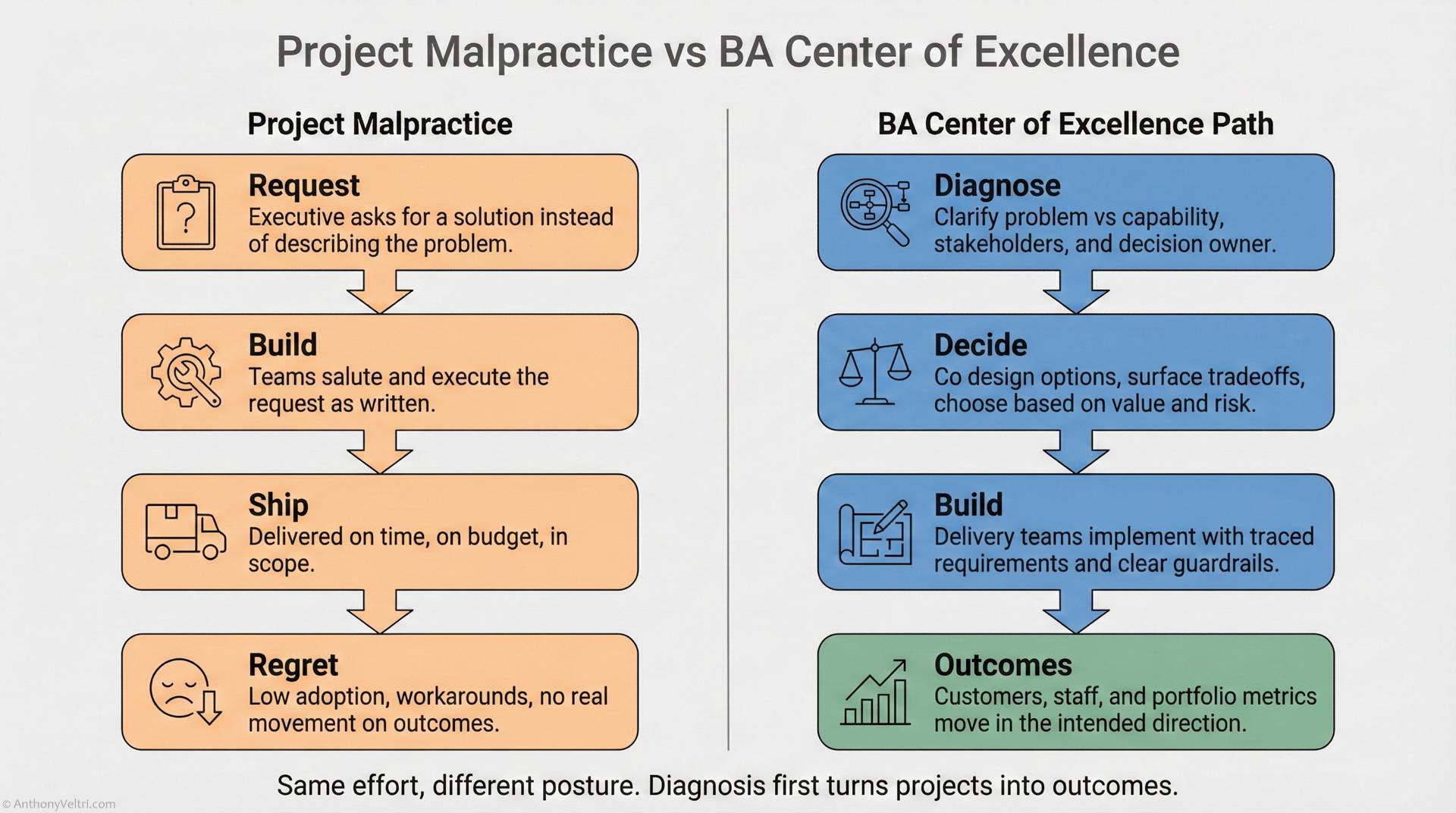
A comparison chart of "Project Malpractice" and "BA Center of Excellence Path," showing steps for each approach in project management. The BA path emphasizes diagnosis, decision, build, and measurable outcomes, while malpractice leads to regret.
The Trap of Malpractice. The “Project Malpractice” path (Red) optimizes for building the request. The “CoE Path” (Blue) optimizes for diagnosing the need. Portfolio thinking forces the Blue path.

This is one of the quiet tragedies of complex organizations.

Teams:

  • deliver on time
  • follow process
  • meet requirements
  • hit KPIs
  • satisfy internal checklists

And still miss the point.

They do the work right, but not the right work.

Portfolio thinking fixes this by aligning:

  • intent
  • resources
  • priorities
  • decisions
  • constraints
  • attention

Portfolio thinking is how you ensure that effort flows into what actually moves the mission.


Lived Example: The team that built a perfect feature nobody needed #

During one modernization wave, an engineering team built a beautifully crafted mapping feature:

  • fast
  • stable
  • elegant
  • high fidelity
  • secure
  • well documented

It took months.

It was exceptional work.

But the feature solved a problem leadership did not have.
It solved a problem analysts did not feel.
It solved a problem that was politically attractive but operationally irrelevant.

Meanwhile, a critical need was going unmet because nobody had aligned priorities.

That team did the work right.
They were not doing the right work.

Portfolio thinking would have prevented that misalignment.


Business Terms: What portfolio thinking actually means #

Portfolio thinking is:

  • choosing what matters most
  • aligning resources with impact
  • stopping low value work
  • protecting high value work
  • balancing short term actions with long term strategy
  • making trade offs explicit
  • saying no more often
  • focusing on outcomes, not outputs

Portfolio thinking is the antidote to:

  • busywork
  • heroics
  • status updates
  • checklist theater
  • political drift
  • project sprawl

Portfolio thinking is leadership by prioritization.


System Terms: The mechanics of portfolio alignment #
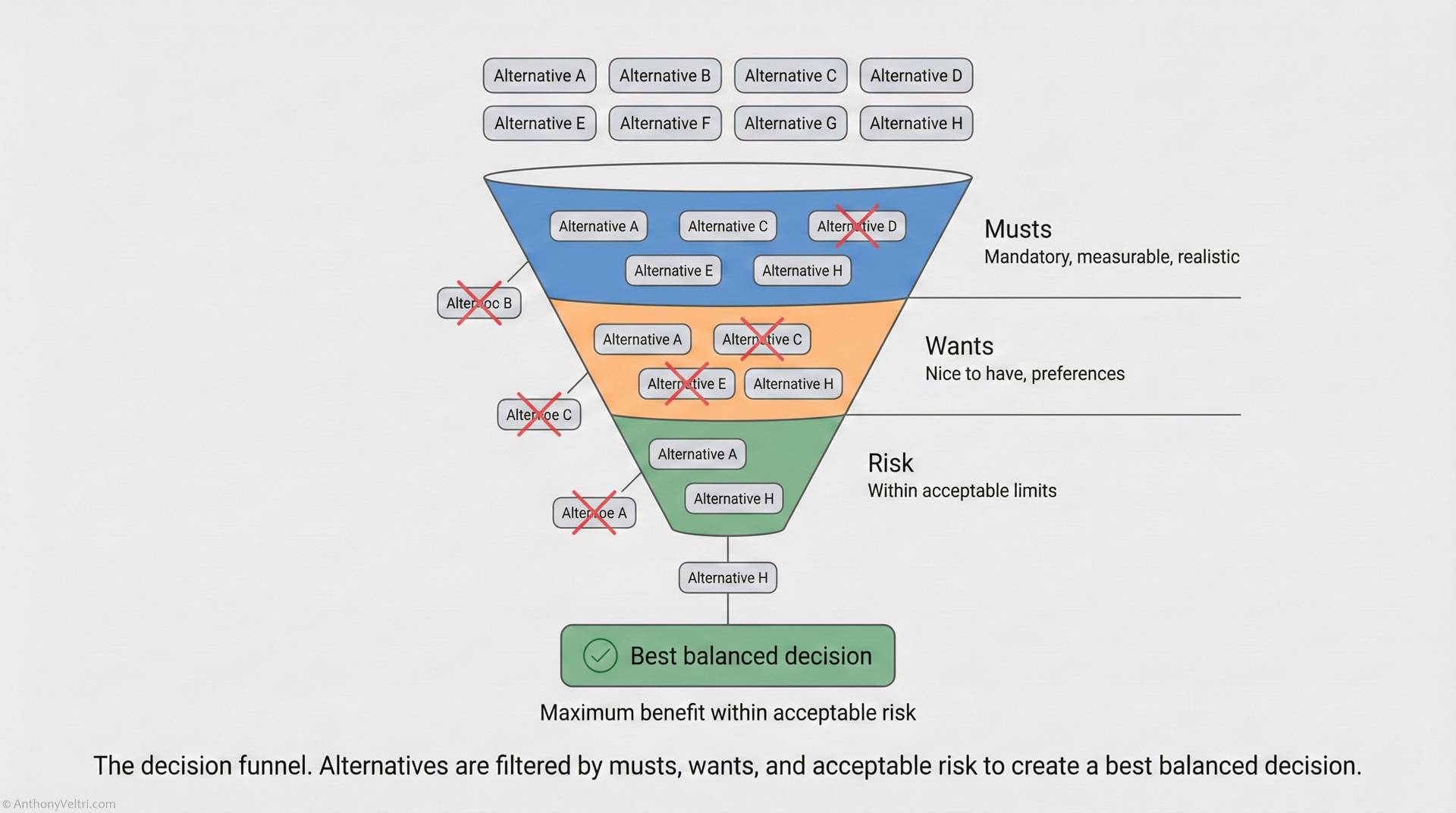
A funnel diagram with alternatives filtered into three sections: "Musts" (top), "Wants" (middle), and "Risk" (bottom). Crosses eliminate some options, leaving one "Best balanced decision" at the bottom.
The Decision Funnel. Stop debating “Wants” before you have satisfied “Musts.” This filter clears the noise so the decision can move. Use this as a Portfolio Filter. You cannot do everything. You must filter requests through “Musts” (Mandatory) and “Risks” before you even consider “Wants.” This funnel protects your team’s capacity.

In system language, portfolio thinking means:

  • choosing which flows get the most bandwidth
  • reducing unnecessary coupling
  • aligning update frequency with mission priority
  • allocating compute and human capital intelligently
  • shaping decision pathways
  • centralizing what must be centralized
  • decentralizing what must be decentralized
  • stabilizing the nodes that carry the most load

Portfolio alignment determines:

  • which interfaces matter
  • which feeds get harmonized first
  • which partners get support
  • which features scale
  • which experiments graduate into production

Portfolio thinking shapes the system’s evolution path.


Why Organizations Fail Without Portfolio Thinking #

Business perspective #

Organizations fail because they:

  • treat every task as equally important
  • allow political pressure to override mission value
  • over serve loud stakeholders
  • under serve quiet but critical ones
  • overload teams with poorly aligned work
  • maintain zombie projects out of habit
  • confuse activity with progress
  • reward delivery instead of impact

Effort becomes noise.

System perspective #

Systems fail because:

  • resources are spread thin
  • High-value pathways starve
  • low-value pathways consume bandwidth
  • architectural debt grows
  • synchronization pressure increases
  • key interfaces degrade
  • upstream teams overload the system

A system without portfolio alignment loses coherence.


Why Portfolio Thinking Succeeds #

Business perspective #

Portfolio thinking succeeds because it:

  • clarifies what matters
  • empowers leaders to stop low value work
  • reveals hidden opportunity costs
  • reduces burnout
  • increases morale
  • improves communication
  • focuses the organization on impact
  • aligns stakeholders around priorities

People are happier when they know their work matters.

System perspective #

Portfolio-aligned systems:

  • evolve cleanly
  • preserve decision tempo
  • move resources toward the right nodes
  • stabilize critical pathways
  • reduce architectural thrash
  • handle disruption better
  • maintain mission coherence

Portfolio thinking is system health management.


Business Example: The “bridge to nowhere” project that burned months #
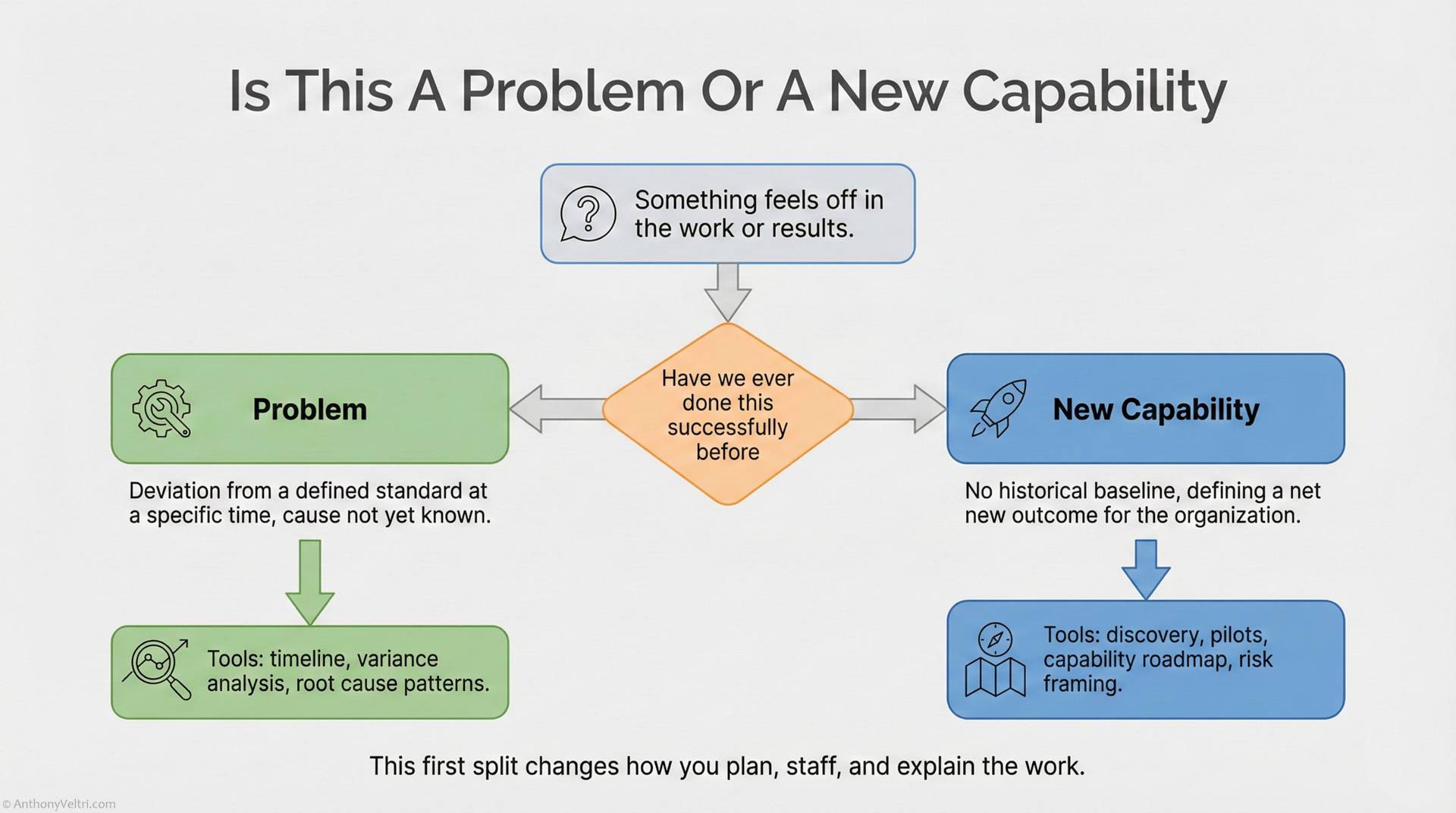
A flowchart titled "Is This A Problem Or A New Capability" compares problems and new capabilities, showing key questions, definitions, and related tools with arrows connecting each concept.
(Why are we doing this?!) Triage First. Before approving a project, ask: Is this a Problem (fixing a standard) or a New Capability (inventing a future)? If you can’t answer, don’t fund it.

In one agency, a team spent months optimizing a dashboard for metrics leadership no longer cared about.

The project persisted because:

  • it was already staffed
  • it had sunk cost
  • reporting looked good
  • no one had reevaluated alignment

Yet another project that actually mattered remained stuck because everyone was at capacity.

Portfolio thinking would have shown:

  • the dashboard was low value
  • the other project was high value
  • reallocation was required

Portfolio thinking reveals where your attention should be.


System Example: The ingest pipeline triage that saved an activation #
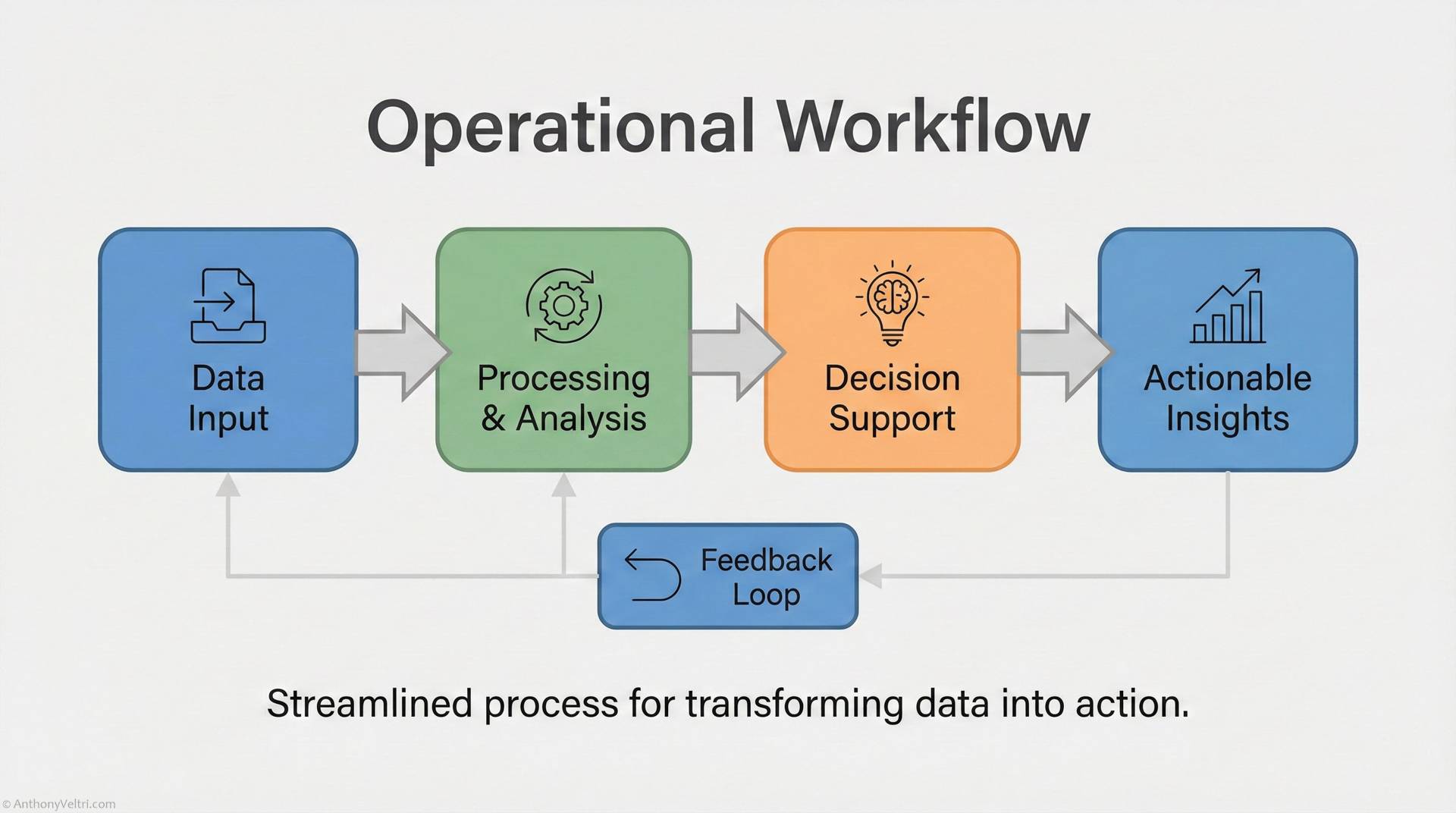
A flowchart titled "Operational Workflow" shows four steps: Data Input, Processing & Analysis, Decision Support, and Actionable Insights, with arrows and a feedback loop; caption: "Streamlined process for transforming data into action.
Value Flow. Data Input is only useful if it leads to Actionable Insights. Portfolio thinking prunes any input that doesn’t cross the gap to Action.

During a severe weather event, we had eight feeds waiting in the ingest queue.

Portfolio thinking allowed us to:

  • prioritize feeds affecting evacuation
  • deprioritize feeds affecting administrative layers
  • temporarily skip low value attributes
  • fast track the feeds that preserved life and access

If we had ingested them in arrival order, we would have lost hours.

Portfolio alignment preserved mission tempo.


Architect Level Principle #

As an architect, I ensure the organization is doing the right work, not just doing work well.
Portfolio thinking aligns effort with strategic goals, mission priorities, and real impact.
It prevents the system from drifting into activity without value.


Twenty-Second Takeaway: #

“Most teams execute well on things that do not matter. Portfolio thinking ensures that effort aligns with what actually drives mission value. I help organizations focus on the right work by shaping priorities, constraints, and resource flow.”


Cross Links to Other Principles #

Portfolio thinking is tightly tied to:

  • Clear intent
  • Decision drag
  • Architecture accelerates
  • Emergent resilience
  • Two-lane systems
  • Distributed decisions
  • Useful interoperability
  • Technical debt
  • Innovation at the edge

Portfolio thinking is where strategy becomes choice.


Doctrine Diagnostic – For Reflection: #

Ask yourself:

Are you doing the right work, or just doing work well?

Only one of those creates impact.

Do the right work.

Last Updated on December 5, 2025

Related Posts #

Thinking in Probabilities featured title card

Doctrine 22: When "It Depends" Is the Right Answer: How to Think in Probabilities Under Uncertainty #

This diagram illustrates increasing salary capacities, with larger houses on higher blocks representing $6k, $24k (median), and $80k per year.

Field Report: College Financing and the 5-Year Home Runway #

A diagram depicts three orange boxes labeled “Maturity Silo” (low, medium, high) feeding blue lines into a central “Federation Engine,” which outputs an arrow labeled “Operational Coherence.” The background looks like wrinkled brown paper.

Field Note: Compass-X Recognition Patterns and Strategic Framing #

This sepia-toned image highlights early logging practices, as seen by seven men on felled logs amid equipment and pine trees.

Field Note: Integration Debt vs Temporal Arbitrage #

A black pen drawing of two rustic barn-like buildings sits on lined paper, with a pen resting at the edge and a brown, crumpled background visible behind the sheet.

Field Note: The 1790 Farmhouse and What It Taught Me About Stewardship #

A diagram shows a translucent seated person labeled

Field Note: Sorting the 20-Year Backpack #

leadership, portfolio
Table of Contents
  • Why doing the work right is meaningless if you are not doing the right work
  • Most teams execute perfectly on things that do not matter.
  • Lived Example: The team that built a perfect feature nobody needed
  • Business Terms: What portfolio thinking actually means
  • System Terms: The mechanics of portfolio alignment
  • Why Organizations Fail Without Portfolio Thinking
    • Business perspective
    • System perspective
  • Why Portfolio Thinking Succeeds
    • Business perspective
    • System perspective
  • Business Example: The “bridge to nowhere” project that burned months
  • System Example: The ingest pipeline triage that saved an activation
  • Architect Level Principle
  • Twenty-Second Takeaway:
  • Cross Links to Other Principles
  • Doctrine Diagnostic - For Reflection:

Share This Article :

  • Facebook
  • X
  • LinkedIn
  • Pinterest

Was it helpful ?

  • Happy
  • Normal
  • Sad
  • Privacy Policy
  • Introductions
  • Contact

© 2026 Anthony Veltri

  • Doctrine
    • Doctrine Library
    • Global Library
  • Field Notes
  • Routes
    • Route 01: When the Interface Is Breaking (and you are becoming the patch)
    • ROUTE 02: If decisions stall and meetings go nowhere, start here
    • ROUTE 03: If you have lots of projects but no portfolio clarity, start here
    • ROUTE 04: If you’re confused about federation vs integration, start here
    • ROUTE 05: If heroics are propping up your system, start here
    • ROUTE 06: If you cannot force compliance across partners, start here
    • ROUTE 07: If compliance exists but commitment does not, start here
    • ROUTE 08: If disconnected workflows create audit anxiety, start here
  • Figure Library
  • FAQ
  • About
    • Capability Statement
    • Interpreter Kit
  • Contact