Why teams fix the wrong thing and how architects identify the signal hidden inside the noise #
This guide explains why solving a problem is linked to being able to define the problem in the first place.
This page is a Doctrine Guide. It shows how to apply one principle from the Doctrine in real systems and real constraints. Use it as a reference when you are making decisions, designing workflows, or repairing things that broke under pressure.
Most problems are not problems. They are symptoms. #
When teams encounter friction, they tend to:
- fix the visible symptom
- debate the surface behavior
- respond to the immediate failure
- treat noise as signal
- try to optimize before understanding
This is how organizations end up:
- solving the wrong problem
- escalating needlessly
- creating rework
- introducing new inconsistencies
- burning time
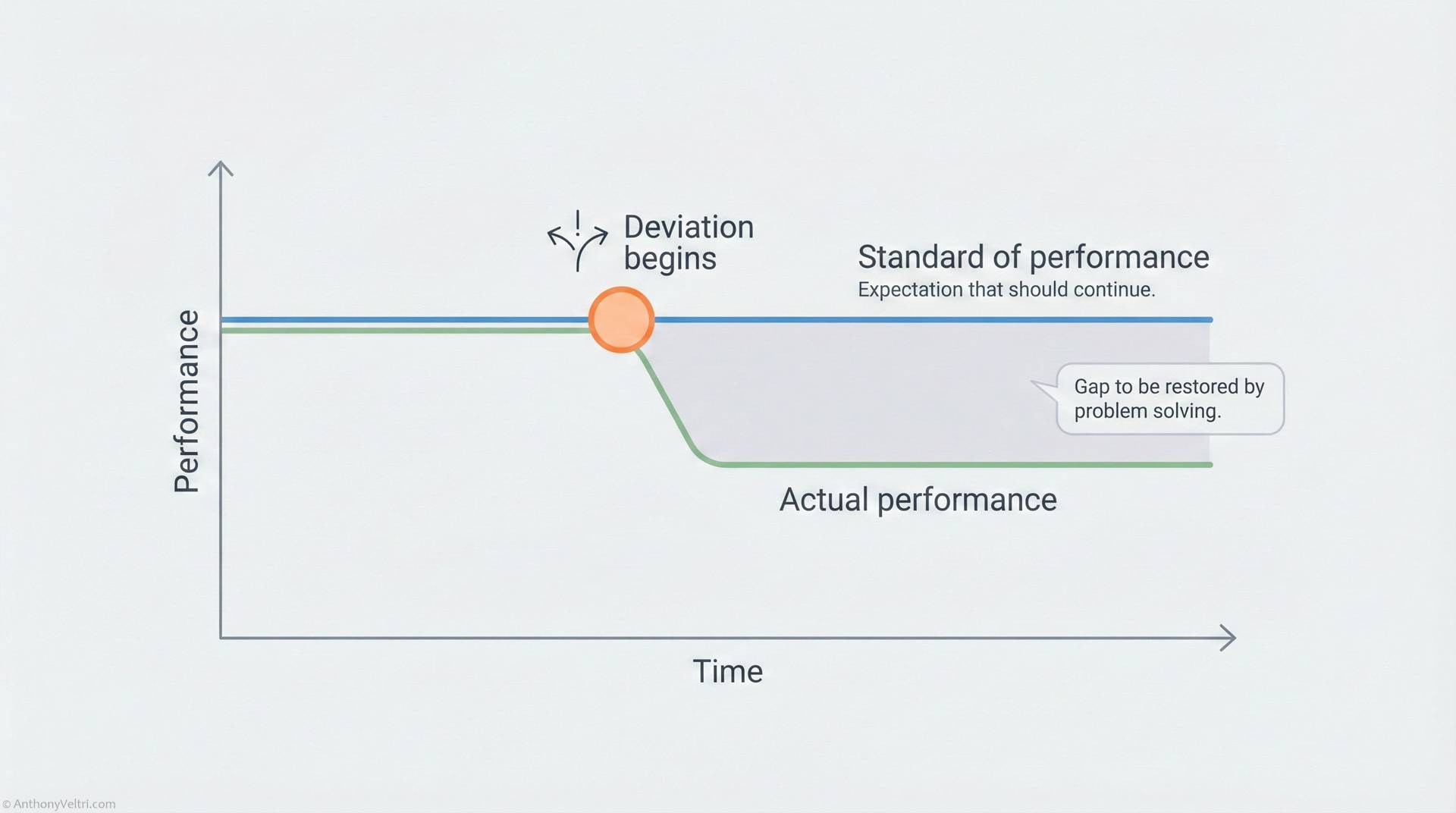
The architect’s job is to identify two things:
1. What is the real deviation?
2. What is the relevant change?
Almost every real problem is a mismatch between those two.
Lived Example: The feed that “broke” when the real problem was a timestamp drift #
During an activation, a partner feed appeared to break:
- polygons rendered incorrectly
- features disappeared
- some features doubled
- analysts sounded the alarm
- leadership asked for immediate fixes
Everyone focused on geometry.
That was the symptom.
The real deviation was a silent timestamp drift that:
- moved the time window forward
- invalidated the last known good data
- triggered a fallback mode incorrectly
- created phantom gaps
The relevant change was not geometry.
It was the partner’s time source drifting by several minutes due to a misconfigured upstream server.
Once we corrected the drift, all symptoms vanished.
Problem solving begins with identifying the deviation.
Then mapping it to the relevant change.
Business Terms: How organizations solve the wrong problem #
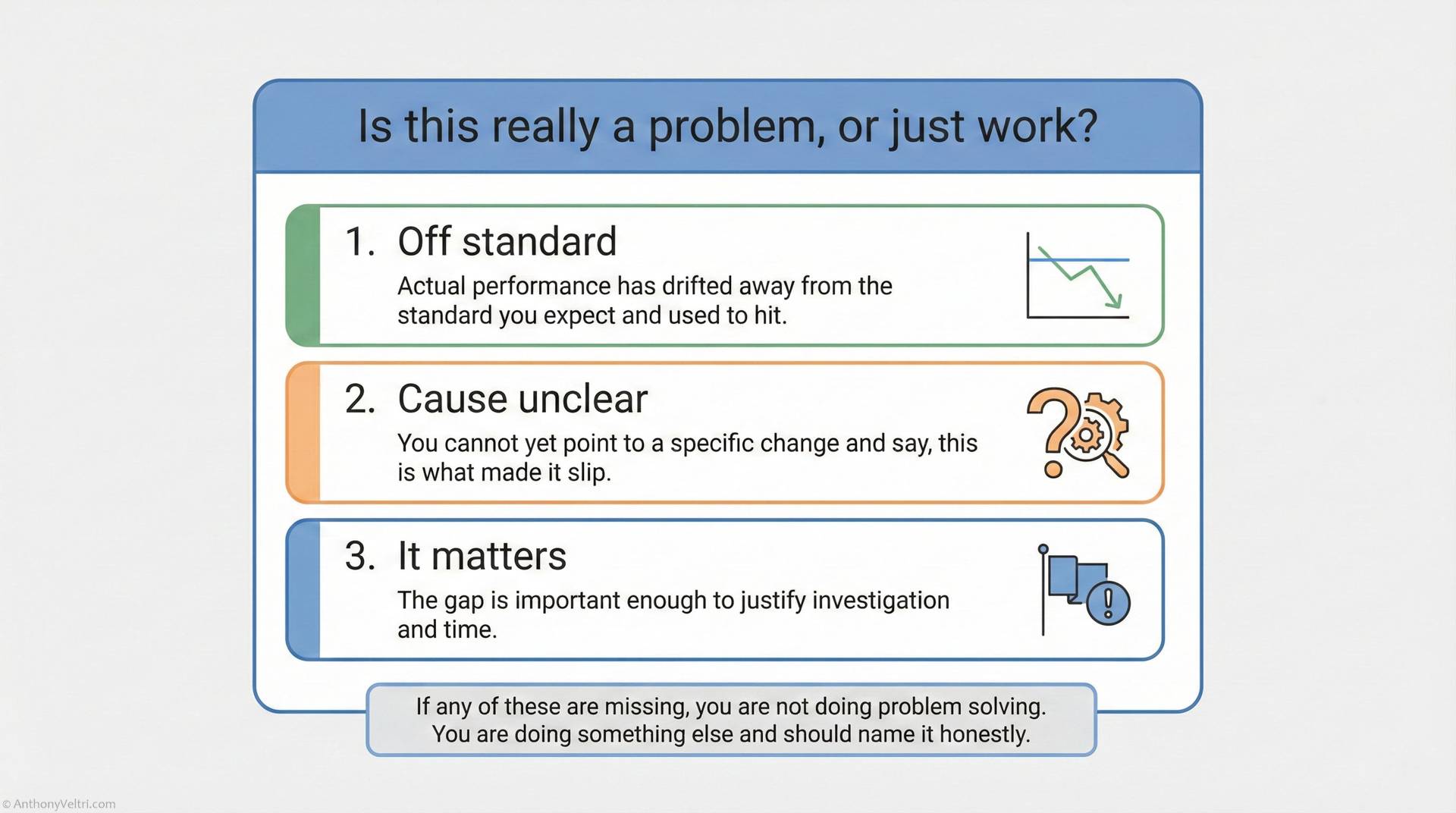
Organizations misdiagnose because:
- they react to noise
- they respond emotionally
- they escalate quickly
- they follow political pressure
- they trust the first complaint
- they do not verify assumptions
- they confuse correlation with causation
- they skip the deviation check
This creates:
- false fixes
- unnecessary meetings
- rework
- blame cycles
- slowdowns
- decision drag
Solving the wrong problem is worse than solving nothing.
System Terms: Deviation and change as analytical primitives #
In systems language:
- Deviation is the measurable divergence from expected behavior.
- Change is the event inside the system that explains the deviation.
- Signal is the specific relationship between deviation and change.
- Noise is everything else.
Good problem solving requires:
- identifying the deviation precisely
- identifying the change accurately
- testing the relationship
- ignoring everything that does not matter
Bad problem solving tries to fix every deviation without understanding the underlying change.
Why Teams Miss the Real Deviation #
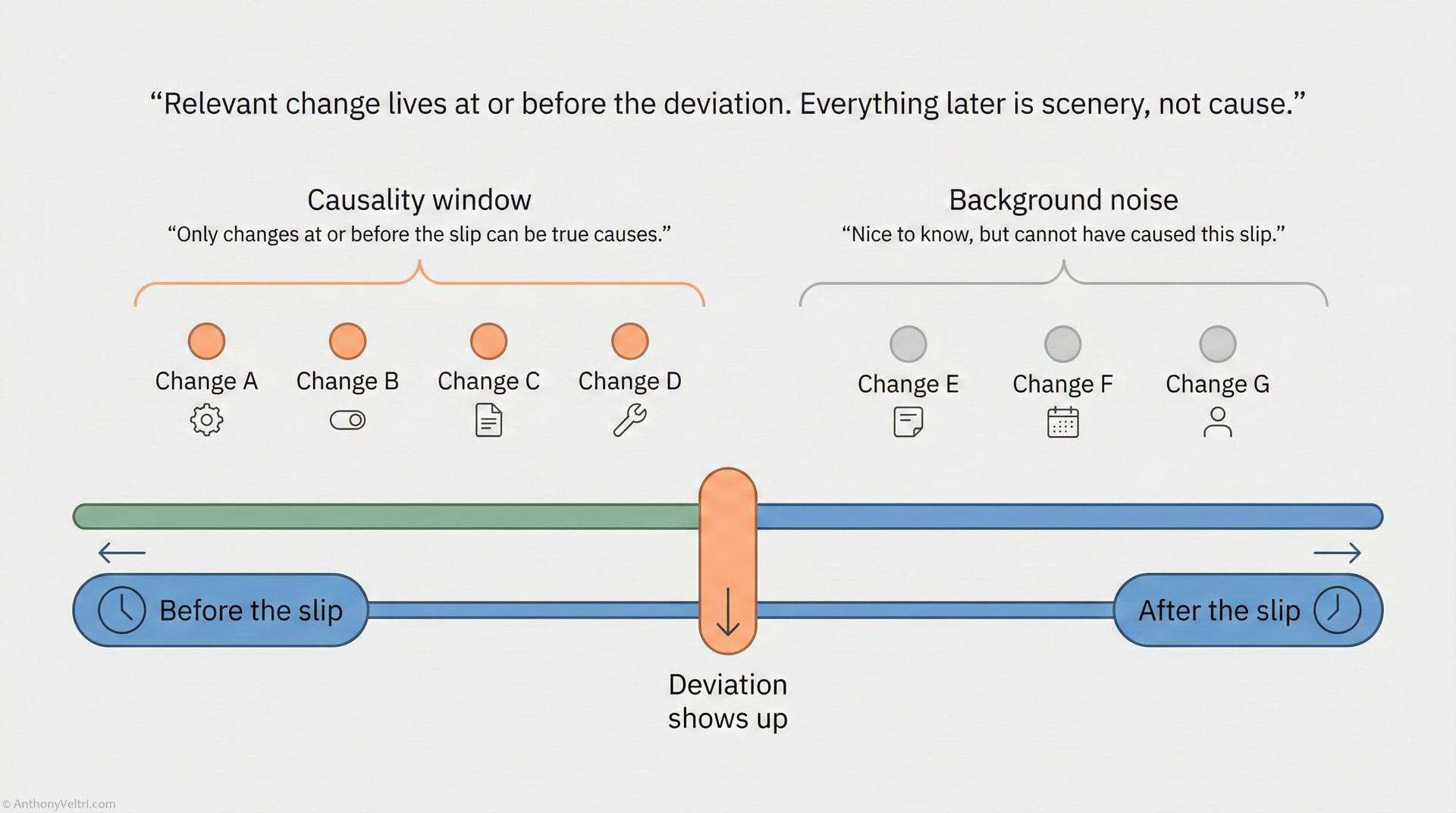
Teams misinterpret deviation because:
- alerts are noisy
- monitoring is inconsistent
- partners report symptoms poorly
- metrics do not match intent
- expectations differ
- assumptions are wrong
- the first theory becomes the dominant theory
- small practical clues are ignored
Most early assumptions are wrong.
Architecture helps teams reject the first assumption faster.
Why Teams Miss the Relevant Change #
Teams fail to identify the relevant change because:
- changes overlap
- logs are noisy
- deployments are staggered
- partners alter behavior without warning
- data formats drift
- timestamps degrade
- security tokens rotate
- updates collide with activations
- environmental conditions shift unpredictably
The real change is often subtle.
You must look for it with discipline.
Why Deviations Multiply When Misdiagnosed #
Misdiagnosis generates more problems:
- fixes introduce new drift
- workarounds increase complexity
- teams override safeguards
- partners adjust incorrectly
- escalations pull in more stakeholders
- a simple deviation becomes a full system disturbance
Every incorrect fix becomes a new change.
Every new change creates new deviations.
Real problem solving stops the multiplication.
How Architects Solve Problems Correctly #
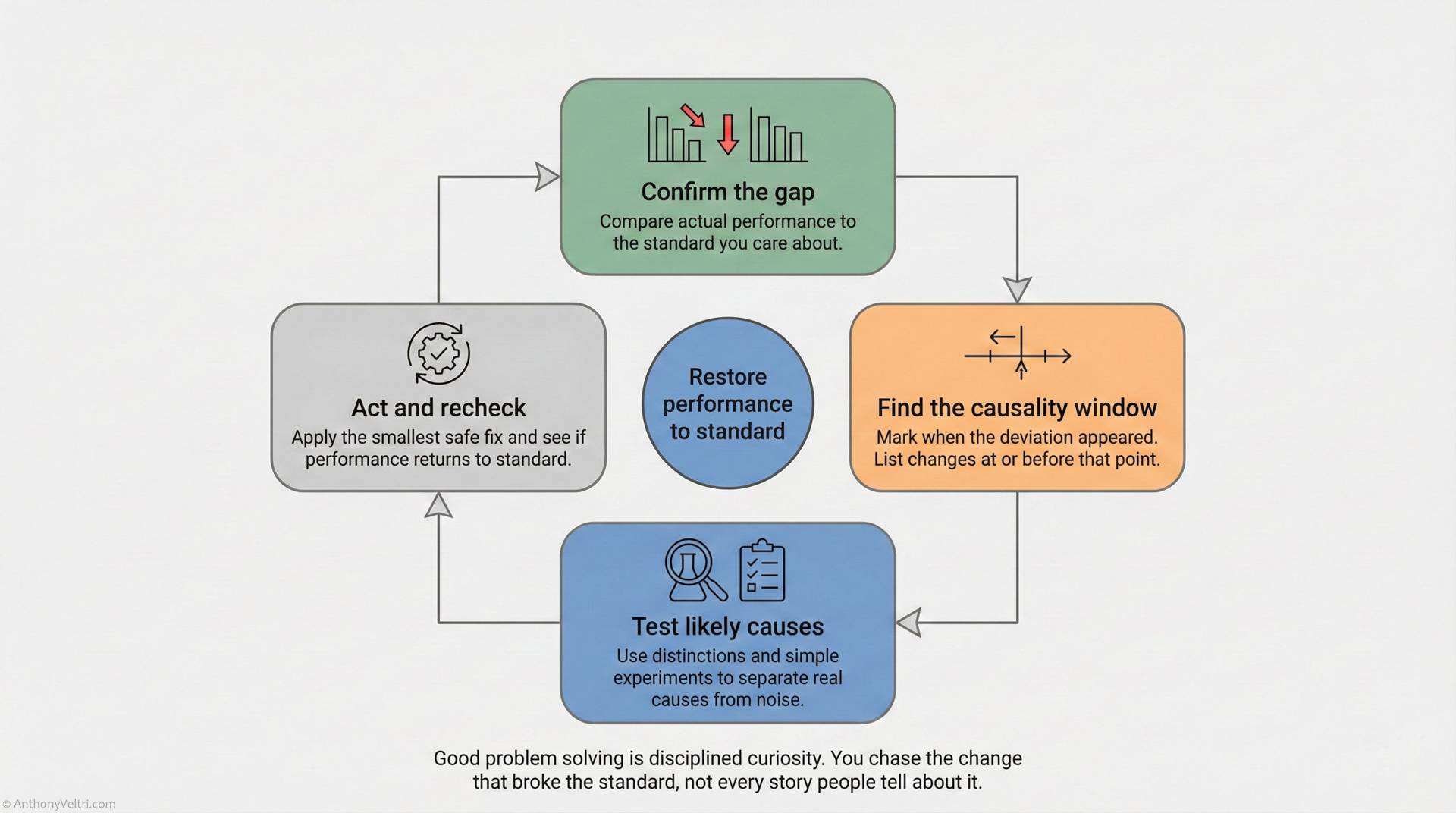
Architects approach problems with a clean four-step method:
1. Define the expected state #
Without a baseline, you cannot identify deviation.
2. Identify the real deviation #
Not the noisy symptom.
The actual measurable divergence.
3. Identify the relevant change #
What changed in the system that explains the deviation?
Ignore all unrelated changes.
4. Map deviation to change #
If the change explains the deviation, you have the problem.
If not, keep searching.
This approach removes emotion and politics from diagnosis.
Business Example: The conflict that evaporated once the deviation was clarified #
Two partner agencies blamed each other for a data quality issue.
Both were wrong.
The deviation was not:
- missing attributes
- incorrect geometry
- stale data
The deviation was:
- inconsistent publishing cadence
The relevant change:
- a partner scheduled a new automated process that shifted their publishing window by two hours.
Once identified:
- nobody was at fault
- no meeting was needed
- no escalation was required
The issue resolved immediately.
The conflict evaporated.
Deviation before blame.
Change before solution.
System Example: The ingest pipeline error that wasn’t an error #
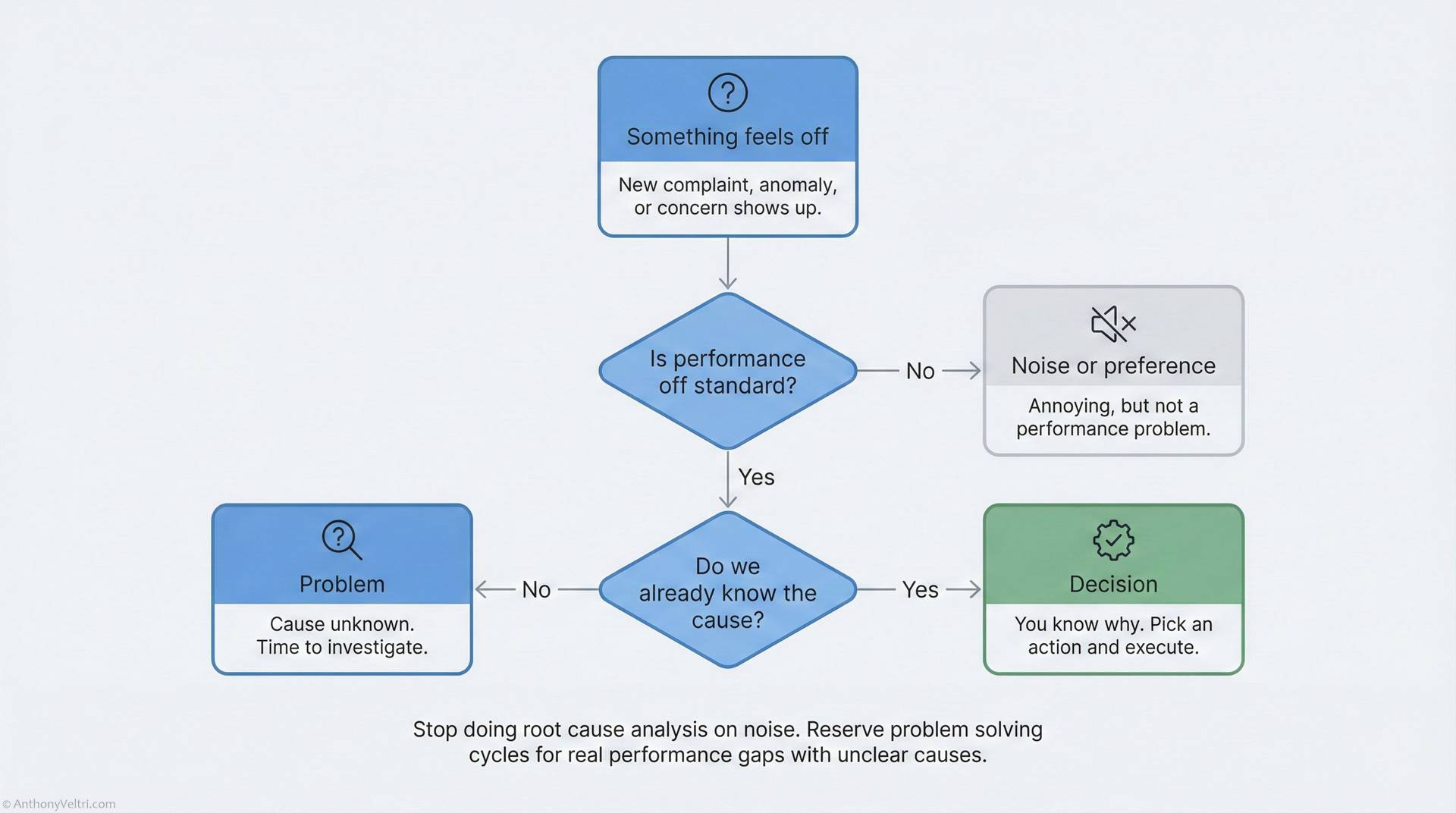
An ingest connector threw a high volume of warning messages.
Engineers assumed:
- schema mismatch
- malformed inputs
- undefined attributes
- logic failure
The deviation:
- a rise in warnings, not errors
The relevant change:
- a partner feed began including optional fields due to an upgrade
The fallback behavior was doing exactly what it should do.
There was no problem.
The deviation was benign.
The change was legitimate.
No action needed.
Accurate diagnosis saves enormous time.
Architect-Level Principle #
As an architect, I solve problems by finding the real deviation and the relevant change.
Symptoms are noise.
Deviations are signal.
Changes are causes.
When these are aligned, solutions become obvious.
Twenty-Second Takeaway: #
“Most problems teams chase are symptoms, not causes. I look for the real deviation and the relevant change. When you connect those two, the true problem becomes clear and the solution becomes simple.”
Cross Links to Other Principles #
This principle strengthens:
- Decision drag
- Useful interoperability
- Interfaces and contracts
- Portfolio thinking
- Degraded operations
- Emergent resilience
- Architecture accelerates
- Innovation at the edge
Problem-solving is a skill reinforced by the entire doctrine.
Doctrine Diagnostic – For Reflection: #
Ask yourself:
Are you solving the surface problem, or the real problem?
Find the deviation.
Find the change.
Ignore the noise.
Field notes and examples #
Last Updated on February 22, 2026