Skip to content

Introduced by a trusted connector?

Start Here

Anthony Veltri

  • Doctrine
    • Doctrine Library
    • Global Library
  • Field Notes
  • Routes
    • Route 01: When the Interface Is Breaking (and you are becoming the patch)
    • ROUTE 02: If decisions stall and meetings go nowhere, start here
    • ROUTE 03: If you have lots of projects but no portfolio clarity, start here
    • ROUTE 04: If you’re confused about federation vs integration, start here
    • ROUTE 05: If heroics are propping up your system, start here
    • ROUTE 06: If you cannot force compliance across partners, start here
    • ROUTE 07: If compliance exists but commitment does not, start here
    • ROUTE 08: If disconnected workflows create audit anxiety, start here
  • Figure Library
  • FAQ
  • About
    • Capability Statement
    • Interpreter Kit
  • Contact
Anthony Veltri

Architecture & Interfaces

15
  • Doctrine 01: Federation vs Integration in Mission Networks
  • Doctrine 03: Interfaces Are Where Systems Break, So They Require Stewards, Contracts, and Ownership
  • Doctrine 04: Useful Interoperability Is the Goal, Not Perfect Interoperability
  • Doctrine 05: Innovation Must Live at the Edge, Not in the Center
  • Doctrine 06: A Two-Lane System Protects Stability and Enables Evolution
  • Doctrine 14: Technical Debt Is a Leadership Signal, Not a Coding Failure
  • Doctrine 15: Architecture Must Accelerate Teams, Not Bottleneck Them
  • Doctrine 17: Architects Translate Strategy Into Engineering and Engineering Into Strategy
  • Doctrine 20: Golden Datasets: Putting Truth In One Place Without Pretending Everything Is Perfect
  • Doctrine 21: Zero Trust Is A Trust Model, Not A Card “Type”
  • Doctrine 23: Loop Closure as Load-Bearing System Infrastructure
  • ANNEX B. Data Contracts
  • ANNEX C. Interface Ownership Model
  • ANNEX H. Architecture Doctrine
  • Annex L: The Rosetta Stone for Data Teams: Bridging the Gap Between Technicians and Executives

Decision Tempo & Governance

10
  • Doctrine 02: Distributed Decisions Increase Alignment, Speed, and Resilience
  • Doctrine 07: Clear Intent Matters More Than Perfect Data
  • Doctrine 08: Clear Intent Compresses Ambiguity, Reduces Conflict, and Accelerates Action
  • Doctrine 09: Decision Drag Is the Enemy of Mission Tempo. Architecture Is the Remedy
  • Doctrine 10: Degraded Operations Are the Normal Mode, Not the Exception
  • Doctrine 11: Preventive Action and Contingent Action Must Both Be Designed Intentionally
  • Doctrine 22: When “It Depends” Is the Right Answer: How to Think in Probabilities Under Uncertainty
  • ANNEX D. Decision Altitudes Model
  • ANNEX E. Prevention–Contingency Matrix
  • ANNEX I. High Visibility Workflows

Portfolio & Alignment

4
  • Doctrine 16: Portfolio Thinking Ensures Effort Aligns With What Actually Matters
  • ANNEX F. Pattern Library
  • ANNEX J. System Evolution and Drift Management
  • ANNEX K. System and Workflow Profiles (Case Studies)

Leadership & Human Systems

6
  • Doctrine 24: Stewardship Places the Burden on the Steward, Not the Parties
  • Doctrine 18: Commitment Outperforms Compliance in High Trust, High Tempo Environments
  • Doctrine 19: Supervision, Management, and Leadership Are Three Different Jobs. Confusing Them Breaks Systems
  • Doctrine 23: Loop Closure as Load-Bearing System Infrastructure
  • ANNEX A. Human Contracts
  • ANNEX G. Leadership Doctrine

Resilience & Operations

3
  • Doctrine 24: Stewardship Places the Burden on the Steward, Not the Parties
  • Doctrine 12: Resilience Is an Emergent Property, Not a Feature
  • Doctrine 13: Problem Solving Requires Finding the Real Deviation and the Relevant Change

Doctrine Companions

7
  • Doctrine 03 Companion: The RS-CAT Framework: Converting Raw Recall into Teachable Principle
  • Doctrine 03 Companion: The Interface Void
  • Doctrine 11 Companion: Agency vs. Outcome
  • Doctrine 09 Companion: Artifacts Over Adjectives
  • Doctrine 03 Companion: Constraints: bidirectional translation: Compression vs Construction
  • Doctrine 10 Companion: Span of Control and Cross Training Are Load-Bearing Constraints
  • Doctrine 21 Companion: Claims, Roles, and Entitlements in Microsoft 365

Field Reports

1
  • Field Report: College Financing and the 5-Year Home Runway
View Categories
  • Home
  • Doctrine & Supporting Guides
  • Leadership & Human Systems
  • Doctrine 19: Supervision, Management, and Leadership Are Three Different Jobs. Confusing Them Breaks Systems

Doctrine 19: Supervision, Management, and Leadership Are Three Different Jobs. Confusing Them Breaks Systems

Anthony Veltri
Updated on December 5, 2025

4 min read

Why systems collapse when these roles blur, and why high-performing mission environments keep them distinct #

This guide distinguishes the Three Altitudes of people management.

This page is a Doctrine Guide. It shows how to apply one principle from the Doctrine in real systems and real constraints. Use it as a reference when you are making decisions, designing workflows, or repairing things that broke under pressure.


When you confuse supervision, management, and leadership, you create drag, conflict, and failure. #
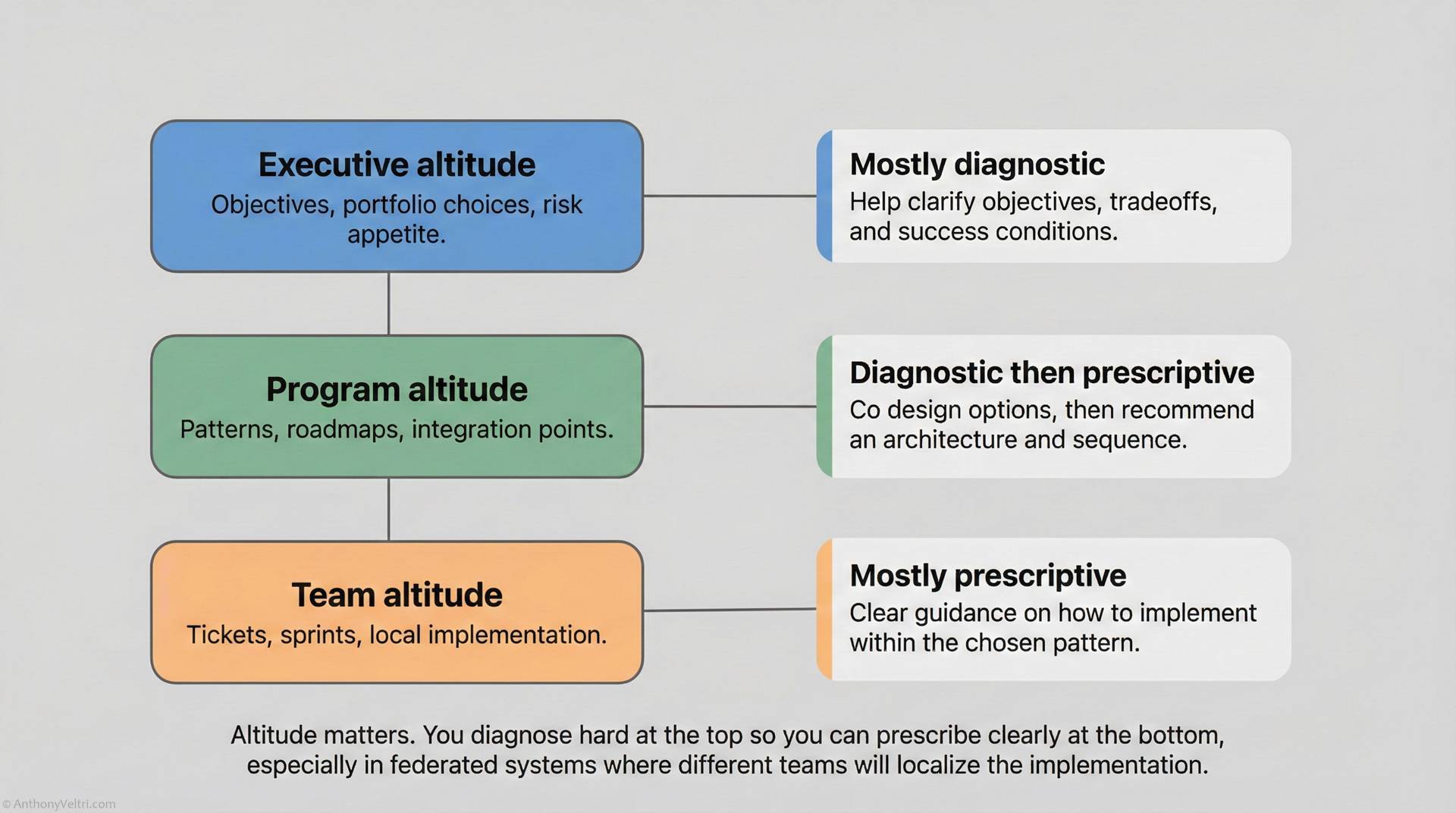
A diagram with three altitudes: Executive (diagnostic), Program (diagnostic then prescriptive), and Team (prescriptive), showing how responsibilities and clarity increase from objectives to implementation.
Altitude Translation / The Leadership Stack. The Executive Altitude sees “Objectives.” The Team Altitude sees “Tickets.” The Architect connects them at the Program Altitude. Supervision happens at the Team Altitude (Orange). Management happens at the Program Altitude (Green). Leadership happens at the Executive Altitude (Blue). When people operate in the wrong box, the system breaks.

Most organizations collapse these three jobs into one fuzzy blob.

But they are different:

  • Supervision is oversight. (local)
  • Management is improvement (process).
  • Leadership is direction.

If you ask a supervisor to lead, they will punish.
If you ask a manager to lead, they will optimize.
If you ask a leader to supervise, they will suffocate innovation.

When roles blur, systems break.
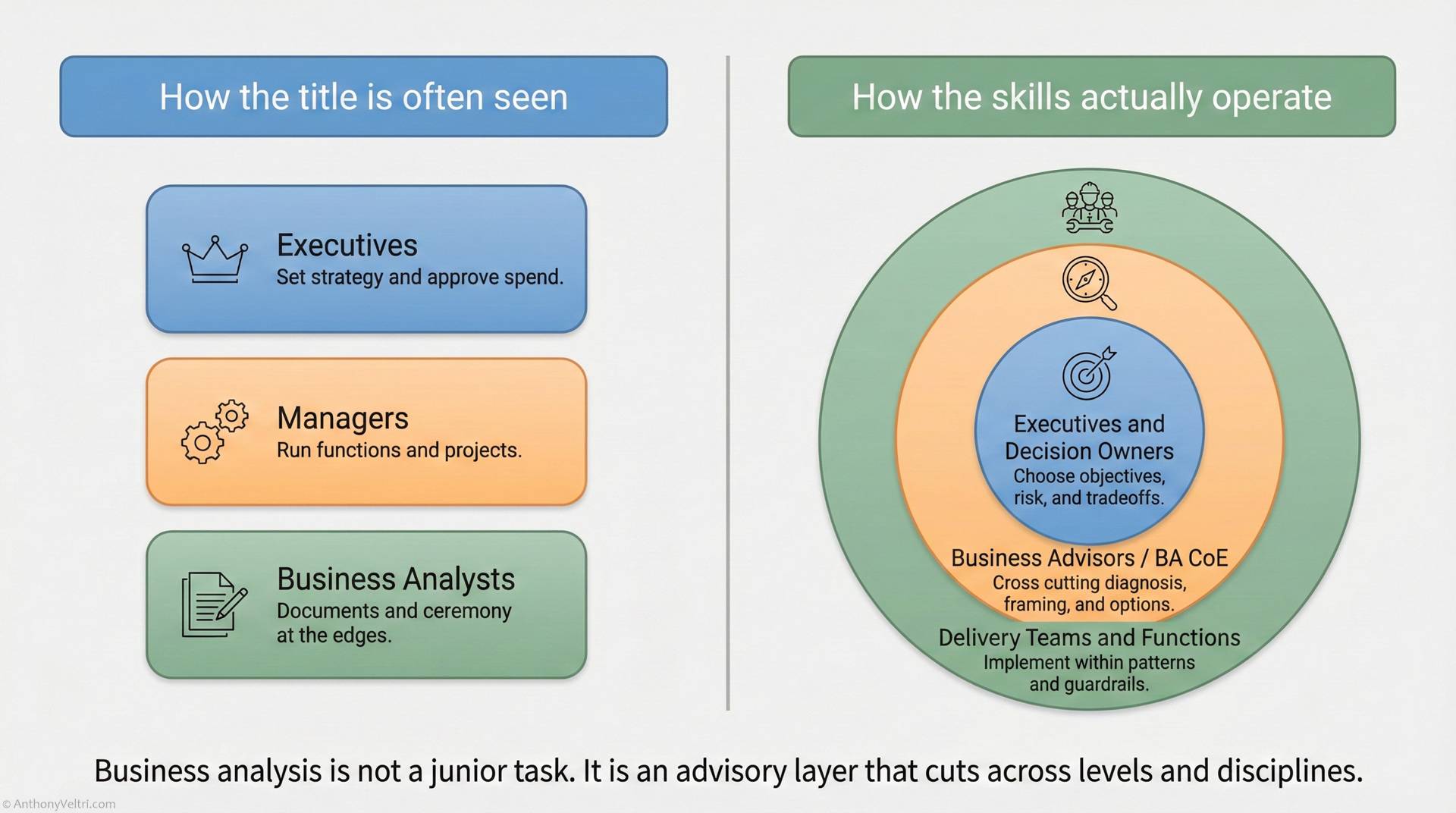
A diagram contrasts traditional job titles with actual skill operation. Left: vertical boxes for Executives, Managers, Business Analysts. Right: nested circles showing skill overlap among Executives, Owners, Advisors, and Delivery Teams.
Role Clarity. The Org Chart (Left) confuses titles with functions. A true system view (Right) places Leadership at the center (Strategy), with Advisors and Managers radiating outward to execution. We use org charts because they are tidy, but remember: we model a spherical cow, but there is no such thing as a spherical cow.

Lived Example: The manager who tried to lead and stalled the team #

During a modernization cycle, a mid-level manager began:

  • reshaping strategy
  • redirecting priorities
  • changing long-term plans
  • redefining architectural intent

The problem:

He did not own strategic direction.
He owned team throughput and workflow health.

By taking on leadership functions without authority:

  • misalignment grew
  • teams waited
  • escalation increased
  • supervisors became confused
  • the system drifted

He was a good manager doing the wrong job.

Once leadership restated roles:

  • leadership set direction
  • management improved execution
  • supervision handled day-to-day oversight

The system aligned again.


Business Terms: The three jobs in plain language #

Supervision #

  • ensures people are present
  • ensures tasks are completed
  • ensures procedures are followed
  • resolves small conflicts
  • maintains safety and order
  • handles performance issues

Supervision protects the local environment.
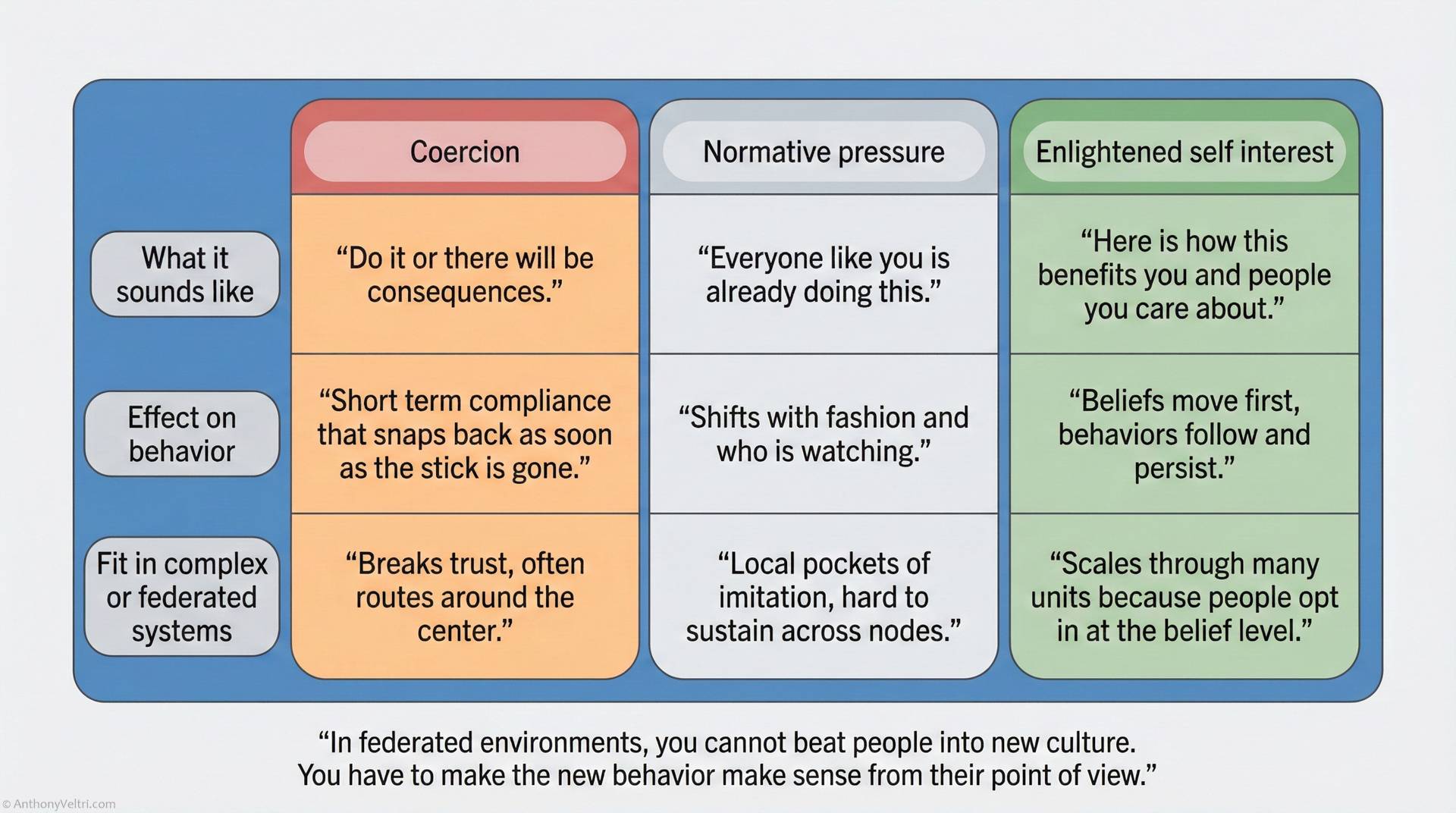
A comparison chart with three columns: Coercion, Normative Pressure, and Enlightened Self Interest, each describing what it sounds like, effects on behavior, and fit in complex systems, plus a quote about behavioral change.
The Compliance Spectrum. Coercion (Red) creates temporary compliance that snaps back. Enlightened Self-Interest (Green) creates commitment that scales. Supervision often relies on Normative Pressure and Compliance (Grey/Red) to maintain safety. Leadership must add Enlightened Self-Interest (Green) to get growth.

Management #

  • improves processes
  • allocates resources
  • optimizes workflows
  • removes bottlenecks
  • develops staff
  • balances demand

Management makes the system more effective.

Leadership #

  • defines intent
  • sets direction
  • handles strategy
  • defines boundaries
  • makes tradeoffs
  • communicates purpose

Leadership aligns the system to outcomes.

When each stays in its lane, systems flow.
When they blur, systems grind.


System Terms: The three roles as system layers #

In system language:

Supervision is a local control loop. #

Fast feedback.
Small radius of action.

Management is a process shaping layer. #

Medium feedback.
Cross-functional radius.

Leadership is a structural and directional layer. #

Slow feedback.
Strategic radius of action.

Terrain:

  • Supervision = the ground
  • Management = the route
  • Leadership = the destination

If these layers misalign, the system loses coherence.


Why Confusion Breaks Systems #

Business perspective #

Confusion causes:

  • supervisors trying to set strategy
  • leaders trying to micromanage
  • managers policing behavior
  • operators receiving contradictory signals
  • escalation of trivial issues
  • unresolved structural issues
  • widespread frustration
  • slow mission tempo

People operate at the wrong altitude.
Everything gets harder.

System perspective #

Confusion causes:

  • decisions to flow to the wrong level
  • misaligned incentives
  • unclear boundaries
  • brittle processes
  • structural drift
  • coupling between the wrong layers
  • collapse of autonomy
  • increased decision drag

Without altitude clarity, the system becomes tangled.


Why Distinction Strengthens Systems #

Business perspective #
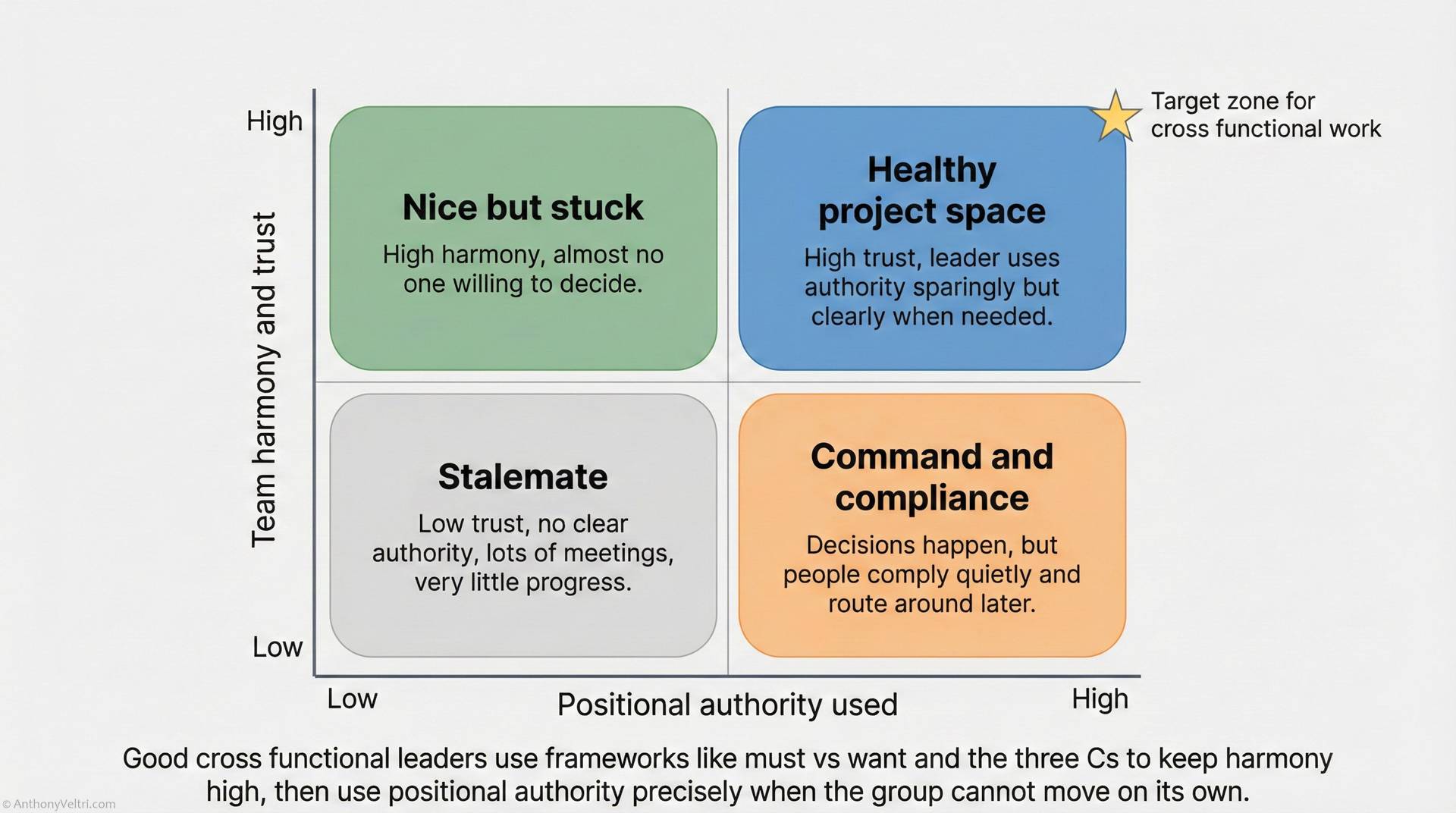
A 2x2 matrix shows team harmony/trust (vertical) vs. positional authority used (horizontal). The top right “Healthy project space” is starred. Other zones: “Nice but stuck,” “Stalemate,” and “Command and compliance.”.
The Leadership Target. A Leader’s job isn’t just to be “Nice” (Green) or “Bossy” (Orange). It is to maintain High Harmony while using Precise Authority (Blue) to set direction. Crucially, leadership must be a net gain. If the team is just as effective without you as with you, you are not leading; you are overhead. This hits hard because it gives the reader (or a practitioner) a diagnostic they can apply immediately: “Does my presence make the team faster or just more managed?”

When supervision, management, and leadership are distinct:

  • supervisors maintain order
  • managers improve flow
  • leaders shape direction
  • operators know who decides what
  • decisions are made at the right altitude
  • conflict decreases
  • clarity increases
  • initiative increases

Everyone works inside the right frame.

System perspective #

Clarity produces:

  • stable control loops
  • predictable escalation paths
  • clean decision altitudes
  • reduced drag
  • improved autonomy
  • reduced rework
  • strong alignment across teams

The architecture breathes correctly when altitudes are respected.


The Three Altitudes Model (Pair This With Decision Altitudes) #

Use this model across the doctrine.

Altitude 1: Supervision (Local Control) #

“Are we doing the work safely and correctly?”

Altitude 2: Management (System Improvement) #

“How do we do the work better?”

Altitude 3: Leadership (Strategic Direction) #

“What work actually matters and why?”

People fail when asked to operate at the wrong altitude.
Teams thrive when altitudes align.


Business Example: The supervisor who tried to manage #

A supervisor tried to redesign the workflow instead of focusing on:

  • oversight
  • safety
  • clarity
  • coaching

As a result:

  • work slowed
  • confusion increased
  • managers felt undermined
  • operators received contradictory instructions

Once roles were clarified:

  • managers redesigned the workflow
  • the supervisor maintained discipline and clarity
  • leadership reinforced direction

Alignment returned instantly.


System Example: iCAV succeeded because altitudes were respected #

In iCAV:

  • Supervision ensured analysts published correctly and safely
  • Management ensured ingest workflows improved over time
  • Leadership set strategic priorities such as degraded mode and federation
  • Architecture aligned these layers so the system behaved coherently

The system worked because no layer tried to be another.

Supervisors did not set strategy.
Managers did not redesign architecture.
Leaders did not micromanage ingest pipelines.

Altitude discipline created coherence.


Architect-Level Principle #

As an architect, I ensure supervision, management, and leadership remain distinct.
Clarity of altitude increases speed, reduces conflict, and strengthens resilience.
Confusion creates drag.
Alignment creates flow.


Twenty-Second Takeaway: #

“Supervision, management, and leadership are three different jobs. Supervision ensures correctness, management improves systems, and leadership sets direction. When these blur, teams slow down and conflict increases. I keep them distinct so the system flows.”


Cross Links to Other Principles #

This principle reinforces:

  • Distributed decisions
  • Clear intent
  • Decision altitudes
  • Architecture accelerates
  • Commitment vs compliance
  • Portfolio thinking
  • Federated operations
  • Interfaces and ownership
  • Emergent resilience

Altitude clarity is leadership architecture.


Doctrine Diagnostic – For Reflection: #

Ask yourself:

Are supervisors trying to lead?
Are leaders trying to supervise?
Are managers stuck in the middle?

If so, the system is already drifting.

Clarify altitudes.
Restore flow.

Last Updated on December 5, 2025

Related Posts #

This slide illustrates the principle that loop closure is structural, as highlighted by the modern, technical design elements.

Doctrine 23: Loop Closure as Load-Bearing System Infrastructure #

This diagram illustrates increasing salary capacities, with larger houses on higher blocks representing $6k, $24k (median), and $80k per year.

Field Report: College Financing and the 5-Year Home Runway #

Thinking in Probabilities featured title card

Doctrine 22: When "It Depends" Is the Right Answer: How to Think in Probabilities Under Uncertainty #

A person in a gray sweater holds a white mug with a colorful logo showing a sunrise, trees, and mountains, and the text “RESILIENCE@USDA.GOV” on the front.

You Remember My Values, But Not Yours #

ANNEX F Pattern Library" text over a background of interconnected geometric lines, circles, and digital patterns resembling a circuit or network schematic.

ANNEX F. Pattern Library #

Zero Trust: Beyond PKI

Doctrine 21: Zero Trust Is A Trust Model, Not A Card "Type" #

altitude, decision-tempo, leadership
Table of Contents
  • Why systems collapse when these roles blur, and why high-performing mission environments keep them distinct
  • When you confuse supervision, management, and leadership, you create drag, conflict, and failure.
  • Lived Example: The manager who tried to lead and stalled the team
  • Business Terms: The three jobs in plain language
    • Supervision
    • Management
    • Leadership
  • System Terms: The three roles as system layers
    • Supervision is a local control loop.
    • Management is a process shaping layer.
    • Leadership is a structural and directional layer.
  • Why Confusion Breaks Systems
    • Business perspective
    • System perspective
  • Why Distinction Strengthens Systems
    • Business perspective
    • System perspective
  • The Three Altitudes Model (Pair This With Decision Altitudes)
    • Altitude 1: Supervision (Local Control)
    • Altitude 2: Management (System Improvement)
    • Altitude 3: Leadership (Strategic Direction)
  • Business Example: The supervisor who tried to manage
  • System Example: iCAV succeeded because altitudes were respected
  • Architect-Level Principle
  • Twenty-Second Takeaway:
  • Cross Links to Other Principles
  • Doctrine Diagnostic - For Reflection:

Share This Article :

  • Facebook
  • X
  • LinkedIn
  • Pinterest

Was it helpful ?

  • Happy
  • Normal
  • Sad
  • Privacy Policy
  • Introductions
  • Contact

© 2026 Anthony Veltri

  • Doctrine
    • Doctrine Library
    • Global Library
  • Field Notes
  • Routes
    • Route 01: When the Interface Is Breaking (and you are becoming the patch)
    • ROUTE 02: If decisions stall and meetings go nowhere, start here
    • ROUTE 03: If you have lots of projects but no portfolio clarity, start here
    • ROUTE 04: If you’re confused about federation vs integration, start here
    • ROUTE 05: If heroics are propping up your system, start here
    • ROUTE 06: If you cannot force compliance across partners, start here
    • ROUTE 07: If compliance exists but commitment does not, start here
    • ROUTE 08: If disconnected workflows create audit anxiety, start here
  • Figure Library
  • FAQ
  • About
    • Capability Statement
    • Interpreter Kit
  • Contact